Circulation
BloodVessels
Heart
Blood
Diseases
Circulatory System
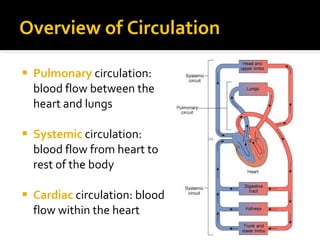
Overview of Circulation
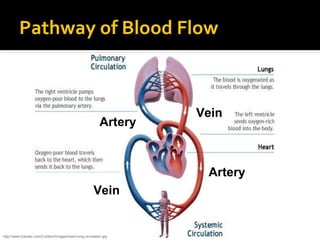
 Pulmonary circulation:
blood flow between the
heart and lungs
 Systemic circulation:
blood flow from heart to
rest of the body
 Cardiac circulation: blood
flow within the heart
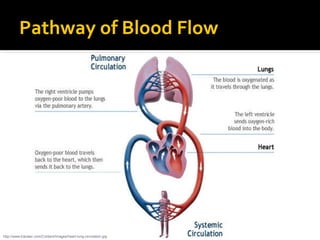
Pathway of Blood Flow
http://www.tracleer.com/Content/Images/heart-lung-circulation.jpg
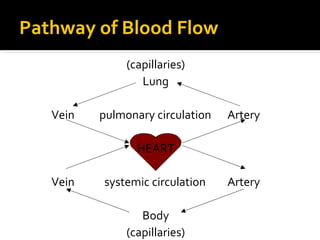
Pathway of Blood Flow
(capillaries)
Lung
Vein pulmonary circulation Artery
HEART
Vein systemic circulation Artery
Body
(capillaries)
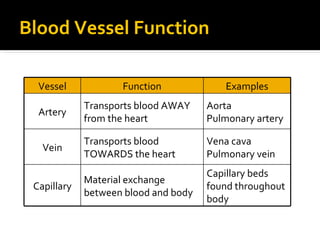
Blood Vessel Function
Vessel Function Examples
Artery
Transports blood AWAY
from the heart
Aorta
Pulmonary artery
Vein
Transports blood
TOWARDS the heart
Vena cava
Pulmonary vein
Capillary
Material exchange
between blood and body
Capillary beds
found throughout
body
Pathway of Blood Flow
http://www.tracleer.com/Content/Images/heart-lung-circulation.jpg
Artery
Artery
Vein
Vein
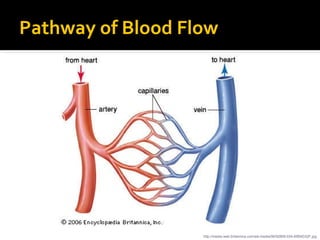
Pathway of Blood Flow
http://media.web.britannica.com/eb-media/06/92806-034-95B4D32F.jpg
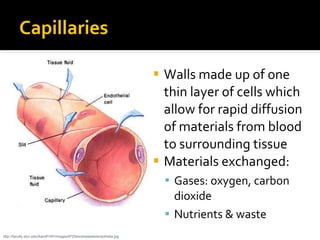
Capillaries
 Walls made up of one
thin layer of cells which
allow for rapid diffusion
of materials from blood
to surrounding tissue
 Materials exchanged:
 Gases: oxygen, carbon
dioxide
 Nutrients & waste
http://faculty.stcc.edu/AandP/AP/imagesAP2/bloodvessels/endothelia.jpg
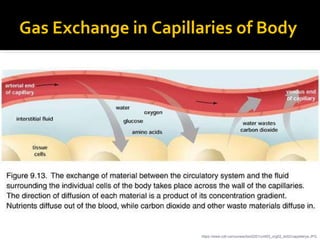
Gas Exchange in Capillaries of Body
https://www.cdli.ca/courses/biol2201/unit03_org02_ilo02/cappillarya.JPG
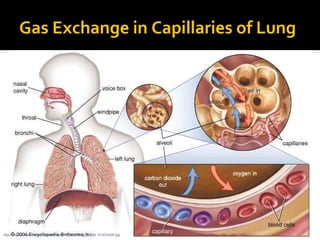
Gas Exchange in Capillaries of Lung
http://media-2.web.britannica.com/eb-media/37/92937-034-1E4EA526.jpg
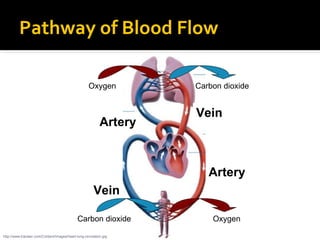
Pathway of Blood Flow
http://www.tracleer.com/Content/Images/heart-lung-circulation.jpg
Artery
Artery
Vein
Vein
Oxygen Carbon dioxide
Carbon dioxide Oxygen
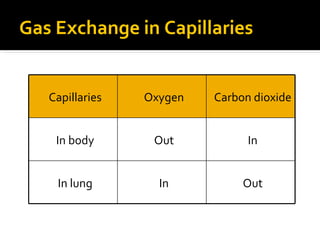
Gas Exchange in Capillaries
OutInIn lung
InOutIn body
Carbon dioxideOxygenCapillaries
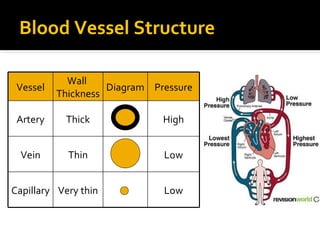
Blood Vessel Structure
Diagram
Low
Low
High
PressureVessel
Wall
Thickness
Artery Thick
Vein Thin
Capillary Very thin
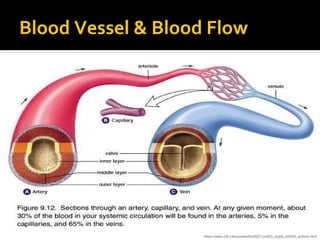
Blood Vessel & Blood Flow
https://www.cdli.ca/courses/biol2201/unit03_org02_ilo02/b_activity.html
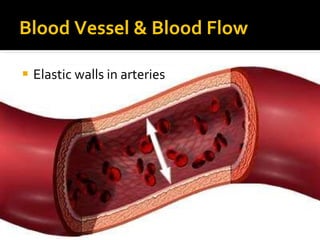
Blood Vessel & Blood Flow
 Elastic walls in arteries
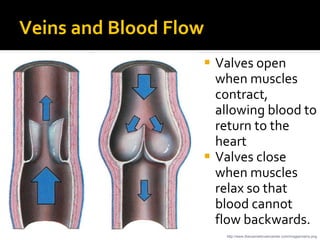
Veins and Blood Flow
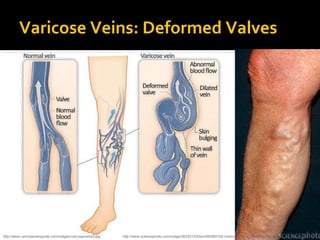
 Valves open
when muscles
contract,
allowing blood to
return to the
heart
 Valves close
when muscles
relax so that
blood cannot
flow backwards.
http://www.thecosmeticveincenter.com/images/veins.png
Varicose Veins: Deformed Valves
http://www.varicoseveinguide.com/images/varicoseveins2.jpg http://www.sciencephoto.com/image/263331/530wm/M2900102-Varicose_veins_affecting_the_leg_of_an_elderly_man-SPL.jp
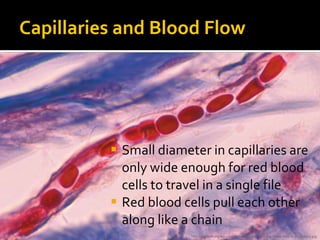
Capillaries and Blood Flow
 Small diameter in capillaries are
only wide enough for red blood
cells to travel in a single file
 Red blood cells pull each other
along like a chain
http://antranik.org/wp-content/uploads/2011/12/red-blood-cells-in-a-capillary.jpg
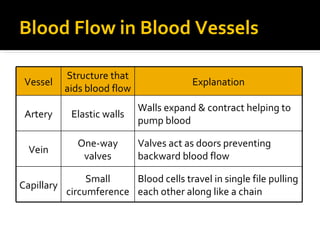
Blood Flow in Blood Vessels
Vessel
Structure that
aids blood flow
Explanation
Artery Elastic walls
Walls expand & contract helping to
pump blood
Vein
One-way
valves
Valves act as doors preventing
backward blood flow
Capillary
Small
circumference
Blood cells travel in single file pulling
each other along like a chain
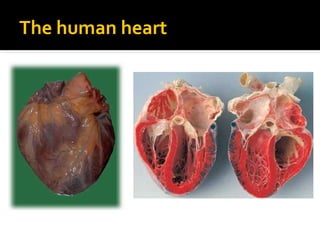
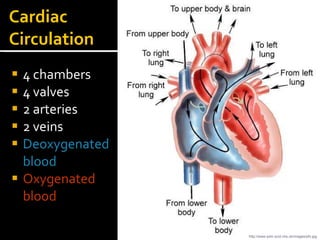
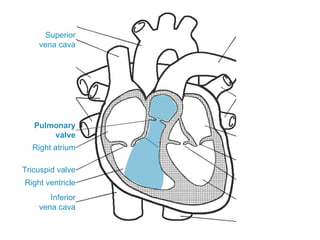
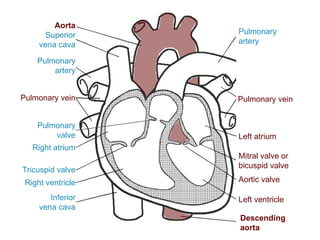
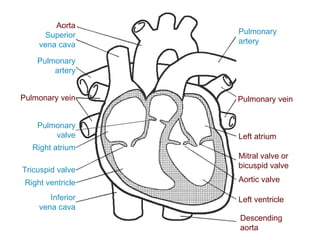
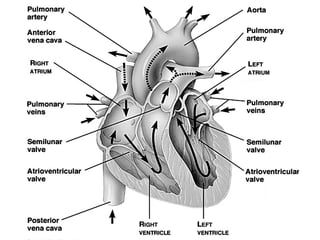
The human heart
Cardiac
Circulation
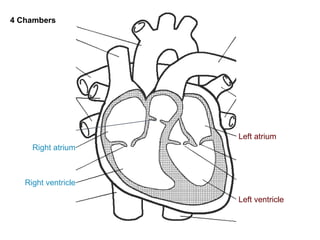
 4 chambers
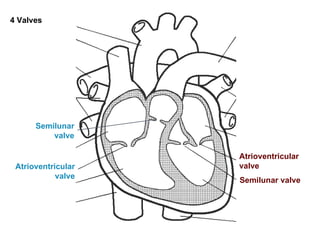
 4 valves
 2 arteries
 2 veins
 Deoxygenated
blood
 Oxygenated
blood
http://www.sdm.scot.nhs.uk/images/pfo.jpg
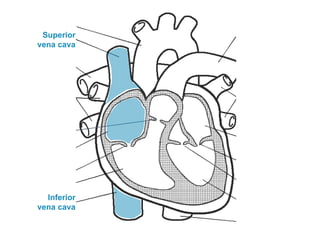
Superior
vena cava
Inferior
vena cava
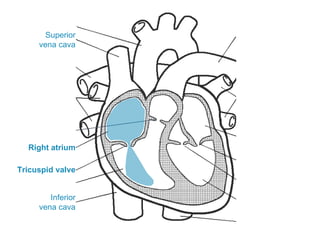
Superior
vena cava
Inferior
vena cava
Right atrium
Tricuspid valve
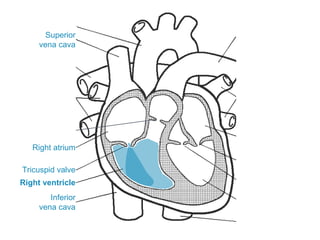
Superior
vena cava
Inferior
vena cava
Right atrium
Tricuspid valve
Right ventricle
Superior
vena cava
Inferior
vena cava
Right atrium
Tricuspid valve
Right ventricle
Pulmonary
valve
Pulmonary
artery
Pulmonary
artery
Superior
vena cava
Inferior
vena cava
Right atrium
Tricuspid valve
Right ventricle
Pulmonary
valve
to right lung
to left lung
Superior
vena cava
Inferior
vena cava
Right atrium
Tricuspid valve
Right ventricle
Pulmonary
valve
Pulmonary
artery
Pulmonary
artery
Superior
vena cava
Inferior
vena cava
Right atrium
Tricuspid valve
Right ventricle
Pulmonary
valve
Pulmonary
artery
Pulmonary
artery
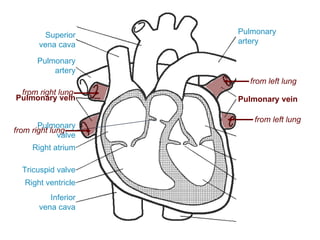
from right lung
from right lung
from left lung
from left lung
from right lung
Superior
vena cava
Inferior
vena cava
Right atrium
Tricuspid valve
Right ventricle
Pulmonary
valve
Pulmonary
artery
from right lung
Pulmonary
artery
from left lung
from left lung
Pulmonary veinPulmonary vein
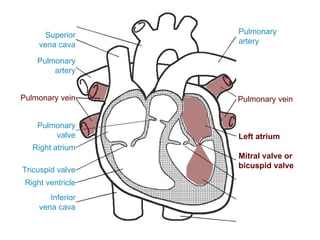
Left atrium
Pulmonary
artery
Pulmonary vein
Superior
vena cava
Inferior
vena cava
Right atrium
Tricuspid valve
Right ventricle
Pulmonary
valve
Pulmonary
artery
Pulmonary vein
Mitral valve or
bicuspid valve
Superior
vena cava
Inferior
vena cava
Right atrium
Tricuspid valve
Right ventricle
Pulmonary
valve
Pulmonary
artery
Pulmonary vein
Pulmonary
artery
Left atrium
Pulmonary vein
Mitral valve or
bicuspid valve
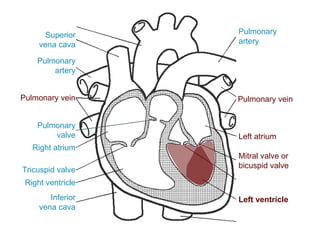
Left ventricle
Superior
vena cava
Inferior
vena cava
Right atrium
Tricuspid valve
Right ventricle
Pulmonary
valve
Pulmonary
artery
Pulmonary vein
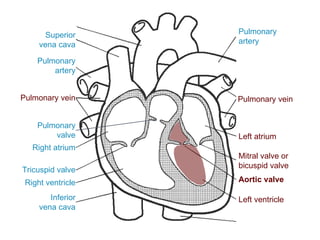
Aortic valve
Pulmonary
artery
Left atrium
Pulmonary vein
Mitral valve or
bicuspid valve
Left ventricle
Superior
vena cava
Inferior
vena cava
Right atrium
Tricuspid valve
Right ventricle
Pulmonary
valve
Pulmonary
artery
Pulmonary vein
Pulmonary
artery
Left atrium
Pulmonary vein
Mitral valve or
bicuspid valve
Aortic valve
Left ventricle
Aorta
Descending
aorta
Pulmonary
artery
Left atrium
Pulmonary vein
Mitral valve or
bicuspid valve
Aortic valve
Left ventricle
Superior
vena cava
Inferior
vena cava
Right atrium
Tricuspid valve
Right ventricle
Pulmonary
valve
Pulmonary
artery
Pulmonary vein
Aorta
Descending
aorta
Left atrium
Left ventricle
Right atrium
Right ventricle
4 Chambers
Mitral valve or
bicuspid valve
Aortic valve
Tricuspid valve
Pulmonary
valve
Atrioventricular
valve
Atrioventricular
valve
Semilunar
valve
Semilunar valve
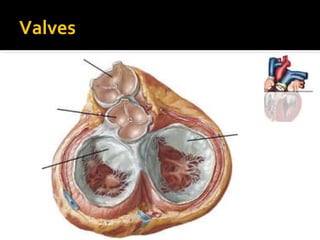
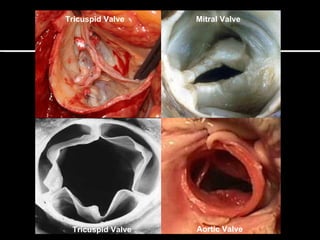
4 Valves
Valves
Tricuspid Valve Mitral Valve
Aortic ValveTricuspid Valve
Pulmonary
artery
Pulmonary vein
Superior
vena cava
Inferior
vena cava
Pulmonary
artery
Pulmonary vein
Aorta
Descending
aorta
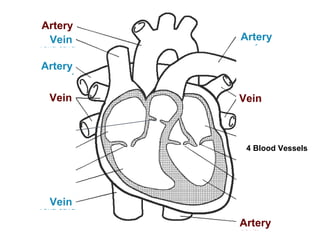
Vein
Vein
Vein
Artery
Artery
Artery
Vein
Artery
4 Blood Vessels
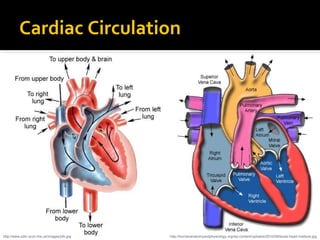
Cardiac Circulation
http://humananatomyandphysiology.org/wp-content/uploads/2010/09/texas-heart-institute.jpghttp://www.sdm.scot.nhs.uk/images/pfo.jpg
Cardiac Circulation
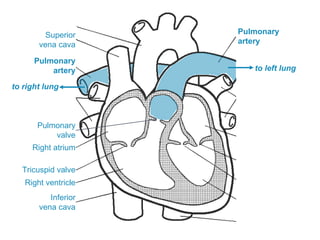
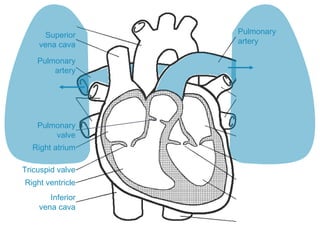
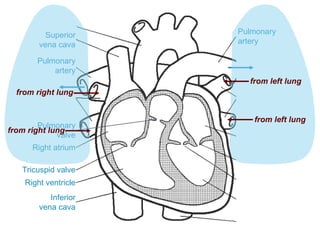
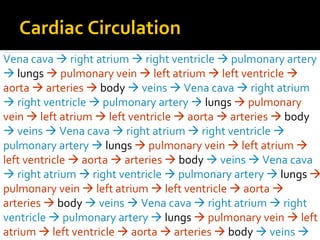
Vena cava  right atrium  right ventricle  pulmonary artery
 lungs  pulmonary vein  left atrium  left ventricle 
aorta  arteries  body  veins  Vena cava  right atrium
 right ventricle  pulmonary artery  lungs  pulmonary
vein  left atrium  left ventricle  aorta  arteries  body
 veins  Vena cava  right atrium  right ventricle 
pulmonary artery  lungs  pulmonary vein  left atrium 
left ventricle  aorta  arteries  body  veins  Vena cava
 right atrium  right ventricle  pulmonary artery  lungs 
pulmonary vein  left atrium  left ventricle  aorta 
arteries  body  veins  Vena cava  right atrium  right
ventricle  pulmonary artery  lungs  pulmonary vein  left
atrium  left ventricle  aorta  arteries  body  veins 
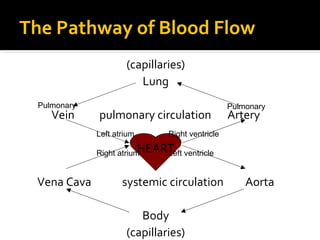
The Pathway of Blood Flow
(capillaries)
Lung
Vein pulmonary circulation Artery
HEART
Vena Cava systemic circulation Aorta
Body
(capillaries)
PulmonaryPulmonary
Right atrium
Right ventricleLeft atrium
Left ventricle
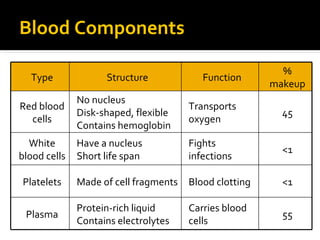
Blood Components
Type Structure Function
%
makeup
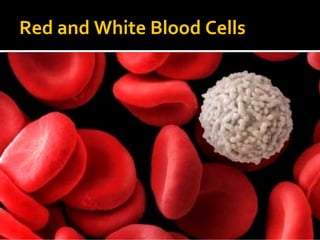
Red blood
cells
No nucleus
Disk-shaped, flexible
Contains hemoglobin
Transports
oxygen
45
White
blood cells
Have a nucleus
Short life span
Fights
infections
<1
Platelets Made of cell fragments Blood clotting <1
Plasma
Protein-rich liquid
Contains electrolytes
Carries blood
cells
55
Red and White Blood Cells
Cardiovascular Diseases
 Atherosclerosis leading to:
 Heart attack
 Hypertension
 Arrhythmias
 Heart Murmurs
 Aneurysms
 Congenital Heart Defects
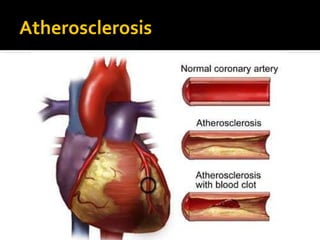
Atherosclerosis
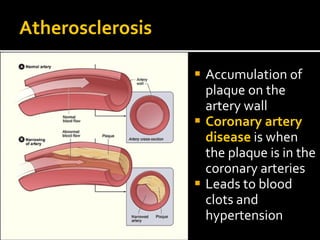
Atherosclerosis
 Accumulation of
plaque on the
artery wall
 Coronary artery
disease is when
the plaque is in the
coronary arteries
 Leads to blood
clots and
hypertension
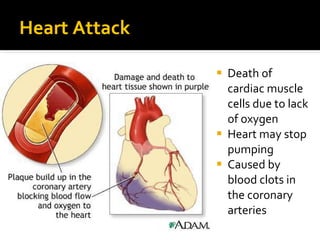
Heart Attack
 Death of
cardiac muscle
cells due to lack
of oxygen
 Heart may stop
pumping
 Caused by
blood clots in
the coronary
arteries
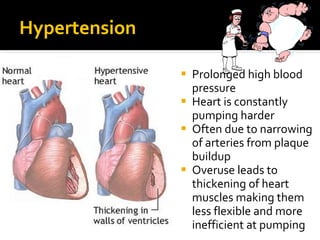
Hypertension
 Prolonged high blood
pressure
 Heart is constantly
pumping harder
 Often due to narrowing
of arteries from plaque
buildup
 Overuse leads to
thickening of heart
muscles making them
less flexible and more
inefficient at pumping
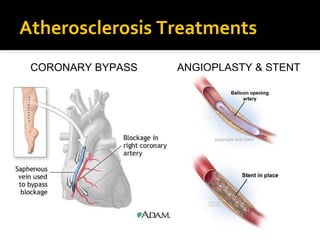
Atherosclerosis Treatments
CORONARY BYPASS ANGIOPLASTY & STENT
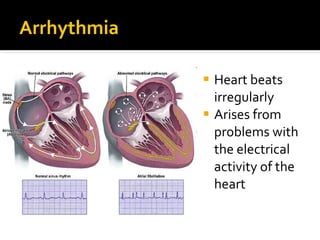
Arrhythmia
 Heart beats
irregularly
 Arises from
problems with
the electrical
activity of the
heart
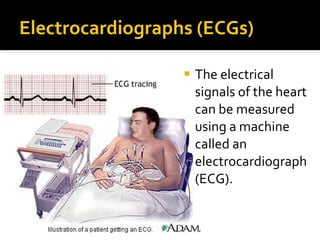
Electrocardiographs (ECGs)
 The electrical
signals of the heart
can be measured
using a machine
called an
electrocardiograph
(ECG).
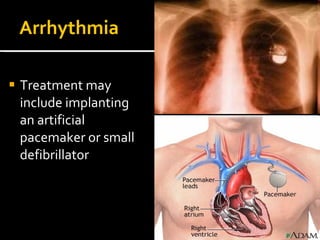
Arrhythmia
 Treatment may
include implanting
an artificial
pacemaker or small
defibrillator
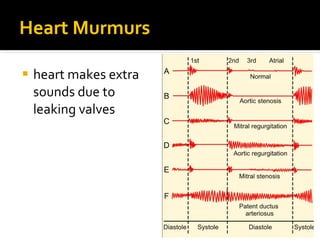
Heart Murmurs
 heart makes extra
sounds due to
leaking valves
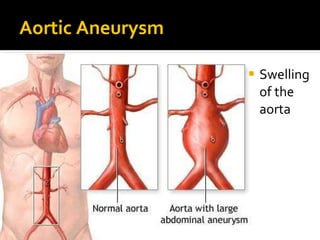
Aortic Aneurysm
 Swelling
of the
aorta
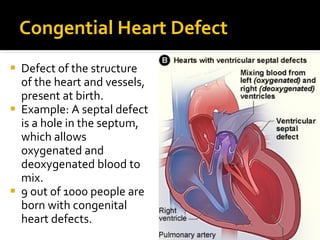
Congential Heart Defect
 Defect of the structure
of the heart and vessels,
present at birth.
 Example: A septal defect
is a hole in the septum,
which allows
oxygenated and
deoxygenated blood to
mix.
 9 out of 1000 people are
born with congenital
heart defects.

Circulatory system