Edited by
Dr Dina Merzeban
physiology lecturer
Fayoum university
www.facebook.com/merzeban physiology
 It consists of the phospholipid bilayer with embedded proteins.
 selectively permeable to ions and organic molecules
 controls the movement of substances in and out of cells.
 protect the cell from its surroundings.
CELL MEMBRANE
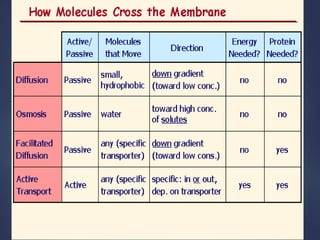
Transport through cell membrane
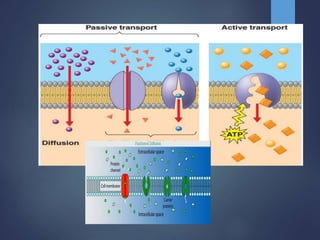
 Passive transport or diffusion
 Active transport
PASSIVE TRANSPORT or
DIFFUSION:
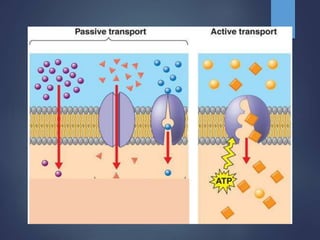
 Molecules move down their concentration
gradient.
 Molecules reach an equilibrium where they are
evenly distributed.
 PASSIVE :no energy
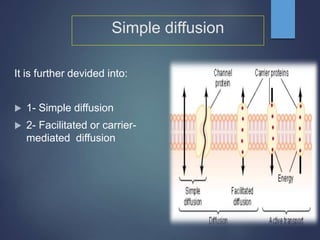
Simple diffusion
It is further devided into:
 1- Simple diffusion
 2- Facilitated or carrier-
mediated diffusion
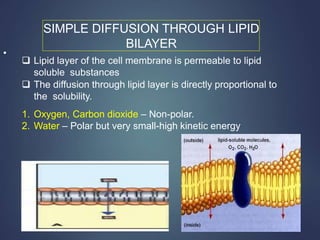
SIMPLE DIFFUSION THROUGH LIPID
BILAYER
•
 Lipid layer of the cell membrane is permeable to lipid
soluble substances
 The diffusion through lipid layer is directly proportional to
the solubility.
1. Oxygen, Carbon dioxide – Non-polar.
2. Water – Polar but very small-high kinetic energy
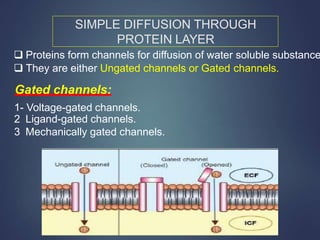
SIMPLE DIFFUSION THROUGH
PROTEIN LAYER
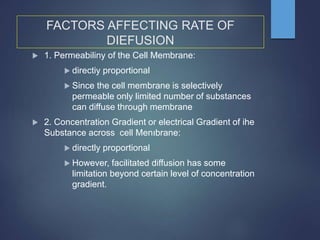
 Proteins form channels for diffusion of water soluble substance
 They are either Ungated channels or Gated channels.
Gated channels:
1- Voltage-gated channels.
2 Ligand-gated channels.
3 Mechanically gated channels.
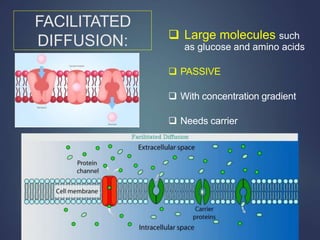
FACILITATED
DIFFUSION:  Large molecules such
as glucose and amino acids
 PASSIVE
 With concentration gradient
 Needs carrier
FACTORS AFFECTING RATE OF
DIEFUSION
 1. Permeabiliny of the Cell Membrane:
 directiy proportional
 Since the cell membrane is selectively
permeable only limited number of substances
can diffuse through membrane
 2. Concentration Gradient or electrical Gradient of ihe
Substance across cell Menıbrane:
 directly proportional
 However, facilitated diffusion has some
limitation beyond certain level of concentration
gradient.
FACTORS AFFECTING RATE
OF DIEFUSION
 3. Solubility of the Substance:
directiy proportional
particularly the lipid soluble substances.
 4. Thickness of the Cell Membrane:
inversely proportional :1f the cell membrane is thick,
the diffusion of the substances is very slow.
 5. Size of the Molecules or ions:
inversely proportional
smaller molecules or ions diffuse rapidly than
larger molecules.
 6.Charge of the lons:
inversely proportional.
 The greater the charge of the ions, the lesser is the
rate of diffusion.
 For example, diffusion of calcium (Ca) ions is slower
than the sodium (Na ) ions* .
FACTORS AFFECTING RATE
OF DIEFUSION
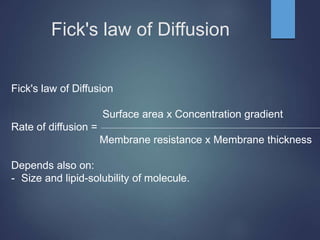
Fick's law of Diffusion
Surface area x Concentration gradient
Rate of diffusion =
Membrane resistance x Membrane thickness
Depends also on:
- Size and lipid-solubility of molecule.
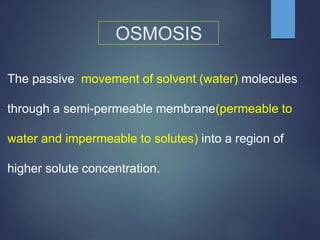
OSMOSIS
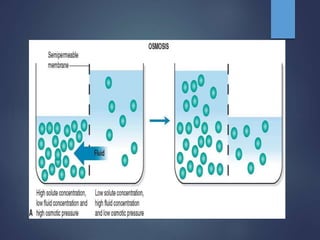
The passive movement of solvent (water) molecules
through a semi-permeable membrane(permeable to
water and impermeable to solutes) into a region of
higher solute concentration.
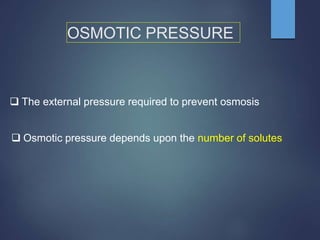
OSMOTIC PRESSURE
 The external pressure required to prevent osmosis
 Osmotic pressure depends upon the number of solutes
ONCOTIC PRESSURE OR
COLLOIDAL OSMOTIC PRESSURE:
 Is the part of the osmotic pressure created by the larger colloidal
substances particularly protein.
 Albumin creates 70% of oncotic pressure. Normal oncotic pressure
is about 25mm hg.
Importance of osmotic pressure:
1- Fluid Balance
2- Blood volume (osmosis significantly
contributes to the regulation of blood volume and
urine excretion).
3- Transfusion (isotonic solution of NACL or
glucose are commonly used in i/v transfusion in
hospital for treatment of dehydration, burns
etc).
PROPERTIES OF ACTIVE
TRANSPORT
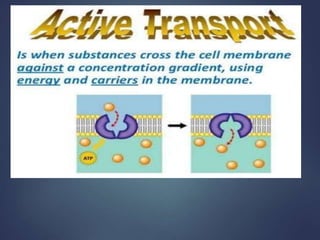
 Active
 Needs carrier
 Against concentration gradient
SUBSTANCES TRANSPORTED
BY ACTIVE TRANSPORT:
Substances, which are transported actively,
are in ionic form and non-ionic form.
 ionic as sodium, potassium, calcium,
hydrogen, chloride and iodide
 non-ionic as glucose, amino acids and
urea.
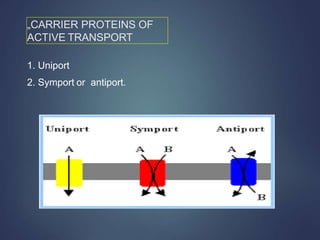
„CARRIER PROTEINS OF
ACTIVE TRANSPORT
1. Uniport
2. Symport or antiport.
TYPES ACTIVE TRANSPORT:
It is further devided into:
A- Primary active transport
B- Secondary active transport
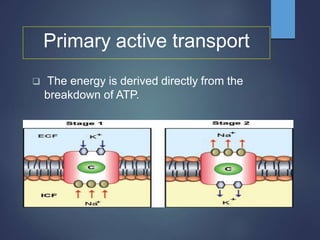
Primary active transport
 The energy is derived directly from the
breakdown of ATP.
SECONDARY ACTIVE TRANSPORT
 In the secondary active transport, the energy is derived
secondarily from energy that has been stored in the form of
ionic concentration differences between the two sides of a
membrane.
 Secondary active transport is the transport of a substance
with sodium ion, by means of a common carrier protein.
When sodium is transported by a carrier protein, another
substance is also transported by the same protein
simultaneously, either in the same direction (of sodium
movement) or in the opposite direction. Thus, the transport of
sodium is coupled with transport of another substance.
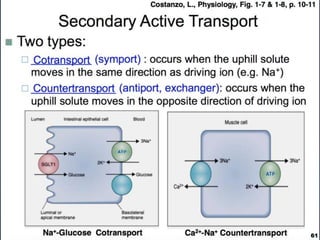
Types of secondary active transport :
1- Cotransport, 2-Countertransport
ACTIVE TRANSPORT VS
FACILITATED DIFFUSION
Active transport mechanism is different from facilitated diffusion
by two ways:
1.Carrier protein of active transport needs energy, whereas
the carrier protein of facilitated diffusion does not need
energy
2.In active transport, the substances are transported against the
concentration or electrical or electrochemical gradient. In facilitated
diffusion, the substances are transported along the concentration or
electrical or electrochemical gradient.
SPECIAL TYPES OF PASSIVE
TRANSPORT
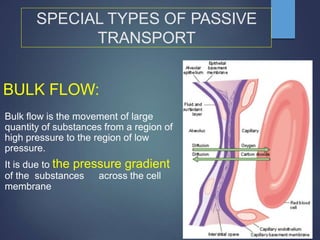
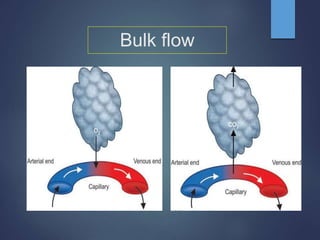
BULK FLOW:
Bulk flow is the movement of large
quantity of substances from a region of
high pressure to the region of low
pressure.
It is due to the pressure gradient
of the substances across the cell
membrane
Bulk flow
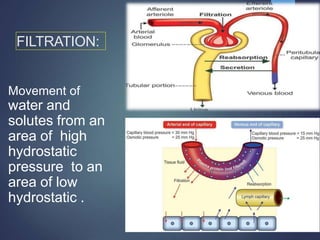
FILTRATION:
Movement of
water and
solutes from an
area of high
hydrostatic
pressure to an
area of low
hydrostatic .
SPECIAL TYPES OF ACTIVE
TRANSPORT
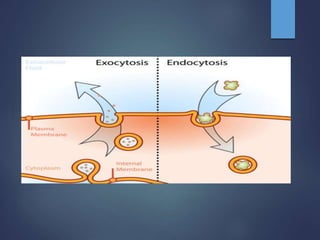
1. Endocytosis
2. Exocytosis
3. Transcytosis.
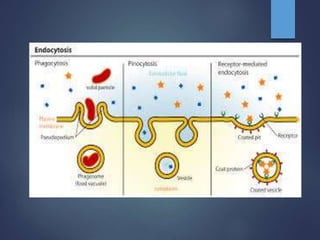
Endocytosis
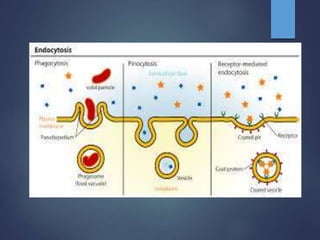
 Endocytosis is defined as a transport
mechanism by which the macromolecules
enter the cell.
types:
1.Pinocytosis
2.Phagocytosis
3.Receptor-mediated endocytosis
PINOCYTOSIS:
Pinocytosis is a process by which extracellular fluid with
some of its contents are taken into the cells. It is
otherwise called the cell drinking.
Phagocytosis:
 Phagocytosis is the process by which particles
larger than the macromolecules are engulfed into the
cells.
 It is also called cell eating.
 Larger bacteria, larger antigens and other larger
foreign bodies are taken inside the cell by means of
phagocytosis.
 Only few cells in the body like neutrophils,
monocytes and the tissue macrophages show
phagocytosis.
 Among these cells, the macrophages are the largest
phagocytic cells.
MECHANISM OF PHAGOCYTOSIS
i.phagocytic cell sends cytoplasmic extension around bacteria or
foreign body.
ii.Then, these particles are engulfed and are converted into Vacuole
called the phagosome.
iii. Phagosome travels into the interior of cell.
iv.Primary lysosome fuses with this phagosome and forms secondary
lysosome.
v.Hydrolytic enzymes present in the secondary lysosome are activated
resulting in digestion and degradation of the phagosomal contents.
RECEPTOR-MEDIATED
ENDOCYTOSIS
 The transport of macromolecules with the help of a receptor protein.
 Surface of cell membrane has some pits (receptor-coated pit)
which contain a receptor protein called clathrin.
 These receptor-coated pits are involved in the receptor-
mediated endocytosis.
Mechanism of receptor-mediated
endocytosis:
 Receptor-mediated endocytosis is induced by
substances like ligands
 Ligand molecules approach the cell and bind to
receptors in the coated pits and form ligand-
receptor complex.
 Ligand-receptor complex gets aggregated in the
coated pits. Then, the pit is detached from cell
membrane and becomes the coated vesicle. This
coated vesicle forms the endosome.
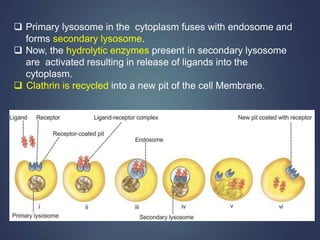
 Primary lysosome in the cytoplasm fuses with endosome and
forms secondary lysosome.
 Now, the hydrolytic enzymes present in secondary lysosome
are activated resulting in release of ligands into the
cytoplasm.
 Clathrin is recycled into a new pit of the cell Membrane.
TRANSCYTOSIS:
 Transporting the substances between two
environments across the cells without any
distinct change in the composition of these
environments.
 Trans-cytosis is a transport mechanism in which
an extracellular macromolecule
 Enters through one side of a cell,
 migrates across cytoplasm of the cell
 and exits through the other side.
MECHANISM OF TRANSCYTOSIS
 Transcytosis involves the receptor-coated pits as in
receptor-mediated endocytosis.
 Receptor protein coating the pits is caveolin and not
clathrin.
 Transcytosis is also called, vesicle trafficking.
 Examples
 the movement of proteins from capillary blood into
interstitial fluid across the endothelial cells of the
capillary.
 pathogens like human immuno deficiency virus (HIV)

Transport through cell membrane

  • 1.
    Edited by Dr DinaMerzeban physiology lecturer Fayoum university www.facebook.com/merzeban physiology
  • 2.
     It consistsof the phospholipid bilayer with embedded proteins.  selectively permeable to ions and organic molecules  controls the movement of substances in and out of cells.  protect the cell from its surroundings. CELL MEMBRANE
  • 3.
    Transport through cellmembrane  Passive transport or diffusion  Active transport
  • 4.
    PASSIVE TRANSPORT or DIFFUSION: Molecules move down their concentration gradient.  Molecules reach an equilibrium where they are evenly distributed.  PASSIVE :no energy
  • 5.
    Simple diffusion It isfurther devided into:  1- Simple diffusion  2- Facilitated or carrier- mediated diffusion
  • 6.
    SIMPLE DIFFUSION THROUGHLIPID BILAYER •  Lipid layer of the cell membrane is permeable to lipid soluble substances  The diffusion through lipid layer is directly proportional to the solubility. 1. Oxygen, Carbon dioxide – Non-polar. 2. Water – Polar but very small-high kinetic energy
  • 7.
    SIMPLE DIFFUSION THROUGH PROTEINLAYER  Proteins form channels for diffusion of water soluble substance  They are either Ungated channels or Gated channels. Gated channels: 1- Voltage-gated channels. 2 Ligand-gated channels. 3 Mechanically gated channels.
  • 8.
    FACILITATED DIFFUSION:  Largemolecules such as glucose and amino acids  PASSIVE  With concentration gradient  Needs carrier
  • 10.
    FACTORS AFFECTING RATEOF DIEFUSION  1. Permeabiliny of the Cell Membrane:  directiy proportional  Since the cell membrane is selectively permeable only limited number of substances can diffuse through membrane  2. Concentration Gradient or electrical Gradient of ihe Substance across cell Menıbrane:  directly proportional  However, facilitated diffusion has some limitation beyond certain level of concentration gradient.
  • 11.
    FACTORS AFFECTING RATE OFDIEFUSION  3. Solubility of the Substance: directiy proportional particularly the lipid soluble substances.  4. Thickness of the Cell Membrane: inversely proportional :1f the cell membrane is thick, the diffusion of the substances is very slow.  5. Size of the Molecules or ions: inversely proportional smaller molecules or ions diffuse rapidly than larger molecules.
  • 12.
     6.Charge ofthe lons: inversely proportional.  The greater the charge of the ions, the lesser is the rate of diffusion.  For example, diffusion of calcium (Ca) ions is slower than the sodium (Na ) ions* . FACTORS AFFECTING RATE OF DIEFUSION
  • 13.
    Fick's law ofDiffusion Fick's law of Diffusion Surface area x Concentration gradient Rate of diffusion = Membrane resistance x Membrane thickness Depends also on: - Size and lipid-solubility of molecule.
  • 14.
    OSMOSIS The passive movementof solvent (water) molecules through a semi-permeable membrane(permeable to water and impermeable to solutes) into a region of higher solute concentration.
  • 16.
    OSMOTIC PRESSURE  Theexternal pressure required to prevent osmosis  Osmotic pressure depends upon the number of solutes
  • 17.
    ONCOTIC PRESSURE OR COLLOIDALOSMOTIC PRESSURE:  Is the part of the osmotic pressure created by the larger colloidal substances particularly protein.  Albumin creates 70% of oncotic pressure. Normal oncotic pressure is about 25mm hg.
  • 18.
    Importance of osmoticpressure: 1- Fluid Balance 2- Blood volume (osmosis significantly contributes to the regulation of blood volume and urine excretion). 3- Transfusion (isotonic solution of NACL or glucose are commonly used in i/v transfusion in hospital for treatment of dehydration, burns etc).
  • 21.
    PROPERTIES OF ACTIVE TRANSPORT Active  Needs carrier  Against concentration gradient
  • 22.
    SUBSTANCES TRANSPORTED BY ACTIVETRANSPORT: Substances, which are transported actively, are in ionic form and non-ionic form.  ionic as sodium, potassium, calcium, hydrogen, chloride and iodide  non-ionic as glucose, amino acids and urea.
  • 23.
    „CARRIER PROTEINS OF ACTIVETRANSPORT 1. Uniport 2. Symport or antiport.
  • 24.
    TYPES ACTIVE TRANSPORT: Itis further devided into: A- Primary active transport B- Secondary active transport
  • 25.
    Primary active transport The energy is derived directly from the breakdown of ATP.
  • 26.
    SECONDARY ACTIVE TRANSPORT In the secondary active transport, the energy is derived secondarily from energy that has been stored in the form of ionic concentration differences between the two sides of a membrane.  Secondary active transport is the transport of a substance with sodium ion, by means of a common carrier protein. When sodium is transported by a carrier protein, another substance is also transported by the same protein simultaneously, either in the same direction (of sodium movement) or in the opposite direction. Thus, the transport of sodium is coupled with transport of another substance. Types of secondary active transport : 1- Cotransport, 2-Countertransport
  • 28.
    ACTIVE TRANSPORT VS FACILITATEDDIFFUSION Active transport mechanism is different from facilitated diffusion by two ways: 1.Carrier protein of active transport needs energy, whereas the carrier protein of facilitated diffusion does not need energy 2.In active transport, the substances are transported against the concentration or electrical or electrochemical gradient. In facilitated diffusion, the substances are transported along the concentration or electrical or electrochemical gradient.
  • 30.
    SPECIAL TYPES OFPASSIVE TRANSPORT BULK FLOW: Bulk flow is the movement of large quantity of substances from a region of high pressure to the region of low pressure. It is due to the pressure gradient of the substances across the cell membrane
  • 31.
  • 32.
    FILTRATION: Movement of water and solutesfrom an area of high hydrostatic pressure to an area of low hydrostatic .
  • 33.
    SPECIAL TYPES OFACTIVE TRANSPORT 1. Endocytosis 2. Exocytosis 3. Transcytosis.
  • 34.
    Endocytosis  Endocytosis isdefined as a transport mechanism by which the macromolecules enter the cell. types: 1.Pinocytosis 2.Phagocytosis 3.Receptor-mediated endocytosis
  • 36.
    PINOCYTOSIS: Pinocytosis is aprocess by which extracellular fluid with some of its contents are taken into the cells. It is otherwise called the cell drinking.
  • 37.
    Phagocytosis:  Phagocytosis isthe process by which particles larger than the macromolecules are engulfed into the cells.  It is also called cell eating.  Larger bacteria, larger antigens and other larger foreign bodies are taken inside the cell by means of phagocytosis.  Only few cells in the body like neutrophils, monocytes and the tissue macrophages show phagocytosis.  Among these cells, the macrophages are the largest phagocytic cells.
  • 38.
    MECHANISM OF PHAGOCYTOSIS i.phagocyticcell sends cytoplasmic extension around bacteria or foreign body. ii.Then, these particles are engulfed and are converted into Vacuole called the phagosome. iii. Phagosome travels into the interior of cell. iv.Primary lysosome fuses with this phagosome and forms secondary lysosome. v.Hydrolytic enzymes present in the secondary lysosome are activated resulting in digestion and degradation of the phagosomal contents.
  • 39.
    RECEPTOR-MEDIATED ENDOCYTOSIS  The transportof macromolecules with the help of a receptor protein.  Surface of cell membrane has some pits (receptor-coated pit) which contain a receptor protein called clathrin.  These receptor-coated pits are involved in the receptor- mediated endocytosis.
  • 40.
    Mechanism of receptor-mediated endocytosis: Receptor-mediated endocytosis is induced by substances like ligands  Ligand molecules approach the cell and bind to receptors in the coated pits and form ligand- receptor complex.  Ligand-receptor complex gets aggregated in the coated pits. Then, the pit is detached from cell membrane and becomes the coated vesicle. This coated vesicle forms the endosome.
  • 41.
     Primary lysosomein the cytoplasm fuses with endosome and forms secondary lysosome.  Now, the hydrolytic enzymes present in secondary lysosome are activated resulting in release of ligands into the cytoplasm.  Clathrin is recycled into a new pit of the cell Membrane.
  • 43.
    TRANSCYTOSIS:  Transporting thesubstances between two environments across the cells without any distinct change in the composition of these environments.  Trans-cytosis is a transport mechanism in which an extracellular macromolecule  Enters through one side of a cell,  migrates across cytoplasm of the cell  and exits through the other side.
  • 45.
    MECHANISM OF TRANSCYTOSIS Transcytosis involves the receptor-coated pits as in receptor-mediated endocytosis.  Receptor protein coating the pits is caveolin and not clathrin.  Transcytosis is also called, vesicle trafficking.  Examples  the movement of proteins from capillary blood into interstitial fluid across the endothelial cells of the capillary.  pathogens like human immuno deficiency virus (HIV)