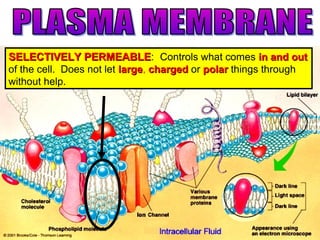
SELECTIVELY PERMEABLESELECTIVELY PERMEABLE: Controls what comes in and outin and out
of the cell. Does not let largelarge, chargedcharged or polarpolar things through
without help.
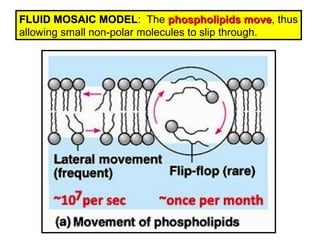
FLUID MOSAIC MODELFLUID MOSAIC MODEL: The phospholipids movephospholipids move, thus
allowing small non-polar molecules to slip through.
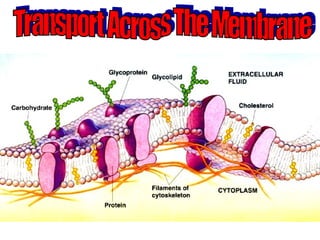
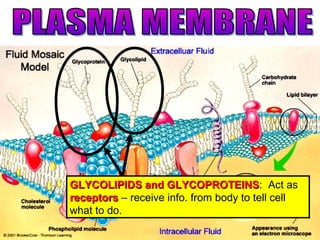
GLYCOLIPIDS and GLYCOPROTEINSGLYCOLIPIDS and GLYCOPROTEINS: Act as
receptorsreceptors – receive info. from body to tell cell
what to do.
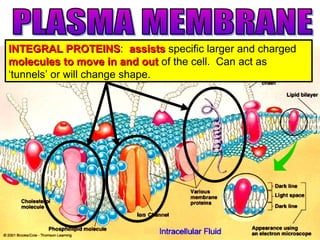
INTEGRAL PROTEINSINTEGRAL PROTEINS: assistsassists specific larger and charged
molecules to move in and outmolecules to move in and out of the cell. Can act as
‘tunnels’ or will change shape.
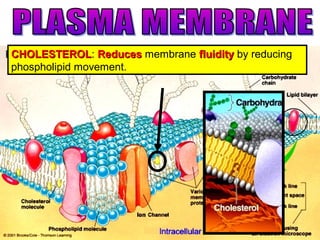
CHOLESTEROLCHOLESTEROL: ReducesReduces membrane fluidityfluidity by reducing
phospholipid movement.
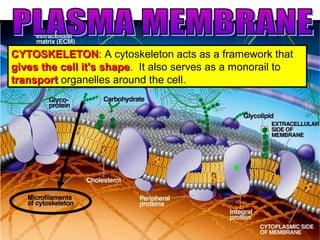
CYTOSKELETONCYTOSKELETON: A cytoskeleton acts as a framework that
gives the cell it's shapegives the cell it's shape. It also serves as a monorail to
transporttransport organelles around the cell.
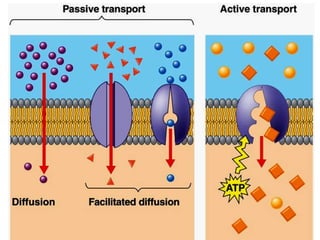
1. Passive transport moves
molecules from a [high][high] to
[low][low] in order to establish
equilibrium.
The molecules may or may
not need to use a proteinprotein
channel or carrier.
Everything that is transported across the cell membrane
takes place by one of two fundamental processes:
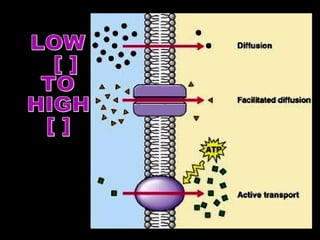
2. Active transport moves molecules from [low][low] to [high][high],
AGAINSTAGAINST the concentration gradient and this process
requires energyenergy in the form of ATP.
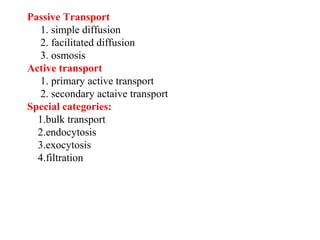
Passive Transport
1. simple diffusion
2. facilitated diffusion
3. osmosis
Active transport
1. primary active transport
2. secondary actaive transport
Special categories:
1.bulk transport
2.endocytosis
3.exocytosis
4.filtration
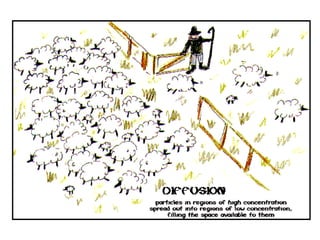
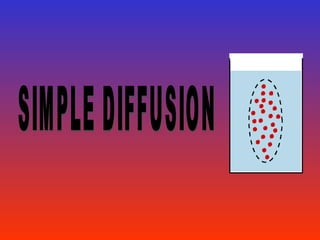
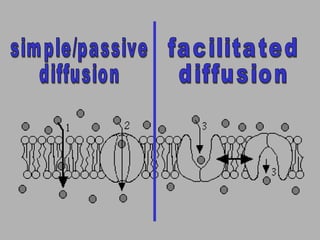
Simple DiffusionSimple Diffusion is a passivepassive process ( nono energy required).
Some substances will diffuse through
membranes as if the membranes
weren’t even there.
Molecules diffuse until they are
evenlyevenly distributed.
The molecules move from an area of [high] to [low].[high] to [low].
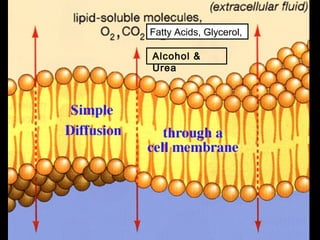
EXAMPLES of molecules that easily cross cell membranes
by simple diffusion are: oxygen, carbon dioxide, alcohols,oxygen, carbon dioxide, alcohols,
fatty acids, glycerol, and ureafatty acids, glycerol, and urea.
Alcohol &
Urea
Fatty Acids, Glycerol,
The rate of diffusion will be increased when there is :
1.1. ConcentrationConcentration: the difference in concentration between
two areas causes diffusion. The greater the difference ingreater the difference in
concentration,concentration, the fasterfaster the diffusion.
2.2. Molecular sizeMolecular size: smaller substances diffuse more quickly.quickly.
Large molecules (such as starches and proteins) simply
cannot diffuse through.
3.3. Movement of the MediumMovement of the Medium: currents will aid diffusion. Like
the wind in air, cytoplasmic steamingcytoplasmic steaming (constant movement
of the cytoplasm) will aid diffusion in the cell.
4. Solubility4. Solubility:: lipidlipid - soluble molecules will dissolve through the
phospholipid bilayer easily,easily, as will gases like CO2 and O2.
5. PolarityPolarity: waterwater will diffuse, but because of its polarity, it will
notnot pass through the non-polar phospholipids. Instead,
water passes though specialized protein ionprotein ion channels.
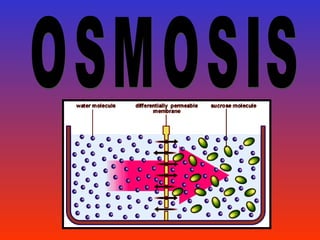
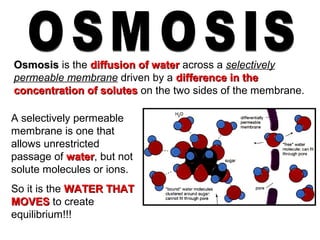
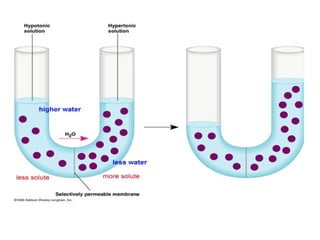
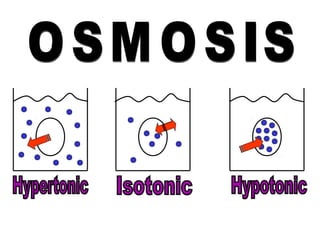
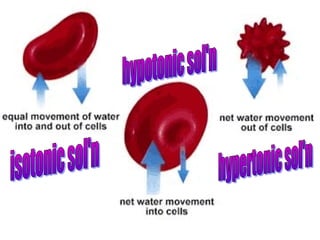
OsmosisOsmosis is the diffusiondiffusion of waterof water across a selectively
permeable membrane driven by a difference in thedifference in the
concentration of solutesconcentration of solutes on the two sides of the membrane.
A selectively permeable
membrane is one that
allows unrestricted
passage of waterwater, but not
solute molecules or ions.
So it is the WATER THATWATER THAT
MOVESMOVES to create
equilibrium!!!
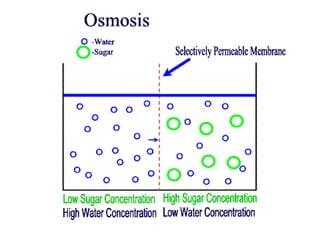
• Osmosis requires NONO ENERGY.
• Osmosis is the net movement of
WATERWATER molecules from the area
of [high][high] of water to the area of
[low][low] of water until it is equallyequally
distributed.distributed.
• Because membranes often
restrict or preventrestrict or prevent the movement
of some molecules, particularly
large ones, the water (solventsolvent)
must be the one to move.move.
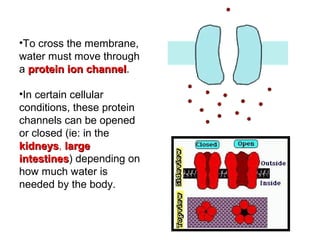
•To cross the membrane,
water must move through
a protein ion channelprotein ion channel.
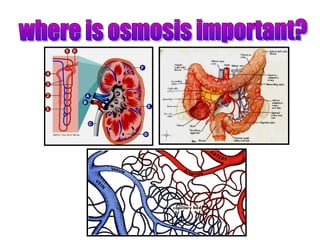
•In certain cellular
conditions, these protein
channels can be opened
or closed (ie: in the
kidneyskidneys, largelarge
intestinesintestines) depending on
how much water is
needed by the body.
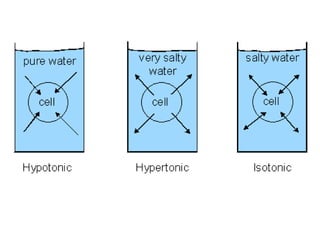
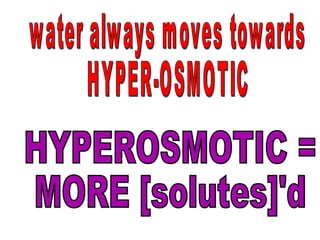
*MEMORY TRICKMEMORY TRICK: If you eat a lot of sugar (ie: solute)
you get HYPER. The solution with a lot of solute is
called HYPEROSMOTIC.
Facilitated TransportFacilitated Transport: Some molecules are notnot
normally able to pass through the lipid membrane,
and need channel or carrierchannel or carrier proteinsproteins to help
them move across.
This does notnot require energyrequire energy when moving
from [H] to [L] (with the concentration gradient).
Molecules that need help to move through the
plasma membrane are either charged, polar,charged, polar,
or too largeor too large..
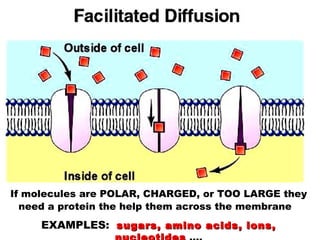
If molecules are POLAR, CHARGED, or TOO LARGE they
need a protein the help them across the membrane
EXAMPLES: sugars, amino acids, ions,sugars, amino acids, ions,
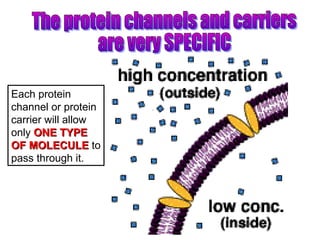
Each protein
channel or protein
carrier will allow
only ONE TYPEONE TYPE
OF MOLECULEOF MOLECULE to
pass through it.
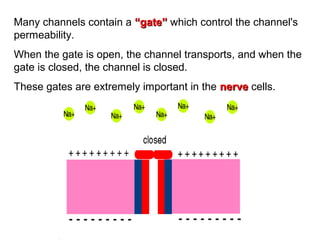
Many channels contain a “gate”“gate” which control the channel's
permeability.
When the gate is open, the channel transports, and when the
gate is closed, the channel is closed.
These gates are extremely important in the nervenerve cells.
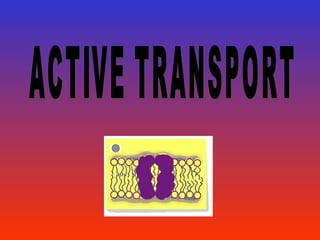
Active TransportActive Transport
1.Primary active transport
Requires direct use of ATP
2.Secondary active transport
Driven by an ion concentration gradient established
by a primary active transport system
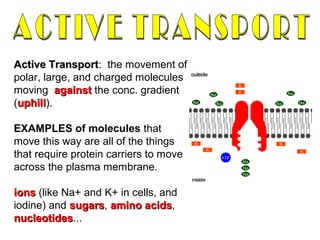
Active TransportActive Transport: the movement of
polar, large, and charged molecules
moving againstagainst the conc. gradient
(uphilluphill).
EXAMPLES of molecules that
move this way are all of the things
that require protein carriers to move
across the plasma membrane.
ionsions (like Na+ and K+ in cells, and
iodine) and sugarssugars, amino acidsamino acids,
nucleotidesnucleotides...
 Movement against concentration gradient
 Hydrolysis of ATP directly required for the
function of the carriers.
 Molecule or ion binds to “recognition site” on
one side of carrier protein.
 Carrier protein undergoes conformational
change.
And releases transported molecules to
opposite side of membrane.
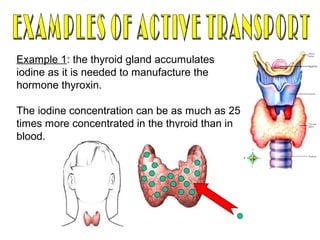
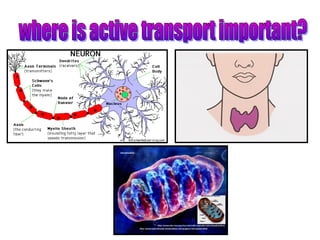
Example 1: the thyroid gland accumulates
iodine as it is needed to manufacture the
hormone thyroxin.
The iodine concentration can be as much as 25
times more concentrated in the thyroid than in
blood.
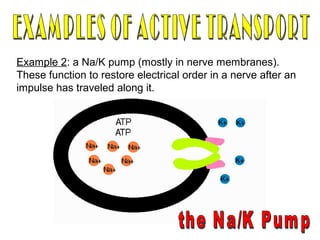
Example 2: a Na/K pump (mostly in nerve membranes).
These function to restore electrical order in a nerve after an
impulse has traveled along it.
Carrier protein has enzymes
activity ( ATPase)
Extrudes 3 Na+
and transports 2 K+
inward against concentration
gradient.
Transport of two or more solutes
are Coupled .
Energy needed for “uphill”
movement obtained from
“downhill” transport of Na+
.
Hydrolysis of ATP by Na+
/K+
pump required indirectly to
maintain [Na+
] gradient.
 High osmotic pressure created by movement of sodium
causes water to move from intestinal lumen to interstitial
space
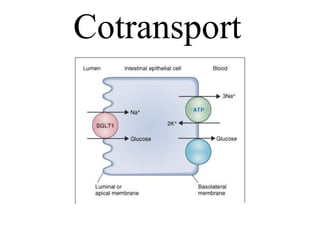
 Protein and glucose r transported actively by
cotransport with sodium
 Chloride passively follow the electrical gradient created
by sodium
Importance of NaImportance of Na++
- K- K++
pump inpump in
intestinal epitheliumintestinal epithelium
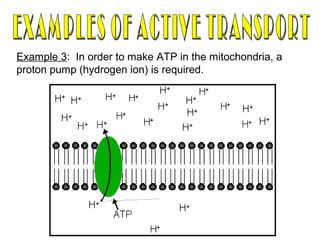
Example 3: In order to make ATP in the mitochondria, a
proton pump (hydrogen ion) is required.
1. Cotransport (symport):
Molecule or ion moving in the
same direction as Na+
.
2. Countertransport (antiport):
Molecule or ion moving in the
opposite direction of Na+
.
Secondary Active Transport
Cotransport
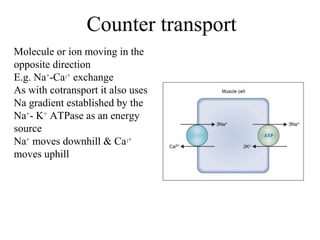
Counter transport
Molecule or ion moving in the
opposite direction
E.g. Na+
-Ca2+
exchange
As with cotransport it also uses
Na gradient established by the
Na+
- K+
ATPase as an energy
source
Na+
moves downhill & Ca2+
moves uphill
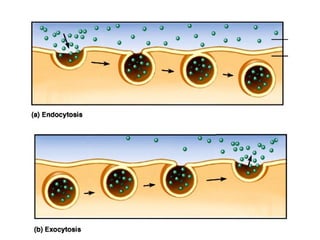
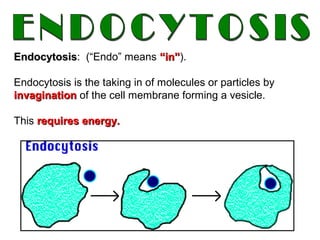
EndocytosisEndocytosis: (“Endo” means “in”“in”).
Endocytosis is the taking in of molecules or particles by
invaginationinvagination of the cell membrane forming a vesicle.
This requires energy.requires energy.
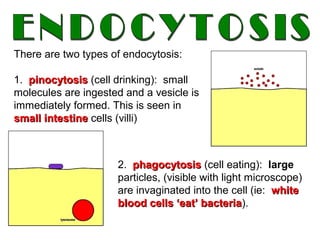
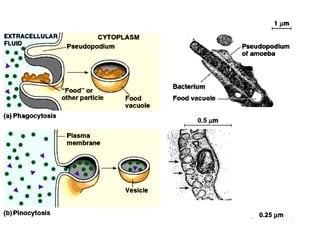
There are two types of endocytosis:
1. pinocytosispinocytosis (cell drinking): small
molecules are ingested and a vesicle is
immediately formed. This is seen in
small intestinesmall intestine cells (villi)
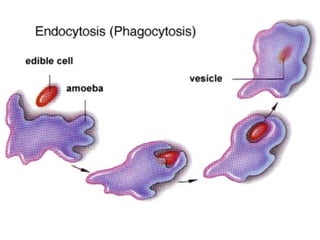
2. phagocytosisphagocytosis (cell eating): large
particles, (visible with light microscope)
are invaginated into the cell (ie: whitewhite
blood cells ‘eat’ bacteriablood cells ‘eat’ bacteria).
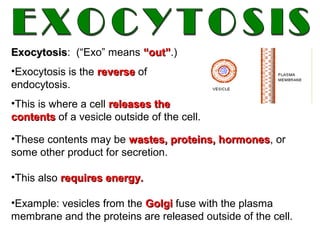
ExocytosisExocytosis: (“Exo” means “out”“out”.)
•Exocytosis is the reversereverse of
endocytosis.
•This is where a cell releases thereleases the
contentscontents of a vesicle outside of the cell.
•These contents may be wastes, proteins, hormoneswastes, proteins, hormones, or
some other product for secretion.
•This also requires energy.requires energy.
•Example: vesicles from the GolgiGolgi fuse with the plasma
membrane and the proteins are released outside of the cell.

4. transport through cell membrane

  • 3.
    SELECTIVELY PERMEABLESELECTIVELY PERMEABLE:Controls what comes in and outin and out of the cell. Does not let largelarge, chargedcharged or polarpolar things through without help.
  • 4.
    FLUID MOSAIC MODELFLUIDMOSAIC MODEL: The phospholipids movephospholipids move, thus allowing small non-polar molecules to slip through.
  • 5.
    GLYCOLIPIDS and GLYCOPROTEINSGLYCOLIPIDSand GLYCOPROTEINS: Act as receptorsreceptors – receive info. from body to tell cell what to do.
  • 6.
    INTEGRAL PROTEINSINTEGRAL PROTEINS:assistsassists specific larger and charged molecules to move in and outmolecules to move in and out of the cell. Can act as ‘tunnels’ or will change shape.
  • 7.
    CHOLESTEROLCHOLESTEROL: ReducesReduces membranefluidityfluidity by reducing phospholipid movement.
  • 8.
    CYTOSKELETONCYTOSKELETON: A cytoskeletonacts as a framework that gives the cell it's shapegives the cell it's shape. It also serves as a monorail to transporttransport organelles around the cell.
  • 9.
    1. Passive transportmoves molecules from a [high][high] to [low][low] in order to establish equilibrium. The molecules may or may not need to use a proteinprotein channel or carrier. Everything that is transported across the cell membrane takes place by one of two fundamental processes:
  • 11.
    2. Active transportmoves molecules from [low][low] to [high][high], AGAINSTAGAINST the concentration gradient and this process requires energyenergy in the form of ATP.
  • 12.
    Passive Transport 1. simplediffusion 2. facilitated diffusion 3. osmosis Active transport 1. primary active transport 2. secondary actaive transport Special categories: 1.bulk transport 2.endocytosis 3.exocytosis 4.filtration
  • 14.
    Simple DiffusionSimple Diffusionis a passivepassive process ( nono energy required). Some substances will diffuse through membranes as if the membranes weren’t even there. Molecules diffuse until they are evenlyevenly distributed. The molecules move from an area of [high] to [low].[high] to [low]. EXAMPLES of molecules that easily cross cell membranes by simple diffusion are: oxygen, carbon dioxide, alcohols,oxygen, carbon dioxide, alcohols, fatty acids, glycerol, and ureafatty acids, glycerol, and urea.
  • 15.
  • 16.
    The rate ofdiffusion will be increased when there is : 1.1. ConcentrationConcentration: the difference in concentration between two areas causes diffusion. The greater the difference ingreater the difference in concentration,concentration, the fasterfaster the diffusion. 2.2. Molecular sizeMolecular size: smaller substances diffuse more quickly.quickly. Large molecules (such as starches and proteins) simply cannot diffuse through.
  • 17.
    3.3. Movement ofthe MediumMovement of the Medium: currents will aid diffusion. Like the wind in air, cytoplasmic steamingcytoplasmic steaming (constant movement of the cytoplasm) will aid diffusion in the cell. 4. Solubility4. Solubility:: lipidlipid - soluble molecules will dissolve through the phospholipid bilayer easily,easily, as will gases like CO2 and O2. 5. PolarityPolarity: waterwater will diffuse, but because of its polarity, it will notnot pass through the non-polar phospholipids. Instead, water passes though specialized protein ionprotein ion channels.
  • 21.
    OsmosisOsmosis is thediffusiondiffusion of waterof water across a selectively permeable membrane driven by a difference in thedifference in the concentration of solutesconcentration of solutes on the two sides of the membrane. A selectively permeable membrane is one that allows unrestricted passage of waterwater, but not solute molecules or ions. So it is the WATER THATWATER THAT MOVESMOVES to create equilibrium!!!
  • 22.
    • Osmosis requiresNONO ENERGY. • Osmosis is the net movement of WATERWATER molecules from the area of [high][high] of water to the area of [low][low] of water until it is equallyequally distributed.distributed. • Because membranes often restrict or preventrestrict or prevent the movement of some molecules, particularly large ones, the water (solventsolvent) must be the one to move.move.
  • 24.
    •To cross themembrane, water must move through a protein ion channelprotein ion channel. •In certain cellular conditions, these protein channels can be opened or closed (ie: in the kidneyskidneys, largelarge intestinesintestines) depending on how much water is needed by the body.
  • 30.
    *MEMORY TRICKMEMORY TRICK:If you eat a lot of sugar (ie: solute) you get HYPER. The solution with a lot of solute is called HYPEROSMOTIC.
  • 35.
    Facilitated TransportFacilitated Transport:Some molecules are notnot normally able to pass through the lipid membrane, and need channel or carrierchannel or carrier proteinsproteins to help them move across. This does notnot require energyrequire energy when moving from [H] to [L] (with the concentration gradient). Molecules that need help to move through the plasma membrane are either charged, polar,charged, polar, or too largeor too large..
  • 36.
    If molecules arePOLAR, CHARGED, or TOO LARGE they need a protein the help them across the membrane EXAMPLES: sugars, amino acids, ions,sugars, amino acids, ions,
  • 37.
    Each protein channel orprotein carrier will allow only ONE TYPEONE TYPE OF MOLECULEOF MOLECULE to pass through it.
  • 38.
    Many channels containa “gate”“gate” which control the channel's permeability. When the gate is open, the channel transports, and when the gate is closed, the channel is closed. These gates are extremely important in the nervenerve cells.
  • 41.
    Active TransportActive Transport 1.Primaryactive transport Requires direct use of ATP 2.Secondary active transport Driven by an ion concentration gradient established by a primary active transport system
  • 42.
    Active TransportActive Transport:the movement of polar, large, and charged molecules moving againstagainst the conc. gradient (uphilluphill). EXAMPLES of molecules that move this way are all of the things that require protein carriers to move across the plasma membrane. ionsions (like Na+ and K+ in cells, and iodine) and sugarssugars, amino acidsamino acids, nucleotidesnucleotides...
  • 43.
     Movement againstconcentration gradient  Hydrolysis of ATP directly required for the function of the carriers.  Molecule or ion binds to “recognition site” on one side of carrier protein.  Carrier protein undergoes conformational change. And releases transported molecules to opposite side of membrane.
  • 47.
    Example 1: thethyroid gland accumulates iodine as it is needed to manufacture the hormone thyroxin. The iodine concentration can be as much as 25 times more concentrated in the thyroid than in blood.
  • 48.
    Example 2: aNa/K pump (mostly in nerve membranes). These function to restore electrical order in a nerve after an impulse has traveled along it.
  • 49.
    Carrier protein hasenzymes activity ( ATPase) Extrudes 3 Na+ and transports 2 K+ inward against concentration gradient. Transport of two or more solutes are Coupled . Energy needed for “uphill” movement obtained from “downhill” transport of Na+ . Hydrolysis of ATP by Na+ /K+ pump required indirectly to maintain [Na+ ] gradient.
  • 50.
     High osmoticpressure created by movement of sodium causes water to move from intestinal lumen to interstitial space  Protein and glucose r transported actively by cotransport with sodium  Chloride passively follow the electrical gradient created by sodium Importance of NaImportance of Na++ - K- K++ pump inpump in intestinal epitheliumintestinal epithelium
  • 51.
    Example 3: Inorder to make ATP in the mitochondria, a proton pump (hydrogen ion) is required.
  • 53.
    1. Cotransport (symport): Moleculeor ion moving in the same direction as Na+ . 2. Countertransport (antiport): Molecule or ion moving in the opposite direction of Na+ . Secondary Active Transport
  • 54.
  • 55.
    Counter transport Molecule orion moving in the opposite direction E.g. Na+ -Ca2+ exchange As with cotransport it also uses Na gradient established by the Na+ - K+ ATPase as an energy source Na+ moves downhill & Ca2+ moves uphill
  • 59.
    EndocytosisEndocytosis: (“Endo” means“in”“in”). Endocytosis is the taking in of molecules or particles by invaginationinvagination of the cell membrane forming a vesicle. This requires energy.requires energy.
  • 60.
    There are twotypes of endocytosis: 1. pinocytosispinocytosis (cell drinking): small molecules are ingested and a vesicle is immediately formed. This is seen in small intestinesmall intestine cells (villi) 2. phagocytosisphagocytosis (cell eating): large particles, (visible with light microscope) are invaginated into the cell (ie: whitewhite blood cells ‘eat’ bacteriablood cells ‘eat’ bacteria).
  • 63.
    ExocytosisExocytosis: (“Exo” means“out”“out”.) •Exocytosis is the reversereverse of endocytosis. •This is where a cell releases thereleases the contentscontents of a vesicle outside of the cell. •These contents may be wastes, proteins, hormoneswastes, proteins, hormones, or some other product for secretion. •This also requires energy.requires energy. •Example: vesicles from the GolgiGolgi fuse with the plasma membrane and the proteins are released outside of the cell.