TRANSPORT ACROSS CELL
MEMBRANE
Name :Y.Vamsi Krishna
Reg No :17BCB0054
3/11/2018Y.Vamsi Krishna 17BCB0054
1
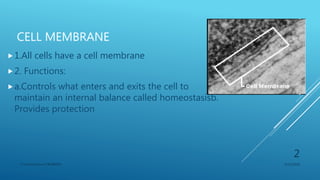
CELL MEMBRANE
1.All cells have a cell membrane
2. Functions:
a.Controls what enters and exits the cell to
maintain an internal balance called homeostasisb.
Provides protection
3/11/2018Y.Vamsi Krishna 17BCB0054
2
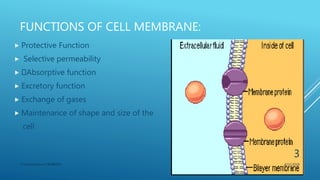
FUNCTIONS OF CELL MEMBRANE:
 Protective Function
 Selective permeability
 Absorptive function
 Excretory function
 Exchange of gases
 Maintenance of shape and size of the
cell
3/11/2018Y.Vamsi Krishna 17BCB0054
3
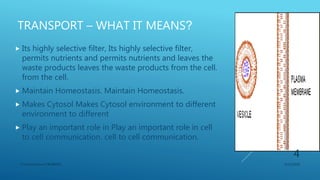
TRANSPORT – WHAT IT MEANS?
 Its highly selective filter, Its highly selective filter,
permits nutrients and permits nutrients and leaves the
waste products leaves the waste products from the cell.
from the cell.
 Maintain Homeostasis. Maintain Homeostasis.
 Makes Cytosol Makes Cytosol environment to different
environment to different
 Play an important role in Play an important role in cell
to cell communication. cell to cell communication.
3/11/2018Y.Vamsi Krishna 17BCB0054
4
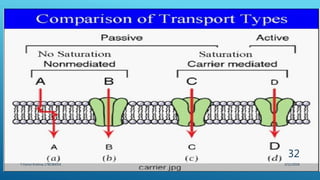
TRANSPORT MECHANISMS
Active process
 Primary Transport
 Secondary Transport
Passive process
 Simple diffusion Simple diffusion
 Facilitated diffusion Facilitated
diffusion
 Osmosis Osmosis
 Bulk flow Bulk flow
 Filtration
3/11/2018Y.Vamsi Krishna 17BCB0054
5
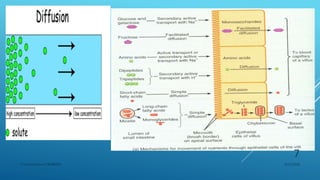
PASSIVE TRANSPORT
cell doesn’t use energy
1. Diffusion
2. Facilitated Diffusion
3.Osmosis
3/11/2018Y.Vamsi Krishna 17BCB0054
6
3/11/2018Y.Vamsi Krishna 17BCB0054
7
FACTORS THAT INFLUENCE DIFFUSION
RATES
 Distance –
The shorter the distance, the more quickly [ ] gradients are eliminated
Few cells are father than 125 microns from a blood vessel
 Molecular Size
Ions and small molecules diffuse more rapidly
 Temperature –
↑ temp., ↑ motion of particles
 Steepness of concentrated gradient –
The larger the [ ] gradient, the faster diffusion proceeds
 Membrane surface area –
The larger the area,the faster diffusion proceeds
3/11/2018Y.Vamsi Krishna 17BCB0054
8
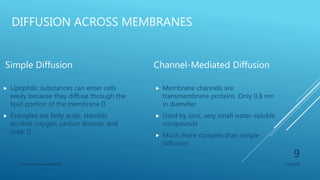
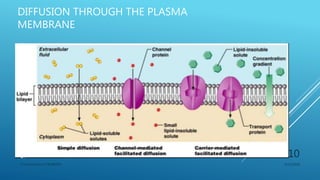
DIFFUSION ACROSS MEMBRANES
Simple Diffusion
 Lipophilic substances can enter cells
easily because they diffuse through the
lipid portion of the membrane
 Examples are fatty acids, steroids,
alcohol, oxygen, carbon dioxide, and
urea,
Channel-Mediated Diffusion
 Membrane channels are
transmembrane proteins .Only 0.8 nm
in diameter
 Used by ions, very small water-soluble
compounds
 Much more complex than simple
diffusion
3/11/2018Y.Vamsi Krishna 17BCB0054
9
DIFFUSION THROUGH THE PLASMA
MEMBRANE
3/11/2018Y.Vamsi Krishna 17BCB0054
10
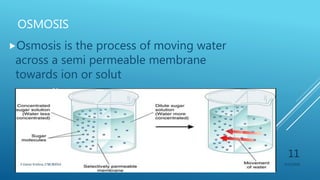
OSMOSIS
Osmosis is the process of moving water
across a semi permeable membrane
towards ion or solut
3/11/2018Y.Vamsi Krishna 17BCB0054
11
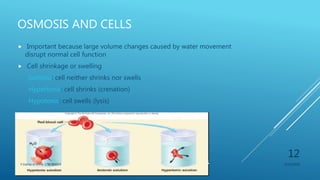
OSMOSIS AND CELLS
 Important because large volume changes caused by water movement
disrupt normal cell function
 Cell shrinkage or swelling
Isotonic: cell neither shrinks nor swells
Hypertonic: cell shrinks (crenation)
Hypotonic: cell swells (lysis)
3/11/2018Y.Vamsi Krishna 17BCB0054
12
ACTIVE TRANSPORT
cell does use energy
1. Endocytosis
2. Exocytosis
3. Protein Pumps
3/11/2018Y.Vamsi Krishna 17BCB0054
13
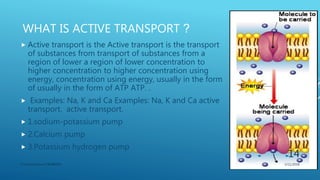
WHAT IS ACTIVE TRANSPORT ?
 Active transport is the Active transport is the transport
of substances from transport of substances from a
region of lower a region of lower concentration to
higher concentration to higher concentration using
energy, concentration using energy, usually in the form
of usually in the form of ATP ATP. .
 Examples: Na, K and Ca Examples: Na, K and Ca active
transport. active transport.
 1.sodium-potassium pump
 2.Calcium pump
 3.Potassium hydrogen pump
3/11/2018Y.Vamsi Krishna 17BCB0054
14
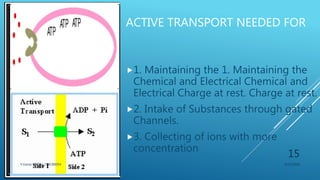
ACTIVE TRANSPORT NEEDED FOR
1. Maintaining the 1. Maintaining the
Chemical and Electrical Chemical and
Electrical Charge at rest. Charge at rest.
2. Intake of Substances through gated
Channels.
3. Collecting of ions with more
concentration
3/11/2018Y.Vamsi Krishna 17BCB0054
15
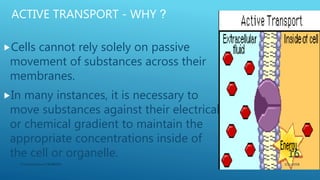
ACTIVE TRANSPORT - WHY ?
Cells cannot rely solely on passive
movement of substances across their
membranes.
In many instances, it is necessary to
move substances against their electrical
or chemical gradient to maintain the
appropriate concentrations inside of
the cell or organelle.
3/11/2018Y.Vamsi Krishna 17BCB0054
16
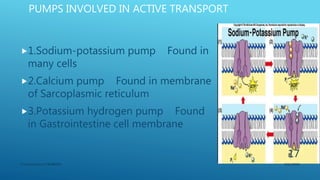
PUMPS INVOLVED IN ACTIVE TRANSPORT
1.Sodium-potassium pump Found in
many cells
2.Calcium pump Found in membrane
of Sarcoplasmic reticulum
3.Potassium hydrogen pump Found
in Gastrointestine cell membrane
3/11/2018Y.Vamsi Krishna 17BCB0054
17
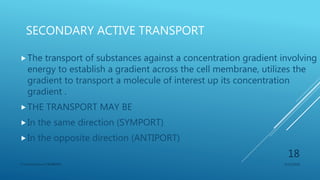
SECONDARY ACTIVE TRANSPORT
The transport of substances against a concentration gradient involving
energy to establish a gradient across the cell membrane, utilizes the
gradient to transport a molecule of interest up its concentration
gradient .
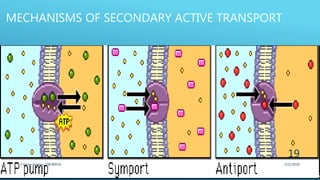
THE TRANSPORT MAY BE
In the same direction (SYMPORT)
In the opposite direction (ANTIPORT)
3/11/2018Y.Vamsi Krishna 17BCB0054
18
MECHANISMS OF SECONDARY ACTIVE TRANSPORT
3/11/2018Y.Vamsi Krishna 17BCB0054
19
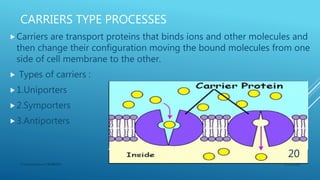
CARRIERS TYPE PROCESSES
Carriers are transport proteins that binds ions and other molecules and
then change their configuration moving the bound molecules from one
side of cell membrane to the other.
 Types of carriers :
1.Uniporters
2.Symporters
3.Antiporters
3/11/2018Y.Vamsi Krishna 17BCB0054
20
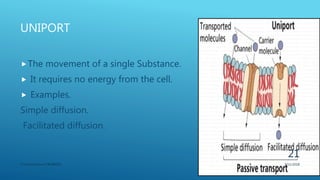
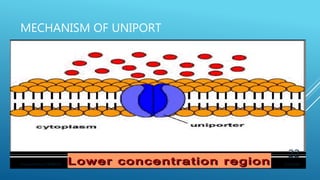
UNIPORT
The movement of a single Substance.
 It requires no energy from the cell.
 Examples.
Simple diffusion.
Facilitated diffusion.
3/11/2018Y.Vamsi Krishna 17BCB0054
21
MECHANISM OF UNIPORT
3/11/2018Y.Vamsi Krishna 17BCB0054
22
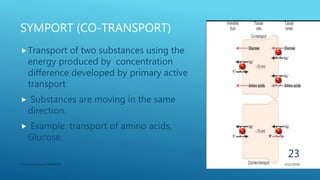
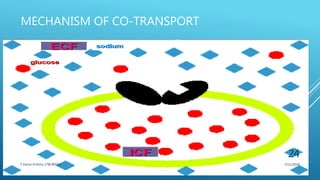
SYMPORT (CO-TRANSPORT)
Transport of two substances using the
energy produced by concentration
difference developed by primary active
transport
 Substances are moving in the same
direction.
 Example: transport of amino acids,
Glucose,
3/11/2018Y.Vamsi Krishna 17BCB0054
23
MECHANISM OF CO-TRANSPORT
3/11/2018Y.Vamsi Krishna 17BCB0054
24
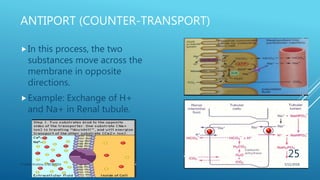
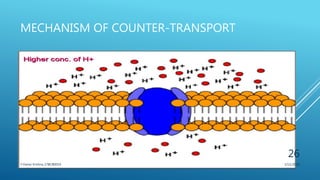
ANTIPORT (COUNTER-TRANSPORT)
In this process, the two
substances move across the
membrane in opposite
directions.
Example: Exchange of H+
and Na+ in Renal tubule.
3/11/2018Y.Vamsi Krishna 17BCB0054
25
MECHANISM OF COUNTER-TRANSPORT
3/11/2018Y.Vamsi Krishna 17BCB0054
26
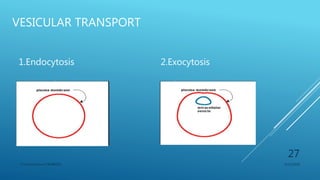
VESICULAR TRANSPORT
1.Endocytosis 2.Exocytosis
3/11/2018Y.Vamsi Krishna 17BCB0054
27
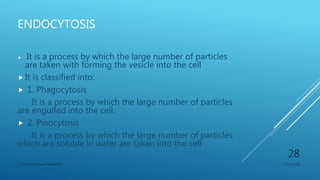
ENDOCYTOSIS
 It is a process by which the large number of particles
are taken with forming the vesicle into the cell
 It is classified into:
 1. Phagocytosis
It is a process by which the large number of particles
are engulfed into the cell.
 2. Pinocytosis
It is a process by which the large number of particles
which are soluble in water are taken into the cell
3/11/2018Y.Vamsi Krishna 17BCB0054
28
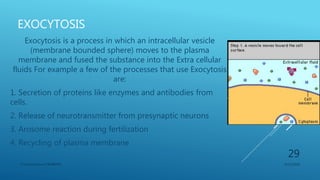
EXOCYTOSIS
Exocytosis is a process in which an intracellular vesicle
(membrane bounded sphere) moves to the plasma
membrane and fused the substance into the Extra cellular
fluids For example a few of the processes that use Exocytosis
are:
1. Secretion of proteins like enzymes and antibodies from
cells.
2. Release of neurotransmitter from presynaptic neurons
3. Arosome reaction during fertilization
4. Recycling of plasma membrane
3/11/2018Y.Vamsi Krishna 17BCB0054
29
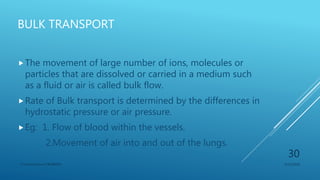
BULK TRANSPORT
The movement of large number of ions, molecules or
particles that are dissolved or carried in a medium such
as a fluid or air is called bulk flow.
Rate of Bulk transport is determined by the differences in
hydrostatic pressure or air pressure.
Eg: 1. Flow of blood within the vessels.
2.Movement of air into and out of the lungs.
3/11/2018Y.Vamsi Krishna 17BCB0054
30
Active transport
Energy is utilised
Movement of ions takes
place against conc. gradient
Specific carrier is required
Cellular respiratory rate is
high
Enzymes are involved
Passive transport
No Energy is utilised
Movement of ions takes
place favouring conc.
gradient
No carrier is required
No change
No Enzymes are involved
3/11/2018Y.Vamsi Krishna 17BCB0054
31
3/11/2018Y.Vamsi Krishna 17BCB0054
32
3/11/2018Y.Vamsi Krishna 17BCB0054
33

Transport across cell membrane

  • 1.
    TRANSPORT ACROSS CELL MEMBRANE Name:Y.Vamsi Krishna Reg No :17BCB0054 3/11/2018Y.Vamsi Krishna 17BCB0054 1
  • 2.
    CELL MEMBRANE 1.All cellshave a cell membrane 2. Functions: a.Controls what enters and exits the cell to maintain an internal balance called homeostasisb. Provides protection 3/11/2018Y.Vamsi Krishna 17BCB0054 2
  • 3.
    FUNCTIONS OF CELLMEMBRANE:  Protective Function  Selective permeability  Absorptive function  Excretory function  Exchange of gases  Maintenance of shape and size of the cell 3/11/2018Y.Vamsi Krishna 17BCB0054 3
  • 4.
    TRANSPORT – WHATIT MEANS?  Its highly selective filter, Its highly selective filter, permits nutrients and permits nutrients and leaves the waste products leaves the waste products from the cell. from the cell.  Maintain Homeostasis. Maintain Homeostasis.  Makes Cytosol Makes Cytosol environment to different environment to different  Play an important role in Play an important role in cell to cell communication. cell to cell communication. 3/11/2018Y.Vamsi Krishna 17BCB0054 4
  • 5.
    TRANSPORT MECHANISMS Active process Primary Transport  Secondary Transport Passive process  Simple diffusion Simple diffusion  Facilitated diffusion Facilitated diffusion  Osmosis Osmosis  Bulk flow Bulk flow  Filtration 3/11/2018Y.Vamsi Krishna 17BCB0054 5
  • 6.
    PASSIVE TRANSPORT cell doesn’tuse energy 1. Diffusion 2. Facilitated Diffusion 3.Osmosis 3/11/2018Y.Vamsi Krishna 17BCB0054 6
  • 7.
  • 8.
    FACTORS THAT INFLUENCEDIFFUSION RATES  Distance – The shorter the distance, the more quickly [ ] gradients are eliminated Few cells are father than 125 microns from a blood vessel  Molecular Size Ions and small molecules diffuse more rapidly  Temperature – ↑ temp., ↑ motion of particles  Steepness of concentrated gradient – The larger the [ ] gradient, the faster diffusion proceeds  Membrane surface area – The larger the area,the faster diffusion proceeds 3/11/2018Y.Vamsi Krishna 17BCB0054 8
  • 9.
    DIFFUSION ACROSS MEMBRANES SimpleDiffusion  Lipophilic substances can enter cells easily because they diffuse through the lipid portion of the membrane  Examples are fatty acids, steroids, alcohol, oxygen, carbon dioxide, and urea, Channel-Mediated Diffusion  Membrane channels are transmembrane proteins .Only 0.8 nm in diameter  Used by ions, very small water-soluble compounds  Much more complex than simple diffusion 3/11/2018Y.Vamsi Krishna 17BCB0054 9
  • 10.
    DIFFUSION THROUGH THEPLASMA MEMBRANE 3/11/2018Y.Vamsi Krishna 17BCB0054 10
  • 11.
    OSMOSIS Osmosis is theprocess of moving water across a semi permeable membrane towards ion or solut 3/11/2018Y.Vamsi Krishna 17BCB0054 11
  • 12.
    OSMOSIS AND CELLS Important because large volume changes caused by water movement disrupt normal cell function  Cell shrinkage or swelling Isotonic: cell neither shrinks nor swells Hypertonic: cell shrinks (crenation) Hypotonic: cell swells (lysis) 3/11/2018Y.Vamsi Krishna 17BCB0054 12
  • 13.
    ACTIVE TRANSPORT cell doesuse energy 1. Endocytosis 2. Exocytosis 3. Protein Pumps 3/11/2018Y.Vamsi Krishna 17BCB0054 13
  • 14.
    WHAT IS ACTIVETRANSPORT ?  Active transport is the Active transport is the transport of substances from transport of substances from a region of lower a region of lower concentration to higher concentration to higher concentration using energy, concentration using energy, usually in the form of usually in the form of ATP ATP. .  Examples: Na, K and Ca Examples: Na, K and Ca active transport. active transport.  1.sodium-potassium pump  2.Calcium pump  3.Potassium hydrogen pump 3/11/2018Y.Vamsi Krishna 17BCB0054 14
  • 15.
    ACTIVE TRANSPORT NEEDEDFOR 1. Maintaining the 1. Maintaining the Chemical and Electrical Chemical and Electrical Charge at rest. Charge at rest. 2. Intake of Substances through gated Channels. 3. Collecting of ions with more concentration 3/11/2018Y.Vamsi Krishna 17BCB0054 15
  • 16.
    ACTIVE TRANSPORT -WHY ? Cells cannot rely solely on passive movement of substances across their membranes. In many instances, it is necessary to move substances against their electrical or chemical gradient to maintain the appropriate concentrations inside of the cell or organelle. 3/11/2018Y.Vamsi Krishna 17BCB0054 16
  • 17.
    PUMPS INVOLVED INACTIVE TRANSPORT 1.Sodium-potassium pump Found in many cells 2.Calcium pump Found in membrane of Sarcoplasmic reticulum 3.Potassium hydrogen pump Found in Gastrointestine cell membrane 3/11/2018Y.Vamsi Krishna 17BCB0054 17
  • 18.
    SECONDARY ACTIVE TRANSPORT Thetransport of substances against a concentration gradient involving energy to establish a gradient across the cell membrane, utilizes the gradient to transport a molecule of interest up its concentration gradient . THE TRANSPORT MAY BE In the same direction (SYMPORT) In the opposite direction (ANTIPORT) 3/11/2018Y.Vamsi Krishna 17BCB0054 18
  • 19.
    MECHANISMS OF SECONDARYACTIVE TRANSPORT 3/11/2018Y.Vamsi Krishna 17BCB0054 19
  • 20.
    CARRIERS TYPE PROCESSES Carriersare transport proteins that binds ions and other molecules and then change their configuration moving the bound molecules from one side of cell membrane to the other.  Types of carriers : 1.Uniporters 2.Symporters 3.Antiporters 3/11/2018Y.Vamsi Krishna 17BCB0054 20
  • 21.
    UNIPORT The movement ofa single Substance.  It requires no energy from the cell.  Examples. Simple diffusion. Facilitated diffusion. 3/11/2018Y.Vamsi Krishna 17BCB0054 21
  • 22.
  • 23.
    SYMPORT (CO-TRANSPORT) Transport oftwo substances using the energy produced by concentration difference developed by primary active transport  Substances are moving in the same direction.  Example: transport of amino acids, Glucose, 3/11/2018Y.Vamsi Krishna 17BCB0054 23
  • 24.
  • 25.
    ANTIPORT (COUNTER-TRANSPORT) In thisprocess, the two substances move across the membrane in opposite directions. Example: Exchange of H+ and Na+ in Renal tubule. 3/11/2018Y.Vamsi Krishna 17BCB0054 25
  • 26.
  • 27.
  • 28.
    ENDOCYTOSIS  It isa process by which the large number of particles are taken with forming the vesicle into the cell  It is classified into:  1. Phagocytosis It is a process by which the large number of particles are engulfed into the cell.  2. Pinocytosis It is a process by which the large number of particles which are soluble in water are taken into the cell 3/11/2018Y.Vamsi Krishna 17BCB0054 28
  • 29.
    EXOCYTOSIS Exocytosis is aprocess in which an intracellular vesicle (membrane bounded sphere) moves to the plasma membrane and fused the substance into the Extra cellular fluids For example a few of the processes that use Exocytosis are: 1. Secretion of proteins like enzymes and antibodies from cells. 2. Release of neurotransmitter from presynaptic neurons 3. Arosome reaction during fertilization 4. Recycling of plasma membrane 3/11/2018Y.Vamsi Krishna 17BCB0054 29
  • 30.
    BULK TRANSPORT The movementof large number of ions, molecules or particles that are dissolved or carried in a medium such as a fluid or air is called bulk flow. Rate of Bulk transport is determined by the differences in hydrostatic pressure or air pressure. Eg: 1. Flow of blood within the vessels. 2.Movement of air into and out of the lungs. 3/11/2018Y.Vamsi Krishna 17BCB0054 30
  • 31.
    Active transport Energy isutilised Movement of ions takes place against conc. gradient Specific carrier is required Cellular respiratory rate is high Enzymes are involved Passive transport No Energy is utilised Movement of ions takes place favouring conc. gradient No carrier is required No change No Enzymes are involved 3/11/2018Y.Vamsi Krishna 17BCB0054 31
  • 32.
  • 33.