Presented by: Shubham Sharma
Pharmaceutical Chemistry
Roll no. : 20029
Presented to : Dr. Ranju Bansal
Professor ,UIPS, Panjab
University
CONTENTS
 INTRODUCTION
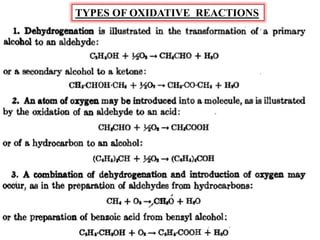
 TYPES OF OXIDATIVE REACTIONS
 NON-METALLIC OXIDIZING AGENTS
 LIQUID PHASE OXIDATION
TYPES OF OXIDATIVE REACTIONS
NON METALLIC OXIDIZING
AGENTS
• Non-metals act as oxidizing agent because
they tend to accept electrons i.e. reduction.
The substance which itself gets reduced by
causing oxidation of others is an oxidizing
agent, e.g., nonmetals.
Hydrogen peroxide
H2O2
Pure form, it is a pale blue, clear liquid,
slightly more
Hydrogen
viscous
peroxide
than water.
is the
simplest peroxide (a compound with an
oxygen–oxygen single bond). It is used
as an oxidizer, bleaching agent and
antiseptic.
Concentrated hydrogen peroxide, or
"high-test peroxide", is a reactive
oxygen species and has been used as a
propellant in rocketry. Its chemistry is
dominated by the nature of its unstable
peroxide bond.
PRODUCTION
• Previously, hydrogen peroxide was prepared industrially by hydrolysis of
ammonium persulfate, which was itself obtained by the electrolysis of a
solution of ammonium bisulfate (NH4HSO4) in sulfuric acid.
• Today, hydrogen peroxide is manufactured almost exclusively by the
anthraquinone process, which was formalized in 1936 and patented in 1939.
It begins with the reduction of an anthraquinone (such as 2-
ethylanthraquinone or the 2-amyl derivative) to the corresponding anthra
hydroquinone, typically by hydrogenation on a palladium catalyst. In the
presence of oxygen, the anthrahydroquinone then undergoes autoxidation:
the labile hydrogen atoms of the hydroxy groups transfer to the oxygen
molecule, to give hydrogen peroxide and regenerating the anthraquinone.
Most commercial processes achieve oxidation by bubbling compressed air
through a solution of the anthrahydroquinone, with the hydrogen peroxide
then extracted from the solution and the anthraquinone recycled back for
successive cycles of hydrogenation and oxidation.
The simplified overall equation for the process is simple.
• The economics of the process depend heavily on effective recycling of the
extraction solvents, the hydrogenation catalyst and the expensivequinone.
• A process to produce hydrogen peroxide directly from the elements has been of
interest for many years. Direct synthesis is difficult to achieve, as the reaction of
hydrogen with oxygen thermodynamically favours production of water. Systems for
direct synthesis have been developed, most of which are based around finely
dispersed metal catalysts similar to those used for hydrogenation of organic
substrates.None of these has yet reached a point where they can be used for industrial-
scale synthesis.
• Hydrogen Peroxide is one of the most powerful oxidizers known stronger
than chlorine, chlorine dioxide, and potassium permanganate. And
through catalysis, H2O2 can be converted into hydroxyl radicals (.OH)
with reactivity second only to fluorine.
• While hydrogen peroxide will oxidize free cyanide, it is common to
catalyze the reaction with a transition metal such as soluble copper,
vanadium, tungsten or silver in concentrations of 5 to 50 mg/L.
• Peroxymonosulfuric acid (Caro’s acid; H2SO5) is an equilibrium product
formed from hydrogen peroxide and sulfuric acid. With Caro’s acid, the
conversion of cyanide to cyanate is complete in a few minutes, according
to the above equation:
• Hydrogen peroxide in both acidic and basic medium acts as an
oxidizing as well as the reducing agent. The following reactions
will give a clear picture:
• Hydrogen peroxide can be used to quickly oxidize soluble ferrous
iron to ferric (Fe+3), forming a rapidly settling ferric hydroxide
floc. The resulting floc can be removed with filtering or a clarifier.
This reaction is shown below:
• Hydrogen peroxide reacts with hydrogen sulfide under acid, neutral and
alkaline conditions. The reaction is accelerated by increasing temperature
and/or the addition of catalysts such as iron. The stoichiometry is also
affected by pH. Under acidic or neutral conditions the reaction with
hydrogen peroxide produces sulfur and water:
• In alkaline solution (> pH8), the dominant reaction is:
• Mercaptans and dialkyl sulfides present in number of refinery products
undergo oxidation under acidic conditions according to the equation given
below:
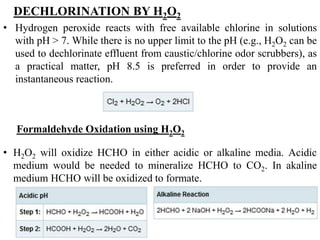
DECHLORINATION BY H2O2
• Hydrogen peroxide reacts with free available chlorine in solutions
with pH > 7. While there is no upper limit to the pH (e.g., H2O2 can be
used to dechlorinate effluent from caustic/chlorine odor scrubbers), as
a practical matter, pH 8.5 is preferred in order to provide an
instantaneous reaction.
Formaldehyde Oxidation using H2O2
• H2O2 will oxidize HCHO in either acidic or alkaline media. Acidic
medium would be needed to mineralize HCHO to CO2. In akaline
medium HCHO will be oxidized to formate.
THIOETHERS TO
SULFOXIDES
• Hydrogen peroxide is frequently
an oxidizing agent. Illustrative is
used as
oxidation
of thioethers to sulfoxides.
• Alkaline hydrogen peroxide is used for
epoxidation of electron-deficient alkenes such as
acrylic acid derivatives, and for the oxidation of
alkylboranes to alcohols, the second step of
hydroboration-oxidation. It is also the principal
reagent in the Dakin oxidation process.
• Hydrogen peroxide
forming hydroperoxide
many metals.
is a weak
or peroxide salts
acid,
with
corresponding peroxides. For example,
• It also converts metal oxides into the
upon
treatment with hydrogen peroxide, chromic acid
forms an unstable blue peroxide CrO(O2)2.
• This kind of reaction is used industrially to
produce peroxoanions. For example, reaction with
borax leads to sodium perborate, a bleach used in
laundry detergents:
USES
• Bleaching
• Detergents
• Production of organic compounds
• Disinfectant
• Cosmetic applications
• Use in alternative medicine
• Propellant
• Other uses-Glow sticks
Horticulture
Fish aeration
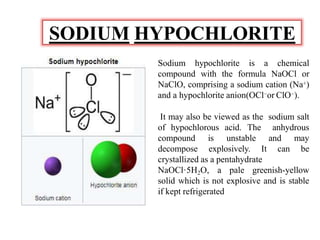
SODIUM HYPOCHLORITE
Sodium hypochlorite is a chemical
compound with the formula NaOCl or
NaClO, comprising a sodium cation (Na+)
and a hypochlorite anion(OCl−or ClO−).
It may also be viewed as the sodium salt
of hypochlorous acid. The anhydrous
compound is unstable and may
decompose explosively. It can be
crystallized as a pentahydrate
NaOCl·5H2O, a pale greenish-yellow
solid which is not explosive and is stable
if kept refrigerated
OXIDATION OF
ORGANIC COMPOUNDS
• Oxidation of starch by sodium hypochlorite, that adds carbonyl
and carboxyl groups, is relevant to the production of modified
starch products.
• In the presence of a phase-transfer catalyst, alcohols are
oxidized to the corresponding carbonyl compound (aldehyde or
ketone). Sodium hypochlorite can also oxidize organic sulfides
to sulfoxides or sulfones,
disulfides or thiols to sulfonylchlorides or bromides, imines to
oxaziridines.It can also de-aromatize phenols.
OXIDATION OF METALS AND COMPLEXES
• Heterogeneous reactions of sodium hypochlorite and metals such as zinc proceed
slowly to give the metal oxide or hydroxide.
NaOCl + Zn → ZnO + NaCl
• Homogeneous reactions with metal coordination complexes proceed somewhat
faster. This has been exploited in the Jacobsen epoxidation.
Other reactions
• If not properly stored in airtight containers, sodium hypochlorite reacts with carbon
dioxide to form sodium carbonate.
2 NaOCl (aq) + CO2 (g) → Na2CO3 (aq) + Cl2 (g)
• Sodium hypochlorite reacts with most nitrogen compounds to form volatile
chloramines, dichloramines, and nitrogen trichloride
• NH3 + NaClO → NH2Cl + NaOH
• NH2Cl + NaClO → NHCl2 + NaOH
• NHCl2 + NaClO → NCl3 +NaOH
PRODUCTION
Chlorination of soda
• Potassium hypochlorite was first produced in 1789 by
Claude Louis Berthollet in his laboratory on the Quai de
Javel in Paris, France, by passing chlorine gas through a
solution of potash lye. The resulting liquid, known as "Eau
de Javel" ("Javel water"), was a weak solution of
potassium hypochlorite. Antoine Labarraque replaced
potash lye by the cheaper soda lye, thus obtaining sodium
hypochlorite (Eau de Labarraque).
Cl2 (g) + 2 NaOH (aq) → NaCl (aq) + NaClO (aq) + H2O(aq)
ELECTROLYSIS OF BRINE
• Near the end of the nineteenth century, E. S. Smith
patented the chloralkali process: a method of producing
sodium hypochlorite involving the electrolysis of brine to
produce sodium hydroxide and chlorine gas, which then mixed
to form sodium hypochlorite.The key reactions are:
2 Cl− → Cl2 + 2 e− (at the anode)
2 H2O + 2 e− → H2 + 2 HO− (at the cathode)
From ozone and salt
• Sodium hypochlorite can be easily produced for research
purposes by reacting ozone with salt.
NaCl + O3 → NaClO + O2
• This reaction happens at room temperature and can be
helpful for oxidizing alcohols.
USES
• Bleaching
• Cleaning
• Disinfection
• Deodorizing
• Waste water treatment
• Endodontics
• Nerve agent neutralization
• Reduction of skin damage
OXYGEN GAS
•Oxygen is the chemical element with the
symbol O and atomic number 8. It is a
member of the chalcogen group on the
periodic table, a highly
reactive nonmetal, and an oxidizing agent
that readily forms oxides with most elements
as well as with other compounds.
•By mass, oxygen is the third-mostabundant
element in the
after hydrogen and helium. At
universe,
standard
temperature and pressure, two atoms of the
element bind to form dioxygen, a colorless
and odorless diatomic gas with the formula
O2. Diatomic oxygen gas constitutes 20.8%
of the Earth's atmosphere. As compounds
including oxides, the element makes up
almost half of the Earth's crust.
INDUSTRIAL PRODUCTION
• One hundred million tonnes of O2 are extracted from
air for industrial uses annually by two primary
methods.
• The most common method is fractional distillation of
liquefied air, with N2 distilling as a vapor while O2 is
left as a liquid.
• The other primary method of producing O2 is passing a
stream of clean, dry air through one bed of a pair of
identical zeolite molecular sieves, which absorbs the
nitrogen and delivers a gas stream that is 90% to 93%
O2.
• Oxygen gas can also be produced through
electrolysis of water into molecular oxygen and
hydrogen.
• DC electricity must be used: if AC is used, the
gases in each limb consist of hydrogen and
oxygen in the explosive ratio 2:1.
• A similar
electrocatalytic
and oxoacids.
method
O2 evolution
is the
from oxides
•Chemical catalysts can be
used as well, such as in
chemical oxygen generators
or oxygen candles that are
used as part of the life-
support equipment on
submarines, and are still part
of standard equipment on
commercial airliners in case
of depressurization
emergencies.
•Another air separation method is forcing air to dissolve through
ceramic membranes based on zirconium dioxide by either high
pressure or an electric current, to produce nearly pure O2 gas.
APPLICATIONS
of iron
• Smelting
ore into steel consumes
55% of commercially
produced oxygen.[In this
process, O2 is injected
through a high-pressure
lance into molten iron,
which
removes sulfur impurities
and excess carbon as the
respective
oxides, SO2 and CO2. The
reactions are exothermic,
so the temperature
increases to 1,700 °C.
• Another 25% of commercially produced oxygen is used
by the chemical industry. Ethylene is reacted with O2 to
create ethylene oxide, which, in turn, is converted into
ethylene glycol; the primary feeder material used to
manufacture a host of products,
including antifreeze and polyester polymers (the
precursors of many plastics and fabrics).
• Most of the remaining 20% of commercially produced
oxygen is used in medical applications, metal cutting and
welding, as an oxidizer in rocket fuel, and in water
treatment. Oxygen is used in oxyacetylene welding
burning acetylene with O2 to produce a very hot flame. In
this process, metal up to 60 cm (24 in) thick is first heated
with a small oxy-acetylene flame and then quickly cut by
a large stream of O2.
OZONOLYSIS
Ozonolysis was invented by Christian Friedrich Schönbein in
1840.Ozonolysis refers to the organic chemical reaction where
ozone is employed to cleave the unsaturated bonds of alkenes,
alkynes, and azo compounds (compounds with the functional
diazenyl functional group).
1. Oxidation of alkenes with the help of ozone can give
alcohols, aldehydes, ketones, or carboxylic acids.
2. Alkynes undergo ozonolysis to give diketones. If water is
present in the reaction, the diketone undergoes hydrolysis to
yield two carboxylic acids.
3. For azo compounds, the ozonolysis yields nitrosamines.
 Electrophillic addition
of ozone to the carbon
carbon bond forms the
molozonide
intermediate.
•
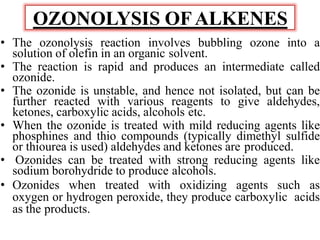
OZONOLYSIS OFALKENES
• The ozonolysis reaction involves bubbling ozone into a
solution of olefin in an organic solvent.
• The reaction is rapid and produces an intermediate called
ozonide.
• The ozonide is unstable, and hence not isolated, but can be
further reacted with various reagents to give aldehydes,
ketones, carboxylic acids, alcohols etc.
• When the ozonide is treated with mild reducing agents like
phosphines and thio compounds (typically dimethyl sulfide
or thiourea is used) aldehydes and ketones are produced.
• Ozonides can be treated with strong reducing agents like
sodium borohydride to produce alcohols.
• Ozonides when treated with oxidizing agents such as
oxygen or hydrogen peroxide, they produce carboxylic acids
as the products.
An example is the ozonolysis of eugenol converting the
terminal alkene to an aldehyde.
OZONOLYSIS OFALKYNES
 Alkynes also undergo ozonolysis but very slowly compared to
alkenes.
 Unlike alkenes, ozonides from alkynes do not need either an oxidizing
agent or reducing agent to provide end products.
 Ozonides from alkynes upon treatment with water provide carboxylic
acids are products.
 Internal alkynes produce two different carboxylic acids while terminal
alkynes produce carboxylic acid with one less carbon; the terminal
carbon is converted to carbon dioxide.
OZONOLYSIS OF ALKANES
Alkanes get oxidized when treated with ozone. The
products formed are alcohols, aldehydes/ketones or
carboxylic acids. The rate of oxidative cleavage of alkanes
is highest for tertiary C-H bond, followed secondary and
primary.
OZONOLYSIS OF ELASTOMERS
 Ozone cracking is a form of
stress corrosion cracking where
active chemical species attack
products of a susceptible
material. Ozone cracking was
once commonly seen in the
sidewalls of tires but is now rare
owing to the use of
antiozonants. Other means of
prevention include replacing
susceptible rubbers with
resistant elastomers such as
polychloroprene, EPDM or
viton.
OZONOLYSIS IN INDUSTRY
• Ozonolysis has been used frequently in major drug
synthesis such as (+)-artemisinin, indolizidine 251F and
D,L-camptothecin, as well as in fine chemical
synthesis such as L- isoxazolylalanine and prostaglandin
endoperoxides
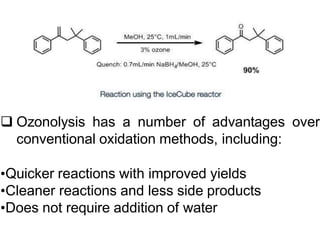
• ThalesNano has developed the IceCube reactor to
overcome these disadvantages. When combined with the
ozone module, ozonolysis can be performed in a safe
and highly controlled manner.
 Ozonolysis has a number of advantages over
conventional oxidation methods, including:
•Quicker reactions with improved yields
•Cleaner reactions and less side products
•Does not require addition of water
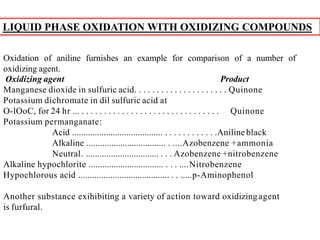
Oxidation of aniline furnishes an example for comparison of a number of
oxidizing agent.
Oxidizing agent Product
Manganese dioxide in sulfuric acid. . . . . . . . . . . . . . . . . . . . . Quinone
Potassium dichromate in dil sulfuric acid at
O-lOoC, for 24 hr ... . . . . . . . . . . . . . . . . . . . . . . . . . . . . . . . Quinone
Potassium permanganate:
Acid ........................................ . . . . . . . . . . . .Aniline black
Alkaline ................................... . ....Azobenzene +ammonia
Neutral. ................................ . . . Azobenzene +nitrobenzene
Alkaline hypochlorite ................................. . . . ....Nitrobenzene
Hypochlorous acid ........................................ . . .....p-Aminophenol
Another substance exihibiting a variety of action toward oxidizing agent
is furfural.
LIQUID PHASE OXIDATION WITH OXIDIZING COMPOUNDS
Mesotartaric acid
REFERENCE
 GROGGINS, P.H. (1983) UNIT PROCESSES IN ORGANIC
SYNTHESIS , PUBLISHED BY MCGRAW. HILL
KOGAKUSHA, LTD. ; 5TH EDITION ; CHAPTER NO. 9
(OXIDATION) ; PP 486-549.

OXIDATION ,PROCESS CHEMISTRY ,MPHARM

  • 1.
    Presented by: ShubhamSharma Pharmaceutical Chemistry Roll no. : 20029 Presented to : Dr. Ranju Bansal Professor ,UIPS, Panjab University
  • 2.
    CONTENTS  INTRODUCTION  TYPESOF OXIDATIVE REACTIONS  NON-METALLIC OXIDIZING AGENTS  LIQUID PHASE OXIDATION
  • 4.
  • 9.
    NON METALLIC OXIDIZING AGENTS •Non-metals act as oxidizing agent because they tend to accept electrons i.e. reduction. The substance which itself gets reduced by causing oxidation of others is an oxidizing agent, e.g., nonmetals.
  • 10.
    Hydrogen peroxide H2O2 Pure form,it is a pale blue, clear liquid, slightly more Hydrogen viscous peroxide than water. is the simplest peroxide (a compound with an oxygen–oxygen single bond). It is used as an oxidizer, bleaching agent and antiseptic. Concentrated hydrogen peroxide, or "high-test peroxide", is a reactive oxygen species and has been used as a propellant in rocketry. Its chemistry is dominated by the nature of its unstable peroxide bond.
  • 11.
    PRODUCTION • Previously, hydrogenperoxide was prepared industrially by hydrolysis of ammonium persulfate, which was itself obtained by the electrolysis of a solution of ammonium bisulfate (NH4HSO4) in sulfuric acid. • Today, hydrogen peroxide is manufactured almost exclusively by the anthraquinone process, which was formalized in 1936 and patented in 1939. It begins with the reduction of an anthraquinone (such as 2- ethylanthraquinone or the 2-amyl derivative) to the corresponding anthra hydroquinone, typically by hydrogenation on a palladium catalyst. In the presence of oxygen, the anthrahydroquinone then undergoes autoxidation: the labile hydrogen atoms of the hydroxy groups transfer to the oxygen molecule, to give hydrogen peroxide and regenerating the anthraquinone. Most commercial processes achieve oxidation by bubbling compressed air through a solution of the anthrahydroquinone, with the hydrogen peroxide then extracted from the solution and the anthraquinone recycled back for successive cycles of hydrogenation and oxidation.
  • 12.
    The simplified overallequation for the process is simple. • The economics of the process depend heavily on effective recycling of the extraction solvents, the hydrogenation catalyst and the expensivequinone. • A process to produce hydrogen peroxide directly from the elements has been of interest for many years. Direct synthesis is difficult to achieve, as the reaction of hydrogen with oxygen thermodynamically favours production of water. Systems for direct synthesis have been developed, most of which are based around finely dispersed metal catalysts similar to those used for hydrogenation of organic substrates.None of these has yet reached a point where they can be used for industrial- scale synthesis.
  • 13.
    • Hydrogen Peroxideis one of the most powerful oxidizers known stronger than chlorine, chlorine dioxide, and potassium permanganate. And through catalysis, H2O2 can be converted into hydroxyl radicals (.OH) with reactivity second only to fluorine. • While hydrogen peroxide will oxidize free cyanide, it is common to catalyze the reaction with a transition metal such as soluble copper, vanadium, tungsten or silver in concentrations of 5 to 50 mg/L. • Peroxymonosulfuric acid (Caro’s acid; H2SO5) is an equilibrium product formed from hydrogen peroxide and sulfuric acid. With Caro’s acid, the conversion of cyanide to cyanate is complete in a few minutes, according to the above equation:
  • 14.
    • Hydrogen peroxidein both acidic and basic medium acts as an oxidizing as well as the reducing agent. The following reactions will give a clear picture: • Hydrogen peroxide can be used to quickly oxidize soluble ferrous iron to ferric (Fe+3), forming a rapidly settling ferric hydroxide floc. The resulting floc can be removed with filtering or a clarifier. This reaction is shown below:
  • 15.
    • Hydrogen peroxidereacts with hydrogen sulfide under acid, neutral and alkaline conditions. The reaction is accelerated by increasing temperature and/or the addition of catalysts such as iron. The stoichiometry is also affected by pH. Under acidic or neutral conditions the reaction with hydrogen peroxide produces sulfur and water: • In alkaline solution (> pH8), the dominant reaction is: • Mercaptans and dialkyl sulfides present in number of refinery products undergo oxidation under acidic conditions according to the equation given below:
  • 16.
    DECHLORINATION BY H2O2 •Hydrogen peroxide reacts with free available chlorine in solutions with pH > 7. While there is no upper limit to the pH (e.g., H2O2 can be used to dechlorinate effluent from caustic/chlorine odor scrubbers), as a practical matter, pH 8.5 is preferred in order to provide an instantaneous reaction. Formaldehyde Oxidation using H2O2 • H2O2 will oxidize HCHO in either acidic or alkaline media. Acidic medium would be needed to mineralize HCHO to CO2. In akaline medium HCHO will be oxidized to formate.
  • 17.
    THIOETHERS TO SULFOXIDES • Hydrogenperoxide is frequently an oxidizing agent. Illustrative is used as oxidation of thioethers to sulfoxides. • Alkaline hydrogen peroxide is used for epoxidation of electron-deficient alkenes such as acrylic acid derivatives, and for the oxidation of alkylboranes to alcohols, the second step of hydroboration-oxidation. It is also the principal reagent in the Dakin oxidation process.
  • 18.
    • Hydrogen peroxide forminghydroperoxide many metals. is a weak or peroxide salts acid, with corresponding peroxides. For example, • It also converts metal oxides into the upon treatment with hydrogen peroxide, chromic acid forms an unstable blue peroxide CrO(O2)2. • This kind of reaction is used industrially to produce peroxoanions. For example, reaction with borax leads to sodium perborate, a bleach used in laundry detergents:
  • 19.
    USES • Bleaching • Detergents •Production of organic compounds • Disinfectant • Cosmetic applications • Use in alternative medicine • Propellant • Other uses-Glow sticks Horticulture Fish aeration
  • 20.
    SODIUM HYPOCHLORITE Sodium hypochloriteis a chemical compound with the formula NaOCl or NaClO, comprising a sodium cation (Na+) and a hypochlorite anion(OCl−or ClO−). It may also be viewed as the sodium salt of hypochlorous acid. The anhydrous compound is unstable and may decompose explosively. It can be crystallized as a pentahydrate NaOCl·5H2O, a pale greenish-yellow solid which is not explosive and is stable if kept refrigerated
  • 21.
    OXIDATION OF ORGANIC COMPOUNDS •Oxidation of starch by sodium hypochlorite, that adds carbonyl and carboxyl groups, is relevant to the production of modified starch products. • In the presence of a phase-transfer catalyst, alcohols are oxidized to the corresponding carbonyl compound (aldehyde or ketone). Sodium hypochlorite can also oxidize organic sulfides to sulfoxides or sulfones, disulfides or thiols to sulfonylchlorides or bromides, imines to oxaziridines.It can also de-aromatize phenols.
  • 22.
    OXIDATION OF METALSAND COMPLEXES • Heterogeneous reactions of sodium hypochlorite and metals such as zinc proceed slowly to give the metal oxide or hydroxide. NaOCl + Zn → ZnO + NaCl • Homogeneous reactions with metal coordination complexes proceed somewhat faster. This has been exploited in the Jacobsen epoxidation. Other reactions • If not properly stored in airtight containers, sodium hypochlorite reacts with carbon dioxide to form sodium carbonate. 2 NaOCl (aq) + CO2 (g) → Na2CO3 (aq) + Cl2 (g) • Sodium hypochlorite reacts with most nitrogen compounds to form volatile chloramines, dichloramines, and nitrogen trichloride • NH3 + NaClO → NH2Cl + NaOH • NH2Cl + NaClO → NHCl2 + NaOH • NHCl2 + NaClO → NCl3 +NaOH
  • 23.
    PRODUCTION Chlorination of soda •Potassium hypochlorite was first produced in 1789 by Claude Louis Berthollet in his laboratory on the Quai de Javel in Paris, France, by passing chlorine gas through a solution of potash lye. The resulting liquid, known as "Eau de Javel" ("Javel water"), was a weak solution of potassium hypochlorite. Antoine Labarraque replaced potash lye by the cheaper soda lye, thus obtaining sodium hypochlorite (Eau de Labarraque). Cl2 (g) + 2 NaOH (aq) → NaCl (aq) + NaClO (aq) + H2O(aq)
  • 24.
    ELECTROLYSIS OF BRINE •Near the end of the nineteenth century, E. S. Smith patented the chloralkali process: a method of producing sodium hypochlorite involving the electrolysis of brine to produce sodium hydroxide and chlorine gas, which then mixed to form sodium hypochlorite.The key reactions are: 2 Cl− → Cl2 + 2 e− (at the anode) 2 H2O + 2 e− → H2 + 2 HO− (at the cathode) From ozone and salt • Sodium hypochlorite can be easily produced for research purposes by reacting ozone with salt. NaCl + O3 → NaClO + O2 • This reaction happens at room temperature and can be helpful for oxidizing alcohols.
  • 25.
    USES • Bleaching • Cleaning •Disinfection • Deodorizing • Waste water treatment • Endodontics • Nerve agent neutralization • Reduction of skin damage
  • 26.
    OXYGEN GAS •Oxygen isthe chemical element with the symbol O and atomic number 8. It is a member of the chalcogen group on the periodic table, a highly reactive nonmetal, and an oxidizing agent that readily forms oxides with most elements as well as with other compounds. •By mass, oxygen is the third-mostabundant element in the after hydrogen and helium. At universe, standard temperature and pressure, two atoms of the element bind to form dioxygen, a colorless and odorless diatomic gas with the formula O2. Diatomic oxygen gas constitutes 20.8% of the Earth's atmosphere. As compounds including oxides, the element makes up almost half of the Earth's crust.
  • 27.
    INDUSTRIAL PRODUCTION • Onehundred million tonnes of O2 are extracted from air for industrial uses annually by two primary methods. • The most common method is fractional distillation of liquefied air, with N2 distilling as a vapor while O2 is left as a liquid. • The other primary method of producing O2 is passing a stream of clean, dry air through one bed of a pair of identical zeolite molecular sieves, which absorbs the nitrogen and delivers a gas stream that is 90% to 93% O2.
  • 28.
    • Oxygen gascan also be produced through electrolysis of water into molecular oxygen and hydrogen. • DC electricity must be used: if AC is used, the gases in each limb consist of hydrogen and oxygen in the explosive ratio 2:1. • A similar electrocatalytic and oxoacids. method O2 evolution is the from oxides
  • 29.
    •Chemical catalysts canbe used as well, such as in chemical oxygen generators or oxygen candles that are used as part of the life- support equipment on submarines, and are still part of standard equipment on commercial airliners in case of depressurization emergencies. •Another air separation method is forcing air to dissolve through ceramic membranes based on zirconium dioxide by either high pressure or an electric current, to produce nearly pure O2 gas.
  • 30.
    APPLICATIONS of iron • Smelting oreinto steel consumes 55% of commercially produced oxygen.[In this process, O2 is injected through a high-pressure lance into molten iron, which removes sulfur impurities and excess carbon as the respective oxides, SO2 and CO2. The reactions are exothermic, so the temperature increases to 1,700 °C.
  • 31.
    • Another 25%of commercially produced oxygen is used by the chemical industry. Ethylene is reacted with O2 to create ethylene oxide, which, in turn, is converted into ethylene glycol; the primary feeder material used to manufacture a host of products, including antifreeze and polyester polymers (the precursors of many plastics and fabrics). • Most of the remaining 20% of commercially produced oxygen is used in medical applications, metal cutting and welding, as an oxidizer in rocket fuel, and in water treatment. Oxygen is used in oxyacetylene welding burning acetylene with O2 to produce a very hot flame. In this process, metal up to 60 cm (24 in) thick is first heated with a small oxy-acetylene flame and then quickly cut by a large stream of O2.
  • 32.
    OZONOLYSIS Ozonolysis was inventedby Christian Friedrich Schönbein in 1840.Ozonolysis refers to the organic chemical reaction where ozone is employed to cleave the unsaturated bonds of alkenes, alkynes, and azo compounds (compounds with the functional diazenyl functional group). 1. Oxidation of alkenes with the help of ozone can give alcohols, aldehydes, ketones, or carboxylic acids. 2. Alkynes undergo ozonolysis to give diketones. If water is present in the reaction, the diketone undergoes hydrolysis to yield two carboxylic acids. 3. For azo compounds, the ozonolysis yields nitrosamines.
  • 33.
     Electrophillic addition ofozone to the carbon carbon bond forms the molozonide intermediate.
  • 34.
  • 36.
    OZONOLYSIS OFALKENES • Theozonolysis reaction involves bubbling ozone into a solution of olefin in an organic solvent. • The reaction is rapid and produces an intermediate called ozonide. • The ozonide is unstable, and hence not isolated, but can be further reacted with various reagents to give aldehydes, ketones, carboxylic acids, alcohols etc. • When the ozonide is treated with mild reducing agents like phosphines and thio compounds (typically dimethyl sulfide or thiourea is used) aldehydes and ketones are produced. • Ozonides can be treated with strong reducing agents like sodium borohydride to produce alcohols. • Ozonides when treated with oxidizing agents such as oxygen or hydrogen peroxide, they produce carboxylic acids as the products.
  • 37.
    An example isthe ozonolysis of eugenol converting the terminal alkene to an aldehyde.
  • 38.
    OZONOLYSIS OFALKYNES  Alkynesalso undergo ozonolysis but very slowly compared to alkenes.  Unlike alkenes, ozonides from alkynes do not need either an oxidizing agent or reducing agent to provide end products.  Ozonides from alkynes upon treatment with water provide carboxylic acids are products.  Internal alkynes produce two different carboxylic acids while terminal alkynes produce carboxylic acid with one less carbon; the terminal carbon is converted to carbon dioxide.
  • 39.
    OZONOLYSIS OF ALKANES Alkanesget oxidized when treated with ozone. The products formed are alcohols, aldehydes/ketones or carboxylic acids. The rate of oxidative cleavage of alkanes is highest for tertiary C-H bond, followed secondary and primary.
  • 40.
    OZONOLYSIS OF ELASTOMERS Ozone cracking is a form of stress corrosion cracking where active chemical species attack products of a susceptible material. Ozone cracking was once commonly seen in the sidewalls of tires but is now rare owing to the use of antiozonants. Other means of prevention include replacing susceptible rubbers with resistant elastomers such as polychloroprene, EPDM or viton.
  • 41.
    OZONOLYSIS IN INDUSTRY •Ozonolysis has been used frequently in major drug synthesis such as (+)-artemisinin, indolizidine 251F and D,L-camptothecin, as well as in fine chemical synthesis such as L- isoxazolylalanine and prostaglandin endoperoxides • ThalesNano has developed the IceCube reactor to overcome these disadvantages. When combined with the ozone module, ozonolysis can be performed in a safe and highly controlled manner.
  • 42.
     Ozonolysis hasa number of advantages over conventional oxidation methods, including: •Quicker reactions with improved yields •Cleaner reactions and less side products •Does not require addition of water
  • 44.
    Oxidation of anilinefurnishes an example for comparison of a number of oxidizing agent. Oxidizing agent Product Manganese dioxide in sulfuric acid. . . . . . . . . . . . . . . . . . . . . Quinone Potassium dichromate in dil sulfuric acid at O-lOoC, for 24 hr ... . . . . . . . . . . . . . . . . . . . . . . . . . . . . . . . Quinone Potassium permanganate: Acid ........................................ . . . . . . . . . . . .Aniline black Alkaline ................................... . ....Azobenzene +ammonia Neutral. ................................ . . . Azobenzene +nitrobenzene Alkaline hypochlorite ................................. . . . ....Nitrobenzene Hypochlorous acid ........................................ . . .....p-Aminophenol Another substance exihibiting a variety of action toward oxidizing agent is furfural. LIQUID PHASE OXIDATION WITH OXIDIZING COMPOUNDS
  • 45.
  • 55.
    REFERENCE  GROGGINS, P.H.(1983) UNIT PROCESSES IN ORGANIC SYNTHESIS , PUBLISHED BY MCGRAW. HILL KOGAKUSHA, LTD. ; 5TH EDITION ; CHAPTER NO. 9 (OXIDATION) ; PP 486-549.