Organometallics in Organic Synthesis
1. So who cares (i.e., why?)
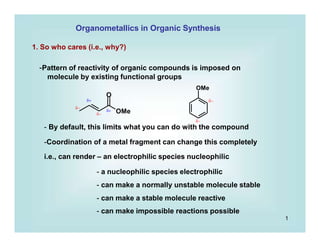
-Pattern of reactivity of organic compounds is imposed on
molecule by existing functional groups
OMe
O
OMe



 

- By default, this limits what you can do with the compound
-Coordination of a metal fragment can change this completely
i.e., can render – an electrophilic species nucleophilic
- a nucleophilic species electrophilic
- can make a normally unstable molecule stable
- can make a stable molecule reactive
- can make impossible reactions possible
1
The (Very) Basics of Organometallics
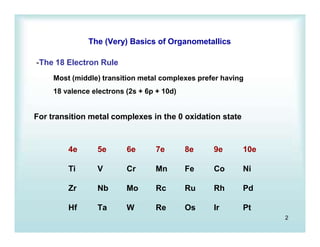
-The 18 Electron Rule
Most (middle) transition metal complexes prefer having
18 valence electrons (2s + 6p + 10d)
For transition metal complexes in the 0 oxidation state
4e 5e 6e 7e 8e 9e 10e
Ti V Cr Mn Fe Co Ni
Zr Nb Mo Rc Ru Rh Pd
Hf Ta W Re Os Ir Pt
2
Ti
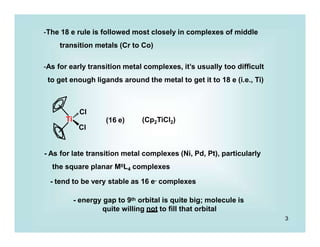
-The 18 e rule is followed most closely in complexes of middle
transition metals (Cr to Co)
-As for early transition metal complexes, it’s usually too difficult
to get enough ligands around the metal to get it to 18 e (i.e., Ti)
Cl
(16 e) (Cp2TiCl2)
Cl
- As for late transition metal complexes (Ni, Pd, Pt), particularly
the square planar MIIL4 complexes
- tend to be very stable as 16 e- complexes
- energy gap to 9th orbital is quite big; molecule is
quite willing not to fill that orbital
3
4
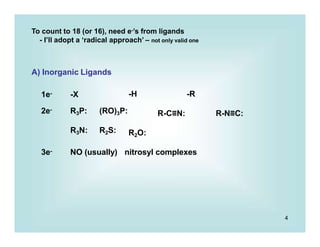
To count to 18 (or 16), need e-’s from ligands
- I’ll adopt a ‘radical approach’ – not only valid one
-H -R
R-C≡N: R-N≡C:
A) Inorganic Ligands
1e- -X
2e- R3P: (RO)3P:
R3N: R2S: R2O:
3e- NO (usually) nitrosyl complexes
5
M
C
C
M
C
C
M
M C
R
R
M
M C R
N
M
R
N
R
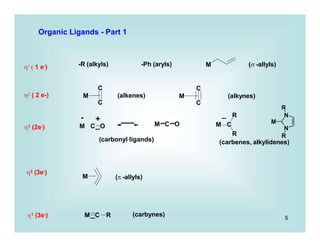
  1 e-) ( -allyls)
 ( 2 e-) (alkenes) (alkynes)
1 (2e-)
- +
M C O M C O
(carbonyl ligands) (carbenes, alkylidenes)
3 (3e-)
( -allyls)
1 (3e-) (carbynes)
-R (alkyls) -Ph (aryls)
Organic Ligands - Part 1
6
M
M
M
M M
M
M
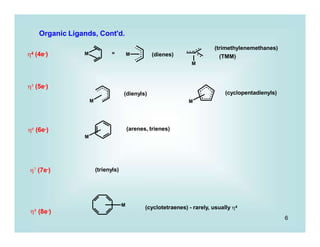
= (dienes)
(trimethylenemethanes)
(TMM)
4 (4e-)
Organic Ligands, Cont'd.
 (5e-)
(dienyls) (cyclopentadienyls)
 (6e-) (arenes, trienes)
 (7e-)
 -
(8e )
(trienyls)
(cyclotetraenes) - rarely, usually 4
7
Fe Cr
C
OC
C
O
O
OC
N
O
Fe
C
OC
C
O
O
Pd
3
Ph P Cl
Ph3P Cl
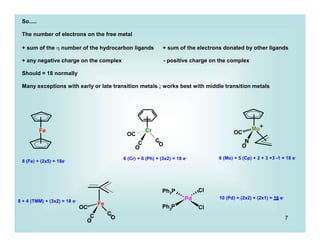
So.....
The number of electrons on the free metal
+ sum of the  number of the hydrocarbon ligands + sum of the electrons donated by other ligands
+ any negative charge on the complex - positive charge on the complex
Should = 18 normally
Many exceptions with early or late transition metals ; works best with middle transition metals
8 (Fe) + (2x5) = 18e- 6 (Cr) + 6 (Ph) + (3x2) = 18 e- 6 (Mo) + 5 (Cp) + 2 + 3 +3 -1 = 18 e-
8 + 4 (TMM) + (3x2) = 18 e-
10 (Pd) + (2x2) + (2x1) = 16 e-
Mo+
8
C
M
C
C
C
C
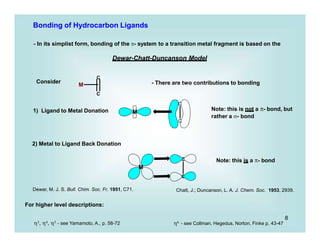
Bonding of Hydrocarbon Ligands
- In its simplist form, bonding of the - system to a transition metal fragment is based on the
Dewar-Chatt-Duncanson Model
C
Consider - There are two contributions to bonding
1) Ligand to Metal Donation M
Note: this is not a - bond, but
rather a - bond
2) Metal to Ligand Back Donation
M
Note: this is a - bond
Dewar, M. J. S. Bull. Chim. Soc. Fr. 1951, C71. Chatt, J.; Duncanson, L. A. J. Chem. Soc. 1953, 2939.
For higher level descriptions:
   - see Yamamoto, A., p. 58-72  - see Collman, Hegedus, Norton, Finke p. 43-47
9
Fe
C
OC
C
O
O
Fe
C C
CO
O
O
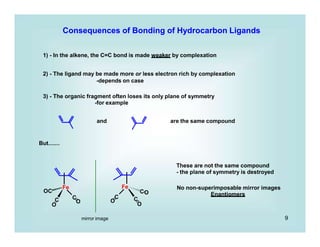
Consequences of Bonding of Hydrocarbon Ligands
1) - In the alkene, the C=C bond is made weaker by complexation
2) - The ligand may be made more or less electron rich by complexation
-depends on case
3) - The organic fragment often loses its only plane of symmetry
-for example
and are the same compound
But.......
mirror image
These are not the same compound
- the plane of symmetry is destroyed
No non-superimposable mirror images
Enantiomers
10
OMe
Cr
C
OC
C
O
O
MeO
Cr
C C
CO
O O
Ph
Pd
Ph2P PPh2
Ph
Pd
Ph2P PPh2
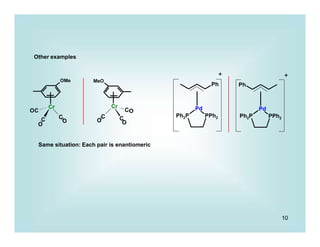
Other examples
+ +
Same situation: Each pair is enantiomeric
H Co(CO)4
SH OH
3
H C CH3
O
Basic Organometallic Reactions
There are several additional fundamental types of reactions in organometallic chemistry
The more complex reactions are normally some combination of these fundamental ones
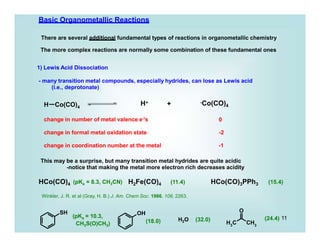
1) Lewis Acid Dissociation
- many transition metal compounds, especially hydrides, can lose as Lewis acid
(i.e., deprotonate)
H+ +
change in number of metal valence e-'s
-Co(CO)4
0
change in formal metal oxidation state -2
change in coordination number at the metal -1
This may be a surprise, but many transition metal hydrides are quite acidic
-notice that making the metal more electron rich decreases acidity
HCo(CO)4 (pKa = 8.3, CH3CN) H2Fe(CO)4 HCo(CO)3PPh3
(11.4) (15.4)
(pK = 10.3,
a
CH3S(O)CH3) (18.0) H2O (32.0) (24.4) 11
Winkler, J. R. et al (Gray, H. B.) J. Am. Chem Soc. 1986, 108, 2263.
12
2) Lewis Base Dissociation
Very, very, very..........common process
Fe(CO)5 Fe(CO)4 + CO
18e 16e
Pd(PPh3)4
+ PPh3
16e 14e
Pd(PPh3)3
change in number of metal valence e-'s -2
change in formal metal oxidation state 0
change in coordination number at the metal -1
-Reverse reaction: Lewis base Association
Obvious application are in ligand substitution processes,
which may be dissociative ('SN1 like')
Ni(CO)4
slow
Ni(CO)3 + CO
L
fast
LNi(CO)3
v = k [ Ni(CO)4] 1st order
Most common for 18 e- systems
13
Pt
X
Lc
Lt Lc
Pt
Lc
Lt
X
Lc
Y
Pt
Lt
Lc
X
Y
Lc
Pt
Lc
Lt
Y
Lc
X
Pt
Lc Y
Lt Lc
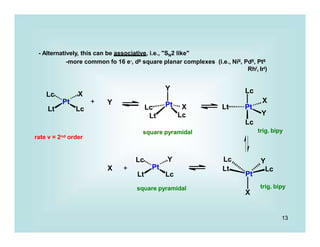
- Alternatively, this can be associative, i.e., "SN2 like"
-more common fo 16 e-, d8 square planar complexes (i.e., NiII, PdII, PtII
RhI, IrI)
+ Y
X +
rate v = 2nd order
square pyramidal
square pyramidal
trig. bipy
trig. bipy
14
Br
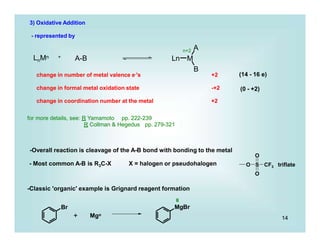
3) Oxidative Addition
- represented by
change in number of metal valence e-'s +2
change in formal metal oxidation state -+2
change in coordination number at the metal +2
(14 - 16 e)
(0 - +2)
LnMn + A-B
for more details, see: R Yamamoto pp. 222-239
R Collman & Hegedus pp. 279-321
-Overall reaction is cleavage of the A-B bond with bonding to the metal
- Most common A-B is R3C-X X = halogen or pseudohalogen
O
O S CF3 triflate
O
-Classic 'organic' example is Grignard reagent formation
+ Mgo
II
MgBr
n+2 A
Ln M
B
15
Br
Ph3P PPh3
Cl
Ph3P
Ir
Cl
3
Ph P
PPh
CO
3
CH3
Ir
Cl
Ph3P
PPh
CO
3
CH3
I
- Most common example in this course will be of the following type:
Pd(PPh3)4 2 PPh3 +
0
Pd(PPh3)2 +
II Br
Pd
i.e., Pdo/PdII , Feo/FeII, IrI/IrIII
.. PPh3
Ir
CO
rds
CH3-I
- Most is known about late transition metals (such as Ir, Ni groups)
A) If the R of R-X is alkyl (especially 1o or 2o), the reaction is believed to (usually) occur
via an SN2 substitution
+
fast
- Inversion at alkyl carbon has been observed
- Kinetics are overall 2nd order v = k [IrI] [CH3I]
- the 2nd step is the oxidative addition
Therefore, system needs: a) 2 available oxidation states
b) open coordination site
- Reverse reaction: Reductive Elimination
Mechanism
X
Pt
Ph3P PPh3
X Pt
3
Ph P
PPh3
X
Pd
X
P P
C
M
X
EWG
X
EWG
2
PdL2X
16
EWG
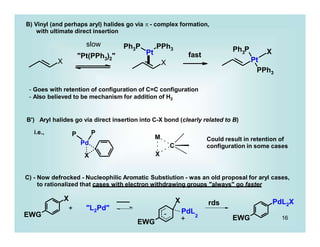
B) Vinyl (and perhaps aryl) halides go via  - complex formation,
with ultimate direct insertion
3 2
"Pt(PPh ) "
slow
fast
- Goes with retention of configuration of C=C configuration
- Also believed to be mechanism for addition of H2
B') Aryl halides go via direct insertion into C-X bond (clearly related to B)
i.e.,
Could result in retention of
configuration in some cases
C) - Now defrocked - Nucleophilic Aromatic Substiution - was an old proposal for aryl cases,
to rationalized that cases with electron withdrawing groups "always" go faster
X
+ "L2Pd" PdL
+
-
rds
17
Pd N
N
R
N R
R
Cl
Cl
Pd
N
N
R
R
Pd
N
N
R
R
Cl
Cl
Pd
R
N
N
R
N
R
+
C)' - much more likely and often detected in calculations is initial formation of an 2-benzene complex
D) - Electron transfer, radical mechanisms do exist (Ni, Mg)
i.e.
rds
[ LnM+ RX-.]
X
LnM
R
Ln + RX
[ LnM+ RX-.]
transition state
Green, J. C. J. Organomet. Chem. 2005, 690, 6054.
18
Br Li
3
Me P
Rh
3
Rh
Me P
H
H
Many new opinions on these matters:
R Hartwig, J. F. Synlett 2006, 1283.
R Espinet, P.; Echavarren, A. M. Angew. Chem. Int. Ed. Engl. 2004, 43, 4704.
R Jutand, A. Eur. J. Inorg. Chem. 2003, 2017.
Alcazar-Roman, L. M.; Luis, M.; Hartwig, J.F.; Rheingold, A. L.; Liable-Sands, L. M.; Guzei, I. A.
J. Am. Chem. Soc. 2000, 122, 4618. (chelate PR3)
Hartwig, J. F.; Paul, P. J. Am. Chem. Soc. 1995, 117, 5373 (monodentate PR3)
R Amatore, C.; Jutand, A. Acc. Chem. Res. 2000, 33, 314.
Lersh,M.; Tilset, M. J. Am. Chem. Soc. 2005, 127, 2471 (C-H activation).
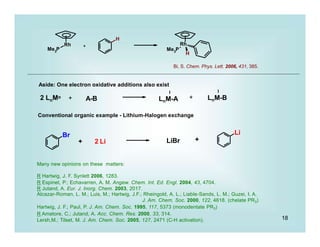
2 LnMo + A-B +
I
LnM-A
I
LnM-B
Conventional organic example - Lithium-Halogen exchange
+ 2 Li LiBr +
+
Bi, S. Chem. Phys. Lett. 2006, 431, 385.
Aside: One electron oxidative additions also exist
19
Pt
Ph3P
3
Ph P Pt
Ph P
3
Ph3P
B
A
3 2
+ "Pt(PPh ) "
transition state
-not an intermediate
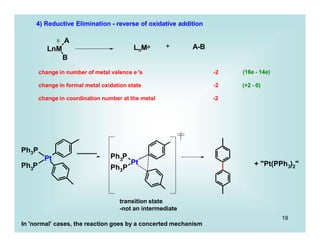
In 'normal' cases, the reaction goes by a concerted mechanism
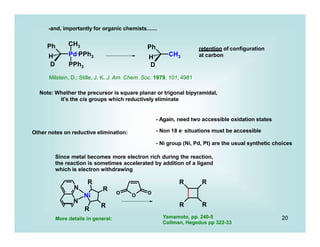
4) Reductive Elimination - reverse of oxidative addition
change in number of metal valence e-'s -2
change in formal metal oxidation state -2
change in coordination number at the metal -2
II
LnM
(16e - 14e)
(+2 - 0)
LnMo A-B
+
20
R
R
R
N
N
O
O O
R R R
Ni
Ph CH3
H Pd PPh3
D PPh3
CH3
Ph
H
D
Other notes on reductive elimination: - Non 18 e- situations must be accessible
- Ni group (Ni, Pd, Pt) are the usual synthetic choices
Since metal becomes more electron rich during the reaction,
the reaction is sometimes accelerated by addition of a ligand
which is electron withdrawing
More details in general:
R R
Yamamoto, pp. 240-5
Collman, Hegedus pp 322-33
-and, importantly for organic chemists.......
retention of configuration
at carbon
Milstein, D.; Stille, J. K. J. Am. Chem. Soc. 1979, 101, 4981
Note: Whether the precursor is square planar or trigonal bipyramidal,
it's the cis groups which reductively eliminate
- Again, need two accessible oxidation states
21
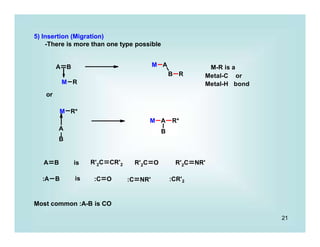
5) Insertion (Migration)
-There is more than one type possible
A B M A
B R
A
B
M A R*
B
M R
A B R'2C O
:A B
R'2C CR'2
:C O :C NR'
or
M R*
M-R is a
Metal-C or
Metal-H bond
is R'2C NR'
:CR'2
is
Most common :A-B is CO
22
-The reaction is a concerted migration of R*, with retention of
configuration at R* and the metal, if they are chiral
Mn
CH
CO
OC
OC
3
CO
CO
Mn
CO
OC CO
OC
H3C
C O
CO
OC CO
OC
L
CH3
Mn
O
rds L
Change in # of valence electron at the metal -2 (18 to 16e)
Change in metal oxidation state 0 (+1 to +1)
Change in coordination number -1 (6 to 5)
O
H Ni O
Ph2P PPh2
O
H Ni
Ph2P
O
PPh2
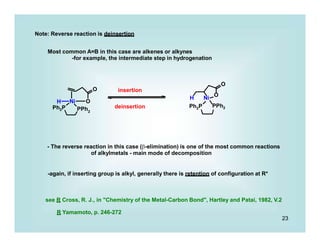
Note: Reverse reaction is deinsertion
Most common A=B in this case are alkenes or alkynes
-for example, the intermediate step in hydrogenation
insertion
deinsertion
- The reverse reaction in this case (-elimination) is one of the most common reactions
of alkylmetals - main mode of decomposition
-again, if inserting group is alkyl, generally there is retention of configuration at R*
see R Cross, R. J., in "Chemistry of the Metal-Carbon Bond", Hartley and Patai, 1982, V.2
R Yamamoto, p. 246-272
23
L M L M
R
R
R
R
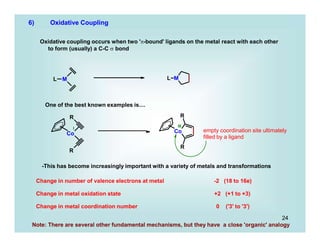
6) Oxidative Coupling
Oxidative coupling occurs when two '-bound' ligands on the metal react with each other
to form (usually) a C-C  bond
One of the best known examples is....
I
Co
III
Co
-This has become increasingly important with a variety of metals and transformations
Change in number of valence electrons at metal -2 (18 to 16e)
Change in metal oxidation state +2 (+1 to +3)
Change in metal coordination number 0 ('3' to '3')
24
Note: There are several other fundamental mechanisms, but they have a close 'organic' analogy
empty coordination site ultimately
filled by a ligand

p001-024.pptx

  • 1.
    Organometallics in OrganicSynthesis 1. So who cares (i.e., why?) -Pattern of reactivity of organic compounds is imposed on molecule by existing functional groups OMe O OMe       - By default, this limits what you can do with the compound -Coordination of a metal fragment can change this completely i.e., can render – an electrophilic species nucleophilic - a nucleophilic species electrophilic - can make a normally unstable molecule stable - can make a stable molecule reactive - can make impossible reactions possible 1
  • 2.
    The (Very) Basicsof Organometallics -The 18 Electron Rule Most (middle) transition metal complexes prefer having 18 valence electrons (2s + 6p + 10d) For transition metal complexes in the 0 oxidation state 4e 5e 6e 7e 8e 9e 10e Ti V Cr Mn Fe Co Ni Zr Nb Mo Rc Ru Rh Pd Hf Ta W Re Os Ir Pt 2
  • 3.
    Ti -The 18 erule is followed most closely in complexes of middle transition metals (Cr to Co) -As for early transition metal complexes, it’s usually too difficult to get enough ligands around the metal to get it to 18 e (i.e., Ti) Cl (16 e) (Cp2TiCl2) Cl - As for late transition metal complexes (Ni, Pd, Pt), particularly the square planar MIIL4 complexes - tend to be very stable as 16 e- complexes - energy gap to 9th orbital is quite big; molecule is quite willing not to fill that orbital 3
  • 4.
    4 To count to18 (or 16), need e-’s from ligands - I’ll adopt a ‘radical approach’ – not only valid one -H -R R-C≡N: R-N≡C: A) Inorganic Ligands 1e- -X 2e- R3P: (RO)3P: R3N: R2S: R2O: 3e- NO (usually) nitrosyl complexes
  • 5.
    5 M C C M C C M M C R R M M CR N M R N R   1 e-) ( -allyls)  ( 2 e-) (alkenes) (alkynes) 1 (2e-) - + M C O M C O (carbonyl ligands) (carbenes, alkylidenes) 3 (3e-) ( -allyls) 1 (3e-) (carbynes) -R (alkyls) -Ph (aryls) Organic Ligands - Part 1
  • 6.
    6 M M M M M M M = (dienes) (trimethylenemethanes) (TMM) 4(4e-) Organic Ligands, Cont'd.  (5e-) (dienyls) (cyclopentadienyls)  (6e-) (arenes, trienes)  (7e-)  - (8e ) (trienyls) (cyclotetraenes) - rarely, usually 4
  • 7.
    7 Fe Cr C OC C O O OC N O Fe C OC C O O Pd 3 Ph PCl Ph3P Cl So..... The number of electrons on the free metal + sum of the  number of the hydrocarbon ligands + sum of the electrons donated by other ligands + any negative charge on the complex - positive charge on the complex Should = 18 normally Many exceptions with early or late transition metals ; works best with middle transition metals 8 (Fe) + (2x5) = 18e- 6 (Cr) + 6 (Ph) + (3x2) = 18 e- 6 (Mo) + 5 (Cp) + 2 + 3 +3 -1 = 18 e- 8 + 4 (TMM) + (3x2) = 18 e- 10 (Pd) + (2x2) + (2x1) = 16 e- Mo+
  • 8.
    8 C M C C C C Bonding of HydrocarbonLigands - In its simplist form, bonding of the - system to a transition metal fragment is based on the Dewar-Chatt-Duncanson Model C Consider - There are two contributions to bonding 1) Ligand to Metal Donation M Note: this is not a - bond, but rather a - bond 2) Metal to Ligand Back Donation M Note: this is a - bond Dewar, M. J. S. Bull. Chim. Soc. Fr. 1951, C71. Chatt, J.; Duncanson, L. A. J. Chem. Soc. 1953, 2939. For higher level descriptions:    - see Yamamoto, A., p. 58-72  - see Collman, Hegedus, Norton, Finke p. 43-47
  • 9.
    9 Fe C OC C O O Fe C C CO O O Consequences ofBonding of Hydrocarbon Ligands 1) - In the alkene, the C=C bond is made weaker by complexation 2) - The ligand may be made more or less electron rich by complexation -depends on case 3) - The organic fragment often loses its only plane of symmetry -for example and are the same compound But....... mirror image These are not the same compound - the plane of symmetry is destroyed No non-superimposable mirror images Enantiomers
  • 10.
    10 OMe Cr C OC C O O MeO Cr C C CO O O Ph Pd Ph2PPPh2 Ph Pd Ph2P PPh2 Other examples + + Same situation: Each pair is enantiomeric
  • 11.
    H Co(CO)4 SH OH 3 HC CH3 O Basic Organometallic Reactions There are several additional fundamental types of reactions in organometallic chemistry The more complex reactions are normally some combination of these fundamental ones 1) Lewis Acid Dissociation - many transition metal compounds, especially hydrides, can lose as Lewis acid (i.e., deprotonate) H+ + change in number of metal valence e-'s -Co(CO)4 0 change in formal metal oxidation state -2 change in coordination number at the metal -1 This may be a surprise, but many transition metal hydrides are quite acidic -notice that making the metal more electron rich decreases acidity HCo(CO)4 (pKa = 8.3, CH3CN) H2Fe(CO)4 HCo(CO)3PPh3 (11.4) (15.4) (pK = 10.3, a CH3S(O)CH3) (18.0) H2O (32.0) (24.4) 11 Winkler, J. R. et al (Gray, H. B.) J. Am. Chem Soc. 1986, 108, 2263.
  • 12.
    12 2) Lewis BaseDissociation Very, very, very..........common process Fe(CO)5 Fe(CO)4 + CO 18e 16e Pd(PPh3)4 + PPh3 16e 14e Pd(PPh3)3 change in number of metal valence e-'s -2 change in formal metal oxidation state 0 change in coordination number at the metal -1 -Reverse reaction: Lewis base Association Obvious application are in ligand substitution processes, which may be dissociative ('SN1 like') Ni(CO)4 slow Ni(CO)3 + CO L fast LNi(CO)3 v = k [ Ni(CO)4] 1st order Most common for 18 e- systems
  • 13.
    13 Pt X Lc Lt Lc Pt Lc Lt X Lc Y Pt Lt Lc X Y Lc Pt Lc Lt Y Lc X Pt Lc Y LtLc - Alternatively, this can be associative, i.e., "SN2 like" -more common fo 16 e-, d8 square planar complexes (i.e., NiII, PdII, PtII RhI, IrI) + Y X + rate v = 2nd order square pyramidal square pyramidal trig. bipy trig. bipy
  • 14.
    14 Br 3) Oxidative Addition -represented by change in number of metal valence e-'s +2 change in formal metal oxidation state -+2 change in coordination number at the metal +2 (14 - 16 e) (0 - +2) LnMn + A-B for more details, see: R Yamamoto pp. 222-239 R Collman & Hegedus pp. 279-321 -Overall reaction is cleavage of the A-B bond with bonding to the metal - Most common A-B is R3C-X X = halogen or pseudohalogen O O S CF3 triflate O -Classic 'organic' example is Grignard reagent formation + Mgo II MgBr n+2 A Ln M B
  • 15.
    15 Br Ph3P PPh3 Cl Ph3P Ir Cl 3 Ph P PPh CO 3 CH3 Ir Cl Ph3P PPh CO 3 CH3 I -Most common example in this course will be of the following type: Pd(PPh3)4 2 PPh3 + 0 Pd(PPh3)2 + II Br Pd i.e., Pdo/PdII , Feo/FeII, IrI/IrIII .. PPh3 Ir CO rds CH3-I - Most is known about late transition metals (such as Ir, Ni groups) A) If the R of R-X is alkyl (especially 1o or 2o), the reaction is believed to (usually) occur via an SN2 substitution + fast - Inversion at alkyl carbon has been observed - Kinetics are overall 2nd order v = k [IrI] [CH3I] - the 2nd step is the oxidative addition Therefore, system needs: a) 2 available oxidation states b) open coordination site - Reverse reaction: Reductive Elimination Mechanism
  • 16.
    X Pt Ph3P PPh3 X Pt 3 PhP PPh3 X Pd X P P C M X EWG X EWG 2 PdL2X 16 EWG B) Vinyl (and perhaps aryl) halides go via  - complex formation, with ultimate direct insertion 3 2 "Pt(PPh ) " slow fast - Goes with retention of configuration of C=C configuration - Also believed to be mechanism for addition of H2 B') Aryl halides go via direct insertion into C-X bond (clearly related to B) i.e., Could result in retention of configuration in some cases C) - Now defrocked - Nucleophilic Aromatic Substiution - was an old proposal for aryl cases, to rationalized that cases with electron withdrawing groups "always" go faster X + "L2Pd" PdL + - rds
  • 17.
    17 Pd N N R N R R Cl Cl Pd N N R R Pd N N R R Cl Cl Pd R N N R N R + C)'- much more likely and often detected in calculations is initial formation of an 2-benzene complex D) - Electron transfer, radical mechanisms do exist (Ni, Mg) i.e. rds [ LnM+ RX-.] X LnM R Ln + RX [ LnM+ RX-.] transition state Green, J. C. J. Organomet. Chem. 2005, 690, 6054.
  • 18.
    18 Br Li 3 Me P Rh 3 Rh MeP H H Many new opinions on these matters: R Hartwig, J. F. Synlett 2006, 1283. R Espinet, P.; Echavarren, A. M. Angew. Chem. Int. Ed. Engl. 2004, 43, 4704. R Jutand, A. Eur. J. Inorg. Chem. 2003, 2017. Alcazar-Roman, L. M.; Luis, M.; Hartwig, J.F.; Rheingold, A. L.; Liable-Sands, L. M.; Guzei, I. A. J. Am. Chem. Soc. 2000, 122, 4618. (chelate PR3) Hartwig, J. F.; Paul, P. J. Am. Chem. Soc. 1995, 117, 5373 (monodentate PR3) R Amatore, C.; Jutand, A. Acc. Chem. Res. 2000, 33, 314. Lersh,M.; Tilset, M. J. Am. Chem. Soc. 2005, 127, 2471 (C-H activation). 2 LnMo + A-B + I LnM-A I LnM-B Conventional organic example - Lithium-Halogen exchange + 2 Li LiBr + + Bi, S. Chem. Phys. Lett. 2006, 431, 385. Aside: One electron oxidative additions also exist
  • 19.
    19 Pt Ph3P 3 Ph P Pt PhP 3 Ph3P B A 3 2 + "Pt(PPh ) " transition state -not an intermediate In 'normal' cases, the reaction goes by a concerted mechanism 4) Reductive Elimination - reverse of oxidative addition change in number of metal valence e-'s -2 change in formal metal oxidation state -2 change in coordination number at the metal -2 II LnM (16e - 14e) (+2 - 0) LnMo A-B +
  • 20.
    20 R R R N N O O O R RR Ni Ph CH3 H Pd PPh3 D PPh3 CH3 Ph H D Other notes on reductive elimination: - Non 18 e- situations must be accessible - Ni group (Ni, Pd, Pt) are the usual synthetic choices Since metal becomes more electron rich during the reaction, the reaction is sometimes accelerated by addition of a ligand which is electron withdrawing More details in general: R R Yamamoto, pp. 240-5 Collman, Hegedus pp 322-33 -and, importantly for organic chemists....... retention of configuration at carbon Milstein, D.; Stille, J. K. J. Am. Chem. Soc. 1979, 101, 4981 Note: Whether the precursor is square planar or trigonal bipyramidal, it's the cis groups which reductively eliminate - Again, need two accessible oxidation states
  • 21.
    21 5) Insertion (Migration) -Thereis more than one type possible A B M A B R A B M A R* B M R A B R'2C O :A B R'2C CR'2 :C O :C NR' or M R* M-R is a Metal-C or Metal-H bond is R'2C NR' :CR'2 is Most common :A-B is CO
  • 22.
    22 -The reaction isa concerted migration of R*, with retention of configuration at R* and the metal, if they are chiral Mn CH CO OC OC 3 CO CO Mn CO OC CO OC H3C C O CO OC CO OC L CH3 Mn O rds L Change in # of valence electron at the metal -2 (18 to 16e) Change in metal oxidation state 0 (+1 to +1) Change in coordination number -1 (6 to 5)
  • 23.
    O H Ni O Ph2PPPh2 O H Ni Ph2P O PPh2 Note: Reverse reaction is deinsertion Most common A=B in this case are alkenes or alkynes -for example, the intermediate step in hydrogenation insertion deinsertion - The reverse reaction in this case (-elimination) is one of the most common reactions of alkylmetals - main mode of decomposition -again, if inserting group is alkyl, generally there is retention of configuration at R* see R Cross, R. J., in "Chemistry of the Metal-Carbon Bond", Hartley and Patai, 1982, V.2 R Yamamoto, p. 246-272 23
  • 24.
    L M LM R R R R 6) Oxidative Coupling Oxidative coupling occurs when two '-bound' ligands on the metal react with each other to form (usually) a C-C  bond One of the best known examples is.... I Co III Co -This has become increasingly important with a variety of metals and transformations Change in number of valence electrons at metal -2 (18 to 16e) Change in metal oxidation state +2 (+1 to +3) Change in metal coordination number 0 ('3' to '3') 24 Note: There are several other fundamental mechanisms, but they have a close 'organic' analogy empty coordination site ultimately filled by a ligand