Cross-Coupling of Unactivated Arenes: Direct Arene C-H
Bond Arylation (Concepts of C-H Activation/Functionalization and its
Recent Developments), Importance in the Drug Discovery Research
Hyderabad
Presented By
SANJEEV KUMAR
(Ph.D. Research Scholar)
Department of Medicinal Chemistry
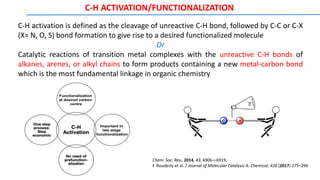
C-H activation is defined as the cleavage of unreactive C-H bond, followed by C-C or C-X
(X= N, O, S) bond formation to give rise to a desired functionalized molecule
Or
Catalytic reactions of transition metal complexes with the unreactive C-H bonds of
alkanes, arenes, or alkyl chains to form products containing a new metal-carbon bond
which is the most fundamental linkage in organic chemistry
C-H ACTIVATION/FUNCTIONALIZATION
Chem. Soc. Rev., 2014, 43, 6906—6919,
F. Roudesly et al. / Journal of Molecular Catalysis A: Chemical, 426 (2017) 275–296
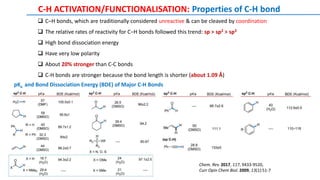
 C–H bonds, which are traditionally considered unreactive & can be cleaved by coordination
 The relative rates of reactivity for C−H bonds followed this trend: sp > sp2 > sp3
 High bond dissociation energy
 Have very low polarity
 About 20% stronger than C-C bonds
 C-H bonds are stronger because the bond length is shorter (about 1.09 Å)
C-H ACTIVATION/FUNCTIONALISATION: Properties of C-H bond
pKa and Bond Dissociation Energy (BDE) of Major C-H Bonds
Chem. Rev. 2017, 117, 9433-9520,
Curr Opin Chem Biol. 2009, 13(1):51-7
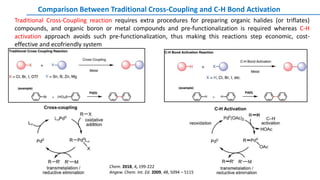
Comparison Between Traditional Cross-Coupling and C-H Bond Activation
Traditional Cross-Coupling reaction requires extra procedures for preparing organic halides (or triflates)
compounds, and organic boron or metal compounds and pre-functionalization is required whereas C-H
activation approach avoids such pre-functionalization, thus making this reactions step economic, cost-
effective and ecofriendly system
C-H Activation
Chem. 2018, 4, 199-222
Angew. Chem. Int. Ed. 2009, 48, 5094 – 5115
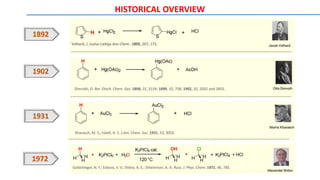
HISTORICAL OVERVIEW
1892
1902
1931
1972
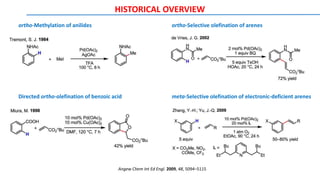
HISTORICAL OVERVIEW
Directed ortho-olefination of benzoic acid
ortho-Selective olefination of arenes
meta-Selective olefination of electronic-deficient arenes
ortho-Methylation of anilides
Angew Chem Int Ed Engl. 2009, 48, 5094–5115
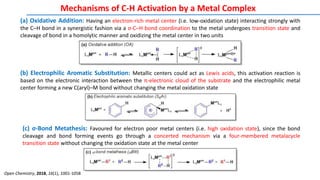
(a) Oxidative Addition: Having an electron-rich metal center (i.e. low-oxidation state) interacting strongly with
the C–H bond in a synergistic fashion via a σ-C–H bond coordination to the metal undergoes transition state and
cleavage of bond in a homolytic manner and oxidizing the metal center in two units
Mechanisms of C-H Activation by a Metal Complex
(b) Electrophilic Aromatic Substitution: Metallic centers could act as Lewis acids, this activation reaction is
based on the electronic interaction between the π-electronic cloud of the substrate and the electrophilic metal
center forming a new C(aryl)–M bond without changing the metal oxidation state
(c) σ-Bond Metathesis: Favoured for electron poor metal centers (i.e. high oxidation state), since the bond
cleavage and bond forming events go through a concerted mechanism via a four-membered metalacycle
transition state without changing the oxidation state at the metal center
Open Chemistry, 2018, 16(1), 1001-1058
Mechanisms of C-H Activation by a Metal Complex
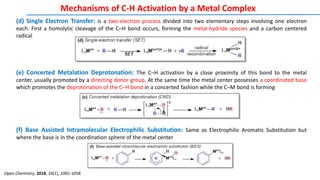
(d) Single Electron Transfer: is a two-electron process divided into two elementary steps involving one electron
each. First a homolytic cleavage of the C–H bond occurs, forming the metal-hydride species and a carbon centered
radical
(e) Concerted Metalation Deprotonation: The C–H activation by a close proximity of this bond to the metal
center, usually promoted by a directing donor group. At the same time the metal center possesses a coordinated base
which promotes the deprotonation of the C–H bond in a concerted fashion while the C–M bond is forming
(f) Base Assisted Intramolecular Electrophilic Substitution: Same as Electrophilic Aromatic Substitution but
where the base is in the coordination sphere of the metal center
Open Chemistry, 2018, 16(1), 1001-1058
Mechanism of the Fujiwara-Moritani Reaction
Moritani, I.; Fujiwara, Y. Tetrahedron Lett. 1967, 8, 1119
Journal of Molecular Catalysis A: Chemical 426 (2017) 275–296
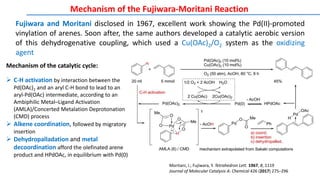
Fujiwara and Moritani disclosed in 1967, excellent work showing the Pd(II)-promoted
vinylation of arenes. Soon after, the same authors developed a catalytic aerobic version
of this dehydrogenative coupling, which used a Cu(OAc)2/O2 system as the oxidizing
agent
Mechanism of the catalytic cycle:
 C-H activation by interaction between the
Pd(OAc)2 and an aryl C-H bond to lead to an
aryl-Pd(OAc) intermediate, according to an
Ambiphilic Metal–Ligand Activation
(AMLA)/Concerted Metalation Deprotonation
(CMD) process
 Alkene coordination, followed by migratory
insertion
 Dehydropalladation and metal
decoordination afford the olefinated arene
product and HPdOAc, in equilibrium with Pd(0)
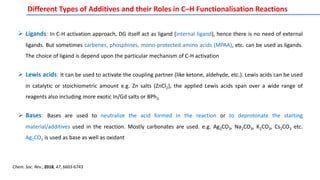
Different Types of Additives and their Roles in C–H Functionalisation Reactions
 Oxidants: Most often Cu salts (commonly Cu(OAc)2), and Ag salts (AgOAc, AgOTf, AgOPiv) sometimes Mn salts,
are used in stoichiometric or superstoichiometric amounts in oxidative reactions. Other oxidants, used alone or in
combination with Cu or Ag are benzoquinones, peroxides, O2/air, K2S2O8 or hypervalent iodine compounds
 Catalytic Ag salts: Catalytic amounts of Ag salts are often used in combination with groups 8 or 9 metal halide
dimers, commonly used as catalysts (e.g. [RhCp*Cl2]2). In these cases the Ag acts as a halide scavenger, and the
counteranion (usually OTf, NTf2, or SbF6) promotes the in situ formation of cationic metal catalysts in solution
 Carboxylates: Main role of carboxylates is to deprotonate the desired C-H bond, which is to be activated. It occurs
via concerted metalation deprotonation (CMD) mechanism. eg. Cu, Ag, Zn, Na salts of acetates, benzoates,
pivalates, admantanecarboxylates, trifluoroacetates, etc.
Chem. Soc. Rev., 2018, 47, 6603-6743
 Ligands: In C-H activation approach, DG itself act as ligand (internal ligand), hence there is no need of external
ligands. But sometimes carbenes, phosphines, mono-protected amino acids (MPAA), etc. can be used as ligands.
The choice of ligand is depend upon the particular mechanism of C-H activation
 Lewis acids: It can be used to activate the coupling partner (like ketone, aldehyde, etc.). Lewis acids can be used
in catalytic or stoichiometric amount e.g. Zn salts (ZnCl2), the applied Lewis acids span over a wide range of
reagents also including more exotic In/Gd salts or BPh3
 Bases: Bases are used to neutralize the acid formed in the reaction or to deprotonate the starting
material/additives used in the reaction. Mostly carbonates are used. e.g. Ag2CO3, Na2CO3, K2CO3, Cs2CO3 etc.
Ag2CO3 is used as base as well as oxidant
Different Types of Additives and their Roles in C–H Functionalisation Reactions
Chem. Soc. Rev., 2018, 47, 6603-6743
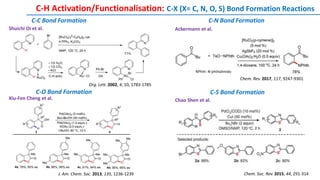
C-H Activation/Functionalisation: C-X (X= C, N, O, S) Bond Formation Reactions
C-C Bond Formation C-N Bond Formation
C-O Bond Formation C-S Bond Formation
Ackermann et al.
Chem. Rev. 2017, 117, 9247-9301
J. Am. Chem. Soc. 2013, 135, 1236-1239
Xiu-Fen Cheng et al.
Chem. Soc. Rev. 2015, 44, 291-314
Chao Shen et al.
Org. Lett. 2002, 4, 10, 1783-1785
Shuichi Oi et al.
NPhth: N-phthalimido
Palladium(II) Acetate
Palladium(II) Acetate Trimer
Palladium(II) Trifluoroacetate Palladium(II) Acetylacetonate
Bis(acetonitrile)palladium(II)
Dichloride
Bis(tricyclohexylphosphine)-
palladium(II) DichlorideDichloro[9,9-dimethyl-4,5-
bis(diphenylphosphino)xanthene]-
palladium(II)
Tetrakis(triphenylphosphine)-
palladium(0)
Tris(dibenzylideneacetone)-
dipalladium(0)
Bis(dibenzylideneacetone)-
palladium(0)
Tetrakis(acetonitrile)-
palladium(II) Ditriflate
Pd(II)Pd(0)
1,2-Bis(phenylsulfinyl)ethane
palladium(II) acetate
(White Catalyst)
Transition-metal catalysts, especially Pd and Rh catalysts, are crucial for C–H bond cleavage and further
transformations. In general, palladium(II), rhodium(I), iridium(I), ruthenium(II), copper(II), and iron(II) are
widely used in C-H bond activation
METAL CATALYSTS: Palladium Catalysts
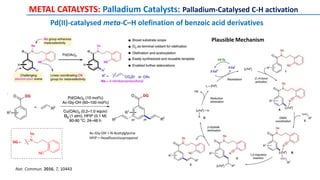
METAL CATALYSTS: Palladium Catalysts: Palladium-Catalysed C-H activation
Plausible Mechanism
Pd(II)-catalysed meta-C–H olefination of benzoic acid derivatives
Nat. Commun. 2016, 7, 10443
Ac-Gly-OH = N-Acetylglycine
HFIP = Hexafluoroisopropanol
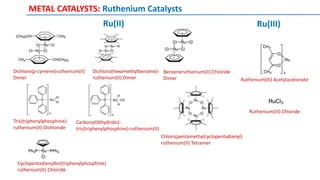
METAL CATALYSTS: Ruthenium Catalysts
Benzeneruthenium(II) Chloride
Dimer
Dichloro(p-cymene)ruthenium(II)
Dimer
Dichloro(hexamethylbenzene)-
ruthenium(II) Dimer
Tris(triphenylphosphine)-
ruthenium(II) Dichloride
Carbonyl(dihydrido)-
tris(triphenylphosphine)-ruthenium(II)
Ruthenium(III) Chloride
Ruthenium(III) Acetylacetonate
Chloro(pentamethylcyclopentadienyl)
ruthenium(II) Tetramer
Cyclopentadienylbis(triphenylphosphine)
ruthenium(II) Chloride
Ru(II) Ru(III)
METAL CATALYSTS: Ruthenium Catalysts: Ruthenium-Catalysed C-H activation
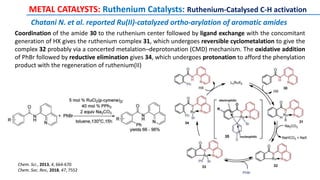
Coordination of the amide 30 to the ruthenium center followed by ligand exchange with the concomitant
generation of HX gives the ruthenium complex 31, which undergoes reversible cyclometalation to give the
complex 32 probably via a concerted metalation–deprotonation (CMD) mechanism. The oxidative addition
of PhBr followed by reductive elimination gives 34, which undergoes protonation to afford the phenylation
product with the regeneration of ruthenium(II)
Chatani N. et al. reported Ru(II)-catalyzed ortho-arylation of aromatic amides
Chem. Sci., 2013, 4, 664-670
Chem. Soc. Rev., 2018, 47, 7552
METAL CATALYSTS: Rhoduim Catalysts
Chlorobis(ethylene)-
rhodium(I) Dimer
Acetylacetonatobis(ethylene)-
rhodium(I)
Chloro(1,5-hexadiene)-
rhodium(I) Dimer
Chloro(1,5-cyclooctadiene)-
rhodium(I) Dimer
Bis(1,5-cyclooctadiene)-
rhodium(I) Tetrafluoroborate
Chlorobis(cyclooctene)-
rhodium(I) Dimer
Norbornadiene
Rhodium(I) Chloride Dimer
Bis[η-(2,5-norbornadiene)]-
rhodium(I) Tetrafluoroborate
(Pentamethylcyclopentadienyl)-
rhodium(III) Dichloride Dimer Tris(triphenylphosphine)rhodium(I)
Chloride
Rhodium(II) Acetate Dimer
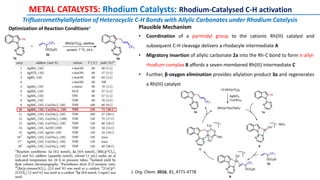
Optimization of Reaction Conditionsa Plausible Mechanism
• Coordination of a pyrimidyl group to the cationic Rh(III) catalyst and
subsequent C-H cleavage delivers a rhodacyle intermediate A
• Migratory insertion of allylic carbonate 2a into the Rh-C bond to form π-allyl-
rhodium complex B affords a seven-membered Rh(III) intermediate C
• Further, β-oxygen elimination provides allylation product 3a and regenerates
a Rh(III) catalyst
METAL CATALYSTS: Rhodium Catalysts: Rhodium-Catalysed C-H activation
J. Org. Chem. 2016, 81, 4771-4778
Trifluoromethylallylation of Heterocyclic C-H Bonds with Allylic Carbonates under Rhodium Catalysis
METAL CATALYSTS: Miscellaneous Catalysts
Iridium
Chlorobis(ethylene)iridium(I)
Dimer
(Acetylacetonato)-
(1,5-cyclooctadiene)iridium(I)
(Pentamethylcyclopentadienyl)-
iridium(III) Dichloride Dimer
Vaska's Catalyst
Copper
Copper(I) Acetate
Copper(I)
2-Thiophenecarboxylate
Tetrakis(acetonitrile)copper(I)
Hexafluorophosphate
Copper(II)
Trifluoromethanesulfonate
Copper(II) Acetylacetonate
Iron
Cyclopentadienyliron Dicarbonyl Dimer
Tris(dibenzoylmethanato) Iron
Iron(II) Acetate
Iron(III) Acetylacetonate
Nickel
Bis(triphenylphosphine)-
nickel(II) Dichloride
[1,3-Bis(diphenylphosphino)-
propane]nickel(II) Dichloride
Nickel(II) Chloride Anhydrous
Nickel(II)
Trifluoromethanesulfonate
METAL CATALYSTS: Miscellaneous Catalysts
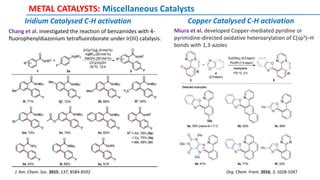
Iridium Catalysed C-H activation Copper Catalysed C-H activation
J. Am. Chem. Soc. 2015, 137, 8584-8592
Chang et al. investigated the reaction of benzamides with 4-
fluorophenyldiazonium tetrafluoroborate under Ir(III) catalysis.
Org. Chem. Front. 2016, 3, 1028-1047
Miura et al. developed Copper-mediated pyridine or
pyrimidine-directed oxidative heteroarylation of C(sp2)–H
bonds with 1,3-azoles
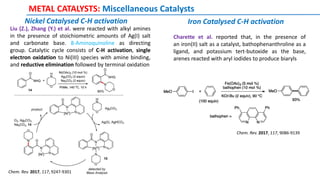
Liu (Z.), Zhang (Y.) et al. were reacted with alkyl amines
in the presence of stoichiometric amounts of Ag(I) salt
and carbonate base. 8-Aminoquinoline as directing
group. Catalytic cycle consists of C-H activation, single
electron oxidation to Ni(III) species with amine binding,
and reductive elimination followed by terminal oxidation
METAL CATALYSTS: Miscellaneous Catalysts
Nickel Catalysed C-H activation Iron Catalysed C-H activation
Chem. Rev. 2017, 117, 9247-9301
Charette et al. reported that, in the presence of
an iron(II) salt as a catalyst, bathophenanthroline as a
ligand, and potassium tert-butoxide as the base,
arenes reacted with aryl iodides to produce biaryls
Chem. Rev. 2017, 117, 9086-9139
 In C-H activation approach, due to ubiquitous nature of C-H bonds in a molecule, the specific C-H
bond activation is a challenging task
 In case of heterocyclic ring system, the hetero atom governs the site selectivity towards adjacent C-H
centre by pre-coordination with T.M. it is known as inherent selectivity
 But in case of simple aromatic or aliphatic system, governing regioselectivity is difficult. In such a
system DG comes into play, leading to regioselective C-H bond activation, adjacent to that particular
DG
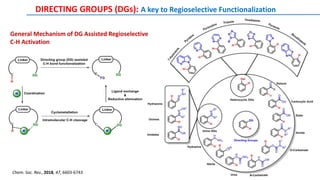
DIRECTING GROUPS (DGs): A key to Regioselective Functionalisation
Chem. Soc. Rev., 2018, 47, 6603-6743
Challenge in Front of Directing Groups (DGs):
 Only functionalization at ortho position to DG present. Meta or para position is still a challenge but it’s possible
DIRECTING GROUPS (DGs): A key to Regioselective Functionalization
Chem. Soc. Rev., 2018, 47, 6603-6743
General Mechanism of DG Assisted Regioselective
C-H Activation
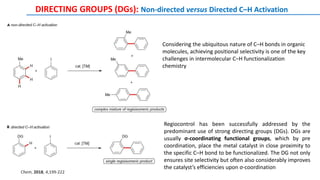
DIRECTING GROUPS (DGs): Non-directed versus Directed C–H Activation
Regiocontrol has been successfully addressed by the
predominant use of strong directing groups (DGs). DGs are
usually σ-coordinating functional groups, which by pre
coordination, place the metal catalyst in close proximity to
the specific C–H bond to be functionalized. The DG not only
ensures site selectivity but often also considerably improves
the catalyst’s efficiencies upon σ-coordination
Considering the ubiquitous nature of C–H bonds in organic
molecules, achieving positional selectivity is one of the key
challenges in intermolecular C–H functionalization
chemistry
Chem, 2018, 4,199-222
J. Am. Chem. Soc. 2011, 133, 7222–7228
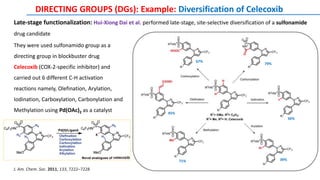
Late-stage functionalization: Hui-Xiong Dai et al. performed late-stage, site-selective diversification of a sulfonamide
drug candidate
They were used sulfonamido group as a
directing group in blockbuster drug
Celecoxib (COX-2-specific inhibitor) and
carried out 6 different C-H activation
reactions namely, Olefination, Arylation,
Iodination, Carboxylation, Carbonylation and
Methylation using Pd(OAc)2 as a catalyst
DIRECTING GROUPS (DGs): Example: Diversification of Celecoxib
67%
79%
45%
71% 39%
56%
Limitations of C-H Activation
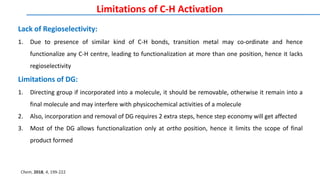
Lack of Regioselectivity:
1. Due to presence of similar kind of C-H bonds, transition metal may co-ordinate and hence
functionalize any C-H centre, leading to functionalization at more than one position, hence it lacks
regioselectivity
Limitations of DG:
1. Directing group if incorporated into a molecule, it should be removable, otherwise it remain into a
final molecule and may interfere with physicochemical activities of a molecule
2. Also, incorporation and removal of DG requires 2 extra steps, hence step economy will get affected
3. Most of the DG allows functionalization only at ortho position, hence it limits the scope of final
product formed
Chem, 2018, 4, 199-222
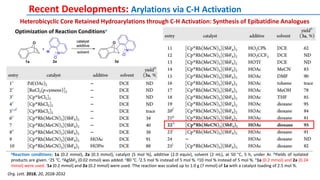
Optimization of Reaction Conditionsa
aReaction conditions: 1a (0.2 mmol), 2a (0.3 mmol), catalyst (5 mol %), additive (2.0 equiv), solvent (2 mL), at 50 °C, 5 h, under Ar. bYields of isolated
products are given. c25 °C. dAgSbF6 (0.02 mmol) was added. e80 °C. f2.5 mol % instead of 5 mol %. g10 mol % instead of 5 mol %. h1a (0.2 mmol) and 2a (0.24
mmol) were used. i1a (0.2 mmol) and 2a (0.2 mmol) were used. jThe reaction was scaled up to 1.0 g (7 mmol) of 1a with a catalyst loading of 2.5 mol %.
Org. Lett. 2018, 20, 2028-2032
Recent Developments: Arylations via C-H Activation
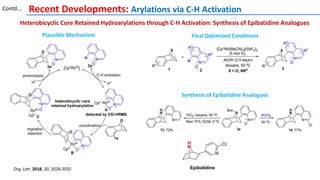
Heterobicyclic Core Retained Hydroarylations through C-H Activation: Synthesis of Epibatidine Analogues
Plausible Mechanism Final Optimized Conditions
Synthesis of Epibatidine Analogues
Contd….
Org. Lett. 2018, 20, 2028-2032
Heterobicyclic Core Retained Hydroarylations through C-H Activation: Synthesis of Epibatidine Analogues
Recent Developments: Arylations via C-H Activation
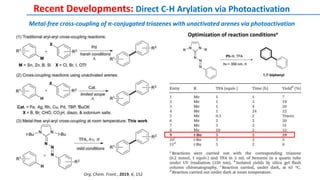
Metal-free cross-coupling of π-conjugated triazenes with unactivated arenes via photoactivation
Recent Developments: Direct C-H Arylation via Photoactivation
Optimization of reaction conditionsa
Org. Chem. Front., 2019, 6, 152
Recent Developments: Direct Arylation of Indoles
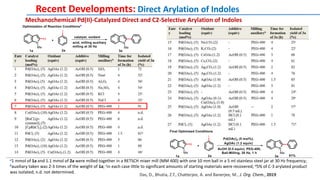
a1 mmol of 1a and 1.1 mmol of 2a were milled together in a RETSCH mixer mill (MM 400) with one 10 mm ball in a 5 ml stainless steel jar at 30 Hz frequency;
bauxiliary taken was 2-3 times of the weight of 1a; cin each case little to significant amounts of starting materials were recovered; d5% of C-3 arylated product
was isolated; n.d. not determined.
Mechanochemical Pd(II)-Catalyzed Direct and C2-Selective Arylation of Indoles
Das, D., Bhutia, Z.T., Chatterjee, A. and Banerjee, M., J. Org. Chem., 2019
a
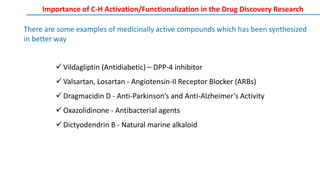
There are some examples of medicinally active compounds which has been synthesized
in better way
 Vildagliptin (Antidiabetic) – DPP-4 inhibitor
 Valsartan, Losartan - Angiotensin-ӀӀ Receptor Blocker (ARBs)
 Dragmacidin D - Anti-Parkinson’s and Anti-Alzheimer’s Activity
 Oxazolidinone - Antibacterial agents
 Dictyodendrin B - Natural marine alkaloid
Importance of C-H Activation/Functionalization in the Drug Discovery Research
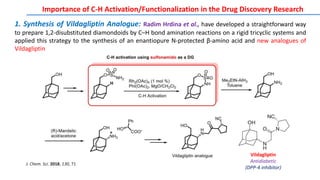
1. Synthesis of Vildagliptin Analogue: Radim Hrdina et al., have developed a straightforward way
to prepare 1,2-disubstituted diamondoids by C–H bond amination reactions on a rigid tricyclic systems and
applied this strategy to the synthesis of an enantiopure N-protected β-amino acid and new analogues of
Vildagliptin
Vildagliptin
Antidiabetic
(DPP-4 inhibitor)
J. Chem. Sci. 2018, 130, 71
Importance of C-H Activation/Functionalization in the Drug Discovery Research
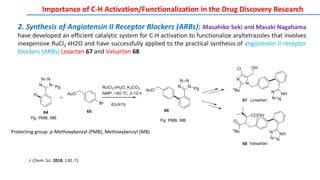
2. Synthesis of Angiotensin II Receptor Blockers (ARBs): Masahiko Seki and Masaki Nagahama
have developed an efficient catalytic system for C-H activation to functionalize aryltetrazoles that involves
inexpensive RuCl3·xH2O and have successfully applied to the practical synthesis of angiotensin II receptor
blockers (ARBs) Losartan 67 and Valsartan 68
Importance of C-H Activation/Functionalization in the Drug Discovery Research
Protecting group: p-Methoxybenzyl (PMB), Methoxybenzyl (MB)
J. Chem. Sci. 2018, 130, 71
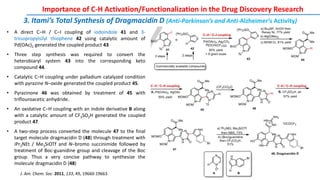
3. Itami’s Total Synthesis of Dragmacidin D (Anti-Parkinson’s and Anti-Alzheimer’s Activity)
Importance of C-H Activation/Functionalization in the Drug Discovery Research
J. Am. Chem. Soc. 2011, 133, 49, 19660-19663
• A direct C‒H / C‒I coupling of iodoindole 41 and 3-
triisopropylsilyl thiophene 42 using catalytic amount of
Pd(OAc)2 generated the coupled product 43
• Three step synthesis was required to convert the
heterobiaryl system 43 into the corresponding keto
compound 44.
• Catalytic C‒H coupling under palladium catalyzed condition
with pyrazine N‒oxide generated the coupled product 45.
• Pyrazinone 46 was obtained by treatment of 45 with
triflouroacetic anhydride.
• An oxidative C‒H coupling with an indole derivative B along
with a catalytic amount of CF3SO2H generated the coupled
product 47.
• A two-step process converted the molecule 47 to the final
target molecule dragmacidin D (48) through treatment with
iPr2NEt / Me3SiOTf and N‒bromo succinimide followed by
treatment of Boc-guanidine group and cleavage of the Boc
group. Thus a very concise pathway to synthesize the
molecule dragmacidin D (48)
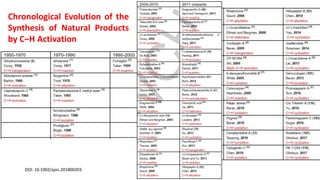
Chronological Evolution of the
Synthesis of Natural Products
by C‒H Activation
DOI: 10.1002/ajoc.201800203
C-H Activation and Functionalization

C-H Activation and Functionalization

  • 1.
    Cross-Coupling of UnactivatedArenes: Direct Arene C-H Bond Arylation (Concepts of C-H Activation/Functionalization and its Recent Developments), Importance in the Drug Discovery Research Hyderabad Presented By SANJEEV KUMAR (Ph.D. Research Scholar) Department of Medicinal Chemistry
  • 2.
    C-H activation isdefined as the cleavage of unreactive C-H bond, followed by C-C or C-X (X= N, O, S) bond formation to give rise to a desired functionalized molecule Or Catalytic reactions of transition metal complexes with the unreactive C-H bonds of alkanes, arenes, or alkyl chains to form products containing a new metal-carbon bond which is the most fundamental linkage in organic chemistry C-H ACTIVATION/FUNCTIONALIZATION Chem. Soc. Rev., 2014, 43, 6906—6919, F. Roudesly et al. / Journal of Molecular Catalysis A: Chemical, 426 (2017) 275–296
  • 3.
     C–H bonds,which are traditionally considered unreactive & can be cleaved by coordination  The relative rates of reactivity for C−H bonds followed this trend: sp > sp2 > sp3  High bond dissociation energy  Have very low polarity  About 20% stronger than C-C bonds  C-H bonds are stronger because the bond length is shorter (about 1.09 Å) C-H ACTIVATION/FUNCTIONALISATION: Properties of C-H bond pKa and Bond Dissociation Energy (BDE) of Major C-H Bonds Chem. Rev. 2017, 117, 9433-9520, Curr Opin Chem Biol. 2009, 13(1):51-7
  • 4.
    Comparison Between TraditionalCross-Coupling and C-H Bond Activation Traditional Cross-Coupling reaction requires extra procedures for preparing organic halides (or triflates) compounds, and organic boron or metal compounds and pre-functionalization is required whereas C-H activation approach avoids such pre-functionalization, thus making this reactions step economic, cost- effective and ecofriendly system C-H Activation Chem. 2018, 4, 199-222 Angew. Chem. Int. Ed. 2009, 48, 5094 – 5115
  • 5.
  • 6.
    HISTORICAL OVERVIEW Directed ortho-olefinationof benzoic acid ortho-Selective olefination of arenes meta-Selective olefination of electronic-deficient arenes ortho-Methylation of anilides Angew Chem Int Ed Engl. 2009, 48, 5094–5115
  • 7.
    (a) Oxidative Addition:Having an electron-rich metal center (i.e. low-oxidation state) interacting strongly with the C–H bond in a synergistic fashion via a σ-C–H bond coordination to the metal undergoes transition state and cleavage of bond in a homolytic manner and oxidizing the metal center in two units Mechanisms of C-H Activation by a Metal Complex (b) Electrophilic Aromatic Substitution: Metallic centers could act as Lewis acids, this activation reaction is based on the electronic interaction between the π-electronic cloud of the substrate and the electrophilic metal center forming a new C(aryl)–M bond without changing the metal oxidation state (c) σ-Bond Metathesis: Favoured for electron poor metal centers (i.e. high oxidation state), since the bond cleavage and bond forming events go through a concerted mechanism via a four-membered metalacycle transition state without changing the oxidation state at the metal center Open Chemistry, 2018, 16(1), 1001-1058
  • 8.
    Mechanisms of C-HActivation by a Metal Complex (d) Single Electron Transfer: is a two-electron process divided into two elementary steps involving one electron each. First a homolytic cleavage of the C–H bond occurs, forming the metal-hydride species and a carbon centered radical (e) Concerted Metalation Deprotonation: The C–H activation by a close proximity of this bond to the metal center, usually promoted by a directing donor group. At the same time the metal center possesses a coordinated base which promotes the deprotonation of the C–H bond in a concerted fashion while the C–M bond is forming (f) Base Assisted Intramolecular Electrophilic Substitution: Same as Electrophilic Aromatic Substitution but where the base is in the coordination sphere of the metal center Open Chemistry, 2018, 16(1), 1001-1058
  • 9.
    Mechanism of theFujiwara-Moritani Reaction Moritani, I.; Fujiwara, Y. Tetrahedron Lett. 1967, 8, 1119 Journal of Molecular Catalysis A: Chemical 426 (2017) 275–296 Fujiwara and Moritani disclosed in 1967, excellent work showing the Pd(II)-promoted vinylation of arenes. Soon after, the same authors developed a catalytic aerobic version of this dehydrogenative coupling, which used a Cu(OAc)2/O2 system as the oxidizing agent Mechanism of the catalytic cycle:  C-H activation by interaction between the Pd(OAc)2 and an aryl C-H bond to lead to an aryl-Pd(OAc) intermediate, according to an Ambiphilic Metal–Ligand Activation (AMLA)/Concerted Metalation Deprotonation (CMD) process  Alkene coordination, followed by migratory insertion  Dehydropalladation and metal decoordination afford the olefinated arene product and HPdOAc, in equilibrium with Pd(0)
  • 10.
    Different Types ofAdditives and their Roles in C–H Functionalisation Reactions  Oxidants: Most often Cu salts (commonly Cu(OAc)2), and Ag salts (AgOAc, AgOTf, AgOPiv) sometimes Mn salts, are used in stoichiometric or superstoichiometric amounts in oxidative reactions. Other oxidants, used alone or in combination with Cu or Ag are benzoquinones, peroxides, O2/air, K2S2O8 or hypervalent iodine compounds  Catalytic Ag salts: Catalytic amounts of Ag salts are often used in combination with groups 8 or 9 metal halide dimers, commonly used as catalysts (e.g. [RhCp*Cl2]2). In these cases the Ag acts as a halide scavenger, and the counteranion (usually OTf, NTf2, or SbF6) promotes the in situ formation of cationic metal catalysts in solution  Carboxylates: Main role of carboxylates is to deprotonate the desired C-H bond, which is to be activated. It occurs via concerted metalation deprotonation (CMD) mechanism. eg. Cu, Ag, Zn, Na salts of acetates, benzoates, pivalates, admantanecarboxylates, trifluoroacetates, etc. Chem. Soc. Rev., 2018, 47, 6603-6743
  • 11.
     Ligands: InC-H activation approach, DG itself act as ligand (internal ligand), hence there is no need of external ligands. But sometimes carbenes, phosphines, mono-protected amino acids (MPAA), etc. can be used as ligands. The choice of ligand is depend upon the particular mechanism of C-H activation  Lewis acids: It can be used to activate the coupling partner (like ketone, aldehyde, etc.). Lewis acids can be used in catalytic or stoichiometric amount e.g. Zn salts (ZnCl2), the applied Lewis acids span over a wide range of reagents also including more exotic In/Gd salts or BPh3  Bases: Bases are used to neutralize the acid formed in the reaction or to deprotonate the starting material/additives used in the reaction. Mostly carbonates are used. e.g. Ag2CO3, Na2CO3, K2CO3, Cs2CO3 etc. Ag2CO3 is used as base as well as oxidant Different Types of Additives and their Roles in C–H Functionalisation Reactions Chem. Soc. Rev., 2018, 47, 6603-6743
  • 12.
    C-H Activation/Functionalisation: C-X(X= C, N, O, S) Bond Formation Reactions C-C Bond Formation C-N Bond Formation C-O Bond Formation C-S Bond Formation Ackermann et al. Chem. Rev. 2017, 117, 9247-9301 J. Am. Chem. Soc. 2013, 135, 1236-1239 Xiu-Fen Cheng et al. Chem. Soc. Rev. 2015, 44, 291-314 Chao Shen et al. Org. Lett. 2002, 4, 10, 1783-1785 Shuichi Oi et al. NPhth: N-phthalimido
  • 13.
    Palladium(II) Acetate Palladium(II) AcetateTrimer Palladium(II) Trifluoroacetate Palladium(II) Acetylacetonate Bis(acetonitrile)palladium(II) Dichloride Bis(tricyclohexylphosphine)- palladium(II) DichlorideDichloro[9,9-dimethyl-4,5- bis(diphenylphosphino)xanthene]- palladium(II) Tetrakis(triphenylphosphine)- palladium(0) Tris(dibenzylideneacetone)- dipalladium(0) Bis(dibenzylideneacetone)- palladium(0) Tetrakis(acetonitrile)- palladium(II) Ditriflate Pd(II)Pd(0) 1,2-Bis(phenylsulfinyl)ethane palladium(II) acetate (White Catalyst) Transition-metal catalysts, especially Pd and Rh catalysts, are crucial for C–H bond cleavage and further transformations. In general, palladium(II), rhodium(I), iridium(I), ruthenium(II), copper(II), and iron(II) are widely used in C-H bond activation METAL CATALYSTS: Palladium Catalysts
  • 14.
    METAL CATALYSTS: PalladiumCatalysts: Palladium-Catalysed C-H activation Plausible Mechanism Pd(II)-catalysed meta-C–H olefination of benzoic acid derivatives Nat. Commun. 2016, 7, 10443 Ac-Gly-OH = N-Acetylglycine HFIP = Hexafluoroisopropanol
  • 15.
    METAL CATALYSTS: RutheniumCatalysts Benzeneruthenium(II) Chloride Dimer Dichloro(p-cymene)ruthenium(II) Dimer Dichloro(hexamethylbenzene)- ruthenium(II) Dimer Tris(triphenylphosphine)- ruthenium(II) Dichloride Carbonyl(dihydrido)- tris(triphenylphosphine)-ruthenium(II) Ruthenium(III) Chloride Ruthenium(III) Acetylacetonate Chloro(pentamethylcyclopentadienyl) ruthenium(II) Tetramer Cyclopentadienylbis(triphenylphosphine) ruthenium(II) Chloride Ru(II) Ru(III)
  • 16.
    METAL CATALYSTS: RutheniumCatalysts: Ruthenium-Catalysed C-H activation Coordination of the amide 30 to the ruthenium center followed by ligand exchange with the concomitant generation of HX gives the ruthenium complex 31, which undergoes reversible cyclometalation to give the complex 32 probably via a concerted metalation–deprotonation (CMD) mechanism. The oxidative addition of PhBr followed by reductive elimination gives 34, which undergoes protonation to afford the phenylation product with the regeneration of ruthenium(II) Chatani N. et al. reported Ru(II)-catalyzed ortho-arylation of aromatic amides Chem. Sci., 2013, 4, 664-670 Chem. Soc. Rev., 2018, 47, 7552
  • 17.
    METAL CATALYSTS: RhoduimCatalysts Chlorobis(ethylene)- rhodium(I) Dimer Acetylacetonatobis(ethylene)- rhodium(I) Chloro(1,5-hexadiene)- rhodium(I) Dimer Chloro(1,5-cyclooctadiene)- rhodium(I) Dimer Bis(1,5-cyclooctadiene)- rhodium(I) Tetrafluoroborate Chlorobis(cyclooctene)- rhodium(I) Dimer Norbornadiene Rhodium(I) Chloride Dimer Bis[η-(2,5-norbornadiene)]- rhodium(I) Tetrafluoroborate (Pentamethylcyclopentadienyl)- rhodium(III) Dichloride Dimer Tris(triphenylphosphine)rhodium(I) Chloride Rhodium(II) Acetate Dimer
  • 18.
    Optimization of ReactionConditionsa Plausible Mechanism • Coordination of a pyrimidyl group to the cationic Rh(III) catalyst and subsequent C-H cleavage delivers a rhodacyle intermediate A • Migratory insertion of allylic carbonate 2a into the Rh-C bond to form π-allyl- rhodium complex B affords a seven-membered Rh(III) intermediate C • Further, β-oxygen elimination provides allylation product 3a and regenerates a Rh(III) catalyst METAL CATALYSTS: Rhodium Catalysts: Rhodium-Catalysed C-H activation J. Org. Chem. 2016, 81, 4771-4778 Trifluoromethylallylation of Heterocyclic C-H Bonds with Allylic Carbonates under Rhodium Catalysis
  • 19.
    METAL CATALYSTS: MiscellaneousCatalysts Iridium Chlorobis(ethylene)iridium(I) Dimer (Acetylacetonato)- (1,5-cyclooctadiene)iridium(I) (Pentamethylcyclopentadienyl)- iridium(III) Dichloride Dimer Vaska's Catalyst Copper Copper(I) Acetate Copper(I) 2-Thiophenecarboxylate Tetrakis(acetonitrile)copper(I) Hexafluorophosphate Copper(II) Trifluoromethanesulfonate Copper(II) Acetylacetonate Iron Cyclopentadienyliron Dicarbonyl Dimer Tris(dibenzoylmethanato) Iron Iron(II) Acetate Iron(III) Acetylacetonate Nickel Bis(triphenylphosphine)- nickel(II) Dichloride [1,3-Bis(diphenylphosphino)- propane]nickel(II) Dichloride Nickel(II) Chloride Anhydrous Nickel(II) Trifluoromethanesulfonate
  • 20.
    METAL CATALYSTS: MiscellaneousCatalysts Iridium Catalysed C-H activation Copper Catalysed C-H activation J. Am. Chem. Soc. 2015, 137, 8584-8592 Chang et al. investigated the reaction of benzamides with 4- fluorophenyldiazonium tetrafluoroborate under Ir(III) catalysis. Org. Chem. Front. 2016, 3, 1028-1047 Miura et al. developed Copper-mediated pyridine or pyrimidine-directed oxidative heteroarylation of C(sp2)–H bonds with 1,3-azoles
  • 21.
    Liu (Z.), Zhang(Y.) et al. were reacted with alkyl amines in the presence of stoichiometric amounts of Ag(I) salt and carbonate base. 8-Aminoquinoline as directing group. Catalytic cycle consists of C-H activation, single electron oxidation to Ni(III) species with amine binding, and reductive elimination followed by terminal oxidation METAL CATALYSTS: Miscellaneous Catalysts Nickel Catalysed C-H activation Iron Catalysed C-H activation Chem. Rev. 2017, 117, 9247-9301 Charette et al. reported that, in the presence of an iron(II) salt as a catalyst, bathophenanthroline as a ligand, and potassium tert-butoxide as the base, arenes reacted with aryl iodides to produce biaryls Chem. Rev. 2017, 117, 9086-9139
  • 22.
     In C-Hactivation approach, due to ubiquitous nature of C-H bonds in a molecule, the specific C-H bond activation is a challenging task  In case of heterocyclic ring system, the hetero atom governs the site selectivity towards adjacent C-H centre by pre-coordination with T.M. it is known as inherent selectivity  But in case of simple aromatic or aliphatic system, governing regioselectivity is difficult. In such a system DG comes into play, leading to regioselective C-H bond activation, adjacent to that particular DG DIRECTING GROUPS (DGs): A key to Regioselective Functionalisation Chem. Soc. Rev., 2018, 47, 6603-6743 Challenge in Front of Directing Groups (DGs):  Only functionalization at ortho position to DG present. Meta or para position is still a challenge but it’s possible
  • 23.
    DIRECTING GROUPS (DGs):A key to Regioselective Functionalization Chem. Soc. Rev., 2018, 47, 6603-6743 General Mechanism of DG Assisted Regioselective C-H Activation
  • 24.
    DIRECTING GROUPS (DGs):Non-directed versus Directed C–H Activation Regiocontrol has been successfully addressed by the predominant use of strong directing groups (DGs). DGs are usually σ-coordinating functional groups, which by pre coordination, place the metal catalyst in close proximity to the specific C–H bond to be functionalized. The DG not only ensures site selectivity but often also considerably improves the catalyst’s efficiencies upon σ-coordination Considering the ubiquitous nature of C–H bonds in organic molecules, achieving positional selectivity is one of the key challenges in intermolecular C–H functionalization chemistry Chem, 2018, 4,199-222
  • 25.
    J. Am. Chem.Soc. 2011, 133, 7222–7228 Late-stage functionalization: Hui-Xiong Dai et al. performed late-stage, site-selective diversification of a sulfonamide drug candidate They were used sulfonamido group as a directing group in blockbuster drug Celecoxib (COX-2-specific inhibitor) and carried out 6 different C-H activation reactions namely, Olefination, Arylation, Iodination, Carboxylation, Carbonylation and Methylation using Pd(OAc)2 as a catalyst DIRECTING GROUPS (DGs): Example: Diversification of Celecoxib 67% 79% 45% 71% 39% 56%
  • 26.
    Limitations of C-HActivation Lack of Regioselectivity: 1. Due to presence of similar kind of C-H bonds, transition metal may co-ordinate and hence functionalize any C-H centre, leading to functionalization at more than one position, hence it lacks regioselectivity Limitations of DG: 1. Directing group if incorporated into a molecule, it should be removable, otherwise it remain into a final molecule and may interfere with physicochemical activities of a molecule 2. Also, incorporation and removal of DG requires 2 extra steps, hence step economy will get affected 3. Most of the DG allows functionalization only at ortho position, hence it limits the scope of final product formed Chem, 2018, 4, 199-222
  • 27.
    Optimization of ReactionConditionsa aReaction conditions: 1a (0.2 mmol), 2a (0.3 mmol), catalyst (5 mol %), additive (2.0 equiv), solvent (2 mL), at 50 °C, 5 h, under Ar. bYields of isolated products are given. c25 °C. dAgSbF6 (0.02 mmol) was added. e80 °C. f2.5 mol % instead of 5 mol %. g10 mol % instead of 5 mol %. h1a (0.2 mmol) and 2a (0.24 mmol) were used. i1a (0.2 mmol) and 2a (0.2 mmol) were used. jThe reaction was scaled up to 1.0 g (7 mmol) of 1a with a catalyst loading of 2.5 mol %. Org. Lett. 2018, 20, 2028-2032 Recent Developments: Arylations via C-H Activation Heterobicyclic Core Retained Hydroarylations through C-H Activation: Synthesis of Epibatidine Analogues
  • 28.
    Plausible Mechanism FinalOptimized Conditions Synthesis of Epibatidine Analogues Contd…. Org. Lett. 2018, 20, 2028-2032 Heterobicyclic Core Retained Hydroarylations through C-H Activation: Synthesis of Epibatidine Analogues Recent Developments: Arylations via C-H Activation
  • 29.
    Metal-free cross-coupling ofπ-conjugated triazenes with unactivated arenes via photoactivation Recent Developments: Direct C-H Arylation via Photoactivation Optimization of reaction conditionsa Org. Chem. Front., 2019, 6, 152
  • 30.
    Recent Developments: DirectArylation of Indoles a1 mmol of 1a and 1.1 mmol of 2a were milled together in a RETSCH mixer mill (MM 400) with one 10 mm ball in a 5 ml stainless steel jar at 30 Hz frequency; bauxiliary taken was 2-3 times of the weight of 1a; cin each case little to significant amounts of starting materials were recovered; d5% of C-3 arylated product was isolated; n.d. not determined. Mechanochemical Pd(II)-Catalyzed Direct and C2-Selective Arylation of Indoles Das, D., Bhutia, Z.T., Chatterjee, A. and Banerjee, M., J. Org. Chem., 2019 a
  • 31.
    There are someexamples of medicinally active compounds which has been synthesized in better way  Vildagliptin (Antidiabetic) – DPP-4 inhibitor  Valsartan, Losartan - Angiotensin-ӀӀ Receptor Blocker (ARBs)  Dragmacidin D - Anti-Parkinson’s and Anti-Alzheimer’s Activity  Oxazolidinone - Antibacterial agents  Dictyodendrin B - Natural marine alkaloid Importance of C-H Activation/Functionalization in the Drug Discovery Research
  • 32.
    1. Synthesis ofVildagliptin Analogue: Radim Hrdina et al., have developed a straightforward way to prepare 1,2-disubstituted diamondoids by C–H bond amination reactions on a rigid tricyclic systems and applied this strategy to the synthesis of an enantiopure N-protected β-amino acid and new analogues of Vildagliptin Vildagliptin Antidiabetic (DPP-4 inhibitor) J. Chem. Sci. 2018, 130, 71 Importance of C-H Activation/Functionalization in the Drug Discovery Research
  • 33.
    2. Synthesis ofAngiotensin II Receptor Blockers (ARBs): Masahiko Seki and Masaki Nagahama have developed an efficient catalytic system for C-H activation to functionalize aryltetrazoles that involves inexpensive RuCl3·xH2O and have successfully applied to the practical synthesis of angiotensin II receptor blockers (ARBs) Losartan 67 and Valsartan 68 Importance of C-H Activation/Functionalization in the Drug Discovery Research Protecting group: p-Methoxybenzyl (PMB), Methoxybenzyl (MB) J. Chem. Sci. 2018, 130, 71
  • 34.
    3. Itami’s TotalSynthesis of Dragmacidin D (Anti-Parkinson’s and Anti-Alzheimer’s Activity) Importance of C-H Activation/Functionalization in the Drug Discovery Research J. Am. Chem. Soc. 2011, 133, 49, 19660-19663 • A direct C‒H / C‒I coupling of iodoindole 41 and 3- triisopropylsilyl thiophene 42 using catalytic amount of Pd(OAc)2 generated the coupled product 43 • Three step synthesis was required to convert the heterobiaryl system 43 into the corresponding keto compound 44. • Catalytic C‒H coupling under palladium catalyzed condition with pyrazine N‒oxide generated the coupled product 45. • Pyrazinone 46 was obtained by treatment of 45 with triflouroacetic anhydride. • An oxidative C‒H coupling with an indole derivative B along with a catalytic amount of CF3SO2H generated the coupled product 47. • A two-step process converted the molecule 47 to the final target molecule dragmacidin D (48) through treatment with iPr2NEt / Me3SiOTf and N‒bromo succinimide followed by treatment of Boc-guanidine group and cleavage of the Boc group. Thus a very concise pathway to synthesize the molecule dragmacidin D (48)
  • 35.
    Chronological Evolution ofthe Synthesis of Natural Products by C‒H Activation DOI: 10.1002/ajoc.201800203