1
KUMADA CROSS-COUPLING REACTION
Dr. Shahid Rasool
Kumada Cross-coupling
reaction
CHEM5128
Advanced Named Reactions
2
Key Concepts
• Kumada Cross-Coupling reactions
• Discussion of reacting species, catalysts, solvents
• Mechanism of reaction
• Explanation of mechanism step by step
• Synthetic applications
3
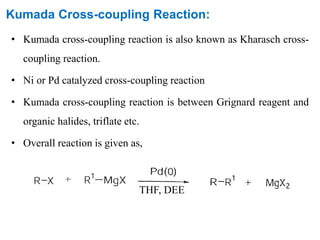
Kumada Cross-coupling Reaction:
• Kumada cross-coupling reaction is also known as Kharasch cross-
coupling reaction.
• Ni or Pd catalyzed cross-coupling reaction
• Kumada cross-coupling reaction is between Grignard reagent and
organic halides, triflate etc.
• Overall reaction is given as,
THF, DEE
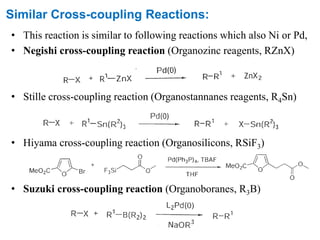
Similar Cross-coupling Reactions:
• This reaction is similar to following reactions which also Ni or Pd,
• Negishi cross-coupling reaction (Organozinc reagents, RZnX)
• Stille cross-coupling reaction (Organostannanes reagents, R4Sn)
• Hiyama cross-coupling reaction (Organosilicons, RSiF3)
• Suzuki cross-coupling reaction (Organoboranes, R3B)
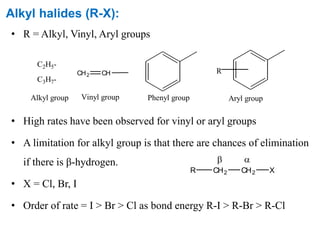
Alkyl halides (R-X):
• R = Alkyl, Vinyl, Aryl groups
• High rates have been observed for vinyl or aryl groups
• A limitation for alkyl group is that there are chances of elimination
if there is β-hydrogen.
• X = Cl, Br, I
• Order of rate = I > Br > Cl as bond energy R-I > R-Br > R-Cl
C2H5-
C3H7-
Alkyl group
CH2 CH
Vinyl group Phenyl group Aryl group
R
R CH2 CH2 X

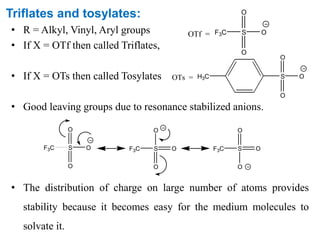
Triflates and tosylates:
• R = Alkyl, Vinyl, Aryl groups
• If X = OTf then called Triflates,
• If X = OTs then called Tosylates
• Good leaving groups due to resonance stabilized anions.
• The distribution of charge on large number of atoms provides
stability because it becomes easy for the medium molecules to
solvate it.
OTf = F3C S
O
O
O
OTs = S
O
O
OH3C
F3C S
O
O
O F3C S
O
O
O F3C S
O
O
O
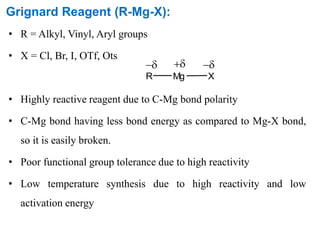
Grignard Reagent (R-Mg-X):
• R = Alkyl, Vinyl, Aryl groups
• X = Cl, Br, I, OTf, Ots
• Highly reactive reagent due to C-Mg bond polarity
• C-Mg bond having less bond energy as compared to Mg-X bond,
so it is easily broken.
• Poor functional group tolerance due to high reactivity
• Low temperature synthesis due to high reactivity and low
activation energy
R Mg X
 
Catalysts:
• Nickel (Ni) or Palladium (Pd)
• Platinum is also of same group (VIIIB) but too expensive
• Complexes of these metals are used e.g. L2M
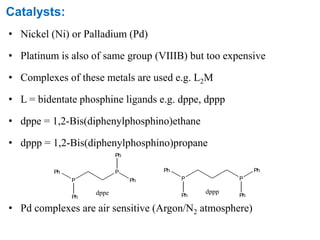
• L = bidentate phosphine ligands e.g. dppe, dppp
• dppe = 1,2-Bis(diphenylphosphino)ethane
• dppp = 1,2-Bis(diphenylphosphino)propane
• Pd complexes are air sensitive (Argon/N2 atmosphere)
P
P
Ph
Ph
Ph
Ph
P P
Ph
Ph
Ph
Phdppe dppp
Solvent:
• Tetrahydrofuran (THF) or Diethylether (DEE)
• Ethereal solvents are used because
• (1) Dry ether avoid reaction of R-Mg-X with moisture
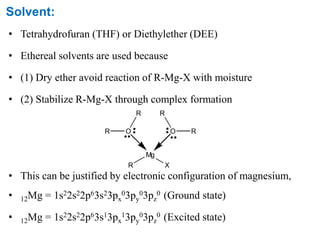
• (2) Stabilize R-Mg-X through complex formation
• This can be justified by electronic configuration of magnesium,
• 12Mg = 1s22s22p63s23px
03py
03pz
0 (Ground state)
• 12Mg = 1s22s22p63s13px
13py
03pz
0 (Excited state)
Mg
R X
O R
R
O
R
R
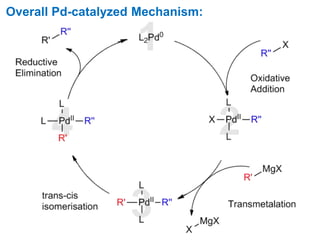
Overall Pd-catalyzed Mechanism:
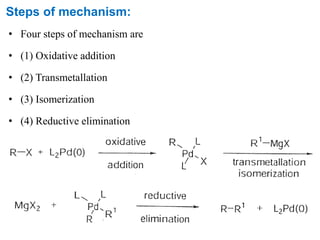
Steps of mechanism:
• Four steps of mechanism are
• (1) Oxidative addition
• (2) Transmetallation
• (3) Isomerization
• (4) Reductive elimination
Step-1, Oxidative addition:
• This step is known to follow concerted mechanism of addition.
• Pd(0) is oxidized to Pd(II)
• R-X is added in concerted way
• Both ‘R’ and ‘X’ are attached to ‘Pd’ through its primary valency.
• Secondary valency ‘4’ is already justified by bidendate ligands.
Pd
L X
L2Pd(0)
R X
L2Pd(0)
R X
R LII
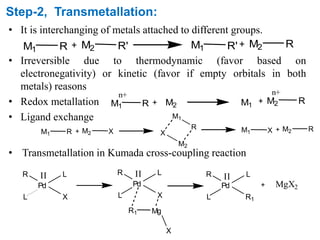
Step-2, Transmetallation:
• It is interchanging of metals attached to different groups.
• Irreversible due to thermodynamic (favor based on
electronegativity) or kinetic (favor if empty orbitals in both
metals) reasons
• Redox metallation
• Ligand exchange
• Transmetallation in Kumada cross-coupling reaction
M1 R M2 R' M1 R' M2 R
M1 R M2 M1
M2 R
n+ n+
M1 R M2 X M1 X M2 R
M1
R
X
M2
Pd
L X
R LII
Pd
L X
R LII
MgR1
X
Pd
L R1
R LII
MgX2
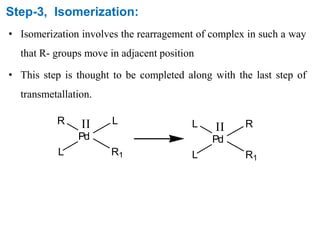
Step-3, Isomerization:
• Isomerization involves the rearragement of complex in such a way
that R- groups move in adjacent position
• This step is thought to be completed along with the last step of
transmetallation.
Pd
L R1
R LII
Pd
L R1
L RII
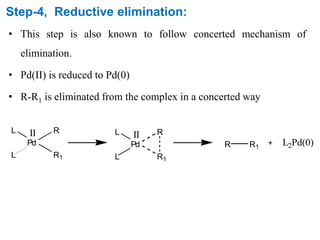
Step-4, Reductive elimination:
• This step is also known to follow concerted mechanism of
elimination.
• Pd(II) is reduced to Pd(0)
• R-R1 is eliminated from the complex in a concerted way
Pd
L R1
L RII
Pd
L R1
L RII
L2Pd(0)R R1
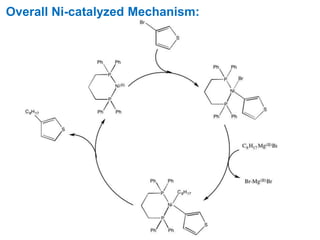
Overall Ni-catalyzed Mechanism:
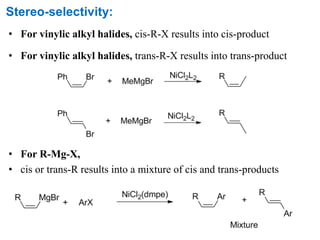
Stereo-selectivity:
• For vinylic alkyl halides, cis-R-X results into cis-product
• For vinylic alkyl halides, trans-R-X results into trans-product
• For R-Mg-X,
• cis or trans-R results into a mixture of cis and trans-products
Enantio-selectivity:
• Asymmetric synthesis by Pladium catalyst with chiral ligands
results into one enantiomeric product (>90%)
A: [Methoxyalkyl(ferrocenyl)] monophosphine
B: bis-oxazoline
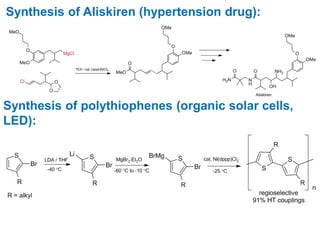
Synthesis of Aliskiren (hypertension drug):
Synthesis of polythiophenes (organic solar cells,
LED):

Kumada cross coupling reaction

  • 1.
  • 2.
    KUMADA CROSS-COUPLING REACTION Dr.Shahid Rasool Kumada Cross-coupling reaction CHEM5128 Advanced Named Reactions 2
  • 3.
    Key Concepts • KumadaCross-Coupling reactions • Discussion of reacting species, catalysts, solvents • Mechanism of reaction • Explanation of mechanism step by step • Synthetic applications 3
  • 4.
    Kumada Cross-coupling Reaction: •Kumada cross-coupling reaction is also known as Kharasch cross- coupling reaction. • Ni or Pd catalyzed cross-coupling reaction • Kumada cross-coupling reaction is between Grignard reagent and organic halides, triflate etc. • Overall reaction is given as, THF, DEE
  • 5.
    Similar Cross-coupling Reactions: •This reaction is similar to following reactions which also Ni or Pd, • Negishi cross-coupling reaction (Organozinc reagents, RZnX) • Stille cross-coupling reaction (Organostannanes reagents, R4Sn) • Hiyama cross-coupling reaction (Organosilicons, RSiF3) • Suzuki cross-coupling reaction (Organoboranes, R3B)
  • 6.
    Alkyl halides (R-X): •R = Alkyl, Vinyl, Aryl groups • High rates have been observed for vinyl or aryl groups • A limitation for alkyl group is that there are chances of elimination if there is β-hydrogen. • X = Cl, Br, I • Order of rate = I > Br > Cl as bond energy R-I > R-Br > R-Cl C2H5- C3H7- Alkyl group CH2 CH Vinyl group Phenyl group Aryl group R R CH2 CH2 X 
  • 7.
    Triflates and tosylates: •R = Alkyl, Vinyl, Aryl groups • If X = OTf then called Triflates, • If X = OTs then called Tosylates • Good leaving groups due to resonance stabilized anions. • The distribution of charge on large number of atoms provides stability because it becomes easy for the medium molecules to solvate it. OTf = F3C S O O O OTs = S O O OH3C F3C S O O O F3C S O O O F3C S O O O
  • 8.
    Grignard Reagent (R-Mg-X): •R = Alkyl, Vinyl, Aryl groups • X = Cl, Br, I, OTf, Ots • Highly reactive reagent due to C-Mg bond polarity • C-Mg bond having less bond energy as compared to Mg-X bond, so it is easily broken. • Poor functional group tolerance due to high reactivity • Low temperature synthesis due to high reactivity and low activation energy R Mg X  
  • 9.
    Catalysts: • Nickel (Ni)or Palladium (Pd) • Platinum is also of same group (VIIIB) but too expensive • Complexes of these metals are used e.g. L2M • L = bidentate phosphine ligands e.g. dppe, dppp • dppe = 1,2-Bis(diphenylphosphino)ethane • dppp = 1,2-Bis(diphenylphosphino)propane • Pd complexes are air sensitive (Argon/N2 atmosphere) P P Ph Ph Ph Ph P P Ph Ph Ph Phdppe dppp
  • 10.
    Solvent: • Tetrahydrofuran (THF)or Diethylether (DEE) • Ethereal solvents are used because • (1) Dry ether avoid reaction of R-Mg-X with moisture • (2) Stabilize R-Mg-X through complex formation • This can be justified by electronic configuration of magnesium, • 12Mg = 1s22s22p63s23px 03py 03pz 0 (Ground state) • 12Mg = 1s22s22p63s13px 13py 03pz 0 (Excited state) Mg R X O R R O R R
  • 11.
  • 12.
    Steps of mechanism: •Four steps of mechanism are • (1) Oxidative addition • (2) Transmetallation • (3) Isomerization • (4) Reductive elimination
  • 13.
    Step-1, Oxidative addition: •This step is known to follow concerted mechanism of addition. • Pd(0) is oxidized to Pd(II) • R-X is added in concerted way • Both ‘R’ and ‘X’ are attached to ‘Pd’ through its primary valency. • Secondary valency ‘4’ is already justified by bidendate ligands. Pd L X L2Pd(0) R X L2Pd(0) R X R LII
  • 14.
    Step-2, Transmetallation: • Itis interchanging of metals attached to different groups. • Irreversible due to thermodynamic (favor based on electronegativity) or kinetic (favor if empty orbitals in both metals) reasons • Redox metallation • Ligand exchange • Transmetallation in Kumada cross-coupling reaction M1 R M2 R' M1 R' M2 R M1 R M2 M1 M2 R n+ n+ M1 R M2 X M1 X M2 R M1 R X M2 Pd L X R LII Pd L X R LII MgR1 X Pd L R1 R LII MgX2
  • 15.
    Step-3, Isomerization: • Isomerizationinvolves the rearragement of complex in such a way that R- groups move in adjacent position • This step is thought to be completed along with the last step of transmetallation. Pd L R1 R LII Pd L R1 L RII
  • 16.
    Step-4, Reductive elimination: •This step is also known to follow concerted mechanism of elimination. • Pd(II) is reduced to Pd(0) • R-R1 is eliminated from the complex in a concerted way Pd L R1 L RII Pd L R1 L RII L2Pd(0)R R1
  • 17.
  • 18.
    Stereo-selectivity: • For vinylicalkyl halides, cis-R-X results into cis-product • For vinylic alkyl halides, trans-R-X results into trans-product • For R-Mg-X, • cis or trans-R results into a mixture of cis and trans-products
  • 19.
    Enantio-selectivity: • Asymmetric synthesisby Pladium catalyst with chiral ligands results into one enantiomeric product (>90%) A: [Methoxyalkyl(ferrocenyl)] monophosphine B: bis-oxazoline
  • 20.
    Synthesis of Aliskiren(hypertension drug): Synthesis of polythiophenes (organic solar cells, LED):