ORIGIN OF COLOUR 
IN 
TRANSITION METAL COMPLEXES
FOR 
CAPE UNIT 1 STUDENTS
INCLUDES THE 6 MAIN POINTS TO GET YOU FULL MARKS IN ANY CAPE QUESTION.
Compiled by Denison at Global in Cunupia. 739-2656.
http://www.facebook.com/CAPEChemistryLessons
YOU WILL LEARN
1. Crystal Field Theory and Ligand Field 
Theory of colour.y
2. 6 main points to be used in answering a 
CAPE question on the origin of colour in 
transition element complexes.p
2Compiled by Denison at Global in Cunupia. 739-2656.
http://www.facebook.com/CAPEChemistryLessons
Origin Of Colour
Thi i l i d b th C t l Fi ld ThThis is explained by the Crystal Field Theory 
and the Ligand Field Theory.
These theories regard the complex (ion) as an 
agglomeration of a central ion surrounded byagglomeration of a central ion surrounded by 
other ions or molecules with electrical fields. 
3Compiled by Denison at Global in Cunupia. 739-2656.
http://www.facebook.com/CAPEChemistryLessons
Origin Of Colour
Th l t i l fi ld f th t l i ill ff tThe electrical field of the central ion will affect 
the surrounding ligands, whilst the combined 
field of the ligands will influence the 
arrangement of electrons in the central ion.g
4Compiled by Denison at Global in Cunupia. 739-2656.
http://www.facebook.com/CAPEChemistryLessons
Origin Of Colour
Th litti f th fi d bit l f thThe splitting of the five d orbitals of the 
central ion into two groups is one of the 
fundamental ideas. In a free ion, as in the Fe3+
ion, the five d orbitals are degenerate, i.e. g
energetically alike.
5Compiled by Denison at Global in Cunupia. 739-2656.
http://www.facebook.com/CAPEChemistryLessons
Origin Of Colour
The five d orbitals are not, however, all alike in , ,
shape and that is why they split up into two 
energetically different groups under theenergetically different groups under the 
influence of the ligand field. 
6Compiled by Denison at Global in Cunupia. 739-2656.
http://www.facebook.com/CAPEChemistryLessons
Origin Of Colour
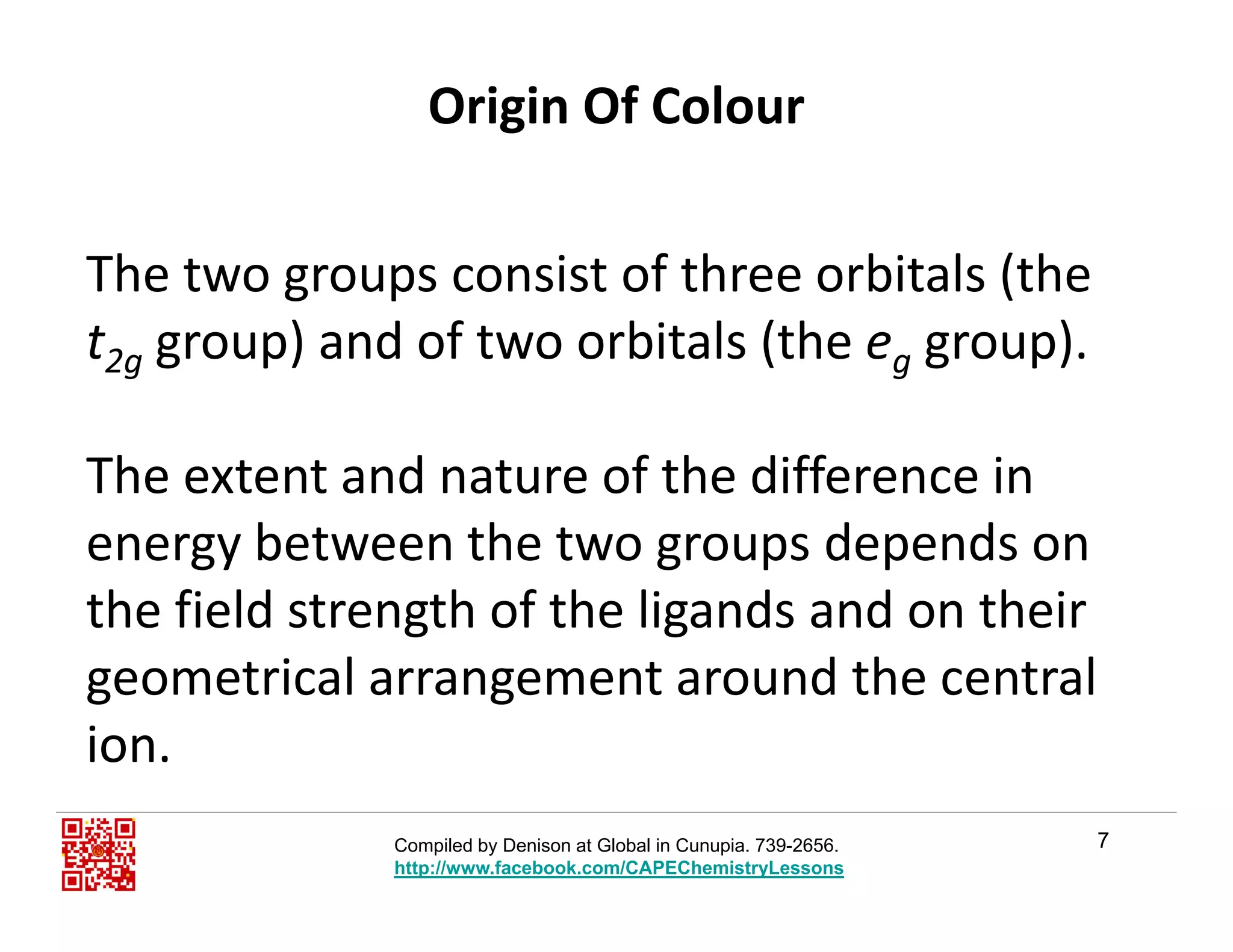
The two groups consist of three orbitals (the g p (
t2g group) and of two orbitals (the eg group).
The extent and nature of the difference in 
energy between the two groups depends onenergy between the two groups depends on 
the field strength of the ligands and on their 
geometrical arrangement around the central 
ion.
7Compiled by Denison at Global in Cunupia. 739-2656.
http://www.facebook.com/CAPEChemistryLessons
Origin Of Colour
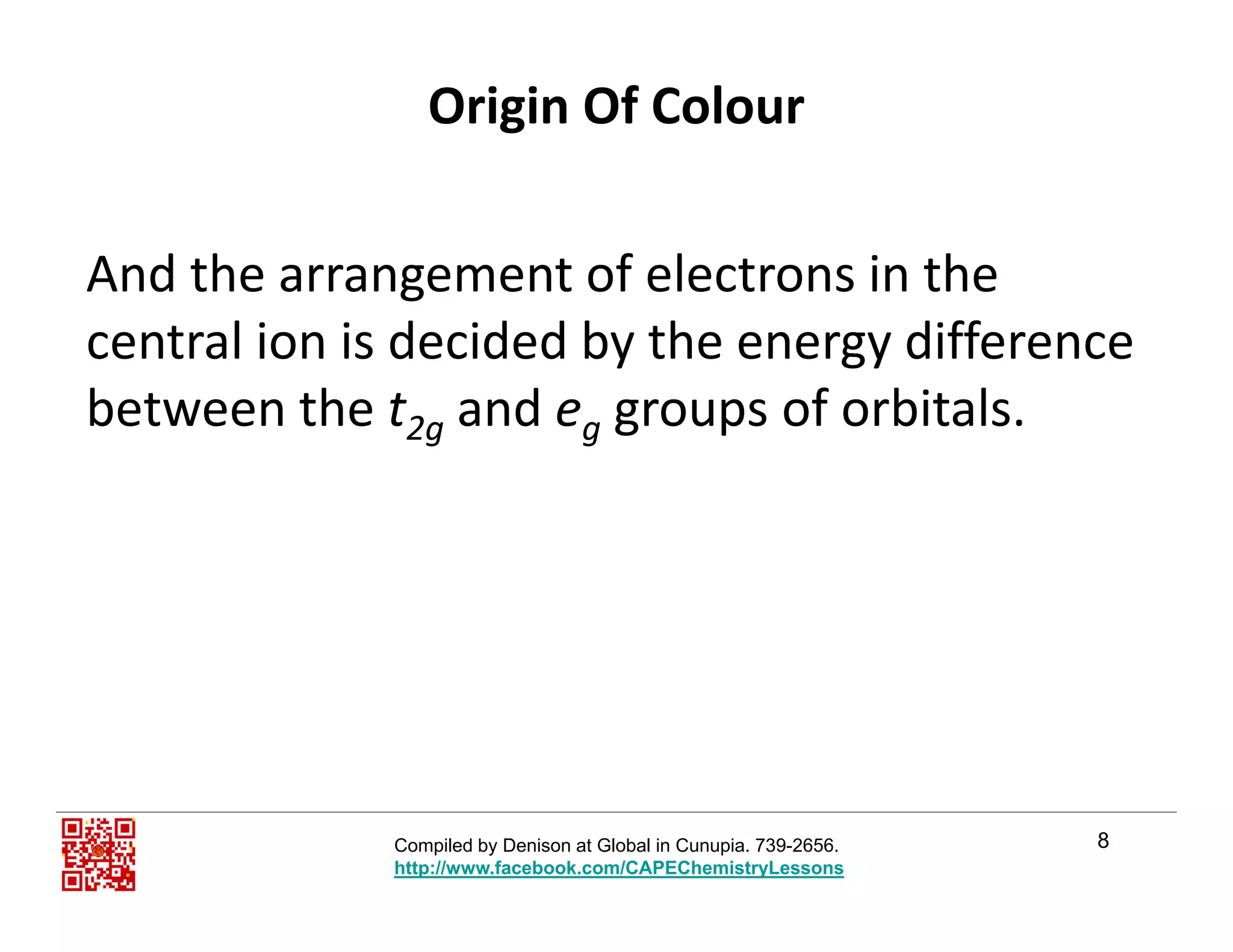
And the arrangement of electrons in the g
central ion is decided by the energy difference 
between the t2 and e groups of orbitalsbetween the t2g and eg groups of orbitals.
8Compiled by Denison at Global in Cunupia. 739-2656.
http://www.facebook.com/CAPEChemistryLessons
Origin Of Colour
The colour of a particular transition metal ion p
depends upon the nature of the ligands 
(either neutral molecules such as water which(either neutral molecules such as water which 
contain lone pairs or negative ions such as the 
chloride ion) bonded to the ionchloride ion) bonded to the ion.
9Compiled by Denison at Global in Cunupia. 739-2656.
http://www.facebook.com/CAPEChemistryLessons
Origin Of Colour
The pale blue hydrated copper(II) ion changes p y pp ( ) g
to dark blue in the presence of ammonia and 
to green if sufficient chloride ions are added;to green if sufficient chloride ions are added; 
copper(II) chloride solution is therefore either 
blue or green depending upon the relativeblue or green, depending upon the relative 
concentrations of water molecules and 
chloride ions.
10Compiled by Denison at Global in Cunupia. 739-2656.
http://www.facebook.com/CAPEChemistryLessons
Origin Of Colour
The colour of a transition metal ion is 
associated with:
(a) An incomplete d level (between 1 and 9 
d electrons)d electrons).
(b) The nature of the ligands surrounding the 
ion.
11Compiled by Denison at Global in Cunupia. 739-2656.
http://www.facebook.com/CAPEChemistryLessons
Origin Of Colour
A complete theory of colour is very complex 
but, put simply, it is due to the movement of 
electrons from one d level to another. 
12Compiled by Denison at Global in Cunupia. 739-2656.
http://www.facebook.com/CAPEChemistryLessons
Origin Of Colour
Si th fi t 3d bit lSince the five separate 3d orbitals are 
orientated differently in space an electron (or 
electrons) which is close to a ligand will be 
repelled and hence the energy of such orbitals p gy
will be raised relative to the others. 
13Compiled by Denison at Global in Cunupia. 739-2656.
http://www.facebook.com/CAPEChemistryLessons
Origin Of Colour
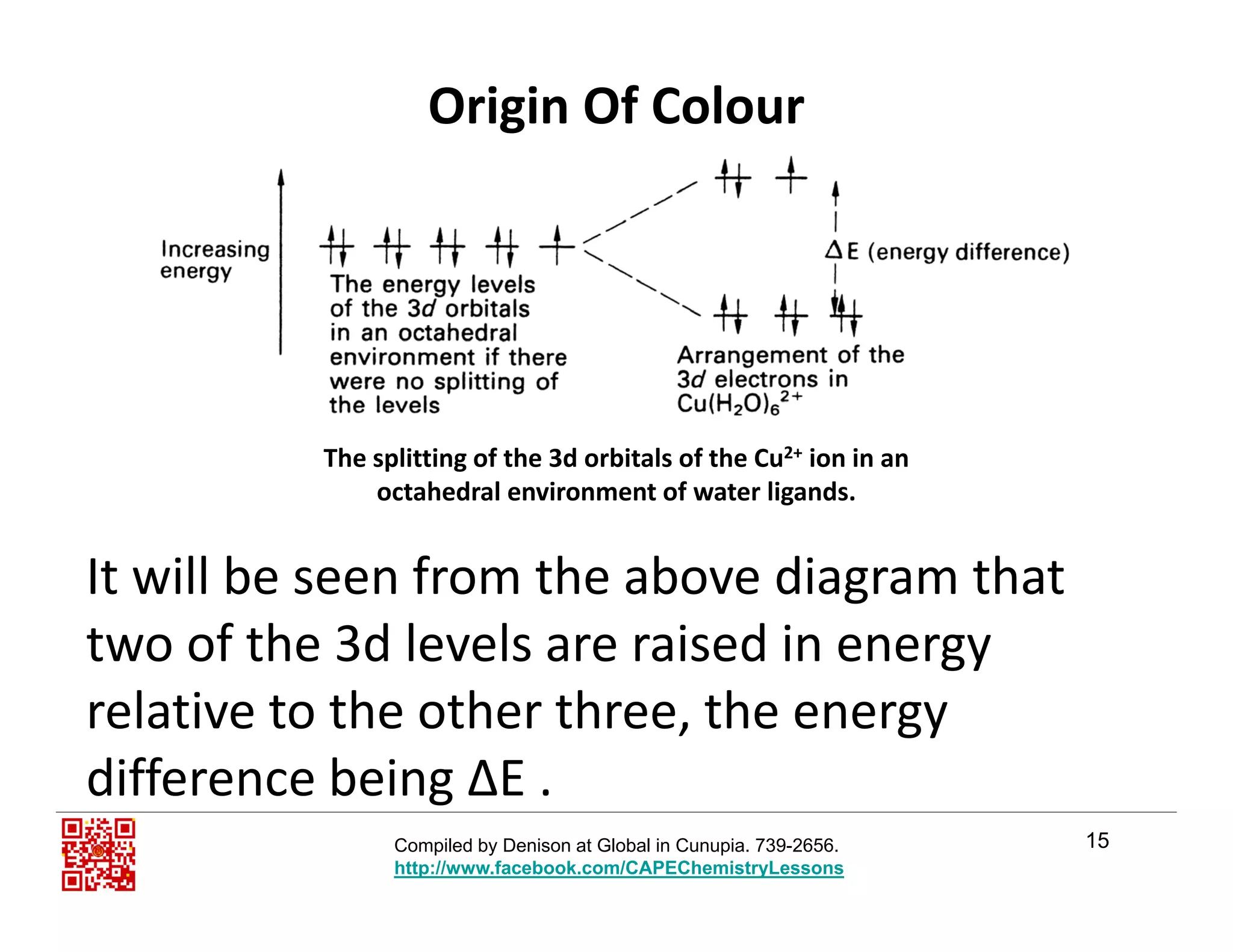
Th d f th 3d l l i th fThe degeneracy of the 3d levels is therefore 
destroyed; this is represented pictorially, for 
the copper(II) ion, in the following diagram.
14Compiled by Denison at Global in Cunupia. 739-2656.
http://www.facebook.com/CAPEChemistryLessons
Origin Of Colour
The splitting of the 3d orbitals of the Cu2+ ion in an 
octahedral environment of water ligands.
It will be seen from the above diagram that 
two of the 3d levels are raised in energytwo of the 3d levels are raised in energy 
relative to the other three, the energy 
difference being ΔE
15
difference being ΔE .
Compiled by Denison at Global in Cunupia. 739-2656.
http://www.facebook.com/CAPEChemistryLessons
Origin Of Colour
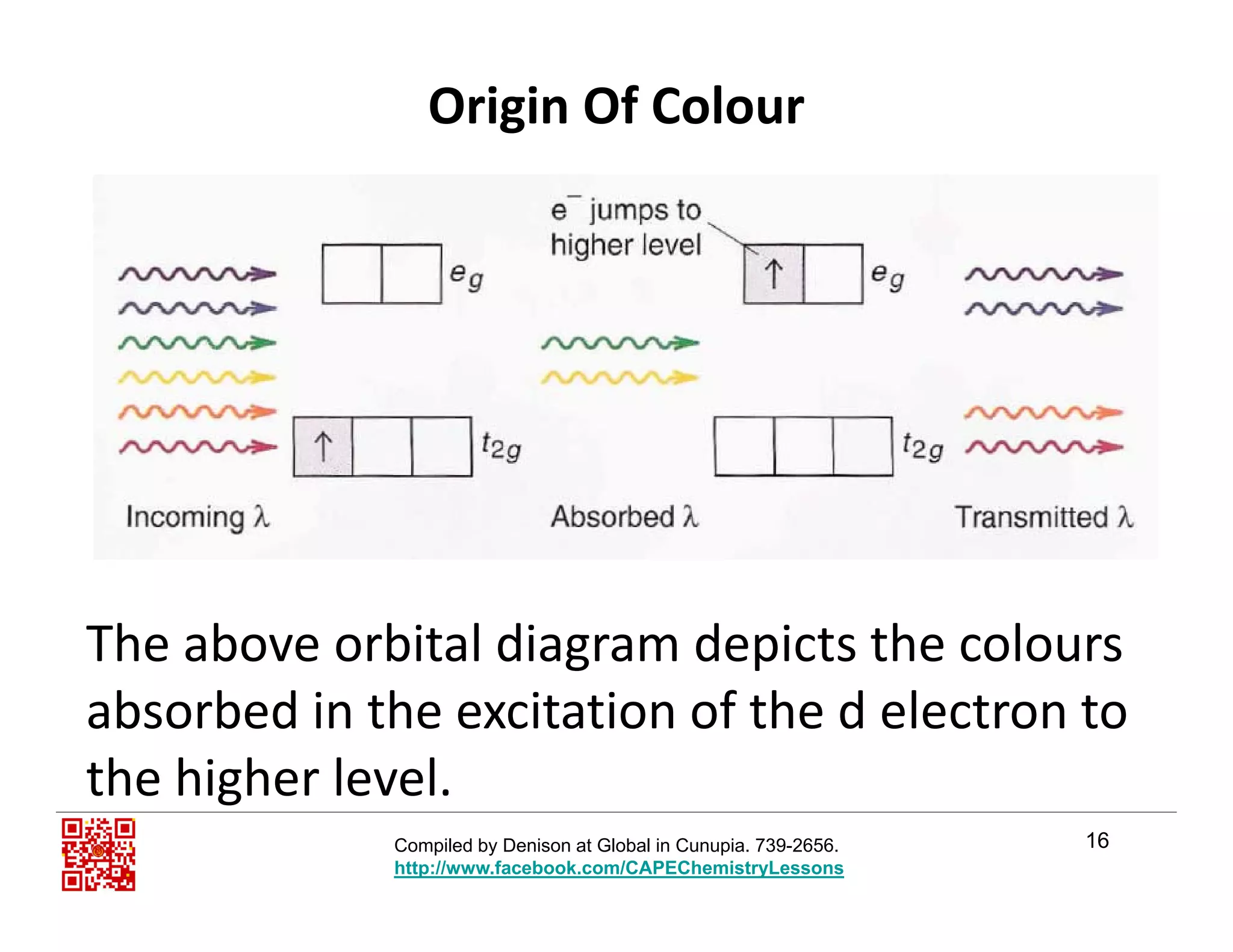
The above orbital diagram depicts the coloursThe above orbital diagram depicts the colours 
absorbed in the excitation of the d electron to
the higher level
16
the higher level.
Compiled by Denison at Global in Cunupia. 739-2656.
http://www.facebook.com/CAPEChemistryLessons
Origin Of Colour
Si th d f litti f th 3d l lSince the degree of splitting of the 3d levels 
depends upon the particular ligands 
themselves, the variation in colour of ions of a 
particular transition metal is explained.p p
17Compiled by Denison at Global in Cunupia. 739-2656.
http://www.facebook.com/CAPEChemistryLessons
Origin Of Colour
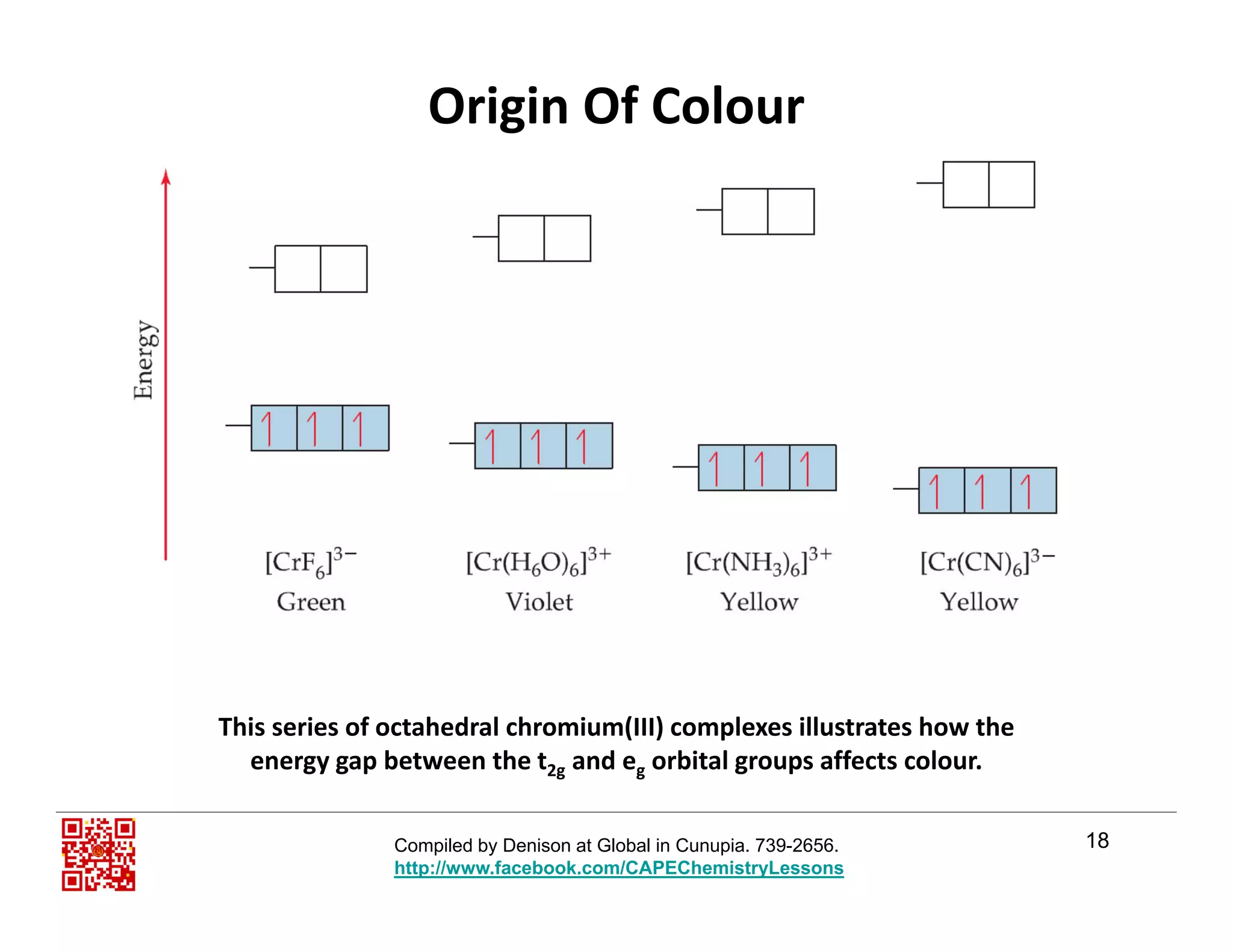
This series of octahedral chromium(III) complexes illustrates how the 
energy gap between the t2g and eg orbital groups affects colour.
18
2g g
Compiled by Denison at Global in Cunupia. 739-2656.
http://www.facebook.com/CAPEChemistryLessons
Origin Of Colour
Ab ti t h th l thAbsorption spectra show the wavelengths 
absorbed by a given metal ion with
different ligands and by different metal ions 
with the same ligand. From suchg
data, we relate the energy of the absorbed 
light to the Δ values, and two importantlight to the Δ values, and two important
observations emerge:
19Compiled by Denison at Global in Cunupia. 739-2656.
http://www.facebook.com/CAPEChemistryLessons
Origin Of Colour
1. For a given ligand, the colour depends 
th id ti t t f th t l ion the oxidation state of the metal ion.
A solution of [V(H2O)6]2+ ion is violet, and 
a solution of [V(H2O)6]3+ ion is yellow.
Solutions of [V(H2O)6]2+ (left) and[V(H2O)6]3+ (right) ions have different colours.
20
2 6 2 6
Compiled by Denison at Global in Cunupia. 739-2656.
http://www.facebook.com/CAPEChemistryLessons
Origin Of Colour
2. For a given metal ion, the colour 
d d th li d E i ldepends on the ligand. Even a single 
ligand substitution can have a major 
effect on the wavelengths absorbed and, 
thus, the colour, as you can see for two y
Cr3+ complex ions below.
A change in even a single ligand can influence the colour. The [Cr(NH3)6]3+ ion is yellow‐
21
3 6
orange (left); the [Cr(NH3)5CI]2+ ion is purple (right).
Compiled by Denison at Global in Cunupia. 739-2656.
http://www.facebook.com/CAPEChemistryLessons
CAPE has asked this 
question only twice in q y
the last 10 years.y
22Compiled by Denison at Global in Cunupia. 739-2656.
http://www.facebook.com/CAPEChemistryLessons
CAPE has asked this 
question only twice in q y
the last 10 years.y
(In fact they’ve only asked it twice              
in the history of the exams.)
23Compiled by Denison at Global in Cunupia. 739-2656.
http://www.facebook.com/CAPEChemistryLessons
In 2009 it went like this:
“Use the distribution in the d‐orbitals to 
account for colour in transition metal ions.f
[2 marks]”
24Compiled by Denison at Global in Cunupia. 739-2656.
http://www.facebook.com/CAPEChemistryLessons
In 2009 it went like this:
“Use the distribution in the d‐orbitals to 
account for colour in transition metal ions.f
[2 marks]”
and in 2007 it went like this:and in 2007 it went like this:
“Account for the origin of colour in transitionAccount for the origin of colour in transition 
metal complexes. [4 marks]”
25Compiled by Denison at Global in Cunupia. 739-2656.
http://www.facebook.com/CAPEChemistryLessons
NEVER MIND THE DIFFERENCE                 
IN MARKS ALLOCATEDIN MARKS ALLOCATED.
26Compiled by Denison at Global in Cunupia. 739-2656.
http://www.facebook.com/CAPEChemistryLessons
NEVER MIND THE DIFFERENCE                 
IN MARKS ALLOCATEDIN MARKS ALLOCATED.
Once you use the following 6 points in your 
answer, even if the question counts for 6 
marks, you’re getting all of them.y g g
27Compiled by Denison at Global in Cunupia. 739-2656.
http://www.facebook.com/CAPEChemistryLessons
Main Points For Answering A CAPE Question
1 If the ion has partially filled d orbitals it1. If the ion has partially filled d orbitals, it
will be coloured. Sc3+ and Ti4+ have d0
structures and Cu+ and Zn2+ have d10 andstructures, and Cu+ and Zn2+ have d10 and 
so are not coloured.
28Compiled by Denison at Global in Cunupia. 739-2656.
http://www.facebook.com/CAPEChemistryLessons
Main Points For Answering A CAPE Question
2 d orbitals point in different directions in2. d orbitals point in different directions in 
space, and so interact to different extents 
with the electrons in the ligandswith the electrons in the ligands.
29Compiled by Denison at Global in Cunupia. 739-2656.
http://www.facebook.com/CAPEChemistryLessons
Main Points For Answering A CAPE Question
3. This causes a splitting of the d orbitals
into two groups of higher energy and
lower energy.gy
30Compiled by Denison at Global in Cunupia. 739-2656.
http://www.facebook.com/CAPEChemistryLessons
Main Points For Answering A CAPE Question
4. When white light is shone into the 
substance, a d electron is moved from
the lower energy to the higher energy gy g gy
level.
31Compiled by Denison at Global in Cunupia. 739-2656.
http://www.facebook.com/CAPEChemistryLessons
Main Points For Answering A CAPE Question
5. The frequency of the light that causes 
this jump is in the visible range, so that 
colour at this frequency is removed from q y
the white light. The colour not removed 
is seen as the colour of the complex (ion).is seen as the colour of the complex (ion).
32Compiled by Denison at Global in Cunupia. 739-2656.
http://www.facebook.com/CAPEChemistryLessons
Main Points For Answering A CAPE Question
6. The colour depends on the size of the 
energy gap which varies with the metal 
ion and with the type of ligand.yp g
33Compiled by Denison at Global in Cunupia. 739-2656.
http://www.facebook.com/CAPEChemistryLessons
END
Found this helpful?
If so, follow me on facebook for more:
http://www.facebook.com/CAPEChemistryLessons
Compiled By Denison At Global In Cunupia. 739-2656.

Transition Elements - Origin Of Colour