CRYSTAL FIELD THEORY
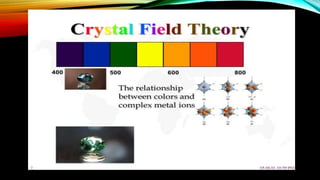
Colour Properties
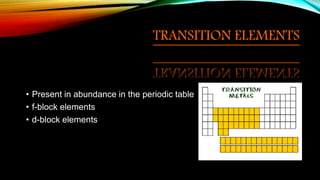
TRANSITION ELEMENTS
• Present in abundance in the periodic table
• f-block elements
• d-block elements
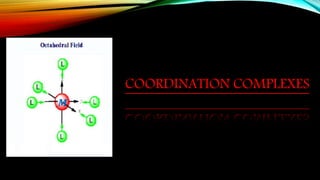
COORDINATION COMPLEXES
𝑴
MAGNETIC & COLOUR PROPERTIES
WHY CFT???
 Werner’s Theory
 Valence Bond Theory
COULD NOT
EXPLAIN THE
COLOUR
PROPERTIES
Introduction To CFT
• Proposed by Bethe and van Vleck.
• Orgel used the concept of crystal field theory to define nature of
bonding between ligands and metals.
• It defines the bonding in ionic crystals due to which
this theory is known as crystal field theory.
• Crystal field theory (CFT) explains many important properties of
transition-metal complexes, including their
ocolours,
omagnetism,
ostructures,
ostability, and
oreactivity
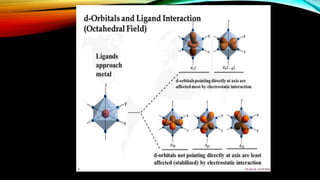
• d-orbitals are degenerate
• BUT, when ligands get
attached and are uniformly
distributed; their energy gets
higher
• IF, the ligands are oriented at
the axes i.e. x, y and z, the
degeneracy gets removed and
the d-orbitals split into two
groups [ 𝐞 𝒈 & 𝐭2𝑔]
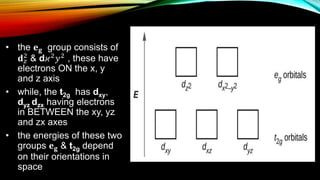
• the 𝐞 𝐠 group consists of
𝐝 𝑧
2 & d𝜘2 𝑦2 , these have
electrons ON the x, y
and z axis
• while, the t2g has dxy,
dyz dzx having electrons
in BETWEEN the xy, yz
and zx axes
• the energies of these two
groups 𝐞 𝐠 & t2g depend
on their orientations in
space
APPEARANCE OF COLOURS
• The striking colours that these metal complexes show are because
of the d-d transition of electrons in the d-orbitals
• Involves the jumping of electrons from lower energy orbitals and
their subsequent jumping back
• Jumping occurs when electrons get excited
• In case of colour properties, excitation is caused by photons of
visible light
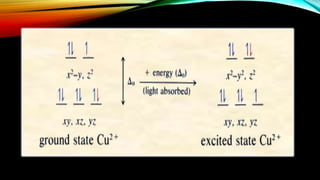
• A photon of light can excite and can cause jumping, if its energy is
equal to the crystal field splitting energy (Δo) (CFSE)
• CFSE is the difference in energy between the two sets of d-orbitals
• Energy is absorbed and then released, respectively
COLORS & HOW WE
PERCEIVE IT
800
430
650 580
560
490
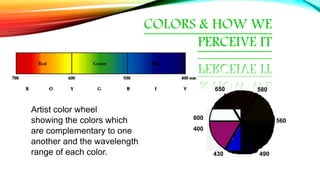
Artist color wheel
showing the colors which
are complementary to one
another and the wavelength
range of each color.
400
BLACK & WHITE
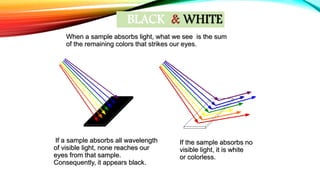
If a sample absorbs all wavelength
of visible light, none reaches our
eyes from that sample.
Consequently, it appears black.
When a sample absorbs light, what we see is the sum
of the remaining colors that strikes our eyes.
If the sample absorbs no
visible light, it is white
or colorless.
COMPLEX INFLUENCE ON
COLOR
[Fe(H2O)6]3+
[Co(H2O)6]2+
[Ni(H2O)6]2+
[Cu(H2O)6]2+
[Zn(H2O)6]2+
800
430
650 580
560
490
400
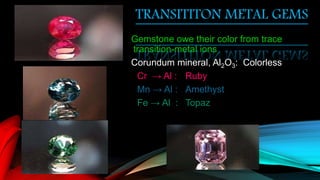
Gemstone owe their color from trace
transition-metal ions
Corundum mineral, Al2O3: Colorless
Cr → Al : Ruby
Mn → Al : Amethyst
Fe → Al : Topaz
TRANSITITON METAL GEMS
Ti & Co Al: Sapphire
Beryl mineral, Be3 Al 2Si6O18: Colorless
Cr → Al : Emerald
Fe → Al : Aquamarine
LIMITATIONS OF CFT
1. This theory does not consider the splitting of the orbital other than d
orbital.
2. The order of ligand in the Spectro-chemical series can not be
explained solely on electrostatic ground.
THANK YOU!!! 

Crystal field theory

  • 1.
  • 2.
    TRANSITION ELEMENTS • Presentin abundance in the periodic table • f-block elements • d-block elements
  • 3.
  • 4.
  • 6.
    WHY CFT???  Werner’sTheory  Valence Bond Theory COULD NOT EXPLAIN THE COLOUR PROPERTIES
  • 7.
    Introduction To CFT •Proposed by Bethe and van Vleck. • Orgel used the concept of crystal field theory to define nature of bonding between ligands and metals. • It defines the bonding in ionic crystals due to which this theory is known as crystal field theory.
  • 8.
    • Crystal fieldtheory (CFT) explains many important properties of transition-metal complexes, including their ocolours, omagnetism, ostructures, ostability, and oreactivity
  • 10.
    • d-orbitals aredegenerate • BUT, when ligands get attached and are uniformly distributed; their energy gets higher • IF, the ligands are oriented at the axes i.e. x, y and z, the degeneracy gets removed and the d-orbitals split into two groups [ 𝐞 𝒈 & 𝐭2𝑔]
  • 11.
    • the 𝐞𝐠 group consists of 𝐝 𝑧 2 & d𝜘2 𝑦2 , these have electrons ON the x, y and z axis • while, the t2g has dxy, dyz dzx having electrons in BETWEEN the xy, yz and zx axes • the energies of these two groups 𝐞 𝐠 & t2g depend on their orientations in space
  • 13.
    APPEARANCE OF COLOURS •The striking colours that these metal complexes show are because of the d-d transition of electrons in the d-orbitals • Involves the jumping of electrons from lower energy orbitals and their subsequent jumping back • Jumping occurs when electrons get excited • In case of colour properties, excitation is caused by photons of visible light • A photon of light can excite and can cause jumping, if its energy is equal to the crystal field splitting energy (Δo) (CFSE) • CFSE is the difference in energy between the two sets of d-orbitals • Energy is absorbed and then released, respectively
  • 15.
    COLORS & HOWWE PERCEIVE IT 800 430 650 580 560 490 Artist color wheel showing the colors which are complementary to one another and the wavelength range of each color. 400
  • 16.
    BLACK & WHITE Ifa sample absorbs all wavelength of visible light, none reaches our eyes from that sample. Consequently, it appears black. When a sample absorbs light, what we see is the sum of the remaining colors that strikes our eyes. If the sample absorbs no visible light, it is white or colorless.
  • 17.
  • 18.
    Gemstone owe theircolor from trace transition-metal ions Corundum mineral, Al2O3: Colorless Cr → Al : Ruby Mn → Al : Amethyst Fe → Al : Topaz TRANSITITON METAL GEMS
  • 19.
    Ti & CoAl: Sapphire Beryl mineral, Be3 Al 2Si6O18: Colorless Cr → Al : Emerald Fe → Al : Aquamarine
  • 20.
    LIMITATIONS OF CFT 1.This theory does not consider the splitting of the orbital other than d orbital. 2. The order of ligand in the Spectro-chemical series can not be explained solely on electrostatic ground.
  • 21.

Editor's Notes

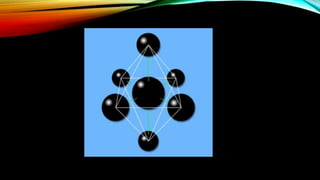
  • #10 CFT focuses on the interaction of the five degenerate d-orbitals with ligands arranged in a regular array around a transition-metal ion. Mostly octahedral complexes (because they are the most common and the easiest to visualize. Other common structures, such as square planar complexes, can be treated as a distortion of the octahedral model.) The octahedral geometry is easily found because since the ligands interact with one other electrostatically, the lowest-energy arrangement of six identical negative charges is an octahedron, which minimizes repulsive interactions between the ligands and prevents the distortion of the octahedron. The occurrence of distortion depends on the strength and size of the approaching ligands.
  • #11 Gauss’s Law (when charge is uniformly distributed over a sphere then the overall charge is zero or unaffected)