DYES
Dr. Nilesh R. Thakare
Intorduction
 “Dyes are coloured substances capable of
being fixed to fabrics like silk, wool and cotton
and other substances such as paper, leather.
When fixed, dyes must be fast to light and
resistant to the action of water, dilute acids,
alkali solution and bleaching.”
Two important conditions for a coloured
compound to act as a dye are-
 Presence of Chromophore :-
These are the groups which are responsible for producing colour to
a dye because they are capable of absorbing light in the near U.V.
region.
Some important chromophores are ;
─N═O, ─NO2, ─N═N, >C═O, ═C═S, ─C≡N, etc.
The compounds bearing chromophores are known as chromogens.
 Presence of auxochromes :-
Dye must be attached to fibres by means of stable chemical bonds.
Those bonds are formed by some acidic or basic groups. Such
groups are known as auxochromes.
e.g. ─OH, ─COOH, ─SO3H (acidic)
─NH2, ─NHR, ─NR2 (basic)
Classification
1. Classification of dyes on the basis of structure
Depending upon the type of chromophore present in
their structures the dyes are classified into following
main types.
 Nitro and Nitroso dyes.
 Azo dyes.
 Triphenyl methane dyes.
 Phthalein dyes.
 Indigoid and Thioindigoid dyes.
 Anthraquinone dyes.
 Miscellaneous dyes. (Azine dyes, sulphur dyes,
xanthene dyes, phthalo-cyanine dyes )
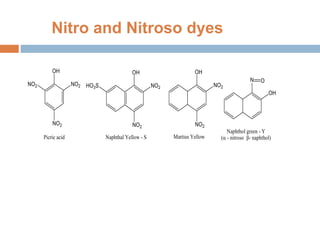
Nitro and Nitroso dyes
 These are polynitro derivatives of phenols and
naphthols in which at least one nitro (-NO2)
group or nitroso (-N=O) group is ortho or para
to the -OH group. Colours of these dyes are
not fast and hence they are industrially less
important.
 Naphhthol yellow-S is one of the dyes used for
colouring edible materials.
Nitro and Nitroso dyes
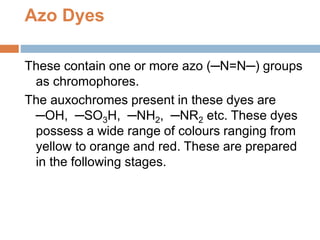
Azo Dyes
These contain one or more azo (─N=N─) groups
as chromophores.
The auxochromes present in these dyes are
─OH, ─SO3H, ─NH2, ─NR2 etc. These dyes
possess a wide range of colours ranging from
yellow to orange and red. These are prepared
in the following stages.
Methyl Orange
It is an azo dye containing one azo N=N group.It
also contains SO3H group (acidic) making it
more souble.
 Preparation :-
Step- 1: Diazotisation of sulphanilic Acid
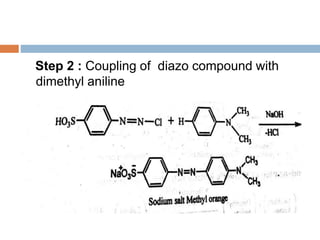
Step 2 : Coupling of diazo compound with
dimethyl aniline
Properties and Uses
 Water is soluble because it contains acidic -SO3H
group.
 It is not sufficiently fast to light and soap. Hence it
is used as a dye.
 It is generally isolated as the sodium salt, which is
used as dyeing.
 It imparts orange colour to wool and silk.
 It is used as an indicator in acid alkali titration. It is
orange in alkaline solution an red in acid solution.
The change in the structure of the ion.
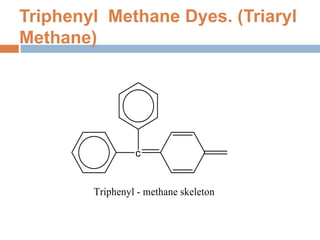
Triphenyl Methane Dyes. (Triaryl
Methane)
Crystal Violet
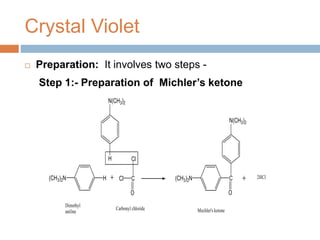
 Preparation: It involves two steps -
Step 1:- Preparation of Michler’s ketone
Step 2 : Condensation of Michler’s ketone with
dimethyl aniline
Properties and Uses
 This dye forms large crystals which are violet in colour. Hence
the name Crystal violet.
 It is soluble in water and gives deep blue colour.
 It dyes wool, silk and tannin mordanted cotton fibre.
Uses
 In the manufacture of inks, stamping pads and type –writer
ribbons.
 As an indicator to find out H+ ion concentration of solution.
 Gentian violet (a combination of crystal violet and methyl
violet) is used as an antiseptic for certain skin diseases like
burn, ulcers and also used for washing the wounds.
 Used as biological stain.
 Used in making pencils.
Phthalin Dyes
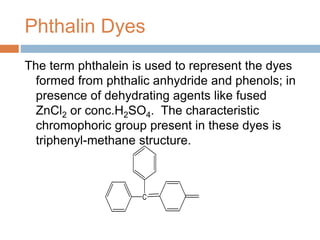
The term phthalein is used to represent the dyes
formed from phthalic anhydride and phenols; in
presence of dehydrating agents like fused
ZnCl2 or conc.H2SO4. The characteristic
chromophoric group present in these dyes is
triphenyl-methane structure.
Phenolphthalin:-
Indigoid and thioindigoid
Dyes
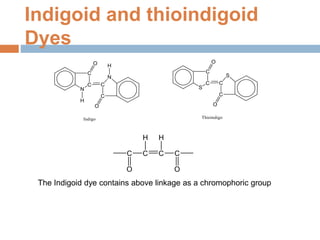
The Indigoid dye contains above linkage as a chromophoric group
Preparation:-
Indigo is used on large scale for dyeing
cotton by vat process. The fabric is soaked
in solution of indigo and then exposed to
air when fabrics gets a dark blue colour
which is extremely fast to washing.
Thioindigoids:-
Thioindigo is similar to indigo but differs only in one
respect that in place of two ─NH groups there are
two ‘S’ -atoms . Thioindigo is used to dye cotton,
wool and polyester.
Anthraquinone Dyes:-
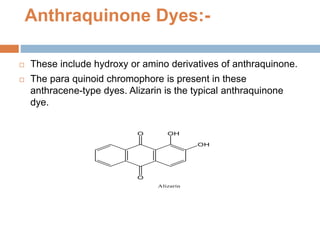
 These include hydroxy or amino derivatives of anthraquinone.
 The para quinoid chromophore is present in these
anthracene-type dyes. Alizarin is the typical anthraquinone
dye.
Preparation of Alizarin:-
 Step : 1 Preparation of
Anthraquinone
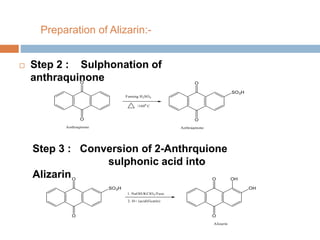
 Step 2 : Sulphonation of
anthraquinone
Step 3 : Conversion of 2-Anthrquione
sulphonic acid into
Alizarin
Preparation of Alizarin:-
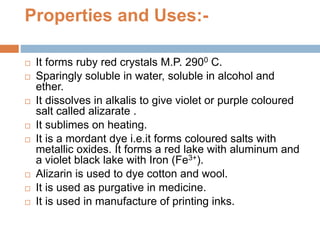
Properties and Uses:-
 It forms ruby red crystals M.P. 2900 C.
 Sparingly soluble in water, soluble in alcohol and
ether.
 It dissolves in alkalis to give violet or purple coloured
salt called alizarate .
 It sublimes on heating.
 It is a mordant dye i.e.it forms coloured salts with
metallic oxides. It forms a red lake with aluminum and
a violet black lake with Iron (Fe3+).
 Alizarin is used to dye cotton and wool.
 It is used as purgative in medicine.
 It is used in manufacture of printing inks.
Exercise :
 What are Dyes
 Discuss properties and Uses of Crystal Violet
 Discuss Classification of Dyes
 What are Indigoids and Thioindigoids
 Give Preparation, Properties and uses of
Alizarin
 Give Preparation, Properties and uses of
Methyl Orange
 Explain with example Chromophore and
Auxochrome
Dyes ppt

Dyes ppt

  • 1.
  • 2.
    Intorduction  “Dyes arecoloured substances capable of being fixed to fabrics like silk, wool and cotton and other substances such as paper, leather. When fixed, dyes must be fast to light and resistant to the action of water, dilute acids, alkali solution and bleaching.”
  • 3.
    Two important conditionsfor a coloured compound to act as a dye are-  Presence of Chromophore :- These are the groups which are responsible for producing colour to a dye because they are capable of absorbing light in the near U.V. region. Some important chromophores are ; ─N═O, ─NO2, ─N═N, >C═O, ═C═S, ─C≡N, etc. The compounds bearing chromophores are known as chromogens.  Presence of auxochromes :- Dye must be attached to fibres by means of stable chemical bonds. Those bonds are formed by some acidic or basic groups. Such groups are known as auxochromes. e.g. ─OH, ─COOH, ─SO3H (acidic) ─NH2, ─NHR, ─NR2 (basic)
  • 4.
    Classification 1. Classification ofdyes on the basis of structure Depending upon the type of chromophore present in their structures the dyes are classified into following main types.  Nitro and Nitroso dyes.  Azo dyes.  Triphenyl methane dyes.  Phthalein dyes.  Indigoid and Thioindigoid dyes.  Anthraquinone dyes.  Miscellaneous dyes. (Azine dyes, sulphur dyes, xanthene dyes, phthalo-cyanine dyes )
  • 5.
    Nitro and Nitrosodyes  These are polynitro derivatives of phenols and naphthols in which at least one nitro (-NO2) group or nitroso (-N=O) group is ortho or para to the -OH group. Colours of these dyes are not fast and hence they are industrially less important.  Naphhthol yellow-S is one of the dyes used for colouring edible materials.
  • 6.
  • 7.
    Azo Dyes These containone or more azo (─N=N─) groups as chromophores. The auxochromes present in these dyes are ─OH, ─SO3H, ─NH2, ─NR2 etc. These dyes possess a wide range of colours ranging from yellow to orange and red. These are prepared in the following stages.
  • 8.
  • 9.
    It is anazo dye containing one azo N=N group.It also contains SO3H group (acidic) making it more souble.  Preparation :- Step- 1: Diazotisation of sulphanilic Acid
  • 10.
    Step 2 :Coupling of diazo compound with dimethyl aniline
  • 11.
    Properties and Uses Water is soluble because it contains acidic -SO3H group.  It is not sufficiently fast to light and soap. Hence it is used as a dye.  It is generally isolated as the sodium salt, which is used as dyeing.  It imparts orange colour to wool and silk.  It is used as an indicator in acid alkali titration. It is orange in alkaline solution an red in acid solution. The change in the structure of the ion.
  • 12.
    Triphenyl Methane Dyes.(Triaryl Methane)
  • 13.
    Crystal Violet  Preparation:It involves two steps - Step 1:- Preparation of Michler’s ketone
  • 14.
    Step 2 :Condensation of Michler’s ketone with dimethyl aniline
  • 16.
    Properties and Uses This dye forms large crystals which are violet in colour. Hence the name Crystal violet.  It is soluble in water and gives deep blue colour.  It dyes wool, silk and tannin mordanted cotton fibre. Uses  In the manufacture of inks, stamping pads and type –writer ribbons.  As an indicator to find out H+ ion concentration of solution.  Gentian violet (a combination of crystal violet and methyl violet) is used as an antiseptic for certain skin diseases like burn, ulcers and also used for washing the wounds.  Used as biological stain.  Used in making pencils.
  • 17.
    Phthalin Dyes The termphthalein is used to represent the dyes formed from phthalic anhydride and phenols; in presence of dehydrating agents like fused ZnCl2 or conc.H2SO4. The characteristic chromophoric group present in these dyes is triphenyl-methane structure.
  • 18.
  • 19.
    Indigoid and thioindigoid Dyes TheIndigoid dye contains above linkage as a chromophoric group
  • 20.
    Preparation:- Indigo is usedon large scale for dyeing cotton by vat process. The fabric is soaked in solution of indigo and then exposed to air when fabrics gets a dark blue colour which is extremely fast to washing.
  • 21.
    Thioindigoids:- Thioindigo is similarto indigo but differs only in one respect that in place of two ─NH groups there are two ‘S’ -atoms . Thioindigo is used to dye cotton, wool and polyester.
  • 22.
    Anthraquinone Dyes:-  Theseinclude hydroxy or amino derivatives of anthraquinone.  The para quinoid chromophore is present in these anthracene-type dyes. Alizarin is the typical anthraquinone dye.
  • 23.
    Preparation of Alizarin:- Step : 1 Preparation of Anthraquinone
  • 24.
     Step 2: Sulphonation of anthraquinone Step 3 : Conversion of 2-Anthrquione sulphonic acid into Alizarin Preparation of Alizarin:-
  • 25.
    Properties and Uses:- It forms ruby red crystals M.P. 2900 C.  Sparingly soluble in water, soluble in alcohol and ether.  It dissolves in alkalis to give violet or purple coloured salt called alizarate .  It sublimes on heating.  It is a mordant dye i.e.it forms coloured salts with metallic oxides. It forms a red lake with aluminum and a violet black lake with Iron (Fe3+).  Alizarin is used to dye cotton and wool.  It is used as purgative in medicine.  It is used in manufacture of printing inks.
  • 26.
    Exercise :  Whatare Dyes  Discuss properties and Uses of Crystal Violet  Discuss Classification of Dyes  What are Indigoids and Thioindigoids  Give Preparation, Properties and uses of Alizarin  Give Preparation, Properties and uses of Methyl Orange  Explain with example Chromophore and Auxochrome