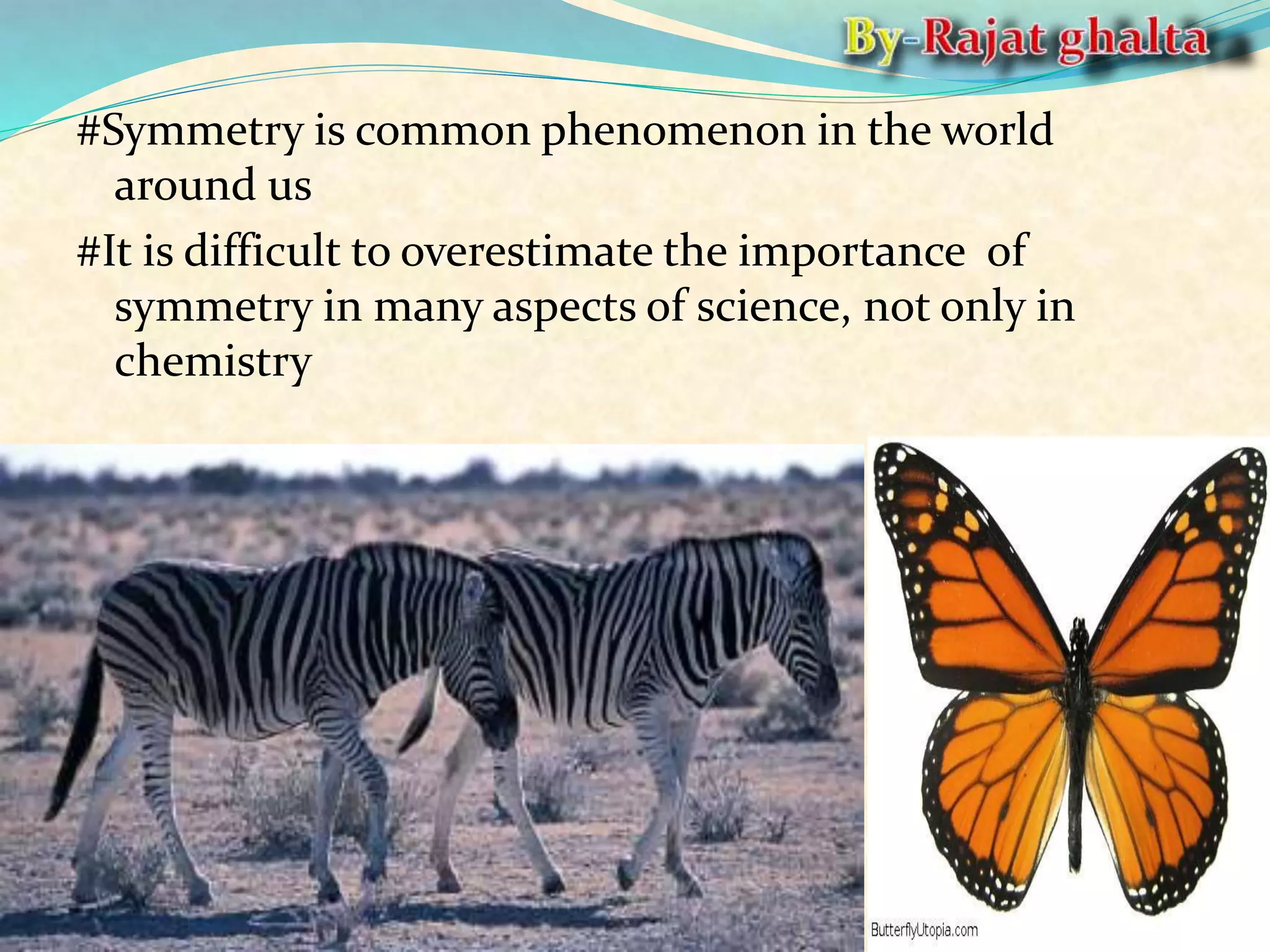
#Symmetry is common phenomenon in the world
around us
#It is difficult to overestimate the importance of
symmetry in many aspects of science, not only in
chemistry
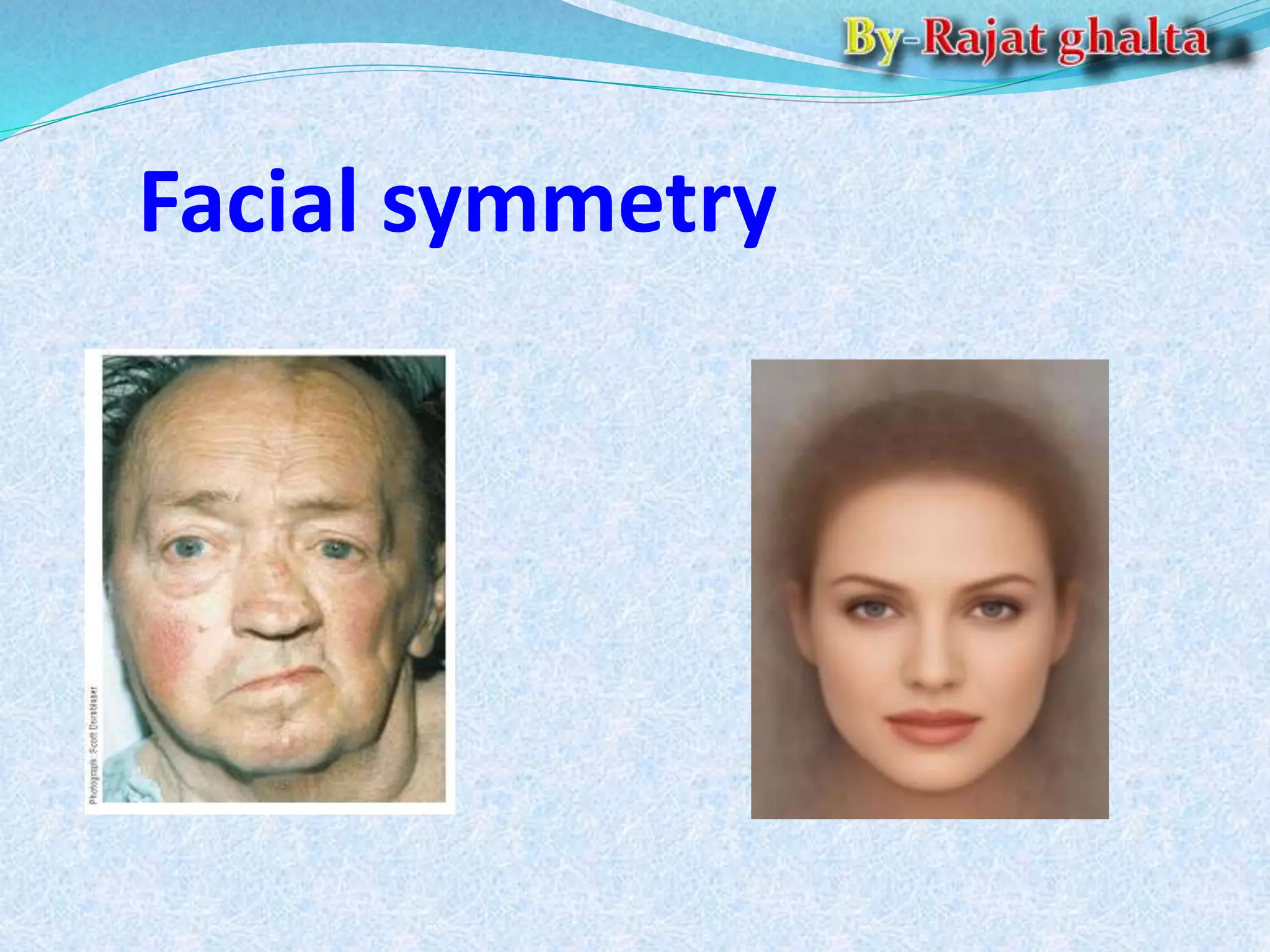
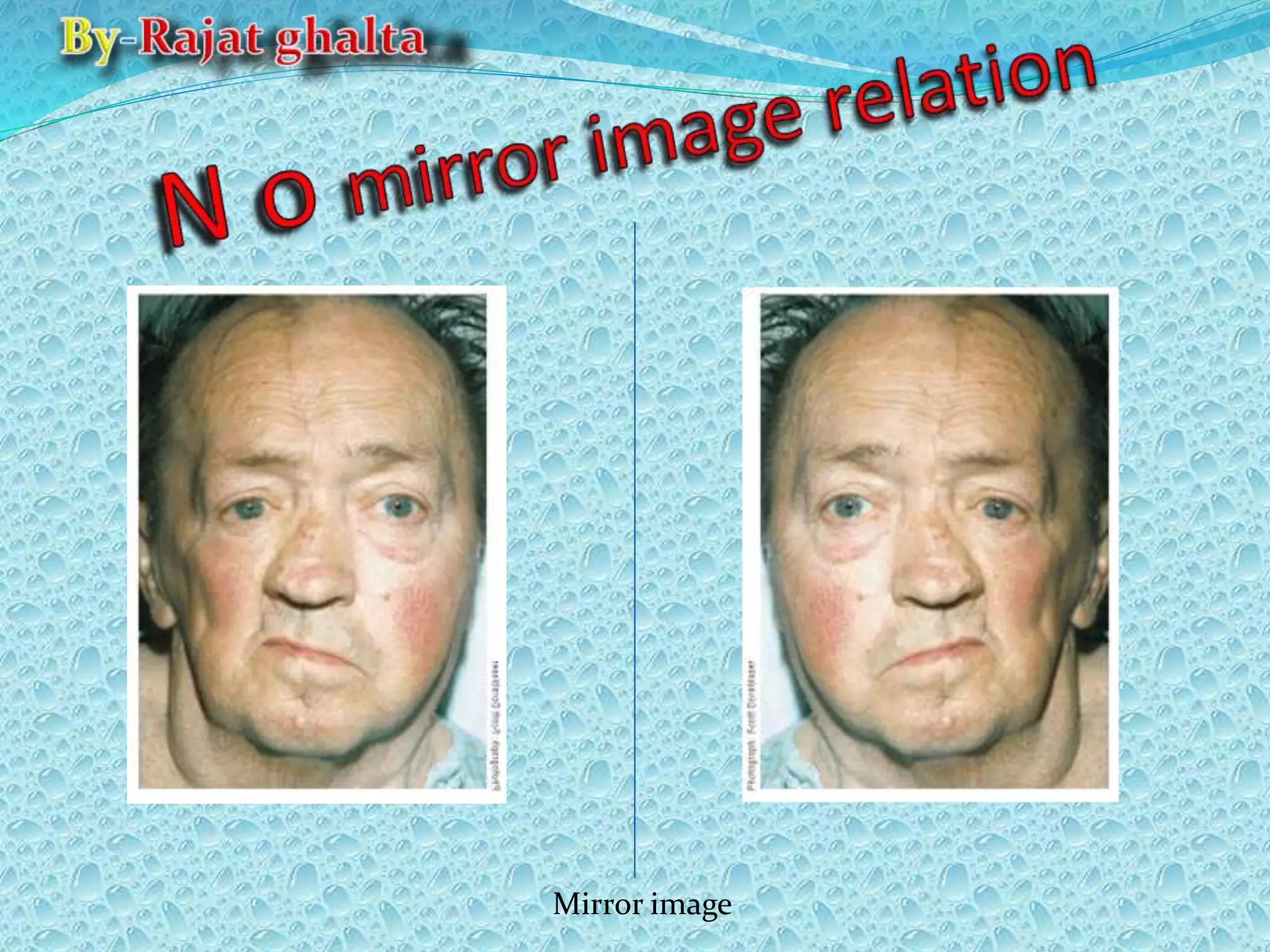
Facial symmetry
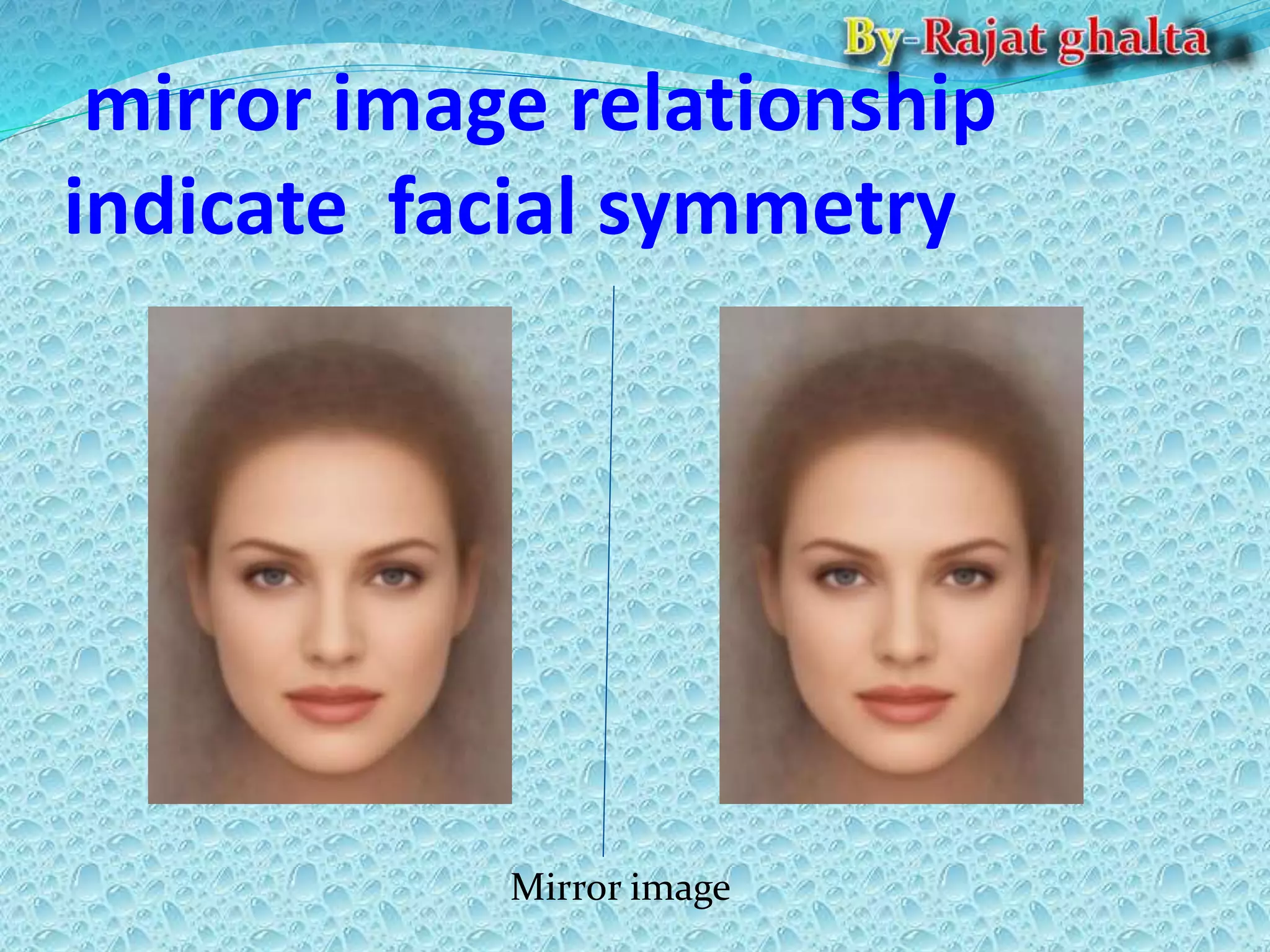
mirror image relationship
indicate facial symmetry
Mirror image
Mirror image
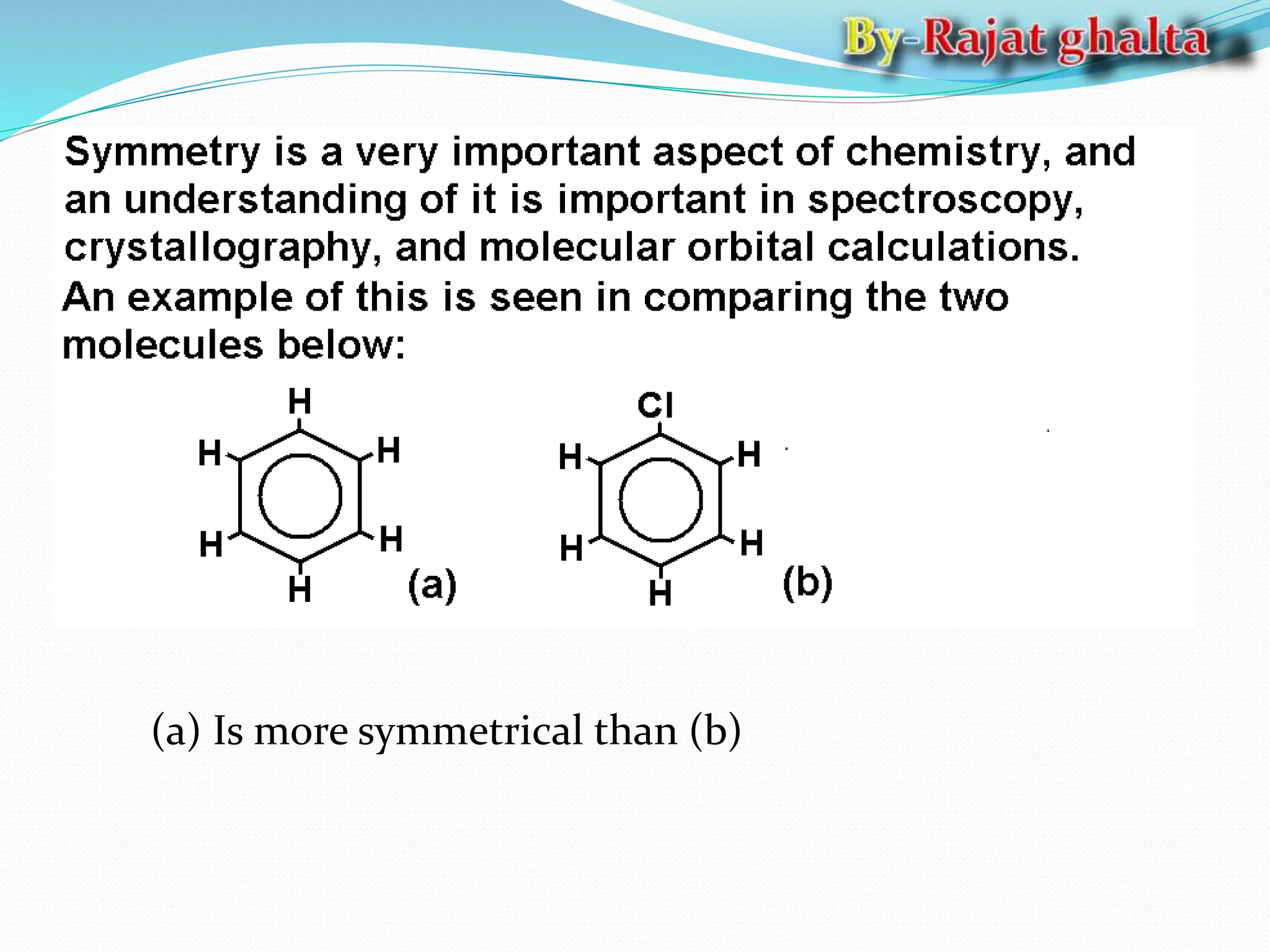
(a) Is more symmetrical than (b)
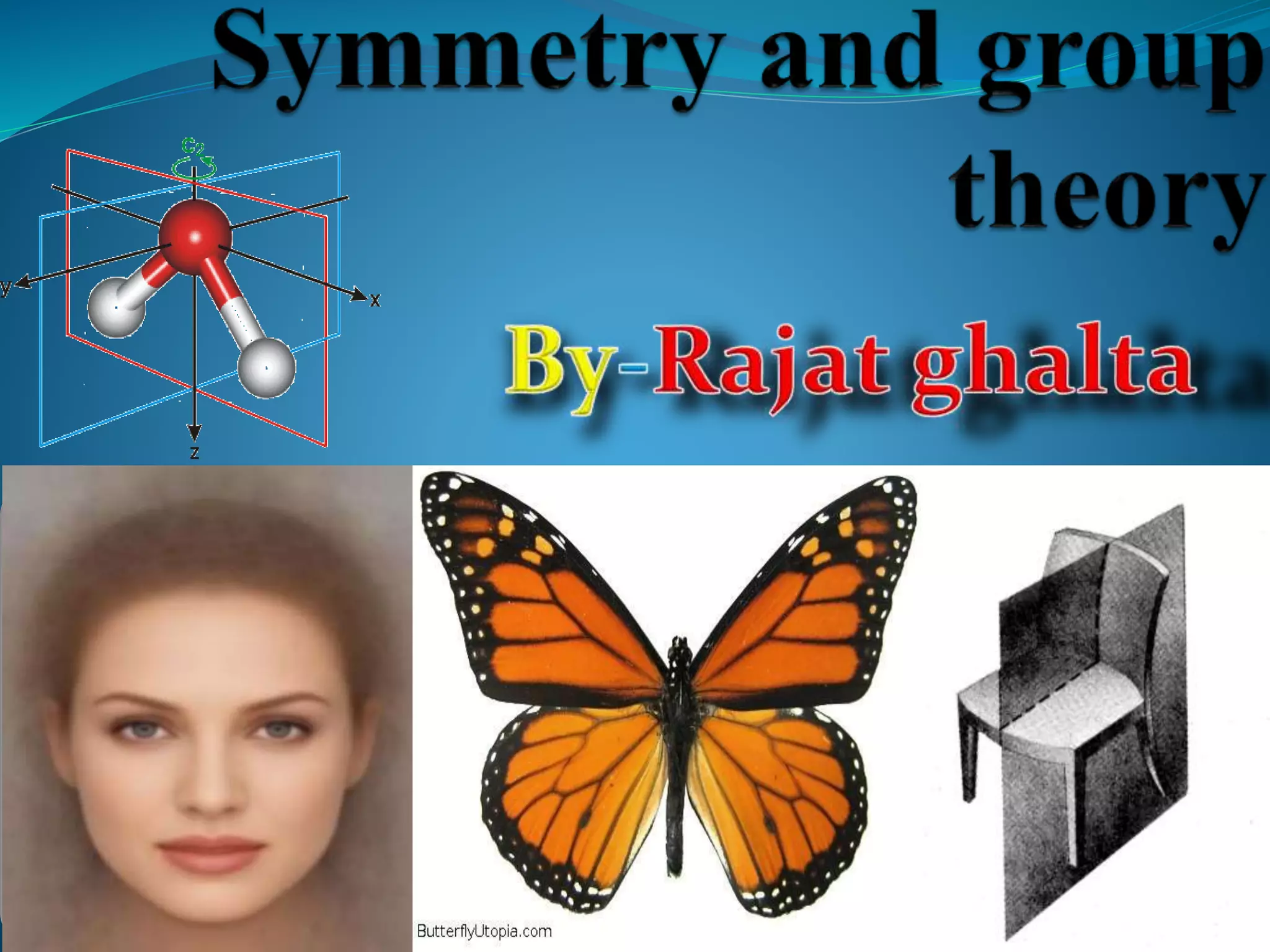
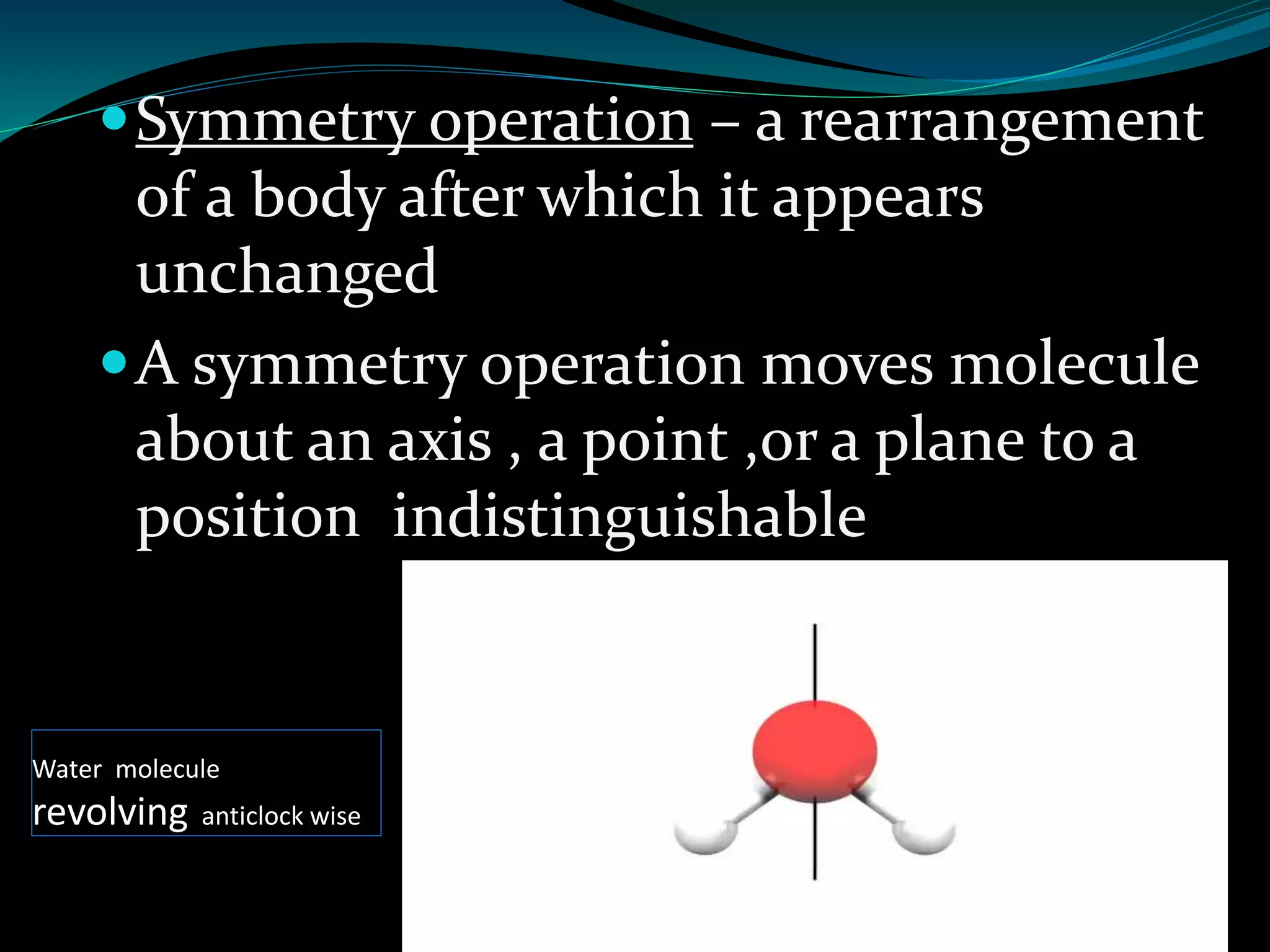
Water molecule
revolving anticlock wise
Symmetry operation – a rearrangement
of a body after which it appears
unchanged
A symmetry operation moves molecule
about an axis , a point ,or a plane to a
position indistinguishable
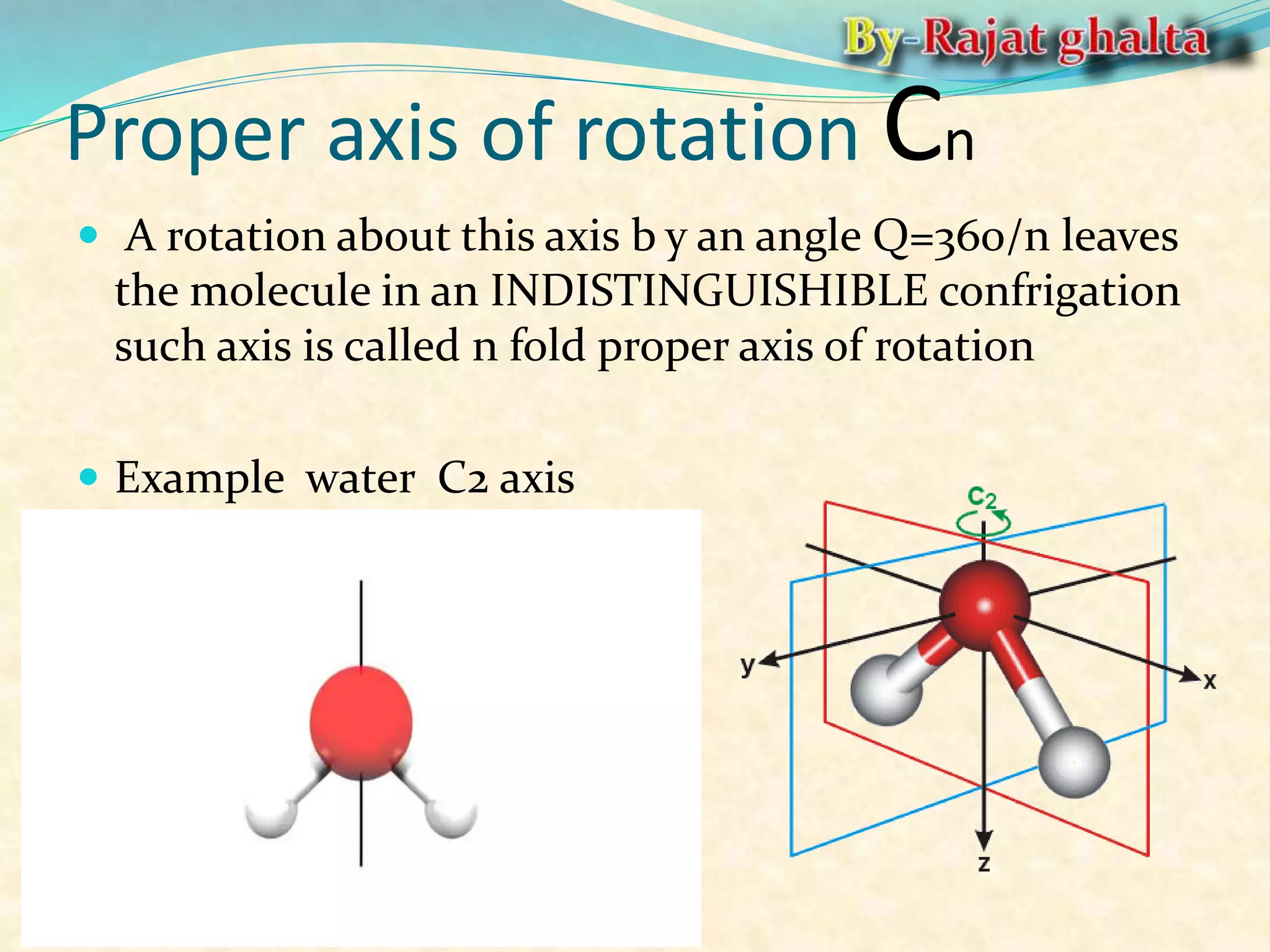
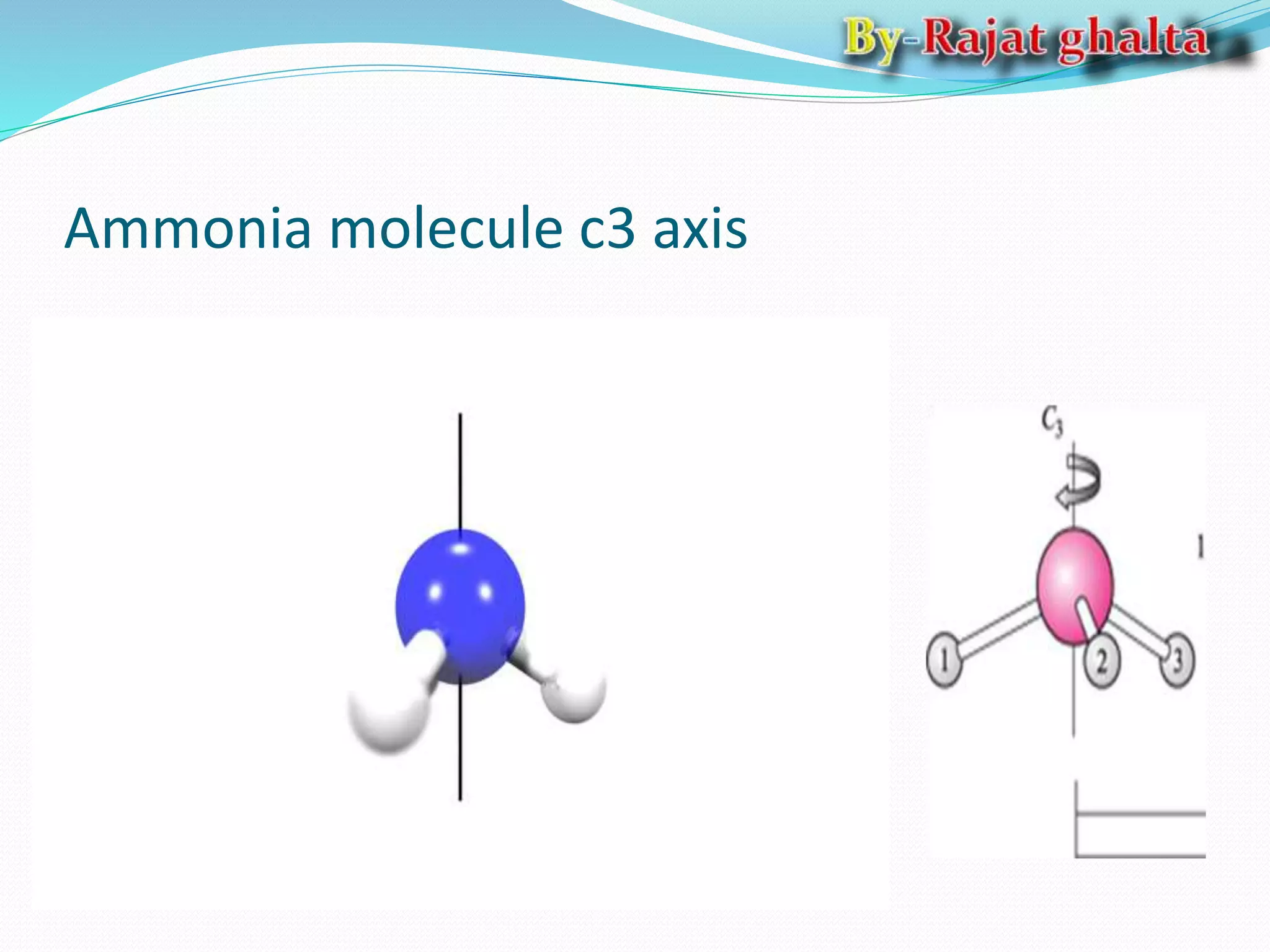
Proper axis of rotation Cn
 A rotation about this axis b y an angle Q=360/n leaves
the molecule in an INDISTINGUISHIBLE confrigation
such axis is called n fold proper axis of rotation
 Example water C2 axis
Ammonia molecule c3 axis
C3 C3
C2
C2
Some gumatricle images
C6
C4 C3 C2
Plane of symmetry ð
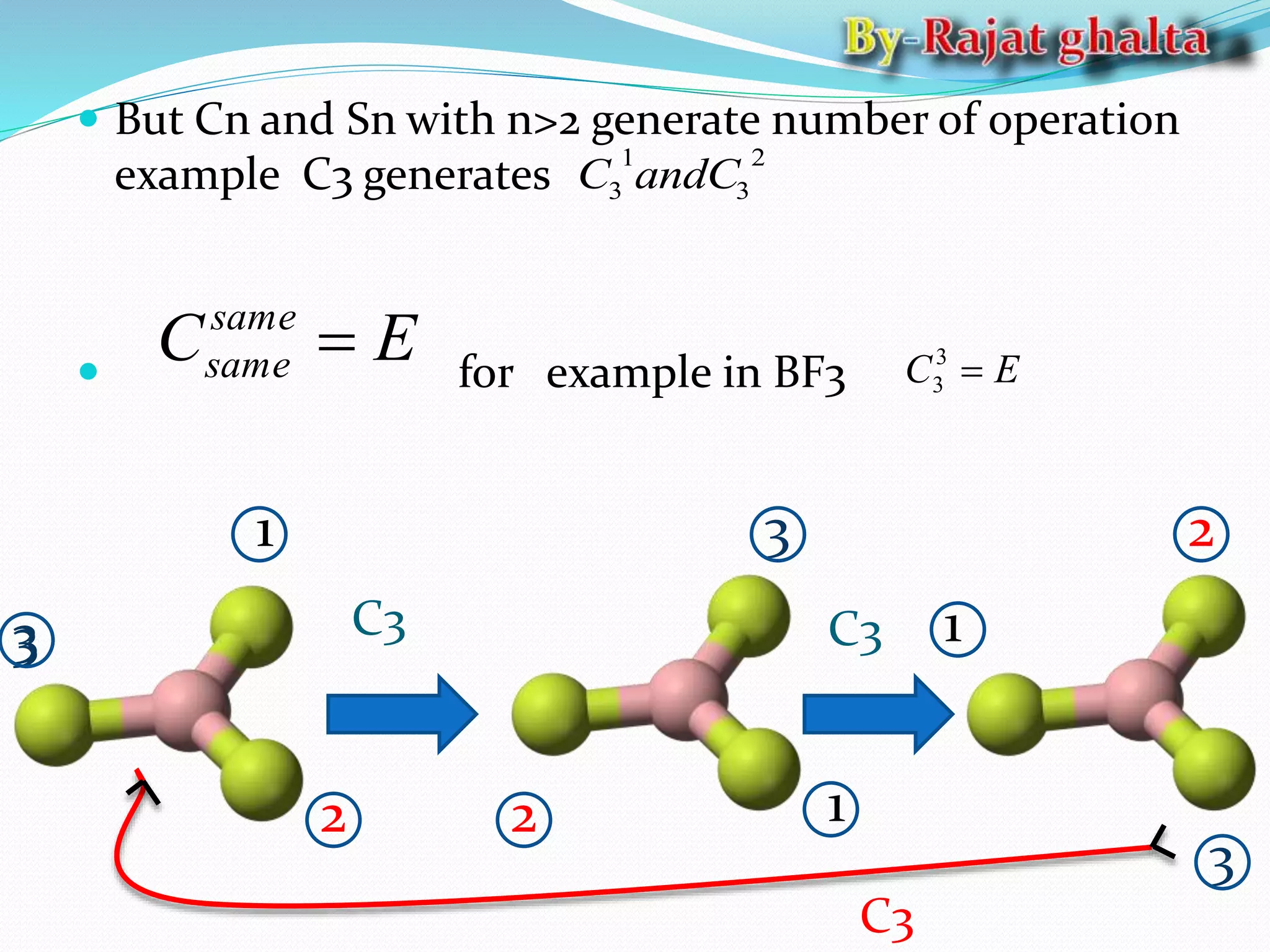
 A molecule posses a plane of symmetry if reflection
through through the plane leaves molecule un
changed
 ðh if plane of symmetry is PERIPENDICULAR to principal
axis
 ðv if plane of symmetry is PARLLEL to principal axis
 Ðd if vertical plane bisect the angle between two C2 axis
 Example in water there is two ðv and no ðh
Red is molecular
plane
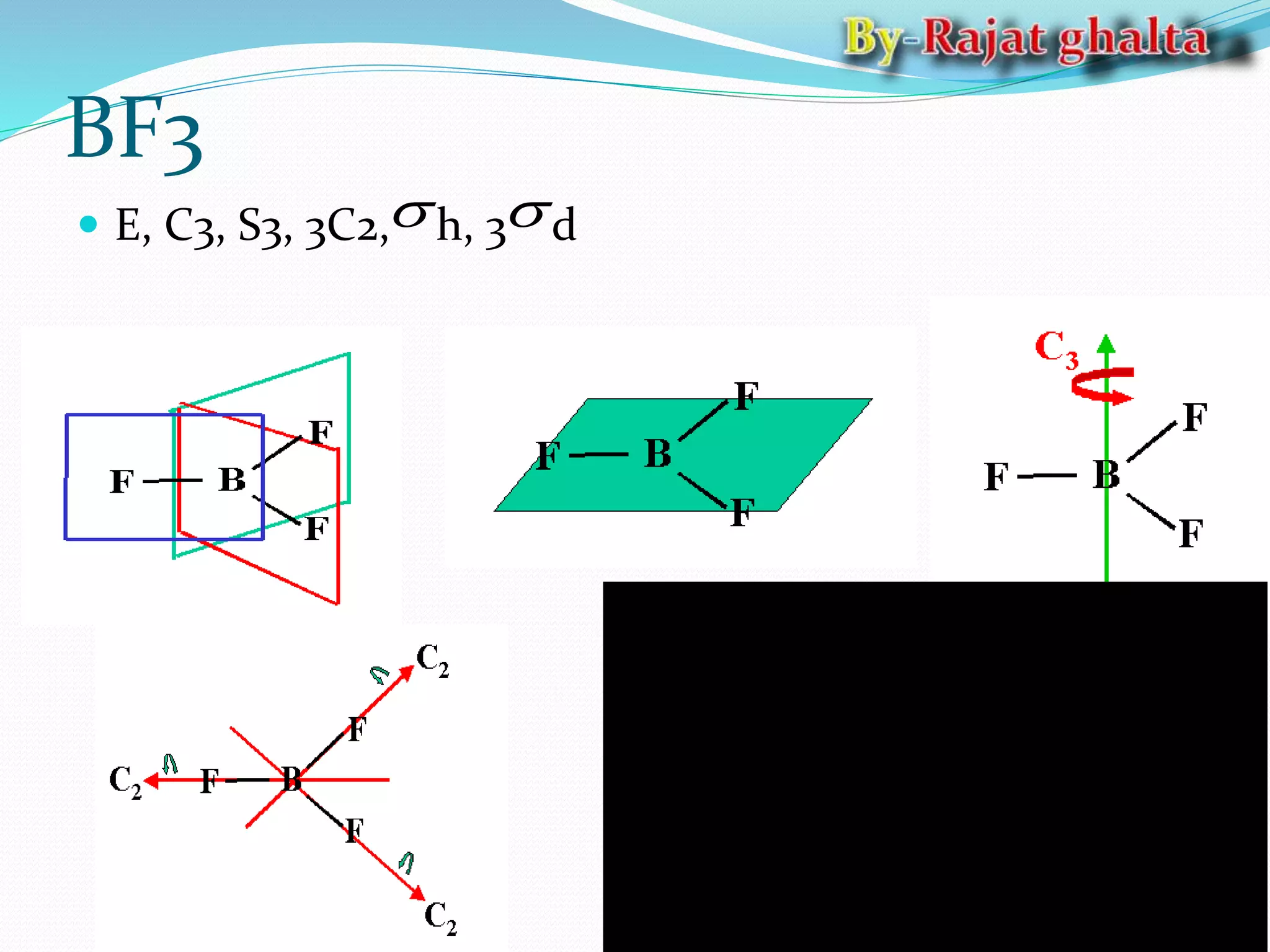
Plane of symmetry in BF3 molicule
 One ðh i.e molecular plane
 Three ðd
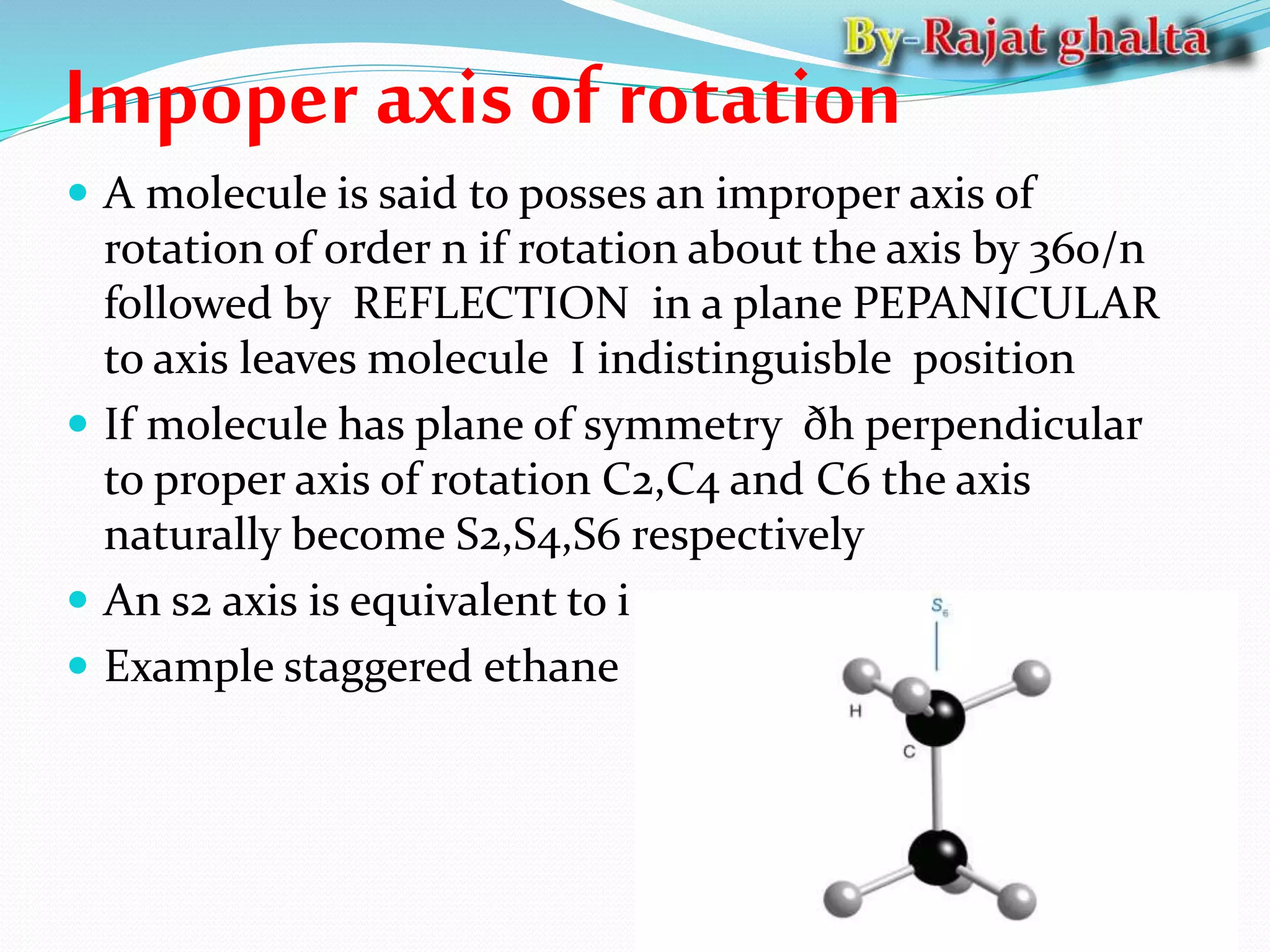
Impoper axis of rotation
 A molecule is said to posses an improper axis of
rotation of order n if rotation about the axis by 360/n
followed by REFLECTION in a plane PEPANICULAR
to axis leaves molecule I indistinguisble position
 If molecule has plane of symmetry ðh perpendicular
to proper axis of rotation C2,C4 and C6 the axis
naturally become S2,S4,S6 respectively
 An s2 axis is equivalent to i
 Example staggered ethane
C6
Inversion i
 If a point exist in center of molecule such that
IDENTICAL atoms are found on either side at equal
distance from it the central point is called center of
inversion
 In H2O and BF3 molecule there is no i
 In C2H4 molecule there is one
ethene
i in some geometrical image
i present
i absent
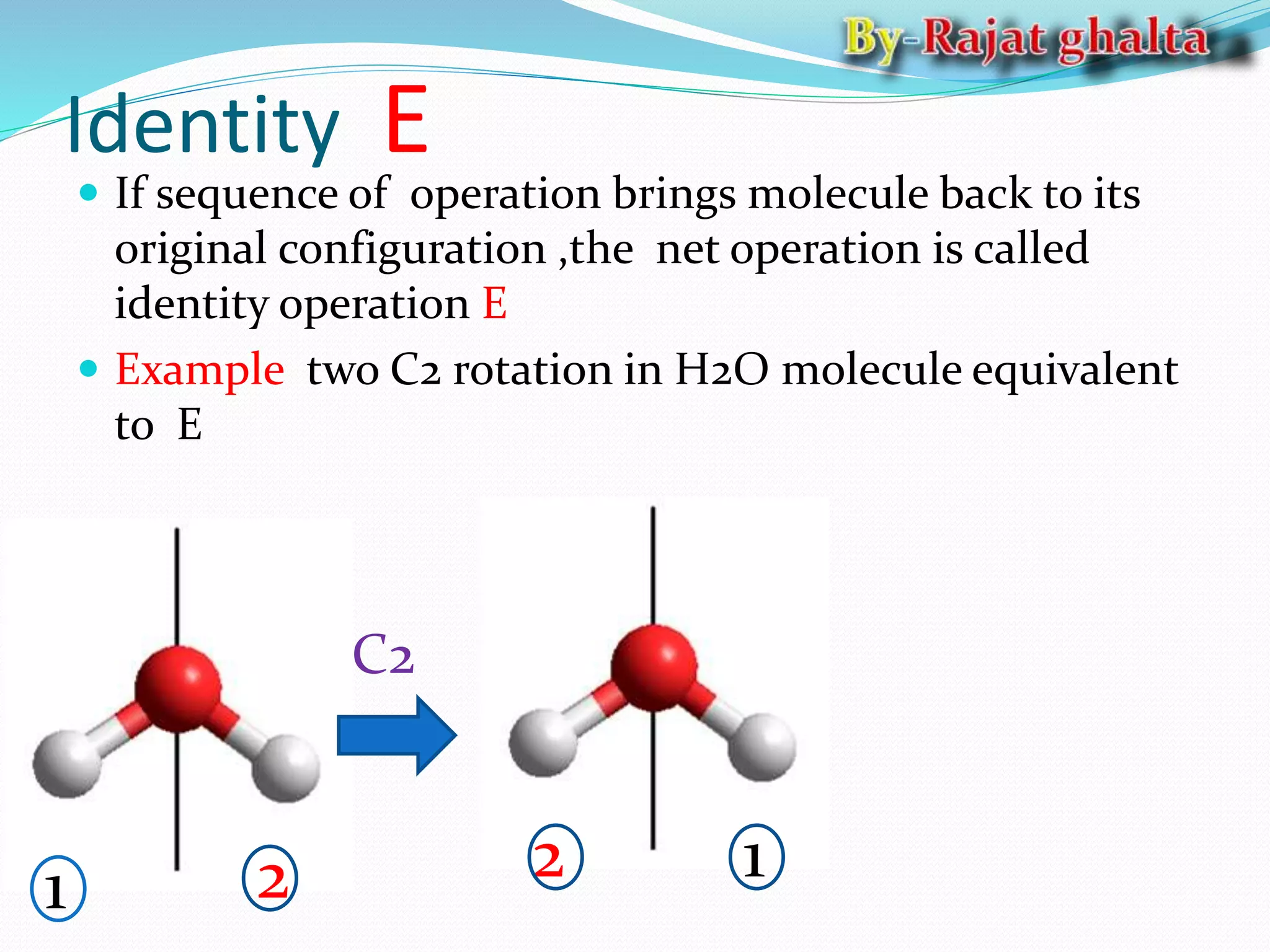
Identity E
 If sequence of operation brings molecule back to its
original configuration ,the net operation is called
identity operation E
 Example two C2 rotation in H2O molecule equivalent
to E
1 2
C2
Identity E
 If sequence of operation brings molecule back to its
original configuration ,the net operation is called
identity operation E
 Example two C2 rotation in H2O molecule equivalent
to E
1 2 12
C2
Identity E
 If sequence of operation brings molecule back to its
original configuration ,the net operation is called
identity operation E
 Example two C2 rotation in H2O molecule equivalent
to E
1 2 112 2
C2 C2
 In BF3
 Each and i generate one operation only because two
successive i and bring back the molecule to its
original configuration
EECEC
ECEC
d 

22,,
2
2,
2
2
2
3
3
,,
,




EiE  22
,

21
EiE  22
,
1
2
i
 
121 2
EiE  22
,
1
2
i
 
121 1 22
EiE  22
,
1
2
i
 
121 1 22
EiE  22
,
1
1
2
2
i i
 
121 1 22
EiE  22
,
1
1
12
2
2
i i
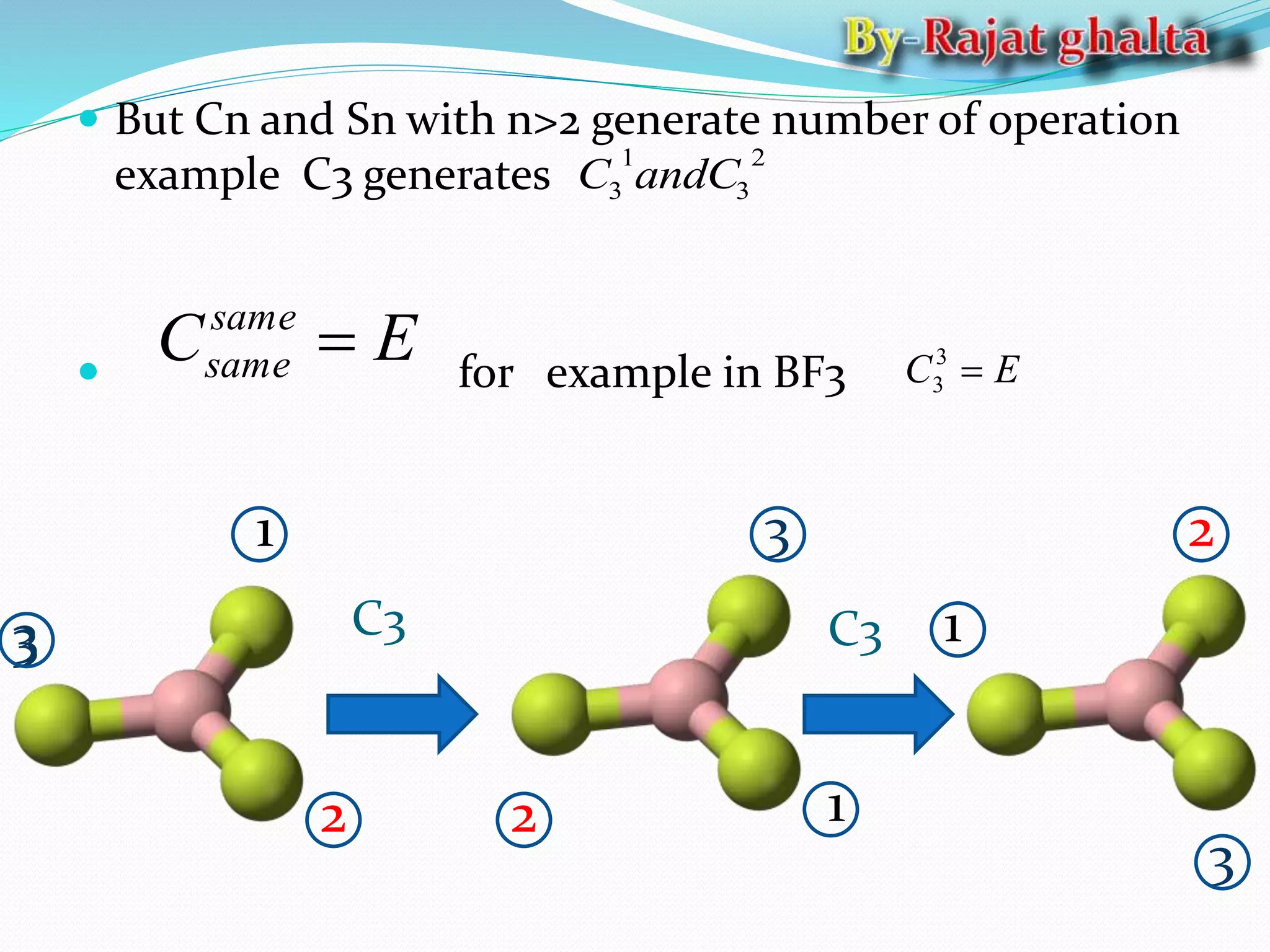
 But Cn and Sn with n>2 generate number of operation
example C3 generates
 for example in BF3
2
3
1
3 andCC
ECsame
same  EC 3
3
C3
1
2
33
 But Cn and Sn with n>2 generate number of operation
example C3 generates
 for example in BF3
2
3
1
3 andCC
ECsame
same  EC 3
3
1
C3
1
22
33
3
 But Cn and Sn with n>2 generate number of operation
example C3 generates
 for example in BF3
2
3
1
3 andCC
ECsame
same  EC 3
3
1
C3C3
1
1
2
22
33
3
3
 But Cn and Sn with n>2 generate number of operation
example C3 generates
 for example in BF3
2
3
1
3 andCC
ECsame
same  EC 3
3
1
C3C3
C3
1
1
2
22
33
3
3
 But Cn and Sn with n>2 generate number of operation
example C3 generates
 for example in BF3
2
3
1
3 andCC
ECsame
same  EC 3
3
1
C3C3
C3
1
1
2
22
33
3
3
E
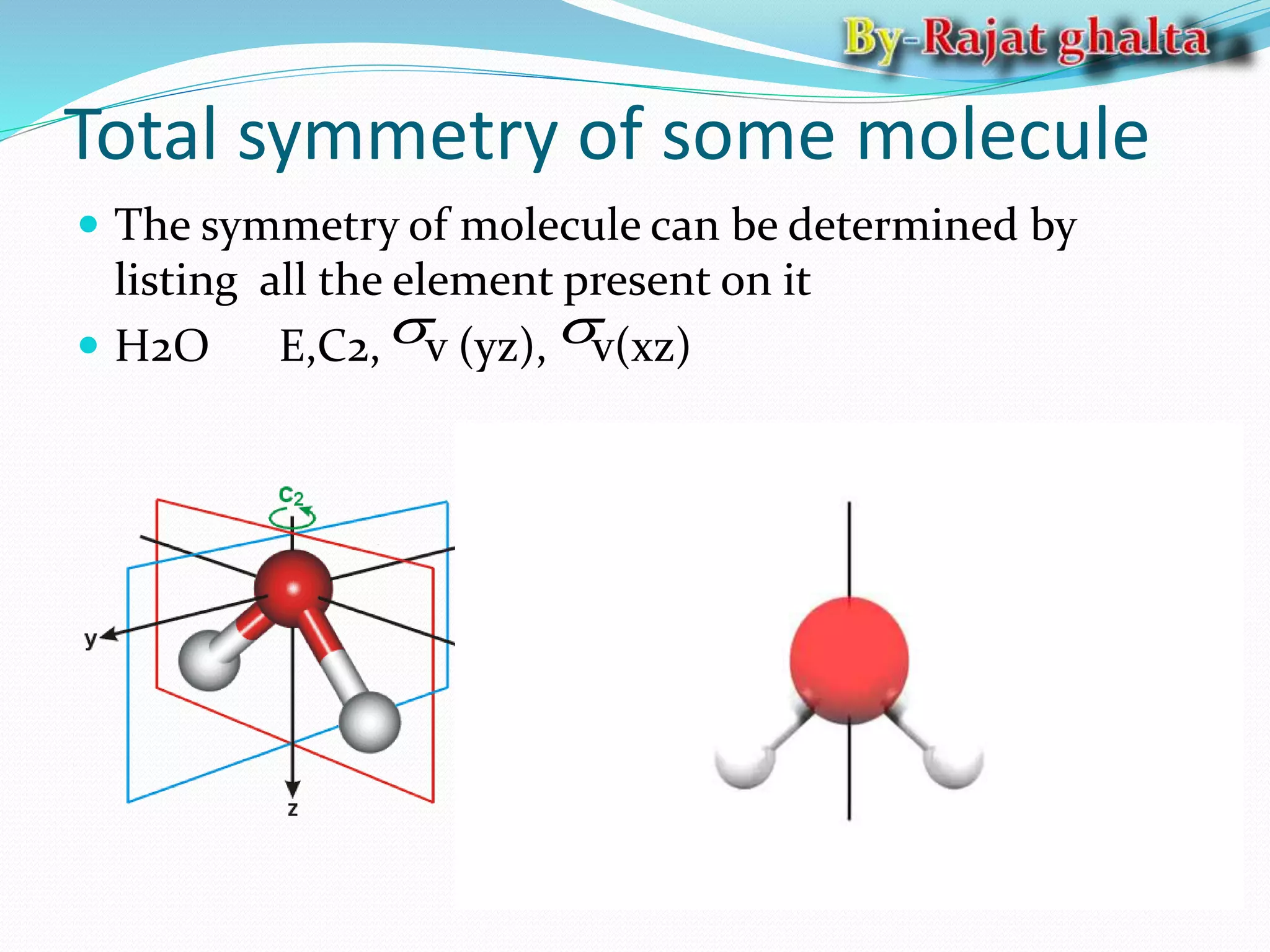
Total symmetry of some molecule
 The symmetry of molecule can be determined by
listing all the element present on it
 H2O E,C2, v (yz), v(xz)
BF3
 E, C3, S3, 3C2, h, 3 d 
Ethene
 E, 3C2, h, v, v ,
 ,,

C CC
H H
H
H
benzene
 E, C6, C3 ,C2 , i , S6, S3, h, ,,3 2

C ,3 2

C 
C6
,2

C
,2

C
d3 v3
WARNING
 Differentiating between a v and d can be little
tricky at first, but with practice it should become clear
 Both v and d are collinear with the principle
rotation axis
 In a molecule that has both v and d mirror plane,
the d planes bisect as many atom possible.
 
 
 

Exercise
 NH3 choose write option 1.E,C2,3 v, h
 Di chloroethylene trans cis



2.E,C2,3 v
3.E,C3,3 v
4.E,C4,3 h
1.E,C2, d, v 1.E,C2, h, v
2.E,C2, h,i
3.E,C3, d, 
d
4.E,C2, v, ,i 
v
2.E,C2, v,

 
 
v
3.E,C1, v, i
4.E,C1, d, i
Cl
Cl
Cl
Cl
Exercise
 NH3 choose write option 1.E,C2,3 v, h
 Di chloroethylene trans cis



2.E,C2,3 v
3.E,C3,3 v
4.E,C4,3 h
1.E,C2, d, v 1.E,C2, h, v
2.E,C2, h,i
3.E,C3, d, 
d
4.E,C2, v, ,i 
v
2.E,C2, v,

 
 
v
3.E,C1, v, i
4.E,C1, d, i
Cl
Cl
Cl
Cl
Exercise
 NH3 choose write option 1.E,C2,3 v, h
 Di chloroethylene trans cis



2.E,C2,3 v
3.E,C3,3 v
4.E,C4,3 h
1.E,C2, d, v 1.E,C2, h, v
2.E,C2, h,i
3.E,C3, d, 
d
4.E,C2, v, ,i 
v
2.E,C2, v,

 
 
v
3.E,C1, v, i
4.E,C1, d, i
Cl
Cl
Cl
Cl
Exercise
 NH3 choose write option 1.E,C2,3 v, h
 Di chloroethylene trans cis



2.E,C2,3 v
3.E,C3,3 v
4.E,C4,3 h
1.E,C2, d, v 1.E,C2, h, v
2.E,C2, h,i
3.E,C3, d, 
d
4.E,C2, v, ,i 
v
2.E,C2, v,

 
 
v
3.E,C1, v, i
4.E,C1, d, i
Cl
Cl
Cl
Cl
Combination of operations
 Two operation over the molecule combined to get a third
operation
 Example in water molecule C2 is followed by operation
the result is same as single operation
v
v
1
1 2
2
C2
Combination of operations
 Two operation over the molecule combined to get a third
operation
 Example in water molecule C2 is followed by operation
the result is same as single operation
v
v
1
1
12
2
2
C2
Combination of operations
 Two operation over the molecule combined to get a third
operation
 Example in water molecule C2 is followed by operation
the result is same as single operation
v

v

v
v
1
1
12
2 12
2
C2 v
Combination of operations
 Two operation over the molecule combined to get a third
operation
 Example in water molecule C2 is followed by operation
the result is same as single operation
v

v

v
v
1
1
12
2 12
2
C2 v

v
Group theory
 The relationships among the symmetry elements can
be treated very elegantly in terms of group theory
 A group in mathematics consists of a set of members
which obey the following four rules
 Rule 1 The combination of any two members A
and B result in C ,which also belong to same group .
 AB = C
 Example water [ E, C2 , , ]

vv

 vvC  2
Group theory
 The relationships among the symmetry elements can
be treated very elegantly in terms of group theory
 A group in mathematics consists of a set of members
which obey the following four rules
 Rule 1 The combination of any two members A
and B result in C ,which also belong to same group .
 AB = C
 Example water [ E, C2 , , ]

vv

 vvC  2

 vvC  2 vvC  
2
Group theory
 The relationships among the symmetry elements can
be treated very elegantly in terms of group theory
 A group in mathematics consists of a set of members
which obey the following four rules
 Rule 1 The combination of any two members A
and B result in C ,which also belong to same group .
 AB = C
 Example water [ E, C2 , , ]

vv

 vvC  2

 vvC  2 vvC  
2
Commutative
 There is two possibilities AB=BA AB BA
Commutative
 There is two possibilities AB=BA AB BA
Commutative Noncommutative

Commutative
 There is two possibilities AB=BA AB BA
Commutative Noncommutative
Abelian group Nonabelian
group

Commutative
 There is two possibilities AB=BA AB BA
Commutative Noncommutative
Abelian group Nonabelian
group
EXAMPLE H2O NH3

H2O
 Example C2 = C2
v
v v
1 2
1 2
abelian
H2O
 Example C2 = C2
v
v v
1 12
1
2
2
abelian
H2O
 Example C2 = C2
v
v v
v
1 1 1
2
1
2 2
2
abelian
H2O
 Example C2 = C2
v
v v
v
1 1 1
2
1 1
2 2
2 2
abelian
H2O
 Example C2 = C2
v
v v
v
1 1 1
1
2
1 1
2 2
2
2 2
same
abelian
Ammonia
 . Pass thru H1 and thru H2vvvv  

H1
v 
v
H2H3
Nonabelian
Ammonia
 . Pass thru H1 and thru H2vvvv  

H1
v 
v
H2H3
v
Nonabelian
Ammonia
 . Pass thru H1 and thru H2vvvv  

H1 H1
v 
v
H2 H2H3 H3
v
Nonabelian
Ammonia
 . Pass thru H1 and thru H2vvvv  

H1 H1
v 
v
H2 H2H3 H3
v 
v
Nonabelian
Ammonia
 . Pass thru H1 and thru H2vvvv  

H1 H1
H1
v 
v
H2 H2 H2H3 H3
H3
v 
v
Nonabelian
Ammonia
 . Pass thru H1 and thru H2vvvv  

H1 H1
H1
H1
v 
v
H2 H2 H2
H2
H3
H3
H3
H3
v 
v
Nonabelian
Ammonia
 . Pass thru H1 and thru H2vvvv  

H1 H1
H1
H1
v 
v
H2 H2 H2
H2
H3
H3
H3
H3
v 
v

v
Nonabelian
Ammonia
 . Pass thru H1 and thru H2vvvv  

H1 H1
H1
H1
H2
v 
v
H2 H2 H2
H2 H1
H3
H3
H3
H3
H3
v 
v

v
Nonabelian
Ammonia
 . Pass thru H1 and thru H2vvvv  

H1 H1
H1
H1
H2 H3
v 
v
H2 H2 H2
H2 H1
H2
H3
H3
H3
H1
H3
H3
v 
v

v
v
Nonabelian
Ammonia
 . Pass thru H1 and thru H2vvvv  

H1 H1
H1
H1
H2 H3
v 
v
H2 H2 H2
H2 H1
H2
H3
H3
H3
H1
H3
H3
v 
v

v
v
Not
same
Nonabelian
Rule 2
 There must be a member E in group such that
 Example in H2O EC2=C2E=C2
Rule 3 When more then two member
combine they do in associative manner
AE=EA=A ,BE=EB =B
Identity
(AB)C=A(BC)
Rule 4
 Every member A must have inverse which is also
member of group
Example in H2O
is anti clock wise rotation and C2 is clock wise
rotation and cancel each other
EAAAA   11
1
A
ECC 
2
1
2
1
2

C
Symmetry Points group
 The group of symmetry operation of molecule is called
point group
 several molecule may have the same set of opeation
 For example following molecule have same set of
operation i.e E,C2, , hence belong to same
point group
v 
v
H
O
O
H
C
HH
O
Cl Cl
 The symbols for most of the point group can be based of
principle axis of rotation as Cnv,Cnh,Dnh,Dnd
 If the Cn principal axis is accompanied by nC2 right angle to
it the latter D is used
 If a plane is present the symbol h is used (Cnh,Dnh)
If n plane are present with out the symbol used is Cnv
If n are present than Dnd when is absent
If no symmetry plane is present than drop small latter
Dihedral group
d
hv
h
h
 If there is S2n collinear with Cn and there is no
the symbol user is S2n
 Using Principal axis
d
No symmetry
element except
E i
C1 Cs Ci
 Linear molicule

vC hD
But no present
v h h
i apsent i present
C OS CO O
Multiplication Table
 The elements of group can be listed in a table known
as multiplication table
 This reveals the different relation between the
element of a group
 Table for water


v
v
1
2
v
1
22 CE



C
E
C vv

 Any thing multiply by E is equal to itself

 E(anything)=anything



vv
vv
1
2
1
2
vv
1
2
v
1
22
C
CE
CE




C
E
C vv
 We know that C2 C2 = E
Evv 
Evv 

E
E
EC
CE
CE
vv
vv
1
2
1
2
vv
1
2
v
1
22







C
E
C vv
 We know that C2 C2 = E
Evv 
Evv 

E
E
EC
CE
CE
vv
vv
1
2
1
2
vv
1
2
v
1
22







C
E
C vv
 We know that C2 =

 vv C  2
E
E
EC
CE
CE
vvv
vv
v
1
2
1
2
vv
1
2
v
1
22










v
v
vv
C
E
C
v 
v
 We know that = C2
EC
CE
EC
CE
CE
1
2vvv
1
2vv
v
1
2
1
2
vv
1
2
v
1
22










v
v
vv
C
E
C
v
v
For ammonia
ECC
CEC
CCE
CEC
ECCC
CCE
CCE
2
33vvv
3
2
3vvvv
2
3
1
3vvv
vv
1
3
3
3
2
3
vvv
2
3
1
3
1
3
vvv
2
3
1
3
v
2
3
1
33














v
v
v
vvv
C
E
C
Similarity of symmetry
operations
 It can be said on the basis of common sense that in the
point group the C3v operation C3 and similar
,thought not identical ,as are
 Similar member of group obey following rule
 Where R is any member of group including A and B
 This rule is called rule of similarity transformation
2
3C

vvv  ,,
BRRA -1

 For example in C3v
 Theoretical language they belong to same class
likewise belong to same class
2
3
1
3v
v
-1
v
1
3
A
RthenR,CB
CC vvv 




similarareC2
3
1
3andC

vvv  ,,
Classes of some point group


vvvh
vvv
h
SSCCCC
C
i



,,,,,,,,,CE,:D
,,CE,:
,,CE,:C
,
5
33222
2
333h
22
22h
Classes of some point group


vvvh
vvv
h
SSCCCC
C
i



,,,,,,,,,CE,:D
,,CE,:
,,CE,:C
,
5
33222
2
333h
22
22h
4 Classes
Classes of some point group


vvvh
vvv
h
SSCCCC
C
i



,,,,,,,,,CE,:D
,,CE,:
,,CE,:C
,
5
33222
2
333h
22
22h 4 Classes
4 Classes
Classes of some point group


vvvh
vvv
h
SSCCCC
C
i



,,,,,,,,,CE,:D
,,CE,:
,,CE,:C
,
5
33222
2
333h
22
22h 4 Classes
4 Classes
6 Classes
Representation of groups
 Each symmetry operation in the point group can be
represented by number or more generally , by matrix
of numbers
Representation of groups
 Each symmetry operation in the point group can be
represented by number or more generally , by matrix
of numbers
 A set of numbers will be true representation of group
all the operation over symmetry element are satisfy by
these number
 For example C2h group

Representation of groups
 Each symmetry operation in the point group can be
represented by number or more generally , by matrix
of numbers
 A set of numbers will be true representation of group
all the operation over symmetry element are satisfy by
these number
 For example C2h group

iCE h2 
Representation of groups
 Each symmetry operation in the point group can be
represented by number or more generally , by matrix
of numbers
 A set of numbers will be true representation of group
all the operation over symmetry element are satisfy by
these number
 For example C2h group

iCE h2 
i2C
This operation should
be satisfy in C2h
Trivial representation
 Assigning a number 1 or unit matrix of any dimantion
to each operation
Trivial representation
 Assigning a number 1 or unit matrix of any dimantoin
to each operation
 For example C2h point group
:
:
iCE:C
1
1
h22h




Trivial representation
 Assigning a number 1 or unit matrix of any dimantoin
to each operation
 For example C2h point group
:
1111:
iCE:C
1
1
h22h




Trivial representation
 Assigning a number 1 or unit matrix of any dimantoin
to each operation
 For example C2h point group



























10
01
10
01
10
01
10
01
:
1111:
iCE:C
1
1
h22h 
Trivial representation
 Assigning a number 1 or unit matrix of any dimantoin
to each operation
 For example C2h point group
 It satisfy



























10
01
10
01
10
01
10
01
:
1111:
iCE:C
1
1
h22h 
iC2 h
Trivial representation
 Assigning a number 1 or unit matrix of any dimantoin
to each operation
 For example C2h point group
 It satisfy



























10
01
10
01
10
01
10
01
:
1111:
iCE:C
1
1
h22h 



















10
01
10
01
10
01
111soiC2 h
Non trivial representation
 There is non trivial representation too
Non trivial representation
 There is non trivial representation too
 It satisfy
:
:
iCE:C
2
2
h22h




iC2 h
Non trivial representation
 There is non trivial representation too
 It satisfy
:
11-1-1:
iCE:C
2
2
h22h




iC2 h
Non trivial representation
 There is non trivial representation too
 It satisfy



























1-0
01-
1-0
01
1-0
01-
10
01
:
11-1-1:
iCE:C
2
2
h22h 
iC2 h
Non trivial representation
 There is non trivial representation too
 It satisfy



























1-0
01-
1-0
01
1-0
01-
10
01
:
11-1-1:
iCE:C
2
2
h22h 



















1-0
01-
10
01-
10
01-
1-11-so1C2 h
 Other two possible representation are
1-1-11:
1-11-1:
4
3


iC2 h
 Other two possible representation are
 These representation in foam of table for C2h point
group
1-1-11:
1-11-1:
4
3


 Other two possible representation are
 These representation in foam of table for C2h point
group
1-1-11:
1-11-1:
4
3


1-11-1
1-1-11
11-1-1
1111
iCEC
4
3
2
1
h22h





Bases
Bases
Cartesian
coordinates
x,y,z
Bases
Cartesian
coordinates
Wave
function
x,y,z px,py,pz,dxy,
dyz, etc
Bases
Cartesian
coordinates
Wave
function
Rotational
coordinates
x,y,z px,py,pz,dxy,
dyz, etc
Rx,Ry,Rz
Cartesian coordinate
 Consider a molecule belonging to C2h point group
Cartesian coordinate
 Consider a molecule belonging to C2h point group
 Concentrate on the effect of four symmetry operation
on coordinate
Cartesian coordinate
 Consider a molecule belonging to C2h point group
 Concentrate on the effect of four symmetry operation
on coordinate
 Let z axis be C2 axis
Cartesian coordinate
 Consider a molecule belonging to C2h point group
 Concentrate on the effect of four symmetry operation
on coordinate
 Let z axis be C2 axis
C2
Cartesian coordinate
 Consider a molecule belonging to C2h point group
 Concentrate on the effect of four symmetry operation
on coordinate
 Let z axis be C2 axis
C2
+Z
-X
+X
+Y
-Z
-Y
Cartesian coordinate
 The xy plane is molecular plane
Cartesian coordinate
 The xy plane is molecular plane
h
Cartesian coordinate
 The xy plane is molecular plane
 When we apply the operation of molecular plane there
only change in z axis x and y remain same as shoan
-Z
+X
-X
-Y
+Z
+Y
h
Cartesian coordinate
 Now we are appalling operation i
i
Cartesian coordinate
 Now we are appalling operation i
 When we apply the operation i there is change in all 3
axis as shon
+Z
-X
+X
+Y
-Z
-Y
i
 Effect on z
 i(z),)(,)(C,E(z) h2 zz 
 Effect on z
-zi(z),)(,)(Cz,E(z) h2  zzzz 
 Effect on z
 This generate following representation
-zi(z),)(,)(Cz,E(z) h2  zzzz 
(z)
BasesiCE h2 
 Effect on z
 This generate following representation
-zi(z),)(,)(Cz,E(z) h2  zzzz 
(z)1-1-11
BasesiCE h2 
 Effect on x and y
 i(x),)(,)(C,E(x) h2 xx 
 i(y),)(,)(C,E(y) h2 yy 
 Effect on x and y
-xi(x),)(,)(Cx,E(x) h2  xxxx 
 i(y),)(,)(C,E(y) h2 yy 
 Effect on x and y
-xi(x),)(,)(Cx,E(x) h2  xxxx 
-yi(y),)(,)(Cx,E(y) h2  yyyy 
 Effect on x and y
 This generate following representation
-xi(x),)(,)(Cx,E(x) h2  xxxx 
y)or(x
BasesiCE h2 
-yi(y),)(,)(Cx,E(y) h2  yyyy 
 Effect on x and y
 This generate following representation
-xi(x),)(,)(Cx,E(x) h2  xxxx 
y)or(x1-11-1
BasesiCE h2 
-yi(y),)(,)(Cx,E(y) h2  yyyy 
Wave function as Bases
 S orbital is spherical symmetrical i.e totally symmetric
 It is un effected by any operation
Wave function as Bases
 S orbital is spherical symmetrical i.e totally symmetric
 It is un effected by any operation
(s)
BasesiCEC h22h 
Wave function as Bases
 S orbital is spherical symmetrical i.e totally symmetric
 It is un effected by any operation
(s)1111
BasesiCEC h22h 
Wave function as Bases
 S orbital is spherical symmetrical i.e totally symmetric
 It is un effected by any operation
 px,py,pz orbital just as x,y,z
(s)1111
BasesiCEC h22h 
Wave function as Bases
 S orbital is spherical symmetrical i.e totally symmetric
 It is un effected by any operation
 px,py,pz orbital just as x,y,z
)(p1-1-11
)por(p1-11-1
BasesiCEC
z
yx
h22h 
(s)1111
BasesiCEC h22h 
Exercise
 Use the 3d orbitals as bases to generate representation
of the C2h point group
yzxz
xy
h22h
d,d
d
BasesiCEC 
Exercise
 Use the 3d orbitals as bases to generate representation
of the C2h point grop
yzxz
xy
h22h
d,d
d1111
BasesiCEC 
Exercise
 Use the 3d orbitals as bases to generate representation
of the C2h point group
yzxz
xy
h22h
d,d11-1-1
d1111
BasesiCEC 
Rotational coordinates as bases
 Effect of symmetry operation on the rotation at axis
can represented by using rotational coordinates as
bases
Rotational coordinates as bases
 Effect of symmetry operation on the rotation at axis
can represented by using rotational coordinates as
bases
 The effect of E,C2, and i on Rx, Ry and Rz can be
seen as follows
 )R(,)(R,)R(C,)E(R xxx2x ih
v
Rotational coordinates as bases
 Effect of symmetry operation on the rotation at axis
can represented by using rotational coordinates as
bases
 The effect of E,C2, and i on Rx, Ry and Rz can be
seen as follows
xxxxxx2x R)R(,-R)(R,-R)R(C,R)E(R  ihx 
v
Rotational coordinates as bases
 Effect of symmetry operation on the rotation at axis
can represented by using rotational coordinates as
bases
 The effect of E,C2, and on Rx, Ry and Rz can be
seen as follows


)R(,)R(,)R(C)E(R
R)R(,-R)(R,-R)R(C,R)E(R
yyy2,Y
xxxxxx2x
i
i
h
hx


v
Rotational coordinates as bases
 Effect of symmetry operation on the rotation at axis
can represented by using rotational coordinates as
bases
 The effect of E,C2, and i on Rx, Ry and Rz can be
seen as follows
Yyyyyy2y,Y
xxxxxx2x
R)R(,-R)R(,-R)R(CR)E(R
R)R(,-R)(R,-R)R(C,R)E(R


i
i
h
hx


v
Rotational coordinates as bases
 Effect of symmetry operation on the rotation at axis
can represented by using rotational coordinates as
bases
 The effect of E,C2, and i on Rx, Ry and Rz can be
seen as follows



)(,)R(,)R(C,)E(R
R)R(,-R)R(,-R)R(CR)E(R
R)R(,-R)(R,-R)R(C,R)E(R
zhz2Z
Yyyyyy2y,Y
xxxxxx2x
z
h
hx
Ri
i
i



v
Rotational coordinates as bases
 Effect of symmetry operation on the rotation at axis
can represented by using rotational coordinates as
bases
 The effect of E,C2, and i on Rx, Ry and Rz can be
seen as follows
Zzzhzz2zZ
Yyyyyy2y,Y
xxxxxx2x
R)(,R)R(,R)R(C,R)E(R
R)R(,-R)R(,-R)R(CR)E(R
R)R(,-R)(R,-R)R(C,R)E(R



z
h
hx
Ri
i
i



v
Rotational coordinates as bases
 The following representation are genrated
)R,(R11-1-1
)(R1111
BasesiCEC
yx
z
h22h 
Matrix representation
 Matrix for reflection operation
 When xy is plane of reflection
Matrix representation
 Matrix for reflection operation
 When xy is plane of reflection











1-00
010
001
xy
Matrix representation
 Matrix for reflection operation
 When xy is plane of reflection
When yz or zx is plane of reflection











1-00
010
001
xy
Matrix representation
 Matrix for reflection operation
 When xy is plane of reflection
When yz or zx is plane of reflection











1-00
010
001
xy











100
010
001-
yz
Matrix representation
 Matrix for reflection operation
 When xy is plane of reflection
When yz or zx is plane of reflection











1-00
010
001
xy











100
010
001-
yz











100
01-0
001
zx
Matrix representation
 Matrix for inversion operation
 After inversion operation x,y and z transform in to -x,-
y,-z
Matrix representation
 Matrix for inversion operation
 After inversion operation x,y and z transform in to -x,-
y,-z
I rr 
Matrix representation
 Matrix for inversion operation
 After inversion operation x,y and z transform in to -x,-
y,-z
1-00
01-0
001-
I











rr
Matrix representation
 Matrix for rotation operation
cossin-
sincos









rCr n
Matrix representation
 Matrix for rotation operation
 For three dimension z is rotation axis
cossin-
sincos









rCr n











100
0cossin-
0sincos
)( 

zCn
Matrix representation
 Matrix for improper rotation
hCS 
Z is rotation axis
so plane is xy
Matrix representation
 Matrix for improper rotation
1-00
010
001
100
0cossin-
0sincos
CS h


























S
Z is rotation axis
so plane is xy
Matrix representation
 Matrix for improper rotation


































1-00
0cossin-
0sincos
1-00
010
001
100
0cossin-
0sincos
CS h





S
Z is rotation axis
so plane is xy
Matrix representation
 Matrix representation for identity element











100
010
001
E
Matrix representation
 Matrix representation for identity element
Trace The sum of the diagonal matrix is called trace
or character of matrix











100
010
001
E











100
010
001
E
Matrix representation
 Matrix representation for identity element
Trace The sum of the diagonal matrix is called trace
or character of matrix











100
010
001
E











100
010
001
E
Trace =3
Reducible representation
 The matrix representation which can be block
dignailised i.e reducing the dimension of matrix
 example
55
30000
07200
06500
00010
00001

















Reducible representation
 The matrix representation which can be block
dignailised i.e reducing the dimension of matrix
 example
55
30000
07200
06500
00010
00001

















 Matrix representation for H2O is
 So its 3D representation is
Reducible representation








































100
010
001-
100
01-0
001
100
01-0
001-
100
010
001
)()(C v2 yzxzE v
zandyx,
BasesCEC vv22v


 Matrix representation for H2O is
 So its 3D representation is
Reducible representation








































100
010
001-
100
01-0
001
100
01-0
001-
100
010
001
)()(C v2 yzxzE v
zandyx,
BasesCEC vv22v


 Matrix representation for H2O is
 So its 3D representation is
Reducible representation








































100
010
001-
100
01-0
001
100
01-0
001-
100
010
001
)()(C v2 yzxzE v
zandyx,111-3
BasesCEC vv22v


 Matrix representation for H2O is
 But we can reduce the dimension of these matrix so it
can reduced in to three 1 dimension representation
Reducible representation








































100
010
001-
100
01-0
001
100
01-0
001-
100
010
001
)()(C v2 yzxzE v
 Matrix representation for H2O is
 First representation
Reducible representation








































100
010
001-
100
01-0
001
100
01-0
001-
100
010
001
)()(C v2 yzxzE v
BasesCEC vv22v


 Matrix representation for H2O is
 First representation
Reducible representation








































100
010
001-
100
01-0
001
100
01-0
001-
100
010
001
)()(C v2 yzxzE v
x1-11-1
BasesCEC vv22v


 Matrix representation for H2O is
 second representation
Reducible representation








































100
010
001-
100
01-0
001
100
01-0
001-
100
010
001
)()(C v2 yzxzE v
y11-1-1
BasesCEC vv22v


 Matrix representation for H2O is
 third representation
Reducible representation








































100
010
001-
100
01-0
001
100
01-0
001-
100
010
001
)()(C v2 yzxzE v
z1111
BasesCEC vv22v


The Grand orthogonality theorem
 nnmmij
ji
mnjmni
R ll
h
RR )()(
jiif0
jiif1

ij




mmif0
mmif1mm





nnif0
nnif1nn

Symmetry and group theory

Symmetry and group theory

  • 2.
    #Symmetry is commonphenomenon in the world around us #It is difficult to overestimate the importance of symmetry in many aspects of science, not only in chemistry
  • 5.
  • 6.
    mirror image relationship indicatefacial symmetry Mirror image
  • 7.
  • 8.
    (a) Is moresymmetrical than (b)
  • 9.
    Water molecule revolving anticlockwise Symmetry operation – a rearrangement of a body after which it appears unchanged A symmetry operation moves molecule about an axis , a point ,or a plane to a position indistinguishable
  • 12.
    Proper axis ofrotation Cn  A rotation about this axis b y an angle Q=360/n leaves the molecule in an INDISTINGUISHIBLE confrigation such axis is called n fold proper axis of rotation  Example water C2 axis
  • 13.
  • 14.
  • 16.
  • 17.
    Plane of symmetryð  A molecule posses a plane of symmetry if reflection through through the plane leaves molecule un changed  ðh if plane of symmetry is PERIPENDICULAR to principal axis  ðv if plane of symmetry is PARLLEL to principal axis  Ðd if vertical plane bisect the angle between two C2 axis  Example in water there is two ðv and no ðh Red is molecular plane
  • 18.
    Plane of symmetryin BF3 molicule  One ðh i.e molecular plane  Three ðd
  • 19.
    Impoper axis ofrotation  A molecule is said to posses an improper axis of rotation of order n if rotation about the axis by 360/n followed by REFLECTION in a plane PEPANICULAR to axis leaves molecule I indistinguisble position  If molecule has plane of symmetry ðh perpendicular to proper axis of rotation C2,C4 and C6 the axis naturally become S2,S4,S6 respectively  An s2 axis is equivalent to i  Example staggered ethane
  • 20.
  • 21.
    Inversion i  Ifa point exist in center of molecule such that IDENTICAL atoms are found on either side at equal distance from it the central point is called center of inversion  In H2O and BF3 molecule there is no i  In C2H4 molecule there is one ethene
  • 22.
    i in somegeometrical image i present i absent
  • 23.
    Identity E  Ifsequence of operation brings molecule back to its original configuration ,the net operation is called identity operation E  Example two C2 rotation in H2O molecule equivalent to E 1 2 C2
  • 24.
    Identity E  Ifsequence of operation brings molecule back to its original configuration ,the net operation is called identity operation E  Example two C2 rotation in H2O molecule equivalent to E 1 2 12 C2
  • 25.
    Identity E  Ifsequence of operation brings molecule back to its original configuration ,the net operation is called identity operation E  Example two C2 rotation in H2O molecule equivalent to E 1 2 112 2 C2 C2
  • 26.
     In BF3 Each and i generate one operation only because two successive i and bring back the molecule to its original configuration EECEC ECEC d   22,, 2 2, 2 2 2 3 3 ,, ,     EiE  22 ,
  • 27.
  • 28.
      121 2 EiE 22 , 1 2 i
  • 29.
      121 122 EiE  22 , 1 2 i
  • 30.
      121 122 EiE  22 , 1 1 2 2 i i
  • 31.
      121 122 EiE  22 , 1 1 12 2 2 i i
  • 32.
     But Cnand Sn with n>2 generate number of operation example C3 generates  for example in BF3 2 3 1 3 andCC ECsame same  EC 3 3 C3 1 2 33
  • 33.
     But Cnand Sn with n>2 generate number of operation example C3 generates  for example in BF3 2 3 1 3 andCC ECsame same  EC 3 3 1 C3 1 22 33 3
  • 34.
     But Cnand Sn with n>2 generate number of operation example C3 generates  for example in BF3 2 3 1 3 andCC ECsame same  EC 3 3 1 C3C3 1 1 2 22 33 3 3
  • 35.
     But Cnand Sn with n>2 generate number of operation example C3 generates  for example in BF3 2 3 1 3 andCC ECsame same  EC 3 3 1 C3C3 C3 1 1 2 22 33 3 3
  • 36.
     But Cnand Sn with n>2 generate number of operation example C3 generates  for example in BF3 2 3 1 3 andCC ECsame same  EC 3 3 1 C3C3 C3 1 1 2 22 33 3 3 E
  • 37.
    Total symmetry ofsome molecule  The symmetry of molecule can be determined by listing all the element present on it  H2O E,C2, v (yz), v(xz)
  • 38.
    BF3  E, C3,S3, 3C2, h, 3 d 
  • 39.
    Ethene  E, 3C2,h, v, v ,  ,,  C CC H H H H
  • 40.
    benzene  E, C6,C3 ,C2 , i , S6, S3, h, ,,3 2  C ,3 2  C  C6 ,2  C ,2  C d3 v3
  • 41.
    WARNING  Differentiating betweena v and d can be little tricky at first, but with practice it should become clear  Both v and d are collinear with the principle rotation axis  In a molecule that has both v and d mirror plane, the d planes bisect as many atom possible.       
  • 42.
    Exercise  NH3 choosewrite option 1.E,C2,3 v, h  Di chloroethylene trans cis    2.E,C2,3 v 3.E,C3,3 v 4.E,C4,3 h 1.E,C2, d, v 1.E,C2, h, v 2.E,C2, h,i 3.E,C3, d,  d 4.E,C2, v, ,i  v 2.E,C2, v,      v 3.E,C1, v, i 4.E,C1, d, i Cl Cl Cl Cl
  • 43.
    Exercise  NH3 choosewrite option 1.E,C2,3 v, h  Di chloroethylene trans cis    2.E,C2,3 v 3.E,C3,3 v 4.E,C4,3 h 1.E,C2, d, v 1.E,C2, h, v 2.E,C2, h,i 3.E,C3, d,  d 4.E,C2, v, ,i  v 2.E,C2, v,      v 3.E,C1, v, i 4.E,C1, d, i Cl Cl Cl Cl
  • 44.
    Exercise  NH3 choosewrite option 1.E,C2,3 v, h  Di chloroethylene trans cis    2.E,C2,3 v 3.E,C3,3 v 4.E,C4,3 h 1.E,C2, d, v 1.E,C2, h, v 2.E,C2, h,i 3.E,C3, d,  d 4.E,C2, v, ,i  v 2.E,C2, v,      v 3.E,C1, v, i 4.E,C1, d, i Cl Cl Cl Cl
  • 45.
    Exercise  NH3 choosewrite option 1.E,C2,3 v, h  Di chloroethylene trans cis    2.E,C2,3 v 3.E,C3,3 v 4.E,C4,3 h 1.E,C2, d, v 1.E,C2, h, v 2.E,C2, h,i 3.E,C3, d,  d 4.E,C2, v, ,i  v 2.E,C2, v,      v 3.E,C1, v, i 4.E,C1, d, i Cl Cl Cl Cl
  • 46.
    Combination of operations Two operation over the molecule combined to get a third operation  Example in water molecule C2 is followed by operation the result is same as single operation v v 1 1 2 2 C2
  • 47.
    Combination of operations Two operation over the molecule combined to get a third operation  Example in water molecule C2 is followed by operation the result is same as single operation v v 1 1 12 2 2 C2
  • 48.
    Combination of operations Two operation over the molecule combined to get a third operation  Example in water molecule C2 is followed by operation the result is same as single operation v  v  v v 1 1 12 2 12 2 C2 v
  • 49.
    Combination of operations Two operation over the molecule combined to get a third operation  Example in water molecule C2 is followed by operation the result is same as single operation v  v  v v 1 1 12 2 12 2 C2 v  v
  • 50.
    Group theory  Therelationships among the symmetry elements can be treated very elegantly in terms of group theory  A group in mathematics consists of a set of members which obey the following four rules  Rule 1 The combination of any two members A and B result in C ,which also belong to same group .  AB = C  Example water [ E, C2 , , ]  vv   vvC  2
  • 51.
    Group theory  Therelationships among the symmetry elements can be treated very elegantly in terms of group theory  A group in mathematics consists of a set of members which obey the following four rules  Rule 1 The combination of any two members A and B result in C ,which also belong to same group .  AB = C  Example water [ E, C2 , , ]  vv   vvC  2   vvC  2 vvC   2
  • 52.
    Group theory  Therelationships among the symmetry elements can be treated very elegantly in terms of group theory  A group in mathematics consists of a set of members which obey the following four rules  Rule 1 The combination of any two members A and B result in C ,which also belong to same group .  AB = C  Example water [ E, C2 , , ]  vv   vvC  2   vvC  2 vvC   2
  • 53.
    Commutative  There istwo possibilities AB=BA AB BA
  • 54.
    Commutative  There istwo possibilities AB=BA AB BA Commutative Noncommutative 
  • 55.
    Commutative  There istwo possibilities AB=BA AB BA Commutative Noncommutative Abelian group Nonabelian group 
  • 56.
    Commutative  There istwo possibilities AB=BA AB BA Commutative Noncommutative Abelian group Nonabelian group EXAMPLE H2O NH3 
  • 57.
    H2O  Example C2= C2 v v v 1 2 1 2 abelian
  • 58.
    H2O  Example C2= C2 v v v 1 12 1 2 2 abelian
  • 59.
    H2O  Example C2= C2 v v v v 1 1 1 2 1 2 2 2 abelian
  • 60.
    H2O  Example C2= C2 v v v v 1 1 1 2 1 1 2 2 2 2 abelian
  • 61.
    H2O  Example C2= C2 v v v v 1 1 1 1 2 1 1 2 2 2 2 2 same abelian
  • 62.
    Ammonia  . Passthru H1 and thru H2vvvv    H1 v  v H2H3 Nonabelian
  • 63.
    Ammonia  . Passthru H1 and thru H2vvvv    H1 v  v H2H3 v Nonabelian
  • 64.
    Ammonia  . Passthru H1 and thru H2vvvv    H1 H1 v  v H2 H2H3 H3 v Nonabelian
  • 65.
    Ammonia  . Passthru H1 and thru H2vvvv    H1 H1 v  v H2 H2H3 H3 v  v Nonabelian
  • 66.
    Ammonia  . Passthru H1 and thru H2vvvv    H1 H1 H1 v  v H2 H2 H2H3 H3 H3 v  v Nonabelian
  • 67.
    Ammonia  . Passthru H1 and thru H2vvvv    H1 H1 H1 H1 v  v H2 H2 H2 H2 H3 H3 H3 H3 v  v Nonabelian
  • 68.
    Ammonia  . Passthru H1 and thru H2vvvv    H1 H1 H1 H1 v  v H2 H2 H2 H2 H3 H3 H3 H3 v  v  v Nonabelian
  • 69.
    Ammonia  . Passthru H1 and thru H2vvvv    H1 H1 H1 H1 H2 v  v H2 H2 H2 H2 H1 H3 H3 H3 H3 H3 v  v  v Nonabelian
  • 70.
    Ammonia  . Passthru H1 and thru H2vvvv    H1 H1 H1 H1 H2 H3 v  v H2 H2 H2 H2 H1 H2 H3 H3 H3 H1 H3 H3 v  v  v v Nonabelian
  • 71.
    Ammonia  . Passthru H1 and thru H2vvvv    H1 H1 H1 H1 H2 H3 v  v H2 H2 H2 H2 H1 H2 H3 H3 H3 H1 H3 H3 v  v  v v Not same Nonabelian
  • 72.
    Rule 2  Theremust be a member E in group such that  Example in H2O EC2=C2E=C2 Rule 3 When more then two member combine they do in associative manner AE=EA=A ,BE=EB =B Identity (AB)C=A(BC)
  • 73.
    Rule 4  Everymember A must have inverse which is also member of group Example in H2O is anti clock wise rotation and C2 is clock wise rotation and cancel each other EAAAA   11 1 A ECC  2 1 2 1 2  C
  • 74.
    Symmetry Points group The group of symmetry operation of molecule is called point group  several molecule may have the same set of opeation  For example following molecule have same set of operation i.e E,C2, , hence belong to same point group v  v H O O H C HH O Cl Cl
  • 75.
     The symbolsfor most of the point group can be based of principle axis of rotation as Cnv,Cnh,Dnh,Dnd  If the Cn principal axis is accompanied by nC2 right angle to it the latter D is used  If a plane is present the symbol h is used (Cnh,Dnh) If n plane are present with out the symbol used is Cnv If n are present than Dnd when is absent If no symmetry plane is present than drop small latter Dihedral group d hv h h
  • 76.
     If thereis S2n collinear with Cn and there is no the symbol user is S2n  Using Principal axis d No symmetry element except E i C1 Cs Ci
  • 77.
     Linear molicule  vChD But no present v h h i apsent i present C OS CO O
  • 84.
    Multiplication Table  Theelements of group can be listed in a table known as multiplication table  This reveals the different relation between the element of a group  Table for water   v v 1 2 v 1 22 CE    C E C vv
  • 85.
      Any thingmultiply by E is equal to itself   E(anything)=anything    vv vv 1 2 1 2 vv 1 2 v 1 22 C CE CE     C E C vv
  • 86.
     We knowthat C2 C2 = E Evv  Evv   E E EC CE CE vv vv 1 2 1 2 vv 1 2 v 1 22        C E C vv
  • 87.
     We knowthat C2 C2 = E Evv  Evv   E E EC CE CE vv vv 1 2 1 2 vv 1 2 v 1 22        C E C vv
  • 88.
     We knowthat C2 =   vv C  2 E E EC CE CE vvv vv v 1 2 1 2 vv 1 2 v 1 22           v v vv C E C v  v
  • 89.
     We knowthat = C2 EC CE EC CE CE 1 2vvv 1 2vv v 1 2 1 2 vv 1 2 v 1 22           v v vv C E C v v
  • 90.
  • 91.
    Similarity of symmetry operations It can be said on the basis of common sense that in the point group the C3v operation C3 and similar ,thought not identical ,as are  Similar member of group obey following rule  Where R is any member of group including A and B  This rule is called rule of similarity transformation 2 3C  vvv  ,, BRRA -1 
  • 92.
     For examplein C3v  Theoretical language they belong to same class likewise belong to same class 2 3 1 3v v -1 v 1 3 A RthenR,CB CC vvv      similarareC2 3 1 3andC  vvv  ,,
  • 93.
    Classes of somepoint group   vvvh vvv h SSCCCC C i    ,,,,,,,,,CE,:D ,,CE,: ,,CE,:C , 5 33222 2 333h 22 22h
  • 94.
    Classes of somepoint group   vvvh vvv h SSCCCC C i    ,,,,,,,,,CE,:D ,,CE,: ,,CE,:C , 5 33222 2 333h 22 22h 4 Classes
  • 95.
    Classes of somepoint group   vvvh vvv h SSCCCC C i    ,,,,,,,,,CE,:D ,,CE,: ,,CE,:C , 5 33222 2 333h 22 22h 4 Classes 4 Classes
  • 96.
    Classes of somepoint group   vvvh vvv h SSCCCC C i    ,,,,,,,,,CE,:D ,,CE,: ,,CE,:C , 5 33222 2 333h 22 22h 4 Classes 4 Classes 6 Classes
  • 97.
    Representation of groups Each symmetry operation in the point group can be represented by number or more generally , by matrix of numbers
  • 98.
    Representation of groups Each symmetry operation in the point group can be represented by number or more generally , by matrix of numbers  A set of numbers will be true representation of group all the operation over symmetry element are satisfy by these number  For example C2h group 
  • 99.
    Representation of groups Each symmetry operation in the point group can be represented by number or more generally , by matrix of numbers  A set of numbers will be true representation of group all the operation over symmetry element are satisfy by these number  For example C2h group  iCE h2 
  • 100.
    Representation of groups Each symmetry operation in the point group can be represented by number or more generally , by matrix of numbers  A set of numbers will be true representation of group all the operation over symmetry element are satisfy by these number  For example C2h group  iCE h2  i2C This operation should be satisfy in C2h
  • 101.
    Trivial representation  Assigninga number 1 or unit matrix of any dimantion to each operation
  • 102.
    Trivial representation  Assigninga number 1 or unit matrix of any dimantoin to each operation  For example C2h point group : : iCE:C 1 1 h22h    
  • 103.
    Trivial representation  Assigninga number 1 or unit matrix of any dimantoin to each operation  For example C2h point group : 1111: iCE:C 1 1 h22h    
  • 104.
    Trivial representation  Assigninga number 1 or unit matrix of any dimantoin to each operation  For example C2h point group                            10 01 10 01 10 01 10 01 : 1111: iCE:C 1 1 h22h 
  • 105.
    Trivial representation  Assigninga number 1 or unit matrix of any dimantoin to each operation  For example C2h point group  It satisfy                            10 01 10 01 10 01 10 01 : 1111: iCE:C 1 1 h22h  iC2 h
  • 106.
    Trivial representation  Assigninga number 1 or unit matrix of any dimantoin to each operation  For example C2h point group  It satisfy                            10 01 10 01 10 01 10 01 : 1111: iCE:C 1 1 h22h                     10 01 10 01 10 01 111soiC2 h
  • 107.
    Non trivial representation There is non trivial representation too
  • 108.
    Non trivial representation There is non trivial representation too  It satisfy : : iCE:C 2 2 h22h     iC2 h
  • 109.
    Non trivial representation There is non trivial representation too  It satisfy : 11-1-1: iCE:C 2 2 h22h     iC2 h
  • 110.
    Non trivial representation There is non trivial representation too  It satisfy                            1-0 01- 1-0 01 1-0 01- 10 01 : 11-1-1: iCE:C 2 2 h22h  iC2 h
  • 111.
    Non trivial representation There is non trivial representation too  It satisfy                            1-0 01- 1-0 01 1-0 01- 10 01 : 11-1-1: iCE:C 2 2 h22h                     1-0 01- 10 01- 10 01- 1-11-so1C2 h
  • 112.
     Other twopossible representation are 1-1-11: 1-11-1: 4 3   iC2 h
  • 113.
     Other twopossible representation are  These representation in foam of table for C2h point group 1-1-11: 1-11-1: 4 3  
  • 114.
     Other twopossible representation are  These representation in foam of table for C2h point group 1-1-11: 1-11-1: 4 3   1-11-1 1-1-11 11-1-1 1111 iCEC 4 3 2 1 h22h     
  • 115.
  • 116.
  • 117.
  • 118.
  • 119.
    Cartesian coordinate  Considera molecule belonging to C2h point group
  • 120.
    Cartesian coordinate  Considera molecule belonging to C2h point group  Concentrate on the effect of four symmetry operation on coordinate
  • 121.
    Cartesian coordinate  Considera molecule belonging to C2h point group  Concentrate on the effect of four symmetry operation on coordinate  Let z axis be C2 axis
  • 122.
    Cartesian coordinate  Considera molecule belonging to C2h point group  Concentrate on the effect of four symmetry operation on coordinate  Let z axis be C2 axis C2
  • 123.
    Cartesian coordinate  Considera molecule belonging to C2h point group  Concentrate on the effect of four symmetry operation on coordinate  Let z axis be C2 axis C2 +Z -X +X +Y -Z -Y
  • 124.
    Cartesian coordinate  Thexy plane is molecular plane
  • 125.
    Cartesian coordinate  Thexy plane is molecular plane h
  • 126.
    Cartesian coordinate  Thexy plane is molecular plane  When we apply the operation of molecular plane there only change in z axis x and y remain same as shoan -Z +X -X -Y +Z +Y h
  • 127.
    Cartesian coordinate  Nowwe are appalling operation i i
  • 128.
    Cartesian coordinate  Nowwe are appalling operation i  When we apply the operation i there is change in all 3 axis as shon +Z -X +X +Y -Z -Y i
  • 129.
     Effect onz  i(z),)(,)(C,E(z) h2 zz 
  • 130.
     Effect onz -zi(z),)(,)(Cz,E(z) h2  zzzz 
  • 131.
     Effect onz  This generate following representation -zi(z),)(,)(Cz,E(z) h2  zzzz  (z) BasesiCE h2 
  • 132.
     Effect onz  This generate following representation -zi(z),)(,)(Cz,E(z) h2  zzzz  (z)1-1-11 BasesiCE h2 
  • 133.
     Effect onx and y  i(x),)(,)(C,E(x) h2 xx   i(y),)(,)(C,E(y) h2 yy 
  • 134.
     Effect onx and y -xi(x),)(,)(Cx,E(x) h2  xxxx   i(y),)(,)(C,E(y) h2 yy 
  • 135.
     Effect onx and y -xi(x),)(,)(Cx,E(x) h2  xxxx  -yi(y),)(,)(Cx,E(y) h2  yyyy 
  • 136.
     Effect onx and y  This generate following representation -xi(x),)(,)(Cx,E(x) h2  xxxx  y)or(x BasesiCE h2  -yi(y),)(,)(Cx,E(y) h2  yyyy 
  • 137.
     Effect onx and y  This generate following representation -xi(x),)(,)(Cx,E(x) h2  xxxx  y)or(x1-11-1 BasesiCE h2  -yi(y),)(,)(Cx,E(y) h2  yyyy 
  • 138.
    Wave function asBases  S orbital is spherical symmetrical i.e totally symmetric  It is un effected by any operation
  • 139.
    Wave function asBases  S orbital is spherical symmetrical i.e totally symmetric  It is un effected by any operation (s) BasesiCEC h22h 
  • 140.
    Wave function asBases  S orbital is spherical symmetrical i.e totally symmetric  It is un effected by any operation (s)1111 BasesiCEC h22h 
  • 141.
    Wave function asBases  S orbital is spherical symmetrical i.e totally symmetric  It is un effected by any operation  px,py,pz orbital just as x,y,z (s)1111 BasesiCEC h22h 
  • 142.
    Wave function asBases  S orbital is spherical symmetrical i.e totally symmetric  It is un effected by any operation  px,py,pz orbital just as x,y,z )(p1-1-11 )por(p1-11-1 BasesiCEC z yx h22h  (s)1111 BasesiCEC h22h 
  • 143.
    Exercise  Use the3d orbitals as bases to generate representation of the C2h point group yzxz xy h22h d,d d BasesiCEC 
  • 144.
    Exercise  Use the3d orbitals as bases to generate representation of the C2h point grop yzxz xy h22h d,d d1111 BasesiCEC 
  • 145.
    Exercise  Use the3d orbitals as bases to generate representation of the C2h point group yzxz xy h22h d,d11-1-1 d1111 BasesiCEC 
  • 146.
    Rotational coordinates asbases  Effect of symmetry operation on the rotation at axis can represented by using rotational coordinates as bases
  • 147.
    Rotational coordinates asbases  Effect of symmetry operation on the rotation at axis can represented by using rotational coordinates as bases  The effect of E,C2, and i on Rx, Ry and Rz can be seen as follows  )R(,)(R,)R(C,)E(R xxx2x ih v
  • 148.
    Rotational coordinates asbases  Effect of symmetry operation on the rotation at axis can represented by using rotational coordinates as bases  The effect of E,C2, and i on Rx, Ry and Rz can be seen as follows xxxxxx2x R)R(,-R)(R,-R)R(C,R)E(R  ihx  v
  • 149.
    Rotational coordinates asbases  Effect of symmetry operation on the rotation at axis can represented by using rotational coordinates as bases  The effect of E,C2, and on Rx, Ry and Rz can be seen as follows   )R(,)R(,)R(C)E(R R)R(,-R)(R,-R)R(C,R)E(R yyy2,Y xxxxxx2x i i h hx   v
  • 150.
    Rotational coordinates asbases  Effect of symmetry operation on the rotation at axis can represented by using rotational coordinates as bases  The effect of E,C2, and i on Rx, Ry and Rz can be seen as follows Yyyyyy2y,Y xxxxxx2x R)R(,-R)R(,-R)R(CR)E(R R)R(,-R)(R,-R)R(C,R)E(R   i i h hx   v
  • 151.
    Rotational coordinates asbases  Effect of symmetry operation on the rotation at axis can represented by using rotational coordinates as bases  The effect of E,C2, and i on Rx, Ry and Rz can be seen as follows    )(,)R(,)R(C,)E(R R)R(,-R)R(,-R)R(CR)E(R R)R(,-R)(R,-R)R(C,R)E(R zhz2Z Yyyyyy2y,Y xxxxxx2x z h hx Ri i i    v
  • 152.
    Rotational coordinates asbases  Effect of symmetry operation on the rotation at axis can represented by using rotational coordinates as bases  The effect of E,C2, and i on Rx, Ry and Rz can be seen as follows Zzzhzz2zZ Yyyyyy2y,Y xxxxxx2x R)(,R)R(,R)R(C,R)E(R R)R(,-R)R(,-R)R(CR)E(R R)R(,-R)(R,-R)R(C,R)E(R    z h hx Ri i i    v
  • 153.
    Rotational coordinates asbases  The following representation are genrated )R,(R11-1-1 )(R1111 BasesiCEC yx z h22h 
  • 154.
    Matrix representation  Matrixfor reflection operation  When xy is plane of reflection
  • 155.
    Matrix representation  Matrixfor reflection operation  When xy is plane of reflection            1-00 010 001 xy
  • 156.
    Matrix representation  Matrixfor reflection operation  When xy is plane of reflection When yz or zx is plane of reflection            1-00 010 001 xy
  • 157.
    Matrix representation  Matrixfor reflection operation  When xy is plane of reflection When yz or zx is plane of reflection            1-00 010 001 xy            100 010 001- yz
  • 158.
    Matrix representation  Matrixfor reflection operation  When xy is plane of reflection When yz or zx is plane of reflection            1-00 010 001 xy            100 010 001- yz            100 01-0 001 zx
  • 159.
    Matrix representation  Matrixfor inversion operation  After inversion operation x,y and z transform in to -x,- y,-z
  • 160.
    Matrix representation  Matrixfor inversion operation  After inversion operation x,y and z transform in to -x,- y,-z I rr 
  • 161.
    Matrix representation  Matrixfor inversion operation  After inversion operation x,y and z transform in to -x,- y,-z 1-00 01-0 001- I            rr
  • 162.
    Matrix representation  Matrixfor rotation operation cossin- sincos          rCr n
  • 163.
    Matrix representation  Matrixfor rotation operation  For three dimension z is rotation axis cossin- sincos          rCr n            100 0cossin- 0sincos )(   zCn
  • 164.
    Matrix representation  Matrixfor improper rotation hCS  Z is rotation axis so plane is xy
  • 165.
    Matrix representation  Matrixfor improper rotation 1-00 010 001 100 0cossin- 0sincos CS h                           S Z is rotation axis so plane is xy
  • 166.
    Matrix representation  Matrixfor improper rotation                                   1-00 0cossin- 0sincos 1-00 010 001 100 0cossin- 0sincos CS h      S Z is rotation axis so plane is xy
  • 167.
    Matrix representation  Matrixrepresentation for identity element            100 010 001 E
  • 168.
    Matrix representation  Matrixrepresentation for identity element Trace The sum of the diagonal matrix is called trace or character of matrix            100 010 001 E            100 010 001 E
  • 169.
    Matrix representation  Matrixrepresentation for identity element Trace The sum of the diagonal matrix is called trace or character of matrix            100 010 001 E            100 010 001 E Trace =3
  • 170.
    Reducible representation  Thematrix representation which can be block dignailised i.e reducing the dimension of matrix  example 55 30000 07200 06500 00010 00001                 
  • 171.
    Reducible representation  Thematrix representation which can be block dignailised i.e reducing the dimension of matrix  example 55 30000 07200 06500 00010 00001                 
  • 172.
     Matrix representationfor H2O is  So its 3D representation is Reducible representation                                         100 010 001- 100 01-0 001 100 01-0 001- 100 010 001 )()(C v2 yzxzE v zandyx, BasesCEC vv22v  
  • 173.
     Matrix representationfor H2O is  So its 3D representation is Reducible representation                                         100 010 001- 100 01-0 001 100 01-0 001- 100 010 001 )()(C v2 yzxzE v zandyx, BasesCEC vv22v  
  • 174.
     Matrix representationfor H2O is  So its 3D representation is Reducible representation                                         100 010 001- 100 01-0 001 100 01-0 001- 100 010 001 )()(C v2 yzxzE v zandyx,111-3 BasesCEC vv22v  
  • 175.
     Matrix representationfor H2O is  But we can reduce the dimension of these matrix so it can reduced in to three 1 dimension representation Reducible representation                                         100 010 001- 100 01-0 001 100 01-0 001- 100 010 001 )()(C v2 yzxzE v
  • 176.
     Matrix representationfor H2O is  First representation Reducible representation                                         100 010 001- 100 01-0 001 100 01-0 001- 100 010 001 )()(C v2 yzxzE v BasesCEC vv22v  
  • 177.
     Matrix representationfor H2O is  First representation Reducible representation                                         100 010 001- 100 01-0 001 100 01-0 001- 100 010 001 )()(C v2 yzxzE v x1-11-1 BasesCEC vv22v  
  • 178.
     Matrix representationfor H2O is  second representation Reducible representation                                         100 010 001- 100 01-0 001 100 01-0 001- 100 010 001 )()(C v2 yzxzE v y11-1-1 BasesCEC vv22v  
  • 179.
     Matrix representationfor H2O is  third representation Reducible representation                                         100 010 001- 100 01-0 001 100 01-0 001- 100 010 001 )()(C v2 yzxzE v z1111 BasesCEC vv22v  
  • 182.
    The Grand orthogonalitytheorem  nnmmij ji mnjmni R ll h RR )()( jiif0 jiif1  ij     mmif0 mmif1mm      nnif0 nnif1nn 