Subject Code     :151003
  Name Of Subject   Integrated Circuit and Application
  Name of Unit     :The Practical Op-Amp
  Topic            :Slew Rate & its equation
  Name of Faculty  : Mr. Jwolin Patel
                     Mr.Yogesh Parmar
  Name of Students : (i) Savalia Avani(100870111020)
                     (ii) Patel Jay   (100870111021)
Sub: ICA             Topic: Slew Rate & its equation
Slew Rate and its equation


Sub: ICA         Topic: Slew Rate & its equation
The Operational Amplifier
  • Usually Called Op Amps
  • An amplifier is a device that accepts a varying input
    signal and produces a similar output signal with a
    larger amplitude.
  • Usually connected so part of the output is fed back
    to the input. (Feedback Loop)
  • Most Op Amps behave like voltage amplifiers. They
    take an input voltage and output a scaled version.


Sub: ICA           Topic: Slew Rate & its equation
•    They are the basic components used to build analog circuits.
  •    The name “operational amplifier” comes from the fact that
       they were originally used to perform mathematical
       operations such as integration and differentiation.
  •    Integrated circuit fabrication techniques have made high-
       performance operational amplifiers very inexpensive in
       comparison to older discrete devices.


Sub: ICA               Topic: Slew Rate & its equation
The Operational Amplifier
                                                          +VS

                       i(-)                 _
           Inverting

                                                         RO
                                vid                                 Output
                                                Ri   A
                                                                    vO = Advid
   Noninverting
                         i(+)               +

                                                              -VS


Sub: ICA                        Topic: Slew Rate & its equation
• i(+), i(-) : Currents into the amplifier on the inverting and noninverting lines
            respectively
 • vid : The input voltage from inverting to non-inverting inputs

 • +VS , -VS : DC source voltages, usually +15V and –15V

 • Ri : The input resistance, ideally infinity
 • A : The gain of the amplifier. Ideally very high, in the 1x10 10 range.

 • RO: The output resistance, ideally zero

 • vO: The output voltage; vO = AOLvid where AOL is the open-loop voltage gain


Sub: ICA                   Topic: Slew Rate & its equation
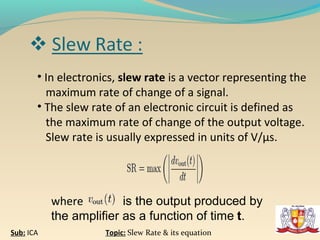
• In electronics, slew rate is a vector representing the
         maximum rate of change of a signal.
       • The slew rate of an electronic circuit is defined as
         the maximum rate of change of the output voltage.
         Slew rate is usually expressed in units of V/µs.


           where         is the output produced by
           the amplifier as a function of time t.
Sub: ICA             Topic: Slew Rate & its equation
•The slew rate can be measured using a
   function generator (usually square wave) and oscilloscope.
  •The unit of slew rate is typically V/µs.
  •The slew rate is same for both when feedback Is
   considered or not considered.


Sub: ICA            Topic: Slew Rate & its equation
There are slight differences between different
           amplifier designs in how the slewing
  phenomenon occurs. However, the general
  principles are the same as in this illustration.
  The input stage of modern amplifiers is usually
  a differential amplifier with
  a transconductance characteristic.
Sub: ICA           Topic: Slew Rate & its equation
This means the input stage takes a differential input
voltage and produces an outputcurrent into the second
stage.
The transconductance is typically very high — this is
where the large open loop gain of the amplifier is
generated. This also means that a fairly small input
voltage can cause the input stage to saturate.
In saturation, the stage produces a nearly constant output
current.
Sub: ICA          Topic: Slew Rate & its equation
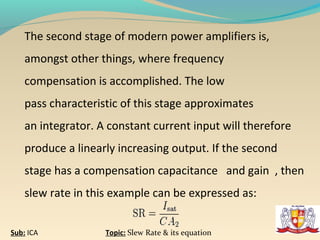
The second stage of modern power amplifiers is,
    amongst other things, where frequency
    compensation is accomplished. The low
    pass characteristic of this stage approximates
    an integrator. A constant current input will therefore
    produce a linearly increasing output. If the second
    stage has a compensation capacitance and gain , then
    slew rate in this example can be expressed as:


Sub: ICA            Topic: Slew Rate & its equation
Slew rate helps us to identify what is the maximum
    input frequency and amplitude applicable to the
    amplifier such that the output is not distorted. Thus it
    becomes imperative to check the datasheet for the
    device's slew rate before using it for high-frequency
    applications.


Sub: ICA            Topic: Slew Rate & its equation

slew rate in opamp

  • 1.
    Subject Code :151003 Name Of Subject Integrated Circuit and Application Name of Unit :The Practical Op-Amp Topic :Slew Rate & its equation Name of Faculty : Mr. Jwolin Patel Mr.Yogesh Parmar Name of Students : (i) Savalia Avani(100870111020) (ii) Patel Jay (100870111021) Sub: ICA Topic: Slew Rate & its equation
  • 2.
    Slew Rate andits equation Sub: ICA Topic: Slew Rate & its equation
  • 3.
    The Operational Amplifier • Usually Called Op Amps • An amplifier is a device that accepts a varying input signal and produces a similar output signal with a larger amplitude. • Usually connected so part of the output is fed back to the input. (Feedback Loop) • Most Op Amps behave like voltage amplifiers. They take an input voltage and output a scaled version. Sub: ICA Topic: Slew Rate & its equation
  • 4.
    They are the basic components used to build analog circuits. • The name “operational amplifier” comes from the fact that they were originally used to perform mathematical operations such as integration and differentiation. • Integrated circuit fabrication techniques have made high- performance operational amplifiers very inexpensive in comparison to older discrete devices. Sub: ICA Topic: Slew Rate & its equation
  • 5.
    The Operational Amplifier +VS i(-) _ Inverting RO vid Output Ri A vO = Advid Noninverting i(+) + -VS Sub: ICA Topic: Slew Rate & its equation
  • 6.
    • i(+), i(-): Currents into the amplifier on the inverting and noninverting lines respectively • vid : The input voltage from inverting to non-inverting inputs • +VS , -VS : DC source voltages, usually +15V and –15V • Ri : The input resistance, ideally infinity • A : The gain of the amplifier. Ideally very high, in the 1x10 10 range. • RO: The output resistance, ideally zero • vO: The output voltage; vO = AOLvid where AOL is the open-loop voltage gain Sub: ICA Topic: Slew Rate & its equation
  • 7.
    • In electronics,slew rate is a vector representing the maximum rate of change of a signal. • The slew rate of an electronic circuit is defined as the maximum rate of change of the output voltage. Slew rate is usually expressed in units of V/µs. where is the output produced by the amplifier as a function of time t. Sub: ICA Topic: Slew Rate & its equation
  • 8.
    •The slew ratecan be measured using a function generator (usually square wave) and oscilloscope. •The unit of slew rate is typically V/µs. •The slew rate is same for both when feedback Is considered or not considered. Sub: ICA Topic: Slew Rate & its equation
  • 9.
    There are slightdifferences between different amplifier designs in how the slewing phenomenon occurs. However, the general principles are the same as in this illustration. The input stage of modern amplifiers is usually a differential amplifier with a transconductance characteristic. Sub: ICA Topic: Slew Rate & its equation
  • 10.
    This means theinput stage takes a differential input voltage and produces an outputcurrent into the second stage. The transconductance is typically very high — this is where the large open loop gain of the amplifier is generated. This also means that a fairly small input voltage can cause the input stage to saturate. In saturation, the stage produces a nearly constant output current. Sub: ICA Topic: Slew Rate & its equation
  • 11.
    The second stageof modern power amplifiers is, amongst other things, where frequency compensation is accomplished. The low pass characteristic of this stage approximates an integrator. A constant current input will therefore produce a linearly increasing output. If the second stage has a compensation capacitance and gain , then slew rate in this example can be expressed as: Sub: ICA Topic: Slew Rate & its equation
  • 12.
    Slew rate helpsus to identify what is the maximum input frequency and amplitude applicable to the amplifier such that the output is not distorted. Thus it becomes imperative to check the datasheet for the device's slew rate before using it for high-frequency applications. Sub: ICA Topic: Slew Rate & its equation