Presented by:


Renu and Piyush


11093 &11089


M.Sc.-Biotech.(III Sem.)
TOPIC: -VECTOR ENGINEERING AND CODON
OPTIMIZATION


Vector engineering
! The expression level of a gene largely
depends upon how efficiently it is
transcribed . Transcription of any gene take
place when the RNA polymerase complex
interacts with promoter sequence, move
along the gene from a 5 ′ to 3′ direction,
giving rise to a RNA transcript and finally
dissociating from the gene at the
transcription terminal signal, freeing the
transcript for eventual translation.
In order to maximize the expression of
heterologous genes , those genes that
are taken from different organisms and
being expressed in bacterial , yeast ,
animal or plant cells , it is necessary to
design a cloning vector , which allows
optimal transcription of the genes .
Such vectors are called expression
vectors .The construction of such
vector is called vector engineering.
Expression vector
! Should have all the required components for maximal
expression of the heterologous gene . The vector
engineering approach depends upon the host system to be
used for expressing the heterologous gene .


! For Prokaryotic hosts like bacteria , bacterial promoters
like those of Lac or trap gene would have to be used ,
which are highly inducible in the presence of small
amount of certain chemicals like IPTG in the growth
medium .


! Some vectors use promoters derived from bacteriophage
lambda . Like the pl promoter, which can be induced at
high temperature using a temperature sensitive repressor.
Synthetic Promoters
! Like tac derived from trp, lac, p1 etc, which combine the
high expression properties of several promoters and are
capable of giving several fold higher expression value, as
compared to individual native promoter.
Eukaryotic Expression
Vectors
! Vectors for eukaryotic system would also have to be based
on same principle of high expression capability of specific
promoter to derive the expression of heterologous gene.


! Most eukaryotic expression vector contain viral promoter,
derived from either animal viruses like Simian virus 14,
Adenovirus, Papillomavirus or from plant viruses like
Cauliflower Mosaic Virus.
Prokaryotic Expression
Vector
! In prokaryotic vectors, often the heterologous gene is
expressed as fusion protein with a bacterial glutathione-S-
transferase or maltose binding protein. This allows the
fusion protein to be easily affinity purified by passing the
bacterial extract through a column containing beads of
glutathione agarose or amylose resins.


! The bound fusion protein is then eluted from the column
and cleaved with a protease called factor Xa, which
cleaves any polypeptide between the amino acids Arginine
and Valine.
! The above vector contain N-terminal amino acid
sequences of the bacterial gene, followed by the codon
for Arginine and Valine to provide cleavage side for Xa and
finally restriction enzyme sites for the introduction of the
heterologous gene to be expressed in appropriate system.


! This system efficiently produce the heterologous protein
as a fusion protein, from which the protein of interest can
be obtained in a pure form.
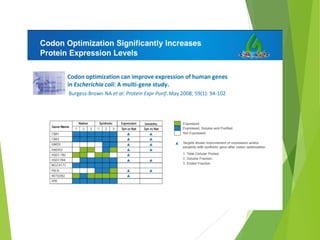
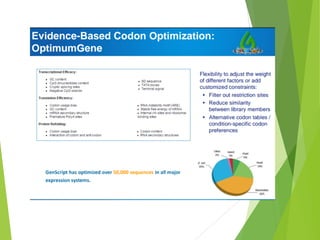
Codon Optimization
! It is one of the key step in achieving the high level
expression of the target gene.


! There are some key factors consideration including
transcription and translation efficiency, gene synthesis
and protein folding.


! Codon optimization : introducing synonymous mutations
that favour efficient soluble protein expression.
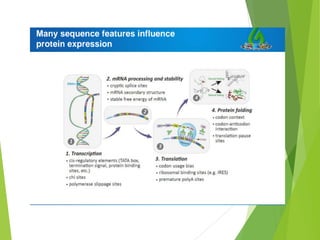
1. tRNA Abundance
! Owing to different tRNA identifies several synonymous
codons and the content of these synonymous codons is
different, therefore the efficiency of translation also
depends of the no. of tRNA.


! Preferred codons are those that can base pair optimally
with the most abundant tRNA.


! Generally this involves Watson-Crick pairing or, when
bases are modified in the tRNA, some modification in
optimal binding occur.
2. Codon usage bias
! There are obvious biases of synonymous codons in
bacteria, E.coli, yeast and some expression system of
higher biological.


! This can directly affect the efficiency of translation.


! So when one gene is expressed in a heterologous system,
the codon usage bias should be taken into account.
3. Complete mRNA structure
! Next to 5’UTR and 3’UTR the complete mRNA structure
also has significant effect on the process of protein
translation.


! Recently, from the systematic study of major factors
which effect the protein expression, folding of mRNA,
especially mRNA structure near the ribosome binding
sites, play an important role in protein expression.


! Eg. Level of protein expression can be greatly improved
by reducing the secondary structure near the start codon.
❖Codon optimization can solve the
problem of protein expression as
follows:
! Can not be expressed in heterologous
systems;


! Expression level was very low;


! Unable to fold properly;


! Lose functional activity.
Vector engineering and codon optimization

Vector engineering and codon optimization

  • 1.
    Presented by: Renu andPiyush 11093 &11089 M.Sc.-Biotech.(III Sem.)
  • 2.
    TOPIC: -VECTOR ENGINEERINGAND CODON OPTIMIZATION 
 

  • 3.
    Vector engineering ! Theexpression level of a gene largely depends upon how efficiently it is transcribed . Transcription of any gene take place when the RNA polymerase complex interacts with promoter sequence, move along the gene from a 5 ′ to 3′ direction, giving rise to a RNA transcript and finally dissociating from the gene at the transcription terminal signal, freeing the transcript for eventual translation.
  • 4.
    In order tomaximize the expression of heterologous genes , those genes that are taken from different organisms and being expressed in bacterial , yeast , animal or plant cells , it is necessary to design a cloning vector , which allows optimal transcription of the genes . Such vectors are called expression vectors .The construction of such vector is called vector engineering.
  • 5.
    Expression vector ! Shouldhave all the required components for maximal expression of the heterologous gene . The vector engineering approach depends upon the host system to be used for expressing the heterologous gene . ! For Prokaryotic hosts like bacteria , bacterial promoters like those of Lac or trap gene would have to be used , which are highly inducible in the presence of small amount of certain chemicals like IPTG in the growth medium . ! Some vectors use promoters derived from bacteriophage lambda . Like the pl promoter, which can be induced at high temperature using a temperature sensitive repressor.
  • 6.
    Synthetic Promoters ! Liketac derived from trp, lac, p1 etc, which combine the high expression properties of several promoters and are capable of giving several fold higher expression value, as compared to individual native promoter.
  • 7.
    Eukaryotic Expression Vectors ! Vectorsfor eukaryotic system would also have to be based on same principle of high expression capability of specific promoter to derive the expression of heterologous gene. ! Most eukaryotic expression vector contain viral promoter, derived from either animal viruses like Simian virus 14, Adenovirus, Papillomavirus or from plant viruses like Cauliflower Mosaic Virus.
  • 8.
    Prokaryotic Expression Vector ! Inprokaryotic vectors, often the heterologous gene is expressed as fusion protein with a bacterial glutathione-S- transferase or maltose binding protein. This allows the fusion protein to be easily affinity purified by passing the bacterial extract through a column containing beads of glutathione agarose or amylose resins. ! The bound fusion protein is then eluted from the column and cleaved with a protease called factor Xa, which cleaves any polypeptide between the amino acids Arginine and Valine.
  • 9.
    ! The abovevector contain N-terminal amino acid sequences of the bacterial gene, followed by the codon for Arginine and Valine to provide cleavage side for Xa and finally restriction enzyme sites for the introduction of the heterologous gene to be expressed in appropriate system. ! This system efficiently produce the heterologous protein as a fusion protein, from which the protein of interest can be obtained in a pure form.
  • 10.
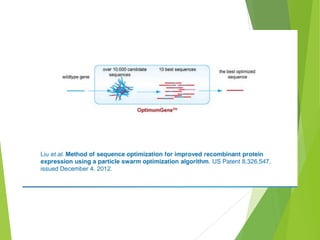
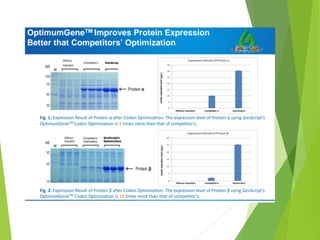
    Codon Optimization ! Itis one of the key step in achieving the high level expression of the target gene. ! There are some key factors consideration including transcription and translation efficiency, gene synthesis and protein folding. ! Codon optimization : introducing synonymous mutations that favour efficient soluble protein expression.
  • 13.
    1. tRNA Abundance !Owing to different tRNA identifies several synonymous codons and the content of these synonymous codons is different, therefore the efficiency of translation also depends of the no. of tRNA. ! Preferred codons are those that can base pair optimally with the most abundant tRNA. ! Generally this involves Watson-Crick pairing or, when bases are modified in the tRNA, some modification in optimal binding occur.
  • 14.
    2. Codon usagebias ! There are obvious biases of synonymous codons in bacteria, E.coli, yeast and some expression system of higher biological. ! This can directly affect the efficiency of translation. ! So when one gene is expressed in a heterologous system, the codon usage bias should be taken into account.
  • 15.
    3. Complete mRNAstructure ! Next to 5’UTR and 3’UTR the complete mRNA structure also has significant effect on the process of protein translation. ! Recently, from the systematic study of major factors which effect the protein expression, folding of mRNA, especially mRNA structure near the ribosome binding sites, play an important role in protein expression. ! Eg. Level of protein expression can be greatly improved by reducing the secondary structure near the start codon.
  • 19.
    ❖Codon optimization cansolve the problem of protein expression as follows: ! Can not be expressed in heterologous systems; ! Expression level was very low; ! Unable to fold properly; ! Lose functional activity.