


MOLECULAR
BIOLOGY TOOLS FOR
ENVIRONMENTAL
MANAGEMENT
PRESENTED BY,
POORANACHITHRA M
What are Molecular Biological Tools?
Tools that target biomarkers to provide information about organisms
and processes relevant to the assessment and/or remediation of
contaminants in the environment.
MBTs target Cellular Components
Nucleic Acids
Phospholipids
Proteins
Quantify total biomass & assess the entire microbial population
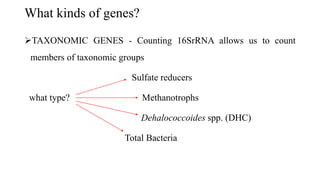
What kinds of genes?
TAXONOMIC GENES - Counting 16SrRNA allows us to count
members of taxonomic groups
Sulfate reducers
what type? Methanotrophs
Dehalococcoides spp. (DHC)
Total Bacteria
FUNCTIONAL GENES
Genes that code for the production of enzymes involved in
biodegradation processes.
An increase in numbers of specific Functional genes can indicate that
the biodegradation process has been stimulated.
Progress of the process of management.
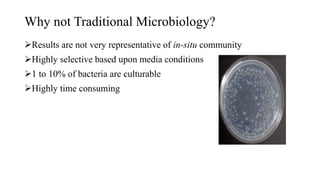
Why not Traditional Microbiology?
Results are not very representative of in-situ community
Highly selective based upon media conditions
1 to 10% of bacteria are culturable
Highly time consuming
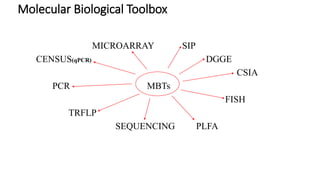
Molecular Biological Toolbox
MICROARRAY SIP
CENSUS(qPCR) DGGE
CSIA
PCR MBTs
FISH
TRFLP
SEQUENCING PLFA
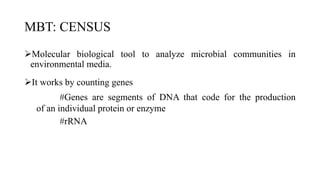
MBT: CENSUS
Molecular biological tool to analyze microbial communities in
environmental media.
It works by counting genes
#Genes are segments of DNA that code for the production
of an individual protein or enzyme
#rRNA
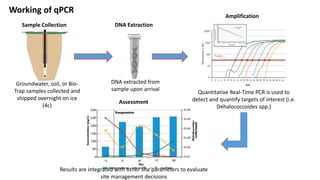
Sample Collection
Groundwater, soil, or Bio-
Trap samples collected and
shipped overnight on ice
(4c)
DNA extracted from
sample upon arrival
Quantitative Real-Time PCR is used to
detect and quantify targets of interest (i.e.
Dehalococcoides spp.)
Results are integrated with other site parameters to evaluate
site management decisions
DNA Extraction
Amplification
Assessment
Working of qPCR
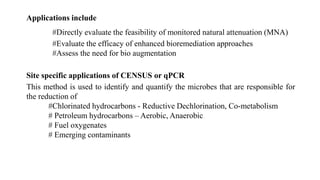
Applications include
#Directly evaluate the feasibility of monitored natural attenuation (MNA)
#Evaluate the efficacy of enhanced bioremediation approaches
#Assess the need for bio augmentation
Site specific applications of CENSUS or qPCR
This method is used to identify and quantify the microbes that are responsible for
the reduction of
#Chlorinated hydrocarbons - Reductive Dechlorination, Co-metabolism
# Petroleum hydrocarbons – Aerobic, Anaerobic
# Fuel oxygenates
# Emerging contaminants
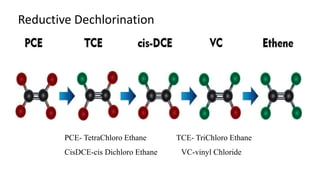
Reductive Dechlorination
PCE- TetraChloro Ethane TCE- TriChloro Ethane
CisDCE-cis Dichloro Ethane VC-vinyl Chloride
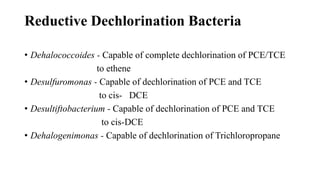
Reductive Dechlorination Bacteria
• Dehalococcoides - Capable of complete dechlorination of PCE/TCE
to ethene
• Desulfuromonas - Capable of dechlorination of PCE and TCE
to cis- DCE
• Desultiftobacterium - Capable of dechlorination of PCE and TCE
to cis-DCE
• Dehalogenimonas - Capable of dechlorination of Trichloropropane
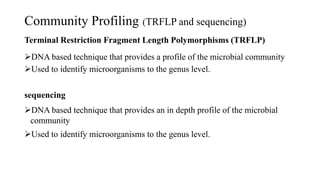
Community Profiling (TRFLP and sequencing)
Terminal Restriction Fragment Length Polymorphisms (TRFLP)
DNA based technique that provides a profile of the microbial community
Used to identify microorganisms to the genus level.
sequencing
DNA based technique that provides an in depth profile of the microbial
community
Used to identify microorganisms to the genus level.
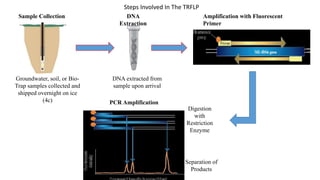
Sample Collection
Groundwater, soil, or Bio-
Trap samples collected and
shipped overnight on ice
(4c)
DNA extracted from
sample upon arrival
DNA
Extraction
Amplification with Fluorescent
Primer
PCR Amplification
Digestion
with
Restriction
Enzyme
Separation of
Products
Steps Involved In The TRFLP
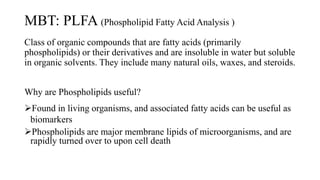
MBT: PLFA (Phospholipid Fatty Acid Analysis )
Class of organic compounds that are fatty acids (primarily
phospholipids) or their derivatives and are insoluble in water but soluble
in organic solvents. They include many natural oils, waxes, and steroids.
Why are Phospholipids useful?
Found in living organisms, and associated fatty acids can be useful as
biomarkers
Phospholipids are major membrane lipids of microorganisms, and are
rapidly turned over to upon cell death
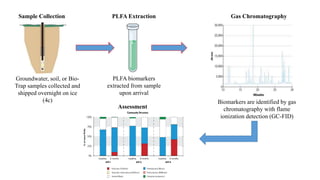
Sample Collection
Groundwater, soil, or Bio-
Trap samples collected and
shipped overnight on ice
(4c)
PLFA biomarkers
extracted from sample
upon arrival
PLFA Extraction Gas Chromatography
Assessment
Biomarkers are identified by gas
chromatography with flame
ionization detection (GC-FID)
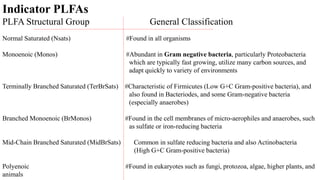
Indicator PLFAs
PLFA Structural Group General Classification
Normal Saturated (Nsats) #Found in all organisms
Monoenoic (Monos) #Abundant in Gram negative bacteria, particularly Proteobacteria
which are typically fast growing, utilize many carbon sources, and
adapt quickly to variety of environments
Terminally Branched Saturated (TerBrSats) #Characteristic of Firmicutes (Low G+C Gram-positive bacteria), and
also found in Bacteriodes, and some Gram-negative bacteria
(especially anaerobes)
Branched Monoenoic (BrMonos) #Found in the cell membranes of micro-aerophiles and anaerobes, such
as sulfate or iron-reducing bacteria
Mid-Chain Branched Saturated (MidBrSats) Common in sulfate reducing bacteria and also Actinobacteria
(High G+C Gram-positive bacteria)
Polyenoic #Found in eukaryotes such as fungi, protozoa, algae, higher plants, and
animals
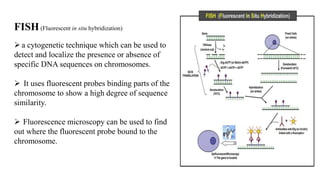
FISH(Fluorescent in situ hybridization)
a cytogenetic technique which can be used to
detect and localize the presence or absence of
specific DNA sequences on chromosomes.
 It uses fluorescent probes binding parts of the
chromosome to show a high degree of sequence
similarity.
 Fluorescence microscopy can be used to find
out where the fluorescent probe bound to the
chromosome.
CSIA (Compound-specific isotope analysis)
 an in situ monitoring tool that characterizes the natural abundance of
stable isotope signatures (C, N, H, and O) of individual dissolved
contaminants.
 Used to measure in-situ transformation processes of pollutants in
contaminated aquifers as well as to help determine the sources of
groundwater Contaminants
DGGE (denaturing gradient gel electrophoresis)
 Screening tool for presence/absence of indicator genes; sequencing
of amplicons for positive identification.
 DGGE also has been applied to evaluate microbial diversity because
it can distinguish closely related species, or even strains within a
species, and it could potentially be applied to RNA to detect
metabolic activity.
SIP(stable isotope probing)
Stable Isotope Probing involves the incorporation of stable-isotope-
labeled substrates (typically 13C) into process-specific biomarkers
(DNA, RNA, proteins, lipids).
SIP in combination with PLFA/nucleic acid/protein analysis can
identify which populations are active in a complex environment.
SIP/PLFA has been used with 13C carbon
DNA microarrays
microarrays may be subsequently developed and used in situ to
understand which genes are being expressed and how the key
metabolic activities are regulated under different environmental
conditions
consisting of rRNA-targeted oligonucleotide probes. Multiple
oligonucleotide probes are included that target 16S rRNA gene
sequences of organisms at different or the same phylogenetic levels
("multiple probe concept").
Thank you

MOLECULAR BIOLOGY TOOLS FOR ENVIRONMENTAL MANAGEMENT

  • 1.
  • 2.
    What are MolecularBiological Tools? Tools that target biomarkers to provide information about organisms and processes relevant to the assessment and/or remediation of contaminants in the environment. MBTs target Cellular Components Nucleic Acids Phospholipids Proteins Quantify total biomass & assess the entire microbial population
  • 3.
    What kinds ofgenes? TAXONOMIC GENES - Counting 16SrRNA allows us to count members of taxonomic groups Sulfate reducers what type? Methanotrophs Dehalococcoides spp. (DHC) Total Bacteria
  • 4.
    FUNCTIONAL GENES Genes thatcode for the production of enzymes involved in biodegradation processes. An increase in numbers of specific Functional genes can indicate that the biodegradation process has been stimulated. Progress of the process of management.
  • 5.
    Why not TraditionalMicrobiology? Results are not very representative of in-situ community Highly selective based upon media conditions 1 to 10% of bacteria are culturable Highly time consuming
  • 6.
    Molecular Biological Toolbox MICROARRAYSIP CENSUS(qPCR) DGGE CSIA PCR MBTs FISH TRFLP SEQUENCING PLFA
  • 7.
    MBT: CENSUS Molecular biologicaltool to analyze microbial communities in environmental media. It works by counting genes #Genes are segments of DNA that code for the production of an individual protein or enzyme #rRNA
  • 8.
    Sample Collection Groundwater, soil,or Bio- Trap samples collected and shipped overnight on ice (4c) DNA extracted from sample upon arrival Quantitative Real-Time PCR is used to detect and quantify targets of interest (i.e. Dehalococcoides spp.) Results are integrated with other site parameters to evaluate site management decisions DNA Extraction Amplification Assessment Working of qPCR
  • 9.
    Applications include #Directly evaluatethe feasibility of monitored natural attenuation (MNA) #Evaluate the efficacy of enhanced bioremediation approaches #Assess the need for bio augmentation Site specific applications of CENSUS or qPCR This method is used to identify and quantify the microbes that are responsible for the reduction of #Chlorinated hydrocarbons - Reductive Dechlorination, Co-metabolism # Petroleum hydrocarbons – Aerobic, Anaerobic # Fuel oxygenates # Emerging contaminants
  • 10.
    Reductive Dechlorination PCE- TetraChloroEthane TCE- TriChloro Ethane CisDCE-cis Dichloro Ethane VC-vinyl Chloride
  • 11.
    Reductive Dechlorination Bacteria •Dehalococcoides - Capable of complete dechlorination of PCE/TCE to ethene • Desulfuromonas - Capable of dechlorination of PCE and TCE to cis- DCE • Desultiftobacterium - Capable of dechlorination of PCE and TCE to cis-DCE • Dehalogenimonas - Capable of dechlorination of Trichloropropane
  • 12.
    Community Profiling (TRFLPand sequencing) Terminal Restriction Fragment Length Polymorphisms (TRFLP) DNA based technique that provides a profile of the microbial community Used to identify microorganisms to the genus level. sequencing DNA based technique that provides an in depth profile of the microbial community Used to identify microorganisms to the genus level.
  • 13.
    Sample Collection Groundwater, soil,or Bio- Trap samples collected and shipped overnight on ice (4c) DNA extracted from sample upon arrival DNA Extraction Amplification with Fluorescent Primer PCR Amplification Digestion with Restriction Enzyme Separation of Products Steps Involved In The TRFLP
  • 14.
    MBT: PLFA (PhospholipidFatty Acid Analysis ) Class of organic compounds that are fatty acids (primarily phospholipids) or their derivatives and are insoluble in water but soluble in organic solvents. They include many natural oils, waxes, and steroids. Why are Phospholipids useful? Found in living organisms, and associated fatty acids can be useful as biomarkers Phospholipids are major membrane lipids of microorganisms, and are rapidly turned over to upon cell death
  • 15.
    Sample Collection Groundwater, soil,or Bio- Trap samples collected and shipped overnight on ice (4c) PLFA biomarkers extracted from sample upon arrival PLFA Extraction Gas Chromatography Assessment Biomarkers are identified by gas chromatography with flame ionization detection (GC-FID)
  • 16.
    Indicator PLFAs PLFA StructuralGroup General Classification Normal Saturated (Nsats) #Found in all organisms Monoenoic (Monos) #Abundant in Gram negative bacteria, particularly Proteobacteria which are typically fast growing, utilize many carbon sources, and adapt quickly to variety of environments Terminally Branched Saturated (TerBrSats) #Characteristic of Firmicutes (Low G+C Gram-positive bacteria), and also found in Bacteriodes, and some Gram-negative bacteria (especially anaerobes) Branched Monoenoic (BrMonos) #Found in the cell membranes of micro-aerophiles and anaerobes, such as sulfate or iron-reducing bacteria Mid-Chain Branched Saturated (MidBrSats) Common in sulfate reducing bacteria and also Actinobacteria (High G+C Gram-positive bacteria) Polyenoic #Found in eukaryotes such as fungi, protozoa, algae, higher plants, and animals
  • 17.
    FISH(Fluorescent in situhybridization) a cytogenetic technique which can be used to detect and localize the presence or absence of specific DNA sequences on chromosomes.  It uses fluorescent probes binding parts of the chromosome to show a high degree of sequence similarity.  Fluorescence microscopy can be used to find out where the fluorescent probe bound to the chromosome.
  • 18.
    CSIA (Compound-specific isotopeanalysis)  an in situ monitoring tool that characterizes the natural abundance of stable isotope signatures (C, N, H, and O) of individual dissolved contaminants.  Used to measure in-situ transformation processes of pollutants in contaminated aquifers as well as to help determine the sources of groundwater Contaminants
  • 19.
    DGGE (denaturing gradientgel electrophoresis)  Screening tool for presence/absence of indicator genes; sequencing of amplicons for positive identification.  DGGE also has been applied to evaluate microbial diversity because it can distinguish closely related species, or even strains within a species, and it could potentially be applied to RNA to detect metabolic activity.
  • 20.
    SIP(stable isotope probing) StableIsotope Probing involves the incorporation of stable-isotope- labeled substrates (typically 13C) into process-specific biomarkers (DNA, RNA, proteins, lipids). SIP in combination with PLFA/nucleic acid/protein analysis can identify which populations are active in a complex environment. SIP/PLFA has been used with 13C carbon
  • 21.
    DNA microarrays microarrays maybe subsequently developed and used in situ to understand which genes are being expressed and how the key metabolic activities are regulated under different environmental conditions consisting of rRNA-targeted oligonucleotide probes. Multiple oligonucleotide probes are included that target 16S rRNA gene sequences of organisms at different or the same phylogenetic levels ("multiple probe concept").
  • 22.