Presented by:-
Jadhao Kundansingh R.
09ABT/11
Department of Agril-biotechnology,
Orissa University of Agriculture & Technology,
BBSR.
• Small RNA Family
• Mechanism of action of RNAi
• Application of RNAi in crop
improvement
• Case study I
• Conclusions
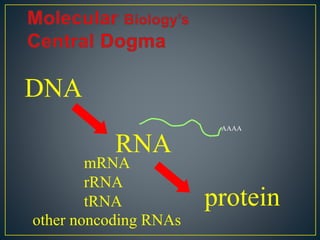
DNA
RNA
protein
AAAA
mRNA
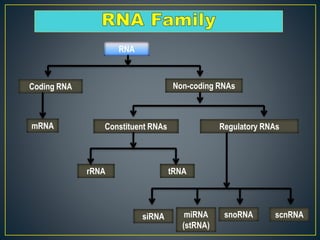
rRNA
tRNA
other noncoding RNAs
scnRNA
Constituent RNAs
tRNA
Regulatory RNAs
rRNA
Non-coding RNAs
RNA
mRNA
Coding RNA
miRNA
(stRNA)
siRNA snoRNA
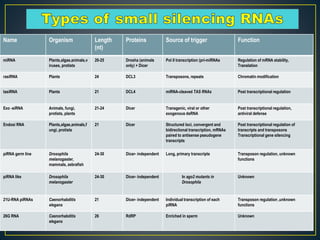
Name Organism Length
(nt)
Proteins Source of trigger Function
miRNA Plants,algae,animals,v
iruses, protists
20-25 Drosha (animals
only) + Dicer
Pol II transcription (pri-miRNAs Regulation of mRNA stability,
Translation
rasiRNA Plants 24 DCL3 Transposons, repeats Chromatin modification
tasiRNA Plants 21 DCL4 miRNA-cleaved TAS RNAs Post transcriptional regulation
Exo -siRNA Animals, fungi,
protists, plants
21-24 Dicer Transgenic, viral or other
exogenous dsRNA
Post transcriptional regulation,
antiviral defense
Endosi RNA Plants,algae,animals,f
ungi, protists
21 Dicer Structured loci, convergent and
bidirectional transcription, mRNAs
paired to antisense pseudogene
transcripts
Post transcriptional regulation of
transcripts and transposons
Transcriptional gene silencing
piRNA germ line Drosophila
melanogaster,
mammals, zebrafish
24-30 Dicer- independent Long, primary transcripts Transposon regulation, unknown
functions
piRNA like Drosophila
melanogaster
24-30 Dicer- independent In ago2 mutants in
Drosophila
Unknown
21U-RNA piRNAs Caenorhabditis
elegans
21 Dicer- independent Individual transcription of each
piRNA
Transposon regulation ,unknown
functions
26G RNA Caenorhabditis
elegans
26 RdRP Enriched in sperm Unknown
• RNA interference (RNAi) is an evolutionally
highly conserved process of post-transcriptional
gene silencing (PTGS) by which double stranded
RNA (dsRNA) causes sequence-specific
degradation of mRNA sequences.
• It was first discovered in 1998 by Andrew Fire
and Craig Mello in the nematode worm
Caenorhabditis elegans and later found in a wide
variety of organisms, including mammals.
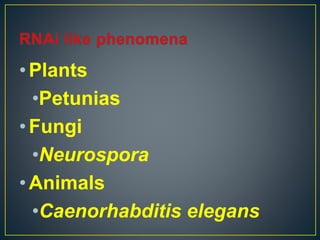
•Plants
•Petunias
•Fungi
•Neurospora
•Animals
•Caenorhabditis elegans
• PTGS (Posttranscriptional Gene
Silencing)
• Cosuppression
• Quelling
• Virus-induced gene silencing
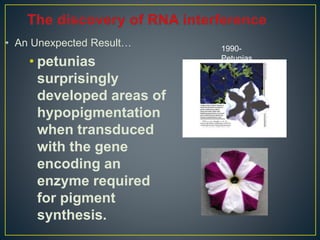
• An Unexpected Result…
• petunias
surprisingly
developed areas of
hypopigmentation
when transduced
with the gene
encoding an
enzyme required
for pigment
synthesis.
1990-
Petunias
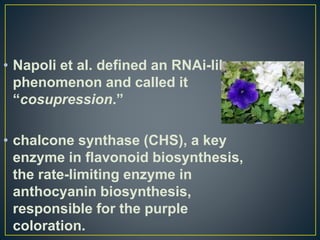
• Napoli et al. defined an RNAi-like
phenomenon and called it
“cosupression.”
• chalcone synthase (CHS), a key
enzyme in flavonoid biosynthesis,
the rate-limiting enzyme in
anthocyanin biosynthesis,
responsible for the purple
coloration.
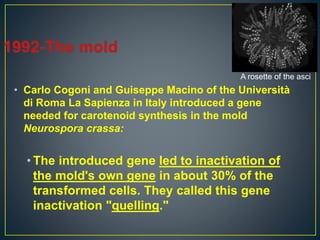
• Carlo Cogoni and Guiseppe Macino of the Università
di Roma La Sapienza in Italy introduced a gene
needed for carotenoid synthesis in the mold
Neurospora crassa:
• The introduced gene led to inactivation of
the mold's own gene in about 30% of the
transformed cells. They called this gene
inactivation "quelling."
A rosette of the asci
• The answer actually came in the year 1988 from
researchers working on C. elegans
Potent and genetic interference
by ds RNA in C. elegans
Fire.A,Xus,Montogomery ,Mk Kosta SA Driver SE
,Mello CG 1998 Feb 19.391:806-11.
Double stranded RNA Posses
Puzzle
Wagner RW, Sun.L Nature 1988 19,744-5
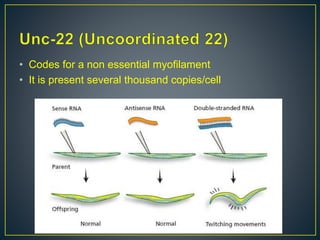
• Codes for a non essential myofilament
• It is present several thousand copies/cell
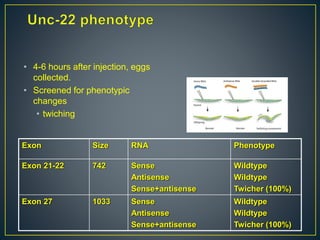
• 4-6 hours after injection, eggs
collected.
• Screened for phenotypic
changes
• twiching
Exon Size RNA Phenotype
Exon 21-22 742 Sense
Antisense
Sense+antisense
Wildtype
Wildtype
Twicher (100%)
Exon 27 1033 Sense
Antisense
Sense+antisense
Wildtype
Wildtype
Twicher (100%)
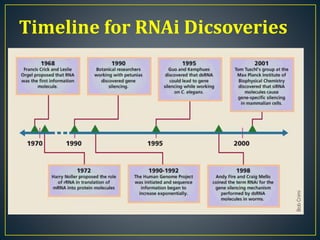
Timeline for RNAi Dicsoveries
Attempting to use antisense RNA to knock down gene
expression, they found synergistic effects on gene
silencing when antisense and sense RNA strands where
delivered together,
this phenomenon is later termed as
• Targetted disruption of gene
function in Drosophylla by RNA
interference : a role for nautilus in
embryonic somatic formation.
L.Misquitta,B.Paterson,proc.Nat.
Acad .Sci,USA,1999.96-1451-1453.
• Double stranded RNA induces m-
RNA degradation in Trypanosoma
bruci.
H.Nigo,C.Tschudi,K.Gull.Proc.Nati.
Acad.Sci.USA.1998,95,14687-14692
•Virus resistance and gene
silencing in plants can be
induced by simultaneous
expression of sense and
antisense RNA.
R.Water house,M.GrahamM.wang proc.Nat. Acad
.sci,USA,1998.95,13959-13964.
It was shown that plants contain
an enzyme RNA dependent RNA
polymerase .
It was responsible for the
synthesis of ds RNA in presence of
high level of m-RNA
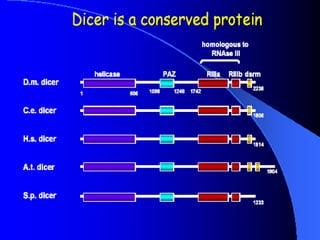
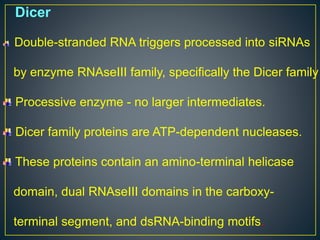
Dicer
Double-stranded RNA triggers processed into siRNAs
by enzyme RNAseIII family, specifically the Dicer family
Processive enzyme - no larger intermediates.
Dicer family proteins are ATP-dependent nucleases.
These proteins contain an amino-terminal helicase
domain, dual RNAseIII domains in the carboxy-
terminal segment, and dsRNA-binding motifs.
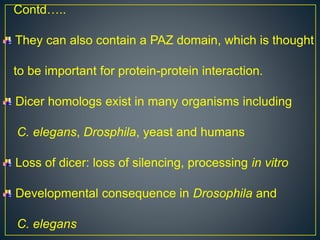
Contd…..
They can also contain a PAZ domain, which is thought
to be important for protein-protein interaction.
Dicer homologs exist in many organisms including
C. elegans, Drosphila, yeast and humans
Loss of dicer: loss of silencing, processing in vitro
Developmental consequence in Drosophila and
C. elegans
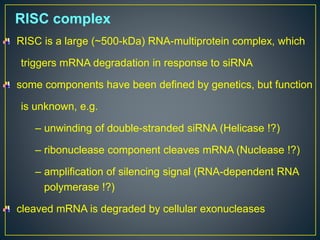
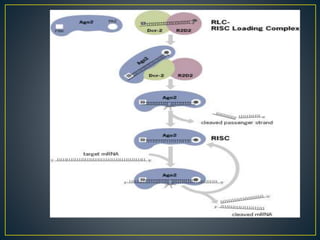
RISC complex
RISC is a large (~500-kDa) RNA-multiprotein complex, which
triggers mRNA degradation in response to siRNA
some components have been defined by genetics, but function
is unknown, e.g.
– unwinding of double-stranded siRNA (Helicase !?)
– ribonuclease component cleaves mRNA (Nuclease !?)
– amplification of silencing signal (RNA-dependent RNA
polymerase !?)
cleaved mRNA is degraded by cellular exonucleases
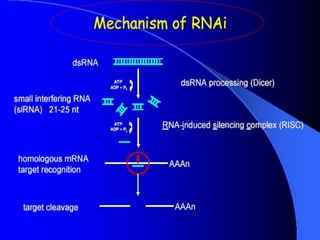
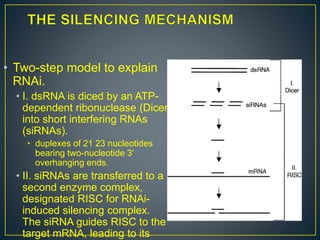
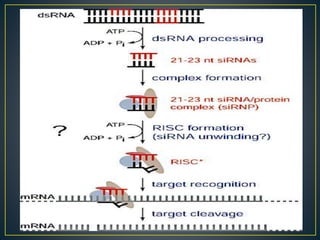
• Two-step model to explain
RNAi.
• I. dsRNA is diced by an ATP-
dependent ribonuclease (Dicer)
into short interfering RNAs
(siRNAs).
• duplexes of 21 23 nucleotides
bearing two-nucleotide 3'
overhanging ends.
• II. siRNAs are transferred to a
second enzyme complex,
designated RISC for RNAi-
induced silencing complex.
The siRNA guides RISC to the
target mRNA, leading to its
AAAA
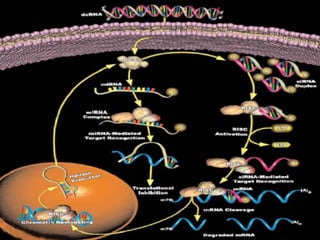
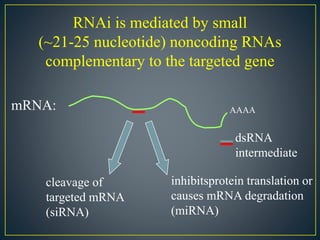
RNAi is mediated by small
(~21-25 nucleotide) noncoding RNAs
complementary to the targeted gene
cleavage of
targeted mRNA
(siRNA)
inhibitsprotein translation or
causes mRNA degradation
(miRNA)
mRNA:
dsRNA
intermediate
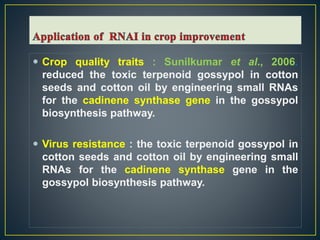
 Crop quality traits : Sunilkumar et al., 2006.
reduced the toxic terpenoid gossypol in cotton
seeds and cotton oil by engineering small RNAs
for the cadinene synthase gene in the gossypol
biosynthesis pathway.
 Virus resistance : the toxic terpenoid gossypol in
cotton seeds and cotton oil by engineering small
RNAs for the cadinene synthase gene in the
gossypol biosynthesis pathway.
 Protection from insect pests :
 Baum et al. 2007. showed that silencing of a vacuolar ATPase
gene (V-type ATPase A gene) in midgut cells of western corn
rootworm (WCR) led to larval mortality and stunted growth.
 Researchers identified a cytochrome P450 monooxygenase
(CYP6AE14) gene important for larval growth expressed in
midgut cells with a causal relationship to gossypol tolerance.
 Transgenic tobacco and Arabidopsis producing CYP6AE14
dsRNA were fed to larvae, successfully decreasing
endogenous CYP6AE14 mRNA in the insect, stunting larval
growth and increasing sensitivity to gossypol.
 Nematode resistance :
Yadav et al., 2006. showed transgenic
tobacco having dsRNA targetting two
Meloidogyne (root knot) nematode genes
had more than 95% resistance to
Meloidogyne incognita.
Huang et al., 2006. showed that Arabidopsis
plants expressing dsRNA for a gene
involved in plant–parasite interaction
(16D10) had suppressed formation of root
galls by Meloidogyne nematodes and
reduced egg production.
Bacterial and fungal risistance :
Little progress.
Escobar et al. 2001. showed that silencing
of two bacterial genes (iaaM and ipt) could
decrease the production of crown gall
tumors (Agrobacterium tumefaciens) to
nearly zero in Arabidopsis, suggesting that
resistance to crown gall disease could be
engineered in trees and woody ornamental
plants.
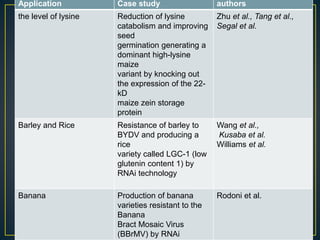
Application Case study authors
the level of lysine Reduction of lysine
catabolism and improving
seed
germination generating a
dominant high-lysine
maize
variant by knocking out
the expression of the 22-
kD
maize zein storage
protein
Zhu et al., Tang et al.,
Segal et al.
Barley and Rice Resistance of barley to
BYDV and producing a
rice
variety called LGC-1 (low
glutenin content 1) by
RNAi technology
Wang et al.,
Kusaba et al.
Williams et al.
Banana Production of banana
varieties resistant to the
Banana
Bract Mosaic Virus
(BBrMV) by RNAi
Rodoni et al.
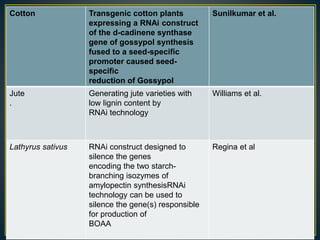
Cotton Transgenic cotton plants
expressing a RNAi construct
of the d-cadinene synthase
gene of gossypol synthesis
fused to a seed-specific
promoter caused seed-
specific
reduction of Gossypol
Sunilkumar et al.
Jute
.
Generating jute varieties with
low lignin content by
RNAi technology
Williams et al.
Lathyrus sativus RNAi construct designed to
silence the genes
encoding the two starch-
branching isozymes of
amylopectin synthesisRNAi
technology can be used to
silence the gene(s) responsible
for production of
BOAA
Regina et al
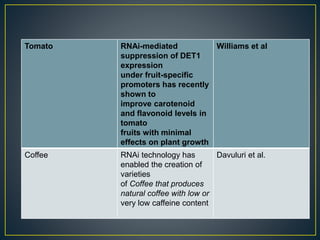
Tomato RNAi-mediated
suppression of DET1
expression
under fruit-specific
promoters has recently
shown to
improve carotenoid
and flavonoid levels in
tomato
fruits with minimal
effects on plant growth
Williams et al
Coffee RNAi technology has
enabled the creation of
varieties
of Coffee that produces
natural coffee with low or
very low caffeine content
Davuluri et al.
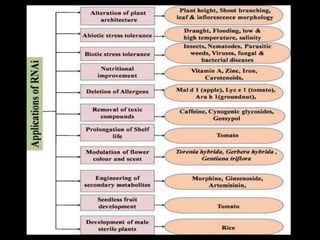
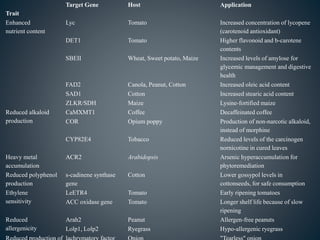
Trait
Target Gene Host Application
Enhanced
nutrient content
Lyc Tomato Increased concentration of lycopene
(carotenoid antioxidant)
DET1 Tomato Higher flavonoid and b-carotene
contents
SBEII Wheat, Sweet potato, Maize Increased levels of amylose for
glycemic management and digestive
health
FAD2 Canola, Peanut, Cotton Increased oleic acid content
SAD1 Cotton Increased stearic acid content
ZLKR/SDH Maize Lysine-fortified maize
Reduced alkaloid
production
CaMXMT1 Coffee Decaffeinated coffee
COR Opium poppy Production of non-narcotic alkaloid,
instead of morphine
CYP82E4 Tobacco Reduced levels of the carcinogen
nornicotine in cured leaves
Heavy metal
accumulation
ACR2 Arabidopsis Arsenic hyperaccumulation for
phytoremediation
Reduced polyphenol
production
s-cadinene synthase
gene
Cotton Lower gossypol levels in
cottonseeds, for safe consumption
Ethylene
sensitivity
LeETR4 Tomato Early ripening tomatoes
ACC oxidase gene Tomato Longer shelf life because of slow
ripening
Reduced
allergenicity
Arah2 Peanut Allergen-free peanuts
Lolp1, Lolp2 Ryegrass Hypo-allergenic ryegrass
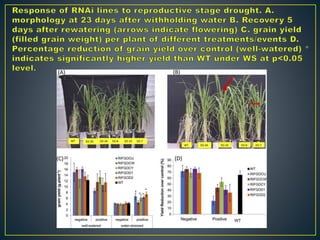
RNAi-mediated disruption of squalene synthase improves drought tolerance and yi
in rice
Lakshmi P. Manavalan et.al.2012
RNAi – Mechanism and Its Application In Crop Improvement

RNAi – Mechanism and Its Application In Crop Improvement

  • 1.
    Presented by:- Jadhao KundansinghR. 09ABT/11 Department of Agril-biotechnology, Orissa University of Agriculture & Technology, BBSR.
  • 2.
    • Small RNAFamily • Mechanism of action of RNAi • Application of RNAi in crop improvement • Case study I • Conclusions
  • 3.
  • 4.
    scnRNA Constituent RNAs tRNA Regulatory RNAs rRNA Non-codingRNAs RNA mRNA Coding RNA miRNA (stRNA) siRNA snoRNA
  • 5.
    Name Organism Length (nt) ProteinsSource of trigger Function miRNA Plants,algae,animals,v iruses, protists 20-25 Drosha (animals only) + Dicer Pol II transcription (pri-miRNAs Regulation of mRNA stability, Translation rasiRNA Plants 24 DCL3 Transposons, repeats Chromatin modification tasiRNA Plants 21 DCL4 miRNA-cleaved TAS RNAs Post transcriptional regulation Exo -siRNA Animals, fungi, protists, plants 21-24 Dicer Transgenic, viral or other exogenous dsRNA Post transcriptional regulation, antiviral defense Endosi RNA Plants,algae,animals,f ungi, protists 21 Dicer Structured loci, convergent and bidirectional transcription, mRNAs paired to antisense pseudogene transcripts Post transcriptional regulation of transcripts and transposons Transcriptional gene silencing piRNA germ line Drosophila melanogaster, mammals, zebrafish 24-30 Dicer- independent Long, primary transcripts Transposon regulation, unknown functions piRNA like Drosophila melanogaster 24-30 Dicer- independent In ago2 mutants in Drosophila Unknown 21U-RNA piRNAs Caenorhabditis elegans 21 Dicer- independent Individual transcription of each piRNA Transposon regulation ,unknown functions 26G RNA Caenorhabditis elegans 26 RdRP Enriched in sperm Unknown
  • 6.
    • RNA interference(RNAi) is an evolutionally highly conserved process of post-transcriptional gene silencing (PTGS) by which double stranded RNA (dsRNA) causes sequence-specific degradation of mRNA sequences. • It was first discovered in 1998 by Andrew Fire and Craig Mello in the nematode worm Caenorhabditis elegans and later found in a wide variety of organisms, including mammals.
  • 7.
  • 8.
    • PTGS (PosttranscriptionalGene Silencing) • Cosuppression • Quelling • Virus-induced gene silencing
  • 10.
    • An UnexpectedResult… • petunias surprisingly developed areas of hypopigmentation when transduced with the gene encoding an enzyme required for pigment synthesis. 1990- Petunias
  • 11.
    • Napoli etal. defined an RNAi-like phenomenon and called it “cosupression.” • chalcone synthase (CHS), a key enzyme in flavonoid biosynthesis, the rate-limiting enzyme in anthocyanin biosynthesis, responsible for the purple coloration.
  • 12.
    • Carlo Cogoniand Guiseppe Macino of the Università di Roma La Sapienza in Italy introduced a gene needed for carotenoid synthesis in the mold Neurospora crassa: • The introduced gene led to inactivation of the mold's own gene in about 30% of the transformed cells. They called this gene inactivation "quelling." A rosette of the asci
  • 13.
    • The answeractually came in the year 1988 from researchers working on C. elegans Potent and genetic interference by ds RNA in C. elegans Fire.A,Xus,Montogomery ,Mk Kosta SA Driver SE ,Mello CG 1998 Feb 19.391:806-11. Double stranded RNA Posses Puzzle Wagner RW, Sun.L Nature 1988 19,744-5
  • 14.
    • Codes fora non essential myofilament • It is present several thousand copies/cell
  • 15.
    • 4-6 hoursafter injection, eggs collected. • Screened for phenotypic changes • twiching Exon Size RNA Phenotype Exon 21-22 742 Sense Antisense Sense+antisense Wildtype Wildtype Twicher (100%) Exon 27 1033 Sense Antisense Sense+antisense Wildtype Wildtype Twicher (100%)
  • 16.
    Timeline for RNAiDicsoveries
  • 17.
    Attempting to useantisense RNA to knock down gene expression, they found synergistic effects on gene silencing when antisense and sense RNA strands where delivered together, this phenomenon is later termed as
  • 19.
    • Targetted disruptionof gene function in Drosophylla by RNA interference : a role for nautilus in embryonic somatic formation. L.Misquitta,B.Paterson,proc.Nat. Acad .Sci,USA,1999.96-1451-1453. • Double stranded RNA induces m- RNA degradation in Trypanosoma bruci. H.Nigo,C.Tschudi,K.Gull.Proc.Nati. Acad.Sci.USA.1998,95,14687-14692
  • 20.
    •Virus resistance andgene silencing in plants can be induced by simultaneous expression of sense and antisense RNA. R.Water house,M.GrahamM.wang proc.Nat. Acad .sci,USA,1998.95,13959-13964.
  • 21.
    It was shownthat plants contain an enzyme RNA dependent RNA polymerase . It was responsible for the synthesis of ds RNA in presence of high level of m-RNA
  • 24.
    Dicer Double-stranded RNA triggersprocessed into siRNAs by enzyme RNAseIII family, specifically the Dicer family Processive enzyme - no larger intermediates. Dicer family proteins are ATP-dependent nucleases. These proteins contain an amino-terminal helicase domain, dual RNAseIII domains in the carboxy- terminal segment, and dsRNA-binding motifs.
  • 25.
    Contd….. They can alsocontain a PAZ domain, which is thought to be important for protein-protein interaction. Dicer homologs exist in many organisms including C. elegans, Drosphila, yeast and humans Loss of dicer: loss of silencing, processing in vitro Developmental consequence in Drosophila and C. elegans
  • 26.
    RISC complex RISC isa large (~500-kDa) RNA-multiprotein complex, which triggers mRNA degradation in response to siRNA some components have been defined by genetics, but function is unknown, e.g. – unwinding of double-stranded siRNA (Helicase !?) – ribonuclease component cleaves mRNA (Nuclease !?) – amplification of silencing signal (RNA-dependent RNA polymerase !?) cleaved mRNA is degraded by cellular exonucleases
  • 29.
    • Two-step modelto explain RNAi. • I. dsRNA is diced by an ATP- dependent ribonuclease (Dicer) into short interfering RNAs (siRNAs). • duplexes of 21 23 nucleotides bearing two-nucleotide 3' overhanging ends. • II. siRNAs are transferred to a second enzyme complex, designated RISC for RNAi- induced silencing complex. The siRNA guides RISC to the target mRNA, leading to its
  • 31.
    AAAA RNAi is mediatedby small (~21-25 nucleotide) noncoding RNAs complementary to the targeted gene cleavage of targeted mRNA (siRNA) inhibitsprotein translation or causes mRNA degradation (miRNA) mRNA: dsRNA intermediate
  • 33.
     Crop qualitytraits : Sunilkumar et al., 2006. reduced the toxic terpenoid gossypol in cotton seeds and cotton oil by engineering small RNAs for the cadinene synthase gene in the gossypol biosynthesis pathway.  Virus resistance : the toxic terpenoid gossypol in cotton seeds and cotton oil by engineering small RNAs for the cadinene synthase gene in the gossypol biosynthesis pathway.
  • 34.
     Protection frominsect pests :  Baum et al. 2007. showed that silencing of a vacuolar ATPase gene (V-type ATPase A gene) in midgut cells of western corn rootworm (WCR) led to larval mortality and stunted growth.  Researchers identified a cytochrome P450 monooxygenase (CYP6AE14) gene important for larval growth expressed in midgut cells with a causal relationship to gossypol tolerance.  Transgenic tobacco and Arabidopsis producing CYP6AE14 dsRNA were fed to larvae, successfully decreasing endogenous CYP6AE14 mRNA in the insect, stunting larval growth and increasing sensitivity to gossypol.
  • 35.
     Nematode resistance: Yadav et al., 2006. showed transgenic tobacco having dsRNA targetting two Meloidogyne (root knot) nematode genes had more than 95% resistance to Meloidogyne incognita. Huang et al., 2006. showed that Arabidopsis plants expressing dsRNA for a gene involved in plant–parasite interaction (16D10) had suppressed formation of root galls by Meloidogyne nematodes and reduced egg production.
  • 36.
    Bacterial and fungalrisistance : Little progress. Escobar et al. 2001. showed that silencing of two bacterial genes (iaaM and ipt) could decrease the production of crown gall tumors (Agrobacterium tumefaciens) to nearly zero in Arabidopsis, suggesting that resistance to crown gall disease could be engineered in trees and woody ornamental plants.
  • 37.
    Application Case studyauthors the level of lysine Reduction of lysine catabolism and improving seed germination generating a dominant high-lysine maize variant by knocking out the expression of the 22- kD maize zein storage protein Zhu et al., Tang et al., Segal et al. Barley and Rice Resistance of barley to BYDV and producing a rice variety called LGC-1 (low glutenin content 1) by RNAi technology Wang et al., Kusaba et al. Williams et al. Banana Production of banana varieties resistant to the Banana Bract Mosaic Virus (BBrMV) by RNAi Rodoni et al.
  • 38.
    Cotton Transgenic cottonplants expressing a RNAi construct of the d-cadinene synthase gene of gossypol synthesis fused to a seed-specific promoter caused seed- specific reduction of Gossypol Sunilkumar et al. Jute . Generating jute varieties with low lignin content by RNAi technology Williams et al. Lathyrus sativus RNAi construct designed to silence the genes encoding the two starch- branching isozymes of amylopectin synthesisRNAi technology can be used to silence the gene(s) responsible for production of BOAA Regina et al
  • 39.
    Tomato RNAi-mediated suppression ofDET1 expression under fruit-specific promoters has recently shown to improve carotenoid and flavonoid levels in tomato fruits with minimal effects on plant growth Williams et al Coffee RNAi technology has enabled the creation of varieties of Coffee that produces natural coffee with low or very low caffeine content Davuluri et al.
  • 40.
    Trait Target Gene HostApplication Enhanced nutrient content Lyc Tomato Increased concentration of lycopene (carotenoid antioxidant) DET1 Tomato Higher flavonoid and b-carotene contents SBEII Wheat, Sweet potato, Maize Increased levels of amylose for glycemic management and digestive health FAD2 Canola, Peanut, Cotton Increased oleic acid content SAD1 Cotton Increased stearic acid content ZLKR/SDH Maize Lysine-fortified maize Reduced alkaloid production CaMXMT1 Coffee Decaffeinated coffee COR Opium poppy Production of non-narcotic alkaloid, instead of morphine CYP82E4 Tobacco Reduced levels of the carcinogen nornicotine in cured leaves Heavy metal accumulation ACR2 Arabidopsis Arsenic hyperaccumulation for phytoremediation Reduced polyphenol production s-cadinene synthase gene Cotton Lower gossypol levels in cottonseeds, for safe consumption Ethylene sensitivity LeETR4 Tomato Early ripening tomatoes ACC oxidase gene Tomato Longer shelf life because of slow ripening Reduced allergenicity Arah2 Peanut Allergen-free peanuts Lolp1, Lolp2 Ryegrass Hypo-allergenic ryegrass
  • 41.
    RNAi-mediated disruption ofsqualene synthase improves drought tolerance and yi in rice Lakshmi P. Manavalan et.al.2012