GENE SILENCING
BY
MRS. S. AMIRTHAM
ASSISTANT PROFESSOR
PG & RESEARCH DEPARTMENT OF BIOTECHNOLOGY
BON SECOURS COLLEGE FOR WOMEN
THANJAVUR
GENE SILENCING
Gene silencing is one of the most efficient and
promising functional genomics tools which
down regulates the expression of a gene in a
very precise manner and has significant impact
on crop improvement.
SILENCING ACHIEVED AT TWO LEVELS
• Silencing of a target gene can be achieved at two
levels; transcriptional and post-transcriptional
stages.
TYPES OF GENE SILENCING METHODS
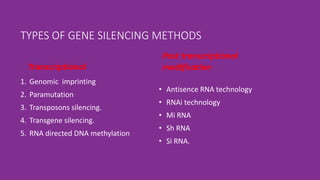
Transcriptional
1. Genomic imprinting
2. Paramutation
3. Transposons silencing.
4. Transgene silencing.
5. RNA directed DNA methylation
Post transcriptional
modification
• Antisence RNA technology
• RNAi technology
• Mi RNA
• Sh RNA
• Si RNA.
TRANSCRIPTIONAL MODIFICATION
• Transcriptional gene silencing occurs through
the repression of the process of transcription
while the post transcriptional gene silencing
can occur through the degradation of the
mRNA.
• Transcriptional gene silencing is the result of histone modifications,
creating an environment of heterochromatin around a gene that makes it
inaccessible to transcriptional machinery (RNA polymerase,
transcriptional factors, etc.).
GENOME IMPRINTING.
• Genomic imprinting is a process of silencing genes through DNA
methylation. The repressed allele is methylated, while the active allele is
unmethylated. ... Both of these syndromes can be caused by imprinting
or other errors involving genes on the long arm of chromosome 15
PARAMUTATION
• Paramutation is an interaction between alleles that leads to a mitotically
and meiotically heritable change in gene expression.
• Paramutation was first described as an interaction between two distinct
alleles of the same gene, recent findings indicate that paramutation-like
interactions can occur between two homologous transgenes (Meyer et al.,
1993), or a transgene and a homologous endogenous gene.
TRANSPOSONS SILENCING
• Transposon silencing, roles for DNA methylation in regulating genes
important for both cancer and development have been established.
• Transposons are mobile elements that can get transferred and
interspersed between different genomic locations, generating insertions,
deletions, and other chromosomal aberrations.
TRANSGENE SILENCING POSITION EFFECT
• Silencing position effects are characterized by progressive silencing
of the transgene at a rate characteristic of the site of integration.
• During the process of silencing, expression occurs in only a fraction
of the cell population and can therefore be described as
heterocellular.
RNA DIRECTED DNA METHYLATION
• RNA-directed DNA methylation (RdDM) is prevalent in flowering
plants and induces transcriptional silencing at repetitive DNA,
including all types of transposons.
POST TRANSCRIPTIONAL MODIFICATION
• Post-transcriptional gene silencing (PTGS) in plants is an RNA-degradation
mechanism that shows similarities to RNA interference (RNAi) in animals.
• Involve double-stranded RNA (dsRNA), spread within the organism from a
localised initiating area, correlate with the accumulation of small interfering
RNA (siRNA).
• In plants, post-transcriptional gene silencing (PTGS) protects the genome from
foreign genes and restricts the expression of certain endogenous genes for
proper development.
INTRODUCTION TO siRNA
Small interfering RNA (siRNA), sometimes known as short interfering RNA or silencing
RNA, is a class of double-stranded RNA non-coding RNA molecules, 20-25 base pairs in
length, similar to miRNA, and operating within the RNA interference (RNAi) pathway. It
interferes with the expression of specific genes with complementary nucleotide
sequences by degrading mRNA after transcription, preventing translation.
Structure.
siRNAs have a well-defined structure: a short (usually 20 to 24-bp) double-stranded RNA
(dsRNA) with phosphorylated 5’ ends and hydroxylated 3’ ends with two overhanging
nucleotides. The Dicer enzyme catalyzes production of siRNAs from long dsRNAs and
small hairpin RNAs.
siRNA TECHNOLOGY
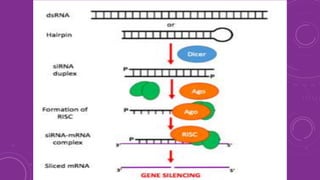
• Long dsRNA (which can come from hairpin, complementary RNAs, and RNA-
dependent RNA polymerases) is cleaved by an endo-ribonuclease called Dicer.
Dicer cuts the long dsRNA to form short interfering RNA or siRNA; this is what
enables the molecules to form the RNA-Induced Silencing Complex (RISC).
• Once siRNA enters the cell it gets incorporated into other proteins to form the
RISC.
• Once the siRNA is part of the RISC complex, the siRNA is unwound to form
single stranded siRNA.
• Once the siRNA is part of the RISC complex, the siRNA is unwound to form
single stranded siRNA.
• The strand that is thermodynamically less stable due to its base pairing at the
5´end is chosen to remain part of the RISC-complex
• The single stranded siRNA which is part of the RISC complex now
can scan and find a complementary mRNA.
• Once the single stranded siRNA (part of the RISC complex) binds to
its target mRNA, it induces mRNA cleavage.
• The mRNA is now cut and recognized as abnormal by the cell. This
causes degradation of the mRNA and in turn no translation of the
mRNA into amino acids and then proteins. Thus silencing the gene
that encodes that mRNA.
”
“
MICRO RNA
MicroRNAs (miRNAs) repress the expression of mRNA targets by
promoting translational repression and mRNA degradation.
In animals, target degradation is initiated by accelerated
deadenylation, which is normally followed by decapping and
subsequent degradation of the mRNA body. However, some
deadenylated targets may not be further degraded.
In plants, target degradation is initiated by endonucleolytic
cleavage catalysed by the Argonaute proteins.Although
translational repression and mRNA degradation have both been
reported in animals and plants, recent evidence indicates that
target degradation provides a major contribution to silencing in
both kingdoms.
• An important difference between the mechanisms of miRNA-mediated
silencing in animals and plants is the requirement, in animals, for proteins of
the GW182 family.
• GW182 proteins are essential for silencing in animal cells. They interact with
Argonaute proteins through an amino-terminal domain and with the
cytoplasmic poly(A)-binding protein (PABPC) through a carboxy-terminal
silencing domain.
• Moreover, the contribution of translational repression to silencing in plants
remains unknown.
Construction of shRNA expression vectors
• The following steps were used to construct a human U6promoter-driven shRNA
vector with a recommended loopsequence of 5’-TTCAAGAGA-3’ as proof of
principle.
• Step 1: Primer designTwo short primers were designed for PCR with the tem-plate
pGsilG. The sequence of the forward primer was 5’-TTC AAG AGA N(19–23)TTT
TTT CCC GGG ACG-3’ andthat of the reverse primer was 5’-TCT CTT GAA N(19–
23)GGA TCC CGC GTC C-3’.
• The 3’ annealing primersequences, which are complementary to the
template,could be shorter than that recommended for a lowerannealing
temperature.
• The 5’ loop sequences are neces-sary for recombination in vivo. For instance, if
the targetsequence is 5’-CCA CAC AAC CTG GTA GCA T-3’, theshRNA structure
should be of the form 5’-CCA CAC AACCTG GTA GCA TTT CAA GAG AAT GCT ACC
AGG TTGTGT GGT TTT
• Step 2 PCR processTo obtain abundant and reliable products, high-qualityand
high-fidelity DNA polymerase was used. In this exper-iment, KOD-Plus Taq
polymerase (Toyobo) or Pfu DNApolymerase (Promega) was used for PCR in a
volume of 50 μL, with annealing at 38°C.
• Step 3 Purification of PCR products and transformationAfter authentication,
the PCR products were purifiedusing a Montage™ PCR centrifugal filter device
(Milli-pore). Then the purified PCR products are transformed in to chemical
competent of E.coli.
PRINCIPLE AND APPLICATION OF GENE SILENCING
Gene silencing is defined as an epi genetic modification does not
alter the DNA sequence and, although it is heritable, variable
frequencies of reversions to expression are observed.
• Gene silencing is used in the course of normal development and
differentiation to repress genes whose products are not required
in specific cell types or tissues.
• This may apply to individual genes or larger chromosome regions.
In some special situations, such as chromosome dosage
compensation in mammals, one of the two female X chromosomes
is almost completely repressed.
• Repression of genes involve changes in chromatin structure and
levels of DNA methylation, or destabilization of mRNA.
• Aberrant silencing of genes may lead to disease in mammals and
generate developmental variants in plants.
• For example, methylation of tumor suppressor genes contributes
to the onset and progression of cancer, while methylation of genes
controlling flower development results in heritable changes of
flower morphology.
• A fundamental mechanism by which REST abundance is regulated
in the transition from pluripotent stem cells.
• Perturbation of REST expression during embryogenesis causes
cellular apoptosis, aberrant differentiation and patterning, and
lethality.
• Gene silencing in ES cells, the shRNA ES cell lines are used for the
production of corresponding shRNA transgenic mouse lines via
blastocyst injection.
• Recent studies of gene silencing in plants have revealed two RNA-
mediated epigenetic processes, RNA-directed RNA degradation
and RNA-directed DNA methylation
• These natural processes have provided new
avenues for developing high-efficiency, high-
throughput technology for gene suppression in
plants.
• Gene silencingDNA methylationRNA
interferencevirus resistanceinverted repeat
transgenedouble-stranded RNA antisensefunctional
genomics
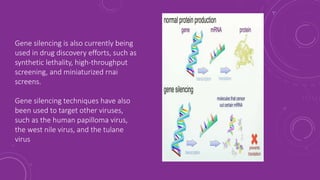
Gene silencing is also currently being
used in drug discovery efforts, such as
synthetic lethality, high-throughput
screening, and miniaturized rnai
screens.
Gene silencing techniques have also
been used to target other viruses,
such as the human papilloma virus,
the west nile virus, and the tulane
virus
Gene silencing   amirtham

Gene silencing amirtham

  • 1.
    GENE SILENCING BY MRS. S.AMIRTHAM ASSISTANT PROFESSOR PG & RESEARCH DEPARTMENT OF BIOTECHNOLOGY BON SECOURS COLLEGE FOR WOMEN THANJAVUR
  • 2.
    GENE SILENCING Gene silencingis one of the most efficient and promising functional genomics tools which down regulates the expression of a gene in a very precise manner and has significant impact on crop improvement.
  • 3.
    SILENCING ACHIEVED ATTWO LEVELS • Silencing of a target gene can be achieved at two levels; transcriptional and post-transcriptional stages.
  • 4.
    TYPES OF GENESILENCING METHODS Transcriptional 1. Genomic imprinting 2. Paramutation 3. Transposons silencing. 4. Transgene silencing. 5. RNA directed DNA methylation Post transcriptional modification • Antisence RNA technology • RNAi technology • Mi RNA • Sh RNA • Si RNA.
  • 5.
    TRANSCRIPTIONAL MODIFICATION • Transcriptionalgene silencing occurs through the repression of the process of transcription while the post transcriptional gene silencing can occur through the degradation of the mRNA.
  • 6.
    • Transcriptional genesilencing is the result of histone modifications, creating an environment of heterochromatin around a gene that makes it inaccessible to transcriptional machinery (RNA polymerase, transcriptional factors, etc.). GENOME IMPRINTING. • Genomic imprinting is a process of silencing genes through DNA methylation. The repressed allele is methylated, while the active allele is unmethylated. ... Both of these syndromes can be caused by imprinting or other errors involving genes on the long arm of chromosome 15
  • 7.
    PARAMUTATION • Paramutation isan interaction between alleles that leads to a mitotically and meiotically heritable change in gene expression. • Paramutation was first described as an interaction between two distinct alleles of the same gene, recent findings indicate that paramutation-like interactions can occur between two homologous transgenes (Meyer et al., 1993), or a transgene and a homologous endogenous gene. TRANSPOSONS SILENCING • Transposon silencing, roles for DNA methylation in regulating genes important for both cancer and development have been established. • Transposons are mobile elements that can get transferred and interspersed between different genomic locations, generating insertions, deletions, and other chromosomal aberrations.

  • 8.
    TRANSGENE SILENCING POSITIONEFFECT • Silencing position effects are characterized by progressive silencing of the transgene at a rate characteristic of the site of integration. • During the process of silencing, expression occurs in only a fraction of the cell population and can therefore be described as heterocellular. RNA DIRECTED DNA METHYLATION • RNA-directed DNA methylation (RdDM) is prevalent in flowering plants and induces transcriptional silencing at repetitive DNA, including all types of transposons.
  • 9.
    POST TRANSCRIPTIONAL MODIFICATION •Post-transcriptional gene silencing (PTGS) in plants is an RNA-degradation mechanism that shows similarities to RNA interference (RNAi) in animals. • Involve double-stranded RNA (dsRNA), spread within the organism from a localised initiating area, correlate with the accumulation of small interfering RNA (siRNA). • In plants, post-transcriptional gene silencing (PTGS) protects the genome from foreign genes and restricts the expression of certain endogenous genes for proper development.
  • 10.
    INTRODUCTION TO siRNA Smallinterfering RNA (siRNA), sometimes known as short interfering RNA or silencing RNA, is a class of double-stranded RNA non-coding RNA molecules, 20-25 base pairs in length, similar to miRNA, and operating within the RNA interference (RNAi) pathway. It interferes with the expression of specific genes with complementary nucleotide sequences by degrading mRNA after transcription, preventing translation. Structure. siRNAs have a well-defined structure: a short (usually 20 to 24-bp) double-stranded RNA (dsRNA) with phosphorylated 5’ ends and hydroxylated 3’ ends with two overhanging nucleotides. The Dicer enzyme catalyzes production of siRNAs from long dsRNAs and small hairpin RNAs.
  • 11.
    siRNA TECHNOLOGY • LongdsRNA (which can come from hairpin, complementary RNAs, and RNA- dependent RNA polymerases) is cleaved by an endo-ribonuclease called Dicer. Dicer cuts the long dsRNA to form short interfering RNA or siRNA; this is what enables the molecules to form the RNA-Induced Silencing Complex (RISC). • Once siRNA enters the cell it gets incorporated into other proteins to form the RISC. • Once the siRNA is part of the RISC complex, the siRNA is unwound to form single stranded siRNA. • Once the siRNA is part of the RISC complex, the siRNA is unwound to form single stranded siRNA. • The strand that is thermodynamically less stable due to its base pairing at the 5´end is chosen to remain part of the RISC-complex
  • 12.
    • The singlestranded siRNA which is part of the RISC complex now can scan and find a complementary mRNA. • Once the single stranded siRNA (part of the RISC complex) binds to its target mRNA, it induces mRNA cleavage. • The mRNA is now cut and recognized as abnormal by the cell. This causes degradation of the mRNA and in turn no translation of the mRNA into amino acids and then proteins. Thus silencing the gene that encodes that mRNA.
  • 13.
  • 14.
    MICRO RNA MicroRNAs (miRNAs)repress the expression of mRNA targets by promoting translational repression and mRNA degradation. In animals, target degradation is initiated by accelerated deadenylation, which is normally followed by decapping and subsequent degradation of the mRNA body. However, some deadenylated targets may not be further degraded. In plants, target degradation is initiated by endonucleolytic cleavage catalysed by the Argonaute proteins.Although translational repression and mRNA degradation have both been reported in animals and plants, recent evidence indicates that target degradation provides a major contribution to silencing in both kingdoms.
  • 15.
    • An importantdifference between the mechanisms of miRNA-mediated silencing in animals and plants is the requirement, in animals, for proteins of the GW182 family. • GW182 proteins are essential for silencing in animal cells. They interact with Argonaute proteins through an amino-terminal domain and with the cytoplasmic poly(A)-binding protein (PABPC) through a carboxy-terminal silencing domain. • Moreover, the contribution of translational repression to silencing in plants remains unknown.
  • 16.
    Construction of shRNAexpression vectors • The following steps were used to construct a human U6promoter-driven shRNA vector with a recommended loopsequence of 5’-TTCAAGAGA-3’ as proof of principle. • Step 1: Primer designTwo short primers were designed for PCR with the tem-plate pGsilG. The sequence of the forward primer was 5’-TTC AAG AGA N(19–23)TTT TTT CCC GGG ACG-3’ andthat of the reverse primer was 5’-TCT CTT GAA N(19– 23)GGA TCC CGC GTC C-3’. • The 3’ annealing primersequences, which are complementary to the template,could be shorter than that recommended for a lowerannealing temperature. • The 5’ loop sequences are neces-sary for recombination in vivo. For instance, if the targetsequence is 5’-CCA CAC AAC CTG GTA GCA T-3’, theshRNA structure should be of the form 5’-CCA CAC AACCTG GTA GCA TTT CAA GAG AAT GCT ACC AGG TTGTGT GGT TTT
  • 17.
    • Step 2PCR processTo obtain abundant and reliable products, high-qualityand high-fidelity DNA polymerase was used. In this exper-iment, KOD-Plus Taq polymerase (Toyobo) or Pfu DNApolymerase (Promega) was used for PCR in a volume of 50 μL, with annealing at 38°C. • Step 3 Purification of PCR products and transformationAfter authentication, the PCR products were purifiedusing a Montage™ PCR centrifugal filter device (Milli-pore). Then the purified PCR products are transformed in to chemical competent of E.coli.
  • 19.
    PRINCIPLE AND APPLICATIONOF GENE SILENCING Gene silencing is defined as an epi genetic modification does not alter the DNA sequence and, although it is heritable, variable frequencies of reversions to expression are observed. • Gene silencing is used in the course of normal development and differentiation to repress genes whose products are not required in specific cell types or tissues. • This may apply to individual genes or larger chromosome regions. In some special situations, such as chromosome dosage compensation in mammals, one of the two female X chromosomes is almost completely repressed. • Repression of genes involve changes in chromatin structure and levels of DNA methylation, or destabilization of mRNA.
  • 20.
    • Aberrant silencingof genes may lead to disease in mammals and generate developmental variants in plants. • For example, methylation of tumor suppressor genes contributes to the onset and progression of cancer, while methylation of genes controlling flower development results in heritable changes of flower morphology. • A fundamental mechanism by which REST abundance is regulated in the transition from pluripotent stem cells.
  • 21.
    • Perturbation ofREST expression during embryogenesis causes cellular apoptosis, aberrant differentiation and patterning, and lethality. • Gene silencing in ES cells, the shRNA ES cell lines are used for the production of corresponding shRNA transgenic mouse lines via blastocyst injection. • Recent studies of gene silencing in plants have revealed two RNA- mediated epigenetic processes, RNA-directed RNA degradation and RNA-directed DNA methylation
  • 22.
    • These naturalprocesses have provided new avenues for developing high-efficiency, high- throughput technology for gene suppression in plants. • Gene silencingDNA methylationRNA interferencevirus resistanceinverted repeat transgenedouble-stranded RNA antisensefunctional genomics
  • 23.
    Gene silencing isalso currently being used in drug discovery efforts, such as synthetic lethality, high-throughput screening, and miniaturized rnai screens. Gene silencing techniques have also been used to target other viruses, such as the human papilloma virus, the west nile virus, and the tulane virus