UNSTRUCTURED
MODEL ON
POPULATION LEVEL
Presented By, Submitted To,
POORANACHITHRA M Mr. RAVI
SHANKAR V
WHAT IS A MODEL:
STRUCTURED (multi component system)
MODEL
UNSTRUCTURED (single component system)
SEGREGATED (heterogeneity)
MODEL
NON SEGREGATED (homogeneity)
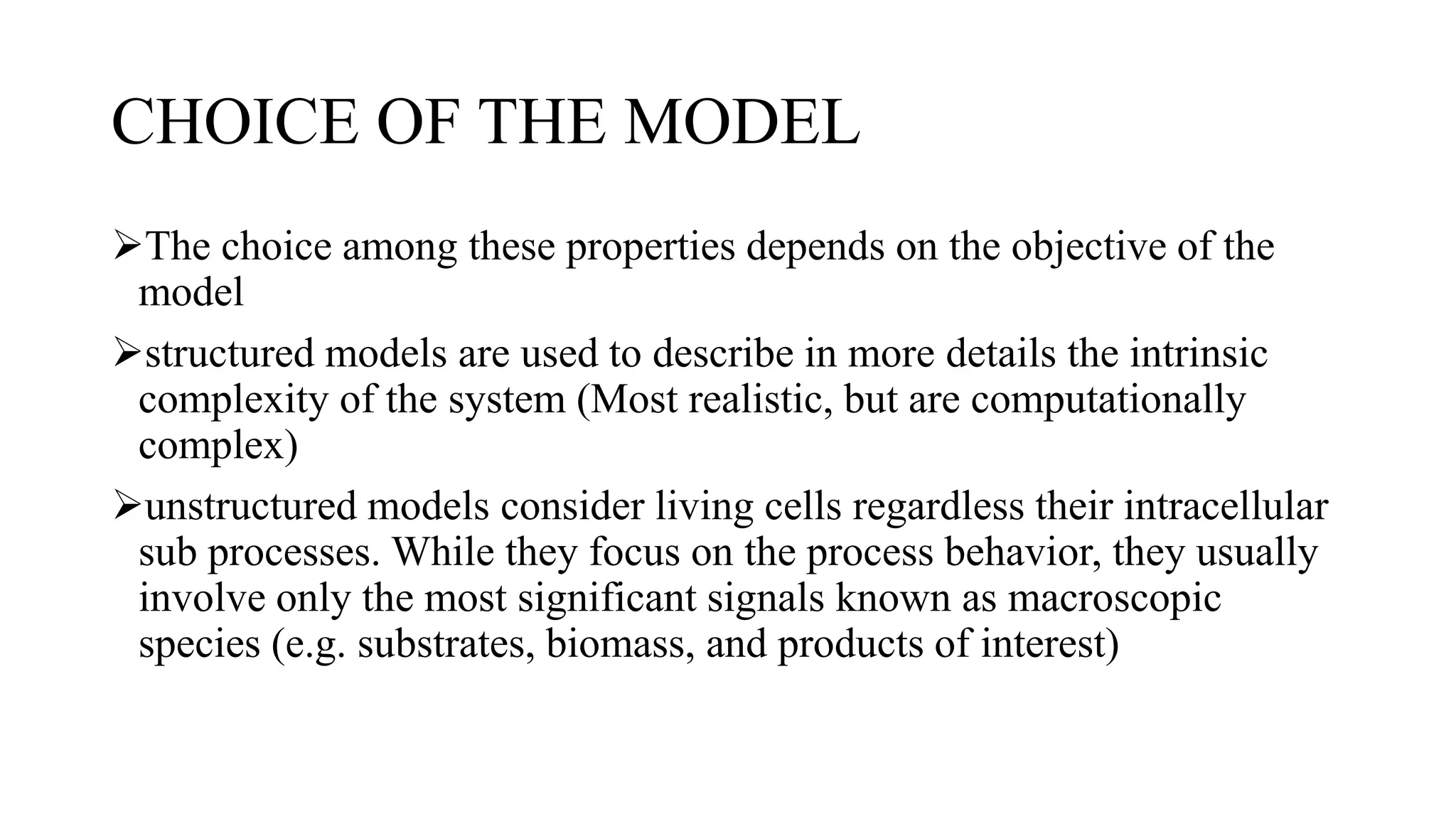
CHOICE OF THE MODEL
The choice among these properties depends on the objective of the
model
structured models are used to describe in more details the intrinsic
complexity of the system (Most realistic, but are computationally
complex)
unstructured models consider living cells regardless their intracellular
sub processes. While they focus on the process behavior, they usually
involve only the most significant signals known as macroscopic
species (e.g. substrates, biomass, and products of interest)
Unstructured, non segregated models:
Monod model:
μ =
μm CS
KS + CS
μ : specific (cell) growth rate
μm : maximum specific growth rate at saturating substrate
concentrations
CS : substrate concentration
KS : saturation constant (CS = KS when μ = μm / 2)
Prof. R. Shanthini
Unstructured, nonsegregated models:
Monod model:
μ =
μm CS
KS + CS
Most commonly used
model for cell growth
0
0.2
0.4
0.6
0.8
1
0 5 10 15
Cs (g/L)
μ(perh)
μm = 0.9 per h
Ks = 0.7 g/L
(1) For noncompetitive substrate inhibition:
μ =
μm
(1 + KS/CS)(1 + CS/KI )
Monod model modified for substrate inhibition:
(2)For competitive substrate inhibition:
μ =
μm CS
KS(1 + CS/KI) + CS
where KI is the substrate inhibition constant.
Monod model does not model substrate inhibition.
Substrate inhibition means increasing substrate concentration beyond
certain value reduces the cell growth rate.
Monod model modified for cell growth with product inhibition:
Monod model does not model product inhibition (where increasing product concentration
beyond certain value reduces the cell growth rate)
where Cp is the product concentration and Kp is a product inhibition constant.
For competitive product inhibition:
For non-competitive product inhibition:
μ =
μm
(1 + KS/CS)(1 + Cp/Kp )
μ =
μm CS
KS(1 + Cp/Kp) + CS
Monod model modified for cell growth with toxic compound inhibition:
where CI is the product concentration and KI is a constant to be determined.
For competitive toxic compound inhibition:
For non-competitive toxic compound inhibition:
μ =
μm
(1 + KS/CS)(1 + CI/KI )
μ =
μm CS
KS(1 + CI/KI) + CS
Assumptions behind Monod model:
 One limiting substrate
 Semi-empirical relationship
 Single enzyme system with M-M kinetics being
responsible for the uptake of substrate
 Amount of enzyme is sufficiently low to be growth
limiting
 Cell growth is slow
 Cell population density is low
Other unstructured, nonsegregated models (assuming one limiting substrate):
Blackman equation: μ = μm if CS ≥ 2KS
μ =
μm CS
2 KS
if CS < 2KS
Tessier equation: μ = μm [1 - exp(-KCS)]
Moser equation: μ =
μm CS
n
KS + CS
n
Contois equation: μ =
μm CS
KSX CX + CS
Prof. R. Shanthini
Blackman equation:
0
0.2
0.4
0.6
0.8
1
0 2 4 6 8 10
Cs (g/L)
μ(perh)
μm = 0.9 per h
Ks = 0.7 g/L
μ = μm
μ =
μm CS
2 KS
if CS ≥ 2 KS
if CS < 2 KS
This often fits the data better than the
Monod model, but the discontinuity can be a
problem.
Prof. R. Shanthini
Tessier equation:
0
0.2
0.4
0.6
0.8
1
0 2 4 6 8 10
Cs (g/L)
μ(perh)
μm = 0.9 per h
K = 0.7 g/L
μ = μm [1 - exp(-KCS)]
Prof. R. Shanthini
Moser equation:
0
0.2
0.4
0.6
0.8
1
0 2 4 6 8 10
Cs (g/L)
Monod
n = 0.25
n = 0.5
n = 0.75
μ(perh)
μ =
μm CS
n
KS + CS
n
μm = 0.9 per h
Ks = 0.7 g/L
When n = 1, Moser equation describes Monod model.
Contois equation:
Saturation constant (KSX CX ) is proportional to cell
concentrationμ =
μm CS
KSX CX + CS
Prof. R. Shanthini
Extended Monod model:
0
0.2
0.4
0.6
0.8
1
0 2 4 6 8 10
Cs (g/L)
μ(perh)
μm = 0.9 per h
Ks = 0.7 g/L
CS,min = 0.5 g/L
μ =
μm (CS – CS,min)
KS + CS – CS,min
Extended Monod model includes a CS,min term,
which denotes the minimal substrate
concentration needed for cell growth.
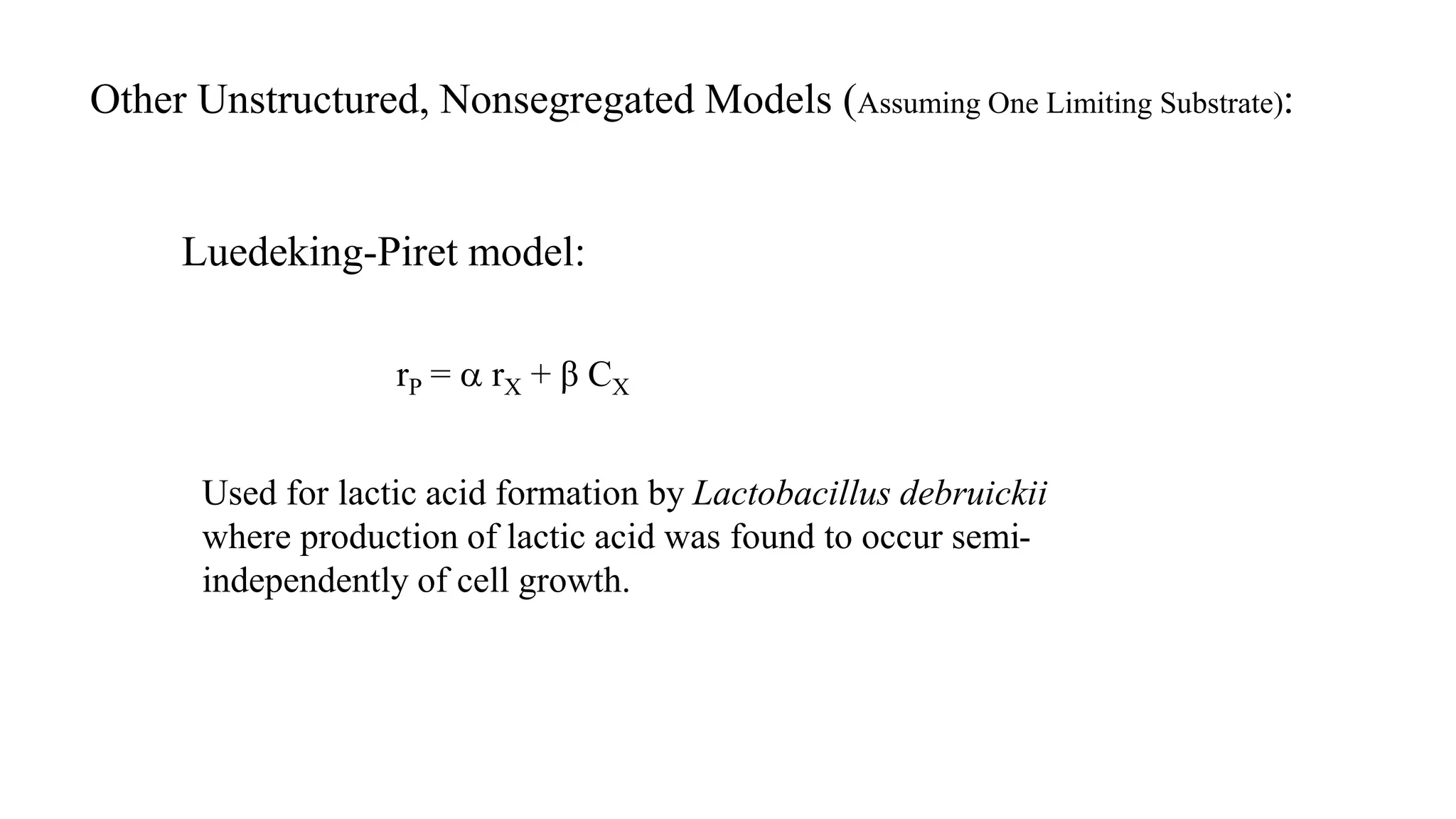
Other Unstructured, Nonsegregated Models (Assuming One Limiting Substrate):
Luedeking-Piret model:
rP =  rX + β CX
Used for lactic acid formation by Lactobacillus debruickii
where production of lactic acid was found to occur semi-
independently of cell growth.
Limitations Of Unstructured Non-segregated Models:
 No attempt to utilize or recognize knowledge about cellular
metabolism and regulation
 Show no lag phase
 Give no insight to the variables that influence growth
 Assume a black box
 Assume dynamic response of a cell is dominated by an internal
process with a time delay on the order of the response time
 Most processes are assumed to be too fast or too slow to
influence the observed response.
Thank you

Unstructured model on population level

  • 1.
    UNSTRUCTURED MODEL ON POPULATION LEVEL PresentedBy, Submitted To, POORANACHITHRA M Mr. RAVI SHANKAR V
  • 2.
    WHAT IS AMODEL: STRUCTURED (multi component system) MODEL UNSTRUCTURED (single component system) SEGREGATED (heterogeneity) MODEL NON SEGREGATED (homogeneity)
  • 3.
    CHOICE OF THEMODEL The choice among these properties depends on the objective of the model structured models are used to describe in more details the intrinsic complexity of the system (Most realistic, but are computationally complex) unstructured models consider living cells regardless their intracellular sub processes. While they focus on the process behavior, they usually involve only the most significant signals known as macroscopic species (e.g. substrates, biomass, and products of interest)
  • 4.
    Unstructured, non segregatedmodels: Monod model: μ = μm CS KS + CS μ : specific (cell) growth rate μm : maximum specific growth rate at saturating substrate concentrations CS : substrate concentration KS : saturation constant (CS = KS when μ = μm / 2)
  • 5.
    Prof. R. Shanthini Unstructured,nonsegregated models: Monod model: μ = μm CS KS + CS Most commonly used model for cell growth 0 0.2 0.4 0.6 0.8 1 0 5 10 15 Cs (g/L) μ(perh) μm = 0.9 per h Ks = 0.7 g/L
  • 6.
    (1) For noncompetitivesubstrate inhibition: μ = μm (1 + KS/CS)(1 + CS/KI ) Monod model modified for substrate inhibition: (2)For competitive substrate inhibition: μ = μm CS KS(1 + CS/KI) + CS where KI is the substrate inhibition constant. Monod model does not model substrate inhibition. Substrate inhibition means increasing substrate concentration beyond certain value reduces the cell growth rate.
  • 7.
    Monod model modifiedfor cell growth with product inhibition: Monod model does not model product inhibition (where increasing product concentration beyond certain value reduces the cell growth rate) where Cp is the product concentration and Kp is a product inhibition constant. For competitive product inhibition: For non-competitive product inhibition: μ = μm (1 + KS/CS)(1 + Cp/Kp ) μ = μm CS KS(1 + Cp/Kp) + CS
  • 8.
    Monod model modifiedfor cell growth with toxic compound inhibition: where CI is the product concentration and KI is a constant to be determined. For competitive toxic compound inhibition: For non-competitive toxic compound inhibition: μ = μm (1 + KS/CS)(1 + CI/KI ) μ = μm CS KS(1 + CI/KI) + CS
  • 9.
    Assumptions behind Monodmodel:  One limiting substrate  Semi-empirical relationship  Single enzyme system with M-M kinetics being responsible for the uptake of substrate  Amount of enzyme is sufficiently low to be growth limiting  Cell growth is slow  Cell population density is low
  • 10.
    Other unstructured, nonsegregatedmodels (assuming one limiting substrate): Blackman equation: μ = μm if CS ≥ 2KS μ = μm CS 2 KS if CS < 2KS Tessier equation: μ = μm [1 - exp(-KCS)] Moser equation: μ = μm CS n KS + CS n Contois equation: μ = μm CS KSX CX + CS
  • 11.
    Prof. R. Shanthini Blackmanequation: 0 0.2 0.4 0.6 0.8 1 0 2 4 6 8 10 Cs (g/L) μ(perh) μm = 0.9 per h Ks = 0.7 g/L μ = μm μ = μm CS 2 KS if CS ≥ 2 KS if CS < 2 KS This often fits the data better than the Monod model, but the discontinuity can be a problem.
  • 12.
    Prof. R. Shanthini Tessierequation: 0 0.2 0.4 0.6 0.8 1 0 2 4 6 8 10 Cs (g/L) μ(perh) μm = 0.9 per h K = 0.7 g/L μ = μm [1 - exp(-KCS)]
  • 13.
    Prof. R. Shanthini Moserequation: 0 0.2 0.4 0.6 0.8 1 0 2 4 6 8 10 Cs (g/L) Monod n = 0.25 n = 0.5 n = 0.75 μ(perh) μ = μm CS n KS + CS n μm = 0.9 per h Ks = 0.7 g/L When n = 1, Moser equation describes Monod model.
  • 14.
    Contois equation: Saturation constant(KSX CX ) is proportional to cell concentrationμ = μm CS KSX CX + CS
  • 15.
    Prof. R. Shanthini ExtendedMonod model: 0 0.2 0.4 0.6 0.8 1 0 2 4 6 8 10 Cs (g/L) μ(perh) μm = 0.9 per h Ks = 0.7 g/L CS,min = 0.5 g/L μ = μm (CS – CS,min) KS + CS – CS,min Extended Monod model includes a CS,min term, which denotes the minimal substrate concentration needed for cell growth.
  • 16.
    Other Unstructured, NonsegregatedModels (Assuming One Limiting Substrate): Luedeking-Piret model: rP =  rX + β CX Used for lactic acid formation by Lactobacillus debruickii where production of lactic acid was found to occur semi- independently of cell growth.
  • 17.
    Limitations Of UnstructuredNon-segregated Models:  No attempt to utilize or recognize knowledge about cellular metabolism and regulation  Show no lag phase  Give no insight to the variables that influence growth  Assume a black box  Assume dynamic response of a cell is dominated by an internal process with a time delay on the order of the response time  Most processes are assumed to be too fast or too slow to influence the observed response.
  • 18.