Reversed Phase
Chromatography
Presented By,
Pooranachithra M,
Ist M.Tech Biotechnology.
Introduction:
It is an Adsorption technique.
The basic principle behind this is the molecular
hydrophobicity.
The separation depends on the hydrophobic binding of the
solute molecule from the mobile phase to the immobilized
hydrophobic ligands attached to the stationary phase
Reason For Reversed Phase
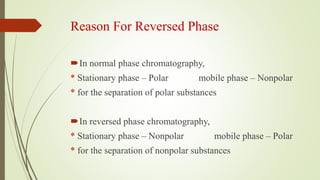
In normal phase chromatography,
* Stationary phase – Polar mobile phase – Nonpolar
* for the separation of polar substances
In reversed phase chromatography,
* Stationary phase – Nonpolar mobile phase – Polar
* for the separation of nonpolar substances
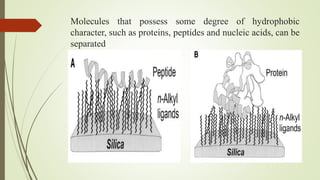
Molecules that possess some degree of hydrophobic
character, such as proteins, peptides and nucleic acids, can be
separated
Theory Of RP Chromatography:
Hydrophobic Theory - the binding of mobile phase
solute to an immobilized n-alkyl hydrocarbon or aromatic
ligand occurs via hydrophobic interaction
Partition Theory - Analyte distributes between aqueous
mobile phase and organic stationary phase
Adsorption Theory – Reversed phase chromatography is
an adsorptive process by experimental design
The Matrix:
A reversed phase chromatography medium consists of
hydrophobic ligands chemically grafted to a porous, insoluble
beaded matrix.
The base matrix for the commercially available reversed phase
media is generally composed of silica or polystyrene
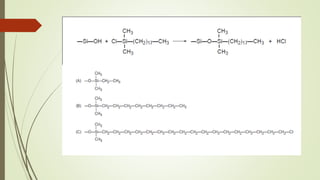
Silanol groups on the silica surface of the silica gel is coupled
to the hydrocarbon ligands using chlorotrialkylsilane reagents.
Silanol Groups
Ligands:
The selectivity is predominantly a function of the type of
ligand grafted to the surface of the medium.
Linear hydrocarbon chains (n-alkyl groups) are the most
popular ligands used in reversed phase applications.
A good rule of thumb is: The more hydrophobic the
molecule to be purified, the less hydrophobic the ligand
needs to be.
For example,
* C18 ligands - peptides and oligonucleotides
* C8 ligands - Proteins and recombinant peptides
Mixed Mode Retention
 Mixed mode retention results from an
ion exchange interaction between
negatively charged silanol groups
exposed on the surface of the silica
and the positively charged amino
groups on the solute molecules.
 The effect of mixed mode retention is
increased retention times with
significant peak broadening.
Properties Of The Matrix:
the chemical composition of the base matrix
particle size of the bead
the type of immobilized ligand
the ligand density on the surface of the bead
 the capping chemistry used (if any)
the pore size of the bead.
Mobile phase
Term used for the mobile phases in reversed phase
chromatography is “buffer”.
Organic solvent (modifier) is added to lower the polarity
of the aqueous mobile phase.
The lower the polarity of the mobile phase, the greater its
eluting strength in reversed phase chromatography.
Widely used organic solvents are - Acetonitrile, methanol,
isopropanol.
Ion suppression
The major benefit of ion suppression in reversed phase
chromatography is the elimination of mixed mode retention
effects due to ionisable silanol groups remaining on the silica
gel surface
The retention of peptides and proteins in reversed phase
chromatography can be modified by mobile phase pH since
these particular solutes contain ionisable groups.
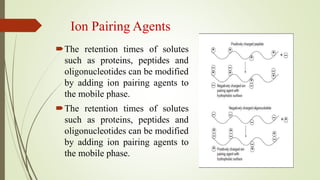
Ion Pairing Agents
The retention times of solutes
such as proteins, peptides and
oligonucleotides can be modified
by adding ion pairing agents to
the mobile phase.
The retention times of solutes
such as proteins, peptides and
oligonucleotides can be modified
by adding ion pairing agents to
the mobile phase.
Gradient Elution
The concentration of organic solvent is lower in the initial
mobile phase (mobile phase A) than it is in the final
mobile phase (mobile phase B).
The typical gradients for preparative reversed phase
chromatography of proteins and peptides are linear and
binary, i.e. involving two mobile phases
Resolution:
Resolution, Rs, is generally defined as the distance
between the centres of two eluting peaks as measured by
retention time or volume divided by the average width of
the respective peaks.
The parameters that contribute to peak resolution are
column selectivity, column efficiency and the column
retention factor
Applications:
Preparative reversed phase chromatography has found
applications ranging from
micro purification of protein fragments for sequencing (1)
To process scale purification of recombinant protein
products (2).
Thank you

reversed phase chromatography

  • 1.
  • 2.
    Introduction: It is anAdsorption technique. The basic principle behind this is the molecular hydrophobicity. The separation depends on the hydrophobic binding of the solute molecule from the mobile phase to the immobilized hydrophobic ligands attached to the stationary phase
  • 3.
    Reason For ReversedPhase In normal phase chromatography, * Stationary phase – Polar mobile phase – Nonpolar * for the separation of polar substances In reversed phase chromatography, * Stationary phase – Nonpolar mobile phase – Polar * for the separation of nonpolar substances
  • 4.
    Molecules that possesssome degree of hydrophobic character, such as proteins, peptides and nucleic acids, can be separated
  • 5.
    Theory Of RPChromatography: Hydrophobic Theory - the binding of mobile phase solute to an immobilized n-alkyl hydrocarbon or aromatic ligand occurs via hydrophobic interaction Partition Theory - Analyte distributes between aqueous mobile phase and organic stationary phase Adsorption Theory – Reversed phase chromatography is an adsorptive process by experimental design
  • 6.
    The Matrix: A reversedphase chromatography medium consists of hydrophobic ligands chemically grafted to a porous, insoluble beaded matrix. The base matrix for the commercially available reversed phase media is generally composed of silica or polystyrene Silanol groups on the silica surface of the silica gel is coupled to the hydrocarbon ligands using chlorotrialkylsilane reagents.
  • 7.
  • 8.
    Ligands: The selectivity ispredominantly a function of the type of ligand grafted to the surface of the medium. Linear hydrocarbon chains (n-alkyl groups) are the most popular ligands used in reversed phase applications. A good rule of thumb is: The more hydrophobic the molecule to be purified, the less hydrophobic the ligand needs to be. For example, * C18 ligands - peptides and oligonucleotides * C8 ligands - Proteins and recombinant peptides
  • 10.
    Mixed Mode Retention Mixed mode retention results from an ion exchange interaction between negatively charged silanol groups exposed on the surface of the silica and the positively charged amino groups on the solute molecules.  The effect of mixed mode retention is increased retention times with significant peak broadening.
  • 11.
    Properties Of TheMatrix: the chemical composition of the base matrix particle size of the bead the type of immobilized ligand the ligand density on the surface of the bead  the capping chemistry used (if any) the pore size of the bead.
  • 12.
    Mobile phase Term usedfor the mobile phases in reversed phase chromatography is “buffer”. Organic solvent (modifier) is added to lower the polarity of the aqueous mobile phase. The lower the polarity of the mobile phase, the greater its eluting strength in reversed phase chromatography. Widely used organic solvents are - Acetonitrile, methanol, isopropanol.
  • 13.
    Ion suppression The majorbenefit of ion suppression in reversed phase chromatography is the elimination of mixed mode retention effects due to ionisable silanol groups remaining on the silica gel surface The retention of peptides and proteins in reversed phase chromatography can be modified by mobile phase pH since these particular solutes contain ionisable groups.
  • 14.
    Ion Pairing Agents Theretention times of solutes such as proteins, peptides and oligonucleotides can be modified by adding ion pairing agents to the mobile phase. The retention times of solutes such as proteins, peptides and oligonucleotides can be modified by adding ion pairing agents to the mobile phase.
  • 15.
    Gradient Elution The concentrationof organic solvent is lower in the initial mobile phase (mobile phase A) than it is in the final mobile phase (mobile phase B). The typical gradients for preparative reversed phase chromatography of proteins and peptides are linear and binary, i.e. involving two mobile phases
  • 17.
    Resolution: Resolution, Rs, isgenerally defined as the distance between the centres of two eluting peaks as measured by retention time or volume divided by the average width of the respective peaks. The parameters that contribute to peak resolution are column selectivity, column efficiency and the column retention factor
  • 18.
    Applications: Preparative reversed phasechromatography has found applications ranging from micro purification of protein fragments for sequencing (1) To process scale purification of recombinant protein products (2).
  • 19.