Classification of
Transformers
http://www.elprocus.com/
Classification of Transformers
Introduction
 A transformer is a static device. The word ‘transformer’ comes form the
word ‘transform’.
 Transformer is not an energy conversion device, but it is device that
changes AC electrical power at one voltage level into AC electrical power
at another voltage level through the action of magnetic field.
 It can be either to step-up or step down.
http://www.elprocus.com/
Classification of Transformers
Working Of Transformer
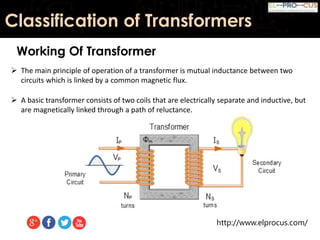
 The main principle of operation of a transformer is mutual inductance between two
circuits which is linked by a common magnetic flux.
 A basic transformer consists of two coils that are electrically separate and inductive, but
are magnetically linked through a path of reluctance.
http://www.elprocus.com/
Classification of Transformers
Working Principal
 The changing current in the primary coil, is usually achieved by applying an
alternating voltage, resulting in an alternating current (AC) AC input.
 As the alternating current changes magnitude and direction, a magnetic field is
produced, which changes in a corresponding manner C-CUBE Group of Engineers.
 The field from the primary coil is intensified
and concentrated through the secondary
coil by an iron core AC output.
 The changing flux through the secondary
coil, induces a potential difference across
the secondary coil.
http://www.elprocus.com/
Classification of Transformers
Classification of Transformer
 As per phase
 Single phase
 Three phase
 As per core
 Core type
 Shell type
 As per cooling system
 Self-cooled
 Air cooled
 Oil cooled
http://www.elprocus.com/
Classification of Transformers
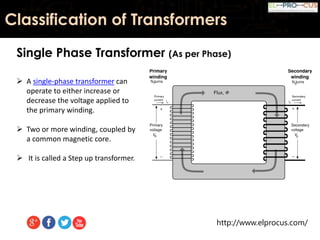
Single Phase Transformer (As per Phase)
 A single-phase transformer can
operate to either increase or
decrease the voltage applied to
the primary winding.
 Two or more winding, coupled by
a common magnetic core.
 It is called a Step up transformer.
http://www.elprocus.com/
Classification of Transformers
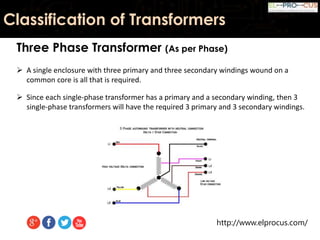
Three Phase Transformer (As per Phase)
 A single enclosure with three primary and three secondary windings wound on a
common core is all that is required.
 Since each single-phase transformer has a primary and a secondary winding, then 3
single-phase transformers will have the required 3 primary and 3 secondary windings.
http://www.elprocus.com/
Classification of Transformers
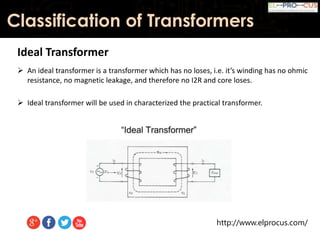
Ideal Transformer
 An ideal transformer is a transformer which has no loses, i.e. it’s winding has no ohmic
resistance, no magnetic leakage, and therefore no I2R and core loses.
 Ideal transformer will be used in characterized the practical transformer.
http://www.elprocus.com/
Classification of Transformers
Core Type Transformer (As per core)
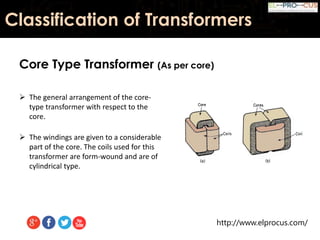
 The windings are given to a considerable
part of the core. The coils used for this
transformer are form-wound and are of
cylindrical type.
 The general arrangement of the core-
type transformer with respect to the
core.
http://www.elprocus.com/
Classification of Transformers
Shell-Type Transformer (As per core)
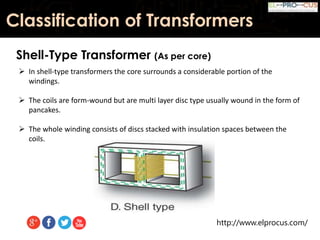
 In shell-type transformers the core surrounds a considerable portion of the
windings.
 The coils are form-wound but are multi layer disc type usually wound in the form of
pancakes.
 The whole winding consists of discs stacked with insulation spaces between the
coils.
http://www.elprocus.com/
Classification of Transformers
Oil Filled Self-Cooled Type (As Per Cooling System)
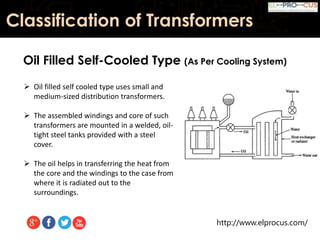
 Oil filled self cooled type uses small and
medium-sized distribution transformers.
 The assembled windings and core of such
transformers are mounted in a welded, oil-
tight steel tanks provided with a steel
cover.
 The oil helps in transferring the heat from
the core and the windings to the case from
where it is radiated out to the
surroundings.
http://www.elprocus.com/
Classification of Transformers
Oil Filled Water Cooled Type (As Per Cooling System)
 This type is used for much more economic construction of large transformers.
 The method is used here as well- the windings and the core are immersed in the
oil.
 The only difference is that a cooling coil is mounted near the surface of the oil,
through which cold water keeps circulating.
 This water carries the heat from the device.
 This design is usually implemented on transformers that are used in high voltage
transmission lines.
http://www.elprocus.com/
Classification of Transformers
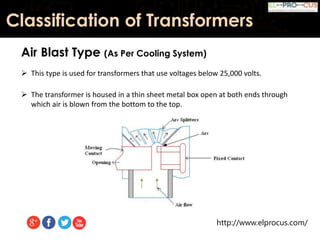
Air Blast Type (As Per Cooling System)
 This type is used for transformers that use voltages below 25,000 volts.
 The transformer is housed in a thin sheet metal box open at both ends through
which air is blown from the bottom to the top.
http://www.elprocus.com/
Classification of Transformers
Advantages
 Copper required is very less.
 High efficient than two winding transformer .
 Small size and low cost.
 Resistance and leakage reactance is less compared to two winding transformer.
 Copper losses are less.
 Superior voltages regulation than two winding transformer.
http://www.elprocus.com/
Classification of Transformers
Disadvantages
 Low impedance hence high short circuit currents for short circuits on secondary side.
 If a section of winding common to primary and secondary is opened , full primary
voltage appears across the secondary resulting in higher voltage on secondary and
danger of accidents.
 No electrical separation between primary and secondary which is risky in case of high
voltage levels .
http://www.elprocus.com/
Classification of Transformers
Conclusion
 Electrical transformer is a static electrical machine which transforms electrical power
from one circuit to another circuit, without changing the frequency.
 Transformer can increase or decrease the voltage with corresponding decrease or
increase in current.
 They are available in power ratings ranging from mW to MW. The insulated
laminations minimizes eddy current losses in the iron core.
 Transformers are used in home appliances and also mini and major of Electrical and
Electronics projects in Engineering.
http://www.elprocus.com/

Transformer types

  • 1.
  • 2.
    http://www.elprocus.com/ Classification of Transformers Introduction A transformer is a static device. The word ‘transformer’ comes form the word ‘transform’.  Transformer is not an energy conversion device, but it is device that changes AC electrical power at one voltage level into AC electrical power at another voltage level through the action of magnetic field.  It can be either to step-up or step down.
  • 3.
    http://www.elprocus.com/ Classification of Transformers WorkingOf Transformer  The main principle of operation of a transformer is mutual inductance between two circuits which is linked by a common magnetic flux.  A basic transformer consists of two coils that are electrically separate and inductive, but are magnetically linked through a path of reluctance.
  • 4.
    http://www.elprocus.com/ Classification of Transformers WorkingPrincipal  The changing current in the primary coil, is usually achieved by applying an alternating voltage, resulting in an alternating current (AC) AC input.  As the alternating current changes magnitude and direction, a magnetic field is produced, which changes in a corresponding manner C-CUBE Group of Engineers.  The field from the primary coil is intensified and concentrated through the secondary coil by an iron core AC output.  The changing flux through the secondary coil, induces a potential difference across the secondary coil.
  • 5.
    http://www.elprocus.com/ Classification of Transformers Classificationof Transformer  As per phase  Single phase  Three phase  As per core  Core type  Shell type  As per cooling system  Self-cooled  Air cooled  Oil cooled
  • 6.
    http://www.elprocus.com/ Classification of Transformers SinglePhase Transformer (As per Phase)  A single-phase transformer can operate to either increase or decrease the voltage applied to the primary winding.  Two or more winding, coupled by a common magnetic core.  It is called a Step up transformer.
  • 7.
    http://www.elprocus.com/ Classification of Transformers ThreePhase Transformer (As per Phase)  A single enclosure with three primary and three secondary windings wound on a common core is all that is required.  Since each single-phase transformer has a primary and a secondary winding, then 3 single-phase transformers will have the required 3 primary and 3 secondary windings.
  • 8.
    http://www.elprocus.com/ Classification of Transformers IdealTransformer  An ideal transformer is a transformer which has no loses, i.e. it’s winding has no ohmic resistance, no magnetic leakage, and therefore no I2R and core loses.  Ideal transformer will be used in characterized the practical transformer.
  • 9.
    http://www.elprocus.com/ Classification of Transformers CoreType Transformer (As per core)  The windings are given to a considerable part of the core. The coils used for this transformer are form-wound and are of cylindrical type.  The general arrangement of the core- type transformer with respect to the core.
  • 10.
    http://www.elprocus.com/ Classification of Transformers Shell-TypeTransformer (As per core)  In shell-type transformers the core surrounds a considerable portion of the windings.  The coils are form-wound but are multi layer disc type usually wound in the form of pancakes.  The whole winding consists of discs stacked with insulation spaces between the coils.
  • 11.
    http://www.elprocus.com/ Classification of Transformers OilFilled Self-Cooled Type (As Per Cooling System)  Oil filled self cooled type uses small and medium-sized distribution transformers.  The assembled windings and core of such transformers are mounted in a welded, oil- tight steel tanks provided with a steel cover.  The oil helps in transferring the heat from the core and the windings to the case from where it is radiated out to the surroundings.
  • 12.
    http://www.elprocus.com/ Classification of Transformers OilFilled Water Cooled Type (As Per Cooling System)  This type is used for much more economic construction of large transformers.  The method is used here as well- the windings and the core are immersed in the oil.  The only difference is that a cooling coil is mounted near the surface of the oil, through which cold water keeps circulating.  This water carries the heat from the device.  This design is usually implemented on transformers that are used in high voltage transmission lines.
  • 13.
    http://www.elprocus.com/ Classification of Transformers AirBlast Type (As Per Cooling System)  This type is used for transformers that use voltages below 25,000 volts.  The transformer is housed in a thin sheet metal box open at both ends through which air is blown from the bottom to the top.
  • 14.
    http://www.elprocus.com/ Classification of Transformers Advantages Copper required is very less.  High efficient than two winding transformer .  Small size and low cost.  Resistance and leakage reactance is less compared to two winding transformer.  Copper losses are less.  Superior voltages regulation than two winding transformer.
  • 15.
    http://www.elprocus.com/ Classification of Transformers Disadvantages Low impedance hence high short circuit currents for short circuits on secondary side.  If a section of winding common to primary and secondary is opened , full primary voltage appears across the secondary resulting in higher voltage on secondary and danger of accidents.  No electrical separation between primary and secondary which is risky in case of high voltage levels .
  • 16.
    http://www.elprocus.com/ Classification of Transformers Conclusion Electrical transformer is a static electrical machine which transforms electrical power from one circuit to another circuit, without changing the frequency.  Transformer can increase or decrease the voltage with corresponding decrease or increase in current.  They are available in power ratings ranging from mW to MW. The insulated laminations minimizes eddy current losses in the iron core.  Transformers are used in home appliances and also mini and major of Electrical and Electronics projects in Engineering.
  • 17.