INDUSTRIAL TRAINING SEMINAR
ON
“TRANSFORMER CONSTRUCTION”
AT
BHEL BHOPAL
DURATION: 29TH MAY – 25TH JUNE,
2014
HEAD OF DEPARTMENT
Dr. Deepak Nagaria
PRESENTED BY
Mandeep Singh
EE Final Yr
B.I.E.T Jhansi
Roll No: 1104320020
UNDER GUIDENCE OF
Shri Shailendra Kumar Somi
Sr. Er. TRM Div BHEL Bhopal
1. INTRODUCTION
2. TRANSFORMER CORE BUILDING
3. WINDING
4. COILASSEMBLY
5. POWER ASSEMBLY
6. CASE FITTING
7. INSULATION SHOP
8. TESTING
9. DISPATCH
10. REFERENCES
CONTENTS
BHEL, Bhopal established in 1964, is an integrated power plant
equipment manufacturer and one of the largest engineering and
manufacturing companies in India in terms of turnover.
It has 15 manufacturing divisions, two repair units, four regional
offices, eight service centers and 15 regional centers.
It has been acquiring and adapting some of the best technologies
from leading companies in the world including General Electric
Company, Alstom SA, Siemens AG and Mitsubishi Heavy
Industries Ltd.
INTRODUCTION TO BHEL BHOPAL
a) Block 1A :- Fabrication
b) Block 1B :- Hydro Turbine, Tanks
c) Block 2 :- Electrical Machine
d) Block 3 :- Transformer Manufacturing, Capacitor & Bushing
e) Block 4 :- Switchgear, Control gear
f) Block 5 :- Foundry Division
g) Block 6 :- Steam Turbine
h) Block 7 :- Factory Store
i) Block 8 :- Coils & Insulation
j) Block 9 :- Traction motor block
k) Block 10 :- Lamination Cutting
BLOCK DISCRIPTION
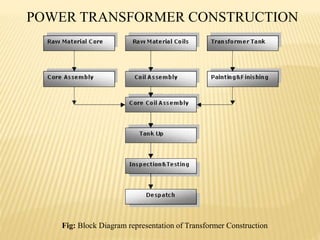
POWER TRANSFORMER CONSTRUCTION
Fig: Block Diagram representation of Transformer Construction
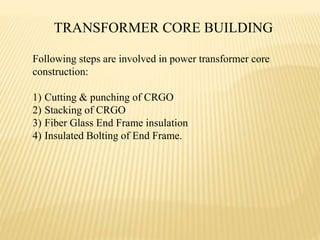
TRANSFORMER CORE BUILDING
Following steps are involved in power transformer core
construction:
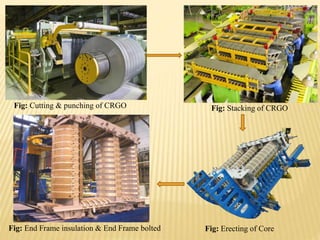
1) Cutting & punching of CRGO
2) Stacking of CRGO
3) Fiber Glass End Frame insulation
4) Insulated Bolting of End Frame.
Fig: Cutting & punching of CRGO Fig: Stacking of CRGO
Fig: End Frame insulation & End Frame bolted Fig: Erecting of Core
WINDING
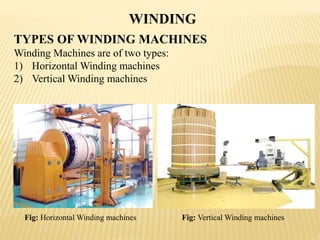
TYPES OF WINDING MACHINES
Winding Machines are of two types:
1) Horizontal Winding machines
2) Vertical Winding machines
Fig: Horizontal Winding machines Fig: Vertical Winding machines
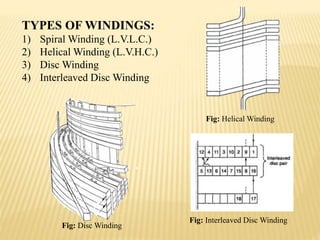
TYPES OF WINDINGS:
1) Spiral Winding (L.V.L.C.)
2) Helical Winding (L.V.H.C.)
3) Disc Winding
4) Interleaved Disc Winding
Fig: Helical Winding
Fig: Interleaved Disc Winding
Fig: Disc Winding
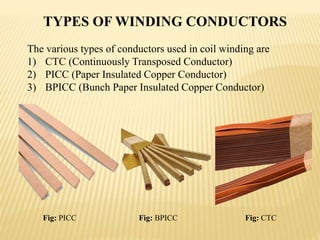
The various types of conductors used in coil winding are
1) CTC (Continuously Transposed Conductor)
2) PICC (Paper Insulated Copper Conductor)
3) BPICC (Bunch Paper Insulated Copper Conductor)
TYPES OF WINDING CONDUCTORS
Fig: CTCFig: PICC Fig: BPICC
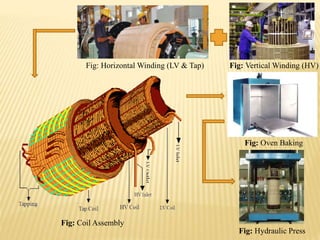
COILASSEMBLEY
Coil Sequence
L.V. Coil is placed adjacent to the CRGO steel core and
H.V coil outside, in order to minimize the amount of
insulation required.
While assembling the different coils (i.e. Tap coil, L.V. Coil
& H.V. Coil) tap coil can be placed in either of three positions
depending upon the length of tap coil i.e. if tap coil is small it
is placed inside of LV coil, if it is medium then between LV &
HV coil, and if large then outside of HV coil.
The coils are specified in the design may be of following types
on the basis of operating voltage:
1) L.V. Coil Winding
2) H.V. Coil Winding
3) Tap Coil Winding
Fig: Vertical Winding (HV)Fig: Horizontal Winding (LV & Tap)
Fig: Coil Assembly
Fig: Oven Baking
Fig: Hydraulic Press
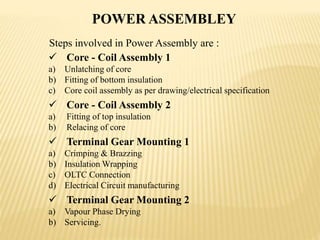
POWER ASSEMBLEY
 Core - Coil Assembly 1
a) Unlatching of core
b) Fitting of bottom insulation
c) Core coil assembly as per drawing/electrical specification
 Core - Coil Assembly 2
a) Fitting of top insulation
b) Relacing of core
 Terminal Gear Mounting 1
a) Crimping & Brazzing
b) Insulation Wrapping
c) OLTC Connection
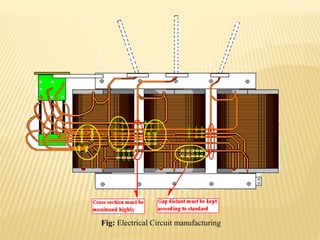
d) Electrical Circuit manufacturing
 Terminal Gear Mounting 2
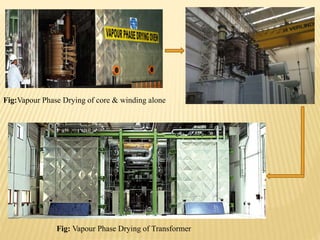
a) Vapour Phase Drying
b) Servicing.
Steps involved in Power Assembly are :
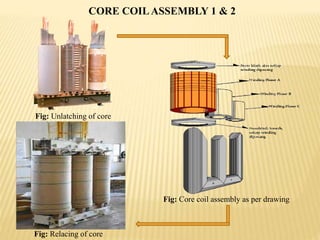
Fig: Unlatching of core
Fig: Core coil assembly as per drawing
Fig: Relacing of core
CORE COILASSEMBLY 1 & 2
Fig: Electrical Circuit manufacturing
Fig:Vapour Phase Drying of core & winding alone
Fig: Vapour Phase Drying of Transformer
CASE FITTING
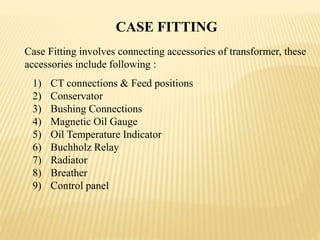
1) CT connections & Feed positions
2) Conservator
3) Bushing Connections
4) Magnetic Oil Gauge
5) Oil Temperature Indicator
6) Buchholz Relay
7) Radiator
8) Breather
9) Control panel
Case Fitting involves connecting accessories of transformer, these
accessories include following :
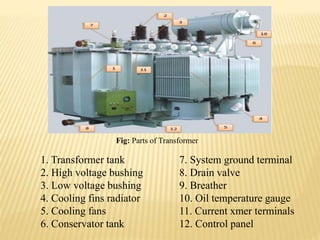
1. Transformer tank
2. High voltage bushing
3. Low voltage bushing
4. Cooling fins radiator
5. Cooling fans
6. Conservator tank
7. System ground terminal
8. Drain valve
9. Breather
10. Oil temperature gauge
11. Current xmer terminals
12. Control panel
Fig: Parts of Transformer
INSULATION MATERIALS
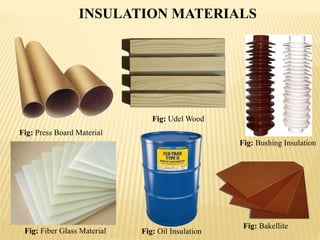
Fig: Press Board Material
Fig: Udel Wood
Fig: Bushing Insulation
Fig: Fiber Glass Material Fig: Oil Insulation
Fig: Bakellite
Items made up of PBM:-
1) Former Base Cylinder
2) DOF Separator
3) T-Block
4) Static Ring
Items made up of Udel Wood:-
1) T-Spacers
2) Full ring segment
3) Half ring segment
4) Shunts
Fig: Items made up of Udel Wood
Fig: Items made up of PBM
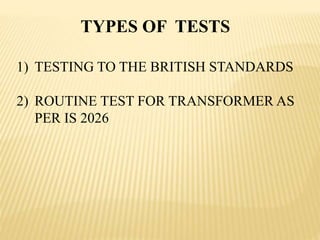
1) TESTING TO THE BRITISH STANDARDS
2) ROUTINE TEST FOR TRANSFORMER AS
PER IS 2026
TYPES OF TESTS
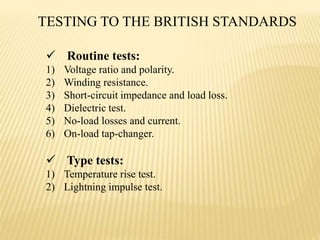
 Routine tests:
1) Voltage ratio and polarity.
2) Winding resistance.
3) Short-circuit impedance and load loss.
4) Dielectric test.
5) No-load losses and current.
6) On-load tap-changer.
 Type tests:
1) Temperature rise test.
2) Lightning impulse test.
TESTING TO THE BRITISH STANDARDS
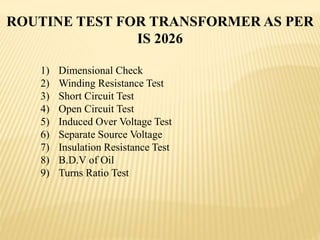
1) Dimensional Check
2) Winding Resistance Test
3) Short Circuit Test
4) Open Circuit Test
5) Induced Over Voltage Test
6) Separate Source Voltage
7) Insulation Resistance Test
8) B.D.V of Oil
9) Turns Ratio Test
ROUTINE TEST FOR TRANSFORMER AS PER
IS 2026
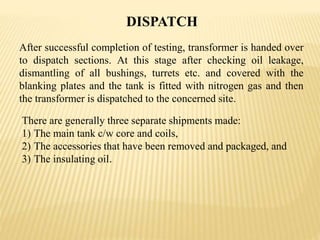
DISPATCH
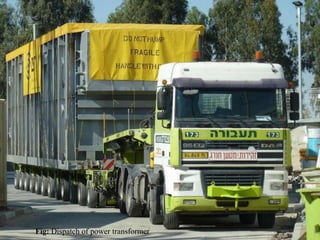
After successful completion of testing, transformer is handed over
to dispatch sections. At this stage after checking oil leakage,
dismantling of all bushings, turrets etc. and covered with the
blanking plates and the tank is fitted with nitrogen gas and then
the transformer is dispatched to the concerned site.
There are generally three separate shipments made:
1) The main tank c/w core and coils,
2) The accessories that have been removed and packaged, and
3) The insulating oil.
Fig: Dispatch of power transformer
[1] Dr. P. S. Bhimbra, “Electrical Machines”, Khanna
Publications, New Delhi.
[2] D. P. Kothari and I. J. Nagrath, “Electrical Machines” , 3rd
Edition, TMH, New Delhi.
[3] BHEL , “Transformers” 2nd Edition ,Tata Mcgraw Hill
Education Private Limited.
REFERENCES
THANK YOU

Summer traning on Power Transformer Construction

  • 1.
    INDUSTRIAL TRAINING SEMINAR ON “TRANSFORMERCONSTRUCTION” AT BHEL BHOPAL DURATION: 29TH MAY – 25TH JUNE, 2014 HEAD OF DEPARTMENT Dr. Deepak Nagaria PRESENTED BY Mandeep Singh EE Final Yr B.I.E.T Jhansi Roll No: 1104320020 UNDER GUIDENCE OF Shri Shailendra Kumar Somi Sr. Er. TRM Div BHEL Bhopal
  • 2.
    1. INTRODUCTION 2. TRANSFORMERCORE BUILDING 3. WINDING 4. COILASSEMBLY 5. POWER ASSEMBLY 6. CASE FITTING 7. INSULATION SHOP 8. TESTING 9. DISPATCH 10. REFERENCES CONTENTS
  • 3.
    BHEL, Bhopal establishedin 1964, is an integrated power plant equipment manufacturer and one of the largest engineering and manufacturing companies in India in terms of turnover. It has 15 manufacturing divisions, two repair units, four regional offices, eight service centers and 15 regional centers. It has been acquiring and adapting some of the best technologies from leading companies in the world including General Electric Company, Alstom SA, Siemens AG and Mitsubishi Heavy Industries Ltd. INTRODUCTION TO BHEL BHOPAL
  • 4.
    a) Block 1A:- Fabrication b) Block 1B :- Hydro Turbine, Tanks c) Block 2 :- Electrical Machine d) Block 3 :- Transformer Manufacturing, Capacitor & Bushing e) Block 4 :- Switchgear, Control gear f) Block 5 :- Foundry Division g) Block 6 :- Steam Turbine h) Block 7 :- Factory Store i) Block 8 :- Coils & Insulation j) Block 9 :- Traction motor block k) Block 10 :- Lamination Cutting BLOCK DISCRIPTION
  • 5.
    POWER TRANSFORMER CONSTRUCTION Fig:Block Diagram representation of Transformer Construction
  • 6.
    TRANSFORMER CORE BUILDING Followingsteps are involved in power transformer core construction: 1) Cutting & punching of CRGO 2) Stacking of CRGO 3) Fiber Glass End Frame insulation 4) Insulated Bolting of End Frame.
  • 7.
    Fig: Cutting &punching of CRGO Fig: Stacking of CRGO Fig: End Frame insulation & End Frame bolted Fig: Erecting of Core
  • 8.
    WINDING TYPES OF WINDINGMACHINES Winding Machines are of two types: 1) Horizontal Winding machines 2) Vertical Winding machines Fig: Horizontal Winding machines Fig: Vertical Winding machines
  • 9.
    TYPES OF WINDINGS: 1)Spiral Winding (L.V.L.C.) 2) Helical Winding (L.V.H.C.) 3) Disc Winding 4) Interleaved Disc Winding Fig: Helical Winding Fig: Interleaved Disc Winding Fig: Disc Winding
  • 10.
    The various typesof conductors used in coil winding are 1) CTC (Continuously Transposed Conductor) 2) PICC (Paper Insulated Copper Conductor) 3) BPICC (Bunch Paper Insulated Copper Conductor) TYPES OF WINDING CONDUCTORS Fig: CTCFig: PICC Fig: BPICC
  • 11.
    COILASSEMBLEY Coil Sequence L.V. Coilis placed adjacent to the CRGO steel core and H.V coil outside, in order to minimize the amount of insulation required. While assembling the different coils (i.e. Tap coil, L.V. Coil & H.V. Coil) tap coil can be placed in either of three positions depending upon the length of tap coil i.e. if tap coil is small it is placed inside of LV coil, if it is medium then between LV & HV coil, and if large then outside of HV coil. The coils are specified in the design may be of following types on the basis of operating voltage: 1) L.V. Coil Winding 2) H.V. Coil Winding 3) Tap Coil Winding
  • 12.
    Fig: Vertical Winding(HV)Fig: Horizontal Winding (LV & Tap) Fig: Coil Assembly Fig: Oven Baking Fig: Hydraulic Press
  • 13.
    POWER ASSEMBLEY  Core- Coil Assembly 1 a) Unlatching of core b) Fitting of bottom insulation c) Core coil assembly as per drawing/electrical specification  Core - Coil Assembly 2 a) Fitting of top insulation b) Relacing of core  Terminal Gear Mounting 1 a) Crimping & Brazzing b) Insulation Wrapping c) OLTC Connection d) Electrical Circuit manufacturing  Terminal Gear Mounting 2 a) Vapour Phase Drying b) Servicing. Steps involved in Power Assembly are :
  • 14.
    Fig: Unlatching ofcore Fig: Core coil assembly as per drawing Fig: Relacing of core CORE COILASSEMBLY 1 & 2
  • 15.
  • 16.
    Fig:Vapour Phase Dryingof core & winding alone Fig: Vapour Phase Drying of Transformer
  • 17.
    CASE FITTING 1) CTconnections & Feed positions 2) Conservator 3) Bushing Connections 4) Magnetic Oil Gauge 5) Oil Temperature Indicator 6) Buchholz Relay 7) Radiator 8) Breather 9) Control panel Case Fitting involves connecting accessories of transformer, these accessories include following :
  • 18.
    1. Transformer tank 2.High voltage bushing 3. Low voltage bushing 4. Cooling fins radiator 5. Cooling fans 6. Conservator tank 7. System ground terminal 8. Drain valve 9. Breather 10. Oil temperature gauge 11. Current xmer terminals 12. Control panel Fig: Parts of Transformer
  • 19.
    INSULATION MATERIALS Fig: PressBoard Material Fig: Udel Wood Fig: Bushing Insulation Fig: Fiber Glass Material Fig: Oil Insulation Fig: Bakellite
  • 20.
    Items made upof PBM:- 1) Former Base Cylinder 2) DOF Separator 3) T-Block 4) Static Ring Items made up of Udel Wood:- 1) T-Spacers 2) Full ring segment 3) Half ring segment 4) Shunts Fig: Items made up of Udel Wood Fig: Items made up of PBM
  • 21.
    1) TESTING TOTHE BRITISH STANDARDS 2) ROUTINE TEST FOR TRANSFORMER AS PER IS 2026 TYPES OF TESTS
  • 22.
     Routine tests: 1)Voltage ratio and polarity. 2) Winding resistance. 3) Short-circuit impedance and load loss. 4) Dielectric test. 5) No-load losses and current. 6) On-load tap-changer.  Type tests: 1) Temperature rise test. 2) Lightning impulse test. TESTING TO THE BRITISH STANDARDS
  • 23.
    1) Dimensional Check 2)Winding Resistance Test 3) Short Circuit Test 4) Open Circuit Test 5) Induced Over Voltage Test 6) Separate Source Voltage 7) Insulation Resistance Test 8) B.D.V of Oil 9) Turns Ratio Test ROUTINE TEST FOR TRANSFORMER AS PER IS 2026
  • 24.
    DISPATCH After successful completionof testing, transformer is handed over to dispatch sections. At this stage after checking oil leakage, dismantling of all bushings, turrets etc. and covered with the blanking plates and the tank is fitted with nitrogen gas and then the transformer is dispatched to the concerned site. There are generally three separate shipments made: 1) The main tank c/w core and coils, 2) The accessories that have been removed and packaged, and 3) The insulating oil.
  • 25.
    Fig: Dispatch ofpower transformer
  • 26.
    [1] Dr. P.S. Bhimbra, “Electrical Machines”, Khanna Publications, New Delhi. [2] D. P. Kothari and I. J. Nagrath, “Electrical Machines” , 3rd Edition, TMH, New Delhi. [3] BHEL , “Transformers” 2nd Edition ,Tata Mcgraw Hill Education Private Limited. REFERENCES
  • 27.

Editor's Notes