Basics of Bypass
Capacitor, Its Functions
and Applications
http://www.elprocus.com/
Basics of Bypass Capacitor, Its
Functions and Applications
Introduction:
 The Bypass capacitors are applied between the power supply pins VCC
and GND of integrated circuits. They reduce both the power supply noise
and the result of spikes on the supply line. They also provide immediate
current demands of an integrated circuit whenever it switches.
 An application note describes the different properties of the bypass
capacitors and provides a guide of their use. This article discusses about a
bypass capacitor, its functions and applications.
http://www.elprocus.com/
Basics of Bypass Capacitor, Its
Functions and Applications
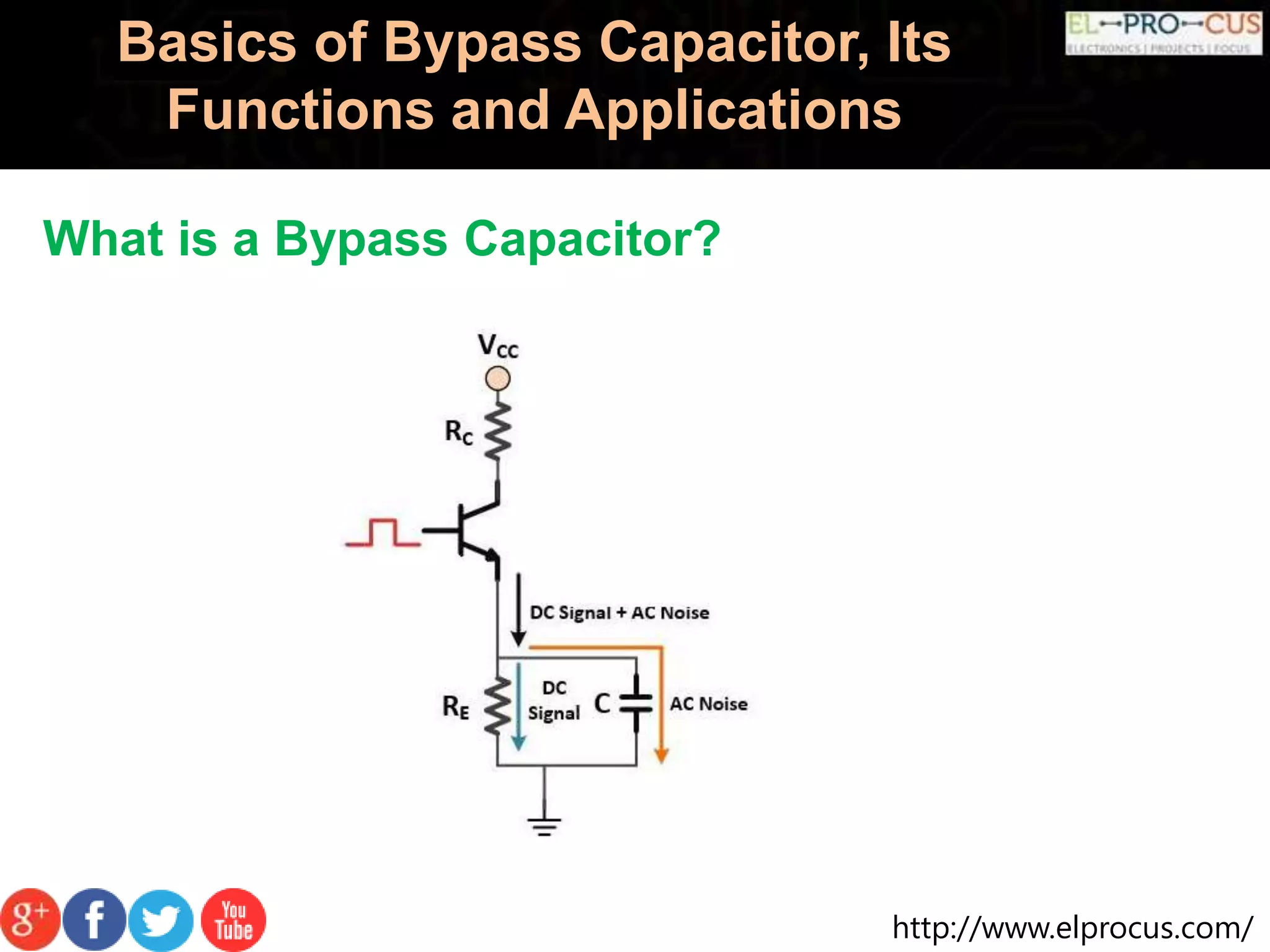
What is a Bypass Capacitor?
 The bypass capacitor is a capacitor that shorts AC signals to the ground.
 In a way that any AC noise that present on a DC signal is removed
producing a much cleaner and pure DC signal.
 A bypass capacitor basically bypasses AC noise that may be on a DC
signal.
 Filtering out of AC so that a clean, pure DC signal goes through without
several AC ripples.
http://www.elprocus.com/
Basics of Bypass Capacitor, Its
Functions and Applications
What is a Bypass Capacitor?
http://www.elprocus.com/
Basics of Bypass Capacitor, Its
Functions and Applications
What is a Bypass Capacitor?
 A capacitor employed to conduct an alternating current around as a
component or group of components.
 Regularly an AC is removed from an AC/DC combination.
 the DC is then freed to pass through the bypassed component.
http://www.elprocus.com/
Basics of Bypass Capacitor, Its
Functions and Applications
Emitter Bypass Capacitor
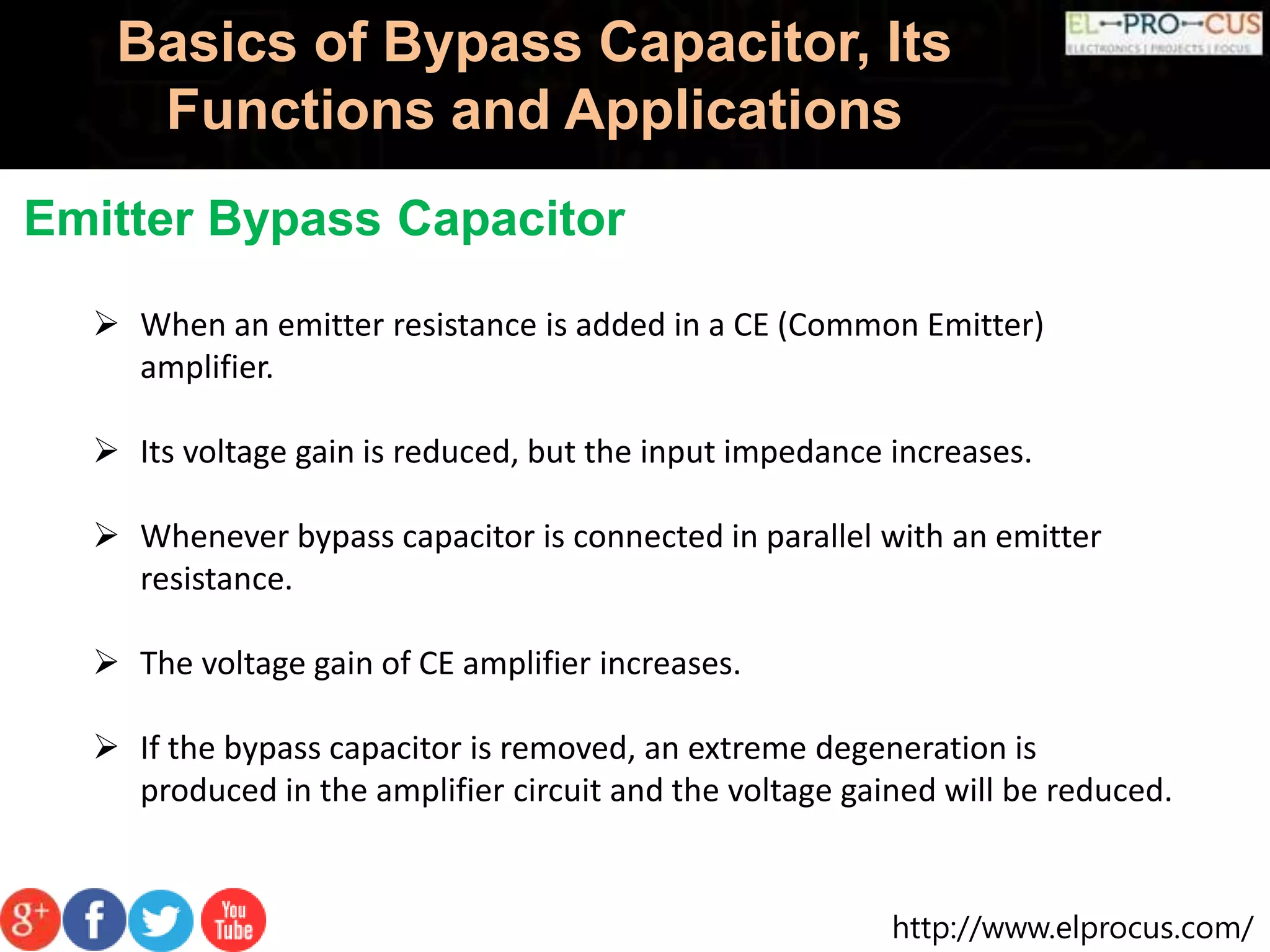
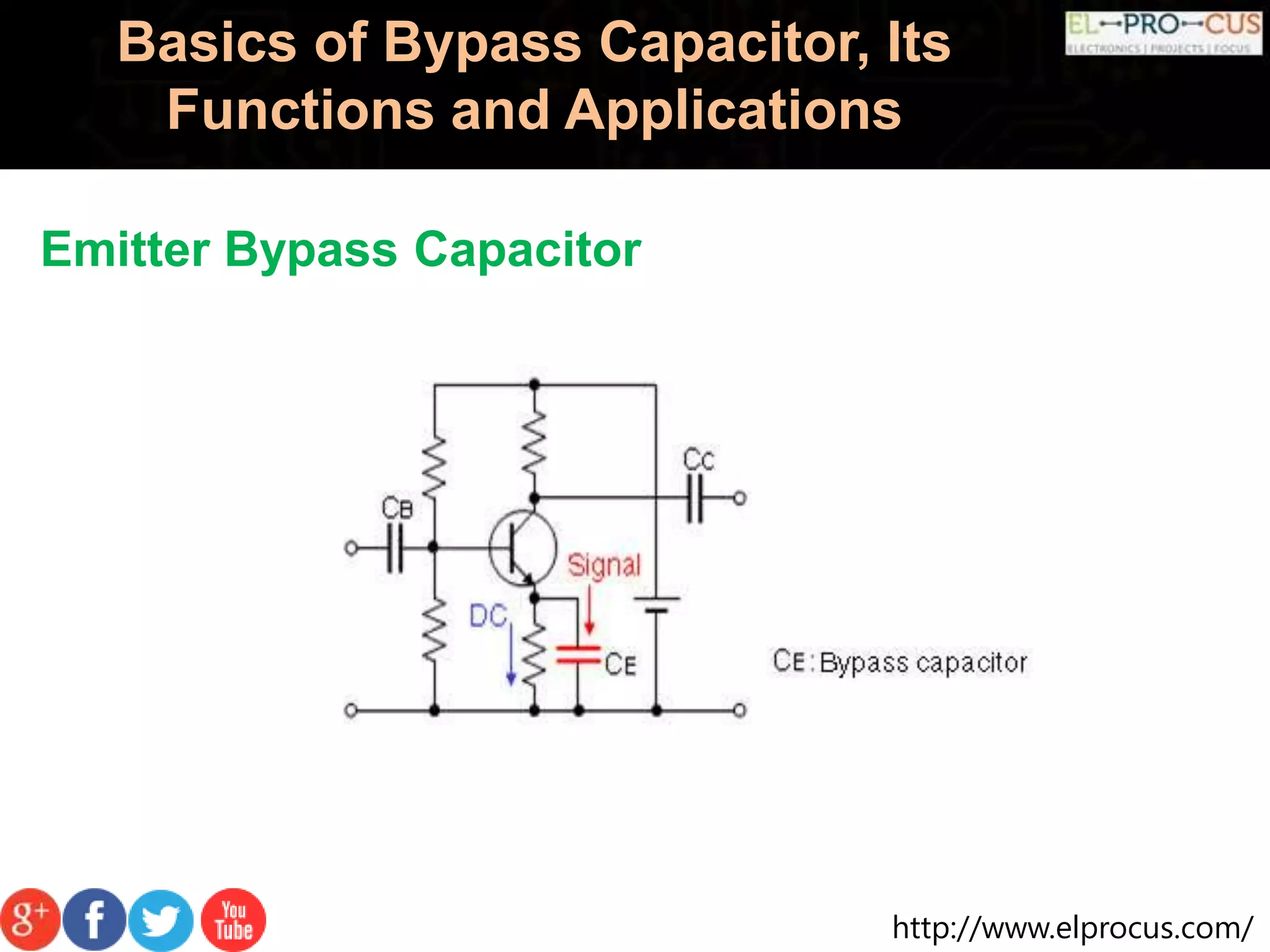
 When an emitter resistance is added in a CE (Common Emitter)
amplifier.
 Its voltage gain is reduced, but the input impedance increases.
 Whenever bypass capacitor is connected in parallel with an emitter
resistance.
 The voltage gain of CE amplifier increases.
 If the bypass capacitor is removed, an extreme degeneration is
produced in the amplifier circuit and the voltage gained will be reduced.
http://www.elprocus.com/
Basics of Bypass Capacitor, Its
Functions and Applications
Emitter Bypass Capacitor
http://www.elprocus.com/
Basics of Bypass Capacitor, Its
Functions and Applications
Cathode Bypass Capacitor
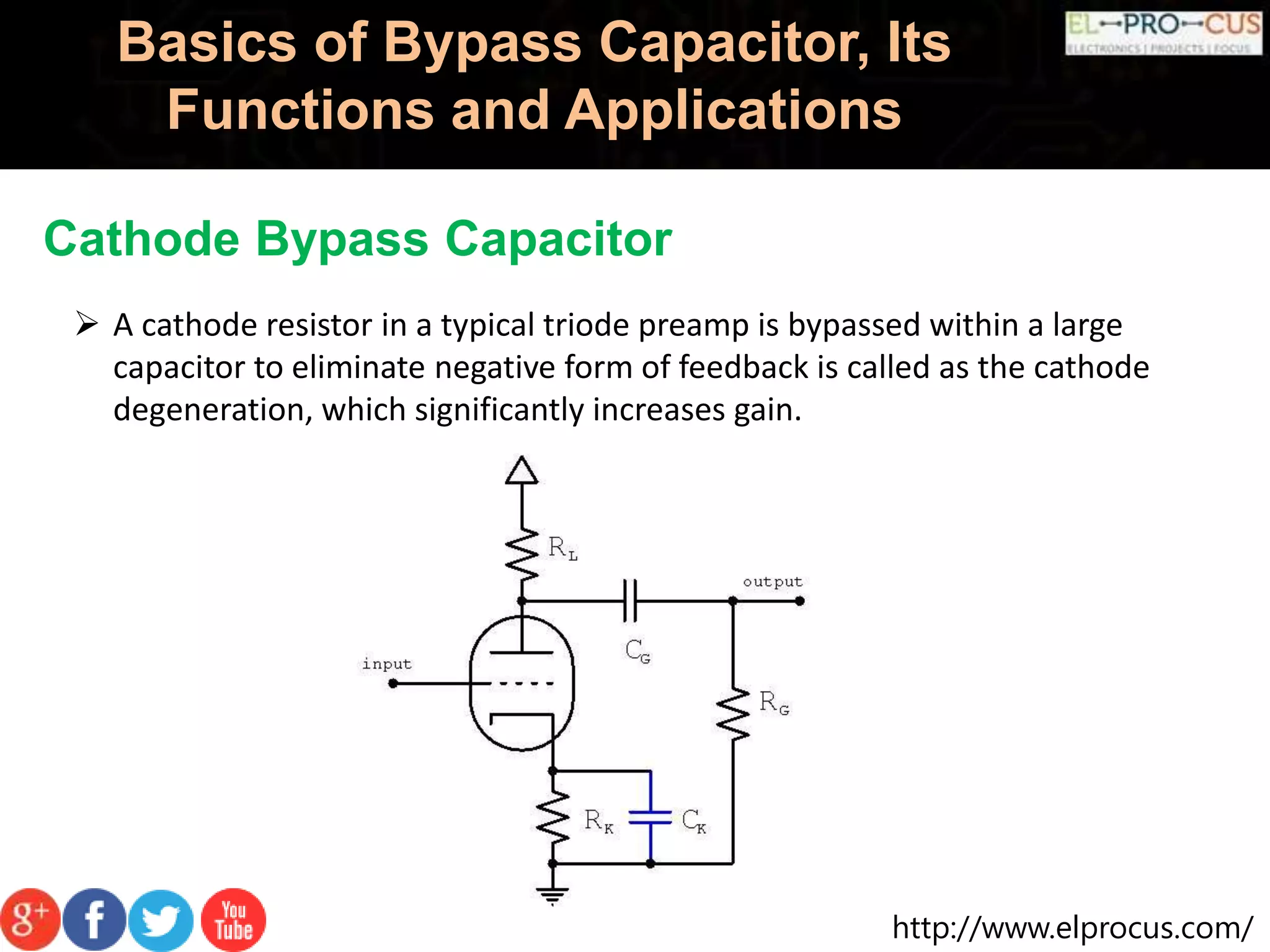
 A cathode resistor in a typical triode preamp is bypassed within a large
capacitor to eliminate negative form of feedback is called as the cathode
degeneration, which significantly increases gain.
http://www.elprocus.com/
Basics of Bypass Capacitor, Its
Functions and Applications
Cathode Bypass Capacitor
 When a capacitor is large enough, it acts as a short circuit for audio
frequencies.
 It eliminates the negative feedback, but acts as an open circuit for a DC,
thereby maintaining the DC grid bias.
 A treble boost can be introduced by using a lower capacitor value.
 The one that acts as a short circuit for the high frequencies but allows a
negative feedback to attenuate bass.
http://www.elprocus.com/
Basics of Bypass Capacitor, Its
Functions and Applications
Cathode Bypass Capacitor
 This is often done in the preamp’s bright channel.
 If the extra gain is unwanted, based on the amplifier’s overall gain
from the input jack to the power amp,
 The capacitor can be eliminated completely.
http://www.elprocus.com/
Basics of Bypass Capacitor, Its
Functions and Applications
How to Calculate Bypass Capacitor Value
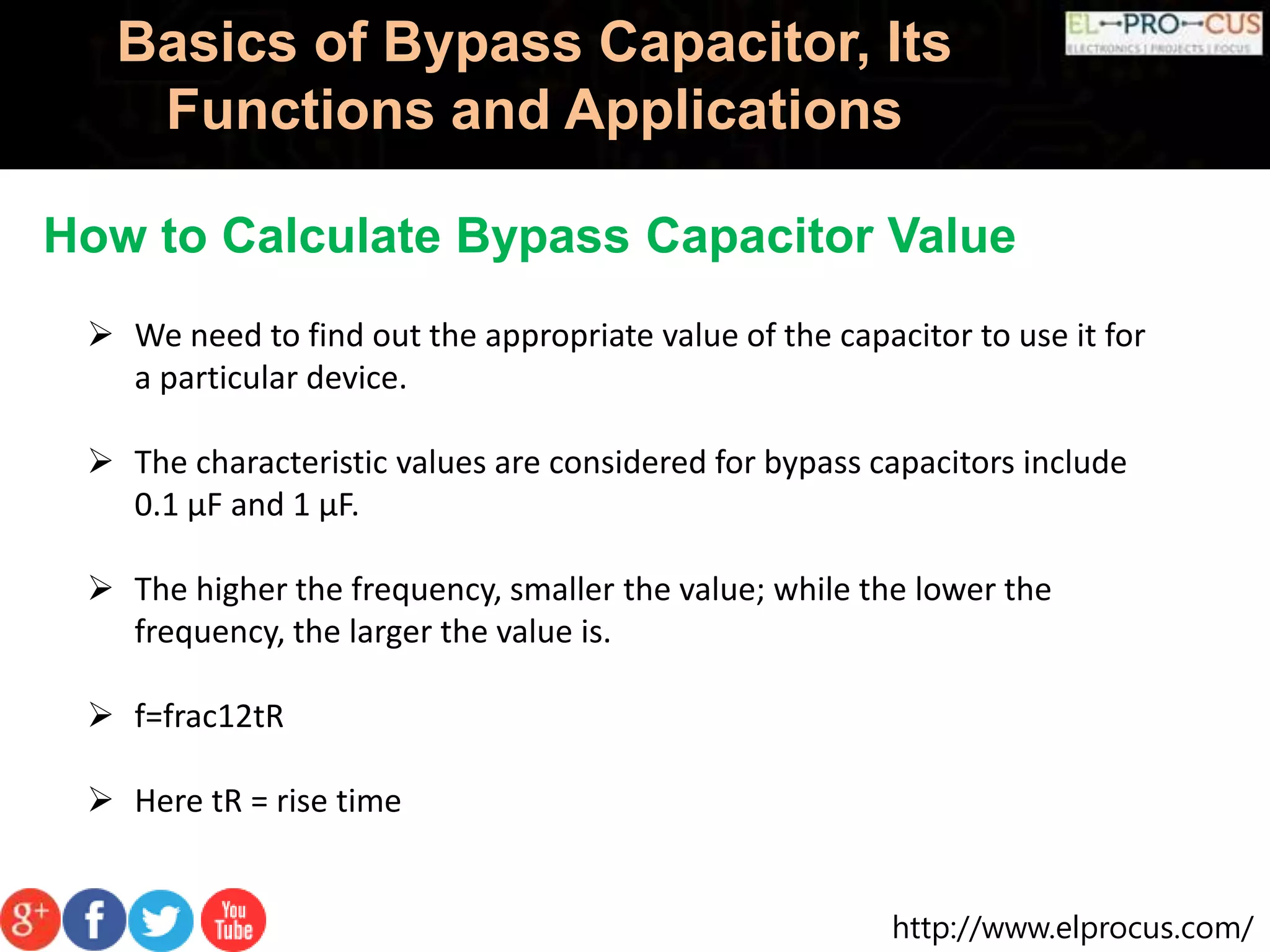
 We need to find out the appropriate value of the capacitor to use it for
a particular device.
 The characteristic values are considered for bypass capacitors include
0.1 µF and 1 µF.
 The higher the frequency, smaller the value; while the lower the
frequency, the larger the value is.
 f=frac12tR
 Here tR = rise time
http://www.elprocus.com/
Basics of Bypass Capacitor, Its
Functions and Applications
How to Calculate Bypass Capacitor Value
 The most significant parameter to select as an appropriate bypass capacitor.
 Its capacity to supply the immediate current when it is needed.
 In order to select a capacitor size for the particular device, we include the
following methods:
 Firstly, the bypass capacitor size can be calculated using the following
equation:
 C=frac1*N*DeltatdeltaV
http://www.elprocus.com/
Basics of Bypass Capacitor, Its
Functions and Applications
How to Calculate Bypass Capacitor Value
• I = amount of current required to switch one output from a low to high
• N = switching the number of outputs
• ∆t = time required to charge the line by the capacitor
• ∆V = tolerated drop in VCC
• The values are given in the formula should be known, where ∆t and
∆V can be assumed.
http://www.elprocus.com/
Basics of Bypass Capacitor, Its
Functions and Applications
How to Calculate Bypass Capacitor Value
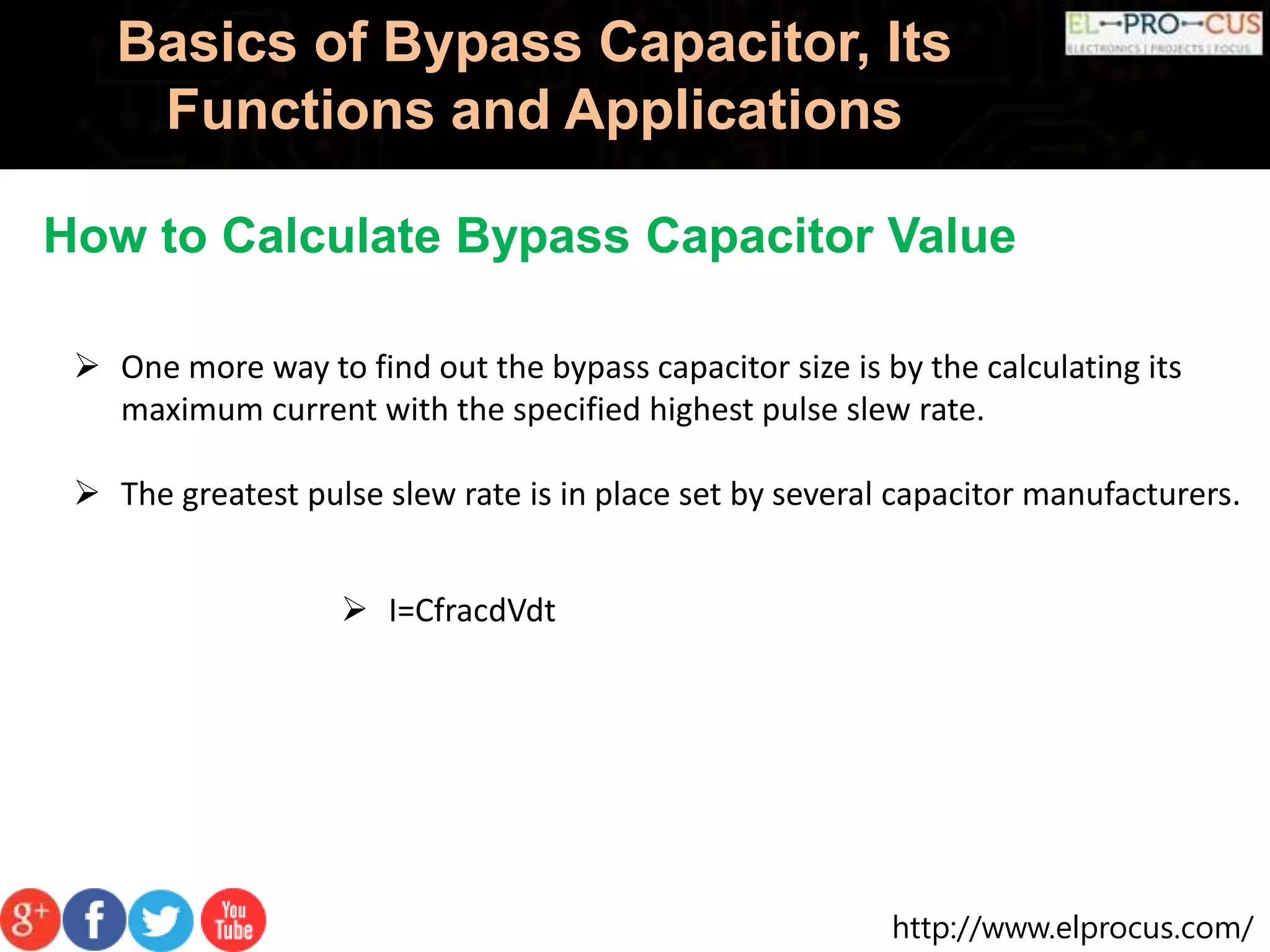
 One more way to find out the bypass capacitor size is by the calculating its
maximum current with the specified highest pulse slew rate.
 The greatest pulse slew rate is in place set by several capacitor manufacturers.
 I=CfracdVdt
http://www.elprocus.com/
Basics of Bypass Capacitor, Its
Functions and Applications
Bypass Capacitor Functions
 Bypass capacitor is used as a bypass AC signal to ground.
 A capacitor is connected between the ground and the wire.
 For an AC signal, the capacitor performs short and bypasses it.
 The DC gone through the capacitor behaves as an open for DC.
 DC is supplied directly to the IC.
http://www.elprocus.com/
Basics of Bypass Capacitor, Its
Functions and Applications
Bypass Capacitor Functions
The necessary characteristics of a bypass capacitor are:
 It has low impedance.
 It electrifies an electric current is well.
 It capably grounds the noise current.
 It effectively decreases the noise current.
http://www.elprocus.com/
Basics of Bypass Capacitor, Its
Functions and Applications
A Bypass capacitor is used in
 Power conditioning and Power factor correction
 Real time clock calendar with EEPROM
 DC/DC Converter
 Voltage Reference
 DSL Amplifiers
 Signal coupling and Decoupling
 High pass and Low pass filters
http://www.elprocus.com/
Basics of Bypass Capacitor, Its
Functions and Applications
Conclusion
 Bypass capacitors help filter the electrical noise out of your circuits. They
do this by removing the alternating currents caused by ripple voltage.
Most digital circuits have at least a couple of bypass capacitors. A good
rule of thumb is to add one bypass capacitor for every integrated circuit on
your board. A good default value for a bypass cap is 0.1uF. Higher
frequencies require lower valued capacitors.
http://www.elprocus.com/

Basics of bypass capacitor, its functions and applications

  • 1.
    Basics of Bypass Capacitor,Its Functions and Applications
  • 2.
    http://www.elprocus.com/ Basics of BypassCapacitor, Its Functions and Applications Introduction:  The Bypass capacitors are applied between the power supply pins VCC and GND of integrated circuits. They reduce both the power supply noise and the result of spikes on the supply line. They also provide immediate current demands of an integrated circuit whenever it switches.  An application note describes the different properties of the bypass capacitors and provides a guide of their use. This article discusses about a bypass capacitor, its functions and applications.
  • 3.
    http://www.elprocus.com/ Basics of BypassCapacitor, Its Functions and Applications What is a Bypass Capacitor?  The bypass capacitor is a capacitor that shorts AC signals to the ground.  In a way that any AC noise that present on a DC signal is removed producing a much cleaner and pure DC signal.  A bypass capacitor basically bypasses AC noise that may be on a DC signal.  Filtering out of AC so that a clean, pure DC signal goes through without several AC ripples.
  • 4.
    http://www.elprocus.com/ Basics of BypassCapacitor, Its Functions and Applications What is a Bypass Capacitor?
  • 5.
    http://www.elprocus.com/ Basics of BypassCapacitor, Its Functions and Applications What is a Bypass Capacitor?  A capacitor employed to conduct an alternating current around as a component or group of components.  Regularly an AC is removed from an AC/DC combination.  the DC is then freed to pass through the bypassed component.
  • 6.
    http://www.elprocus.com/ Basics of BypassCapacitor, Its Functions and Applications Emitter Bypass Capacitor  When an emitter resistance is added in a CE (Common Emitter) amplifier.  Its voltage gain is reduced, but the input impedance increases.  Whenever bypass capacitor is connected in parallel with an emitter resistance.  The voltage gain of CE amplifier increases.  If the bypass capacitor is removed, an extreme degeneration is produced in the amplifier circuit and the voltage gained will be reduced.
  • 7.
    http://www.elprocus.com/ Basics of BypassCapacitor, Its Functions and Applications Emitter Bypass Capacitor
  • 8.
    http://www.elprocus.com/ Basics of BypassCapacitor, Its Functions and Applications Cathode Bypass Capacitor  A cathode resistor in a typical triode preamp is bypassed within a large capacitor to eliminate negative form of feedback is called as the cathode degeneration, which significantly increases gain.
  • 9.
    http://www.elprocus.com/ Basics of BypassCapacitor, Its Functions and Applications Cathode Bypass Capacitor  When a capacitor is large enough, it acts as a short circuit for audio frequencies.  It eliminates the negative feedback, but acts as an open circuit for a DC, thereby maintaining the DC grid bias.  A treble boost can be introduced by using a lower capacitor value.  The one that acts as a short circuit for the high frequencies but allows a negative feedback to attenuate bass.
  • 10.
    http://www.elprocus.com/ Basics of BypassCapacitor, Its Functions and Applications Cathode Bypass Capacitor  This is often done in the preamp’s bright channel.  If the extra gain is unwanted, based on the amplifier’s overall gain from the input jack to the power amp,  The capacitor can be eliminated completely.
  • 11.
    http://www.elprocus.com/ Basics of BypassCapacitor, Its Functions and Applications How to Calculate Bypass Capacitor Value  We need to find out the appropriate value of the capacitor to use it for a particular device.  The characteristic values are considered for bypass capacitors include 0.1 µF and 1 µF.  The higher the frequency, smaller the value; while the lower the frequency, the larger the value is.  f=frac12tR  Here tR = rise time
  • 12.
    http://www.elprocus.com/ Basics of BypassCapacitor, Its Functions and Applications How to Calculate Bypass Capacitor Value  The most significant parameter to select as an appropriate bypass capacitor.  Its capacity to supply the immediate current when it is needed.  In order to select a capacitor size for the particular device, we include the following methods:  Firstly, the bypass capacitor size can be calculated using the following equation:  C=frac1*N*DeltatdeltaV
  • 13.
    http://www.elprocus.com/ Basics of BypassCapacitor, Its Functions and Applications How to Calculate Bypass Capacitor Value • I = amount of current required to switch one output from a low to high • N = switching the number of outputs • ∆t = time required to charge the line by the capacitor • ∆V = tolerated drop in VCC • The values are given in the formula should be known, where ∆t and ∆V can be assumed.
  • 14.
    http://www.elprocus.com/ Basics of BypassCapacitor, Its Functions and Applications How to Calculate Bypass Capacitor Value  One more way to find out the bypass capacitor size is by the calculating its maximum current with the specified highest pulse slew rate.  The greatest pulse slew rate is in place set by several capacitor manufacturers.  I=CfracdVdt
  • 15.
    http://www.elprocus.com/ Basics of BypassCapacitor, Its Functions and Applications Bypass Capacitor Functions  Bypass capacitor is used as a bypass AC signal to ground.  A capacitor is connected between the ground and the wire.  For an AC signal, the capacitor performs short and bypasses it.  The DC gone through the capacitor behaves as an open for DC.  DC is supplied directly to the IC.
  • 16.
    http://www.elprocus.com/ Basics of BypassCapacitor, Its Functions and Applications Bypass Capacitor Functions The necessary characteristics of a bypass capacitor are:  It has low impedance.  It electrifies an electric current is well.  It capably grounds the noise current.  It effectively decreases the noise current.
  • 17.
    http://www.elprocus.com/ Basics of BypassCapacitor, Its Functions and Applications A Bypass capacitor is used in  Power conditioning and Power factor correction  Real time clock calendar with EEPROM  DC/DC Converter  Voltage Reference  DSL Amplifiers  Signal coupling and Decoupling  High pass and Low pass filters
  • 18.
    http://www.elprocus.com/ Basics of BypassCapacitor, Its Functions and Applications Conclusion  Bypass capacitors help filter the electrical noise out of your circuits. They do this by removing the alternating currents caused by ripple voltage. Most digital circuits have at least a couple of bypass capacitors. A good rule of thumb is to add one bypass capacitor for every integrated circuit on your board. A good default value for a bypass cap is 0.1uF. Higher frequencies require lower valued capacitors.
  • 19.