Hartley Oscillator Circuit
Theory Working and
Application
http://www.elprocus.com/
Introduction:
Hartley Oscillator Circuit Theory
Working and Application
 The Hartley oscillator is an electronic oscillator circuit in which the oscillation
frequency is determined by the tuned circuit consisting of capacitors and
inductors, that is, an LC oscillator. The Hartley oscillator was invented by
Hartley while he was working in the Research Laboratory of the Western
Electric Company. The circuit was invented in 1915 by American engineer
Ralph Hartley.
http://www.elprocus.com/
Hartley Oscillator Circuit Theory
Working and Application
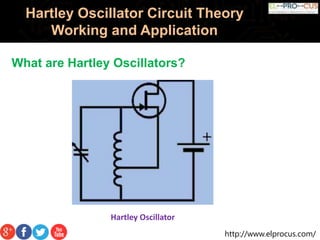
What are Hartley Oscillators?
 Hartley oscillator is inductively coupled.
 It's a variable frequency oscillators where the oscillator may be a
series or shunt fed.
 Hartley oscillators is the advantage of having one tuning capacitor
and one center tapped inductor.
 This processor simplifies the construction of a Hartley oscillator
circuit.
http://www.elprocus.com/
Hartley Oscillator Circuit Theory
Working and Application
What are Hartley Oscillators?
Hartley Oscillator
http://www.elprocus.com/
Hartley Oscillator Circuit Theory
Working and Application
Hartley Oscillator Circuit and Working
 The circuit diagram of a Hartley oscillator consists of an NPN transistor
connected in a common emitter configuration.
 It works as the active device in amplifier stage.
 R1 and R2 are biasing resistors.
 CC1 and CC2 are the coupling capacitors
 L1 and L2 are Inductance.
http://www.elprocus.com/
Hartley Oscillator Circuit Theory
Working and Application
Hartley Oscillator Circuit and Working
 RFC is the radio frequency choke.
 Which provides the isolation between AC and DC operation.
 At high frequencies, the reactance value of this choke is very high.
 So, it can be treated as an open circuit.
http://www.elprocus.com/
Hartley Oscillator Circuit Theory
Working and Application
Hartley Oscillator Circuit and Working
 The reactance is zero for DC condition, hence causes no problem for DC
capacitors.
 The CE is the emitter bypass capacitor.
 RE is also be a biasing resistor.
 The CC1 and CC2 are the coupling capacitors.
http://www.elprocus.com/
Hartley Oscillator Circuit Theory
Working and Application
Hartley Oscillator Circuit and Working
 When the DC supply (Vcc) is given to the circuit.
 The collector current starts raising and begins with the charging of the
capacitor C.
 Once capacitor C is fully charged, it starts discharging through L1 and L2
and again starts charging.
 This back-and-fourth voltage waveform is a sine wave which is a small
and leads with its negative alteration.
 It will eventually die out unless it is amplified.
http://www.elprocus.com/
Hartley Oscillator Circuit Theory
Working and Application
Hartley Oscillator Circuit and Working
 Now the transistor comes into the picture.
 The sine wave generated by the tank circuit is coupled to the base of
the transistor through the capacitor CC1.
 Since the transistor is configured as common-emitter,
 It takes the input from tank circuit and inverts it to a standard sine
wave with a leading positive alteration.
http://www.elprocus.com/
Hartley Oscillator Circuit Theory
Working and Application
Hartley Oscillator Circuit and Working
 The transistor provides amplification along with inversion to
amplify and correct the signal generated by the tank circuit.
 The mutual inductance between L1 and L2 provides the feedback
of energy from collector-emitter circuit to the base-emitter
circuit.
 The frequency of oscillations in this circuit is
fo = 1/ (2π √ (Leq C))
http://www.elprocus.com/
Hartley Oscillator Circuit Theory
Working and Application
Hartley Oscillator Circuit and Working
 Where Leq is the total inductance of coils in the tank circuit is given as
Leq = L1 + L2 + 2M
 For a practical circuit, if L1 = L2 = L and the mutual inductance are
neglected, then the frequency of oscillations can be simplified as
fo = 1/ (2π √ (2 L C))
http://www.elprocus.com/
Hartley Oscillator Circuit Theory
Working and Application
Hartley Oscillator Circuit Using Op-Amp
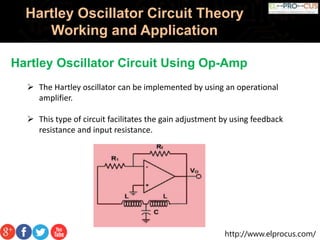
 The Hartley oscillator can be implemented by using an operational
amplifier.
 This type of circuit facilitates the gain adjustment by using feedback
resistance and input resistance.
http://www.elprocus.com/
Hartley Oscillator Circuit Theory
Working and Application
Hartley Oscillator Circuit Using Op-Amp
 In transistorized Hartley oscillator, the gain depending up on the tank
circuit elements like L1 and L2.
 Whereas in Op-amp oscillator gain is less depends on the tank circuit
element.
 Hence provides greater frequency stability.
 The operation of this circuit is similar to the transistor version of Hartley
oscillator.
http://www.elprocus.com/
Hartley Oscillator Circuit Theory
Working and Application
Hartley Oscillator Circuit Using Op-Amp
 The sine wave is generated by the feedback circuit and it’s coupled with
the op-amp section.
 Then this wave is stabilized and inverted by the amplifier.
 The frequency of an oscillator is varied by using a variable capacitor in
the tank circuit.
 Keeping the feedback ratio and the amplitude of the output is constant
for over a frequency range.
http://www.elprocus.com/
Hartley Oscillator Circuit Theory
Working and Application
Hartley Oscillator Circuit Using Op-Amp
 The frequency of oscillations for this type of oscillator is same as
the above discussed oscillator and is given as
fo = 1/ (2π √ (Leq C))
Where: Leq = L1 + L2 + 2M
Or
Leq = L1 + L2
http://www.elprocus.com/
Hartley Oscillator Circuit Theory
Working and Application
Hartley Oscillator Circuit Using Op-Amp
 To generate the oscillation from this circuit, the amplifier gain must
and should selected greater than or at least equal to the ratio of two
inductances.
 If the mutual inductance exists between L1 and L2 because the common
core of these two coils, then the gain becomes
Av = L1 / L2
Av = (L1 + M) / (L2 + M)
http://www.elprocus.com/
Hartley Oscillator Circuit Theory
Working and Application
Advantages of Hartley Oscillator
 Instead of two separate coils L1 and L2, a single coil of bare wire can be
used and the coil grounded at any desired point along it.
 By using a variable capacitor or by making core movable (varying the
inductance), frequency of oscillations can be varied.
 Very few components are needed, including either two fixed inductors
or a tapped coil.
 The amplitude of the output remains constant over the working
frequency range.
http://www.elprocus.com/
Hartley Oscillator Circuit Theory
Working and Application
Disadvantages of Hartley Oscillator
 It cannot be used as a low frequency oscillator since the value of
inductors becomes large and the size of the inductors becomes large.
 The harmonic content in the output of this oscillator is very high.
 Hence it is not suitable for the applications which require a pure sine
wave.
http://www.elprocus.com/
Hartley Oscillator Circuit Theory
Working and Application
Applications
 The Hartley oscillator is to produce a sine wave with the desired
frequency.
 Hartley oscillators are mainly used as radio receivers.
 Due to its wide range of frequencies, it is the most popular oscillator.
 The Hartley oscillator is Suitable for oscillations in RF (Radio-
Frequency) range, up to 30MHZ
http://www.elprocus.com/
Hartley Oscillator Circuit Theory
Working and Application
Conclusion
 This is all about Hartley oscillator circuit theory working and
applications. The personal feature of Hartley oscillator is that the
tuned circuit consists of a single capacitor in parallel with two
inductors are in series or a single tapped inductor, and the feedback
signal needed for oscillation is taken from the center connection of
the two inductors.
http://www.elprocus.com/

Hartley oscillator circuit theory working and application

  • 1.
    Hartley Oscillator Circuit TheoryWorking and Application
  • 2.
    http://www.elprocus.com/ Introduction: Hartley Oscillator CircuitTheory Working and Application  The Hartley oscillator is an electronic oscillator circuit in which the oscillation frequency is determined by the tuned circuit consisting of capacitors and inductors, that is, an LC oscillator. The Hartley oscillator was invented by Hartley while he was working in the Research Laboratory of the Western Electric Company. The circuit was invented in 1915 by American engineer Ralph Hartley.
  • 3.
    http://www.elprocus.com/ Hartley Oscillator CircuitTheory Working and Application What are Hartley Oscillators?  Hartley oscillator is inductively coupled.  It's a variable frequency oscillators where the oscillator may be a series or shunt fed.  Hartley oscillators is the advantage of having one tuning capacitor and one center tapped inductor.  This processor simplifies the construction of a Hartley oscillator circuit.
  • 4.
    http://www.elprocus.com/ Hartley Oscillator CircuitTheory Working and Application What are Hartley Oscillators? Hartley Oscillator
  • 5.
    http://www.elprocus.com/ Hartley Oscillator CircuitTheory Working and Application Hartley Oscillator Circuit and Working  The circuit diagram of a Hartley oscillator consists of an NPN transistor connected in a common emitter configuration.  It works as the active device in amplifier stage.  R1 and R2 are biasing resistors.  CC1 and CC2 are the coupling capacitors  L1 and L2 are Inductance.
  • 6.
    http://www.elprocus.com/ Hartley Oscillator CircuitTheory Working and Application Hartley Oscillator Circuit and Working  RFC is the radio frequency choke.  Which provides the isolation between AC and DC operation.  At high frequencies, the reactance value of this choke is very high.  So, it can be treated as an open circuit.
  • 7.
    http://www.elprocus.com/ Hartley Oscillator CircuitTheory Working and Application Hartley Oscillator Circuit and Working  The reactance is zero for DC condition, hence causes no problem for DC capacitors.  The CE is the emitter bypass capacitor.  RE is also be a biasing resistor.  The CC1 and CC2 are the coupling capacitors.
  • 8.
    http://www.elprocus.com/ Hartley Oscillator CircuitTheory Working and Application Hartley Oscillator Circuit and Working  When the DC supply (Vcc) is given to the circuit.  The collector current starts raising and begins with the charging of the capacitor C.  Once capacitor C is fully charged, it starts discharging through L1 and L2 and again starts charging.  This back-and-fourth voltage waveform is a sine wave which is a small and leads with its negative alteration.  It will eventually die out unless it is amplified.
  • 9.
    http://www.elprocus.com/ Hartley Oscillator CircuitTheory Working and Application Hartley Oscillator Circuit and Working  Now the transistor comes into the picture.  The sine wave generated by the tank circuit is coupled to the base of the transistor through the capacitor CC1.  Since the transistor is configured as common-emitter,  It takes the input from tank circuit and inverts it to a standard sine wave with a leading positive alteration.
  • 10.
    http://www.elprocus.com/ Hartley Oscillator CircuitTheory Working and Application Hartley Oscillator Circuit and Working  The transistor provides amplification along with inversion to amplify and correct the signal generated by the tank circuit.  The mutual inductance between L1 and L2 provides the feedback of energy from collector-emitter circuit to the base-emitter circuit.  The frequency of oscillations in this circuit is fo = 1/ (2π √ (Leq C))
  • 11.
    http://www.elprocus.com/ Hartley Oscillator CircuitTheory Working and Application Hartley Oscillator Circuit and Working  Where Leq is the total inductance of coils in the tank circuit is given as Leq = L1 + L2 + 2M  For a practical circuit, if L1 = L2 = L and the mutual inductance are neglected, then the frequency of oscillations can be simplified as fo = 1/ (2π √ (2 L C))
  • 12.
    http://www.elprocus.com/ Hartley Oscillator CircuitTheory Working and Application Hartley Oscillator Circuit Using Op-Amp  The Hartley oscillator can be implemented by using an operational amplifier.  This type of circuit facilitates the gain adjustment by using feedback resistance and input resistance.
  • 13.
    http://www.elprocus.com/ Hartley Oscillator CircuitTheory Working and Application Hartley Oscillator Circuit Using Op-Amp  In transistorized Hartley oscillator, the gain depending up on the tank circuit elements like L1 and L2.  Whereas in Op-amp oscillator gain is less depends on the tank circuit element.  Hence provides greater frequency stability.  The operation of this circuit is similar to the transistor version of Hartley oscillator.
  • 14.
    http://www.elprocus.com/ Hartley Oscillator CircuitTheory Working and Application Hartley Oscillator Circuit Using Op-Amp  The sine wave is generated by the feedback circuit and it’s coupled with the op-amp section.  Then this wave is stabilized and inverted by the amplifier.  The frequency of an oscillator is varied by using a variable capacitor in the tank circuit.  Keeping the feedback ratio and the amplitude of the output is constant for over a frequency range.
  • 15.
    http://www.elprocus.com/ Hartley Oscillator CircuitTheory Working and Application Hartley Oscillator Circuit Using Op-Amp  The frequency of oscillations for this type of oscillator is same as the above discussed oscillator and is given as fo = 1/ (2π √ (Leq C)) Where: Leq = L1 + L2 + 2M Or Leq = L1 + L2
  • 16.
    http://www.elprocus.com/ Hartley Oscillator CircuitTheory Working and Application Hartley Oscillator Circuit Using Op-Amp  To generate the oscillation from this circuit, the amplifier gain must and should selected greater than or at least equal to the ratio of two inductances.  If the mutual inductance exists between L1 and L2 because the common core of these two coils, then the gain becomes Av = L1 / L2 Av = (L1 + M) / (L2 + M)
  • 17.
    http://www.elprocus.com/ Hartley Oscillator CircuitTheory Working and Application Advantages of Hartley Oscillator  Instead of two separate coils L1 and L2, a single coil of bare wire can be used and the coil grounded at any desired point along it.  By using a variable capacitor or by making core movable (varying the inductance), frequency of oscillations can be varied.  Very few components are needed, including either two fixed inductors or a tapped coil.  The amplitude of the output remains constant over the working frequency range.
  • 18.
    http://www.elprocus.com/ Hartley Oscillator CircuitTheory Working and Application Disadvantages of Hartley Oscillator  It cannot be used as a low frequency oscillator since the value of inductors becomes large and the size of the inductors becomes large.  The harmonic content in the output of this oscillator is very high.  Hence it is not suitable for the applications which require a pure sine wave.
  • 19.
    http://www.elprocus.com/ Hartley Oscillator CircuitTheory Working and Application Applications  The Hartley oscillator is to produce a sine wave with the desired frequency.  Hartley oscillators are mainly used as radio receivers.  Due to its wide range of frequencies, it is the most popular oscillator.  The Hartley oscillator is Suitable for oscillations in RF (Radio- Frequency) range, up to 30MHZ
  • 20.
    http://www.elprocus.com/ Hartley Oscillator CircuitTheory Working and Application Conclusion  This is all about Hartley oscillator circuit theory working and applications. The personal feature of Hartley oscillator is that the tuned circuit consists of a single capacitor in parallel with two inductors are in series or a single tapped inductor, and the feedback signal needed for oscillation is taken from the center connection of the two inductors.
  • 21.