Angelo Baggini, angelo.baggini@unibg.it, Bergamo University - Engineering Department
Via Marconi 5, 24044 Dalmine (BG) – Italy
Power Transformer Design Principles
Index
0. Sizing criteria
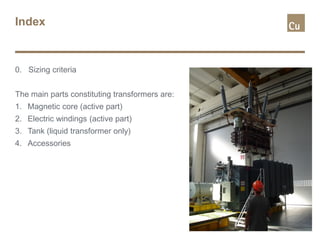
The main parts constituting transformers are:
1. Magnetic core (active part)
2. Electric windings (active part)
3. Tank (liquid transformer only)
4. Accessories
Power Transformers Design Principles
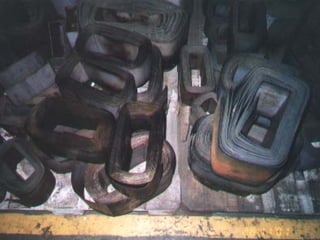
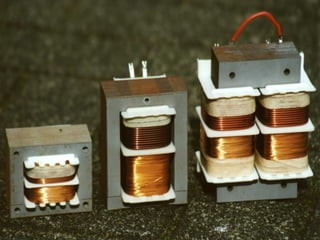
SIZING CRITERIA
Sizing criteria
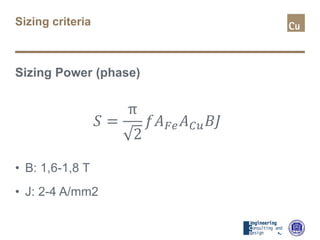
Sizing Power (phase)
• B: 1,6-1,8 T
• J: 2-4 A/mm2
𝑆𝑆 =
π
2
𝑓𝑓𝐴𝐴𝐹𝐹𝐹𝐹 𝐴𝐴𝐶𝐶𝐶𝐶 𝐵𝐵𝐵𝐵
Power Transformers Design Principles
MAGNETIC CORE
1.1 losses
1.2 sound levels
1.3 types
1.4 section
1.5 interwoven methods
1.6 packaging and locking
Power Transformers Design Principles
MAGNETIC CORE
LOSSES
.1
Magnetic core
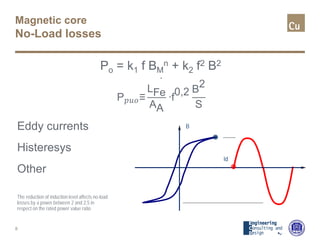
No-Load losses
Eddy currents
Histeresys
Other
8
Id
B
Po = k1 f BM
n + k2 f2 B2
P𝑝𝑝𝑝𝑝𝑝𝑝≡
LFe
AA
∙f
0,2 B2
S
̇
The reduction of induction level affects no-load
losses by a power between 2 and 2,5 in
respect on the rated power value ratio
Power Transformers Design Principles
MAGNETIC CORE
SOUND LEVELS
.2
Magnetic core
Sound levels
The magnetic circuit is an important source of sound
due to:
• Electromagnetic stresses
• Magnetostriction
Induction values:
• For a better exploitation of the magnetic material it should be
possible to use induction values greater than 1,7 T if no
acoustic pollution limits exist
• otherwise induction values between 1,55 and 1,6 T shall be
used
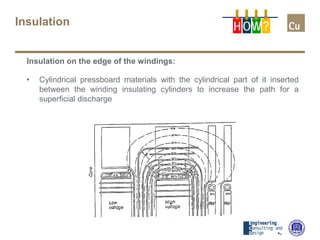
Power Transformers Design Principles
MAGNETIC CORE
TYPES
.3
Magnetic core
Main types
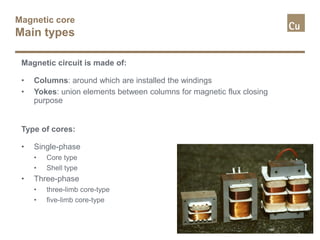
Magnetic circuit is made of:
• Columns: around which are installed the windings
• Yokes: union elements between columns for magnetic flux closing
purpose
Type of cores:
• Single-phase
• Core type
• Shell type
• Three-phase
• three-limb core-type
• five-limb core-type
Magnetic core
Single-phase types
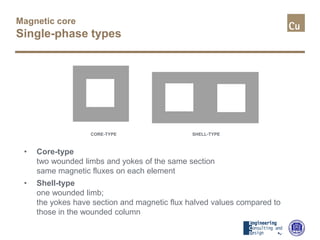
• Core-type
two wounded limbs and yokes of the same section
same magnetic fluxes on each element
• Shell-type
one wounded limb;
the yokes have section and magnetic flux halved values compared to
those in the wounded column
CORE-TYPE SHELL-TYPE
| Presentation title and date
| Presentation title and date
| Presentation title and date
Magnetic core
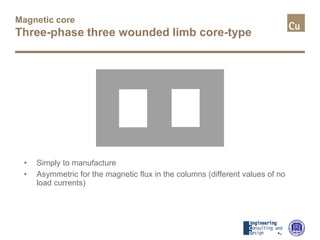
Three-phase three wounded limb core-type
• Simply to manufacture
• Asymmetric for the magnetic flux in the columns (different values of no
load currents)
Magnetic core
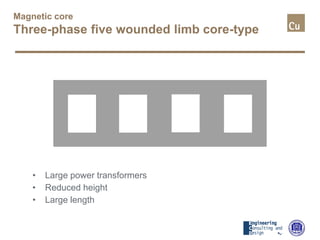
Three-phase five wounded limb core-type
• Large power transformers
• Reduced height
• Large length
Power Transformers Design Principles
MAGNETIC CORE
SECTION
.4
Magnetic core
Section
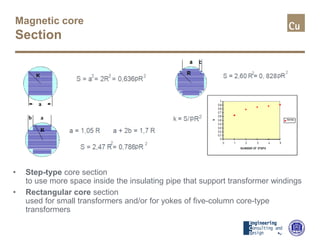
• Step-type core section
to use more space inside the insulating pipe that support transformer windings
• Rectangular core section
used for small transformers and/or for yokes of five-column core-type
transformers
Magnetic core
Cooling
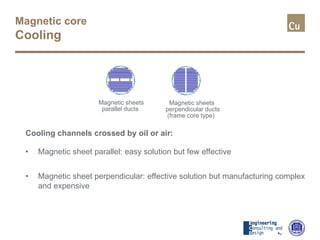
Cooling channels crossed by oil or air:
• Magnetic sheet parallel: easy solution but few effective
• Magnetic sheet perpendicular: effective solution but manufacturing complex
and expensive
Magnetic sheets
parallel ducts
Magnetic sheets
perpendicular ducts
(frame core type)
| Presentation title and date
Power Transformers Design Principles
MAGNETIC CORE
INTERWOVEN METHODS
.5
Magnetic core
Interwoven methods
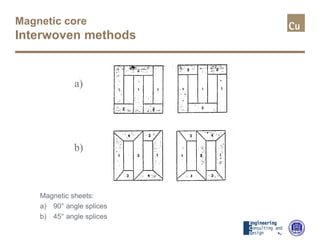
a)
b)
Magnetic sheets:
a) 90° angle splices
b) 45° angle splices
Magnetic core
Interwoven methods
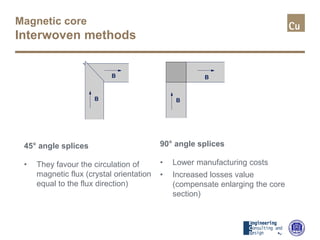
45° angle splices
• They favour the circulation of
magnetic flux (crystal orientation
equal to the flux direction)
B B
B B
90° angle splices
• Lower manufacturing costs
• Increased losses value
(compensate enlarging the core
section)
Magnetic core
Interwoven methods - Step lap
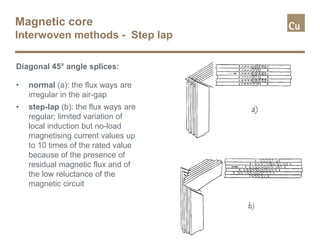
Diagonal 45° angle splices:
• normal (a): the flux ways are
irregular in the air-gap
• step-lap (b): the flux ways are
regular; limited variation of
local induction but no-load
magnetising current values up
to 10 times of the rated value
because of the presence of
residual magnetic flux and of
the low reluctance of the
magnetic circuit
Magnetic core
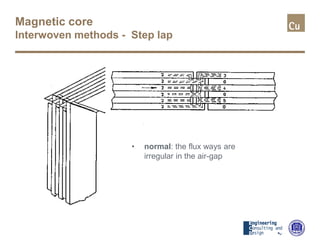
Interwoven methods - Step lap
• normal: the flux ways are
irregular in the air-gap
Magnetic core
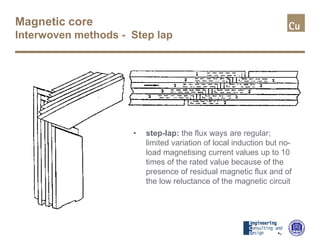
Interwoven methods - Step lap
• step-lap: the flux ways are regular;
limited variation of local induction but no-
load magnetising current values up to 10
times of the rated value because of the
presence of residual magnetic flux and of
the low reluctance of the magnetic circuit
Power Transformers Design Principles
MAGNETIC CORE
PACKAGING AND LOCKING
.6
Magnetic core
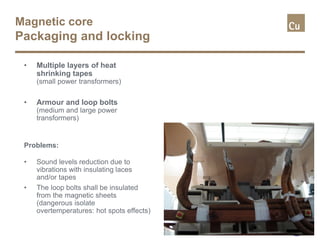
Packaging and locking
• Multiple layers of heat
shrinking tapes
(small power transformers)
• Armour and loop bolts
(medium and large power
transformers)
Problems:
• Sound levels reduction due to
vibrations with insulating laces
and/or tapes
• The loop bolts shall be insulated
from the magnetic sheets
(dangerous isolate
overtemperatures: hot spots effects)
Power Transformers Design Principles
WINDINGS
Mutual positioning
Type
Conductor shapes
Windings
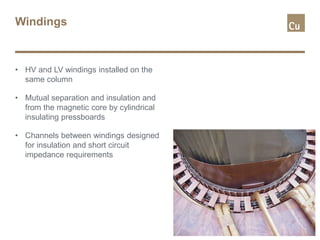
• HV and LV windings installed on the
same column
• Mutual separation and insulation and
from the magnetic core by cylindrical
insulating pressboards
• Channels between windings designed
for insulation and short circuit
impedance requirements
Power Transformers Design Principles
WINDINGS
MUTUAL POSITIONING
.1
Windings
Mutual positioning
Typical manufacturing types are:
• Concentric windings:
• Simple-type
• Symmetric biconcentric type
• Asymmetric biconcentric type
• Alternate windings:
• Symmetric type
• Asymmetric type
The symmetry of the windings:
• reduce the short circuit reactance
• balance the electrodynamic stresses
Windings
Mutual positioning
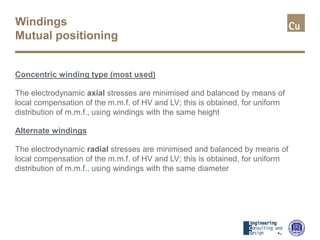
Concentric winding type (most used)
The electrodynamic axial stresses are minimised and balanced by means of
local compensation of the m.m.f. of HV and LV; this is obtained, for uniform
distribution of m.m.f., using windings with the same height
Alternate windings
The electrodynamic radial stresses are minimised and balanced by means of
local compensation of the m.m.f. of HV and LV; this is obtained, for uniform
distribution of m.m.f., using windings with the same diameter
Windings - Mutual positioning
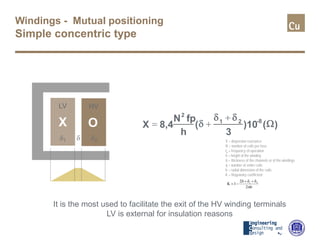
Simple concentric type
X 8,4
N fp
h
(
3
)10 ( )
2
1 2 -8
= +
+
δ
δ δ
Ω
It is the most used to facilitate the exit of the HV winding terminals
LV is external for insulation reasons
X O
LV HV
δ1 δ2δ X = dispersion reactance
N = number of coils per fase
fp = frequency of operation
h = height of the winding
δ = thickness of the channels or of the windings
q = number of entire coils
b = radial dimension of the coils
K = Rogowsky coefficient:
b2
2
1K 21
π
δ+δ+δ
−=
Windings - Mutual positioning
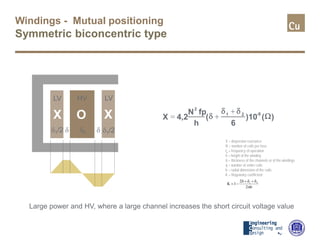
Symmetric biconcentric type
X 4,2
N fp
h
(
6
)10 ( )
2
1 2 -8
= +
+
δ
δ δ
Ω
Large power and HV, where a large channel increases the short circuit voltage value
X O
LV HV
δ1/2 δ2δ
X
LV
δ1/2δ
X = dispersion reactance
N = number of coils per fase
fp = frequency of operation
h = height of the winding
δ = thickness of the channels or of the windings
q = number of entire coils
b = radial dimension of the coils
K = Rogowsky coefficient:
b2
2
1K 21
π
δ+δ+δ
−=
Windings - Mutual positioning
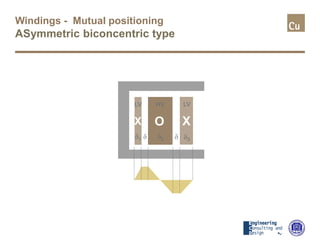
ASymmetric biconcentric type
X O
LV HV
δ1 δ2δ
X
LV
δ3δ
Windings - Mutual positioning
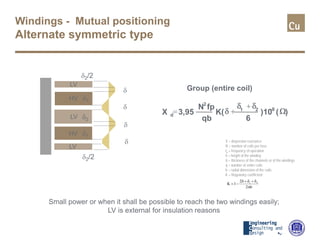
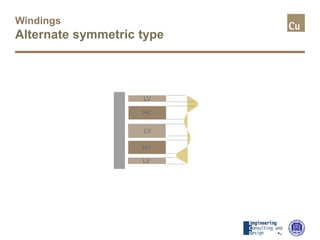
Alternate symmetric type
X 3,95
N fp
qb
K(
6
)10 ( )d
2
1 2 -8
= +
+
δ
δ δ
Ω
Small power or when it shall be possible to reach the two windings easily;
LV is external for insulation reasons
Group (entire coil)
X O
LV
HV
δ
δ
LV
HV
LV
δ2
δ2/2
δ2/2
δ1
δ1
δ
δ X = dispersion reactance
N = number of coils per fase
fp = frequency of operation
h = height of the winding
δ = thickness of the channels or of the windings
q = number of entire coils
b = radial dimension of the coils
K = Rogowsky coefficient:
b2
2
1K 21
π
δ+δ+δ
−=
Windings
Alternate symmetric type
X
LV
HV
LV
HV
LV
Power Transformers Design Principles
WINDINGS
TYPES
.2
Windings
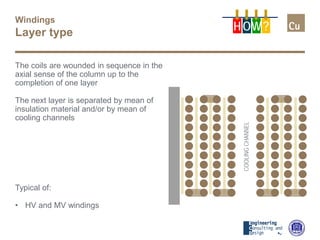
Layer type
The coils are wounded in sequence in the
axial sense of the column up to the
completion of one layer
The next layer is separated by mean of
insulation material and/or by mean of
cooling channels
Typical of:
• HV and MV windings
H OW?
COOLINGCHANNEL
Windings
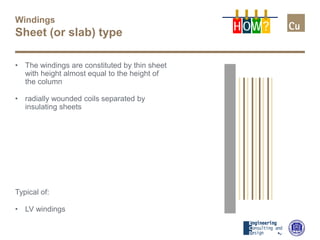
Sheet (or slab) type
• The windings are constituted by thin sheet
with height almost equal to the height of
the column
• radially wounded coils separated by
insulating sheets
Typical of:
• LV windings
H OW?
Windings
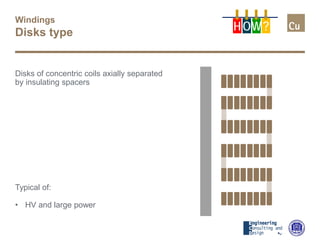
Disks type
Disks of concentric coils axially separated
by insulating spacers
Typical of:
• HV and large power
H OW?
Windings
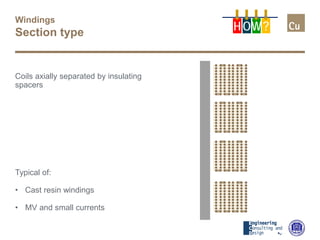
Section type
Coils axially separated by insulating
spacers
Typical of:
• Cast resin windings
• MV and small currents
H OW?
Windings
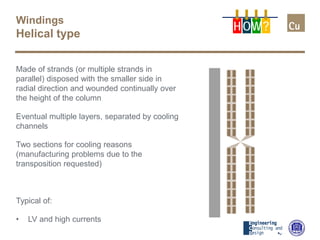
Helical type
Made of strands (or multiple strands in
parallel) disposed with the smaller side in
radial direction and wounded continually over
the height of the column
Eventual multiple layers, separated by cooling
channels
Two sections for cooling reasons
(manufacturing problems due to the
transposition requested)
Typical of:
• LV and high currents
H OW?
Power Transformers Design Principles
WINDINGS
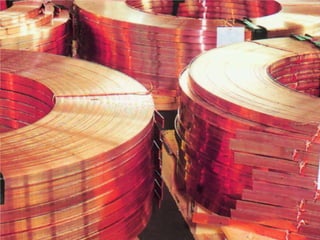
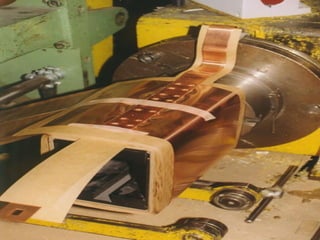
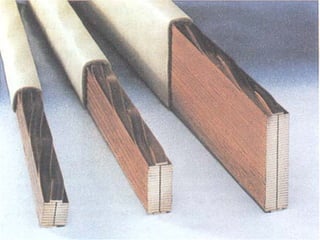
CONDUCTOR SHAPES
.3
| Presentation title and date
| Presentation title and date
| Presentation title and date
| Presentation title and date
Power Transformers Design Principles
WINDINGS
HV/MV WINDINGS
.4
HV/MV
HV Windings
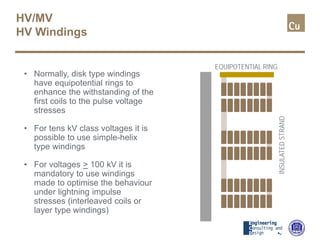
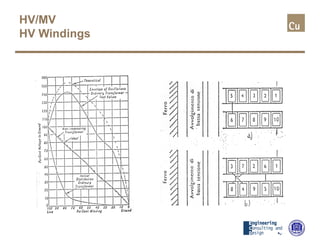
• Normally, disk type windings
have equipotential rings to
enhance the withstanding of the
first coils to the pulse voltage
stresses
• For tens kV class voltages it is
possible to use simple-helix
type windings
• For voltages > 100 kV it is
mandatory to use windings
made to optimise the behaviour
under lightning impulse
stresses (interleaved coils or
layer type windings)
EQUIPOTENTIAL RING
INSULATEDSTRAND
HV/MV
HV Windings
HV/MV
Conductors
HV
• Glazed round conductors up to 1÷1,5 mm in diameter, for upper
dimensions it is used pure cellulose-type paper
• The HV windings shall have very good insulation in the edge zones (exit of
the terminals), where bending is and in the transposition zones
MV
• Epoxy-bonding continuously-transposed conductor-strands for rated
power > 63 MVA; for lower powers it is used normal-transposed
conductor-strands
Power Transformers Design Principles
WINDINGS
TAPPED WINDINGS
.5
Windings
Tapped Windings
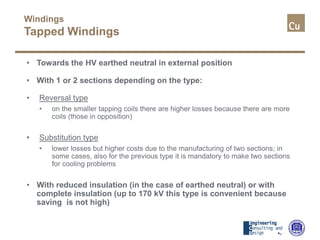
• Towards the HV earthed neutral in external position
• With 1 or 2 sections depending on the type:
• Reversal type
• on the smaller tapping coils there are higher losses because there are more
coils (those in opposition)
• Substitution type
• lower losses but higher costs due to the manufacturing of two sections; in
some cases, also for the previous type it is mandatory to make two sections
for cooling problems
• With reduced insulation (in the case of earthed neutral) or with
complete insulation (up to 170 kV this type is convenient because
saving is not high)
58
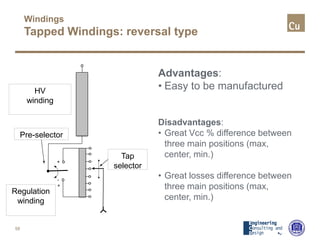
Advantages:
• Easy to be manufactured
Disadvantages:
• Great Vcc % difference between
three main positions (max,
center, min.)
• Great losses difference between
three main positions (max,
center, min.)
HV
winding
Tap
selector
Pre-selector
+
-
+
Regulation
winding
Windings
Tapped Windings: reversal type
59
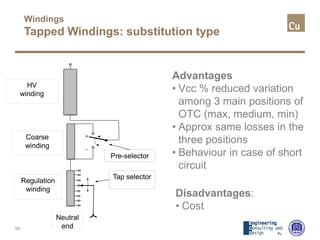
Advantages
• Vcc % reduced variation
among 3 main positions of
OTC (max, medium, min)
• Approx same losses in the
three positions
• Behaviour in case of short
circuit
Disadvantages:
• Cost
Neutral
end
Regulation
winding
Coarse
winding
HV
winding
Tap selector
Pre-selector
+
-
Windings
Tapped Windings: substitution type
Power Transformers Design Principles
WINDINGS
MV/LV WINDINGS
.4
MV/LV
Windings
• Oil transformers type: layer and sheet type windings
• Cast resin transformers type: section and sheet type windings
• Open type transformers (air insulated): disk and sheet type
windings
LV Windings
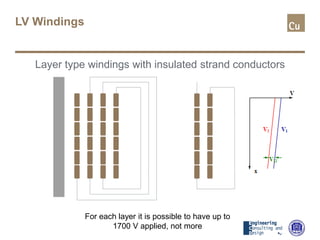
Layer type windings with insulated strand conductors
For each layer it is possible to have up to
1700 V applied, not more
LV Windings
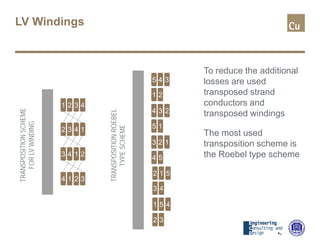
To reduce the additional
losses are used
transposed strand
conductors and
transposed windings
The most used
transposition scheme is
the Roebel type scheme
1 2 3 4
2 3 4 1
3 4 1 2
4 1 2 3
TRANSPOSITIONSCHEME
FORLVWINDING
5 4 3
1 2
4 3 2
5 1
TRANSPOSITIONROEBEL
TYPESCHEME
3 2 1
4 5
2 1 5
3 4
1 5 4
2 3
LV Windings
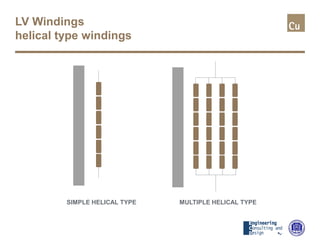
helical type windings
SIMPLE HELICAL TYPE MULTIPLE HELICAL TYPE
LV Windings
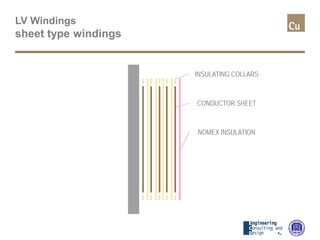
sheet type windings
INSULATING COLLARS
CONDUCTOR SHEET
NOMEX INSULATION
Power Transformers Design Principles
INSULATION
Insulation
• The insulation is critical specially for the HV oil type transformers
• It is possible to distinguish:
• Conductor insulation
• Insulation between winding layers
• Insulation between windings / core and earth
• The insulation design mainly depends:
• on the lightning impulse insulation level (MV)
• on the switching impulse insulation level (HV)
Insulation
• Insulation between coils or sections:
• Paper tapes with tens micron thickness
• Quantity depending on the higher stress to maintain during the tests
• Insulation between disks:
• Insulation between coils + oil channels
• Insulation between windings:
• Concentric cylindrical pressboards + oil channels
H OW?
Insulation
Insulation on the edge of the windings:
• Cylindrical pressboard materials with the cylindrical part of it inserted
between the winding insulating cylinders to increase the path for a
superficial discharge
H OW?
Thank you
| Presentation title and date
For more information please contact
Angelo Baggini
Università di Bergamo
Dipartimento di Ingegneria
Viale Marconi 5,
24044 Dalmine (BG) Italy
email: angelo.baggini@unibg.it
ECD Engineering Consulting and Design
Via Maffi 21 27100 PAVIA Italy

Transformer design principles

  • 1.
    Angelo Baggini, angelo.baggini@unibg.it,Bergamo University - Engineering Department Via Marconi 5, 24044 Dalmine (BG) – Italy Power Transformer Design Principles
  • 2.
    Index 0. Sizing criteria Themain parts constituting transformers are: 1. Magnetic core (active part) 2. Electric windings (active part) 3. Tank (liquid transformer only) 4. Accessories
  • 3.
    Power Transformers DesignPrinciples SIZING CRITERIA
  • 4.
    Sizing criteria Sizing Power(phase) • B: 1,6-1,8 T • J: 2-4 A/mm2 𝑆𝑆 = π 2 𝑓𝑓𝐴𝐴𝐹𝐹𝐹𝐹 𝐴𝐴𝐶𝐶𝐶𝐶 𝐵𝐵𝐵𝐵
  • 5.
    Power Transformers DesignPrinciples MAGNETIC CORE 1.1 losses 1.2 sound levels 1.3 types 1.4 section 1.5 interwoven methods 1.6 packaging and locking
  • 6.
    Power Transformers DesignPrinciples MAGNETIC CORE LOSSES .1
  • 7.
    Magnetic core No-Load losses Eddycurrents Histeresys Other 8 Id B Po = k1 f BM n + k2 f2 B2 P𝑝𝑝𝑝𝑝𝑝𝑝≡ LFe AA ∙f 0,2 B2 S ̇ The reduction of induction level affects no-load losses by a power between 2 and 2,5 in respect on the rated power value ratio
  • 8.
    Power Transformers DesignPrinciples MAGNETIC CORE SOUND LEVELS .2
  • 9.
    Magnetic core Sound levels Themagnetic circuit is an important source of sound due to: • Electromagnetic stresses • Magnetostriction Induction values: • For a better exploitation of the magnetic material it should be possible to use induction values greater than 1,7 T if no acoustic pollution limits exist • otherwise induction values between 1,55 and 1,6 T shall be used
  • 10.
    Power Transformers DesignPrinciples MAGNETIC CORE TYPES .3
  • 11.
    Magnetic core Main types Magneticcircuit is made of: • Columns: around which are installed the windings • Yokes: union elements between columns for magnetic flux closing purpose Type of cores: • Single-phase • Core type • Shell type • Three-phase • three-limb core-type • five-limb core-type
  • 12.
    Magnetic core Single-phase types •Core-type two wounded limbs and yokes of the same section same magnetic fluxes on each element • Shell-type one wounded limb; the yokes have section and magnetic flux halved values compared to those in the wounded column CORE-TYPE SHELL-TYPE
  • 13.
  • 14.
  • 15.
  • 16.
    Magnetic core Three-phase threewounded limb core-type • Simply to manufacture • Asymmetric for the magnetic flux in the columns (different values of no load currents)
  • 17.
    Magnetic core Three-phase fivewounded limb core-type • Large power transformers • Reduced height • Large length
  • 18.
    Power Transformers DesignPrinciples MAGNETIC CORE SECTION .4
  • 19.
    Magnetic core Section • Step-typecore section to use more space inside the insulating pipe that support transformer windings • Rectangular core section used for small transformers and/or for yokes of five-column core-type transformers
  • 20.
    Magnetic core Cooling Cooling channelscrossed by oil or air: • Magnetic sheet parallel: easy solution but few effective • Magnetic sheet perpendicular: effective solution but manufacturing complex and expensive Magnetic sheets parallel ducts Magnetic sheets perpendicular ducts (frame core type)
  • 21.
  • 22.
    Power Transformers DesignPrinciples MAGNETIC CORE INTERWOVEN METHODS .5
  • 23.
    Magnetic core Interwoven methods a) b) Magneticsheets: a) 90° angle splices b) 45° angle splices
  • 24.
    Magnetic core Interwoven methods 45°angle splices • They favour the circulation of magnetic flux (crystal orientation equal to the flux direction) B B B B 90° angle splices • Lower manufacturing costs • Increased losses value (compensate enlarging the core section)
  • 25.
    Magnetic core Interwoven methods- Step lap Diagonal 45° angle splices: • normal (a): the flux ways are irregular in the air-gap • step-lap (b): the flux ways are regular; limited variation of local induction but no-load magnetising current values up to 10 times of the rated value because of the presence of residual magnetic flux and of the low reluctance of the magnetic circuit
  • 26.
    Magnetic core Interwoven methods- Step lap • normal: the flux ways are irregular in the air-gap
  • 27.
    Magnetic core Interwoven methods- Step lap • step-lap: the flux ways are regular; limited variation of local induction but no- load magnetising current values up to 10 times of the rated value because of the presence of residual magnetic flux and of the low reluctance of the magnetic circuit
  • 28.
    Power Transformers DesignPrinciples MAGNETIC CORE PACKAGING AND LOCKING .6
  • 29.
    Magnetic core Packaging andlocking • Multiple layers of heat shrinking tapes (small power transformers) • Armour and loop bolts (medium and large power transformers) Problems: • Sound levels reduction due to vibrations with insulating laces and/or tapes • The loop bolts shall be insulated from the magnetic sheets (dangerous isolate overtemperatures: hot spots effects)
  • 30.
    Power Transformers DesignPrinciples WINDINGS Mutual positioning Type Conductor shapes
  • 31.
    Windings • HV andLV windings installed on the same column • Mutual separation and insulation and from the magnetic core by cylindrical insulating pressboards • Channels between windings designed for insulation and short circuit impedance requirements
  • 32.
    Power Transformers DesignPrinciples WINDINGS MUTUAL POSITIONING .1
  • 33.
    Windings Mutual positioning Typical manufacturingtypes are: • Concentric windings: • Simple-type • Symmetric biconcentric type • Asymmetric biconcentric type • Alternate windings: • Symmetric type • Asymmetric type The symmetry of the windings: • reduce the short circuit reactance • balance the electrodynamic stresses
  • 34.
    Windings Mutual positioning Concentric windingtype (most used) The electrodynamic axial stresses are minimised and balanced by means of local compensation of the m.m.f. of HV and LV; this is obtained, for uniform distribution of m.m.f., using windings with the same height Alternate windings The electrodynamic radial stresses are minimised and balanced by means of local compensation of the m.m.f. of HV and LV; this is obtained, for uniform distribution of m.m.f., using windings with the same diameter
  • 35.
    Windings - Mutualpositioning Simple concentric type X 8,4 N fp h ( 3 )10 ( ) 2 1 2 -8 = + + δ δ δ Ω It is the most used to facilitate the exit of the HV winding terminals LV is external for insulation reasons X O LV HV δ1 δ2δ X = dispersion reactance N = number of coils per fase fp = frequency of operation h = height of the winding δ = thickness of the channels or of the windings q = number of entire coils b = radial dimension of the coils K = Rogowsky coefficient: b2 2 1K 21 π δ+δ+δ −=
  • 36.
    Windings - Mutualpositioning Symmetric biconcentric type X 4,2 N fp h ( 6 )10 ( ) 2 1 2 -8 = + + δ δ δ Ω Large power and HV, where a large channel increases the short circuit voltage value X O LV HV δ1/2 δ2δ X LV δ1/2δ X = dispersion reactance N = number of coils per fase fp = frequency of operation h = height of the winding δ = thickness of the channels or of the windings q = number of entire coils b = radial dimension of the coils K = Rogowsky coefficient: b2 2 1K 21 π δ+δ+δ −=
  • 37.
    Windings - Mutualpositioning ASymmetric biconcentric type X O LV HV δ1 δ2δ X LV δ3δ
  • 38.
    Windings - Mutualpositioning Alternate symmetric type X 3,95 N fp qb K( 6 )10 ( )d 2 1 2 -8 = + + δ δ δ Ω Small power or when it shall be possible to reach the two windings easily; LV is external for insulation reasons Group (entire coil) X O LV HV δ δ LV HV LV δ2 δ2/2 δ2/2 δ1 δ1 δ δ X = dispersion reactance N = number of coils per fase fp = frequency of operation h = height of the winding δ = thickness of the channels or of the windings q = number of entire coils b = radial dimension of the coils K = Rogowsky coefficient: b2 2 1K 21 π δ+δ+δ −=
  • 39.
  • 40.
    Power Transformers DesignPrinciples WINDINGS TYPES .2
  • 41.
    Windings Layer type The coilsare wounded in sequence in the axial sense of the column up to the completion of one layer The next layer is separated by mean of insulation material and/or by mean of cooling channels Typical of: • HV and MV windings H OW? COOLINGCHANNEL
  • 42.
    Windings Sheet (or slab)type • The windings are constituted by thin sheet with height almost equal to the height of the column • radially wounded coils separated by insulating sheets Typical of: • LV windings H OW?
  • 43.
    Windings Disks type Disks ofconcentric coils axially separated by insulating spacers Typical of: • HV and large power H OW?
  • 44.
    Windings Section type Coils axiallyseparated by insulating spacers Typical of: • Cast resin windings • MV and small currents H OW?
  • 45.
    Windings Helical type Made ofstrands (or multiple strands in parallel) disposed with the smaller side in radial direction and wounded continually over the height of the column Eventual multiple layers, separated by cooling channels Two sections for cooling reasons (manufacturing problems due to the transposition requested) Typical of: • LV and high currents H OW?
  • 46.
    Power Transformers DesignPrinciples WINDINGS CONDUCTOR SHAPES .3
  • 47.
  • 48.
  • 49.
  • 50.
  • 51.
    Power Transformers DesignPrinciples WINDINGS HV/MV WINDINGS .4
  • 52.
    HV/MV HV Windings • Normally,disk type windings have equipotential rings to enhance the withstanding of the first coils to the pulse voltage stresses • For tens kV class voltages it is possible to use simple-helix type windings • For voltages > 100 kV it is mandatory to use windings made to optimise the behaviour under lightning impulse stresses (interleaved coils or layer type windings) EQUIPOTENTIAL RING INSULATEDSTRAND
  • 53.
  • 54.
    HV/MV Conductors HV • Glazed roundconductors up to 1÷1,5 mm in diameter, for upper dimensions it is used pure cellulose-type paper • The HV windings shall have very good insulation in the edge zones (exit of the terminals), where bending is and in the transposition zones MV • Epoxy-bonding continuously-transposed conductor-strands for rated power > 63 MVA; for lower powers it is used normal-transposed conductor-strands
  • 55.
    Power Transformers DesignPrinciples WINDINGS TAPPED WINDINGS .5
  • 56.
    Windings Tapped Windings • Towardsthe HV earthed neutral in external position • With 1 or 2 sections depending on the type: • Reversal type • on the smaller tapping coils there are higher losses because there are more coils (those in opposition) • Substitution type • lower losses but higher costs due to the manufacturing of two sections; in some cases, also for the previous type it is mandatory to make two sections for cooling problems • With reduced insulation (in the case of earthed neutral) or with complete insulation (up to 170 kV this type is convenient because saving is not high)
  • 57.
    58 Advantages: • Easy tobe manufactured Disadvantages: • Great Vcc % difference between three main positions (max, center, min.) • Great losses difference between three main positions (max, center, min.) HV winding Tap selector Pre-selector + - + Regulation winding Windings Tapped Windings: reversal type
  • 58.
    59 Advantages • Vcc %reduced variation among 3 main positions of OTC (max, medium, min) • Approx same losses in the three positions • Behaviour in case of short circuit Disadvantages: • Cost Neutral end Regulation winding Coarse winding HV winding Tap selector Pre-selector + - Windings Tapped Windings: substitution type
  • 59.
    Power Transformers DesignPrinciples WINDINGS MV/LV WINDINGS .4
  • 60.
    MV/LV Windings • Oil transformerstype: layer and sheet type windings • Cast resin transformers type: section and sheet type windings • Open type transformers (air insulated): disk and sheet type windings
  • 61.
    LV Windings Layer typewindings with insulated strand conductors For each layer it is possible to have up to 1700 V applied, not more
  • 62.
    LV Windings To reducethe additional losses are used transposed strand conductors and transposed windings The most used transposition scheme is the Roebel type scheme 1 2 3 4 2 3 4 1 3 4 1 2 4 1 2 3 TRANSPOSITIONSCHEME FORLVWINDING 5 4 3 1 2 4 3 2 5 1 TRANSPOSITIONROEBEL TYPESCHEME 3 2 1 4 5 2 1 5 3 4 1 5 4 2 3
  • 63.
    LV Windings helical typewindings SIMPLE HELICAL TYPE MULTIPLE HELICAL TYPE
  • 64.
    LV Windings sheet typewindings INSULATING COLLARS CONDUCTOR SHEET NOMEX INSULATION
  • 65.
    Power Transformers DesignPrinciples INSULATION
  • 66.
    Insulation • The insulationis critical specially for the HV oil type transformers • It is possible to distinguish: • Conductor insulation • Insulation between winding layers • Insulation between windings / core and earth • The insulation design mainly depends: • on the lightning impulse insulation level (MV) • on the switching impulse insulation level (HV)
  • 67.
    Insulation • Insulation betweencoils or sections: • Paper tapes with tens micron thickness • Quantity depending on the higher stress to maintain during the tests • Insulation between disks: • Insulation between coils + oil channels • Insulation between windings: • Concentric cylindrical pressboards + oil channels H OW?
  • 68.
    Insulation Insulation on theedge of the windings: • Cylindrical pressboard materials with the cylindrical part of it inserted between the winding insulating cylinders to increase the path for a superficial discharge H OW?
  • 69.
    Thank you | Presentationtitle and date For more information please contact Angelo Baggini Università di Bergamo Dipartimento di Ingegneria Viale Marconi 5, 24044 Dalmine (BG) Italy email: angelo.baggini@unibg.it ECD Engineering Consulting and Design Via Maffi 21 27100 PAVIA Italy