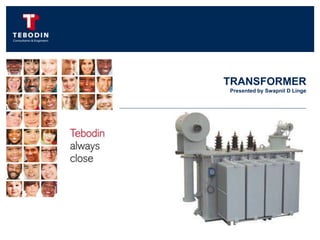
TRANSFORMER
Presented by Swapnil D Linge
Contents
 Applicable Standards
 Working Principle
 Construction
 Type of Transformer
 Sizing of Transformer
 Testing of Transformer
Applicable Standards
 IEC 60076 (Part 1)- Power Transformer, General
 IEC 60076 (Part 2)- Power Transformer, Temperature Rise
 IEC 60076 (Part 3)- Power Transformer, Insulation Levels,
dielectric tests and external clearance in air
 IEC 60076 (Part 5)- Power Transformer, Ability to withstand short
circuit
 IEC 60076 (Part 7)- Power Transformer, Loading guide for oil-
immersed power transformer
 IEC 60076 (Part 8)- Power Transformer, Application guide
 IEC 60076 (Part 11)- Dry Type Transformer
Why do we need Transformers?
If power losses in electricity distribution networks are to be
kept within reasonable limits, then large amount of electric
power have to be transmitted across long distances at the
highest feasible voltage.
In absolute terms, higher the transmission voltage, smaller
the current and hence smaller the (resistive) power losses
in transmission cables.
Working Principle
Transformer is a static piece of apparatus by means of
which electric power in one circuit is transformed into
electric power of same frequency in another circuit. It
can raise or lower the voltage in a circuit but with a
corresponding increase or decrease in current.
In simplest form, it consists of two inductive coils which
are electrically separated but magnetically linked
through a path of low reluctance.
Type of Transformer
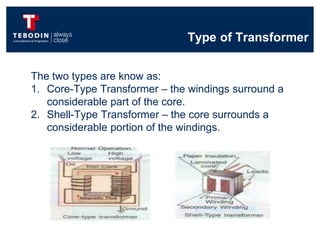
The two types are know as:
1. Core-Type Transformer – the windings surround a
considerable part of the core.
2. Shell-Type Transformer – the core surrounds a
considerable portion of the windings.
Types of Transformer
• Distribution Transformer
• Power Transformer
• Phase Shift Transformer
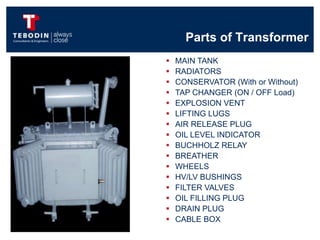
Parts of Transformer
 MAIN TANK
 RADIATORS
 CONSERVATOR (With or Without)
 TAP CHANGER (ON / OFF Load)
 EXPLOSION VENT
 LIFTING LUGS
 AIR RELEASE PLUG
 OIL LEVEL INDICATOR
 BUCHHOLZ RELAY
 BREATHER
 WHEELS
 HV/LV BUSHINGS
 FILTER VALVES
 OIL FILLING PLUG
 DRAIN PLUG
 CABLE BOX
Sizing of Transformer
With maximum demand (Peak Load) + spare capacity
transformer sizing done. Also need to check highest
motor starting.
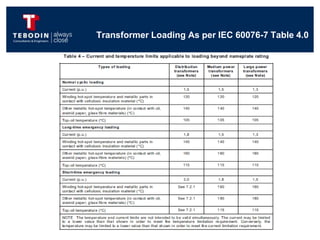
Transformer Loading As per IEC 60076-7 Table 4.0
Transformer Capacity on basis of concepts
• 1 x 100% - Only a single power-transformer of rated
capacity 15 to 20% higher than the calculated
maximum demand.
• 2 x 100% - Two power transformers each capable of
meeting the full maximum demand.
• 3 x 50% - Three power transformers each rating higher
than 50% of maximum demand.
3 x 50% Power Transformer Arrangement
Ceiling on MVA ratings
The ceiling on individual transformer capacity is due to the necessity to limit HV system
fault level and is also non availability of single HV-CB for larger current ratings.
Secondary Voltage of
Power Transformer
Max MVA rating of power
transformer
3.3kV secondary ……12.5MVA
6.6kV secondary …… 25MVA
11kV secondary …… 40MVA
Letter denotes form of Cooling
First letter: Internal cooling medium in contact with the windings
O – mineral oil or synthetic insulating liquid with fire point < 300°C
K – insulating liquid with fire point > 300°C
L – insulating liquid with no measurable fire point
Second letter: Circulation Mechanism for internal cooling medium
N – natural convection flow through cooling equipment and windings
F – Forced circulation through cooling equipment (cooling pumps), natural
convection flow in windings (non-directed flow)
D – forced circulation through cooling equipment, directed from the cooling
equipment into at least the main windings
Letter denotes form of Cooling
Third letter: External cooling medium
A – Air
W – Water
Fourth letter: Circulation Mechanism for external cooling medium
N – natural convection
F – Forced circulation (fans, pumps)
Type of Tanks
Conservator Type:
This is fitted with an overhead tank which is approximately half full of the oil. The overhead tank is
allowed to breath to atmosphere as the oil level varies with the average temperature inside the
transformer.
Sealed Type:
An alternative design which has the advantage of reduced periodic maintenance of oil in the sealed
type. The main tank is designed not to breath and is provided with gas or vapour space between the
top of surface of the liquid and the underside of the tank lid.
Vector Group of Transformers
• Delta – delta : Generally used where it needs to carry large currents on
low voltage
• Star – star : this type of transformer is rarely used due to problem with
unbalanced loads.
• Delta – star : Commonly used as Step Up transformer at the beginning of
a HT transmission line, Commercial, industrial and residential locations
• Star – delta : commonly used as Step Down transformer at the end of
transmission line
• Delta – zigzag : to reduce harmonics in distribution system. Normally in
transmission line
• Star – zigzag : to reduce harmonics in distribution system. Normally in
transmission line
Vector Group of Transformers
High voltage (not primary) line emf is placed at 12 o’clock
position and corresponding low voltage line emf position is
noted. Low voltage line emf position denotes Hour hand of
the clock and accordingly nomenclature is given (vector
group is denoted).
HV connection is denoted by capital letter, LV connection is
denoted by small letter and corresponding LV line emf
position is termed as HOUR hand of the clock and is
denoted by suffix.
For HV delta connected and LV star connected, and LV line
emf 30° leading is written as Dy11
Vector Group of Transformers
Min. Information required for Enquiry
• Particulars of specification
• Kind of transformer (separate winding, auto or booster transformer)
• Single or three phase unit
• Number of phases in system
• Frequency
• Dry type or liquid filled
• Indoor or outdoor type
• Type of cooling
• Rated power
• Rated voltage
• Method of system earthing
• Details of auxiliary supply voltage
• Insulation Level for each winding
Testing of Transformer
• TYPE TESTS
• ROUTINE
• SPECIAL TESTS
Testing of Transformer
TYPE TESTS (TO BE CARRIED OUT ONLY ON ONE TRANSFORMER OF THE LOT)
• Lightning Impulse Test
• Temperature Rise Test
Testing of Transformer
ROUTINE TESTS ( TO BE CARRIED OUT ON EACH JOB)
• Measurement of winding resistance
• Measurement of insulation resistance
• Separate source voltage withstand test (High Voltage
tests on HV & LV)
• Induced Over voltage Withstand test (DVDF test)
• Measurement of voltage ratio
• Measurement of NO LOAD LOSS & current.
• Measurement of LOAD LOSS & IMPEDENCE.
• Vector Group Verification
• Oil BDV test.
• Tests on OLTC (if Attached)
Testing of Transformer
SPECIAL TESTS
• Additional Impulse Test
• Short Circuit Test
• Measurement of Zero Phase sequence Impedance Test
• Measurement of acoustic noise level
• Measurement of harmonics of the no load current
• Magnetic balance test
Photos
THANK YOU
THANK YOU

Transformer Presentation-1.pptx

  • 1.
  • 2.
    Contents  Applicable Standards Working Principle  Construction  Type of Transformer  Sizing of Transformer  Testing of Transformer
  • 3.
    Applicable Standards  IEC60076 (Part 1)- Power Transformer, General  IEC 60076 (Part 2)- Power Transformer, Temperature Rise  IEC 60076 (Part 3)- Power Transformer, Insulation Levels, dielectric tests and external clearance in air  IEC 60076 (Part 5)- Power Transformer, Ability to withstand short circuit  IEC 60076 (Part 7)- Power Transformer, Loading guide for oil- immersed power transformer  IEC 60076 (Part 8)- Power Transformer, Application guide  IEC 60076 (Part 11)- Dry Type Transformer
  • 4.
    Why do weneed Transformers? If power losses in electricity distribution networks are to be kept within reasonable limits, then large amount of electric power have to be transmitted across long distances at the highest feasible voltage. In absolute terms, higher the transmission voltage, smaller the current and hence smaller the (resistive) power losses in transmission cables.
  • 5.
    Working Principle Transformer isa static piece of apparatus by means of which electric power in one circuit is transformed into electric power of same frequency in another circuit. It can raise or lower the voltage in a circuit but with a corresponding increase or decrease in current. In simplest form, it consists of two inductive coils which are electrically separated but magnetically linked through a path of low reluctance.
  • 6.
    Type of Transformer Thetwo types are know as: 1. Core-Type Transformer – the windings surround a considerable part of the core. 2. Shell-Type Transformer – the core surrounds a considerable portion of the windings.
  • 7.
    Types of Transformer •Distribution Transformer • Power Transformer • Phase Shift Transformer
  • 8.
    Parts of Transformer MAIN TANK  RADIATORS  CONSERVATOR (With or Without)  TAP CHANGER (ON / OFF Load)  EXPLOSION VENT  LIFTING LUGS  AIR RELEASE PLUG  OIL LEVEL INDICATOR  BUCHHOLZ RELAY  BREATHER  WHEELS  HV/LV BUSHINGS  FILTER VALVES  OIL FILLING PLUG  DRAIN PLUG  CABLE BOX
  • 9.
    Sizing of Transformer Withmaximum demand (Peak Load) + spare capacity transformer sizing done. Also need to check highest motor starting.
  • 10.
    Transformer Loading Asper IEC 60076-7 Table 4.0
  • 11.
    Transformer Capacity onbasis of concepts • 1 x 100% - Only a single power-transformer of rated capacity 15 to 20% higher than the calculated maximum demand. • 2 x 100% - Two power transformers each capable of meeting the full maximum demand. • 3 x 50% - Three power transformers each rating higher than 50% of maximum demand.
  • 12.
    3 x 50%Power Transformer Arrangement
  • 13.
    Ceiling on MVAratings The ceiling on individual transformer capacity is due to the necessity to limit HV system fault level and is also non availability of single HV-CB for larger current ratings. Secondary Voltage of Power Transformer Max MVA rating of power transformer 3.3kV secondary ……12.5MVA 6.6kV secondary …… 25MVA 11kV secondary …… 40MVA
  • 14.
    Letter denotes formof Cooling First letter: Internal cooling medium in contact with the windings O – mineral oil or synthetic insulating liquid with fire point < 300°C K – insulating liquid with fire point > 300°C L – insulating liquid with no measurable fire point Second letter: Circulation Mechanism for internal cooling medium N – natural convection flow through cooling equipment and windings F – Forced circulation through cooling equipment (cooling pumps), natural convection flow in windings (non-directed flow) D – forced circulation through cooling equipment, directed from the cooling equipment into at least the main windings
  • 15.
    Letter denotes formof Cooling Third letter: External cooling medium A – Air W – Water Fourth letter: Circulation Mechanism for external cooling medium N – natural convection F – Forced circulation (fans, pumps)
  • 16.
    Type of Tanks ConservatorType: This is fitted with an overhead tank which is approximately half full of the oil. The overhead tank is allowed to breath to atmosphere as the oil level varies with the average temperature inside the transformer. Sealed Type: An alternative design which has the advantage of reduced periodic maintenance of oil in the sealed type. The main tank is designed not to breath and is provided with gas or vapour space between the top of surface of the liquid and the underside of the tank lid.
  • 17.
    Vector Group ofTransformers • Delta – delta : Generally used where it needs to carry large currents on low voltage • Star – star : this type of transformer is rarely used due to problem with unbalanced loads. • Delta – star : Commonly used as Step Up transformer at the beginning of a HT transmission line, Commercial, industrial and residential locations • Star – delta : commonly used as Step Down transformer at the end of transmission line • Delta – zigzag : to reduce harmonics in distribution system. Normally in transmission line • Star – zigzag : to reduce harmonics in distribution system. Normally in transmission line
  • 18.
    Vector Group ofTransformers High voltage (not primary) line emf is placed at 12 o’clock position and corresponding low voltage line emf position is noted. Low voltage line emf position denotes Hour hand of the clock and accordingly nomenclature is given (vector group is denoted). HV connection is denoted by capital letter, LV connection is denoted by small letter and corresponding LV line emf position is termed as HOUR hand of the clock and is denoted by suffix. For HV delta connected and LV star connected, and LV line emf 30° leading is written as Dy11
  • 19.
    Vector Group ofTransformers
  • 20.
    Vector Group ofTransformers
  • 21.
    Min. Information requiredfor Enquiry • Particulars of specification • Kind of transformer (separate winding, auto or booster transformer) • Single or three phase unit • Number of phases in system • Frequency • Dry type or liquid filled • Indoor or outdoor type • Type of cooling • Rated power • Rated voltage • Method of system earthing • Details of auxiliary supply voltage • Insulation Level for each winding
  • 22.
    Testing of Transformer •TYPE TESTS • ROUTINE • SPECIAL TESTS
  • 23.
    Testing of Transformer TYPETESTS (TO BE CARRIED OUT ONLY ON ONE TRANSFORMER OF THE LOT) • Lightning Impulse Test • Temperature Rise Test
  • 24.
    Testing of Transformer ROUTINETESTS ( TO BE CARRIED OUT ON EACH JOB) • Measurement of winding resistance • Measurement of insulation resistance • Separate source voltage withstand test (High Voltage tests on HV & LV) • Induced Over voltage Withstand test (DVDF test) • Measurement of voltage ratio • Measurement of NO LOAD LOSS & current. • Measurement of LOAD LOSS & IMPEDENCE. • Vector Group Verification • Oil BDV test. • Tests on OLTC (if Attached)
  • 25.
    Testing of Transformer SPECIALTESTS • Additional Impulse Test • Short Circuit Test • Measurement of Zero Phase sequence Impedance Test • Measurement of acoustic noise level • Measurement of harmonics of the no load current • Magnetic balance test
  • 26.
  • 27.

Editor's Notes