BEF 43303
BEF 43303
POWER SYSTEM PROTECTION
Chapter 1: Introduction to
Protection
Protection
d
Introduction
• System Protection: the equipment use
to detect and isolate the faulty section
y
from the system automatically.
d
Introduction
• Short circuit occur when equipment
insulation fails due to system overvoltages
caused by:
caused by:
– Lightning or switching surges
• Flashover line-line (caused by wind)
• Flashover to tree
• Flashover to tree
– Insulation contamination by dirt/salt
– Mechanical failure
Cable insulation failure
• Cable insulation failure
– Natural causes
• Tower/pole or conductor falls
• Objects fall on conductors
d
Introduction
• Short circuit currents can be several orders
of magnitude larger than normal operating
currents
currents
• If it is allowed to persist, may cause:
– Damage to the equipment due to heavy currents
Damage to the equipment due to heavy currents,
unbalanced current, or low voltage produces by
the short circuit
Fire and explosion effect equipment/people
– Fire and explosion effect equipment/people
– Disruption of service in the entire power system
area
d
Introduction
• Careful design, operation and
maintenance of system protection can
y p
minimize the occurrence of short
circuit but cannot eliminate them.
l d l
Fault Currents and Voltages
f
Function of System Protection
• Why do we need system protection:
– Detect fault
Detect fault
– Isolate faulted component
– Restore faulted component
Restore faulted component
• Aims:
Continued supply for rest of system
– Continued supply for rest of system
– Protect faulted part from damage
f
Types of Protection
A – Fuses
• For LV Systems, Distribution Feeders and
Transformers VT’s Auxiliary Supplies
Transformers, VT’s, Auxiliary Supplies
B - Over current and earth fault
B Over current and earth fault
• Widely used in All Power Systems
– Non-Directional
– Directional
f
Types of Protection
C - Differential
• For Distribution Feeders, Busbars,
Transformers Generators etc
Transformers, Generators etc
f
Types of Protection
D - Distance
• For Transmission and Sub-transmission Lines
and Distribution Feeders
and Distribution Feeders,
• Also used as back-up protection for
transformers and generators without
g
signaling/with signaling to provide unit
protection e.g.:
– Time-stepped distance protection
Time stepped distance protection
– Phase comparison for transmission lines
– Directional comparison for transmission lines
f
Types of Protection
E - Miscellaneous:
• Under and over voltage
Under and over voltage
• Under and over frequency
• A special relay for generators transformers
• A special relay for generators, transformers,
motors etc.
• Control relays: auto-reclose, tap change
Control relays: auto reclose, tap change
control, etc.
• Tripping and auxiliary relays
pp g y y
Design Criteria/Characteristics
Simplicity
Economy
Simplicity
Speed
Reliability
Sensitivity
Selectivity
Reliability
Design Criteria/Characteristics
• Reliability
– Operate dependably and in healthy operating
condition when fault conditions occur, even after
remaining idle for months or years.
• Selectivity
Clearly discriminate between normal and
– Clearly discriminate between normal and
abnormal system condition to avoid unnecessary,
false trips.
• Sensitivity
• Sensitivity
– Ability to distinguish the fault condition,
although the different between fault and normal
condition is small
condition is small.
Design Criteria/Characteristics
• Speed
– Fault at any point in the system must be
detected and isolated rapidly to minimize fault
duration and equipment damage. Any intentional
time delays should be precise.
• Economy
Economy
– Provide maximum protection at minimum cost
• Simplicity
– Minimize protection equipment and circuitry
Economic Factor
• Total cost should take account of :
– Relays, schemes and associated panels and panel wiring
Relays, schemes and associated panels and panel wiring
– Setting studies
– Commissioning
– CTs and VTs
– Maintenance and repairs to relays
– Damage repair if protection fails to operate
– Lost revenue if protection operates unnecessarily
Economic Factor
• The cost of protection is equivalent to an insurance
policy against damage to plant, and loss of supply
and customer goodwill.
• Acceptable cost is based on a balance of economics
p
and technical factors. Cost of protection should be
balanced against the cost of potential hazards.
g p
• There is an economic limit on what can be spent.
• MINIMUM COST :Must ensure that all faulty
equipment is isolated by protection.
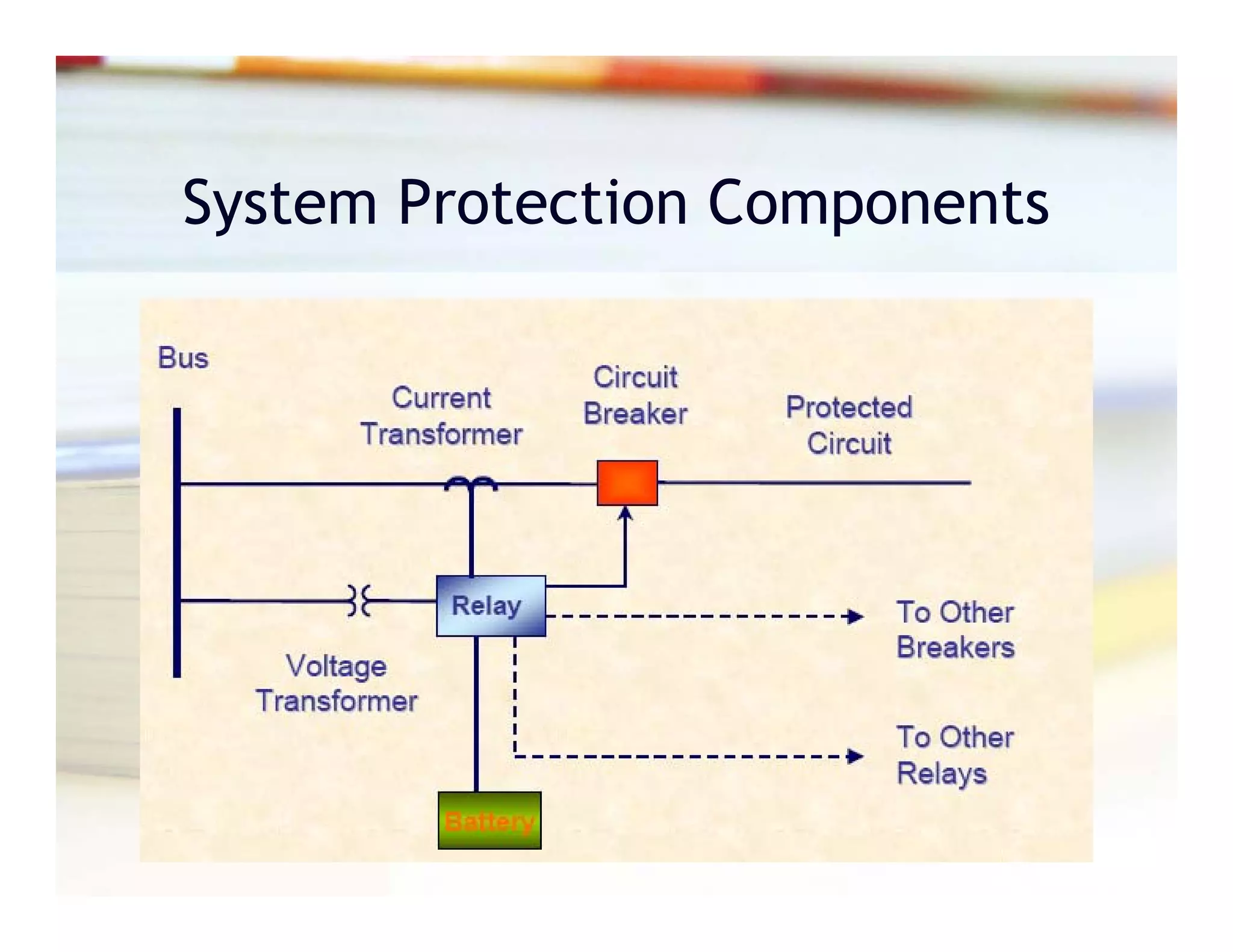
System Protection Components
• Transducer / Instrument Transformer
R l
• Relay
• Circuit Breaker
System Protection Components
Function:
• Transducers/Instrument Transformers (PT/VT & CT)
– Provide low current and voltage, standardized levels
suitable for the relays operation.
y p
• Relays
– Discriminate between normal operating and fault
conditions.
conditions.
– When current exceed a specified value, relay will be
operated and cause the trip coil of CB to be
energized/open their contact.
• Circuit Breakers
– Open the line, isolate the fault portion from the rest of the
system
y
System Protection Components
l
System Protection Flow
voltage or current rise from normal condition
voltage/current is reduced to match with relay rating
ti t i it b k
activate circuit breaker
circuit isolation
Relay
Transducer
Fault
Occur
Circuit
Breaker
Fault
Clear
I’ d ifi d l
I’ exceeds a specified value
O i il h NO
I’I’
Operating coil causes the NO
contacts to close
Trip coil of CB is energized (by
relay operation @ manually)
CB open
f
Zones of Protection
• For fault anyway within the zone, the
protection system responsible to
p y p
isolate everything within the zone from
the rest of the system.
y
• Isolation done by CB
• Must isolate only the faulty equipment
or section
f
Zones of Protection
• Zones are defined for:
– Generators
Generators
– Transformers
– Buses
Buses
– Transmission and distribution lines
– Motors
– Motors
f
Zones of Protection
f
Zones of Protection
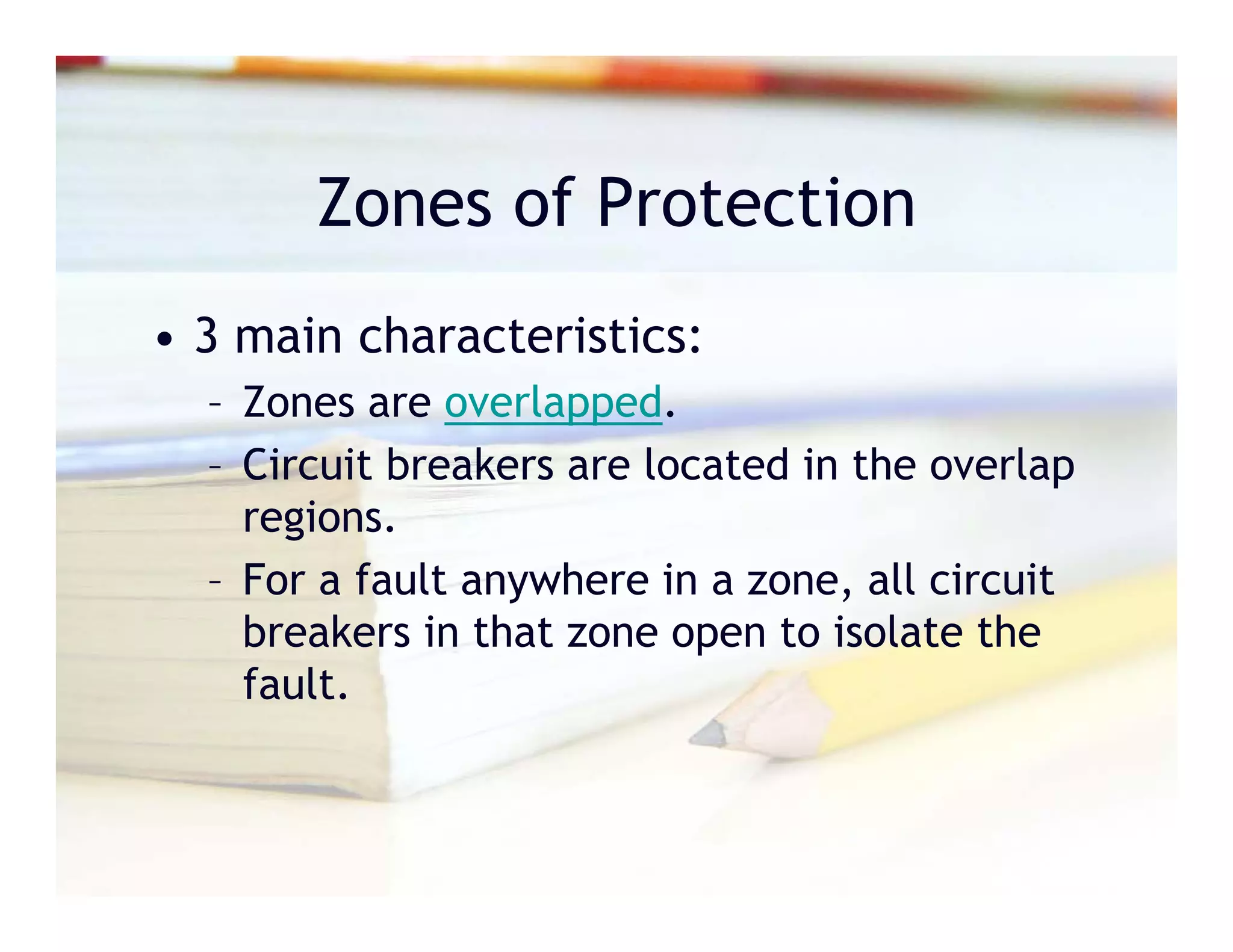
• 3 main characteristics:
– Zones are overlapped.
Zones are overlapped.
– Circuit breakers are located in the overlap
regions.
g
– For a fault anywhere in a zone, all circuit
breakers in that zone open to isolate the
fault.
l d f
Overlapped of Protection
• No blind spot:
– Neighboring zones are overlapped to avoid
Neighboring zones are overlapped to avoid
the possibility of unprotected areas
• Use overlapping CBs:
Use overlapping CBs:
– Isolation done by CB. Thus, it must be
inserted in each overlap region to identify
se ted eac ove lap eg o to de t y
the boundary of protective zones.
k
Primary & Back-up Protection
• Primary protection is the protection
provided by each zone to its elements.
p y
• However, some component of a zone
protection scheme fail to operate
protection scheme fail to operate.
• Back-up protection is provided which
take over only in the event of primary
protection failure.
l
Example
a) Consider the power system shown below, with the
generating source beyond buses 1, 3 and 4. What
are the zones of protection in which the system
should be divided? Which circuit breakers will open
for faults at P1 and P2?
1
2
3
P1 P
A C
P1
B
P2
A C
4
B
Fault at P1 = A, B, C
Fault at P2 = A, B, C,D, E
2 , , , ,
l
Example
a) If three circuits breakers are added at the tap
point 2, how would the zones of protection be
modified? Which circuit breakers will operate for
fault at P1 and P2 under these conditions?
1 3
2
P1 P2
A C
B
4
Fault at P1 = A, F
Fault at P2 = C,D,E,G
l
Example
Fault Primary Back-up
K C, D, E A, B, F
K , , , ,
l
Example
Fault Primary Back-up
Line E F C D E F G H A B I J
Line E F C, D, E, F, G, H A, B, I, J
Zone Discrimination
• A system as shown with relays and breakers marked.
A single fa lt has res lted in the operation of
A single fault has resulted in the operation of
breakers B1, B2, B3 and B4.Identify the location of
the fault
Answer:
• Answer:
– Fault in the overlap zone at breaker B2 as shown
Discrimination
A t ti t t b bl t
• A protection system must be able to
discriminate between healthy and
f lt i t i it
faulty equipment or circuits.
• Discrimination can be achieved by
1. Current (Magnitude)
2. Time
2. Time
3. Comparison
d
Transducers
• Also known as Instrument Transformer
• Use to reduce abnormal current & voltage
l l d i i i l h
levels and transmit input signals to the
relays of a protection system.
• Why do we need transducer:
– The lower level input to the relays ensures that
the physical hardware used to construct the
l ill b ll & h
relays will be small & cheap
– The personnel who work with the relays will be
working in a safe environment.
g
d
Transducers
• Current and Voltage Transformers
– Correct connection of CTs and VTs to the
Correct connection of CTs and VTs to the
protection is important directional,
distance, phase comparison and
differential protections.
– Earth CT and VT circuits at one point only;
d h
VT and CT Schematic
l f
Voltage Transformers
• VT is considered to be sufficiently
accurate.
• It is generally modeled as an ideal
transformer
transformer.
• VT secondary connected to voltage-
sensing device with infinite
impedance.
l f
Voltage Transformers
• Types of VTs
– Electromagnetic VT
– Capacitive VT
• Busbar VTs
S i l id i d d h d f li
– Special consideration needed when used for line
protection
• LV application(12 kV or lower)
– Industry standard – transformer with a primary
winding at a system voltage and secondary winding at
g y g y g
67 V(line-to-neutral) and 116 V(line-to-line).
l f
Voltage Transformers
l f
Voltage Transformers
Voltage/Potential
Transformer
(VT/PT)
( )
l f
Voltage Transformers
l f
Voltage Transformers
l f
Voltage Transformers
HV and EHV
• Capacitor-coupled VT (CVT)
p p ( )
– C1 & C2 are adjusted, so that a few kVs of
voltage is obtains across C2
g 2
– Then, stepped down by T
• VTs must be fused or protected by MCB.
VTs must be fused or protected by MCB.
l f
Voltage Transformers
l f
Voltage Transformers
• VT ratios:
– ratio of the high voltage/secondary
ratio of the high voltage/secondary
voltage
1:1 2:1 2.5:1 4:1
5:1 20:1 40:1 60:1
80:1 100:1 200:1 300:1
80:1 100:1 200:1 300:1
400:1 600:1 800:1 1000:1
2000:1 3000:1 4500:1
2000:1 3000:1 4500:1
f
Current Transformers
• CT is an instrument transformer that is used
to supply a reduced value of current to
meters, protective relays, and other
instruments.
Th i i di i f i l
• The primary winding consist of a single turn
which is the power conductor itself.
CT d i t d t t
• CT secondary is connected to a current-
sensing device with zero impedance.
Function
Function
 Isolate the high primary voltage of the system (main
system) from the protection and measuring
equipment
 Transform the high primary current of the circuit to a
small secondary current in the 1 – 5 Amp range
Example of CT ratio: 100/1, 200/1 100/5, 200/5, etc
 If the primary current changes the secondary
current output will change accordingly For
current output will change accordingly. For
example, if 150 amps flow through the 300 amp
rated primary (300:5), the secondary current
p y ( ), y
output will be 2.5 amps.
Advantages:
 Safety
 provide electrical isolation from power system so that
personnel working with relays will work in a safer
environment
 currents of 10 to 20 times (or greater) normal rating
often occur in CT windings for a few cycles during short
circuit
 Economy
Economy
 lower input for relays ( smaller, simpler and less
expensive)
• Accuracy
– reading from measurement will be more
accurate since the range has been scaled
down.
– Because of their high degree of accuracy,
h CT i ll d b ili
these CTs are typically used by utility
companies for measuring usage for billing
purposes
purposes
Two main types
Two main types
 Protection CT
 Monitor operation of power grid
 not as accurate as Measuring CTs
 for supplying current to protective relays.
 The wider range of current allows the protective relay
to operate at different fault levels.
M i CT ( t i )
 Measuring CT (metering)
 are used where a high degree of accuracy is required
from low-load values up to full-load of a system.
An e ample : tili ed b tilit companies for large
 An example : utilized by utility companies for large
capacity revenue billing.
f
Current Transformers
• CTs ratio(secondary current rating is 5A)
50:5 100:5 150:5 200:5
250:5 300:5 400:5 450:5
500:5 600:5 800:5 900:5
1000:5 1200:5
• CTs also available with the secondary rating
CTs also available with the secondary rating
of 1A
Current transformers used in metering equipment for 3 phase 400 ampere electricity supply
 Shapes and sizes can vary depending on the
end user or switchgear manufacturer. Typical
examples of low voltage single ratio metering
current transformers are either ring type or
plastic moulded case. High-voltage current
transformers are mounted on porcelain
bushings to insulate them from ground.
A CT for operation on a 110 kV grid
f
Current Transformers
f
Current Transformers
4 Important Parameters on CT
R d i
• Rated primary current.
• Rated secondary current (usually in the 1 – 5 Amp range)
• Burden (in VA)
• Burden (in VA)
– max load can be connected to the secondary of the CT.
– Expressed in VA or impedance
p p
– CT is unloaded if the secondary winding is short‐circuited
(burden = 0 because voltage = 0)
• Accuracy class
– the error limits of the CT specified in the standard
specification (on the label or the nameplate of the CT)
– Eg: Protection CT – class 5P, 10P
Types of CT
Types of CT
1. Protection CT
 divided into Class 5P or 10P
 CT marked “5P20” indicates the composite error of 5%
which is applicable for current up to 20 times rated
current.
 Special purpose of CT are designed as Class X
p p p g
 Examples of Protection CT:
 Instantaneous over current relays & trip coils : 2.5VA class 10P5
Thermal in erse time rela s :7 5VA Class 10P10
 Thermal inverse time relays :7.5VA Class 10P10
 Low consumption Relay : 2.5VA class 10P10
 (IDMT) Over current : 15VA Class 10P10/15
IDMT th f lt l ith f lt t bilit t ti di
 IDMT earth fault relays with fault stability or accurate time grading :
15VA 5P10
2 Measuring CT
2. Measuring CT
 Divided into accuracy classes 0.1, 0.2, 0.5, 1.0
 Measuring CT with a specification 800/5 A 15 VA Class
 Measuring CT with a specification 800/5 A, 15 VA, Class
0.5 means the rated primary current is 800 A, the
rated secondary current is 5A, the burden is 15 VA and
th t ti f 0 5% t th t d t
the current ratio error of 0.5% at the rated current
 Accuracy Class Requirements:
 0 1 or 0 2 for precision measurements
 0.1 or 0.2 for precision measurements
 0.5 for high grade kilowatt hour meters.
 1.0 for commercial grade kilowatt hour meters
g
 1 or 3 for general industrial measurements.
 3 or 5 for approximate measurements
l
Example:
• Protection CT Class 5P
– Protection CT with a composite error of 5% for
current up to rated current
– A CT marked “5P20’ indicates that this is a
protection CT with a composite error of 5% for
currents up to 20 times the rated current.
• Measuring CT Class 0.1
– Measuring CT has current ratio error of 0.1% for
g
currents between 100% to 120% of the rated
current.
CT Performance
CT Performance
 A measuring CT has to be accurate from
above 10% to 120% of their rated current
above 10% to 120% of their rated current.
 On the other hand a protection CT has to be
 On the other hand, a protection CT has to be
accurate for currents well in excess of the
rated current i.e. at least 10 times the rated
current.
 To provide the required accuracy the CT’s
 To provide the required accuracy, the CT s
have to operate in the linear portion of the
magnetizing curve as shown in figure below;
CT Errors
hi i d b d hi h i ll l i h i i
•This error is due to burden which is parallel with excitation
impedance.
•A small value of input current is used to excite the core, thus,
p , ,
current flows to the burden is reduced.
Ip’ = Io’ + Is Ip = Io + Is’
Ip’ = Primary current referred secondary Ip = primary current
Io’ = excitation current referred to secondary Io = excitation current
Io excitation current referred to secondary Io excitation current
Is = secondary current Is’ = secondary current referred to primary.
 Current ratio error (refer to sec)
( )
%
100





p
s
I
I
I
Where,
Kn rated transformer ratio
%
100


 n
p
s
p
I
K
I
I
I Kn – rated transformer ratio
Ip ‐ actual primary current
Is ‐ actual secondary current
 Current ratio error (refer to primary)
n
p
K
I when Ip is flowing
Current ratio error (refer to primary)
%
100




p
s
I
I
I
%
100



p
p
s
n
p
I
I
I
K
I
Example
p
In a 300/5A CT, the measured secondary current of a
primary current of 300 is 4.9 A. Calc the CT ratio error.
300
Solution
60
5
300


n
K
Refer to sec Refer to
%
100



p
n
p
s
I
K
I
I
error
ratio
Current
or %
100



p
s
n I
I
K
error
ratio
Current
Refer to sec
primary
%
2
%
100
60
300
60
300
9
.
4





n
p
K
or
%
2
%
100
300
300
)
9
.
4
(
60
%
100







p
I
error
ratio
Current
60
Example 2
p
Evaluate the performance & calculate the CT
error of a 100/5A CT for the following secondary
output currents & burdens :
• Is = 5A , = 0.5Ω
• Is = 8A , = 0.8Ω
• Is = 15A , = 1.5Ω
Use excitation curve & secondary resistance for
multiratio CT
Solution '
( ) 5 , 0.5
0 082 0 5
S B
Total eq B
a I A Z
Z Z Z
  
 
 
0.082 0.5
0.582
S S Total
E I Z
 
 
 
5 0.582
2.91
, ' 0.25
o
V
From the curve I A
  


F th t bl 100/5A CT
' '
o
P o s
I I I
 
0.25 5
5 25A
 

• From the table, 100/5A CT
has secondary resistance of
0.082Ω. Thus Zeq’= 0.082Ω
5.25
100
5.25
5
105
P
A
I
A

 
q
105
'
100%
'
s P
P
A
I I
current ratio error
I


  
5 5.25
100%
5.25
4.8%

 
 
Z ’
Zeq’
2.91 V
0 25 A
0.25 A
( ) 8 , 0.8
0.082 0.8
0 882
S B
Total
b I A Z
Z
  
 

0.882
8 0.882
S S Total
E I Z
 
 
 
8 0.882
7.06
, ' 0.4
o
V
From the curve I A


' 0.4 8
8.4
P
I
A
 

100
8.4
P
I  
100
5
168A

'
100%
'
8 8 4
s P
P
I I
current ratio error
I

  
8 8.4
100%
8.4
4.8%

 
 
C) IS = 15A , ZS = 1.5Ω
Z = 0 082 + 1 5
ZTOTAL 0.082 + 1.5
= 1.582Ω
ES = IS X ZTOTAL
15 X 1 582
=15 X 1.582
= 23.73V
From the curve, IO’=20A
Conclusion:
O
IP’ = 20 + 15 = 35A
IP = 35 X 100/5
= 700A
Conclusion:
High CT saturation causes a
large CT error as in case( C ).
S d d i i l
700A
•Current ratio error =
%
1
57
%
100
35
15
Standard practice is to select a
CT ratio to give a little less
than 5A secondary current
%
1
.
57
%
100
35



y
(IS< 5A) at max normal load.
However, case (a) is still
suitable for a max primary load
current of about 100A
Example
p
• An over current relay set to operate at 8A is
connected to a 100/5A CT with Is = 8A. Will
the relay detect a 200A primary fault
current if the burden ZB
(a) 0.8 Ω
(b) 3.0 Ω
• Use excitation current curve and secondary
resistance table for multi‐ratio CT
Solution
Solution
I 8A ( t l tti )
• IS = 8A (overcurrent relay setting)
• IP = 200A (fault current), 100/5A CT , ZEQ’ = 0.082
V
Z
I
E
Z
Z
Z
A
I
b
eq
total
s
06
7
882
0
8
882
.
0
8
.
0
082
.
0
'
8







A
I
I
I
A
I
curve
the
from
V
Z
I
E
o
total
s
s
4
8
4
0
8
'
'
4
.
0
'
,
06
.
7
882
.
0
8











A
K
I
I
A
I
I
I
n
p
p
o
s
p
168
5
100
4
.
8
'
4
.
8
4
.
0
8







IP = 168A produces IS = 8A
– relay will operate
y p
So, if IP = 200A (>168A)
– relay will operate
l d
Reclosers and Fuses
• Automatic reclosers are commonly used for
distribution circuit protection.
• Recloser: self-controlled device for automatically
interrupting and reclosing an AC circuit with preset
sequence of openings and reclosures
Ha e b ilt in control to clear temporar fa lts and
• Have built-in control to clear temporary faults and
restores service with momentary outages.
• Disadvantages:
– increase hazard when circuit is physically contacted by
people.
– Recloser should be locked out during live-line maintenance.
l d
Reclosers and Fuses
1. An upstream fuse/relay
has detected a fault
2. Downstream system
isolated by fuse or
b k
breaker
3. Automatic re-closing
ft d l f l if
after delay successful if
fault not permanent
l
Relays
• Discriminate between normal operating
and fault conditions.
• Type of Relays
– Magnitude Relay
– Directional Relay
– Distance/Ratio Relay
– Differential Relay
– Pilot Relay
d l
Magnitude Relays
• Also called as Overcurrent Relay
• Response to the magnitude of input
quantities ie current
quantities ie. current.
• Energize CB trip coil when the fault current
magnitude exceeds a predetermined value or
i h i b i
trips when a current rises above a set point
(pick-up current).
• If it is less than the set point value, the relay
If it is less than the set point value, the relay
remains open, blocking the trip coil.
• Time-delay Overcurrent Relay also have the
same operating method but with an
intentional time-delay.
l l
Directional Relays
R d t f lt l i di ti
• Responds to fault only in one direction,
either to the left or to the right of its
location
location
• Operation depends upon the direction (lead
or lag) of the fault current with respect to a
reference voltage.
• The directional element of these relays
checks the phase angle between the current
and voltage of one phase, and allows the
overcurrent unit to operate if this phase
p p
angle indicates current in the reverse
direction.
l
Ratio Relays
f l b h
• Operate for certain relations between the
magnitudes of voltage, current and the
phase angle between them
phase angle between them.
• Measures the distance between the relay
location and the point of fault in term of
location and the point of fault, in term of
impedance, reactance and admittance.
• Respond to the ratio of two phasor
quantities as example Voltage and Current (Z
= V/R)
)
• Also called impedance or distance relay
ff l l
Differential Relays
• Respond to the vector difference between two
currents within the zone protection determined by
the location of CTs
the location of CTs.
• Not suitable for transmission-line protection
because the terminals of a line are separated by too
p y
great a distance to interconnect the CT secondaries.
• For the protection of generators, transformers,
buses
buses,
• Most differential-relay applications are of the
‘current-differential’ type.
yp
ff l l
Differential Relays
Relay
• Fault occur at X
• Suppose that current flows through the primary
circuit either to a load or to a short circuit located
at X.
• If the two current transformers have the same ratio,
and are properly connected, their secondary
currents will merely circulate between the two CTs
as sho n b the arro s and no c rrent ill flo
as shown by the arrows, and no current will flow
through the differential relay.
ff l l
R l
Differential Relays
Relay
• A flow on one side only, or even some current
flowing out of one side while a larger current
t th th id ill diff ti l
enters the other side, will cause a differential
current.
• In other words, the differential-relay current
y
will be proportional to the vector difference
between the currents entering and leaving the
protected circuit; and, if the differential
d h l ’ i k l h
current exceeds the relay’s pickup value, the
relay
ff l l
Differential Relays
Relay
• When a short circuit develop anywhere between
th t CT
the two CTs.
• If current flows to the short circuit from both
sides as shown, the sum of the CT secondary
currents will flow through the differential relay.
• It is not necessary that short-circuit current
flow to the fault from both sides to cause
secondary current to flow through the
differential relay.
l l
Pilot Relays
• The term ‘pilot’ means that between
the ends of the transmission line there
is an interconnecting channel of some
sort over which information can be
conveyed.
• Use communicated information from
remote sites as input signals.
l l
Pilot Relays
• Transmitting fault signals from a
remote zone boundary to relays at the
terminals of a long TL
• Pilot relaying provides primary
protection only; back-up protection
must be provided by supplementary
relaying.
• Type : wire pilot, carrier-current pilot
Type : wire pilot, carrier current pilot
and microwave pilot.
l l
Pilot Relays
ZA
Z
• Station 1 consist of meter for reading
lt t d f t
ZB
voltage, current and power factor.
• Distance relay, tell the different between
fault at A (middle) and B (end) by knowing
the impedance characteristic per unit length
of the line
of the line.
l l
Pilot Relays
• Could not possibly distinguish between fault
B and C because impedance would be so
small- Mistake in tripping CB for fault B or C
• Solution- indication from station B, when the
,
phase angle of the current at S-B(with
respect to current A) is different by
approximately 180o from it value for fault in
the line section AB.
l l
Pilot Relays
1 2
1
B C
A
(with respect to current A) is
different by approximately 180o
from it value for fault in the line
section
(with respect to current A) is
not different in degree from it
value for fault in the line
section

2_Intro Protection + Protection CT.pdf

  • 1.
    BEF 43303 BEF 43303 POWERSYSTEM PROTECTION Chapter 1: Introduction to Protection Protection
  • 2.
    d Introduction • System Protection:the equipment use to detect and isolate the faulty section y from the system automatically.
  • 3.
    d Introduction • Short circuitoccur when equipment insulation fails due to system overvoltages caused by: caused by: – Lightning or switching surges • Flashover line-line (caused by wind) • Flashover to tree • Flashover to tree – Insulation contamination by dirt/salt – Mechanical failure Cable insulation failure • Cable insulation failure – Natural causes • Tower/pole or conductor falls • Objects fall on conductors • Objects fall on conductors
  • 4.
    d Introduction • Short circuitcurrents can be several orders of magnitude larger than normal operating currents currents • If it is allowed to persist, may cause: – Damage to the equipment due to heavy currents Damage to the equipment due to heavy currents, unbalanced current, or low voltage produces by the short circuit Fire and explosion effect equipment/people – Fire and explosion effect equipment/people – Disruption of service in the entire power system area
  • 5.
    d Introduction • Careful design,operation and maintenance of system protection can y p minimize the occurrence of short circuit but cannot eliminate them.
  • 6.
    l d l FaultCurrents and Voltages
  • 7.
    f Function of SystemProtection • Why do we need system protection: – Detect fault Detect fault – Isolate faulted component – Restore faulted component Restore faulted component • Aims: Continued supply for rest of system – Continued supply for rest of system – Protect faulted part from damage
  • 8.
    f Types of Protection A– Fuses • For LV Systems, Distribution Feeders and Transformers VT’s Auxiliary Supplies Transformers, VT’s, Auxiliary Supplies B - Over current and earth fault B Over current and earth fault • Widely used in All Power Systems – Non-Directional – Directional
  • 9.
    f Types of Protection C- Differential • For Distribution Feeders, Busbars, Transformers Generators etc Transformers, Generators etc
  • 10.
    f Types of Protection D- Distance • For Transmission and Sub-transmission Lines and Distribution Feeders and Distribution Feeders, • Also used as back-up protection for transformers and generators without g signaling/with signaling to provide unit protection e.g.: – Time-stepped distance protection Time stepped distance protection – Phase comparison for transmission lines – Directional comparison for transmission lines
  • 11.
    f Types of Protection E- Miscellaneous: • Under and over voltage Under and over voltage • Under and over frequency • A special relay for generators transformers • A special relay for generators, transformers, motors etc. • Control relays: auto-reclose, tap change Control relays: auto reclose, tap change control, etc. • Tripping and auxiliary relays pp g y y
  • 12.
  • 13.
    Design Criteria/Characteristics • Reliability –Operate dependably and in healthy operating condition when fault conditions occur, even after condition when fault conditions occur, even after remaining idle for months or years. • Selectivity Clearly discriminate between normal and – Clearly discriminate between normal and abnormal system condition to avoid unnecessary, false trips. • Sensitivity • Sensitivity – Ability to distinguish the fault condition, although the different between fault and normal condition is small condition is small.
  • 14.
    Design Criteria/Characteristics • Speed –Fault at any point in the system must be detected and isolated rapidly to minimize fault detected and isolated rapidly to minimize fault duration and equipment damage. Any intentional time delays should be precise. • Economy Economy – Provide maximum protection at minimum cost • Simplicity – Minimize protection equipment and circuitry
  • 15.
    Economic Factor • Totalcost should take account of : – Relays, schemes and associated panels and panel wiring Relays, schemes and associated panels and panel wiring – Setting studies – Commissioning – CTs and VTs – Maintenance and repairs to relays – Damage repair if protection fails to operate – Lost revenue if protection operates unnecessarily
  • 16.
    Economic Factor • Thecost of protection is equivalent to an insurance policy against damage to plant, and loss of supply and customer goodwill. • Acceptable cost is based on a balance of economics p and technical factors. Cost of protection should be balanced against the cost of potential hazards. g p • There is an economic limit on what can be spent. • MINIMUM COST :Must ensure that all faulty • MINIMUM COST :Must ensure that all faulty equipment is isolated by protection.
  • 17.
    System Protection Components SystemProtection Components • Transducer / Instrument Transformer R l • Relay • Circuit Breaker
  • 18.
    System Protection Components SystemProtection Components Function: • Transducers/Instrument Transformers (PT/VT & CT) – Provide low current and voltage, standardized levels suitable for the relays operation. y p • Relays – Discriminate between normal operating and fault conditions. conditions. – When current exceed a specified value, relay will be operated and cause the trip coil of CB to be energized/open their contact. • Circuit Breakers – Open the line, isolate the fault portion from the rest of the system y
  • 19.
  • 20.
  • 21.
    l System Protection Flow voltageor current rise from normal condition voltage or current rise from normal condition voltage/current is reduced to match with relay rating ti t i it b k activate circuit breaker circuit isolation Relay Transducer Fault Occur Circuit Breaker Fault Clear
  • 22.
    I’ d ifid l I’ exceeds a specified value O i il h NO I’I’ Operating coil causes the NO contacts to close Trip coil of CB is energized (by relay operation @ manually) CB open
  • 23.
    f Zones of Protection •For fault anyway within the zone, the protection system responsible to p y p isolate everything within the zone from the rest of the system. y • Isolation done by CB • Must isolate only the faulty equipment • Must isolate only the faulty equipment or section
  • 24.
    f Zones of Protection •Zones are defined for: – Generators Generators – Transformers – Buses Buses – Transmission and distribution lines – Motors – Motors
  • 25.
  • 26.
    f Zones of Protection •3 main characteristics: – Zones are overlapped. Zones are overlapped. – Circuit breakers are located in the overlap regions. g – For a fault anywhere in a zone, all circuit breakers in that zone open to isolate the fault.
  • 27.
    l d f Overlappedof Protection • No blind spot: – Neighboring zones are overlapped to avoid Neighboring zones are overlapped to avoid the possibility of unprotected areas • Use overlapping CBs: Use overlapping CBs: – Isolation done by CB. Thus, it must be inserted in each overlap region to identify se ted eac ove lap eg o to de t y the boundary of protective zones.
  • 28.
    k Primary & Back-upProtection • Primary protection is the protection provided by each zone to its elements. p y • However, some component of a zone protection scheme fail to operate protection scheme fail to operate. • Back-up protection is provided which take over only in the event of primary take over only in the event of primary protection failure.
  • 29.
    l Example a) Consider thepower system shown below, with the generating source beyond buses 1, 3 and 4. What are the zones of protection in which the system are the zones of protection in which the system should be divided? Which circuit breakers will open for faults at P1 and P2? 1 2 3 P1 P A C P1 B P2 A C 4 B
  • 30.
    Fault at P1= A, B, C Fault at P2 = A, B, C,D, E 2 , , , ,
  • 31.
    l Example a) If threecircuits breakers are added at the tap point 2, how would the zones of protection be modified? Which circuit breakers will operate for modified? Which circuit breakers will operate for fault at P1 and P2 under these conditions? 1 3 2 P1 P2 A C B 4
  • 32.
    Fault at P1= A, F Fault at P2 = C,D,E,G
  • 33.
    l Example Fault Primary Back-up KC, D, E A, B, F K , , , ,
  • 34.
    l Example Fault Primary Back-up LineE F C D E F G H A B I J Line E F C, D, E, F, G, H A, B, I, J
  • 35.
    Zone Discrimination • Asystem as shown with relays and breakers marked. A single fa lt has res lted in the operation of A single fault has resulted in the operation of breakers B1, B2, B3 and B4.Identify the location of the fault Answer: • Answer: – Fault in the overlap zone at breaker B2 as shown
  • 36.
    Discrimination A t tit t b bl t • A protection system must be able to discriminate between healthy and f lt i t i it faulty equipment or circuits. • Discrimination can be achieved by 1. Current (Magnitude) 2. Time 2. Time 3. Comparison
  • 37.
    d Transducers • Also knownas Instrument Transformer • Use to reduce abnormal current & voltage l l d i i i l h levels and transmit input signals to the relays of a protection system. • Why do we need transducer: • Why do we need transducer: – The lower level input to the relays ensures that the physical hardware used to construct the l ill b ll & h relays will be small & cheap – The personnel who work with the relays will be working in a safe environment. g
  • 38.
    d Transducers • Current andVoltage Transformers – Correct connection of CTs and VTs to the Correct connection of CTs and VTs to the protection is important directional, distance, phase comparison and differential protections. – Earth CT and VT circuits at one point only;
  • 39.
    d h VT andCT Schematic
  • 40.
    l f Voltage Transformers •VT is considered to be sufficiently accurate. • It is generally modeled as an ideal transformer transformer. • VT secondary connected to voltage- sensing device with infinite sensing device with infinite impedance.
  • 41.
    l f Voltage Transformers •Types of VTs – Electromagnetic VT – Capacitive VT • Busbar VTs S i l id i d d h d f li – Special consideration needed when used for line protection • LV application(12 kV or lower) • LV application(12 kV or lower) – Industry standard – transformer with a primary winding at a system voltage and secondary winding at g y g y g 67 V(line-to-neutral) and 116 V(line-to-line).
  • 42.
  • 43.
  • 44.
  • 45.
  • 46.
    l f Voltage Transformers HVand EHV • Capacitor-coupled VT (CVT) p p ( ) – C1 & C2 are adjusted, so that a few kVs of voltage is obtains across C2 g 2 – Then, stepped down by T • VTs must be fused or protected by MCB. VTs must be fused or protected by MCB.
  • 47.
  • 48.
    l f Voltage Transformers •VT ratios: – ratio of the high voltage/secondary ratio of the high voltage/secondary voltage 1:1 2:1 2.5:1 4:1 5:1 20:1 40:1 60:1 80:1 100:1 200:1 300:1 80:1 100:1 200:1 300:1 400:1 600:1 800:1 1000:1 2000:1 3000:1 4500:1 2000:1 3000:1 4500:1
  • 49.
    f Current Transformers • CTis an instrument transformer that is used to supply a reduced value of current to meters, protective relays, and other instruments. Th i i di i f i l • The primary winding consist of a single turn which is the power conductor itself. CT d i t d t t • CT secondary is connected to a current- sensing device with zero impedance.
  • 50.
    Function Function  Isolate thehigh primary voltage of the system (main  Isolate the high primary voltage of the system (main system) from the protection and measuring equipment  Transform the high primary current of the circuit to a small secondary current in the 1 – 5 Amp range Example of CT ratio: 100/1, 200/1 100/5, 200/5, etc  If the primary current changes the secondary current output will change accordingly For current output will change accordingly. For example, if 150 amps flow through the 300 amp rated primary (300:5), the secondary current p y ( ), y output will be 2.5 amps.
  • 51.
    Advantages:  Safety  provideelectrical isolation from power system so that personnel working with relays will work in a safer personnel working with relays will work in a safer environment  currents of 10 to 20 times (or greater) normal rating often occur in CT windings for a few cycles during short often occur in CT windings for a few cycles during short circuit  Economy Economy  lower input for relays ( smaller, simpler and less expensive)
  • 52.
    • Accuracy – readingfrom measurement will be more accurate since the range has been scaled down. – Because of their high degree of accuracy, h CT i ll d b ili these CTs are typically used by utility companies for measuring usage for billing purposes purposes
  • 53.
    Two main types Twomain types  Protection CT  Monitor operation of power grid  Monitor operation of power grid  not as accurate as Measuring CTs  for supplying current to protective relays.  The wider range of current allows the protective relay  The wider range of current allows the protective relay to operate at different fault levels. M i CT ( t i )  Measuring CT (metering)  are used where a high degree of accuracy is required from low-load values up to full-load of a system. An e ample : tili ed b tilit companies for large  An example : utilized by utility companies for large capacity revenue billing.
  • 54.
    f Current Transformers • CTsratio(secondary current rating is 5A) 50:5 100:5 150:5 200:5 250:5 300:5 400:5 450:5 500:5 600:5 800:5 900:5 1000:5 1200:5 • CTs also available with the secondary rating CTs also available with the secondary rating of 1A
  • 55.
    Current transformers usedin metering equipment for 3 phase 400 ampere electricity supply  Shapes and sizes can vary depending on the end user or switchgear manufacturer. Typical examples of low voltage single ratio metering examples of low voltage single ratio metering current transformers are either ring type or plastic moulded case. High-voltage current transformers are mounted on porcelain transformers are mounted on porcelain bushings to insulate them from ground.
  • 56.
    A CT foroperation on a 110 kV grid
  • 57.
  • 58.
  • 59.
    4 Important Parameterson CT R d i • Rated primary current. • Rated secondary current (usually in the 1 – 5 Amp range) • Burden (in VA) • Burden (in VA) – max load can be connected to the secondary of the CT. – Expressed in VA or impedance p p – CT is unloaded if the secondary winding is short‐circuited (burden = 0 because voltage = 0) • Accuracy class – the error limits of the CT specified in the standard specification (on the label or the nameplate of the CT) specification (on the label or the nameplate of the CT) – Eg: Protection CT – class 5P, 10P
  • 60.
    Types of CT Typesof CT 1. Protection CT  divided into Class 5P or 10P  CT marked “5P20” indicates the composite error of 5% which is applicable for current up to 20 times rated which is applicable for current up to 20 times rated current.  Special purpose of CT are designed as Class X p p p g  Examples of Protection CT:  Instantaneous over current relays & trip coils : 2.5VA class 10P5 Thermal in erse time rela s :7 5VA Class 10P10  Thermal inverse time relays :7.5VA Class 10P10  Low consumption Relay : 2.5VA class 10P10  (IDMT) Over current : 15VA Class 10P10/15 IDMT th f lt l ith f lt t bilit t ti di  IDMT earth fault relays with fault stability or accurate time grading : 15VA 5P10
  • 61.
    2 Measuring CT 2.Measuring CT  Divided into accuracy classes 0.1, 0.2, 0.5, 1.0  Measuring CT with a specification 800/5 A 15 VA Class  Measuring CT with a specification 800/5 A, 15 VA, Class 0.5 means the rated primary current is 800 A, the rated secondary current is 5A, the burden is 15 VA and th t ti f 0 5% t th t d t the current ratio error of 0.5% at the rated current  Accuracy Class Requirements:  0 1 or 0 2 for precision measurements  0.1 or 0.2 for precision measurements  0.5 for high grade kilowatt hour meters.  1.0 for commercial grade kilowatt hour meters g  1 or 3 for general industrial measurements.  3 or 5 for approximate measurements
  • 62.
    l Example: • Protection CTClass 5P – Protection CT with a composite error of 5% for current up to rated current – A CT marked “5P20’ indicates that this is a protection CT with a composite error of 5% for protection CT with a composite error of 5% for currents up to 20 times the rated current. • Measuring CT Class 0.1 – Measuring CT has current ratio error of 0.1% for g currents between 100% to 120% of the rated current.
  • 63.
    CT Performance CT Performance A measuring CT has to be accurate from above 10% to 120% of their rated current above 10% to 120% of their rated current.  On the other hand a protection CT has to be  On the other hand, a protection CT has to be accurate for currents well in excess of the rated current i.e. at least 10 times the rated current.  To provide the required accuracy the CT’s  To provide the required accuracy, the CT s have to operate in the linear portion of the magnetizing curve as shown in figure below;
  • 64.
    CT Errors hi id b d hi h i ll l i h i i •This error is due to burden which is parallel with excitation impedance. •A small value of input current is used to excite the core, thus, p , , current flows to the burden is reduced. Ip’ = Io’ + Is Ip = Io + Is’ Ip’ = Primary current referred secondary Ip = primary current Io’ = excitation current referred to secondary Io = excitation current Io excitation current referred to secondary Io excitation current Is = secondary current Is’ = secondary current referred to primary.
  • 65.
     Current ratioerror (refer to sec) ( ) % 100      p s I I I Where, Kn rated transformer ratio % 100    n p s p I K I I I Kn – rated transformer ratio Ip ‐ actual primary current Is ‐ actual secondary current  Current ratio error (refer to primary) n p K I when Ip is flowing Current ratio error (refer to primary) % 100     p s I I I % 100    p p s n p I I I K I
  • 66.
    Example p In a 300/5ACT, the measured secondary current of a primary current of 300 is 4.9 A. Calc the CT ratio error. 300 Solution 60 5 300   n K Refer to sec Refer to % 100    p n p s I K I I error ratio Current or % 100    p s n I I K error ratio Current Refer to sec primary % 2 % 100 60 300 60 300 9 . 4      n p K or % 2 % 100 300 300 ) 9 . 4 ( 60 % 100        p I error ratio Current 60
  • 67.
    Example 2 p Evaluate theperformance & calculate the CT error of a 100/5A CT for the following secondary error of a 100/5A CT for the following secondary output currents & burdens : • Is = 5A , = 0.5Ω • Is = 8A , = 0.8Ω • Is = 15A , = 1.5Ω Use excitation curve & secondary resistance for Use excitation curve & secondary resistance for multiratio CT
  • 69.
    Solution ' ( )5 , 0.5 0 082 0 5 S B Total eq B a I A Z Z Z Z        0.082 0.5 0.582 S S Total E I Z       5 0.582 2.91 , ' 0.25 o V From the curve I A      F th t bl 100/5A CT ' ' o P o s I I I   0.25 5 5 25A    • From the table, 100/5A CT has secondary resistance of 0.082Ω. Thus Zeq’= 0.082Ω 5.25 100 5.25 5 105 P A I A    q 105 ' 100% ' s P P A I I current ratio error I      5 5.25 100% 5.25 4.8%     
  • 70.
  • 71.
    ( ) 8, 0.8 0.082 0.8 0 882 S B Total b I A Z Z       0.882 8 0.882 S S Total E I Z       8 0.882 7.06 , ' 0.4 o V From the curve I A   ' 0.4 8 8.4 P I A    100 8.4 P I   100 5 168A  ' 100% ' 8 8 4 s P P I I current ratio error I     8 8.4 100% 8.4 4.8%     
  • 72.
    C) IS =15A , ZS = 1.5Ω Z = 0 082 + 1 5 ZTOTAL 0.082 + 1.5 = 1.582Ω ES = IS X ZTOTAL 15 X 1 582 =15 X 1.582 = 23.73V From the curve, IO’=20A Conclusion: O IP’ = 20 + 15 = 35A IP = 35 X 100/5 = 700A Conclusion: High CT saturation causes a large CT error as in case( C ). S d d i i l 700A •Current ratio error = % 1 57 % 100 35 15 Standard practice is to select a CT ratio to give a little less than 5A secondary current % 1 . 57 % 100 35    y (IS< 5A) at max normal load. However, case (a) is still suitable for a max primary load suitable for a max primary load current of about 100A
  • 73.
    Example p • An overcurrent relay set to operate at 8A is connected to a 100/5A CT with Is = 8A. Will the relay detect a 200A primary fault current if the burden ZB (a) 0.8 Ω (b) 3.0 Ω • Use excitation current curve and secondary • Use excitation current curve and secondary resistance table for multi‐ratio CT
  • 74.
    Solution Solution I 8A (t l tti ) • IS = 8A (overcurrent relay setting) • IP = 200A (fault current), 100/5A CT , ZEQ’ = 0.082 V Z I E Z Z Z A I b eq total s 06 7 882 0 8 882 . 0 8 . 0 082 . 0 ' 8        A I I I A I curve the from V Z I E o total s s 4 8 4 0 8 ' ' 4 . 0 ' , 06 . 7 882 . 0 8            A K I I A I I I n p p o s p 168 5 100 4 . 8 ' 4 . 8 4 . 0 8        IP = 168A produces IS = 8A – relay will operate y p So, if IP = 200A (>168A) – relay will operate
  • 76.
    l d Reclosers andFuses • Automatic reclosers are commonly used for distribution circuit protection. • Recloser: self-controlled device for automatically • Recloser: self-controlled device for automatically interrupting and reclosing an AC circuit with preset sequence of openings and reclosures Ha e b ilt in control to clear temporar fa lts and • Have built-in control to clear temporary faults and restores service with momentary outages. • Disadvantages: – increase hazard when circuit is physically contacted by people. – Recloser should be locked out during live-line maintenance.
  • 77.
    l d Reclosers andFuses 1. An upstream fuse/relay has detected a fault 2. Downstream system isolated by fuse or b k breaker 3. Automatic re-closing ft d l f l if after delay successful if fault not permanent
  • 78.
    l Relays • Discriminate betweennormal operating and fault conditions. • Type of Relays – Magnitude Relay – Directional Relay – Distance/Ratio Relay – Differential Relay – Pilot Relay
  • 79.
    d l Magnitude Relays •Also called as Overcurrent Relay • Response to the magnitude of input quantities ie current quantities ie. current. • Energize CB trip coil when the fault current magnitude exceeds a predetermined value or i h i b i trips when a current rises above a set point (pick-up current). • If it is less than the set point value, the relay If it is less than the set point value, the relay remains open, blocking the trip coil. • Time-delay Overcurrent Relay also have the same operating method but with an same operating method but with an intentional time-delay.
  • 80.
    l l Directional Relays Rd t f lt l i di ti • Responds to fault only in one direction, either to the left or to the right of its location location • Operation depends upon the direction (lead or lag) of the fault current with respect to a reference voltage. • The directional element of these relays checks the phase angle between the current checks the phase angle between the current and voltage of one phase, and allows the overcurrent unit to operate if this phase p p angle indicates current in the reverse direction.
  • 81.
    l Ratio Relays f lb h • Operate for certain relations between the magnitudes of voltage, current and the phase angle between them phase angle between them. • Measures the distance between the relay location and the point of fault in term of location and the point of fault, in term of impedance, reactance and admittance. • Respond to the ratio of two phasor • Respond to the ratio of two phasor quantities as example Voltage and Current (Z = V/R) ) • Also called impedance or distance relay
  • 82.
    ff l l DifferentialRelays • Respond to the vector difference between two currents within the zone protection determined by the location of CTs the location of CTs. • Not suitable for transmission-line protection because the terminals of a line are separated by too p y great a distance to interconnect the CT secondaries. • For the protection of generators, transformers, buses buses, • Most differential-relay applications are of the ‘current-differential’ type. yp
  • 83.
    ff l l DifferentialRelays Relay • Fault occur at X • Suppose that current flows through the primary circuit either to a load or to a short circuit located at X. • If the two current transformers have the same ratio, and are properly connected, their secondary currents will merely circulate between the two CTs as sho n b the arro s and no c rrent ill flo as shown by the arrows, and no current will flow through the differential relay.
  • 84.
    ff l l Rl Differential Relays Relay • A flow on one side only, or even some current flowing out of one side while a larger current t th th id ill diff ti l enters the other side, will cause a differential current. • In other words, the differential-relay current y will be proportional to the vector difference between the currents entering and leaving the protected circuit; and, if the differential d h l ’ i k l h current exceeds the relay’s pickup value, the relay
  • 85.
    ff l l DifferentialRelays Relay • When a short circuit develop anywhere between th t CT the two CTs. • If current flows to the short circuit from both sides as shown, the sum of the CT secondary currents will flow through the differential relay. • It is not necessary that short-circuit current flow to the fault from both sides to cause secondary current to flow through the differential relay.
  • 86.
    l l Pilot Relays •The term ‘pilot’ means that between the ends of the transmission line there is an interconnecting channel of some sort over which information can be conveyed. • Use communicated information from • Use communicated information from remote sites as input signals.
  • 87.
    l l Pilot Relays •Transmitting fault signals from a remote zone boundary to relays at the terminals of a long TL • Pilot relaying provides primary protection only; back-up protection must be provided by supplementary relaying. • Type : wire pilot, carrier-current pilot Type : wire pilot, carrier current pilot and microwave pilot.
  • 88.
    l l Pilot Relays ZA Z •Station 1 consist of meter for reading lt t d f t ZB voltage, current and power factor. • Distance relay, tell the different between fault at A (middle) and B (end) by knowing fault at A (middle) and B (end) by knowing the impedance characteristic per unit length of the line of the line.
  • 89.
    l l Pilot Relays •Could not possibly distinguish between fault B and C because impedance would be so B and C because impedance would be so small- Mistake in tripping CB for fault B or C • Solution- indication from station B, when the , phase angle of the current at S-B(with respect to current A) is different by approximately 180o from it value for fault in the line section AB.
  • 90.
    l l Pilot Relays 12 1 B C A (with respect to current A) is different by approximately 180o from it value for fault in the line section (with respect to current A) is (with respect to current A) is not different in degree from it value for fault in the line section