by Edward L. Thorndike (1874-1949)
Trial-and-Error Learning
A kind of learning in which one response after another is tried
(e.g. trials) and rejected as ineffective (e.g. errors), until eventually a
successful response is made.
An organism slowly eliminates responses that do not achieve the
desired outcome, and continues to respond in different ways until they
determine the response that leads to the desired reward.
By Edward L. Thorndike
Trial-and-Error Learning
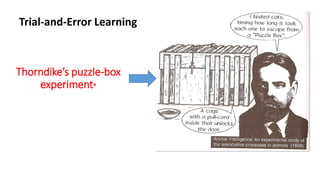
Thorndike’s puzzle-box
experiment*
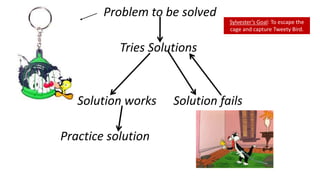
Problem to be solved
Tries Solutions
Solution works Solution fails
Practice solution
Sylvester’s Goal: To escape the
cage and capture Tweety Bird.
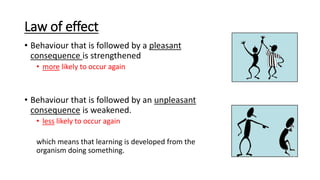
Law of effect
• Behaviour that is followed by a pleasant
consequence is strengthened
• more likely to occur again
• Behaviour that is followed by an unpleasant
consequence is weakened.
• less likely to occur again
which means that learning is developed from the
organism doing something.
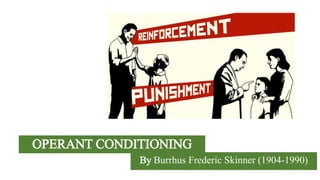
OPERANT CONDITIONING
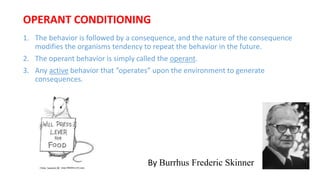
By Burrhus Frederic Skinner (1904-1990)
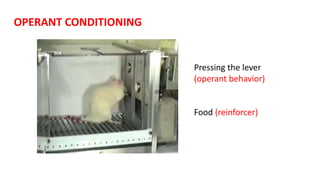
OPERANT CONDITIONING
Pressing the lever
(operant behavior)
Food (reinforcer)
1. The behavior is followed by a consequence, and the nature of the consequence
modifies the organisms tendency to repeat the behavior in the future.
2. The operant behavior is simply called the operant.
3. Any active behavior that “operates” upon the environment to generate
consequences.
OPERANT CONDITIONING
By Burrhus Frederic Skinner
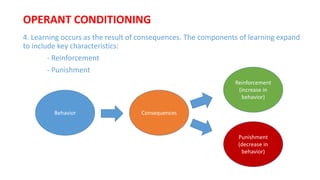
4. Learning occurs as the result of consequences. The components of learning expand
to include key characteristics:
- Reinforcement
- Punishment
OPERANT CONDITIONING
Behavior Consequences
Reinforcement
(increase in
behavior)
Punishment
(decrease in
behavior)
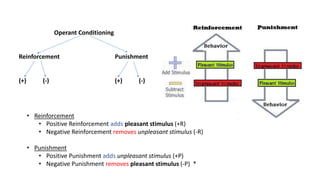
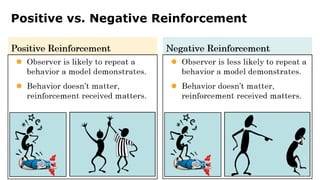
• Reinforcement
• Positive Reinforcement adds pleasant stimulus (+R)
• Negative Reinforcement removes unpleasant stimulus (-R)
• Punishment
• Positive Punishment adds unpleasant stimulus (+P)
• Negative Punishment removes pleasant stimulus (-P) *
Operant Conditioning
Reinforcement Punishment
(+) (-) (+) (-)
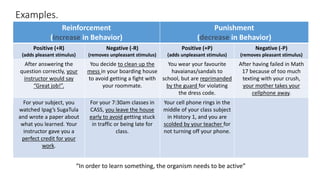
Examples.
Reinforcement
(increase in Behavior)
Punishment
(decrease in Behavior)
Positive (+R)
(adds pleasant stimulus)
Negative (-R)
(removes unpleasant stimulus)
Positive (+P)
(adds unpleasant stimulus)
Negative (-P)
(removes pleasant stimulus)
After answering the
question correctly, your
instructor would say
“Great job!”.
You decide to clean up the
mess in your boarding house
to avoid getting a fight with
your roommate.
You wear your favourite
havaianas/sandals to
school, but are reprimanded
by the guard for violating
the dress code.
After having failed in Math
17 because of too much
texting with your crush,
your mother takes your
cellphone away.
For your subject, you
watched Ipag’s SugaTula
and wrote a paper about
what you learned. Your
instructor gave you a
perfect credit for your
work.
For your 7:30am classes in
CASS, you leave the house
early to avoid getting stuck
in traffic or being late for
class.
Your cell phone rings in the
middle of your class subject
in History 1, and you are
scolded by your teacher for
not turning off your phone.
“In order to learn something, the organism needs to be active”
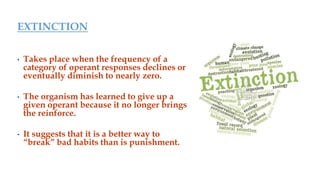
EXTINCTION
• Takes place when the frequency of a
category of operant responses declines or
eventually diminish to nearly zero.
• The organism has learned to give up a
given operant because it no longer brings
the reinforce.
• It suggests that it is a better way to
“break” bad habits than is punishment.
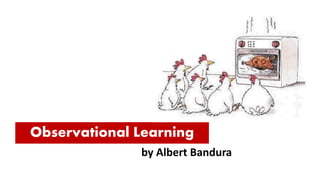
Observational Learning
by Albert Bandura
Observational Learning
• Learning new behaviour without first hand learning, but by
observation.
• Learning takes place when an individual acquires behavior by
watching the behavior of a second individual.
By Albert Bandura
Observational Learning
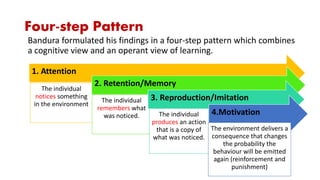
Four-step Pattern
Bandura formulated his findings in a four-step pattern which combines
a cognitive view and an operant view of learning.
1. Attention
The individual
notices something
in the environment
2. Retention/Memory
The individual
remembers what
was noticed.
3. Reproduction/Imitation
The individual
produces an action
that is a copy of
what was noticed.
4.Motivation
The environment delivers a
consequence that changes
the probability the
behaviour will be emitted
again (reinforcement and
punishment)
References:
• http://www.trialerror.org/
• https://pheonad.wordpress.com/

Psychological Learning

  • 1.
    by Edward L.Thorndike (1874-1949)
  • 2.
    Trial-and-Error Learning A kindof learning in which one response after another is tried (e.g. trials) and rejected as ineffective (e.g. errors), until eventually a successful response is made. An organism slowly eliminates responses that do not achieve the desired outcome, and continues to respond in different ways until they determine the response that leads to the desired reward. By Edward L. Thorndike
  • 3.
  • 4.
    Problem to besolved Tries Solutions Solution works Solution fails Practice solution Sylvester’s Goal: To escape the cage and capture Tweety Bird.
  • 5.
    Law of effect •Behaviour that is followed by a pleasant consequence is strengthened • more likely to occur again • Behaviour that is followed by an unpleasant consequence is weakened. • less likely to occur again which means that learning is developed from the organism doing something.
  • 6.
    OPERANT CONDITIONING By BurrhusFrederic Skinner (1904-1990)
  • 7.
    OPERANT CONDITIONING Pressing thelever (operant behavior) Food (reinforcer)
  • 8.
    1. The behavioris followed by a consequence, and the nature of the consequence modifies the organisms tendency to repeat the behavior in the future. 2. The operant behavior is simply called the operant. 3. Any active behavior that “operates” upon the environment to generate consequences. OPERANT CONDITIONING By Burrhus Frederic Skinner
  • 9.
    4. Learning occursas the result of consequences. The components of learning expand to include key characteristics: - Reinforcement - Punishment OPERANT CONDITIONING Behavior Consequences Reinforcement (increase in behavior) Punishment (decrease in behavior)
  • 10.
    • Reinforcement • PositiveReinforcement adds pleasant stimulus (+R) • Negative Reinforcement removes unpleasant stimulus (-R) • Punishment • Positive Punishment adds unpleasant stimulus (+P) • Negative Punishment removes pleasant stimulus (-P) * Operant Conditioning Reinforcement Punishment (+) (-) (+) (-)
  • 11.
    Examples. Reinforcement (increase in Behavior) Punishment (decreasein Behavior) Positive (+R) (adds pleasant stimulus) Negative (-R) (removes unpleasant stimulus) Positive (+P) (adds unpleasant stimulus) Negative (-P) (removes pleasant stimulus) After answering the question correctly, your instructor would say “Great job!”. You decide to clean up the mess in your boarding house to avoid getting a fight with your roommate. You wear your favourite havaianas/sandals to school, but are reprimanded by the guard for violating the dress code. After having failed in Math 17 because of too much texting with your crush, your mother takes your cellphone away. For your subject, you watched Ipag’s SugaTula and wrote a paper about what you learned. Your instructor gave you a perfect credit for your work. For your 7:30am classes in CASS, you leave the house early to avoid getting stuck in traffic or being late for class. Your cell phone rings in the middle of your class subject in History 1, and you are scolded by your teacher for not turning off your phone. “In order to learn something, the organism needs to be active”
  • 12.
    EXTINCTION • Takes placewhen the frequency of a category of operant responses declines or eventually diminish to nearly zero. • The organism has learned to give up a given operant because it no longer brings the reinforce. • It suggests that it is a better way to “break” bad habits than is punishment.
  • 13.
  • 14.
    Observational Learning • Learningnew behaviour without first hand learning, but by observation. • Learning takes place when an individual acquires behavior by watching the behavior of a second individual. By Albert Bandura
  • 15.
  • 16.
    Four-step Pattern Bandura formulatedhis findings in a four-step pattern which combines a cognitive view and an operant view of learning. 1. Attention The individual notices something in the environment 2. Retention/Memory The individual remembers what was noticed. 3. Reproduction/Imitation The individual produces an action that is a copy of what was noticed. 4.Motivation The environment delivers a consequence that changes the probability the behaviour will be emitted again (reinforcement and punishment)
  • 18.

Editor's Notes

  • #6 Previously Sylvester experienced failures and success in trying to solve the problem. Unpleasant – (cage) Pleasant (released!)
  • #10 Behavior is acquired and shaped by experience Effects shape the behaviour– frequency (inc,dec)
  • #11 The positive and negative here refers to the adding and removing of stimulus (whether pleasant or unpleasant.
  • #13 Punishment is simply temporary and tends to make the organism more aggressive.