ASSESSING THE CURRICULUMLinking Curriculum, Instruction and Assessment(CIA): Making a FitReporter: ROHEMA MAGUAD
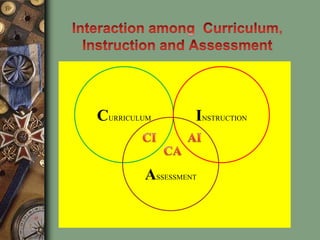
Interaction among Curriculum, Instruction and AssessmentCURRICULUMINSTRUCTIONASSESSMENTCIAICA
CURRICULUM AND INSTRUCTIONAccording to Howell and Evans (1995)SandsCurriculum is..  Structured set of learning outcomes or task that  educators usually call goals and objectives.
  The “what” of teaching.
  Knowledge for successful assessment, evaluation, decision making and teaching.Criteria for curriculum content selectionSignificance: It is obvious that content selected should be significant. But, the definition of significance varies with an individual’s beliefs. For example, curriculum developers who favour subject matter designs think of significance in terms of the concepts and principles of each subject area. Those who favour learner-centred designs think of significance in terms of the needs and interests of the learner. While those who favour a problem-centred design would regard the problems and issues in society as significant. Utility: refers to the usefulness of content. This again depends on your philosophical beliefs. If you subscribe to the subject-centred design, then you believe that the content learned from the various subject areas will be useful in the workplace. If you subscribe to the learner-centred design, then you will take into consideration the needs and interests of learners which will enable them to realise their potential to function effectively in the workplace. Validity: refers to whether the information passed on to students is authentic and obtained from credible sources. This is especially significant today with the deluge of information that is easily accessible which may not necessarily be credible or reliable. How much of the billions of pages on the internet are credible? Content needs to be checked to determine its accuracy and constantly updated.Learnability: It may seem strange that anyone would select content that is not learnable. Unfortunately, it does happen. Can you give examples of this happening? For example, the content selected for a particular age group might be too difficult and teachers need more time but insufficient time is allotted. Eventually, teachers will end up rushing through the material and some students left behind not understanding the content. Feasibility: Educators who select content have to take into consideration the constraints of time, expertise of staff, funding and other educational resources that schools might face when implementing the curriculum. For example, the number of days allotted for teaching may be insufficient to cover all the content because schools have to allocate time for extra-curricular activities and other schools events.
CURRICULUM AND ASSESSMENTAssessment is the process of collecting information which describes students achievement in relation to curriculum expectations.
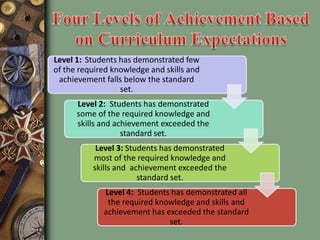
Four Levels of Achievement Based on Curriculum Expectations
INSTRUCTION AND ASSESSMENTInstruction refers to the various ways of teaching, teaching styles, approaches, techniques, and steps in delivering the curriculum. It is a complex activity that requires teachers to use a variety of action to accomplish a variety of functions.
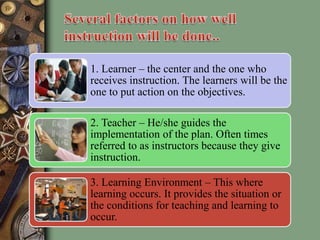
Several factors on how well instruction will be done..
THANK YOU!
Curriculum assessment Instruction

Curriculum assessment Instruction

  • 1.
    ASSESSING THE CURRICULUMLinkingCurriculum, Instruction and Assessment(CIA): Making a FitReporter: ROHEMA MAGUAD
  • 2.
    Interaction among Curriculum,Instruction and AssessmentCURRICULUMINSTRUCTIONASSESSMENTCIAICA
  • 3.
    CURRICULUM AND INSTRUCTIONAccordingto Howell and Evans (1995)SandsCurriculum is.. Structured set of learning outcomes or task that educators usually call goals and objectives.
  • 4.
    The“what” of teaching.
  • 5.
    Knowledgefor successful assessment, evaluation, decision making and teaching.Criteria for curriculum content selectionSignificance: It is obvious that content selected should be significant. But, the definition of significance varies with an individual’s beliefs. For example, curriculum developers who favour subject matter designs think of significance in terms of the concepts and principles of each subject area. Those who favour learner-centred designs think of significance in terms of the needs and interests of the learner. While those who favour a problem-centred design would regard the problems and issues in society as significant. Utility: refers to the usefulness of content. This again depends on your philosophical beliefs. If you subscribe to the subject-centred design, then you believe that the content learned from the various subject areas will be useful in the workplace. If you subscribe to the learner-centred design, then you will take into consideration the needs and interests of learners which will enable them to realise their potential to function effectively in the workplace. Validity: refers to whether the information passed on to students is authentic and obtained from credible sources. This is especially significant today with the deluge of information that is easily accessible which may not necessarily be credible or reliable. How much of the billions of pages on the internet are credible? Content needs to be checked to determine its accuracy and constantly updated.Learnability: It may seem strange that anyone would select content that is not learnable. Unfortunately, it does happen. Can you give examples of this happening? For example, the content selected for a particular age group might be too difficult and teachers need more time but insufficient time is allotted. Eventually, teachers will end up rushing through the material and some students left behind not understanding the content. Feasibility: Educators who select content have to take into consideration the constraints of time, expertise of staff, funding and other educational resources that schools might face when implementing the curriculum. For example, the number of days allotted for teaching may be insufficient to cover all the content because schools have to allocate time for extra-curricular activities and other schools events.
  • 6.
    CURRICULUM AND ASSESSMENTAssessmentis the process of collecting information which describes students achievement in relation to curriculum expectations.
  • 7.
    Four Levels ofAchievement Based on Curriculum Expectations
  • 8.
    INSTRUCTION AND ASSESSMENTInstructionrefers to the various ways of teaching, teaching styles, approaches, techniques, and steps in delivering the curriculum. It is a complex activity that requires teachers to use a variety of action to accomplish a variety of functions.
  • 9.
    Several factors onhow well instruction will be done..
  • 11.

Editor's Notes

  • #5 SignificanceValidityInterestLearnabilityFeasibility