Constructivism and
Learner-centered Teaching
Learning Outcomes:
a. Explain the concept of constructivism;
b. Analyze the relationship of constructivism and learner-centered teaching;
c. Compare constructivism with cognitivism and other theories; and
d. Analyze the application of constructivism in teaching.
What is constructivism?
• It is a learning theory that says learners construct knowledge instead of just
receiving information passively.
• This happens when people make meaning or make sense from experience.
• This theory promotes the context of real-life situations which usually
develop the creation of innovations.
Four guiding principles of constructivists:
1. Learning is a search for meaning. A learner must start with an issue in which the
learners are actively trying to construct meaning.
2. Meaning requires understanding of the wholes and parts, studying both the big picture and
analyzing the details, focusing on primary concepts and noy isolated facts;
3. Teachers must understand the mental models learners use to perceive the environment and
what assumptions they make to support those mental models.
4. Learning is when a learner individually constructs his/her own meaning from an
experience. This means not simply taking in information and retrieving it during a test.
Constructivism Learning Model
Constructivism
• In constructivism, the learner actively constructs his/her knowledge making connections
between existing schema (or knowledge) and his/her personal experiences.
• There is meaning attached to the objects or events going on in the environment.
• Constructivists believe that there is this process of personal interpretation going on in
each learner’s mind when they see things or events in the environment, including attending
lectures, reading books, watching a model, or watching media.
• The brain has its own strengths and limitations depending on the resources the brain has to
interpret things in the environment.
The Nature of Learning
1. Learning is incremental because active and deliberate learning requires focus in our
working memories, and this has a very limited capacity.
‒ Therefore, we can process only a limited amount of material at a certain time. We learn
things in chunks of information.
‒ A beginner may learn new things at a slower pace or learn only a small amount of
information given at the same time.
‒ Learning occurs through a series of additions of small-sized information.
The Nature of Learning
2. Learning is interpretive. Therefore, meanings are not directly communicated in words,
gestures, symbol drawings, or other representations.
― Language is a very convenient of communication, especially if someone speaks the
same language as we do.
― Meaning-making always takes place in the mind of a person being communicated to.
― The leaners must make sense of words, phrases, intonation, body language, hand-
pointing, diagrams, hand-waving, words are written on the board, drawings, pictures,
films, or models used by the teacher, let alone try to decipher numerals or letters written
on the board with very bad penmanship.
The Nature of Learning
3. Learning is iterative. This means that there is iteration or repetition.
― As we go through life, we constantly build up our interpretive resources so we can make
sense of the world.
― If you are an expert in one are, you can learn information very effectively. However, if
you have a misconception and this is not corrected from the very start, you may have
difficult time trying to change the direction of your thoughts.
― Learners adapt their models of understanding by reflecting on their prior knowledge or
by resolving their misconceptions.
How to Change Misconceptions
❑FOUR DIMENSIONS TO CHANGING MISCONCEPTIONS:
1. Acceptance. We may know some things exist without believing in them, like folk tales or
superstitions. We know that they are out there but we do not believe them.
2. Connectedness. You would believe something new if it is connected or if it fits into your
existing concepts. It is very difficult to change what you think if you know things only in
isolation.
3. Multiplicity. A person learns things by integrating them with different interpretive
resources. Many different resources might be brought into mind to understand a certain
topic. Sometimes, people have multiple ways of thinking about things.
How to Change Misconceptions
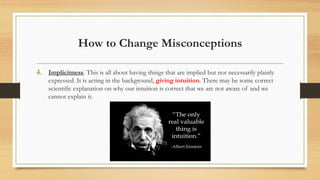
4. Implicitness. This is all about having things that are implied but not necessarily plainly
expressed. It is acting in the background, giving intuition. There may be some correct
scientific explanation on why our intuition is correct that we are not aware of and we
cannot explain it.
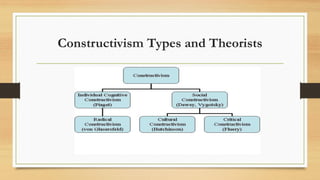
Constructivism Types and Theorists
❑a) Cognitive Constructivism – states that knowledge is actively constructed by learners
based on their cognitive capacities, relative to their stage of cognitive development.
➢ Learning is an active process of assimilation and accommodation.
➢ Learning is an active, contextual, personal process of constructing knowledge rather than a
passive acquisition of knowledge.
➢ Each person has a different interpretation or knowledge construction based on past experiences.
Constructivism Types and Theorists
• John Dewey (1922/1998) – is known as the philosophical founder of cognitive
constructivism. He did not believe in repetitive, rote memorization of facts.
• He things learning should be “directed living” where learners engage in real-world, practical
experience where they can demonstrate what they know through creativity and
collaboration.
• Learners should be given an opportunity to think for themselves and express their thoughts,
and learn by doing.
• He believe that learning should be student-directed, with teachers serving as guides for
resources.
Constructivism Types and Theorists
• Jean Piaget (1972) – He is known for his Theory of Cognitive Development and
Developmentally Appropriate Practice.
• Another implication of his theory of cognitive development is the Constructivist Teaching.
• In constructivist teaching, teachers minimize but not completely eliminate the role of the
adult. Teachers provide experiences, ask questions, provoke discussions, facilitate
experimentation, encourage reflection, and minimize lecturing of facts.
• Many teaching methods are based on constructivism, like project-based learning, problem-
based learning, inquiry-based learning, experiential learning, discovery learning,
transformational approach, teaching for understanding, and so on.
Constructivism Types and Theorists
• Jerome Bruner (1990) – is the theorist behind Discovery Learning. This is where a student is
given opportunities for problem-solving, and where they are required to draw from past
experiences and current knowledge to discover facts, relationships, and new knowledge.
• Teaching methods associated with this theory include PBL, cased-based learning, guided
discovery, simulation-based learning, and incidental learning.
― Curriculum planning should be carefully designed so that one area builds upon the other, where
learning is a process of discovery, allowing the learners to construct knowledge while building their
existing knowledge upon the other.
― Instruction should therefore be: (1) concerned with experiences that would make the students
motivated and ready to learn; (2) structured in a spiral organization; and (3) designed so students can
easily extrapolate to go beyond the basic information given.
Constructivism Types and Theorists
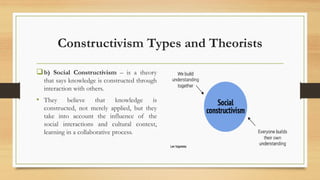
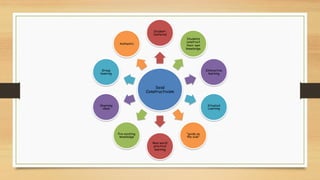
❑b) Social Constructivism – is a theory
that says knowledge is constructed through
interaction with others.
• They believe that knowledge is
constructed, not merely applied, but they
take into account the influence of the
social interactions and cultural context,
learning in a collaborative process.
Constructivism Types and Theorists
• Lev Vygotsky (1978) – He is responsible for the sociocultural theory. The key contribution
of his theory is the emphasis on the role of social interactions in cognitive development.
His other contributions are the concept of Zone of Proximal Development and private
speech.
• He believes that social interaction with other contributes to constructivism. He says culture
determines what students learn, how they learn it, and what materials are available to learn it.
• Vygotsky (1987) proposed that private speech in children correlates with rates of social
interaction. He said that when children are raised in mentally stimulating and language
stimulating environments, the earlier these children engage in private speech. Considering
the children from higher socioeconomic status (SES).
Constructivism Types and Theorists
• Lev Vygotsky (1978) – He is responsible for the sociocultural theory. The key contribution
of his theory is the emphasis on the role of social interactions in cognitive development.
His other contributions are the concept of Zone of Proximal Development and private
speech.
• He believes that social interaction with other contributes to constructivism. He says culture
determines what students learn, how they learn it, and what materials are available to learn it.
• Vygotsky (1987) proposed that private speech in children correlates with rates of social
interaction. He said that when children are raised in mentally stimulating and language
stimulating environments, the earlier these children engage in private speech. Considering
the children from higher socioeconomic status (SES).
“Private speech”
Constructivism Types and Theorists
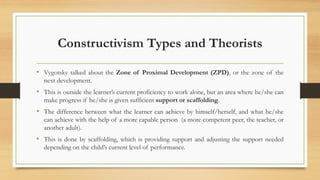
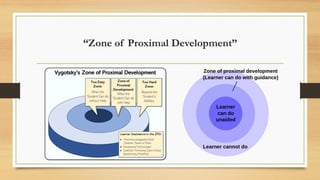
• Vygotsky talked about the Zone of Proximal Development (ZPD), or the zone of the
next development.
• This is outside the learner’s current proficiency to work alone, but an area where he/she can
make progress if he/she is given sufficient support or scaffolding.
• The difference between what the learner can achieve by himself/herself, and what he/she
can achieve with the help of a more capable person (a more competent peer, the teacher, or
another adult).
• This is done by scaffolding, which is providing support and adjusting the support needed
depending on the child’s current level of performance.
“Zone of Proximal Development”
Constructivism Types and Theorists
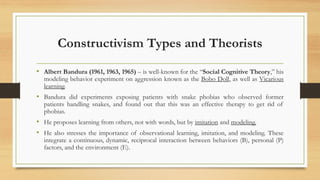
• Albert Bandura (1961, 1963, 1965) – is well-known for the “Social Cognitive Theory,” his
modeling behavior experiment on aggression known as the Bobo Doll, as well as Vicarious
learning.
• Bandura did experiments exposing patients with snake phobias who observed former
patients handling snakes, and found out that this was an effective therapy to get rid of
phobias.
• He proposes learning from others, not with words, but by imitation and modeling.
• He also stresses the importance of observational learning, imitation, and modeling. These
integrate a continuous, dynamic, reciprocal interaction between behaviors (B), personal (P)
factors, and the environment (E).
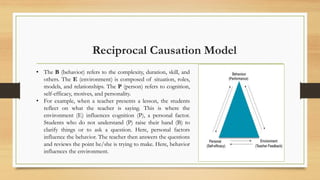
Reciprocal Causation Model
• The B (behavior) refers to the complexity, duration, skill, and
others. The E (environment) is composed of situation, roles,
models, and relationships. The P (person) refers to cognition,
self-efficacy, motives, and personality.
• For example, when a teacher presents a lesson, the students
reflect on what the teacher is saying. This is where the
environment (E) influences cognition (P), a personal factor.
Students who do not understand (P) raise their hand (B) to
clarify things or to ask a question. Here, personal factors
influence the behavior. The teacher then answers the questions
and reviews the point he/she is trying to make. Here, behavior
influences the environment.
The Bobo Doll Modeling Experiment
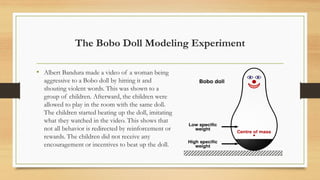
• Albert Bandura made a video of a woman being
aggressive to a Bobo doll by hitting it and
shouting violent words. This was shown to a
group of children. Afterward, the children were
allowed to play in the room with the same doll.
The children started beating up the doll, imitating
what they watched in the video. This shows that
not all behavior is redirected by reinforcement or
rewards. The children did not receive any
encouragement or incentives to beat up the doll.
The Bobo Doll Modeling Experiment
• This is modeling or learning by observing. The primary function of the model (like the
woman in the video) is to transmit information to the observer. The model behavior can:
1) serve as cues or prompts to initiate similar behaviors in others,
2) strengthen or weaken the learner’s existing restraints against the performance of the modeled
behavior, and
3) be used to demonstrate new patterns of behavior.
The Bobo Doll Modeling Experiment
• Outcomes of the model behavior, whether reinforced or punished, arouse emotional
reactions in the observer. This is referred to as vicarious experience.
• Two components of vicarious reinforcement are:
(1) the behavior of the model produces reinforcement
(2) the positive emotional reactions are aroused in the observer
For example, when employees see how others performing something it's easier to learn this rather than just
doing it on your own. You can watch first what to do, and then copy steps or movements to achieve the same
result and learn through both experiences: vicarious (observational part) and real practical experience
• Punishment administered to a model works in the opposite direction. A lack of punishment,
however, makes the observer think that the inappropriate behavior is acceptable, like when a
teacher is careless in monitoring of cheating in exams. Similarly, when violence is ignored, other
people would think that this behavior is acceptable or is expected. Promoting more violence to
occur in society.
• Parents should monitor what children are watching on television and other media.
• Teachers can model behavior for students to learn how to do things. They should also be aware
of their own behavior and attitudes.
• In learning from models, direct reinforcement is the positive reinforcement produced by the
observer’s imitation of the model.
• Self-reinforcement – happens in situations where a person has established standards for their own
behavior, and they evaluate their behavior in relation to those standards.
• Self-efficacy – is the belief of a person in his/her own ability to produce desired results by
himself/herself.
❖Mastery, modeling, and persuasion or encouragement can help increase the self-efficacy of the
observer.
❖Implications:
▪ Parents and teachers can enrich a child’s environment with models that they would like their
child to emulate.
▪ Adults should focus on what they wish the child would gain, and avoid what they do not want
the child to know.
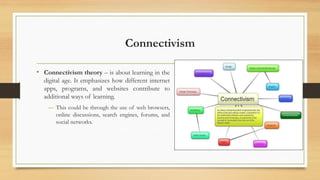
Connectivism
• Connectivism theory – is about learning in the
digital age. It emphasizes how different internet
apps, programs, and websites contribute to
additional ways of learning.
― This could be through the use of web browsers,
online discussions, search engines, forums, and
social networks.
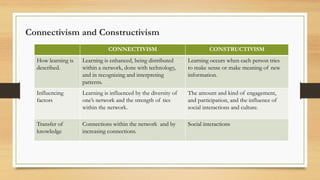
CONNECTIVISM CONSTRUCTIVISM
How learning is
described.
Learning is enhanced, being distributed
within a network, done with technology,
and in recognizing and interpreting
patterns.
Learning occurs when each person tries
to make sense or make meaning of new
information.
Influencing
factors
Learning is influenced by the diversity of
one’s network and the strength of ties
within the network.
The amount and kind of engagement,
and participation, and the influence of
social interactions and culture.
Transfer of
knowledge
Connections within the network and by
increasing connections.
Social interactions
Connectivism and Constructivism
Learner-centered Teaching/Constructivism and Its
Implications for Teaching
• For classroom management, the learning environment should be goal-oriented. This makes
students work together and stay focused to achieve their goal.
• It is commonly misunderstood that teachers should never tell students anything directly and
allow them to construct knowledge by themselves.
• Strategies used in constructivist teaching or what is commonly called learner-centered
teaching do facilitate knowledge construction.
• Students are naturally curious and giving them the opportunity to explore and do
experiments and be placed in real-life situations for problem solving.
Advantages of Constructivist learning
1. Children learn more, and enjoy learning more when they are actively involved, rather than
passive listeners.
2. Education works best when it concentrates on thinking and understanding, rather than on
rote memorization. Constructivism concentrates on learning how to think and
understand.
3. Constructivist learning is transferable. In constructivist classrooms, students create
organizing principles that they can take with them to other learning settings.
4. Constructivism gives students ownership of what they learn, since learning is based on
students' questions and explorations, and often the students have a hand in designing the
assessments as well.
Advantages of Constructivist learning
5. By grounding learning activities in an authentic, real-world context, constructivism
stimulates and engages students. Students in constructivist classrooms learn to question
things and to apply their natural curiousity to the world.
6. Constructivism promotes social and communication skills by creating a classroom
environment that emphasizes collaboration and exchange of ideas. Students must learn
how to articulate their ideas clearly as well as to collaborate on tasks effectively by sharing
in group projects.
Disadvantages of Constructivist learning
• The biggest criticism of constructivist learning is its lack of structure. Some students need
highly structured and organized learning environments to thrive, and constructivist learning
focuses on a more laid-back method to help students engage in their own learning.
• Grading is often removed from constructivist classrooms and places more value on student
progress, which can lead to students falling behind and not meeting standardized grading
requirements.
• If you are hoping to become a teacher, a degree is crucial to getting on the right path.
Additionally, it’s valuable for teachers to understand different learning theories and how they
impact their classroom and their students.

Constructivism and Learner-centered Teaching.pdf

  • 1.
  • 2.
    Learning Outcomes: a. Explainthe concept of constructivism; b. Analyze the relationship of constructivism and learner-centered teaching; c. Compare constructivism with cognitivism and other theories; and d. Analyze the application of constructivism in teaching.
  • 3.
    What is constructivism? •It is a learning theory that says learners construct knowledge instead of just receiving information passively. • This happens when people make meaning or make sense from experience. • This theory promotes the context of real-life situations which usually develop the creation of innovations.
  • 4.
    Four guiding principlesof constructivists: 1. Learning is a search for meaning. A learner must start with an issue in which the learners are actively trying to construct meaning. 2. Meaning requires understanding of the wholes and parts, studying both the big picture and analyzing the details, focusing on primary concepts and noy isolated facts; 3. Teachers must understand the mental models learners use to perceive the environment and what assumptions they make to support those mental models. 4. Learning is when a learner individually constructs his/her own meaning from an experience. This means not simply taking in information and retrieving it during a test.
  • 5.
  • 6.
    Constructivism • In constructivism,the learner actively constructs his/her knowledge making connections between existing schema (or knowledge) and his/her personal experiences. • There is meaning attached to the objects or events going on in the environment. • Constructivists believe that there is this process of personal interpretation going on in each learner’s mind when they see things or events in the environment, including attending lectures, reading books, watching a model, or watching media. • The brain has its own strengths and limitations depending on the resources the brain has to interpret things in the environment.
  • 8.
    The Nature ofLearning 1. Learning is incremental because active and deliberate learning requires focus in our working memories, and this has a very limited capacity. ‒ Therefore, we can process only a limited amount of material at a certain time. We learn things in chunks of information. ‒ A beginner may learn new things at a slower pace or learn only a small amount of information given at the same time. ‒ Learning occurs through a series of additions of small-sized information.
  • 9.
    The Nature ofLearning 2. Learning is interpretive. Therefore, meanings are not directly communicated in words, gestures, symbol drawings, or other representations. ― Language is a very convenient of communication, especially if someone speaks the same language as we do. ― Meaning-making always takes place in the mind of a person being communicated to. ― The leaners must make sense of words, phrases, intonation, body language, hand- pointing, diagrams, hand-waving, words are written on the board, drawings, pictures, films, or models used by the teacher, let alone try to decipher numerals or letters written on the board with very bad penmanship.
  • 10.
    The Nature ofLearning 3. Learning is iterative. This means that there is iteration or repetition. ― As we go through life, we constantly build up our interpretive resources so we can make sense of the world. ― If you are an expert in one are, you can learn information very effectively. However, if you have a misconception and this is not corrected from the very start, you may have difficult time trying to change the direction of your thoughts. ― Learners adapt their models of understanding by reflecting on their prior knowledge or by resolving their misconceptions.
  • 11.
    How to ChangeMisconceptions ❑FOUR DIMENSIONS TO CHANGING MISCONCEPTIONS: 1. Acceptance. We may know some things exist without believing in them, like folk tales or superstitions. We know that they are out there but we do not believe them. 2. Connectedness. You would believe something new if it is connected or if it fits into your existing concepts. It is very difficult to change what you think if you know things only in isolation. 3. Multiplicity. A person learns things by integrating them with different interpretive resources. Many different resources might be brought into mind to understand a certain topic. Sometimes, people have multiple ways of thinking about things.
  • 12.
    How to ChangeMisconceptions 4. Implicitness. This is all about having things that are implied but not necessarily plainly expressed. It is acting in the background, giving intuition. There may be some correct scientific explanation on why our intuition is correct that we are not aware of and we cannot explain it.
  • 13.
  • 14.
    Constructivism Types andTheorists ❑a) Cognitive Constructivism – states that knowledge is actively constructed by learners based on their cognitive capacities, relative to their stage of cognitive development. ➢ Learning is an active process of assimilation and accommodation. ➢ Learning is an active, contextual, personal process of constructing knowledge rather than a passive acquisition of knowledge. ➢ Each person has a different interpretation or knowledge construction based on past experiences.
  • 15.
    Constructivism Types andTheorists • John Dewey (1922/1998) – is known as the philosophical founder of cognitive constructivism. He did not believe in repetitive, rote memorization of facts. • He things learning should be “directed living” where learners engage in real-world, practical experience where they can demonstrate what they know through creativity and collaboration. • Learners should be given an opportunity to think for themselves and express their thoughts, and learn by doing. • He believe that learning should be student-directed, with teachers serving as guides for resources.
  • 16.
    Constructivism Types andTheorists • Jean Piaget (1972) – He is known for his Theory of Cognitive Development and Developmentally Appropriate Practice. • Another implication of his theory of cognitive development is the Constructivist Teaching. • In constructivist teaching, teachers minimize but not completely eliminate the role of the adult. Teachers provide experiences, ask questions, provoke discussions, facilitate experimentation, encourage reflection, and minimize lecturing of facts. • Many teaching methods are based on constructivism, like project-based learning, problem- based learning, inquiry-based learning, experiential learning, discovery learning, transformational approach, teaching for understanding, and so on.
  • 17.
    Constructivism Types andTheorists • Jerome Bruner (1990) – is the theorist behind Discovery Learning. This is where a student is given opportunities for problem-solving, and where they are required to draw from past experiences and current knowledge to discover facts, relationships, and new knowledge. • Teaching methods associated with this theory include PBL, cased-based learning, guided discovery, simulation-based learning, and incidental learning. ― Curriculum planning should be carefully designed so that one area builds upon the other, where learning is a process of discovery, allowing the learners to construct knowledge while building their existing knowledge upon the other. ― Instruction should therefore be: (1) concerned with experiences that would make the students motivated and ready to learn; (2) structured in a spiral organization; and (3) designed so students can easily extrapolate to go beyond the basic information given.
  • 18.
    Constructivism Types andTheorists ❑b) Social Constructivism – is a theory that says knowledge is constructed through interaction with others. • They believe that knowledge is constructed, not merely applied, but they take into account the influence of the social interactions and cultural context, learning in a collaborative process.
  • 20.
    Constructivism Types andTheorists • Lev Vygotsky (1978) – He is responsible for the sociocultural theory. The key contribution of his theory is the emphasis on the role of social interactions in cognitive development. His other contributions are the concept of Zone of Proximal Development and private speech. • He believes that social interaction with other contributes to constructivism. He says culture determines what students learn, how they learn it, and what materials are available to learn it. • Vygotsky (1987) proposed that private speech in children correlates with rates of social interaction. He said that when children are raised in mentally stimulating and language stimulating environments, the earlier these children engage in private speech. Considering the children from higher socioeconomic status (SES).
  • 21.
    Constructivism Types andTheorists • Lev Vygotsky (1978) – He is responsible for the sociocultural theory. The key contribution of his theory is the emphasis on the role of social interactions in cognitive development. His other contributions are the concept of Zone of Proximal Development and private speech. • He believes that social interaction with other contributes to constructivism. He says culture determines what students learn, how they learn it, and what materials are available to learn it. • Vygotsky (1987) proposed that private speech in children correlates with rates of social interaction. He said that when children are raised in mentally stimulating and language stimulating environments, the earlier these children engage in private speech. Considering the children from higher socioeconomic status (SES).
  • 22.
  • 23.
    Constructivism Types andTheorists • Vygotsky talked about the Zone of Proximal Development (ZPD), or the zone of the next development. • This is outside the learner’s current proficiency to work alone, but an area where he/she can make progress if he/she is given sufficient support or scaffolding. • The difference between what the learner can achieve by himself/herself, and what he/she can achieve with the help of a more capable person (a more competent peer, the teacher, or another adult). • This is done by scaffolding, which is providing support and adjusting the support needed depending on the child’s current level of performance.
  • 24.
    “Zone of ProximalDevelopment”
  • 25.
    Constructivism Types andTheorists • Albert Bandura (1961, 1963, 1965) – is well-known for the “Social Cognitive Theory,” his modeling behavior experiment on aggression known as the Bobo Doll, as well as Vicarious learning. • Bandura did experiments exposing patients with snake phobias who observed former patients handling snakes, and found out that this was an effective therapy to get rid of phobias. • He proposes learning from others, not with words, but by imitation and modeling. • He also stresses the importance of observational learning, imitation, and modeling. These integrate a continuous, dynamic, reciprocal interaction between behaviors (B), personal (P) factors, and the environment (E).
  • 26.
    Reciprocal Causation Model •The B (behavior) refers to the complexity, duration, skill, and others. The E (environment) is composed of situation, roles, models, and relationships. The P (person) refers to cognition, self-efficacy, motives, and personality. • For example, when a teacher presents a lesson, the students reflect on what the teacher is saying. This is where the environment (E) influences cognition (P), a personal factor. Students who do not understand (P) raise their hand (B) to clarify things or to ask a question. Here, personal factors influence the behavior. The teacher then answers the questions and reviews the point he/she is trying to make. Here, behavior influences the environment.
  • 27.
    The Bobo DollModeling Experiment • Albert Bandura made a video of a woman being aggressive to a Bobo doll by hitting it and shouting violent words. This was shown to a group of children. Afterward, the children were allowed to play in the room with the same doll. The children started beating up the doll, imitating what they watched in the video. This shows that not all behavior is redirected by reinforcement or rewards. The children did not receive any encouragement or incentives to beat up the doll.
  • 28.
    The Bobo DollModeling Experiment • This is modeling or learning by observing. The primary function of the model (like the woman in the video) is to transmit information to the observer. The model behavior can: 1) serve as cues or prompts to initiate similar behaviors in others, 2) strengthen or weaken the learner’s existing restraints against the performance of the modeled behavior, and 3) be used to demonstrate new patterns of behavior.
  • 29.
    The Bobo DollModeling Experiment • Outcomes of the model behavior, whether reinforced or punished, arouse emotional reactions in the observer. This is referred to as vicarious experience. • Two components of vicarious reinforcement are: (1) the behavior of the model produces reinforcement (2) the positive emotional reactions are aroused in the observer For example, when employees see how others performing something it's easier to learn this rather than just doing it on your own. You can watch first what to do, and then copy steps or movements to achieve the same result and learn through both experiences: vicarious (observational part) and real practical experience
  • 30.
    • Punishment administeredto a model works in the opposite direction. A lack of punishment, however, makes the observer think that the inappropriate behavior is acceptable, like when a teacher is careless in monitoring of cheating in exams. Similarly, when violence is ignored, other people would think that this behavior is acceptable or is expected. Promoting more violence to occur in society. • Parents should monitor what children are watching on television and other media. • Teachers can model behavior for students to learn how to do things. They should also be aware of their own behavior and attitudes.
  • 31.
    • In learningfrom models, direct reinforcement is the positive reinforcement produced by the observer’s imitation of the model. • Self-reinforcement – happens in situations where a person has established standards for their own behavior, and they evaluate their behavior in relation to those standards. • Self-efficacy – is the belief of a person in his/her own ability to produce desired results by himself/herself. ❖Mastery, modeling, and persuasion or encouragement can help increase the self-efficacy of the observer. ❖Implications: ▪ Parents and teachers can enrich a child’s environment with models that they would like their child to emulate. ▪ Adults should focus on what they wish the child would gain, and avoid what they do not want the child to know.
  • 32.
    Connectivism • Connectivism theory– is about learning in the digital age. It emphasizes how different internet apps, programs, and websites contribute to additional ways of learning. ― This could be through the use of web browsers, online discussions, search engines, forums, and social networks.
  • 33.
    CONNECTIVISM CONSTRUCTIVISM How learningis described. Learning is enhanced, being distributed within a network, done with technology, and in recognizing and interpreting patterns. Learning occurs when each person tries to make sense or make meaning of new information. Influencing factors Learning is influenced by the diversity of one’s network and the strength of ties within the network. The amount and kind of engagement, and participation, and the influence of social interactions and culture. Transfer of knowledge Connections within the network and by increasing connections. Social interactions Connectivism and Constructivism
  • 34.
    Learner-centered Teaching/Constructivism andIts Implications for Teaching • For classroom management, the learning environment should be goal-oriented. This makes students work together and stay focused to achieve their goal. • It is commonly misunderstood that teachers should never tell students anything directly and allow them to construct knowledge by themselves. • Strategies used in constructivist teaching or what is commonly called learner-centered teaching do facilitate knowledge construction. • Students are naturally curious and giving them the opportunity to explore and do experiments and be placed in real-life situations for problem solving.
  • 35.
    Advantages of Constructivistlearning 1. Children learn more, and enjoy learning more when they are actively involved, rather than passive listeners. 2. Education works best when it concentrates on thinking and understanding, rather than on rote memorization. Constructivism concentrates on learning how to think and understand. 3. Constructivist learning is transferable. In constructivist classrooms, students create organizing principles that they can take with them to other learning settings. 4. Constructivism gives students ownership of what they learn, since learning is based on students' questions and explorations, and often the students have a hand in designing the assessments as well.
  • 36.
    Advantages of Constructivistlearning 5. By grounding learning activities in an authentic, real-world context, constructivism stimulates and engages students. Students in constructivist classrooms learn to question things and to apply their natural curiousity to the world. 6. Constructivism promotes social and communication skills by creating a classroom environment that emphasizes collaboration and exchange of ideas. Students must learn how to articulate their ideas clearly as well as to collaborate on tasks effectively by sharing in group projects.
  • 37.
    Disadvantages of Constructivistlearning • The biggest criticism of constructivist learning is its lack of structure. Some students need highly structured and organized learning environments to thrive, and constructivist learning focuses on a more laid-back method to help students engage in their own learning. • Grading is often removed from constructivist classrooms and places more value on student progress, which can lead to students falling behind and not meeting standardized grading requirements. • If you are hoping to become a teacher, a degree is crucial to getting on the right path. Additionally, it’s valuable for teachers to understand different learning theories and how they impact their classroom and their students.