METACOGNITION
WHAT IS METACOGNITION ?
 is defined as "cognition about cognition",
or "knowing about knowing”
 It can take many forms; it includes knowledge about
when and how to use particular strategies for learning
or for problem solving.
 is the understanding and awareness of one's own
mental or cognitive processes.
 For example:
after a student answers a question or makes a
statement, the teacher might say, "Why do you
think that?" or, "Is that the only possibility?"
or, What evidence do you have for that?" or, "Do
you have an example?"
THE METACOGNITIVE PROCESS
The metacognitive process enhances learning by
guiding students' thinking, and by helping the
learner follow a wise course of action as he or she
thinks through a problem, makes decisions, or
attempts to understand a situation or text.
COMPONENTS OF METACOGNITION:
 Students Knowledge and Learning Strategies :
-- To use in a particular situation .
 Cognitive Monitoring:
-- Which includes students ability to select, use, and
monitor learning strategies that complement their
learning styles in a specific situation.
WHAT IS MNEMONIC DEVICES ?
-- is any learning technique that aids information
retention. Mnemonics aim to translate information
into a form that the human brain can retain better
than its original form.
ROY G. BIV
= colors of the Rainbow ..
(Red, Orange, Yellow, Green, Blue, Indigo, Violet.)
METACOGNITION CAN BE DIVIDED IN TWO
TYPES OF KNOWLEDGE :
 Explicit metacognitive knowledge
-- is the ability to monitor ones own cognitive
activites.
 A perfect example is about a child who continually
is monitoring his/her own speech. When the child
makes a mistake when speaking they will stop and
say the sentence over again but correctly.
 Explicit Metacognitive Knowledge
-- refers to the conscious factual knowledge
 EXAMPLE:
For instance, it easy to remember the major point in
the selection rather than to memorize the entire
text.
METACOGNITIVE EXPERIENCES
 Things happen to us that refers to our
understanding and knowledge of our own cognitive
process.
METAMEMORY in regards to an individual's ability to
manage and monitor the input, storage, search and
retrieval of the contents of his own memory. (John
Flavell 1971).
ESSENTIAL SKILLS OF
METACOGNITION :
 PLANNING:
Is a form of decision making. Planning allows us to
decide on various aspects.
 MONITORING:
Means to have a special duty to be responsible.
 EVALUATING:
Is developing a sound judgment about the process
and outcome of thinking.
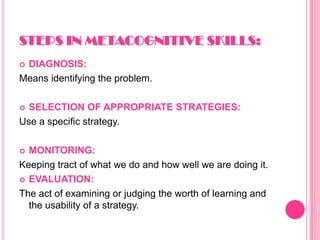
STEPS IN METACOGNITIVE SKILLS:
 DIAGNOSIS:
Means identifying the problem.
 SELECTION OF APPROPRIATE STRATEGIES:
Use a specific strategy.
 MONITORING:
Keeping tract of what we do and how well we are doing it.
 EVALUATION:
The act of examining or judging the worth of learning and
the usability of a strategy.
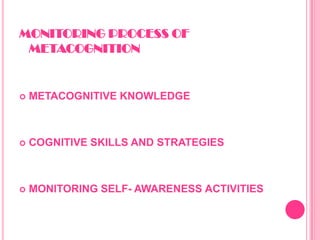
MONITORING PROCESS OF
METACOGNITION
 METACOGNITIVE KNOWLEDGE
 COGNITIVE SKILLS AND STRATEGIES
 MONITORING SELF- AWARENESS ACTIVITIES
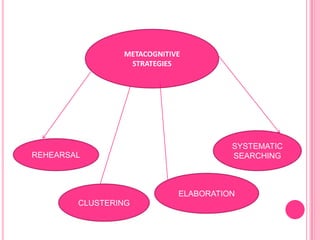
METACOGNITIVE
STRATEGIES
REHEARSAL
CLUSTERING
ELABORATION
SYSTEMATIC
SEARCHING
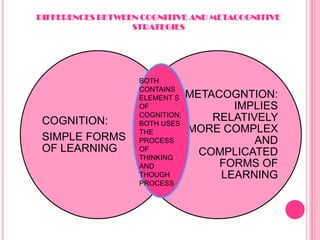
COGNITION:
SIMPLE FORMS
OF LEARNING
METACOGNTION:
IMPLIES
RELATIVELY
MORE COMPLEX
AND
COMPLICATED
FORMS OF
LEARNING
BOTH
CONTAINS
ELEMENT S
OF
COGNITION;
BOTH USES
THE
PROCESS
OF
THINKING
AND
THOUGH
PROCESS
DIFFERENCES BETWEEN COGNITIVE AND METACOGNITIVE
STRATEGIES
THANK YOU
FOR LISTENING :’>
Jhez.xhaii.pamz

The metacognitive process

  • 1.
  • 2.
    WHAT IS METACOGNITION?  is defined as "cognition about cognition", or "knowing about knowing”  It can take many forms; it includes knowledge about when and how to use particular strategies for learning or for problem solving.  is the understanding and awareness of one's own mental or cognitive processes.
  • 3.
     For example: aftera student answers a question or makes a statement, the teacher might say, "Why do you think that?" or, "Is that the only possibility?" or, What evidence do you have for that?" or, "Do you have an example?" THE METACOGNITIVE PROCESS The metacognitive process enhances learning by guiding students' thinking, and by helping the learner follow a wise course of action as he or she thinks through a problem, makes decisions, or attempts to understand a situation or text.
  • 4.
    COMPONENTS OF METACOGNITION: Students Knowledge and Learning Strategies : -- To use in a particular situation .  Cognitive Monitoring: -- Which includes students ability to select, use, and monitor learning strategies that complement their learning styles in a specific situation.
  • 5.
    WHAT IS MNEMONICDEVICES ? -- is any learning technique that aids information retention. Mnemonics aim to translate information into a form that the human brain can retain better than its original form. ROY G. BIV = colors of the Rainbow .. (Red, Orange, Yellow, Green, Blue, Indigo, Violet.)
  • 7.
    METACOGNITION CAN BEDIVIDED IN TWO TYPES OF KNOWLEDGE :  Explicit metacognitive knowledge -- is the ability to monitor ones own cognitive activites.  A perfect example is about a child who continually is monitoring his/her own speech. When the child makes a mistake when speaking they will stop and say the sentence over again but correctly.
  • 8.
     Explicit MetacognitiveKnowledge -- refers to the conscious factual knowledge  EXAMPLE: For instance, it easy to remember the major point in the selection rather than to memorize the entire text.
  • 9.
    METACOGNITIVE EXPERIENCES  Thingshappen to us that refers to our understanding and knowledge of our own cognitive process. METAMEMORY in regards to an individual's ability to manage and monitor the input, storage, search and retrieval of the contents of his own memory. (John Flavell 1971).
  • 10.
    ESSENTIAL SKILLS OF METACOGNITION:  PLANNING: Is a form of decision making. Planning allows us to decide on various aspects.  MONITORING: Means to have a special duty to be responsible.  EVALUATING: Is developing a sound judgment about the process and outcome of thinking.
  • 11.
    STEPS IN METACOGNITIVESKILLS:  DIAGNOSIS: Means identifying the problem.  SELECTION OF APPROPRIATE STRATEGIES: Use a specific strategy.  MONITORING: Keeping tract of what we do and how well we are doing it.  EVALUATION: The act of examining or judging the worth of learning and the usability of a strategy.
  • 12.
    MONITORING PROCESS OF METACOGNITION METACOGNITIVE KNOWLEDGE  COGNITIVE SKILLS AND STRATEGIES  MONITORING SELF- AWARENESS ACTIVITIES
  • 13.
  • 14.
    COGNITION: SIMPLE FORMS OF LEARNING METACOGNTION: IMPLIES RELATIVELY MORECOMPLEX AND COMPLICATED FORMS OF LEARNING BOTH CONTAINS ELEMENT S OF COGNITION; BOTH USES THE PROCESS OF THINKING AND THOUGH PROCESS DIFFERENCES BETWEEN COGNITIVE AND METACOGNITIVE STRATEGIES
  • 15.
    THANK YOU FOR LISTENING:’> Jhez.xhaii.pamz