




7/24/2022
1
UNIT-1(1.1)
RESPIRATORY SYSTEM
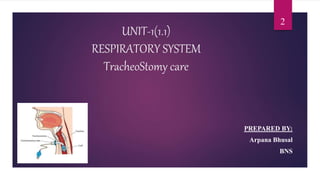
TracheoStomy care
PREPARED BY:
Arpana Bhusal
BNS
2
Content layout
 Definition
 Purpose
 Indication
 Contraindication
 Equipments for tracheostomy insertion.
 Goals of tracheostomy care.
 Equipments for tracheostomy care.
7/24/2022
3
Content Layout
 Components and Types of tracheostomy tube
 Care of patient with tracheostomy
 Daily care of patient with tracheostomy.
 Nursing management
 Complication.
 Preventing complication associated with tracheostomy
tube
7/24/2022
4
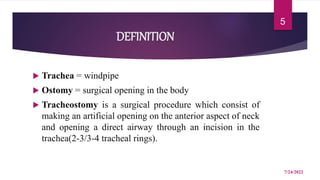
DEFINITION
 Trachea = windpipe
 Ostomy = surgical opening in the body
 Tracheostomy is a surgical procedure which consist of
making an artificial opening on the anterior aspect of neck
and opening a direct airway through an incision in the
trachea(2-3/3-4 tracheal rings).
7/24/2022
5
DEFINITION (1/4)
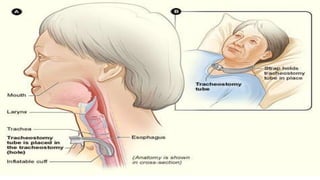
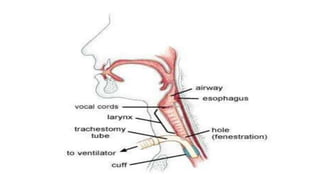
 A tracheostomy is a surgical opening into the trachea
below the larynx through which an indwelling tube is
placed to overcome upper airway obstruction, facilitate
mechanical ventilatory support and/ or the removal of
tracheobronchial secretions.
7/24/2022
6
7/24/2022
7
7/24/2022
8
PURPOSE
a) To maintain the airways to facilitate the therapeutic
exchanges of gases.
b) To remove trachea bronchial secretion.
c) To maintain optimum physical comfort.
d) To decrease airway resistance.
7/24/2022
9
PURPOSE
e) To provide a method of mechanical ventilation.
f) To improve respiratory insufficiency.
g) To prevent from aspiration and transmission of
pathogenic micro-organisms.
7/24/2022
10
INDICATION
1. Airway obstruction
 Hemorrhage after thyroid surgery or upper airway
bleeding.
 Foreign bodies impacted in larynx.
 Trauma to larynx or pharynx.
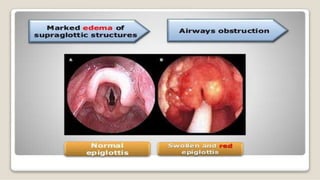
 Acute edema of epiglottis e.g. diphtheria,
Facial burns
7/24/2022
11
indication
2. Congenital cause
 Laryngeal weakness stenosis
 Inflammatory disease conditions
 Tracheal laryngeal fracture
 Need for continuous mechanical ventilation
 Tumor in the respiratory airway
7/24/2022
13
indication
3. Retained secretions in tracheo-bronchial tree
 Unconscious patient following head injury and poisoning.
 Chest injury patient who is unable to cough.
 Paralysis of the muscles of respiration.
 Tetanus
 For radical surgery in the neck e.g. laryngectomy.
7/24/2022
14
INDICATION
4. Others
 To protect / minimize risk of aspiration in the patients
with poor or absent cough reflex
 Neurologic conditions (Amyotrophic lateral sclerosis)
 Severe sleep apnea
 Laryngeal hypoplasia
7/24/2022
15
CONTRAINDICATION
 No absolute contraindications exist to tracheostomy.
 Relative contraindication is Laryngeal CA.
 Tracheo-esophageal fistula.
 Cancer in upper GI or respiratory tract
7/24/2022
16
EQUIPMENTS FOR TRACHEOSTOMY
INSERTION
 Tracheostomy tube (size 6-9 mm for most adults)
 Sterile instruments: blade, forceps, suture material,
scissors
 Sterile gown and gloves
 Cap and face shield
 Antiseptic preparation solution
 Gauze pads
7/24/2022
17
EQUIPMENTS FOR TRACHEOSTOMY
INSERTION
 Shave preparation kit
 Sedation
 Local anesthetic and syringe
 Resuscitation bag and mask with oxygen source
 Suction source and catheters
 Syringe for cuff inflation
 Respiratory support available for post
tracheostomy(mechanical ventilation, tracheal oxygen mask,
CPAP)
7/24/2022
18
TRACHEOSTOMY CARE
GOALS
 To maintain airway patency by removing mucous and
encrusted secretions.
 To maintain cleanliness and prevent infections to the
tracheostomy site.
 To facilitate healing and maintain skin intergrity.
 To promote comfort and prevent displacement.
7/24/2022
19
EQUIPMENTS FOR TRACHEOSTOMY CARE
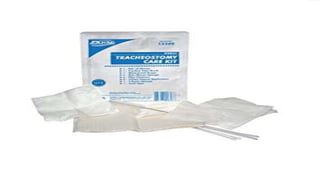
 Sterile disposable tracheostomy cleaning kit or supplies
( sterile containers, sterile nylon brush or pipe cleaner)
 Sterile applicators ( gauze squares)
 Sterile suction kit and Sterile normal saline
 Sterile gloves and clean gloves
7/24/2022
20
EQUIPMENTS
 Towel to drape to protect bed linens
 Sterile gauze dressing, cotton twill ties and clean scissors
 Moisture proof bag
7/24/2022
21
Disposable tracheostomy cleaning kit
BED SIDE EQUIPMENTS
 Spare tracheostomy tubes same size and type as the patient is
wearing
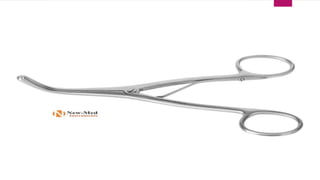
 Tracheal dilator
 Suctioning equipment
 Oxygen equipment with humidification
 Gloves (non sterile)
 Gloves (sterile) for suctioning
 Infectious waste bag
7/24/2022
23
Tracheal dilator
Tracheostomy tube
 Tracheostomy tube is a curved tube that is inserted into
the tracheostomy stoma made of plastic rubber or metal.
 Tracheostomy tubes have an outer cannula that is
inserted into the trachea and a flange that rests against the
neck and allows the tube to be secured in place with tape
or ties.
7/24/2022
25
TRACHEOSTOMY TUBE
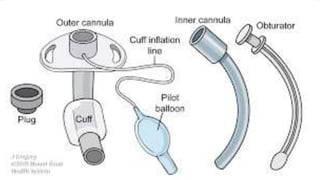
 Tracheostomy tubes also have an obturator which is used
to insert the outer cannula which is then removed
afterwards. The obturator is kept at the client's bedside in
case the tube becomes dislodge and needs to be
reinserted.
7/24/2022
26
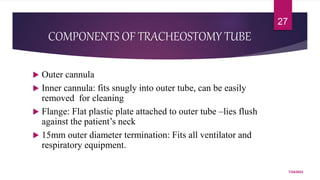
COMPONENTS OF TRACHEOSTOMY TUBE
 Outer cannula
 Inner cannula: fits snugly into outer tube, can be easily
removed for cleaning
 Flange: Flat plastic plate attached to outer tube –lies flush
against the patient’s neck
 15mm outer diameter termination: Fits all ventilator and
respiratory equipment.
7/24/2022
27
7/24/2022
28
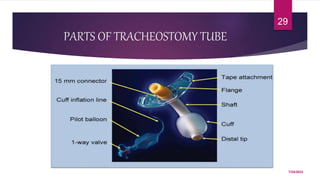
PARTS OF TRACHEOSTOMY TUBE
7/24/2022
29
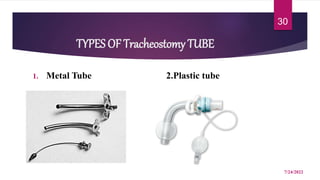
TYPES OF Tracheostomy TUBE
1. Metal Tube 2.Plastic tube
7/24/2022
30
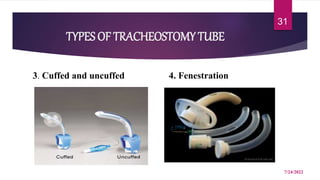
TYPES OF TRACHEOSTOMY TUBE
3. Cuffed and uncuffed 4. Fenestration
7/24/2022
31
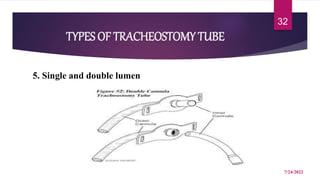
TYPES OF TRACHEOSTOMY TUBE
5. Single and double lumen
7/24/2022
32
CARE OF PATIENT WITHTRACHEOSTOMY
1. PREPARATIVE PHASE
 Assess the condition of the patient .
 Bathing or scrubbing the local skin area with antiseptic
procedures.
 Keep the patient in NPO.
 Promote rest and sleep
 Collect informed consent, report of diagnostic test .
7/24/2022
33
CARE OF PATIENT WITHTRACHEOSTOMY
 Provide the preoperative medications.
 Instruct patient to remove jewellery, dentures, contact
lenses
 Perform mouth care
 Place the identification band.
7/24/2022
34
CARE OF PATIENT WITHTRACHEOSTOMY
2. PERFORMANCE PHASE
 Explain the procedure to the patient. Discuss a
communication system with the patient
 Obtain consent for operative procedure
 Shave a neck region
 Assemble equipments. Using aseptic technique.
7/24/2022
35
CARE OF PATIENT WITHTRACHEOSTOMY
 Position the patient (in a supine position with head
extended and a support under the shoulders)
 Obtain an order for and apply soft wrist restraints if the
patient is confused.
 Give medication if ordered
 Position the light source
7/24/2022
36
CARE OF PATIENT WITHTRACHEOSTOMY
 Assist with antiseptic preparation
 Assist with gowning and gloving
 Assist with sterile draping
 Put on face shield
7/24/2022
37
 During procedure, monitor the patient’s vital signs,
suction as necessary , give medication as prescribed, and
be prepared to administer emergency care.
 Immediately after the tube is inserted , inflate the cuff.
The chest should be ausculted for the presence of bilateral
breath sounds.
7/24/2022
38
CARE OF PATIENT WITHTRACHEOSTOMY
 Secure the tracheostomy tube with tapes or other securing
device and apply dressing
 Apply appropriate respiratory assistive device(mechanical
ventilation. Tracheostomy, oxygen mask, CPAP)
 Check the tracheostomy tube cuff pressure
7/24/2022
39
3. Follow up phase/ Post-operative phase
 Check the symmetry of chest expansion.
 Auscultate the breathe sound of anterior and the lateral chest
bilaterally .
 Obtain order for chest x-ray to verify proper tube
placement.
 Check cuff pressure every 8-12 hrs
7/24/2022
40
CARE OF PATIENT WITHTRACHEOSTOMY
 Monitor the sign and symptoms of aspiration
 Assess vitals signs and breath sounds; note tube size
used, physician performing procedure, type, dose, and
route of medications given.
 Assess and chart condition of stoma: bleeding, swelling,
subcutaneous air
7/24/2022
41
CARE OF PATIENT WITHTRACHEOSTOMY
 Administer oxygen concentration as prescribed by
physician
 Secure the tube to the patient face with the tape, and
mark the proximal end for position maintenance.
7/24/2022
42
Use the sterile suction technique and airway care to
prevent iatrogenic contamination and infection.
Continue to reposition patient every 2 hours and as needed
to prevent atelectasis and to optimize lung expansion.
Provide oral hygiene and suction the oropharynx whenever
required.
7/24/2022
43
CARE OF PATIENT WITHTRACHEOSTOMY
Maintain patency of tracheostomy tube and airway
 Frequent atraumatic suction.
 Humidification of inspired air and oxygen
 Fowler’s position to aid in breathing
 Maintain adequate fluid intake
7/24/2022
44
CARE OF PATIENT WITHTRACHEOSTOMY
 Provide frequent mouth wash
 Mucolytic agents
 Coughing and physiotherapy
7/24/2022
45
CARE OF PATIENT WITHTRACHEOSTOMY
 Prevent infection and complication:
 Aseptic tube suction, handling and tube changing
 Prophylactic antibiotics
 An extra tube, obturator, and tracheostomy kit should be
kept at the bedside. In the event of tube dislodgement,
reinsertion of a new tube mat be necessary .
7/24/2022
46
DAILY CARE OF PATIENT WITH
TRACHEOSTOMY
1.Assessment
 An increased monitoring of the patient’s blood pressure,
respiratory rate, pulse and color is necessary
 An increased in the respiratory rate, wheezes ,an
increased pulse rate may indicate the need for suction
7/24/2022
47
DAILY CARE OF PATIENT WITH
TRACHEOSTOMY
 Cyanosis and distress not relieved by suctioning should
be reported promptly
 Increasing restlessness with a rapid pulse rate may
indicate hypoxia or bleeding
 Observe the wound for bleeding and then check daily for
signs of infection
7/24/2022
48
DAILY CARE OF PATIENT WITH
TRACHEOSTOMY
2.Maintain an open airway:
 Assess the patient regularly for excess secretions and
suction and clean the tube as indicated.
 The trachea is suctioned using a sterile glove and a sterile
suction catheter moisture in sterile water or normal saline
with aseptic technique.
7/24/2022
49
DAILY CARE OF PATIENT WITH
TRACHEOSTOMY
 Frequent repositioning of the patient
3. Suctioning
7/24/2022
50
DAILY CARE OF PATIENT WITH
TRACHEOSTOMY
 Suctioning raises the risk of hypoxemia, bronchospasm,
and other adverse reactions, so suction only when needed,
not on a set schedule, and suction for the shortest time
necessary to clear secretions.
 Suctioning can be an uncomfortable and scary experience
for the patient, so thoroughly explain the procedure to
him before start.
7/24/2022
51
 Indications for suctioning include coughing, secretions in
the airway, respiratory distress, presence of rhonchi on
auscultation, increased peak airway pressures on the
ventilator, and decreasing SaO2 or PaO2.
 Comfortable position of the patient.
 Maintain aseptic technique .
7/24/2022
52
DAILY CARE OF PATIENT WITH
TRACHEOSTOMY
DAILY CARE OF PATIENT WITH
TRACHEOSTOMY
4.Cleaning of the tracheostomy tube and wound care:
 Tracheostomy care includes cleaning or changing the
inner cannula, changing the dressing and tracheostomy
tube holder, and suctioning if needed.
 Never clean and reuse a disposable cannula.
7/24/2022
53
DAILY CARE OF PATIENT WITH
TRACHEOSTOMY
 Unlock and remove the inner cannula and place it in a solution
of equal parts hydrogen peroxide and 0.9% sodium chloride
unless the manufacturer directs otherwise.
 The inner cannula of the tracheostomy tube is carefully
removed, cleansed every 3-5 hours or as often as
necessary(perhaps even hourly)
7/24/2022
54
 Remove encrusted secretions from the lumen with sterile
pipe cleaners.
 After cleaning, rinse the cannula thoroughly with sterile
0.9% sodium chloride solution.
7/24/2022
55
DAILY CARE OF PATIENT WITH
TRACHEOSTOMY
DAILY CARE OF PATIENT WITH
TRACHEOSTOMY
 Reinsert the inner cannula and securely lock it into place.
 Stoma should be cleaned everyday carefully without
dislodging tube.
7/24/2022
56
DAILY CARE OF PATIENT WITH
TRACHEOSTOMY
5.Humidification:
 Maintaining humidification is another key nursing
responsibility.
 Provide constant airway humidification to avoid
thickening and crusting of bronchial secretion .
7/24/2022
57
DAILY CARE OF PATIENT WITH
TRACHEOSTOMY
 Ensure humidification of inspired air placing a piece of moist
gauze over the tracheostomy tube so that the air takes up the
moisture.
 Humidifier is useful.
 In addition, patient must be properly hydrated; for example,
with I.V. fluids.
7/24/2022
58
DAILYCARE OF PATIENT WITHTRACHEOSTOMY
6.Mouth care:
 Provide frequent mouth care in every 2 hours for the
patient’s comfort and to reduces the possibility of
infection.
7/24/2022
59
DAILY CARE OF PATIENT WITH
TRACHEOSTOMY
7.Nutrition:
 If the patient eats by mouth, it is recommended that the
tracheostomy tube be suctioned prior to eating. This often
prevents the need for suctioning during or after meals,
which may stimulate excessive coughing and could result
in vomiting
7/24/2022
60
DAILY CARE OF PATIENT WITH
TRACHEOSTOMY
 Encouraging fluid intake is helpful for a patient with a
tracheostomy. Increased fluid intake will thin and loosen
secretions making coughing and suctioning easier.
 Always observe the patient while eating to be sure food
does not get into the trachea.
7/24/2022
61
DAILY CARE OF PATIENT WITH
TRACHEOSTOMY
8. Communication
9. Documentation
 Document the patient's response each time you suction,
including his vital signs, cardiac rhythm, oxygen
saturation, amount and consistency of secretions, breath
sounds, and the frequency of needed suctioning
7/24/2022
62
NURSING MANAGEMENT
7/24/202
2
63
NURSINGASSESSMENT
 Frequent monitoring of the patients blood pressure ,
respiratory rate, pulse and color is necessary.
 An increased in the respiratory rate , wheezes, an
increased pulse rate may indicate the need for suction.
 Cyanosis and distress not relieved by suction should be
reported promptly.
7/24/2022
64
NURSING ASSESSMENT
 Increasing restlessness with a rapid pulse rate may
indicate hypoxia or bleeding.
 Observe the wound for bleeding in the immediate post-
operative period and then check daily for signs of
infection and sloughing.
 Assess patient ability to understand the spoken word.
7/24/2022
65
NURSING ASSESSMENT
 Assess patients ability to expression.
 Assess and observe swallowing reflexes , gag reflexes.
 Assess mental status confusion , lethargy , restlessness.
 Assess amount, color, consistency of secretion.
7/24/2022
66
NURSING DIAGNOSIS
1. Ineffective airway clearance related to presence of
artificial airway (tracheostomy) as evidenced by
tachypnea and changes in breathing pattern.
2. Impaired verbal communication related to presence of
artificial airway as evidenced by difficulty in maintaining
the usual communication pattern.
7/24/2022
67
Nursing diagnosis
3) Anxiety related to threat to self concept as evidenced by
expressed feeling of distress over the presence of
tracheostomy.
4) Knowledge deficit related to new procedure or
intervention in hospital as evidenced by increased
questioning.
7/24/2022
68
Nursing diagnosis
5) Risk for infection related to surgical incision of
tracheostomy.
6) Risk of aspiration related to presence of tracheostomy.
7/24/2022
69
GOALS AND OUTCOME
1) Patient will maintain a clear ,open airways and ability to
effectively cough up secretion.
2) Patient will use a form of communication to get needs
met and to relate effectively with persons and
environment.
3) Patient will verbalize their own feeling.
7/24/2022
70
GOALS AND OUTCOME
4) Patient or caregiver will demonstrate the knowledge and
skills appropriate for tracheostomy care.
5) Patient will remain free of infection.
6) Patient will swallow meals without coughing, choking or
changing color.
7/24/2022
71
NURSING INTERVENTION
1. Maintaining airway clearance
 Assess changes in BP, Heart rate and temperature.
 Auscultate the lungs , presence of breathe sounds.
 Observe the color , consistency , and quantity of secretion
 Provide warm humidified air
7/24/2022
72
Nursing intervention
 Administer O2 as needed.
 Encourage patient to cough out secretion.
 Keep suction equipment and AMBU bag at bed side.
 Keep the patient in semi fowlers position.
7/24/2022
73
Nursing intervention
2. Promoting verbal communication
 Assess the clients communication ability.
 Assess the effectiveness of non verbal communication
methods.
 Place the patient in a room close to the nurses station.
 Provide a call light within easy reach at all times.
7/24/2022
74
Nursing intervention
 Provide alternative methods for communicating.
 Hand gestures
 Word and phrase cards
 Picture board
 Writing pad
 Pencil or pen
7/24/2022
75
Nursing intervention
3. Reducing anxiety
 Assess the level and manifestation of anxiety in patients.
 Allow patient to express fears and concerns to ask,
inquiries about disease and procedure.
 Inform of all procedure and care to the patient as well as
visitors.
 Provide psychological support.
7/24/2022
76
Nursing intervention
7/24/2022
77
4. Enhancing knowledge
 Assess the patients knowledge regarding the purpose and
care of tracheostomy.
 Provide instruction in sterile tracheostomy care and
suctioning.
 Instruct in the need to call health care provider if the
amount of secretion increases or change in color and
characteristics occurs.
NURSING INTERVENTION
5. Preventing infection
 Assess patients vital sign.
 Assess skin integrity under tracheal ties.
 Monitor white blood cell count.
 Observe the stoma for color, crusting lesions
7/24/2022
78
NURSING INTERVENTION
 Provide stoma care.
 Do not allow secretions to pool around the stoma , suction
the area , wipe with aseptic technique.
7/24/2022
79
NURSING INTERVENTION
6. Preventing aspiration
 Assess the ability to swallow and type of food
consistency.
 Encourage liquid initially in small amounts and gradually
increase as tolerated.
 Maintain in an upright sitting position during feeding.
 Suction fluids from mouth and airway.
7/24/2022
80
COMPLICATIONS
1. Immediate (at the time of operation):
 hemorrhage, air embolism, cardiac arrest apnea,
aspiration, pneumothorax, injury to laryngeal nerves and
esophagus, local damage (thyroid cartilage, cricoid
cartilage, recurrent laryngeal nerve).
7/24/2022
81
complications
2. Intermediate(during first few hours or days)
 bleeding, displacement of tube, blocking of tube,
subcutaneous emphysema, pneumothorax, scabs, tracheal
necrosis, tracheitis, local wound infection and dysphagia
7/24/2022
82
COMPLICATIONS
3. Late (with prolonged use of tube for weeks and months):
 laryngeal stenosis, tracheal stenosis, tracheo - esophageal
fistula.
7/24/2022
83
Preventing complications WITH TUBE
 Administer adequate warmed humidity: steam inhalation,
nebulization, keeping wet gauze piece over the
tracheostomy site and changing it as per need.
 Maintain cuff around tube
 Suction as needed per assessment findings
 Maintain skin integrity. Change tape and dressing as
needed or per protocol
7/24/2022
84
Preventing complication WITH TUBE
 Ascultate lungs sounds
 Monitor for signs and symptoms of infection, including
temperature and white blood cell count
 Protein rich diet should be provided for early healing of
incision site.
 Administer prescribed oxygen and monitor oxygen
saturation
7/24/2022
85
PREVENTINGCOMPLICATION WITH TUBE
 Monitor for cyanosis
 Maintain adequate hydration of the patient
 Use sterile technique when suctioning and performing
tracheostomy care
 Emergency drugs should be ready
7/24/2022
86
REFRENCES
 Smeltzer.S.G. Bare.B.G. Hinkle.J.G. Cheezer K.H.(2010)
“Brunner & Suddarth’s textbook of Medical- Surgical
Nursing", Volume 1. (12th edition). New Delhi, Kluwer
India. Pvt. Ltd. 2078/04/10 at 1 pm
 Mandal G.N (2016) “A Textbook Of Medical Surgical
Nursing”. 5th edition. Kathmandu. Makalu Publication
House.2078/04/11at 3 pm.
7/24/2022
88
REFRENCES
 2019. Mayo Foundation Of Medical Foundation And
Research. Tracheostomy care
https://www.mayoclinic.org@2021/08/02at 3pm.
 Nov4,2019,tracheostomy care
https://www.slideshare.net/gamandeep@2021/08/03 at
5pm
7/24/2022
89
7/24/2022
90

Tracheostomy care (Adult)

  • 1.
  • 2.
  • 3.
    Content layout  Definition Purpose  Indication  Contraindication  Equipments for tracheostomy insertion.  Goals of tracheostomy care.  Equipments for tracheostomy care. 7/24/2022 3
  • 4.
    Content Layout  Componentsand Types of tracheostomy tube  Care of patient with tracheostomy  Daily care of patient with tracheostomy.  Nursing management  Complication.  Preventing complication associated with tracheostomy tube 7/24/2022 4
  • 5.
    DEFINITION  Trachea =windpipe  Ostomy = surgical opening in the body  Tracheostomy is a surgical procedure which consist of making an artificial opening on the anterior aspect of neck and opening a direct airway through an incision in the trachea(2-3/3-4 tracheal rings). 7/24/2022 5
  • 6.
    DEFINITION (1/4)  Atracheostomy is a surgical opening into the trachea below the larynx through which an indwelling tube is placed to overcome upper airway obstruction, facilitate mechanical ventilatory support and/ or the removal of tracheobronchial secretions. 7/24/2022 6
  • 7.
  • 8.
  • 9.
    PURPOSE a) To maintainthe airways to facilitate the therapeutic exchanges of gases. b) To remove trachea bronchial secretion. c) To maintain optimum physical comfort. d) To decrease airway resistance. 7/24/2022 9
  • 10.
    PURPOSE e) To providea method of mechanical ventilation. f) To improve respiratory insufficiency. g) To prevent from aspiration and transmission of pathogenic micro-organisms. 7/24/2022 10
  • 11.
    INDICATION 1. Airway obstruction Hemorrhage after thyroid surgery or upper airway bleeding.  Foreign bodies impacted in larynx.  Trauma to larynx or pharynx.  Acute edema of epiglottis e.g. diphtheria, Facial burns 7/24/2022 11
  • 13.
    indication 2. Congenital cause Laryngeal weakness stenosis  Inflammatory disease conditions  Tracheal laryngeal fracture  Need for continuous mechanical ventilation  Tumor in the respiratory airway 7/24/2022 13
  • 14.
    indication 3. Retained secretionsin tracheo-bronchial tree  Unconscious patient following head injury and poisoning.  Chest injury patient who is unable to cough.  Paralysis of the muscles of respiration.  Tetanus  For radical surgery in the neck e.g. laryngectomy. 7/24/2022 14
  • 15.
    INDICATION 4. Others  Toprotect / minimize risk of aspiration in the patients with poor or absent cough reflex  Neurologic conditions (Amyotrophic lateral sclerosis)  Severe sleep apnea  Laryngeal hypoplasia 7/24/2022 15
  • 16.
    CONTRAINDICATION  No absolutecontraindications exist to tracheostomy.  Relative contraindication is Laryngeal CA.  Tracheo-esophageal fistula.  Cancer in upper GI or respiratory tract 7/24/2022 16
  • 17.
    EQUIPMENTS FOR TRACHEOSTOMY INSERTION Tracheostomy tube (size 6-9 mm for most adults)  Sterile instruments: blade, forceps, suture material, scissors  Sterile gown and gloves  Cap and face shield  Antiseptic preparation solution  Gauze pads 7/24/2022 17
  • 18.
    EQUIPMENTS FOR TRACHEOSTOMY INSERTION Shave preparation kit  Sedation  Local anesthetic and syringe  Resuscitation bag and mask with oxygen source  Suction source and catheters  Syringe for cuff inflation  Respiratory support available for post tracheostomy(mechanical ventilation, tracheal oxygen mask, CPAP) 7/24/2022 18
  • 19.
    TRACHEOSTOMY CARE GOALS  Tomaintain airway patency by removing mucous and encrusted secretions.  To maintain cleanliness and prevent infections to the tracheostomy site.  To facilitate healing and maintain skin intergrity.  To promote comfort and prevent displacement. 7/24/2022 19
  • 20.
    EQUIPMENTS FOR TRACHEOSTOMYCARE  Sterile disposable tracheostomy cleaning kit or supplies ( sterile containers, sterile nylon brush or pipe cleaner)  Sterile applicators ( gauze squares)  Sterile suction kit and Sterile normal saline  Sterile gloves and clean gloves 7/24/2022 20
  • 21.
    EQUIPMENTS  Towel todrape to protect bed linens  Sterile gauze dressing, cotton twill ties and clean scissors  Moisture proof bag 7/24/2022 21
  • 22.
  • 23.
    BED SIDE EQUIPMENTS Spare tracheostomy tubes same size and type as the patient is wearing  Tracheal dilator  Suctioning equipment  Oxygen equipment with humidification  Gloves (non sterile)  Gloves (sterile) for suctioning  Infectious waste bag 7/24/2022 23
  • 24.
  • 25.
    Tracheostomy tube  Tracheostomytube is a curved tube that is inserted into the tracheostomy stoma made of plastic rubber or metal.  Tracheostomy tubes have an outer cannula that is inserted into the trachea and a flange that rests against the neck and allows the tube to be secured in place with tape or ties. 7/24/2022 25
  • 26.
    TRACHEOSTOMY TUBE  Tracheostomytubes also have an obturator which is used to insert the outer cannula which is then removed afterwards. The obturator is kept at the client's bedside in case the tube becomes dislodge and needs to be reinserted. 7/24/2022 26
  • 27.
    COMPONENTS OF TRACHEOSTOMYTUBE  Outer cannula  Inner cannula: fits snugly into outer tube, can be easily removed for cleaning  Flange: Flat plastic plate attached to outer tube –lies flush against the patient’s neck  15mm outer diameter termination: Fits all ventilator and respiratory equipment. 7/24/2022 27
  • 28.
  • 29.
    PARTS OF TRACHEOSTOMYTUBE 7/24/2022 29
  • 30.
    TYPES OF TracheostomyTUBE 1. Metal Tube 2.Plastic tube 7/24/2022 30
  • 31.
    TYPES OF TRACHEOSTOMYTUBE 3. Cuffed and uncuffed 4. Fenestration 7/24/2022 31
  • 32.
    TYPES OF TRACHEOSTOMYTUBE 5. Single and double lumen 7/24/2022 32
  • 33.
    CARE OF PATIENTWITHTRACHEOSTOMY 1. PREPARATIVE PHASE  Assess the condition of the patient .  Bathing or scrubbing the local skin area with antiseptic procedures.  Keep the patient in NPO.  Promote rest and sleep  Collect informed consent, report of diagnostic test . 7/24/2022 33
  • 34.
    CARE OF PATIENTWITHTRACHEOSTOMY  Provide the preoperative medications.  Instruct patient to remove jewellery, dentures, contact lenses  Perform mouth care  Place the identification band. 7/24/2022 34
  • 35.
    CARE OF PATIENTWITHTRACHEOSTOMY 2. PERFORMANCE PHASE  Explain the procedure to the patient. Discuss a communication system with the patient  Obtain consent for operative procedure  Shave a neck region  Assemble equipments. Using aseptic technique. 7/24/2022 35
  • 36.
    CARE OF PATIENTWITHTRACHEOSTOMY  Position the patient (in a supine position with head extended and a support under the shoulders)  Obtain an order for and apply soft wrist restraints if the patient is confused.  Give medication if ordered  Position the light source 7/24/2022 36
  • 37.
    CARE OF PATIENTWITHTRACHEOSTOMY  Assist with antiseptic preparation  Assist with gowning and gloving  Assist with sterile draping  Put on face shield 7/24/2022 37
  • 38.
     During procedure,monitor the patient’s vital signs, suction as necessary , give medication as prescribed, and be prepared to administer emergency care.  Immediately after the tube is inserted , inflate the cuff. The chest should be ausculted for the presence of bilateral breath sounds. 7/24/2022 38 CARE OF PATIENT WITHTRACHEOSTOMY
  • 39.
    CARE OF PATIENTWITHTRACHEOSTOMY  Secure the tracheostomy tube with tapes or other securing device and apply dressing  Apply appropriate respiratory assistive device(mechanical ventilation. Tracheostomy, oxygen mask, CPAP)  Check the tracheostomy tube cuff pressure 7/24/2022 39
  • 40.
    3. Follow upphase/ Post-operative phase  Check the symmetry of chest expansion.  Auscultate the breathe sound of anterior and the lateral chest bilaterally .  Obtain order for chest x-ray to verify proper tube placement.  Check cuff pressure every 8-12 hrs 7/24/2022 40 CARE OF PATIENT WITHTRACHEOSTOMY
  • 41.
    CARE OF PATIENTWITHTRACHEOSTOMY  Monitor the sign and symptoms of aspiration  Assess vitals signs and breath sounds; note tube size used, physician performing procedure, type, dose, and route of medications given.  Assess and chart condition of stoma: bleeding, swelling, subcutaneous air 7/24/2022 41
  • 42.
    CARE OF PATIENTWITHTRACHEOSTOMY  Administer oxygen concentration as prescribed by physician  Secure the tube to the patient face with the tape, and mark the proximal end for position maintenance. 7/24/2022 42
  • 43.
    Use the sterilesuction technique and airway care to prevent iatrogenic contamination and infection. Continue to reposition patient every 2 hours and as needed to prevent atelectasis and to optimize lung expansion. Provide oral hygiene and suction the oropharynx whenever required. 7/24/2022 43 CARE OF PATIENT WITHTRACHEOSTOMY
  • 44.
    CARE OF PATIENTWITHTRACHEOSTOMY Maintain patency of tracheostomy tube and airway  Frequent atraumatic suction.  Humidification of inspired air and oxygen  Fowler’s position to aid in breathing  Maintain adequate fluid intake 7/24/2022 44
  • 45.
    CARE OF PATIENTWITHTRACHEOSTOMY  Provide frequent mouth wash  Mucolytic agents  Coughing and physiotherapy 7/24/2022 45
  • 46.
    CARE OF PATIENTWITHTRACHEOSTOMY  Prevent infection and complication:  Aseptic tube suction, handling and tube changing  Prophylactic antibiotics  An extra tube, obturator, and tracheostomy kit should be kept at the bedside. In the event of tube dislodgement, reinsertion of a new tube mat be necessary . 7/24/2022 46
  • 47.
    DAILY CARE OFPATIENT WITH TRACHEOSTOMY 1.Assessment  An increased monitoring of the patient’s blood pressure, respiratory rate, pulse and color is necessary  An increased in the respiratory rate, wheezes ,an increased pulse rate may indicate the need for suction 7/24/2022 47
  • 48.
    DAILY CARE OFPATIENT WITH TRACHEOSTOMY  Cyanosis and distress not relieved by suctioning should be reported promptly  Increasing restlessness with a rapid pulse rate may indicate hypoxia or bleeding  Observe the wound for bleeding and then check daily for signs of infection 7/24/2022 48
  • 49.
    DAILY CARE OFPATIENT WITH TRACHEOSTOMY 2.Maintain an open airway:  Assess the patient regularly for excess secretions and suction and clean the tube as indicated.  The trachea is suctioned using a sterile glove and a sterile suction catheter moisture in sterile water or normal saline with aseptic technique. 7/24/2022 49
  • 50.
    DAILY CARE OFPATIENT WITH TRACHEOSTOMY  Frequent repositioning of the patient 3. Suctioning 7/24/2022 50
  • 51.
    DAILY CARE OFPATIENT WITH TRACHEOSTOMY  Suctioning raises the risk of hypoxemia, bronchospasm, and other adverse reactions, so suction only when needed, not on a set schedule, and suction for the shortest time necessary to clear secretions.  Suctioning can be an uncomfortable and scary experience for the patient, so thoroughly explain the procedure to him before start. 7/24/2022 51
  • 52.
     Indications forsuctioning include coughing, secretions in the airway, respiratory distress, presence of rhonchi on auscultation, increased peak airway pressures on the ventilator, and decreasing SaO2 or PaO2.  Comfortable position of the patient.  Maintain aseptic technique . 7/24/2022 52 DAILY CARE OF PATIENT WITH TRACHEOSTOMY
  • 53.
    DAILY CARE OFPATIENT WITH TRACHEOSTOMY 4.Cleaning of the tracheostomy tube and wound care:  Tracheostomy care includes cleaning or changing the inner cannula, changing the dressing and tracheostomy tube holder, and suctioning if needed.  Never clean and reuse a disposable cannula. 7/24/2022 53
  • 54.
    DAILY CARE OFPATIENT WITH TRACHEOSTOMY  Unlock and remove the inner cannula and place it in a solution of equal parts hydrogen peroxide and 0.9% sodium chloride unless the manufacturer directs otherwise.  The inner cannula of the tracheostomy tube is carefully removed, cleansed every 3-5 hours or as often as necessary(perhaps even hourly) 7/24/2022 54
  • 55.
     Remove encrustedsecretions from the lumen with sterile pipe cleaners.  After cleaning, rinse the cannula thoroughly with sterile 0.9% sodium chloride solution. 7/24/2022 55 DAILY CARE OF PATIENT WITH TRACHEOSTOMY
  • 56.
    DAILY CARE OFPATIENT WITH TRACHEOSTOMY  Reinsert the inner cannula and securely lock it into place.  Stoma should be cleaned everyday carefully without dislodging tube. 7/24/2022 56
  • 57.
    DAILY CARE OFPATIENT WITH TRACHEOSTOMY 5.Humidification:  Maintaining humidification is another key nursing responsibility.  Provide constant airway humidification to avoid thickening and crusting of bronchial secretion . 7/24/2022 57
  • 58.
    DAILY CARE OFPATIENT WITH TRACHEOSTOMY  Ensure humidification of inspired air placing a piece of moist gauze over the tracheostomy tube so that the air takes up the moisture.  Humidifier is useful.  In addition, patient must be properly hydrated; for example, with I.V. fluids. 7/24/2022 58
  • 59.
    DAILYCARE OF PATIENTWITHTRACHEOSTOMY 6.Mouth care:  Provide frequent mouth care in every 2 hours for the patient’s comfort and to reduces the possibility of infection. 7/24/2022 59
  • 60.
    DAILY CARE OFPATIENT WITH TRACHEOSTOMY 7.Nutrition:  If the patient eats by mouth, it is recommended that the tracheostomy tube be suctioned prior to eating. This often prevents the need for suctioning during or after meals, which may stimulate excessive coughing and could result in vomiting 7/24/2022 60
  • 61.
    DAILY CARE OFPATIENT WITH TRACHEOSTOMY  Encouraging fluid intake is helpful for a patient with a tracheostomy. Increased fluid intake will thin and loosen secretions making coughing and suctioning easier.  Always observe the patient while eating to be sure food does not get into the trachea. 7/24/2022 61
  • 62.
    DAILY CARE OFPATIENT WITH TRACHEOSTOMY 8. Communication 9. Documentation  Document the patient's response each time you suction, including his vital signs, cardiac rhythm, oxygen saturation, amount and consistency of secretions, breath sounds, and the frequency of needed suctioning 7/24/2022 62
  • 63.
  • 64.
    NURSINGASSESSMENT  Frequent monitoringof the patients blood pressure , respiratory rate, pulse and color is necessary.  An increased in the respiratory rate , wheezes, an increased pulse rate may indicate the need for suction.  Cyanosis and distress not relieved by suction should be reported promptly. 7/24/2022 64
  • 65.
    NURSING ASSESSMENT  Increasingrestlessness with a rapid pulse rate may indicate hypoxia or bleeding.  Observe the wound for bleeding in the immediate post- operative period and then check daily for signs of infection and sloughing.  Assess patient ability to understand the spoken word. 7/24/2022 65
  • 66.
    NURSING ASSESSMENT  Assesspatients ability to expression.  Assess and observe swallowing reflexes , gag reflexes.  Assess mental status confusion , lethargy , restlessness.  Assess amount, color, consistency of secretion. 7/24/2022 66
  • 67.
    NURSING DIAGNOSIS 1. Ineffectiveairway clearance related to presence of artificial airway (tracheostomy) as evidenced by tachypnea and changes in breathing pattern. 2. Impaired verbal communication related to presence of artificial airway as evidenced by difficulty in maintaining the usual communication pattern. 7/24/2022 67
  • 68.
    Nursing diagnosis 3) Anxietyrelated to threat to self concept as evidenced by expressed feeling of distress over the presence of tracheostomy. 4) Knowledge deficit related to new procedure or intervention in hospital as evidenced by increased questioning. 7/24/2022 68
  • 69.
    Nursing diagnosis 5) Riskfor infection related to surgical incision of tracheostomy. 6) Risk of aspiration related to presence of tracheostomy. 7/24/2022 69
  • 70.
    GOALS AND OUTCOME 1)Patient will maintain a clear ,open airways and ability to effectively cough up secretion. 2) Patient will use a form of communication to get needs met and to relate effectively with persons and environment. 3) Patient will verbalize their own feeling. 7/24/2022 70
  • 71.
    GOALS AND OUTCOME 4)Patient or caregiver will demonstrate the knowledge and skills appropriate for tracheostomy care. 5) Patient will remain free of infection. 6) Patient will swallow meals without coughing, choking or changing color. 7/24/2022 71
  • 72.
    NURSING INTERVENTION 1. Maintainingairway clearance  Assess changes in BP, Heart rate and temperature.  Auscultate the lungs , presence of breathe sounds.  Observe the color , consistency , and quantity of secretion  Provide warm humidified air 7/24/2022 72
  • 73.
    Nursing intervention  AdministerO2 as needed.  Encourage patient to cough out secretion.  Keep suction equipment and AMBU bag at bed side.  Keep the patient in semi fowlers position. 7/24/2022 73
  • 74.
    Nursing intervention 2. Promotingverbal communication  Assess the clients communication ability.  Assess the effectiveness of non verbal communication methods.  Place the patient in a room close to the nurses station.  Provide a call light within easy reach at all times. 7/24/2022 74
  • 75.
    Nursing intervention  Providealternative methods for communicating.  Hand gestures  Word and phrase cards  Picture board  Writing pad  Pencil or pen 7/24/2022 75
  • 76.
    Nursing intervention 3. Reducinganxiety  Assess the level and manifestation of anxiety in patients.  Allow patient to express fears and concerns to ask, inquiries about disease and procedure.  Inform of all procedure and care to the patient as well as visitors.  Provide psychological support. 7/24/2022 76
  • 77.
    Nursing intervention 7/24/2022 77 4. Enhancingknowledge  Assess the patients knowledge regarding the purpose and care of tracheostomy.  Provide instruction in sterile tracheostomy care and suctioning.  Instruct in the need to call health care provider if the amount of secretion increases or change in color and characteristics occurs.
  • 78.
    NURSING INTERVENTION 5. Preventinginfection  Assess patients vital sign.  Assess skin integrity under tracheal ties.  Monitor white blood cell count.  Observe the stoma for color, crusting lesions 7/24/2022 78
  • 79.
    NURSING INTERVENTION  Providestoma care.  Do not allow secretions to pool around the stoma , suction the area , wipe with aseptic technique. 7/24/2022 79
  • 80.
    NURSING INTERVENTION 6. Preventingaspiration  Assess the ability to swallow and type of food consistency.  Encourage liquid initially in small amounts and gradually increase as tolerated.  Maintain in an upright sitting position during feeding.  Suction fluids from mouth and airway. 7/24/2022 80
  • 81.
    COMPLICATIONS 1. Immediate (atthe time of operation):  hemorrhage, air embolism, cardiac arrest apnea, aspiration, pneumothorax, injury to laryngeal nerves and esophagus, local damage (thyroid cartilage, cricoid cartilage, recurrent laryngeal nerve). 7/24/2022 81
  • 82.
    complications 2. Intermediate(during firstfew hours or days)  bleeding, displacement of tube, blocking of tube, subcutaneous emphysema, pneumothorax, scabs, tracheal necrosis, tracheitis, local wound infection and dysphagia 7/24/2022 82
  • 83.
    COMPLICATIONS 3. Late (withprolonged use of tube for weeks and months):  laryngeal stenosis, tracheal stenosis, tracheo - esophageal fistula. 7/24/2022 83
  • 84.
    Preventing complications WITHTUBE  Administer adequate warmed humidity: steam inhalation, nebulization, keeping wet gauze piece over the tracheostomy site and changing it as per need.  Maintain cuff around tube  Suction as needed per assessment findings  Maintain skin integrity. Change tape and dressing as needed or per protocol 7/24/2022 84
  • 85.
    Preventing complication WITHTUBE  Ascultate lungs sounds  Monitor for signs and symptoms of infection, including temperature and white blood cell count  Protein rich diet should be provided for early healing of incision site.  Administer prescribed oxygen and monitor oxygen saturation 7/24/2022 85
  • 86.
    PREVENTINGCOMPLICATION WITH TUBE Monitor for cyanosis  Maintain adequate hydration of the patient  Use sterile technique when suctioning and performing tracheostomy care  Emergency drugs should be ready 7/24/2022 86
  • 88.
    REFRENCES  Smeltzer.S.G. Bare.B.G.Hinkle.J.G. Cheezer K.H.(2010) “Brunner & Suddarth’s textbook of Medical- Surgical Nursing", Volume 1. (12th edition). New Delhi, Kluwer India. Pvt. Ltd. 2078/04/10 at 1 pm  Mandal G.N (2016) “A Textbook Of Medical Surgical Nursing”. 5th edition. Kathmandu. Makalu Publication House.2078/04/11at 3 pm. 7/24/2022 88
  • 89.
    REFRENCES  2019. MayoFoundation Of Medical Foundation And Research. Tracheostomy care https://www.mayoclinic.org@2021/08/02at 3pm.  Nov4,2019,tracheostomy care https://www.slideshare.net/gamandeep@2021/08/03 at 5pm 7/24/2022 89
  • 90.