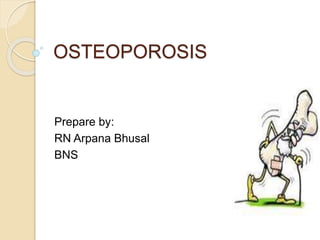
OSTEOPOROSIS
Prepare by:
RN Arpana Bhusal
BNS
NORMAL BONE FORMATION
& REMODELING
 Bone is continually remodeled throughout our lives in
response to microtrauma.
 Bone remodeling occurs at discrete sites within the
skeleton and proceeds in an orderly fashion, and bone
resorption is always followed by bone formation,
 Dense cortical bone and Cancellous bone(trabecular) differ
in their architecture but are similar in molecular composition
and have an extracellular matrix with mineralized and non-
mineralized components.
 Bone strength is determined by collagenous proteins and
greater concentration of calcium (mineralized osteoid).
 In adults, approximately 25% of trabecular bone is
reabsorbed and replaced each year,
Contd……
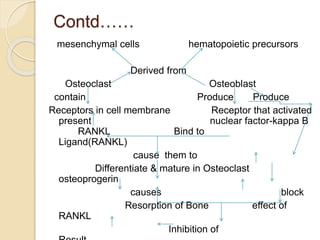
mesenchymal cells hematopoietic precursors
Derived from
Osteoclast Osteoblast
contain Produce Produce
Receptors in cell membrane Receptor that activated
present nuclear factor-kappa B
RANKL Bind to
Ligand(RANKL)
cause them to
Differentiate & mature in Osteoclast
osteoprogerin
causes block
Resorption of Bone effect of
RANKL
Inhibition of
INTRODUCTION
 Osteoporosis is a chronic, progressive disease of
multifactorial etiology.
 It is most frequently recognized in particularly in elderly
people and does occur in sexes, all races, and all age
groups.
 Osteoporosis is a preventable disease that can result in
disturbing physical, psychosocial, and economic
consequences.
 Osteoporosis is a systemic skeletal disease characterized
by low bone mass and micro architectural deterioration of
bone tissue.
 There is a change in the normal homeostatic bone
turnover i.e; rate of bone reabsorption is greater than the
rate of bone formation and resulting reduced total bone
mass.
Contd……
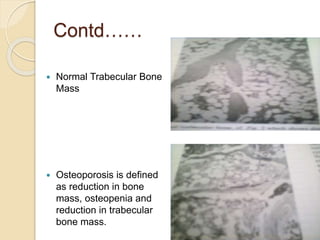
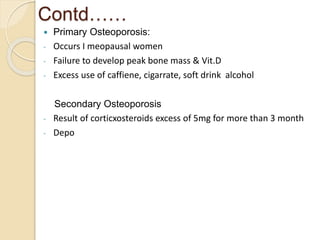
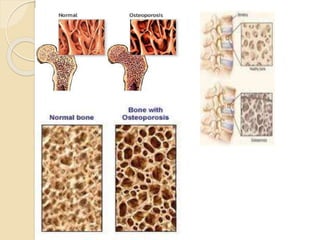
 Normal Trabecular Bone
Mass
 Osteoporosis is defined
as reduction in bone
mass, osteopenia and
reduction in trabecular
bone mass.
Contd……
 Primary Osteoporosis:
- Occurs I meopausal women
- Failure to develop peak bone mass & Vit.D
- Excess use of caffiene, cigarrate, soft drink alcohol
Secondary Osteoporosis
- Result of corticxosteroids excess of 5mg for more than 3 month
- Depo
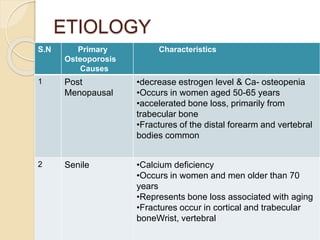
ETIOLOGY
S.N Primary
Osteoporosis
Causes
Characteristics
1 Post
Menopausal
•decrease estrogen level & Ca- osteopenia
•Occurs in women aged 50-65 years
•accelerated bone loss, primarily from
trabecular bone
•Fractures of the distal forearm and vertebral
bodies common
2 Senile •Calcium deficiency
•Occurs in women and men older than 70
years
•Represents bone loss associated with aging
•Fractures occur in cortical and trabecular
boneWrist, vertebral
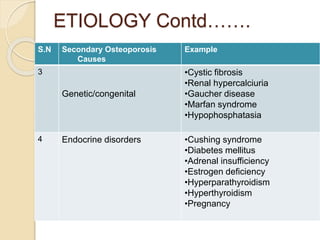
ETIOLOGY Contd…….
S.N Secondary Osteoporosis
Causes
Example
3
Genetic/congenital
•Cystic fibrosis
•Renal hypercalciuria
•Gaucher disease
•Marfan syndrome
•Hypophosphatasia
4 Endocrine disorders •Cushing syndrome
•Diabetes mellitus
•Adrenal insufficiency
•Estrogen deficiency
•Hyperparathyroidism
•Hyperthyroidism
•Pregnancy
ETIOLOGY Contd…….
S.N Secondary Osteoporosis
Causes
Example
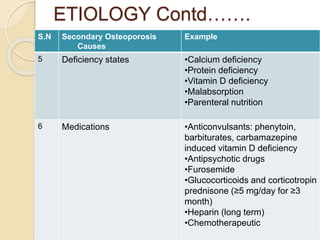
5 Deficiency states •Calcium deficiency
•Protein deficiency
•Vitamin D deficiency
•Malabsorption
•Parenteral nutrition
6 Medications •Anticonvulsants: phenytoin,
barbiturates, carbamazepine
induced vitamin D deficiency
•Antipsychotic drugs
•Furosemide
•Glucocorticoids and corticotropin
prednisone (≥5 mg/day for ≥3
month)
•Heparin (long term)
•Chemotherapeutic
ETIOLOGY Contd…….
S.N Secondary Osteoporosis
Causes
Example
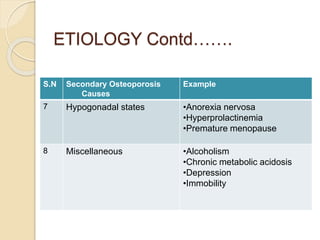
7 Hypogonadal states •Anorexia nervosa
•Hyperprolactinemia
•Premature menopause
8 Miscellaneous •Alcoholism
•Chronic metabolic acidosis
•Depression
•Immobility
RISK FACTORS & EFFECTS ON
BONE
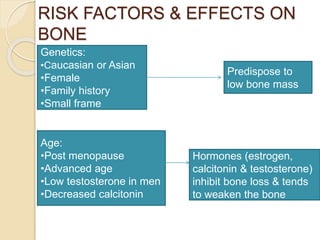
Age:
•Post menopause
•Advanced age
•Low testosterone in men
•Decreased calcitonin
Hormones (estrogen,
calcitonin & testosterone)
inhibit bone loss & tends
to weaken the bone
Genetics:
•Caucasian or Asian
•Female
•Family history
•Small frame
Predispose to
low bone mass
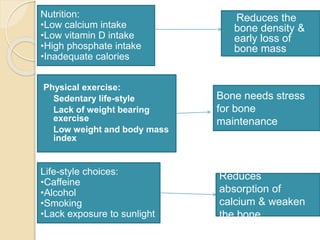
Physical exercise:
 Sedentary life-style
 Lack of weight bearing
exercise
 Low weight and body mass
index
Life-style choices:
•Caffeine
•Alcohol
•Smoking
•Lack exposure to sunlight
Nutrition:
•Low calcium intake
•Low vitamin D intake
•High phosphate intake
•Inadequate calories
Reduces the
bone density &
early loss of
bone mass
Reduces
absorption of
calcium & weaken
the bone
Bone needs stress
for bone
maintenance
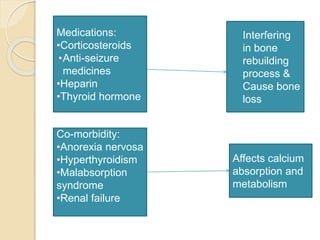
Medications:
•Corticosteroids
•Anti-seizure
medicines
•Heparin
•Thyroid hormone
Co-morbidity:
•Anorexia nervosa
•Hyperthyroidism
•Malabsorption
syndrome
•Renal failure
Affects calcium
absorption and
metabolism
 Interfering
in bone
rebuilding
process &
Cause bone
loss
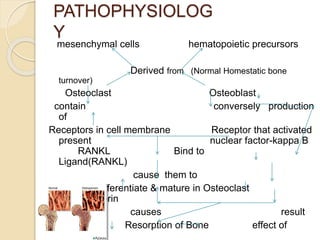
PATHOPHYSIOLOG
Y
mesenchymal cells hematopoietic precursors
Derived from (Normal Homestatic bone
turnover)
Osteoclast Osteoblast
contain conversely production
of
Receptors in cell membrane Receptor that activated
present nuclear factor-kappa B
RANKL Bind to
Ligand(RANKL)
cause them to
Differentiate & mature in Osteoclast
osteoprogerin
causes result
Resorption of Bone effect of
RANKL
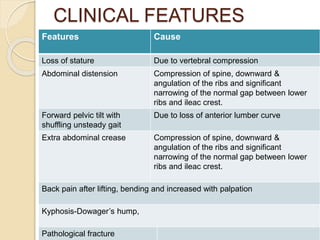
CLINICAL FEATURES
Features Cause
Loss of stature Due to vertebral compression
Abdominal distension Compression of spine, downward &
angulation of the ribs and significant
narrowing of the normal gap between lower
ribs and ileac crest.
Forward pelvic tilt with
shuffling unsteady gait
Due to loss of anterior lumber curve
Extra abdominal crease Compression of spine, downward &
angulation of the ribs and significant
narrowing of the normal gap between lower
ribs and ileac crest.
Back pain after lifting, bending and increased with palpation
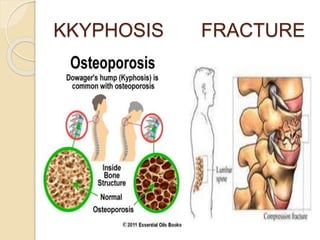
Kyphosis-Dowager’s hump,
Pathological fracture
KKYPHOSIS FRACTURE
DIAGNOSIS
• History
• Clinical examination
-Examination of active and passive range of motion (ROM)
assists in determining whether spine, hip, wrist, or other
osseous pathology may be present.
-Thorough neurologic examination = to rule out spinal cord
and/or peripheral nerve compromise.
-Thoracic kyphosis with an exaggerated cervical lordosis
(dowager hump).
-Pain at fractured sites
DIAGNOSIS Contd……..
• X-ray-Chest, Spine, Pelvic- loss of density of bone and
thinning of cortices
• CT Scan- Widened Haversian Canal with thin Trabeculae
• Laboratory test-
Blood Biochemistry:
-Sr, Calcium , Sr. Phosphate, Sr. Alkaline phosphatase,
Protien-Normal in primary osteoporosis
- Creatinine= Increased
Liver function Test:
Increase level of alanine aminotransferase (ALT),
aspartate aminotransferase (AST), gamma-glutamyl
transferase (GGT), bilirubin, and alkaline phosphatase may
indicate alcohol abuse .
DIAGNOSIS Contd……..
 Hematological Test:
Hematocrit, Hb , ESR
 Bone biopsy
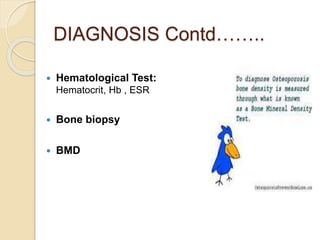
 BMD
TREATMENT
 Conservative :
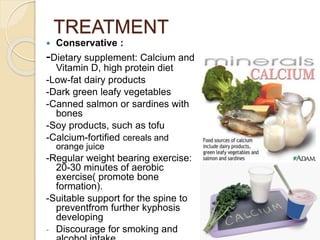
-Dietary supplement: Calcium and
Vitamin D, high protein diet
-Low-fat dairy products
-Dark green leafy vegetables
-Canned salmon or sardines with
bones
-Soy products, such as tofu
-Calcium-fortified cereals and
orange juice
-Regular weight bearing exercise:
20-30 minutes of aerobic
exercise( promote bone
formation).
-Suitable support for the spine to
preventfrom further kyphosis
developing
- Discourage for smoking and
TREATMENT Contd……
• Pharmacological:
Hormonal Therapy: raloxifene, and estrogen
Anti-osteoporotic drug:
-bisphosphonates
-Zoledronic acid
- Alendronate (Fosamax)
-Risedronate (Actonel, Atelvia)
-Ibandronate (Boniva)
CalcitoninTherapy:
by Nasal spray or IM or Subcutaneous- inhibits
osteoclast=reducing loss of bone.
• Management of Fracture
SURGICAL PROCEDURE
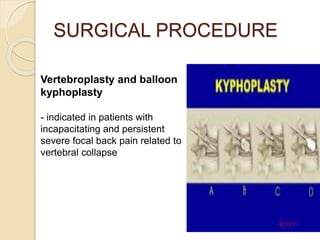
Vertebroplasty and balloon
kyphoplasty
- indicated in patients with
incapacitating and persistent
severe focal back pain related to
vertebral collapse
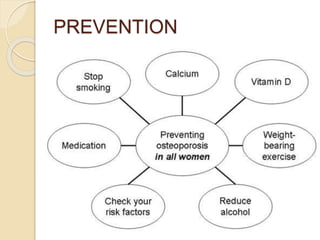
PREVENTION
NURSING ASSESSMENT
 History concerning the osteopenia i.e family history, H/o
previous fracture, dietary consumption
 Exercise pattern
 Onset of menopause
 Use of steroids
 Alcohol , smoking and caffeine intake
 H/o Back pain, constipation, altered gait
 O/E-
- Fracture,pain
- Kyphosis of thoracic spine
- Shortened stature
- Decreased mobility
- Difficulty in breathing
NURSING DIAGNOSIS
 Deficit knowledge R/T disease process and
treatment.
 Acute pain R/T fracture and muscle spasm.
 Risk for constipation R/T immobility.
 Risk for injury R/T osteoporosis.
NURSING INTERVENTION
 promote understanding of osteoporosis and the
treatment :
- Patient teaching focuses on factors and development of
osteoporosis which promote understanding of
osteoporosis and the treatment .
- Encouraged patient for normal diet and nutrients.
 Relieving pain:
- Patient is kept in bed in supine position or side- lying
position for several times a day.
- Firm and nonsagging mattress is kept.
- Encourage patient for knee flexion to relieve back pain.
- Encouraged patient for intermittent local heat and back
rub for muscles relaxation.
NURSING INTERVENTION
Contd…….
 Improving bowel elimination:
-patient encouraged for high fibre diet, increased fluids.
• Preventing injury:
- Patient was taught for isometric exercise of trunk.
- Patient encouraged for walking, good body mechanics
with good posture.
- Encouraged for daily weight bearing activities.
HOME BASED CARE
• Encourage patient for the active exercise
daily or five days/week.
• Advice patient to increase calcium intake by
having calcium containing foods.
• Advice family to form rough floor or prevent
from the sliding.
• Advice family member to keep support or
rails at the stairs, bathroom, rest room.
THANK YOU
THANK
YOU

Osteoporosis

  • 1.
  • 2.
    NORMAL BONE FORMATION &REMODELING  Bone is continually remodeled throughout our lives in response to microtrauma.  Bone remodeling occurs at discrete sites within the skeleton and proceeds in an orderly fashion, and bone resorption is always followed by bone formation,  Dense cortical bone and Cancellous bone(trabecular) differ in their architecture but are similar in molecular composition and have an extracellular matrix with mineralized and non- mineralized components.  Bone strength is determined by collagenous proteins and greater concentration of calcium (mineralized osteoid).  In adults, approximately 25% of trabecular bone is reabsorbed and replaced each year,
  • 3.
    Contd…… mesenchymal cells hematopoieticprecursors Derived from Osteoclast Osteoblast contain Produce Produce Receptors in cell membrane Receptor that activated present nuclear factor-kappa B RANKL Bind to Ligand(RANKL) cause them to Differentiate & mature in Osteoclast osteoprogerin causes block Resorption of Bone effect of RANKL Inhibition of
  • 4.
    INTRODUCTION  Osteoporosis isa chronic, progressive disease of multifactorial etiology.  It is most frequently recognized in particularly in elderly people and does occur in sexes, all races, and all age groups.  Osteoporosis is a preventable disease that can result in disturbing physical, psychosocial, and economic consequences.  Osteoporosis is a systemic skeletal disease characterized by low bone mass and micro architectural deterioration of bone tissue.  There is a change in the normal homeostatic bone turnover i.e; rate of bone reabsorption is greater than the rate of bone formation and resulting reduced total bone mass.
  • 5.
    Contd……  Normal TrabecularBone Mass  Osteoporosis is defined as reduction in bone mass, osteopenia and reduction in trabecular bone mass.
  • 6.
    Contd……  Primary Osteoporosis: -Occurs I meopausal women - Failure to develop peak bone mass & Vit.D - Excess use of caffiene, cigarrate, soft drink alcohol Secondary Osteoporosis - Result of corticxosteroids excess of 5mg for more than 3 month - Depo
  • 7.
    ETIOLOGY S.N Primary Osteoporosis Causes Characteristics 1 Post Menopausal •decreaseestrogen level & Ca- osteopenia •Occurs in women aged 50-65 years •accelerated bone loss, primarily from trabecular bone •Fractures of the distal forearm and vertebral bodies common 2 Senile •Calcium deficiency •Occurs in women and men older than 70 years •Represents bone loss associated with aging •Fractures occur in cortical and trabecular boneWrist, vertebral
  • 8.
    ETIOLOGY Contd……. S.N SecondaryOsteoporosis Causes Example 3 Genetic/congenital •Cystic fibrosis •Renal hypercalciuria •Gaucher disease •Marfan syndrome •Hypophosphatasia 4 Endocrine disorders •Cushing syndrome •Diabetes mellitus •Adrenal insufficiency •Estrogen deficiency •Hyperparathyroidism •Hyperthyroidism •Pregnancy
  • 9.
    ETIOLOGY Contd……. S.N SecondaryOsteoporosis Causes Example 5 Deficiency states •Calcium deficiency •Protein deficiency •Vitamin D deficiency •Malabsorption •Parenteral nutrition 6 Medications •Anticonvulsants: phenytoin, barbiturates, carbamazepine induced vitamin D deficiency •Antipsychotic drugs •Furosemide •Glucocorticoids and corticotropin prednisone (≥5 mg/day for ≥3 month) •Heparin (long term) •Chemotherapeutic
  • 10.
    ETIOLOGY Contd……. S.N SecondaryOsteoporosis Causes Example 7 Hypogonadal states •Anorexia nervosa •Hyperprolactinemia •Premature menopause 8 Miscellaneous •Alcoholism •Chronic metabolic acidosis •Depression •Immobility
  • 11.
    RISK FACTORS &EFFECTS ON BONE Age: •Post menopause •Advanced age •Low testosterone in men •Decreased calcitonin Hormones (estrogen, calcitonin & testosterone) inhibit bone loss & tends to weaken the bone Genetics: •Caucasian or Asian •Female •Family history •Small frame Predispose to low bone mass
  • 12.
    Physical exercise:  Sedentarylife-style  Lack of weight bearing exercise  Low weight and body mass index Life-style choices: •Caffeine •Alcohol •Smoking •Lack exposure to sunlight Nutrition: •Low calcium intake •Low vitamin D intake •High phosphate intake •Inadequate calories Reduces the bone density & early loss of bone mass Reduces absorption of calcium & weaken the bone Bone needs stress for bone maintenance
  • 13.
  • 14.
    PATHOPHYSIOLOG Y mesenchymal cells hematopoieticprecursors Derived from (Normal Homestatic bone turnover) Osteoclast Osteoblast contain conversely production of Receptors in cell membrane Receptor that activated present nuclear factor-kappa B RANKL Bind to Ligand(RANKL) cause them to Differentiate & mature in Osteoclast osteoprogerin causes result Resorption of Bone effect of RANKL
  • 16.
    CLINICAL FEATURES Features Cause Lossof stature Due to vertebral compression Abdominal distension Compression of spine, downward & angulation of the ribs and significant narrowing of the normal gap between lower ribs and ileac crest. Forward pelvic tilt with shuffling unsteady gait Due to loss of anterior lumber curve Extra abdominal crease Compression of spine, downward & angulation of the ribs and significant narrowing of the normal gap between lower ribs and ileac crest. Back pain after lifting, bending and increased with palpation Kyphosis-Dowager’s hump, Pathological fracture
  • 17.
  • 18.
    DIAGNOSIS • History • Clinicalexamination -Examination of active and passive range of motion (ROM) assists in determining whether spine, hip, wrist, or other osseous pathology may be present. -Thorough neurologic examination = to rule out spinal cord and/or peripheral nerve compromise. -Thoracic kyphosis with an exaggerated cervical lordosis (dowager hump). -Pain at fractured sites
  • 19.
    DIAGNOSIS Contd…….. • X-ray-Chest,Spine, Pelvic- loss of density of bone and thinning of cortices • CT Scan- Widened Haversian Canal with thin Trabeculae • Laboratory test- Blood Biochemistry: -Sr, Calcium , Sr. Phosphate, Sr. Alkaline phosphatase, Protien-Normal in primary osteoporosis - Creatinine= Increased Liver function Test: Increase level of alanine aminotransferase (ALT), aspartate aminotransferase (AST), gamma-glutamyl transferase (GGT), bilirubin, and alkaline phosphatase may indicate alcohol abuse .
  • 20.
    DIAGNOSIS Contd……..  HematologicalTest: Hematocrit, Hb , ESR  Bone biopsy  BMD
  • 21.
    TREATMENT  Conservative : -Dietarysupplement: Calcium and Vitamin D, high protein diet -Low-fat dairy products -Dark green leafy vegetables -Canned salmon or sardines with bones -Soy products, such as tofu -Calcium-fortified cereals and orange juice -Regular weight bearing exercise: 20-30 minutes of aerobic exercise( promote bone formation). -Suitable support for the spine to preventfrom further kyphosis developing - Discourage for smoking and
  • 22.
    TREATMENT Contd…… • Pharmacological: HormonalTherapy: raloxifene, and estrogen Anti-osteoporotic drug: -bisphosphonates -Zoledronic acid - Alendronate (Fosamax) -Risedronate (Actonel, Atelvia) -Ibandronate (Boniva) CalcitoninTherapy: by Nasal spray or IM or Subcutaneous- inhibits osteoclast=reducing loss of bone. • Management of Fracture
  • 23.
    SURGICAL PROCEDURE Vertebroplasty andballoon kyphoplasty - indicated in patients with incapacitating and persistent severe focal back pain related to vertebral collapse
  • 24.
  • 25.
    NURSING ASSESSMENT  Historyconcerning the osteopenia i.e family history, H/o previous fracture, dietary consumption  Exercise pattern  Onset of menopause  Use of steroids  Alcohol , smoking and caffeine intake  H/o Back pain, constipation, altered gait  O/E- - Fracture,pain - Kyphosis of thoracic spine - Shortened stature - Decreased mobility - Difficulty in breathing
  • 26.
    NURSING DIAGNOSIS  Deficitknowledge R/T disease process and treatment.  Acute pain R/T fracture and muscle spasm.  Risk for constipation R/T immobility.  Risk for injury R/T osteoporosis.
  • 27.
    NURSING INTERVENTION  promoteunderstanding of osteoporosis and the treatment : - Patient teaching focuses on factors and development of osteoporosis which promote understanding of osteoporosis and the treatment . - Encouraged patient for normal diet and nutrients.  Relieving pain: - Patient is kept in bed in supine position or side- lying position for several times a day. - Firm and nonsagging mattress is kept. - Encourage patient for knee flexion to relieve back pain. - Encouraged patient for intermittent local heat and back rub for muscles relaxation.
  • 28.
    NURSING INTERVENTION Contd…….  Improvingbowel elimination: -patient encouraged for high fibre diet, increased fluids. • Preventing injury: - Patient was taught for isometric exercise of trunk. - Patient encouraged for walking, good body mechanics with good posture. - Encouraged for daily weight bearing activities.
  • 29.
    HOME BASED CARE •Encourage patient for the active exercise daily or five days/week. • Advice patient to increase calcium intake by having calcium containing foods. • Advice family to form rough floor or prevent from the sliding. • Advice family member to keep support or rails at the stairs, bathroom, rest room.
  • 30.