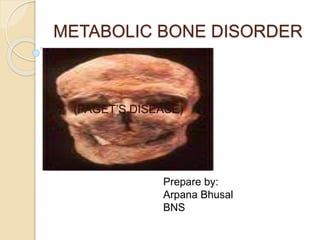
METABOLIC BONE DISORDER
(PAGET’S DISEASE)
Prepare by:
Arpana Bhusal
BNS
INTRODUCTION
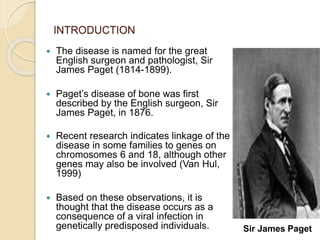
 The disease is named for the great
English surgeon and pathologist, Sir
James Paget (1814-1899).
 Paget’s disease of bone was first
described by the English surgeon, Sir
James Paget, in 1876.
 Recent research indicates linkage of the
disease in some families to genes on
chromosomes 6 and 18, although other
genes may also be involved (Van Hul,
1999)
 Based on these observations, it is
thought that the disease occurs as a
consequence of a viral infection in
genetically predisposed individuals. Sir James Paget
DEFINITION
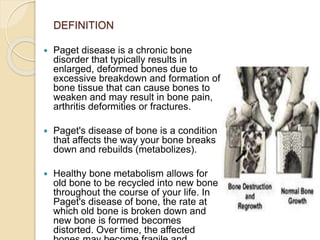
 Paget disease is a chronic bone
disorder that typically results in
enlarged, deformed bones due to
excessive breakdown and formation of
bone tissue that can cause bones to
weaken and may result in bone pain,
arthritis deformities or fractures.
 Paget's disease of bone is a condition
that affects the way your bone breaks
down and rebuilds (metabolizes).
 Healthy bone metabolism allows for
old bone to be recycled into new bone
throughout the course of your life. In
Paget's disease of bone, the rate at
which old bone is broken down and
new bone is formed becomes
distorted. Over time, the affected
AETIOLOGY
 The cause of Paget’s disease is unknown.
 Up to 15% of affected individuals report a family history in a
first-degree relative, suggesting that genetic factors are
important in pathogenesis.
Genetics
infectious
viral cause
Calcium &
Vit. D
Deficiency
RISK FACTORS
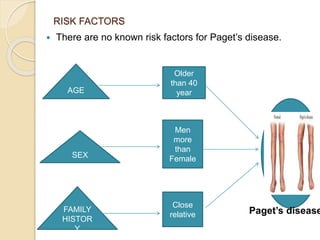
 There are no known risk factors for Paget’s disease.
Older
than 40
year
Men
more
than
Female
Close
relative
AGE
SEX
FAMILY
HISTOR
Y
Paget’s disease
BONE INVOLVED IN PAGET’S DISEASE
Most common bones in Paget’s disease
are:
 The pelvis
 Lumbar spine
 Femur
 Thoracic spine
 Sacrum
 Skull
 Tibia and Humerus
 Internal structure of bone, chest
 Lower extremity
 Hands and wrists
 Feet
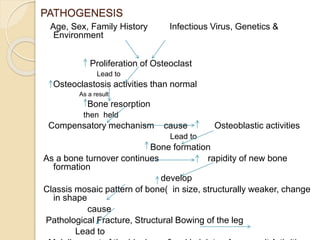
PATHOGENESIS
Age, Sex, Family History Infectious Virus, Genetics &
Environment
Proliferation of Osteoclast
Lead to
Osteoclastosis activities than normal
As a result
Bone resorption
then held
Compensatory mechanism cause Osteoblastic activities
Lead to
Bone formation
As a bone turnover continues rapidity of new bone
formation
develop
Classis mosaic pattern of bone( in size, structurally weaker, change
in shape
cause
Pathological Fracture, Structural Bowing of the leg
Lead to
CLINICAL FEATURES
 Most common symptom is pain:-
o Bone pain
◦ Pain may be worse at night
◦ Headache
◦ Arm pain(bilateral)
◦ Leg pain(bilateral)
◦ Neck pain
o Joint Pain
◦ Shoulder pain(bilateral)
◦ Elbow pain
◦ Hip pain(bilateral)
◦ Knee pain(bilateral)
◦ Ankle pain
o Back pain
◦ Low Back pain
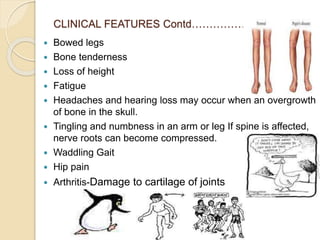
CLINICAL FEATURES Contd……………
 Bowed legs
 Bone tenderness
 Loss of height
 Fatigue
 Headaches and hearing loss may occur when an overgrowth
of bone in the skull.
 Tingling and numbness in an arm or leg If spine is affected,
nerve roots can become compressed.
 Waddling Gait
 Hip pain
 Arthritis-Damage to cartilage of joints
DIAGNOSIS
 History
 Physical Examination
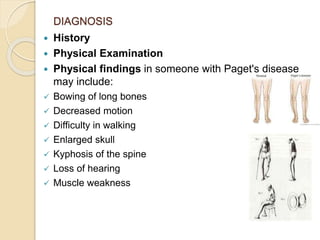
 Physical findings in someone with Paget's disease
may include:
 Bowing of long bones
 Decreased motion
 Difficulty in walking
 Enlarged skull
 Kyphosis of the spine
 Loss of hearing
 Muscle weakness
DIAGNOSIS Contd………
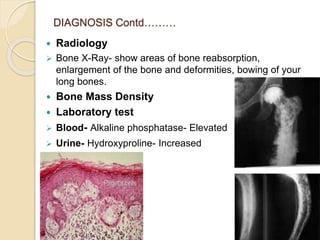
 Radiology
 Bone X-Ray- show areas of bone reabsorption,
enlargement of the bone and deformities, bowing of your
long bones.
 Bone Mass Density
 Laboratory test
 Blood- Alkaline phosphatase- Elevated
 Urine- Hydroxyproline- Increased
 Bone Biopsy
MANAGEMENT
 General measures
 give information and education about it.
 Treat the patient with the multidisciplinary team i.e surgeon,
physiotherapist and occupational therapist.
 Patients with lower limb deformities may develop secondary
foot problems and should be referred for podiatric
assessment.
 Advice about suitable shoe-wear or the provision of simple
foot orthosis which can often result in reduced pain and
improved mobility.
MANAGEMENT Contd…………
 General measures
 Encourage patient with lower limb for the degree of activity
and rest that they can undertake, including the importance of
pacing and planning activities.
 They should receive counseling about lifestyle measures to
reduce risk of falls.
 patients should have audiometry and provision of a
hearing aid if necessary.
 Cane or Walker
PHARMACOLOGICAL MANAGEMENT
 The goal of drug treatment is to control Paget's disease
activity for as long a period of time as possible.
 If you don't have symptoms, you may not need
treatment.
 NSAIDs for pain- Naproxen, Ibubrufen, Ketoprofen
 Calcium supplement
 Vitamin D supplement
 Biphosphonates- to stabilize rapid bone turnover
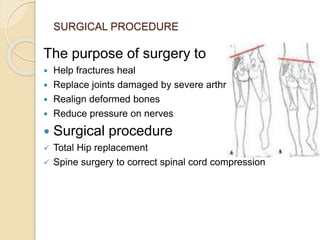
SURGICAL PROCEDURE
The purpose of surgery to
 Help fractures heal
 Replace joints damaged by severe arthritis
 Realign deformed bones
 Reduce pressure on nerves
 Surgical procedure
 Total Hip replacement
 Spine surgery to correct spinal cord compression
COMPLICATIONS
 Fractures:
 Osteoarthritis:
 Heart failure:
 Bone cancer:
 Loss of Vision
 Paraplegia
 Spinal stenosis
 Deafness
WARNING SIGN OF PAGET’S DISEASE
Notify the doctor if you have Paget's disease and any of
the following:
 Difficulty in walking
 Inability to take prescribed medications
 Kyphosis
 Abnormal curvature to the upper spine
 Loss of height
 Joint pain and Joint swelling
 Worsening back pain, hip pain and joint pain
NURSING CONSIDERATION
 Nursing Assessment
 Asses the pain and function ability of the affected part.
 Observe for bowing leg or waddling gait.
 Assess for cardiovascular complications.
 Assess for auditory symptoms- tinnitus, vertigo & hearing
loss.
• Nursing Diagnosis
 Pain R/T pathophysiologic process.
 Risk for injury R/T fall , fragile and dense bone structure
bow, weak leg.
• Nursing Goal
 Patient’s pain will be reduced as evidenced by providing
facial expression,verbalization.
NURSING CONSIDERATION Contd………….
 Nursing Planning & Action
 Reducing pain
-administer and teach self administration of analgesics.
-position the patient as ordered or frequently if there is no
restriction.
 Dietary Therapy
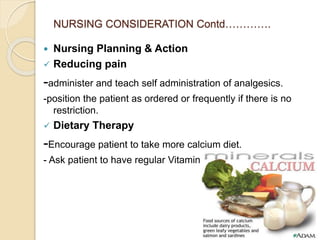
-Encourage patient to take more calcium diet.
- Ask patient to have regular Vitamin D.
NURSING CONSIDERATION Contd………….
 Preventing injury
 Establish exercise protocols through a physiotherapist to
maintain physical abilities and prevent from fall.
 Assist the patient with activities as necessary.
 Provide heel lift, walking aids as needed.
• Surgery Intervention
 Do perioperative care to the patient as needed.
HOME BASED CARE
 Ask Family to remove slippery floor coverings, use
nonskid mats in your bathtub or shower, tuck away
cords, and install handrails on stairways and grab bars
in your bathroom, use a cane or a walker to prevent
from fall.
 Maintain good lighting to prevent from fall injury.
 Provide education about the disease process and
medication.
 Educate the patient about the use of mobility aids.
HOME BASED CARE Contd……..
 Follow an exercise plan developed with your doctor.
 Perform gentle stretching after exercise.
 Encourage patient to loose weight if she/he is
overweight.
 Apply warm compresses for stiffness for 20-30 minutes,
every 1-2 hours.
 Use splints when the joints are swollen.
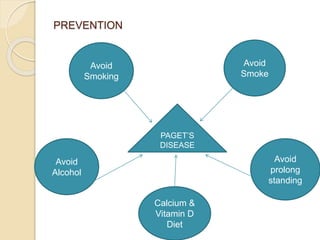
PREVENTION
PAGET’S
DISEASE
Avoid
Smoking
Avoid
Alcohol
Calcium &
Vitamin D
Diet
Avoid
prolong
standing
Avoid
Smoke
THANK YOU
THANK
YOU

PAGET'S DISEASE

  • 1.
    METABOLIC BONE DISORDER (PAGET’SDISEASE) Prepare by: Arpana Bhusal BNS
  • 2.
    INTRODUCTION  The diseaseis named for the great English surgeon and pathologist, Sir James Paget (1814-1899).  Paget’s disease of bone was first described by the English surgeon, Sir James Paget, in 1876.  Recent research indicates linkage of the disease in some families to genes on chromosomes 6 and 18, although other genes may also be involved (Van Hul, 1999)  Based on these observations, it is thought that the disease occurs as a consequence of a viral infection in genetically predisposed individuals. Sir James Paget
  • 3.
    DEFINITION  Paget diseaseis a chronic bone disorder that typically results in enlarged, deformed bones due to excessive breakdown and formation of bone tissue that can cause bones to weaken and may result in bone pain, arthritis deformities or fractures.  Paget's disease of bone is a condition that affects the way your bone breaks down and rebuilds (metabolizes).  Healthy bone metabolism allows for old bone to be recycled into new bone throughout the course of your life. In Paget's disease of bone, the rate at which old bone is broken down and new bone is formed becomes distorted. Over time, the affected
  • 4.
    AETIOLOGY  The causeof Paget’s disease is unknown.  Up to 15% of affected individuals report a family history in a first-degree relative, suggesting that genetic factors are important in pathogenesis. Genetics infectious viral cause Calcium & Vit. D Deficiency
  • 5.
    RISK FACTORS  Thereare no known risk factors for Paget’s disease. Older than 40 year Men more than Female Close relative AGE SEX FAMILY HISTOR Y Paget’s disease
  • 6.
    BONE INVOLVED INPAGET’S DISEASE Most common bones in Paget’s disease are:  The pelvis  Lumbar spine  Femur  Thoracic spine  Sacrum  Skull  Tibia and Humerus  Internal structure of bone, chest  Lower extremity  Hands and wrists  Feet
  • 7.
    PATHOGENESIS Age, Sex, FamilyHistory Infectious Virus, Genetics & Environment Proliferation of Osteoclast Lead to Osteoclastosis activities than normal As a result Bone resorption then held Compensatory mechanism cause Osteoblastic activities Lead to Bone formation As a bone turnover continues rapidity of new bone formation develop Classis mosaic pattern of bone( in size, structurally weaker, change in shape cause Pathological Fracture, Structural Bowing of the leg Lead to
  • 8.
    CLINICAL FEATURES  Mostcommon symptom is pain:- o Bone pain ◦ Pain may be worse at night ◦ Headache ◦ Arm pain(bilateral) ◦ Leg pain(bilateral) ◦ Neck pain o Joint Pain ◦ Shoulder pain(bilateral) ◦ Elbow pain ◦ Hip pain(bilateral) ◦ Knee pain(bilateral) ◦ Ankle pain o Back pain ◦ Low Back pain
  • 9.
    CLINICAL FEATURES Contd…………… Bowed legs  Bone tenderness  Loss of height  Fatigue  Headaches and hearing loss may occur when an overgrowth of bone in the skull.  Tingling and numbness in an arm or leg If spine is affected, nerve roots can become compressed.  Waddling Gait  Hip pain  Arthritis-Damage to cartilage of joints
  • 10.
    DIAGNOSIS  History  PhysicalExamination  Physical findings in someone with Paget's disease may include:  Bowing of long bones  Decreased motion  Difficulty in walking  Enlarged skull  Kyphosis of the spine  Loss of hearing  Muscle weakness
  • 11.
    DIAGNOSIS Contd………  Radiology Bone X-Ray- show areas of bone reabsorption, enlargement of the bone and deformities, bowing of your long bones.  Bone Mass Density  Laboratory test  Blood- Alkaline phosphatase- Elevated  Urine- Hydroxyproline- Increased  Bone Biopsy
  • 12.
    MANAGEMENT  General measures give information and education about it.  Treat the patient with the multidisciplinary team i.e surgeon, physiotherapist and occupational therapist.  Patients with lower limb deformities may develop secondary foot problems and should be referred for podiatric assessment.  Advice about suitable shoe-wear or the provision of simple foot orthosis which can often result in reduced pain and improved mobility.
  • 13.
    MANAGEMENT Contd…………  Generalmeasures  Encourage patient with lower limb for the degree of activity and rest that they can undertake, including the importance of pacing and planning activities.  They should receive counseling about lifestyle measures to reduce risk of falls.  patients should have audiometry and provision of a hearing aid if necessary.  Cane or Walker
  • 14.
    PHARMACOLOGICAL MANAGEMENT  Thegoal of drug treatment is to control Paget's disease activity for as long a period of time as possible.  If you don't have symptoms, you may not need treatment.  NSAIDs for pain- Naproxen, Ibubrufen, Ketoprofen  Calcium supplement  Vitamin D supplement  Biphosphonates- to stabilize rapid bone turnover
  • 15.
    SURGICAL PROCEDURE The purposeof surgery to  Help fractures heal  Replace joints damaged by severe arthritis  Realign deformed bones  Reduce pressure on nerves  Surgical procedure  Total Hip replacement  Spine surgery to correct spinal cord compression
  • 16.
    COMPLICATIONS  Fractures:  Osteoarthritis: Heart failure:  Bone cancer:  Loss of Vision  Paraplegia  Spinal stenosis  Deafness
  • 17.
    WARNING SIGN OFPAGET’S DISEASE Notify the doctor if you have Paget's disease and any of the following:  Difficulty in walking  Inability to take prescribed medications  Kyphosis  Abnormal curvature to the upper spine  Loss of height  Joint pain and Joint swelling  Worsening back pain, hip pain and joint pain
  • 18.
    NURSING CONSIDERATION  NursingAssessment  Asses the pain and function ability of the affected part.  Observe for bowing leg or waddling gait.  Assess for cardiovascular complications.  Assess for auditory symptoms- tinnitus, vertigo & hearing loss. • Nursing Diagnosis  Pain R/T pathophysiologic process.  Risk for injury R/T fall , fragile and dense bone structure bow, weak leg. • Nursing Goal  Patient’s pain will be reduced as evidenced by providing facial expression,verbalization.
  • 19.
    NURSING CONSIDERATION Contd…………. Nursing Planning & Action  Reducing pain -administer and teach self administration of analgesics. -position the patient as ordered or frequently if there is no restriction.  Dietary Therapy -Encourage patient to take more calcium diet. - Ask patient to have regular Vitamin D.
  • 20.
    NURSING CONSIDERATION Contd…………. Preventing injury  Establish exercise protocols through a physiotherapist to maintain physical abilities and prevent from fall.  Assist the patient with activities as necessary.  Provide heel lift, walking aids as needed. • Surgery Intervention  Do perioperative care to the patient as needed.
  • 21.
    HOME BASED CARE Ask Family to remove slippery floor coverings, use nonskid mats in your bathtub or shower, tuck away cords, and install handrails on stairways and grab bars in your bathroom, use a cane or a walker to prevent from fall.  Maintain good lighting to prevent from fall injury.  Provide education about the disease process and medication.  Educate the patient about the use of mobility aids.
  • 22.
    HOME BASED CAREContd……..  Follow an exercise plan developed with your doctor.  Perform gentle stretching after exercise.  Encourage patient to loose weight if she/he is overweight.  Apply warm compresses for stiffness for 20-30 minutes, every 1-2 hours.  Use splints when the joints are swollen.
  • 23.
  • 24.