PREPARED BY:
RN Arpana Bhusal
BNS
CONTENT LAYOUT
•Introduction
•Types
•Causes
•Sign and symptoms
•Assessment and diagnostic findings
•Management
•References
INTRODUCTION
•An airway obstruction is a blockage in any part of the
airway.
•The airway is a complex system of tubes that conveys
inhaled air from nose and mouth into the lungs.
•An obstruction may partially or totally prevent air from
getting into lungs.
•Acute upper airway obstruction is a life-threatening
medical emergency.
CONTD..
• If the airway is completely obstructed, permanent brain
damage or death will occur within 3 to 5 minutes
secondary to hypoxia.
•Partial obstruction of the airway can lead to progressive
hypoxia, hypercarbia, and respiratory and cardiac arrest.
TYPES OF AIRWAY OBSTRUCTION
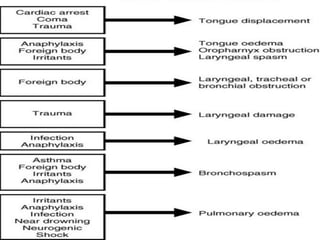
CAUSES OF OBSTRUCTION
Upper airway obstruction
•Foreign objects(candy, nuts, grapes, balloon, coin - in
children. Meat, fish, sausage, fruits, vegetables- in adults.)
•Anaphylaxis ( peanuts, tree nuts, insect venom, seeds,
medicines )
•Burns
•Infections ( epiglottitis, bacterial tracheitis, diphtheria,
retropharyngeal abscess, peritonsillar abscess)
CAUSES OF OBSTRUCTIONCONTD..
Lower airways obstruction
•Asthma
•Bronchitis
•COPD
SIGN AND SYMPTOMS
•Violent cough
•Difficulty in breathing
•Choking, Gasping for air
•Panic
•Gagging and vomiting
•Cyanosis
•Confusion
•High pitched breathing such as wheezing, stridor.
•unconsciousness
ASSESSMENT AND DIAGNOSTIC
FINDINGS
•Assessment of the patient who has a foreign object
occluding the airway may involve simply asking the
person whether he or she is choking and requires help.
•If the person is unconscious, inspection of the oropharynx
may reveal the offending object.
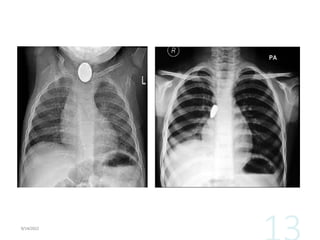
•X-rays, laryngoscopy, or bronchoscopy also may be
performed.
MANAGEMENT
Brain storming season
EMERGENCYMANAGEMENTOFAIRWAY
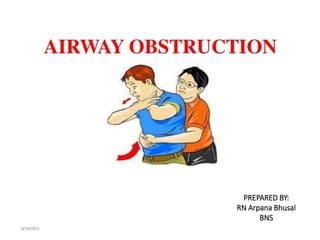
OBSTRUCTIONDUE TOFOREIGNBODIES
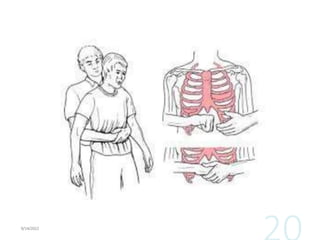
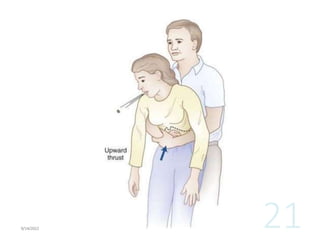
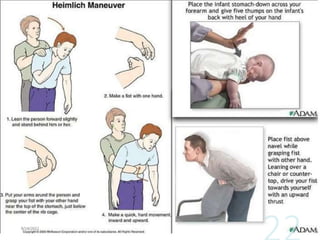
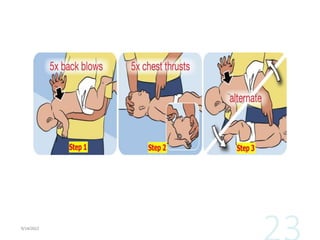
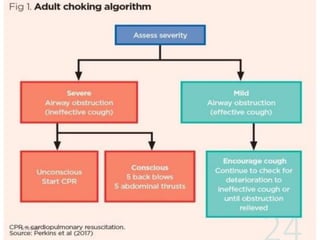
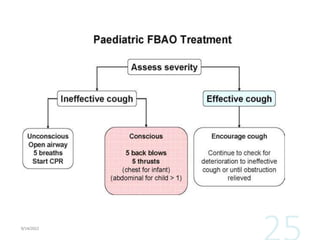
•Calm and reassure the patient and encourage to cough.
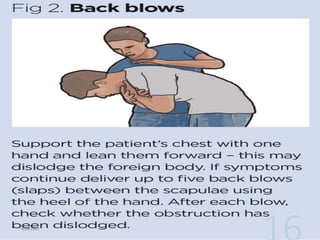
•If this is not successful, then give sharp 5 back blows.
•Check the mouth and remove any obstruction.
•If back blow is unsuccessful, then give five abdominal
thrust( Heimlich maneuver).
•If this is also unsuccessful, then repeat 5 back blow and 5
abdominal thrust.
•Three cycle should be done.
Back blows For patient lying
(unconscious):
•Position patient on the back.
•Kneel astride the patient’s thighs, facing the head.
• Place the heel of one hand against the patient’s abdomen, in
the midline slightly above the umbilicus and well below the tip
of the xiphoid; place the second hand directly on top of the
first.
•Press into the abdomen with a quick upward thrust.
Chest thrust with patient lying
(unconscious)
•Place the patient on the back and kneel close to the side of
the patient’s body.
•Place the heel of your hand on the lower half of the
sternum.
•Deliver each chest thrust slowly and distinctly with the
intent of relieving the obstruction.
MANAGEMENT CONTD…
•Establishing an airway may be as simple as repositioning
the patient’s head to prevent the tongue from obstructing
the pharynx.
•Alternatively, other maneuvers, such as the head-tilt–
chin-lift maneuver, the jaw-thrust maneuver, or insertion
of specialized equipment may be needed to open the
airway, remove a foreign body, or maintain the airway.
•In all maneuvers, the cervical spine must be protected
from injury.
MANAGEMENT CONTD…
MANAGEMENT CONTD…
REFERENCES
•Brunner and Siddhartha's (2004), ‘medical and surgical nursing,”
7th edition, J.B Lippincott co, Philadelphia, page no:2151-2153
•2019. Mayo Foundation of Medical Foundation and Research.
Airway obstruction. https://www.mayoclinic.org@2021/07/07at
2pm.
•October 22, 2018. Airway obstruction. https://www.slideshare.net@
2021/07/07 at 2pm.
•https://www.webmd.com/lung/what-to-know-about-airway-
obstruction @2021/07/07 at 1pm.
Airway obstruction

Airway obstruction

  • 2.
  • 3.
    CONTENT LAYOUT •Introduction •Types •Causes •Sign andsymptoms •Assessment and diagnostic findings •Management •References
  • 4.
    INTRODUCTION •An airway obstructionis a blockage in any part of the airway. •The airway is a complex system of tubes that conveys inhaled air from nose and mouth into the lungs. •An obstruction may partially or totally prevent air from getting into lungs. •Acute upper airway obstruction is a life-threatening medical emergency.
  • 5.
    CONTD.. • If theairway is completely obstructed, permanent brain damage or death will occur within 3 to 5 minutes secondary to hypoxia. •Partial obstruction of the airway can lead to progressive hypoxia, hypercarbia, and respiratory and cardiac arrest.
  • 6.
    TYPES OF AIRWAYOBSTRUCTION
  • 7.
    CAUSES OF OBSTRUCTION Upperairway obstruction •Foreign objects(candy, nuts, grapes, balloon, coin - in children. Meat, fish, sausage, fruits, vegetables- in adults.) •Anaphylaxis ( peanuts, tree nuts, insect venom, seeds, medicines ) •Burns •Infections ( epiglottitis, bacterial tracheitis, diphtheria, retropharyngeal abscess, peritonsillar abscess)
  • 8.
    CAUSES OF OBSTRUCTIONCONTD.. Lowerairways obstruction •Asthma •Bronchitis •COPD
  • 10.
    SIGN AND SYMPTOMS •Violentcough •Difficulty in breathing •Choking, Gasping for air •Panic •Gagging and vomiting •Cyanosis •Confusion •High pitched breathing such as wheezing, stridor. •unconsciousness
  • 12.
    ASSESSMENT AND DIAGNOSTIC FINDINGS •Assessmentof the patient who has a foreign object occluding the airway may involve simply asking the person whether he or she is choking and requires help. •If the person is unconscious, inspection of the oropharynx may reveal the offending object. •X-rays, laryngoscopy, or bronchoscopy also may be performed.
  • 14.
  • 15.
    EMERGENCYMANAGEMENTOFAIRWAY OBSTRUCTIONDUE TOFOREIGNBODIES •Calm andreassure the patient and encourage to cough. •If this is not successful, then give sharp 5 back blows. •Check the mouth and remove any obstruction. •If back blow is unsuccessful, then give five abdominal thrust( Heimlich maneuver). •If this is also unsuccessful, then repeat 5 back blow and 5 abdominal thrust. •Three cycle should be done.
  • 17.
    Back blows Forpatient lying (unconscious): •Position patient on the back. •Kneel astride the patient’s thighs, facing the head. • Place the heel of one hand against the patient’s abdomen, in the midline slightly above the umbilicus and well below the tip of the xiphoid; place the second hand directly on top of the first. •Press into the abdomen with a quick upward thrust.
  • 19.
    Chest thrust withpatient lying (unconscious) •Place the patient on the back and kneel close to the side of the patient’s body. •Place the heel of your hand on the lower half of the sternum. •Deliver each chest thrust slowly and distinctly with the intent of relieving the obstruction.
  • 26.
    MANAGEMENT CONTD… •Establishing anairway may be as simple as repositioning the patient’s head to prevent the tongue from obstructing the pharynx. •Alternatively, other maneuvers, such as the head-tilt– chin-lift maneuver, the jaw-thrust maneuver, or insertion of specialized equipment may be needed to open the airway, remove a foreign body, or maintain the airway. •In all maneuvers, the cervical spine must be protected from injury.
  • 27.
  • 28.
  • 31.
    REFERENCES •Brunner and Siddhartha's(2004), ‘medical and surgical nursing,” 7th edition, J.B Lippincott co, Philadelphia, page no:2151-2153 •2019. Mayo Foundation of Medical Foundation and Research. Airway obstruction. https://www.mayoclinic.org@2021/07/07at 2pm. •October 22, 2018. Airway obstruction. https://www.slideshare.net@ 2021/07/07 at 2pm. •https://www.webmd.com/lung/what-to-know-about-airway- obstruction @2021/07/07 at 1pm.