








9/14/2022 1
Heat Stroke
9/14/2022 2
PREPARED BY:
RN Arpana Bhusal
BNS
DEFINITION
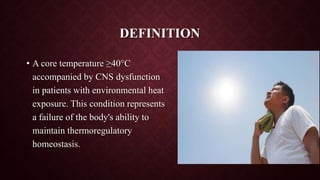
• A core temperature ≥40°C
accompanied by CNS dysfunction
in patients with environmental heat
exposure. This condition represents
a failure of the body's ability to
maintain thermoregulatory
homeostasis.
9/14/2022 3
CLASSIFICATION
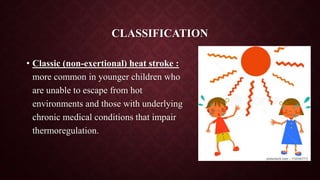
• Classic (non-exertional) heat stroke :
more common in younger children who
are unable to escape from hot
environments and those with underlying
chronic medical conditions that impair
thermoregulation.
9/14/2022 4
CONT…
• Exertional heat stroke : generally
occurs in healthy individuals who
engage in heavy exercise during
periods of high temperature and
humidity. Typical patients are
athletes and military recruits in basic
training
9/14/2022 5
PREDISPOSING FACTORS
• Increased heat production e.g. hyperthyroidism, exercise, sepsis
• Impaired heat loss – impaired sweating e.g. drugs ,abnormal sweat glands
• Impaired delivery of blood to peripheral circulation cardiovascular disease,
hypokalemia, dehydration
• Others :
 elderly,
obesity,
fatigue, DM 9/14/2022 6
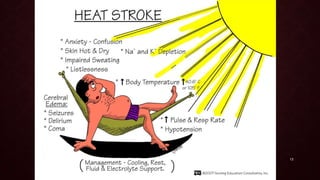
CLINICAL FEATURES
• The diagnostic criteria are elevated core temperature (≥40°C) and
(CNS) abnormalities following environmental heat exposure.
• 3 cardinal signs are
CNS dysfunction
Hyperpyrexia
Hot dry skin, pink or red depending on circulatory state
9/14/2022 7
CONT…
Children commonly present with more significant neurologic symptoms
such as –
seizures
 delirium
 hallucinations
 ataxia
coma
9/14/2022 8
OTHER CLINICAL MANIFESTATIONS
• Tachycardia
• Tachypnea
• The skin may be flushed and warm or diaphoretic.
• Vomiting and diarrhea are also common.
9/14/2022 9
CONT…
Those patients with coagulopathy may demonstrate
 purpura
 hemoptysis
 hematemesis
melena
 hematochezia
9/14/2022 10
NEUROLOGIC ABNORMALITIES:
• Permanent neurologic damage is more commonly seen in
patients with core temperatures >42ºC (107.6ºF) and consist of
 spasticity,
ataxia,
 dysarthria,
 poor coordination,
9/14/2022 11
CONT…
impaired memory, and
 behavioral changes.
• Patients recovering from rapidly treated exertional or classic heat
stroke with core body temperatures below this level may manifest
some of these neurologic findings but typically recover full.
9/14/2022 12
9/14/2022 13
PRE-HOSPITAL CARE
• Cooling might have occurred prior to the arrival of the hospital.
• Removal from the source of heat stress and rapid initiation of
cooling, as the risk of morbidity and mortality for patients with heat-
related illness is associated with the duration of hyperthermia.
9/14/2022 14
CONT…
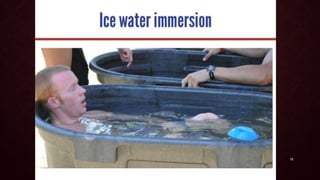
• Patients with heat stroke should be treated with either ice water
immersion or evaporative external cooling in the field.
• Pre-hospital cooling measure should be initiated prior to or
simultaneously with activation of emergency medical services.
9/14/2022 15
9/14/2022 16
CONT…
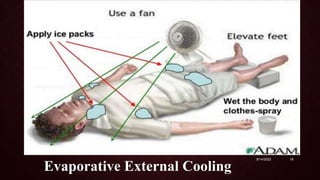
• Evaporative cooling may be accomplished in the field by spraying
patients with water or saline and fanning these patients, either
manually or with ambulance fans or air conditioners. Application of
ice packs to the neck, axillae, and groin.
• The institution of pre-hospital cooling should not delay timely
transportation to definitive care
9/14/2022 17
Evaporative External Cooling
9/14/2022 18
HOSPITAL MANAGEMENT
• Stabilization: In addition to the careful assessment and support of
airway, breathing, and circulation, the clinician should anticipate and
aggressively manage hyperthermia, dehydration, rhabdomyolysis,
DIC, high output cardiac insufficiency, renal and hepatic failure.
9/14/2022 19
CONT…
• Altered mental status typically resolves once oxygenation, adequate
tissue perfusion, and normothermia are achieved.
• Seizures should be treated with benzodiazepines (lorazepam
0.1mg/kg,IV)
9/14/2022 20
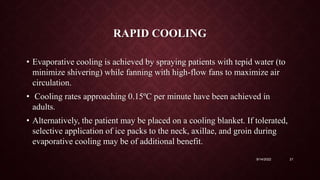
RAPID COOLING
• Evaporative cooling is achieved by spraying patients with tepid water (to
minimize shivering) while fanning with high-flow fans to maximize air
circulation.
• Cooling rates approaching 0.15ºC per minute have been achieved in
adults.
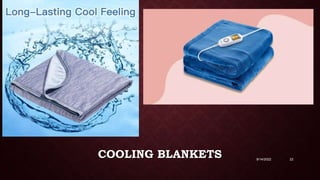
• Alternatively, the patient may be placed on a cooling blanket. If tolerated,
selective application of ice packs to the neck, axillae, and groin during
evaporative cooling may be of additional benefit.
9/14/2022 21
COOLING BLANKETS 9/14/2022 22
CONT…
Cold water immersion:
• Cold water immersion is another adjunctive cooling modality when
evaporative cooling with or without selective ice application is not
possible.
9/14/2022 23
CONT…
Internal Cooling
• The most effective method of lowering the core body temperature
quickly is the use of cardiopulmonary bypass; however, this highly
specialized intervention is not rapidly available at most institutions.
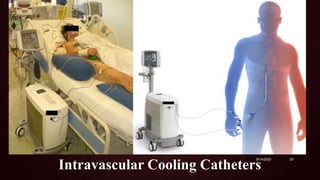
Newer, less invasive devices such as intravascular cooling catheters
have been utilized to rapidly induce therapeutic hypothermia
9/14/2022 24
Intravascular Cooling Catheters
9/14/2022 25
CONT…
• Gastric, rectal, and/or bladder lavage with cold isotonic fluids (e.g.,
normal saline that has been iced) have been proposed as additional
means of invasive cooling.
9/14/2022 26
PHARMACOLOGIC THERAPY
• Medications have a limited role in the management of heat stroke.
However, pharmacologic measures taken to prevent shivering.
• Patients with heat stroke should receive benzodiazepines (e.g.,
midazolam 0.05 to 0.1 mg/kg iv ) to prevent shivering during cooling
measures.
9/14/2022 27
CONT…
• Although antipsychotic agents (chlorpromazine) have been used in
adults to prevent shivering, it may exacerbate hypotension in heat
stroke victims.
9/14/2022 28
COMPLICATIONS
• After stabilization and rapid cooling, the victim with heat stroke
remains at high risk for multiple organ failure, metabolic
abnormalities, and disorders of coagulation.
9/14/2022 29
CONT…
 Rhabdomyolysis with hyperkalemia
 hypocalcemia and hyperphosphatemia
 DIC
Acute kidney injury
Hyponatremic dehydration
 Cardiogenic shock with low systemic vascular resistance
9/14/2022 30
CONT…
• Cardiogenic and noncardiogenic pulmonary (ARDS)
• Liver failure : Treatment is supportive. Rarely, liver transplantation
has been necessary in teenagers with heat stroke-associated liver
failure.
• Cerebral edema
9/14/2022 31
PREVENTING HEAT-RELATED ILLNESS
• Dress for the heat : Wear lightweight, light-colored clothing. It is also
a good idea to wear hats or to use an umbrella.
• Drink water : Carry water or juice and drink continuously even if we
do not feel thirsty. Avoid alcohol and caffeine, which dehydrate the
body.
• Avoid foods that are high in protein, which increase metabolic heat.
9/14/2022 32
CONT…
• Stay indoors when possible.
• Take regular breaks when engaged in physical activity on warm days.
• Take time out to find a cool place.
9/14/2022 33
POINT TO BE REMEMBER..
• Children with elevated body temperature and CNS abnormalities
should be treated as victims of heat stroke.
• Rectal temperature is the most commonly obtained core temperature
measurement.
• Morbidity or mortality are directly related to duration and degree of
hyperthermia.
9/14/2022 34
CONT…
• The institution of prehospital cooling should not delay timely
transportation to definitive care.
• The most effective method of lowering the core body temperature
quickly is the use of cardiopulmonary bypass.
9/14/2022 35
9/14/2022 36
REFERENCES:
• 2021. Slideshare. Heatstroke. https://www.slideshare.net/drasimrana/heat-stroke-
37983872 @2021/07/07 at 2pm
• July 16. 2019. Mayoclinic. Heatstroke. https://www.mayoclinic.org/diseases-
conditions/heat-stroke/symptoms-causes/syc-20353581 @2021/ 07/07 at 3pm
• 2020. WebMD. Heatstroke. https://www.webmd.com/a-to-z-guides/heat-stroke-
symptoms-and-treatment @2021/07/08 at 11am
• March 8. 2019. Vetfolio. Heatstroke: Thermoregulation, Pathophysiology, and
Predisposing Factors. https://www.vetfolio.com/learn/article/heatstroke-
thermoregulation-pathophysiology-and-predisposing-factors. @2021/07/08 at 10
pm 9/14/2022 37
Thank You 9/14/2022 38

Heat stroke

  • 1.
  • 2.
    Heat Stroke 9/14/2022 2 PREPAREDBY: RN Arpana Bhusal BNS
  • 3.
    DEFINITION • A coretemperature ≥40°C accompanied by CNS dysfunction in patients with environmental heat exposure. This condition represents a failure of the body's ability to maintain thermoregulatory homeostasis. 9/14/2022 3
  • 4.
    CLASSIFICATION • Classic (non-exertional)heat stroke : more common in younger children who are unable to escape from hot environments and those with underlying chronic medical conditions that impair thermoregulation. 9/14/2022 4
  • 5.
    CONT… • Exertional heatstroke : generally occurs in healthy individuals who engage in heavy exercise during periods of high temperature and humidity. Typical patients are athletes and military recruits in basic training 9/14/2022 5
  • 6.
    PREDISPOSING FACTORS • Increasedheat production e.g. hyperthyroidism, exercise, sepsis • Impaired heat loss – impaired sweating e.g. drugs ,abnormal sweat glands • Impaired delivery of blood to peripheral circulation cardiovascular disease, hypokalemia, dehydration • Others :  elderly, obesity, fatigue, DM 9/14/2022 6
  • 7.
    CLINICAL FEATURES • Thediagnostic criteria are elevated core temperature (≥40°C) and (CNS) abnormalities following environmental heat exposure. • 3 cardinal signs are CNS dysfunction Hyperpyrexia Hot dry skin, pink or red depending on circulatory state 9/14/2022 7
  • 8.
    CONT… Children commonly presentwith more significant neurologic symptoms such as – seizures  delirium  hallucinations  ataxia coma 9/14/2022 8
  • 9.
    OTHER CLINICAL MANIFESTATIONS •Tachycardia • Tachypnea • The skin may be flushed and warm or diaphoretic. • Vomiting and diarrhea are also common. 9/14/2022 9
  • 10.
    CONT… Those patients withcoagulopathy may demonstrate  purpura  hemoptysis  hematemesis melena  hematochezia 9/14/2022 10
  • 11.
    NEUROLOGIC ABNORMALITIES: • Permanentneurologic damage is more commonly seen in patients with core temperatures >42ºC (107.6ºF) and consist of  spasticity, ataxia,  dysarthria,  poor coordination, 9/14/2022 11
  • 12.
    CONT… impaired memory, and behavioral changes. • Patients recovering from rapidly treated exertional or classic heat stroke with core body temperatures below this level may manifest some of these neurologic findings but typically recover full. 9/14/2022 12
  • 13.
  • 14.
    PRE-HOSPITAL CARE • Coolingmight have occurred prior to the arrival of the hospital. • Removal from the source of heat stress and rapid initiation of cooling, as the risk of morbidity and mortality for patients with heat- related illness is associated with the duration of hyperthermia. 9/14/2022 14
  • 15.
    CONT… • Patients withheat stroke should be treated with either ice water immersion or evaporative external cooling in the field. • Pre-hospital cooling measure should be initiated prior to or simultaneously with activation of emergency medical services. 9/14/2022 15
  • 16.
  • 17.
    CONT… • Evaporative coolingmay be accomplished in the field by spraying patients with water or saline and fanning these patients, either manually or with ambulance fans or air conditioners. Application of ice packs to the neck, axillae, and groin. • The institution of pre-hospital cooling should not delay timely transportation to definitive care 9/14/2022 17
  • 18.
  • 19.
    HOSPITAL MANAGEMENT • Stabilization:In addition to the careful assessment and support of airway, breathing, and circulation, the clinician should anticipate and aggressively manage hyperthermia, dehydration, rhabdomyolysis, DIC, high output cardiac insufficiency, renal and hepatic failure. 9/14/2022 19
  • 20.
    CONT… • Altered mentalstatus typically resolves once oxygenation, adequate tissue perfusion, and normothermia are achieved. • Seizures should be treated with benzodiazepines (lorazepam 0.1mg/kg,IV) 9/14/2022 20
  • 21.
    RAPID COOLING • Evaporativecooling is achieved by spraying patients with tepid water (to minimize shivering) while fanning with high-flow fans to maximize air circulation. • Cooling rates approaching 0.15ºC per minute have been achieved in adults. • Alternatively, the patient may be placed on a cooling blanket. If tolerated, selective application of ice packs to the neck, axillae, and groin during evaporative cooling may be of additional benefit. 9/14/2022 21
  • 22.
  • 23.
    CONT… Cold water immersion: •Cold water immersion is another adjunctive cooling modality when evaporative cooling with or without selective ice application is not possible. 9/14/2022 23
  • 24.
    CONT… Internal Cooling • Themost effective method of lowering the core body temperature quickly is the use of cardiopulmonary bypass; however, this highly specialized intervention is not rapidly available at most institutions. Newer, less invasive devices such as intravascular cooling catheters have been utilized to rapidly induce therapeutic hypothermia 9/14/2022 24
  • 25.
  • 26.
    CONT… • Gastric, rectal,and/or bladder lavage with cold isotonic fluids (e.g., normal saline that has been iced) have been proposed as additional means of invasive cooling. 9/14/2022 26
  • 27.
    PHARMACOLOGIC THERAPY • Medicationshave a limited role in the management of heat stroke. However, pharmacologic measures taken to prevent shivering. • Patients with heat stroke should receive benzodiazepines (e.g., midazolam 0.05 to 0.1 mg/kg iv ) to prevent shivering during cooling measures. 9/14/2022 27
  • 28.
    CONT… • Although antipsychoticagents (chlorpromazine) have been used in adults to prevent shivering, it may exacerbate hypotension in heat stroke victims. 9/14/2022 28
  • 29.
    COMPLICATIONS • After stabilizationand rapid cooling, the victim with heat stroke remains at high risk for multiple organ failure, metabolic abnormalities, and disorders of coagulation. 9/14/2022 29
  • 30.
    CONT…  Rhabdomyolysis withhyperkalemia  hypocalcemia and hyperphosphatemia  DIC Acute kidney injury Hyponatremic dehydration  Cardiogenic shock with low systemic vascular resistance 9/14/2022 30
  • 31.
    CONT… • Cardiogenic andnoncardiogenic pulmonary (ARDS) • Liver failure : Treatment is supportive. Rarely, liver transplantation has been necessary in teenagers with heat stroke-associated liver failure. • Cerebral edema 9/14/2022 31
  • 32.
    PREVENTING HEAT-RELATED ILLNESS •Dress for the heat : Wear lightweight, light-colored clothing. It is also a good idea to wear hats or to use an umbrella. • Drink water : Carry water or juice and drink continuously even if we do not feel thirsty. Avoid alcohol and caffeine, which dehydrate the body. • Avoid foods that are high in protein, which increase metabolic heat. 9/14/2022 32
  • 33.
    CONT… • Stay indoorswhen possible. • Take regular breaks when engaged in physical activity on warm days. • Take time out to find a cool place. 9/14/2022 33
  • 34.
    POINT TO BEREMEMBER.. • Children with elevated body temperature and CNS abnormalities should be treated as victims of heat stroke. • Rectal temperature is the most commonly obtained core temperature measurement. • Morbidity or mortality are directly related to duration and degree of hyperthermia. 9/14/2022 34
  • 35.
    CONT… • The institutionof prehospital cooling should not delay timely transportation to definitive care. • The most effective method of lowering the core body temperature quickly is the use of cardiopulmonary bypass. 9/14/2022 35
  • 36.
  • 37.
    REFERENCES: • 2021. Slideshare.Heatstroke. https://www.slideshare.net/drasimrana/heat-stroke- 37983872 @2021/07/07 at 2pm • July 16. 2019. Mayoclinic. Heatstroke. https://www.mayoclinic.org/diseases- conditions/heat-stroke/symptoms-causes/syc-20353581 @2021/ 07/07 at 3pm • 2020. WebMD. Heatstroke. https://www.webmd.com/a-to-z-guides/heat-stroke- symptoms-and-treatment @2021/07/08 at 11am • March 8. 2019. Vetfolio. Heatstroke: Thermoregulation, Pathophysiology, and Predisposing Factors. https://www.vetfolio.com/learn/article/heatstroke- thermoregulation-pathophysiology-and-predisposing-factors. @2021/07/08 at 10 pm 9/14/2022 37
  • 38.