9/14/2022
1
WOUNDPrepared by:
RN ARPANA BHUSAL
BNS
9/14/2022
2
Content:
 Introduction
 Definition
 Types of wound

 First-Aid Treatment
 General ways to care wound
 Treatment
9/14/2022
3
Introduction:
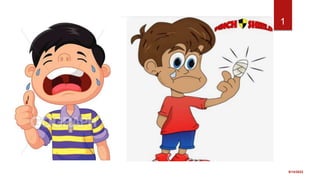
A wound is a break or cut in the continuity of any body structure, internal or
external caused by physical means.
A wound is a type of injury which happens relatively quickly in which skin is torn,
cut, or punctured (an open wound), or where blunt force trauma causes a contusion
(a closed wound).
9/14/2022
4
Definition:
 Wound is an injury to the body (as from violence, accident or
surgery) that typically involves laceration or breaking of a
membrane ( such as the skin) and usually damage to underlying
tissues.
9/14/2022
5
Types Of Wounds:
 Wounds can be classified into two main types. These are :
 Open wounds
 Closed wounds.
In the category open and closed wounds, the wounds are then
summarized again into more specific categories.
9/14/2022
6
Open Wounds
 An open wound is an injury involving an external or internal break
in body tissue, usually involving the skin.
 Nearly everyone will experience an open wound at some point in
their life. Most open wounds are minor and can be treated at home.
 Falls, accidents with sharp objects, and car accidents are the most
common causes of open wounds.
9/14/2022
7
Cont…
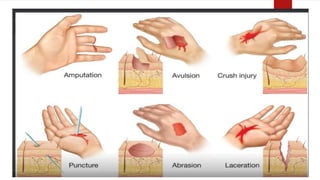
 There are four types of open wounds, which are classified depending on their
cause.
I. Abrasion
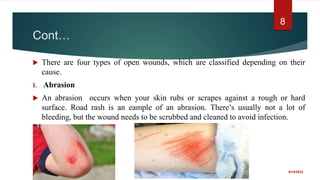
 An abrasion occurs when your skin rubs or scrapes against a rough or hard
surface. Road rash is an eample of an abrasion. There’s usually not a lot of
bleeding, but the wound needs to be scrubbed and cleaned to avoid infection.
9/14/2022
8
Cont…
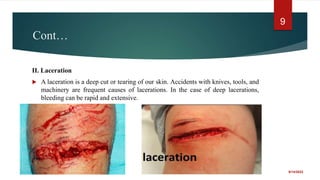
II. Laceration
 A laceration is a deep cut or tearing of our skin. Accidents with knives, tools, and
machinery are frequent causes of lacerations. In the case of deep lacerations,
bleeding can be rapid and extensive.
9/14/2022
9
Cont…
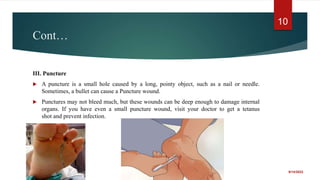
III. Puncture
 A puncture is a small hole caused by a long, pointy object, such as a nail or needle.
Sometimes, a bullet can cause a Puncture wound.
 Punctures may not bleed much, but these wounds can be deep enough to damage internal
organs. If you have even a small puncture wound, visit your doctor to get a tetanus
shot and prevent infection.
9/14/2022
10
Cont…
IV. Avulsion
 An avulsion is a partial or complete
tearing away of skin and the tissue
beneath. Avulsions usually occur
during violent accidents, such as
body-crushing accidents, explosions,
and gunshots. They bleed heavily and
rapidly.
9/14/2022
11
9/14/2022
12
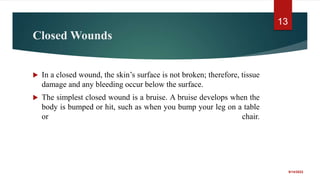
Closed Wounds
 In a closed wound, the skin’s surface is not broken; therefore, tissue
damage and any bleeding occur below the surface.
 The simplest closed wound is a bruise. A bruise develops when the
body is bumped or hit, such as when you bump your leg on a table
or chair.
9/14/2022
13
Types of Closed Wounds:
 Explained below are the main types of closed wounds: -
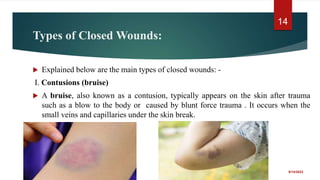
I. Contusions (bruise)
 A bruise, also known as a contusion, typically appears on the skin after trauma
such as a blow to the body or caused by blunt force trauma . It occurs when the
small veins and capillaries under the skin break.
9/14/2022
14
Cont…
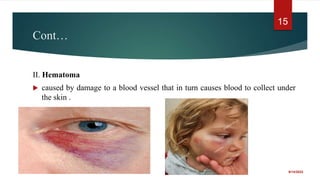
II. Hematoma
 caused by damage to a blood vessel that in turn causes blood to collect under
the skin .
9/14/2022
15
Cont…
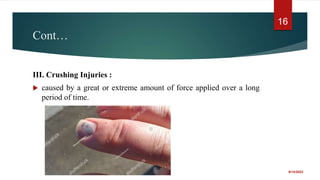
III. Crushing Injuries :
 caused by a great or extreme amount of force applied over a long
period of time.
9/14/2022
16
Types of wound according to nature of the injury:
 Wounds can be divided into three main groups to emphasis their
seriousness, these groups are: -
I. Minor Cuts and Scrapes
II. Puncture Wounds
III. Major wounds
9/14/2022
17
The signs and symptoms of Wounds:
 Redness or excessive swelling in the wound area.
 Throbbing pain or tenderness in the wound area.
 Red streaks in the skin around the wound or progressing away from
the wound.
 Pus or watery discharge collected beneath the skin or draining from
the wound.
9/14/2022
18
Cont…
 Tender lumps or swelling in your armpit, groin or neck.
 Foul odor from the wound .
 Generalized chills or fever.
9/14/2022
19
Specific symptoms for specific wounds.
 The general symptoms of a wound are localized pain and bleeding.
Specific symptoms include: -
 An abrasion usually appears as lines of scraped skin with tiny spots
of bleeding.
 An avulsion has heavy, rapid bleeding and a noticeable absence of
tissue.
 A contusion may appear as a bruise beneath the skin or may appear
only on imaging tests; an internal wound may also generate
symptoms such as weakness, perspiration, and pain.
9/14/2022
20
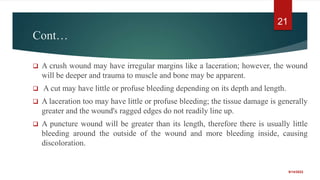
Cont…
 A crush wound may have irregular margins like a laceration; however, the wound
will be deeper and trauma to muscle and bone may be apparent.
 A cut may have little or profuse bleeding depending on its depth and length.
 A laceration too may have little or profuse bleeding; the tissue damage is generally
greater and the wound's ragged edges do not readily line up.
 A puncture wound will be greater than its length, therefore there is usually little
bleeding around the outside of the wound and more bleeding inside, causing
discoloration.
9/14/2022
21
First – Aid Treatment :
 Some wounds may be treated at home and others may require a trip
to your doctor for a medical approach.
9/14/2022
22
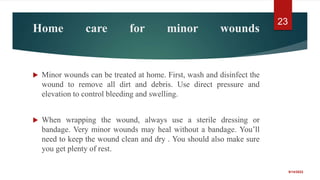
Home care for minor wounds
 Minor wounds can be treated at home. First, wash and disinfect the
wound to remove all dirt and debris. Use direct pressure and
elevation to control bleeding and swelling.
 When wrapping the wound, always use a sterile dressing or
bandage. Very minor wounds may heal without a bandage. You’ll
need to keep the wound clean and dry . You should also make sure
you get plenty of rest.
9/14/2022
23
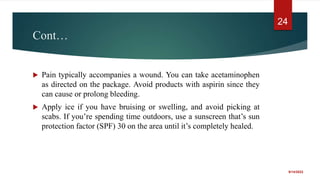
Cont…
 Pain typically accompanies a wound. You can take acetaminophen
as directed on the package. Avoid products with aspirin since they
can cause or prolong bleeding.
 Apply ice if you have bruising or swelling, and avoid picking at
scabs. If you’re spending time outdoors, use a sunscreen that’s sun
protection factor (SPF) 30 on the area until it’s completely healed.
9/14/2022
24
When to see a doctor
Although we can treat some wounds at home, we should see a doctor
if:
 an open wound is deeper than 1/2 inch.
 bleeding doesn’t stop with direct pressure.
 bleeding lasts longer than 20 minutes.
 bleeding is the result of a serious accident.
9/14/2022
25
Puncture Wounds- how to treat them.
 Puncture wounds are difficult to clean. If the object has penetrated
the bone, it is especially risky.
 Flush the area thoroughly with water, cleaning well and on a
number of occasions.
 Elevate the wound, and if signs of infection manifest (redness,
swelling, persistent pain, pus, or fever), contact a health
professional
9/14/2022
26
Major Wounds- How to treat them
 For severe bleeding, apply constant pressure to the wound with a
sterile dressing. Hold for up to twenty minutes.
 If there is a foreign object in the wound don't press directly, but
apply pressure along the wound area.
 If broken bones or dislocations are suspected, do not move the
affected limb. If you are sure there are no broken bones or
dislocations , you can gently elevate and support the part while
keeping pressure on it. This action should minimize bleeding. Then
get Medical Help.
9/14/2022
27
General ways to treat any wound
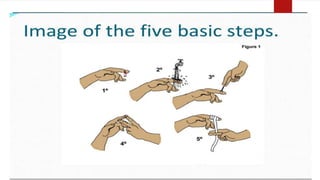
The following are the 5 basic steps for treating a cut or wound :
1. Stop the bleeding. Put a clean cloth over the wound. Press down for
at least 3 minutes.
2. Wash the wound. Washing the wound is the best way to prevent
infection. Wash hands first with soap and water and rinse in
purified water or sanitized solution. Wash wound with purified
water and disinfectant soap.
9/14/2022
28
Cont…
3. Remove dirt particles. Lift flaps of skin gently with sterile tweezers. (sterilize
tweezers by boiling them in water for a few minutes or soaking in alcohol for
15 minutes and them covering them until they will be used.) Continue to squirt
or pour purified water on the wound until it is completely clean.
4. Close the skin. A wound less than 12 hours old will heal faster with the edges
held together. This can be done by stitches by a health worker or with a
butterfly bandage made from adhesive tape.
5. Dress and cover the wound. Once the wound is clean and closed, it will heal
faster.
9/14/2022
29
Cont…
 Anytime a person is seriously hurt, for example with a cut or burn,
they may react by going into shock. A person in shock may have a
weak, rapid pulse; damp, pale, or clammy skin; and feel confused,
weak, or go unconscious.
 Steps to follow if the person is in shock:
• Have there person lie down with feet elevated above the head.
• Cover person with a blanket if feeling cold.
• If person is conscious, let him drink lukewarm liquids, especially
oral rehydration solution.
9/14/2022
30
9/14/2022
31
Treatment
 Minor, or acute, open wounds may not require medical treatment.
People can treat these types of wound at home.
 However, severe open wounds that involve significant bleeding will
require immediate medical attention.
9/14/2022
32
Cont…
Open wound care should involve the following steps:
 Stop the bleeding: Using a clean cloth or bandage, gently apply
pressure to the wound to promote blood clotting.
 Clean the wound: Use clean water and a saline solution to flush
away any debris or bacteria. Once the wound looks clean, pat it dry
with a clean cloth. A doctor may need to perform a surgical
debridement to remove debris from severe wounds that contain
dead tissue, glass, bullets, or other foreign objects.
9/14/2022
33
Cont…
 Treat the wound with antibiotics: After cleaning the wound, apply
a thin layer of antibiotic ointment to prevent infection.
 Close and dress the wound: Closing clean wounds helps promote
faster healing. Waterproof bandages and gauze work well for minor
wounds. Deep open wounds may require stitches or staples.
However, leave an already infected wound open until the infection
clears.
9/14/2022
34
Cont…
 Routinely change the dressing: The Centers for Disease Control
and Prevention (CDC)Trusted Source recommend removing the old
bandages and checking for signs of infection every 24 hours.
Disinfect and dry the wound before reapplying a clean adhesive
bandage or gauze. Remember to keep the wound dry while it heals.
9/14/2022
35
9/14/2022
36
References:
 Lippincott Williams & Wilkins (2010) “Brunner & Suddarth’s Handbook for medical-
surgical nursing”. (12th edition), New Delhi Kluwer India. Pvt. Ltd.
 2020. MedicalNewsToday. Open wound Care.
https://www.medicalnewstoday.com/articles/325260#types at 2021/07/08 @2pm
 14 August. 2018. Healthline..Wounds and its types..
https://www.healthline.com/health/open-wound?fbclid=IwAR3E292YPewwbFdyDJxulc-
0TDRUt4D3hA03IHSf7LctuOQkii4jSKkdry0#complications.at 2021/07/08 @2pm.
 woundsjovski-1220608763031889-9.pdf
9/14/2022
37
9/14/2022
38

Wound

  • 1.
  • 2.
    WOUNDPrepared by: RN ARPANABHUSAL BNS 9/14/2022 2
  • 3.
    Content:  Introduction  Definition Types of wound  First-Aid Treatment  General ways to care wound  Treatment 9/14/2022 3
  • 4.
    Introduction: A wound isa break or cut in the continuity of any body structure, internal or external caused by physical means. A wound is a type of injury which happens relatively quickly in which skin is torn, cut, or punctured (an open wound), or where blunt force trauma causes a contusion (a closed wound). 9/14/2022 4
  • 5.
    Definition:  Wound isan injury to the body (as from violence, accident or surgery) that typically involves laceration or breaking of a membrane ( such as the skin) and usually damage to underlying tissues. 9/14/2022 5
  • 6.
    Types Of Wounds: Wounds can be classified into two main types. These are :  Open wounds  Closed wounds. In the category open and closed wounds, the wounds are then summarized again into more specific categories. 9/14/2022 6
  • 7.
    Open Wounds  Anopen wound is an injury involving an external or internal break in body tissue, usually involving the skin.  Nearly everyone will experience an open wound at some point in their life. Most open wounds are minor and can be treated at home.  Falls, accidents with sharp objects, and car accidents are the most common causes of open wounds. 9/14/2022 7
  • 8.
    Cont…  There arefour types of open wounds, which are classified depending on their cause. I. Abrasion  An abrasion occurs when your skin rubs or scrapes against a rough or hard surface. Road rash is an eample of an abrasion. There’s usually not a lot of bleeding, but the wound needs to be scrubbed and cleaned to avoid infection. 9/14/2022 8
  • 9.
    Cont… II. Laceration  Alaceration is a deep cut or tearing of our skin. Accidents with knives, tools, and machinery are frequent causes of lacerations. In the case of deep lacerations, bleeding can be rapid and extensive. 9/14/2022 9
  • 10.
    Cont… III. Puncture  Apuncture is a small hole caused by a long, pointy object, such as a nail or needle. Sometimes, a bullet can cause a Puncture wound.  Punctures may not bleed much, but these wounds can be deep enough to damage internal organs. If you have even a small puncture wound, visit your doctor to get a tetanus shot and prevent infection. 9/14/2022 10
  • 11.
    Cont… IV. Avulsion  Anavulsion is a partial or complete tearing away of skin and the tissue beneath. Avulsions usually occur during violent accidents, such as body-crushing accidents, explosions, and gunshots. They bleed heavily and rapidly. 9/14/2022 11
  • 12.
  • 13.
    Closed Wounds  Ina closed wound, the skin’s surface is not broken; therefore, tissue damage and any bleeding occur below the surface.  The simplest closed wound is a bruise. A bruise develops when the body is bumped or hit, such as when you bump your leg on a table or chair. 9/14/2022 13
  • 14.
    Types of ClosedWounds:  Explained below are the main types of closed wounds: - I. Contusions (bruise)  A bruise, also known as a contusion, typically appears on the skin after trauma such as a blow to the body or caused by blunt force trauma . It occurs when the small veins and capillaries under the skin break. 9/14/2022 14
  • 15.
    Cont… II. Hematoma  causedby damage to a blood vessel that in turn causes blood to collect under the skin . 9/14/2022 15
  • 16.
    Cont… III. Crushing Injuries:  caused by a great or extreme amount of force applied over a long period of time. 9/14/2022 16
  • 17.
    Types of woundaccording to nature of the injury:  Wounds can be divided into three main groups to emphasis their seriousness, these groups are: - I. Minor Cuts and Scrapes II. Puncture Wounds III. Major wounds 9/14/2022 17
  • 18.
    The signs andsymptoms of Wounds:  Redness or excessive swelling in the wound area.  Throbbing pain or tenderness in the wound area.  Red streaks in the skin around the wound or progressing away from the wound.  Pus or watery discharge collected beneath the skin or draining from the wound. 9/14/2022 18
  • 19.
    Cont…  Tender lumpsor swelling in your armpit, groin or neck.  Foul odor from the wound .  Generalized chills or fever. 9/14/2022 19
  • 20.
    Specific symptoms forspecific wounds.  The general symptoms of a wound are localized pain and bleeding. Specific symptoms include: -  An abrasion usually appears as lines of scraped skin with tiny spots of bleeding.  An avulsion has heavy, rapid bleeding and a noticeable absence of tissue.  A contusion may appear as a bruise beneath the skin or may appear only on imaging tests; an internal wound may also generate symptoms such as weakness, perspiration, and pain. 9/14/2022 20
  • 21.
    Cont…  A crushwound may have irregular margins like a laceration; however, the wound will be deeper and trauma to muscle and bone may be apparent.  A cut may have little or profuse bleeding depending on its depth and length.  A laceration too may have little or profuse bleeding; the tissue damage is generally greater and the wound's ragged edges do not readily line up.  A puncture wound will be greater than its length, therefore there is usually little bleeding around the outside of the wound and more bleeding inside, causing discoloration. 9/14/2022 21
  • 22.
    First – AidTreatment :  Some wounds may be treated at home and others may require a trip to your doctor for a medical approach. 9/14/2022 22
  • 23.
    Home care forminor wounds  Minor wounds can be treated at home. First, wash and disinfect the wound to remove all dirt and debris. Use direct pressure and elevation to control bleeding and swelling.  When wrapping the wound, always use a sterile dressing or bandage. Very minor wounds may heal without a bandage. You’ll need to keep the wound clean and dry . You should also make sure you get plenty of rest. 9/14/2022 23
  • 24.
    Cont…  Pain typicallyaccompanies a wound. You can take acetaminophen as directed on the package. Avoid products with aspirin since they can cause or prolong bleeding.  Apply ice if you have bruising or swelling, and avoid picking at scabs. If you’re spending time outdoors, use a sunscreen that’s sun protection factor (SPF) 30 on the area until it’s completely healed. 9/14/2022 24
  • 25.
    When to seea doctor Although we can treat some wounds at home, we should see a doctor if:  an open wound is deeper than 1/2 inch.  bleeding doesn’t stop with direct pressure.  bleeding lasts longer than 20 minutes.  bleeding is the result of a serious accident. 9/14/2022 25
  • 26.
    Puncture Wounds- howto treat them.  Puncture wounds are difficult to clean. If the object has penetrated the bone, it is especially risky.  Flush the area thoroughly with water, cleaning well and on a number of occasions.  Elevate the wound, and if signs of infection manifest (redness, swelling, persistent pain, pus, or fever), contact a health professional 9/14/2022 26
  • 27.
    Major Wounds- Howto treat them  For severe bleeding, apply constant pressure to the wound with a sterile dressing. Hold for up to twenty minutes.  If there is a foreign object in the wound don't press directly, but apply pressure along the wound area.  If broken bones or dislocations are suspected, do not move the affected limb. If you are sure there are no broken bones or dislocations , you can gently elevate and support the part while keeping pressure on it. This action should minimize bleeding. Then get Medical Help. 9/14/2022 27
  • 28.
    General ways totreat any wound The following are the 5 basic steps for treating a cut or wound : 1. Stop the bleeding. Put a clean cloth over the wound. Press down for at least 3 minutes. 2. Wash the wound. Washing the wound is the best way to prevent infection. Wash hands first with soap and water and rinse in purified water or sanitized solution. Wash wound with purified water and disinfectant soap. 9/14/2022 28
  • 29.
    Cont… 3. Remove dirtparticles. Lift flaps of skin gently with sterile tweezers. (sterilize tweezers by boiling them in water for a few minutes or soaking in alcohol for 15 minutes and them covering them until they will be used.) Continue to squirt or pour purified water on the wound until it is completely clean. 4. Close the skin. A wound less than 12 hours old will heal faster with the edges held together. This can be done by stitches by a health worker or with a butterfly bandage made from adhesive tape. 5. Dress and cover the wound. Once the wound is clean and closed, it will heal faster. 9/14/2022 29
  • 30.
    Cont…  Anytime aperson is seriously hurt, for example with a cut or burn, they may react by going into shock. A person in shock may have a weak, rapid pulse; damp, pale, or clammy skin; and feel confused, weak, or go unconscious.  Steps to follow if the person is in shock: • Have there person lie down with feet elevated above the head. • Cover person with a blanket if feeling cold. • If person is conscious, let him drink lukewarm liquids, especially oral rehydration solution. 9/14/2022 30
  • 31.
  • 32.
    Treatment  Minor, oracute, open wounds may not require medical treatment. People can treat these types of wound at home.  However, severe open wounds that involve significant bleeding will require immediate medical attention. 9/14/2022 32
  • 33.
    Cont… Open wound careshould involve the following steps:  Stop the bleeding: Using a clean cloth or bandage, gently apply pressure to the wound to promote blood clotting.  Clean the wound: Use clean water and a saline solution to flush away any debris or bacteria. Once the wound looks clean, pat it dry with a clean cloth. A doctor may need to perform a surgical debridement to remove debris from severe wounds that contain dead tissue, glass, bullets, or other foreign objects. 9/14/2022 33
  • 34.
    Cont…  Treat thewound with antibiotics: After cleaning the wound, apply a thin layer of antibiotic ointment to prevent infection.  Close and dress the wound: Closing clean wounds helps promote faster healing. Waterproof bandages and gauze work well for minor wounds. Deep open wounds may require stitches or staples. However, leave an already infected wound open until the infection clears. 9/14/2022 34
  • 35.
    Cont…  Routinely changethe dressing: The Centers for Disease Control and Prevention (CDC)Trusted Source recommend removing the old bandages and checking for signs of infection every 24 hours. Disinfect and dry the wound before reapplying a clean adhesive bandage or gauze. Remember to keep the wound dry while it heals. 9/14/2022 35
  • 36.
  • 37.
    References:  Lippincott Williams& Wilkins (2010) “Brunner & Suddarth’s Handbook for medical- surgical nursing”. (12th edition), New Delhi Kluwer India. Pvt. Ltd.  2020. MedicalNewsToday. Open wound Care. https://www.medicalnewstoday.com/articles/325260#types at 2021/07/08 @2pm  14 August. 2018. Healthline..Wounds and its types.. https://www.healthline.com/health/open-wound?fbclid=IwAR3E292YPewwbFdyDJxulc- 0TDRUt4D3hA03IHSf7LctuOQkii4jSKkdry0#complications.at 2021/07/08 @2pm.  woundsjovski-1220608763031889-9.pdf 9/14/2022 37
  • 38.