Care of the Patient on Ventilator and Weaning
Prof. Dr. RS Mehta 1
Terminologies
• Inspiration: movement of air into the lungs from
atmosphere.
• Expiration: movement of air out from the lungs.
• Tidal volume (TV): The amount of air passing into
and out of the lungs during each cycle of quiet
breathing. (about 500ml)
Prof. Dr. RS Mehta 2
Contd…
• Vital capacity (VC): The amount of air that can be
forcibly expired after the deepest possible inspiration.
It indicates the largest volume of air that can be
exchanged during respiration. (about 3500ml)
• PaO2 : Arterial partial pressure of oxygen
• PaCO2 : Partial pressure of carbon dioxide
• Fio2: Fractional inspired oxygen concentration
Prof. Dr. RS Mehta 3
Ventilator
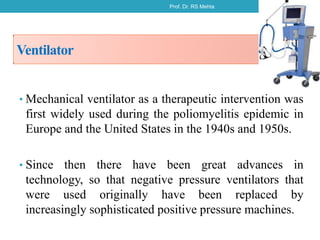
• Mechanical ventilator as a therapeutic intervention was
first widely used during the poliomyelitis epidemic in
Europe and the United States in the 1940s and 1950s.
• Since then there have been great advances in
technology, so that negative pressure ventilators that
were used originally have been replaced by
increasingly sophisticated positive pressure machines.
Prof. Dr. RS Mehta 4
Contd…
• Mechanical ventilation is a life support treatment,
sometimes referred to as artificial respiration.
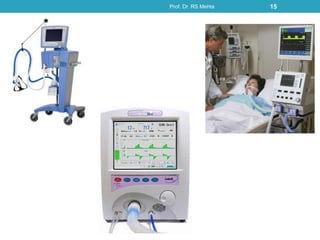
• A mechanical ventilator is a machine designed to
provide breathing for a patient who is physically unable
to breathe enough on their own, or breathing
insufficiently.
• It is a positive or negative pressure breathing device
that can maintain ventilation and oxygen delivery for a
prolonged period.
Prof. Dr. RS Mehta 5
Contd…
• The purpose of mechanical ventilation is to provide
ventilatory support partially or fully by an external
device to patients who cannot maintain an adequate
gas exchange.
• It can be noninvasive involving various types of face
masks or invasive involving endotracheal intubation
Prof. Dr. RS Mehta 6
Types of ventilator
Negative
pressure ventilator
Positive pressure
ventilator
Prof. Dr. RS Mehta 7
Negative pressure ventilator
• It applies negative pressure around the chest wall,
causes intrathoracic pressure to become negative, allows
air to flow into the lungs and filling its volume.
• These are simple to use and do not require intubations of
the airway; consequently, they are especially adaptable
for home use.
• It is used mainly in chronic respiratory failure associated
with neuromuscular conditions such as poliomyelitis,
muscular dystrophy and myasthenia gravis.
Prof. Dr. RS Mehta 8
Prof. Dr. RS Mehta 9
Positive pressure ventilator
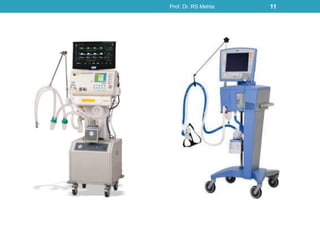
• Positive pressure ventilators inflate the lungs by
exerting positive pressure on the airway forcing the
alveoli to expand during inspiration.
• Expiration occurs passively.
• Positive-pressure ventilators require an artificial
airway (Endotracheal or tracheostomy tube) and use
positive pressure to force gas into a patient's lungs.
Prof. Dr. RS Mehta 10
Prof. Dr. RS Mehta 11
Indications
• Apnea with respiratory arrest
• Tachypnea
• Upper and lower airway obstruction
• Acute lung injury and acute respiratory distress
syndrome
• Acute severe asthma, requiring intubation
Prof. Dr. RS Mehta 12
Contd…
• Chronic obstructive pulmonary disease (COPD)
• Neuromuscular disease eg. Guillain–Barré
syndrome, myasthenia gravis, spinal cord injury
• Post- operative cardiac surgery, shock and trauma
• CNS depression (drug intoxication, respiratory
depressants, cardiac arrest)
• Respiratory muscle fatigue
Prof. Dr. RS Mehta 13
Criteria for institution of ventilator support
• Respiratory rate >35 breaths per minute
• Tidal volume less than 5 mL/kg body weight
• Vital capacity less than 15 mL/kg body weight
• Arterial partial pressure of oxygen (PaO2) <60 mm Hg
• Partial pressure of carbon dioxide (PaCO2)>50 mm Hg
Prof. Dr. RS Mehta 14
Prof. Dr. RS Mehta 15
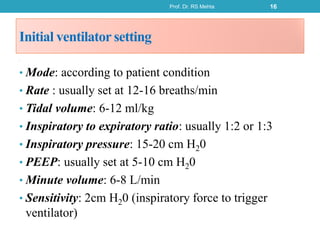
Initial ventilator setting
8
• Mode: according to patient condition
• Rate : usually set at 12-16 breaths/min
• Tidal volume: 6-12 ml/kg
• Inspiratory to expiratory ratio: usually 1:2 or 1:3
• Inspiratory pressure: 15-20 cm H20
• PEEP: usually set at 5-10 cm H20
• Minute volume: 6-8 L/min
• Sensitivity: 2cm H20 (inspiratory force to trigger
ventilator)
Prof. Dr. RS Mehta 16
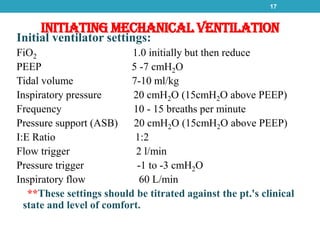
Initiating Mechanical Ventilation
Initial ventilator settings:
FiO2 1.0 initially but then reduce
PEEP 5 -7 cmH2O
Tidal volume 7-10 ml/kg
Inspiratory pressure 20 cmH2O (15cmH2O above PEEP)
Frequency 10 - 15 breaths per minute
Pressure support (ASB) 20 cmH2O (15cmH2O above PEEP)
I:E Ratio 1:2
Flow trigger 2 l/min
Pressure trigger -1 to -3 cmH2O
Inspiratory flow 60 L/min
**These settings should be titrated against the pt.'s clinical
state and level of comfort.
17
Prof. Dr. RS Mehta, BPKIHS
18
Prof. Dr. RS Mehta, BPKIHS
Modes of ventilator support
• Controlled mode ventilation
• Assist / Control Ventilation (A/C)
• Intermittent Mandatory Ventilation (IMV)
• Synchronous intermittent mandatory ventilation (SIMV)
• Pressure support ventilation
• Continuous positive airway pressure (CPAP)
• Inverse ratio ventilation (IRV)
• Positive end expiratory pressure (PEEP)
• Bilevel positive airway pressure (BIPAP)
Prof. Dr. RS Mehta 19
Controlled mode ventilation
• In this mode, the ventilator completely controls the
patient’s ventilation, provides a fixed level of
ventilation.
• The ventilator initiates and controls both the volume
delivered and the frequency of breaths.
• This mode is used for patients who are unable to initiate
spontaneous breath.
Prof. Dr. RS Mehta 20
Contd…
• It is indicated in patients with apnea, respiratory
muscle paralysis, drug overdose, neuromuscular
disease and paralyzed with drugs.
• If it is used with spontaneously breathing patients, they
must be sedated and/or pharmacologically paralyzed
so they don't breathe out of synchrony with the
ventilator.
Prof. Dr. RS Mehta 21
Assist / Control Ventilation (A/C)
• This mode is used for patients who can initiate a breath
but who have weakened respiratory muscles.
• In this mode the ventilator provides a mechanical
breath with either a pre-set tidal volume or pressure
every time the patient initiates a breath.
• If the patients fail to initiate inspiration, the ventilator
automatically goes into the back-up mode and delivers
the preset rate and tidal volume until it senses an
inspiratory effort.
Prof. Dr. RS Mehta 22
Contd…
• It is indicated for the patients who are breathing
spontaneously, but who have the potential to lose their
respiratory drive or muscular control of ventilation.
• It is used in disease conditions such as Myasthenia
gravis , Gulaine- Barre syndrome, post cardiac or
respiratory arrest, pulmonary edema, ARDS etc.
Prof. Dr. RS Mehta 23
Intermittent Mandatory Ventilation (IMV)
• A mode of mechanical ventilation in which the patient is
allowed to breathe independently.
• Periodically, at preselected rate and volume or pressure
cycles gives a mandated ventilator breath.
• It is indicated for the patients who are breathing
spontaneously but less than adequate for their needs. It
allows the patient to do some of the work of breathing.
Prof. Dr. RS Mehta 24
Synchronous intermittent mandatory ventilation
(SIMV)
• The ventilator initiates each breath in synchrony with
the patient's breaths.
• This mode allows the patient to breath at their own rate
and volume spontaneously.
• Periodically, at a preselected time, a mandatory breath is
delivered.
• The mandatory breaths are synchronized with the
patient’s inspiratory effort.
Prof. Dr. RS Mehta 25
Contd…
• Within that cycle time the ventilator waits for the
patient to initiate a breath using either a pressure or
flow sensor.
• If the patient fails to initiate a breath, the ventilator
delivers a mechanical breath at the end of the breath
cycle.
• It is used as a primary mode of ventilation as well as a
weaning mode.
Prof. Dr. RS Mehta 26
Pressure support ventilation
• In this mode, a patient’s inspiratory effort triggers a
response from the ventilator.
• The ventilator delivers a preset positive pressure to the
airways, reducing the work of breathing and helping in
patient comfort.
• Once the predefined percentage of maximal inspiratory
flow is reached, the ventilator stops inspiration and
opens the expiratory valve.
Prof. Dr. RS Mehta 27
Contd…
• The respiratory rate and inspiratory flow rate are
determined by the patient.
• This mode cannot be used in an apneic patient or in
one who lacks an adequate spontaneous respiratory
drive.
Prof. Dr. RS Mehta 28
Continuous positive airway pressure (CPAP)
• It assists the spontaneously breathing patients to
improve oxygenation by elevating the end- expiratory
pressure in the lungs throughout the respiratory cycle.
• The effect of CPAP is compared to inflating a balloon
but not letting it completely deflate before inflating it
again.
• The second inflation is easier to perform because
resistance is decreased.
Prof. Dr. RS Mehta 29
Contd…
• A continuous level of elevated pressure is provided
through the patient circuit to maintain adequate
oxygenation, decrease the work of breathing.
• It is indicated for patient who are capable of
maintaining an adequate breathing but who have
pathology preventing maintenance of adequate levels
of tissue oxygenation or for sleep apnea.
Prof. Dr. RS Mehta 30
Inverse ratio ventilation (IRV)
• The normal inspiratory: expiratory ratio is 1:2, but this
is reversed during IRV to 2:1 or greater (the maximum is
4:1).
• Longer inspiratory time increases the amount of air in
the lungs at the end of expiration and improves
oxygenation by re-expanding collapsed alveoli.
• The shorter expiratory time prevents the alveoli from
collapsing again.
Prof. Dr. RS Mehta 31
Contd…
• It is potentially used in patients who are in acute
severe hypoxemic respiratory failure.
• This method requires sedation and therapeutic
paralysis because it is very uncomfortable for the
patient.
Prof. Dr. RS Mehta 32
Positive end expiratory pressure (PEEP)
• Mechanical positive pressure is applied at the end of
exhalation to prevent the lungs from emptying
completely and returning to a ―zero‖ reading.
• The benefit of positive pressure at the end of exhalation
is increased lung volume for improved oxygenation.
• This mode does not deliver breaths but is used as an
adjunct to CV, A/C, and SIMV to improve oxygenation
by opening collapsed alveoli at the end of expiration.
Prof. Dr. RS Mehta 33
Contd…
• It is used to increase the surface area to prevent
collapse of alveoli and to prevent atelectasis.
• Complications from the increased pressure can include
decreased cardiac output, lung rupture, and increased
intracranial pressure.
Prof. Dr. RS Mehta 34
Bilevel positive airway pressure (BIPAP)
• Bilevel positive airway pressure is a form of non-
invasive mechanical pressure support ventilation used
when positive airway pressure is needed with the
addition of pressure support.
• BIPAP provides positive airway pressure during both
inspiration (IPAP) and expiration (EPAP).
• It optimizes the lungs' efficiency and reduces the work
of breathing. It is an effective management tool
for COPD and acute and chronic respiratory failure.
Prof. Dr. RS Mehta 35
Prof. Dr. RS Mehta 36
Ventilation alarms and causes
High pressure limit Secretions, coughing or gaging,
kinked or compressed tubing,
bronchospasm, pneumothorax
Low pressure limit ET tube cuff leak, total or partial
extubation, insufficient gas flow
Apnea alarm Respiratory arrest, oversedation,
loss of airway
Ventilator
inoperative or low
battery
Machine malfunction, unplugged,
power failure or battery not
charged
Prof. Dr. RS Mehta 37
VENTILATOR ALARMS
ALARM DEFINITION POTENTIAL CAUSE
1. High
pressure
•Pressure required to ventilate
exceeds preset pressure
Pneumothorax, excessive
secretions, decreased lung
compliance.
2.Low pressure •Resistance to inspiratory flow is
less than preset pressure.
Disconnected from ventilator,
break in circuit.
3.Low exhaled
volume
•Exhaled tidal volume drops
below preset amount.
Leak in system, increased
airway resistance, decreased
lung compliance
4.Rate /apnea •Respiratory rate drops below
preset level. Apnea period
exceeds set time
Client fatigue, decreased R.R
due to medication.
5. FIO2 •Indicates FIO2 drift from preset
range.
Change in level of
consciousness, disconnected
from O2 source, break in
circuit.
38
Prof. Dr. RS Mehta, BPKIHS
Complications of ventilator
Related to mechanical
ventilation
• Decreased Cardiac
Output
• Decreased Renal
Perfusion
• Positive Water Balance
• Barotrauma
• Pneumonia
Related to Endotrachial
Intubation
• Sinusitis and nasal
injury
• Tracheo-esophageal
fistula
• Cricoids abscess
• Laryngeal or tracheal
Stenosis
Prof. Dr. RS Mehta 39
Other complications
• Skin: Pressure sore, laceration
• Respiratory system: Hypostatic pneumonia,
pulmonary embolism
• C.V. system: Deep vein thrombosis,
thromboembolism
• G.I. system: Paralytic ileus, constipation, distention
• Musculo-skeletal System: Contracture , dystrophy,
weakness
• Urinary system: UTI, stone
• Neurological : foot drop
Prof. Dr. RS Mehta 40
Nursing Care of patients on ventilator
Prof. Dr. RS Mehta 41
Assess the patient’s condition
• Assess patient’s level of pain, anxiety levels and
sedation needs.
• Monitor vital signs.
• Monitor for airway obstruction, ineffective breathing
pattern, ET tube kinking etc.
• Check oxygen saturation, listen to breath sounds, and
note changes from previous findings.
Prof. Dr. RS Mehta 42
Manage airway
• Assess respiratory rate and depth.
• Assess patient for oxygenation and signs and symptoms
of hypoxia.
• Elevate the head of bed.
• Suction the airway for clearance.
• Provide chest physiotherapy and breathing exercises for
secretions mobilization.
Prof. Dr. RS Mehta 43
Suction appropriately
• Assess the tube insertion site, breath sounds, vital signs
to identify complications.
• Suction only as needed—not according to a schedule.
• Hyperoxygenate the patient before and after suctioning
to help prevent oxygen desaturation.
• Suction for the shortest duration possible.
Prof. Dr. RS Mehta 44
Contd…
• Don’t instill normal saline solution into the
endotracheal tube in an attempt to promote secretion
removal.
• Limit suctioning pressure to the lowest level needed to
remove secretions.
Prof. Dr. RS Mehta 45
Check ventilator settings and
modes
• Read the patient’s order and obtain information about
the ventilator. Compare current ventilator settings with
the settings prescribed in the order.
• Check type of ventilator, controlling mode, tidal volume
and rate settings,Fio2 setting, inspiratory to expiratory
ratio, inspiratory pressure, PEEP, humidifier etc
• Familiarize yourself with ventilator alarms and the
actions to take when an alarm sounds.
Prof. Dr. RS Mehta 46
Meet the patient’s physiological needs
• Provide eye care, oral care and moisten the lips with
lubricant.
• Maintain hygiene of the patient.
• Administer Naso-gastric tube feeding as ordered.
• If NG tube feeding is not possible, administer parenteral
nutrition.
• Address the patient’s elimination needs.
Prof. Dr. RS Mehta 47
Contd…
• Provide catheter care.
• Keep quiet and calm environment to promote rest and
sleep.
• Keep monitor alarm down if possible.
• Provide dim light at night.
• Cover patient’s eye with eyepatch.
Prof. Dr. RS Mehta 48
Provide psychological support to patient and
family
• To ease distress in the patient and family, teach them
why mechanical ventilation is needed and emphasize
the positive outcomes it can provide.
• Encourage family members to verbalize their feelings
about the ventilators, patient's condition.
• Explain the procedures to the patient and family each
time.
Prof. Dr. RS Mehta 49
Contd…
• Reinforce the need and reason for multiple
assessments and procedures, such as laboratory tests
and X-rays.
• Communicate desired outcomes and progression
toward outcomes so the patient and family can actively
participate in the plan of care.
Prof. Dr. RS Mehta 50
Review communication
• Assess the ability of the ventilator- dependent patient's
to communicate.
• Be alert to non-verbal clues of the patient and use non-
verbal methods of communication.
• Provide writing tools, communication board or call bell
so patient can express their needs.
• Ask simple yes/no questions to which patient can nod
or shake his/her head.
Prof. Dr. RS Mehta 51
Prevent hemodynamic instability
• Monitor the patient’s blood pressure every 2 to 4 hours,
especially after ventilator settings are changed or
adjusted.
• Assess breath sounds and oxygenation status.
• To maintain hemodynamic stability, maintain I.V. fluids
or administer a drug such as dopamine or
norepinephrine, if ordered.
Prof. Dr. RS Mehta 52
Prevent complications of ventilator
• Wash hands and use appropriate personal protective
equipment, such as gloves, when touching patients,
intubation tubes or ventilators.
• Keep the head of the bed elevated 30 to 45 degrees at
all times, if patient condition allows.
• Provide oral care at least twice a day and provide oral
moisturizers every 2 to 4 hours.
Prof. Dr. RS Mehta 53
Contd…
• Observe skin for pressure sores. Provide back care, use
pressure relief mattress and change the position of the
patient frequently.
• Provide deep vein thrombosis prophylaxis, as with an
intermittent compression device.
• Provide range-of-motion exercises and patient turning
and positioning to prevent the effects of muscle disuse.
Prof. Dr. RS Mehta 54
Weaning the patient from the ventilator
Prof. Dr. RS Mehta 55
Weaning
• Weaning is the process of withdrawing mechanical
ventilatory support and transferring the work of
breathing from ventilator to the patient.
• It takes place in 3 stages; patient is gradually removed
from ventilator, then from tube and finally from
oxygen.
• It is started when the patient is recovering from the
acute stage of medical and surgical problems and when
the cause of respiratory failure is sufficiently reversed.
Prof. Dr. RS Mehta 56
Criteria for weaning
• Respiratory rate: <30 b/min
• Tidal volume: >5 ml/kg
• Vital capacity: 10-15 ml/kg
• PaO2: > 60 mmHg
• Fio2:< 40%
• Stable vital signs and Arterial blood gases
• Clinical reason for ventilator support no longer exists
or resolved
Prof. Dr. RS Mehta 57
Methods of weaning
T-piece trial
CPAP weaning
SIMV weaning
Pressure support ventilation
weaning
Prof. Dr. RS Mehta 58
Signs of weaning intolerance
• Diaphoresis
• Dyspnea and labored respiratory pattern
• Increased anxiety, restlessness and decreased level of
consciousness
• Dysrhythmia , increase or decrease heart rate of more
than 20b/min or heart rate more than 110 b/min
Prof. Dr. RS Mehta 59
Contd…
• Increase or decrease blood pressure of more than 20
mmHg
• Tidal volume ≤5 ml/kg
• PH < 7.35
• PaO2 < 60 mmHg
• Increase in PaCO2
Prof. Dr. RS Mehta 60
Nursing care of the patient being weaned from
ventilator
• Assess patient for weaning criteria.
• Assess psychological readiness for weaning.
• Monitor activity level, assess dietary intake and
monitor results of laboratory tests of nutritional status.
• Assess the patient and family’s understanding of
weaning process and address any concerns about the
process.
Prof. Dr. RS Mehta 61
Contd…
• Prepare appropriate equipment.
• Implement the weaning method prescribed; IMV,SIMV,
CPAP or T-piece.
• Monitor vital signs, pulse oximetry, ECG and
respiratory pattern constantly for the first 20-30 minutes
and every 5 minutes after that until weaning is
complete.
• Maintain a patent airway; monitor ABG levels and
pulmonary function tests. Suction the airway as needed.
Prof. Dr. RS Mehta 62
Contd…
• Terminate the weaning process, if adverse reactions
occur.
• Record at each weaning interval: heart rate, BP,
respiratory rate, ABG, pulse oxymetry value,
respiratory and ventilator rate or length of time off
ventilator ( if T-piece weaning)
• Note patient tolerance of procedure.
Prof. Dr. RS Mehta 63
Contd…
• Observe the patient closely for any signs and
symptoms of airway obstruction or respiratory
insufficiency.
• Observe character of voice and signs of blood in
sputum.
• Provide supplemental oxygen using face mask.
• Record and report the procedure.
Prof. Dr. RS Mehta 64
THANK YOU!!!
65
Prof. Dr. RS Mehta, BPKIHS
Ventilator management algorithim
Initial intubation
• FiO2 = 50%
• PEEP = 5
• RR = 12 – 15
• VT = 8 – 10 ml/kg
SaO2 < 90% SaO2 > 90%
SaO2 > 90%
• Adjust RR to maintain PaCO2 = 40
• Reduce FiO2 < 50% as tolerated
• Reduce PEEP < 8 as tolerated
• Assess criteria for SBT daily
SaO2 < 90%
• Increase FiO2 (keep SaO2>90%)
• Increase PEEP to max 20
• Identify possible acute lung injury
• Identify respiratory failure causes
Acute lung injury
No injury
Fail SBT
Acute lung injury
• Low TV (lung-protective) settings
• Reduce TV to 6 ml/kg
• Increase RR up to 35 to keep
pH > 7.2, PaCO2 < 50
• Adjust PEEP to keep FiO2 < 60%
SaO2 < 90% SaO2 > 90%
SaO2 < 90%
• Dx/Tx associated conditions
(PTX, hemothorax, hydrothorax)
• Consider adjunct measures
(prone positioning, HFOV, IRV)
SaO2 > 90%
• Continue lung-protective
ventilation until:
• PaO2/FiO2 > 300
• Criteria met for SBT
Persistently fail SBT
• Consider tracheostomy
• Resume daily SBTs with CPAP or
tracheostomy collar
Pass SBT
Airway stable
Extubate
Intubated > 2 wks
• Consider PSV wean (gradual
reduction of pressure support)
• Consider gradual increases in SBT
duration until endurance improves
Prolonged ventilator
dependence
Pass SBT
Pass SBT
Airway stable
Modified from Sena et al, ACS Surgery:
Principles and Practice (2005).
66

10. ventilator care

  • 1.
    Care of thePatient on Ventilator and Weaning Prof. Dr. RS Mehta 1
  • 2.
    Terminologies • Inspiration: movementof air into the lungs from atmosphere. • Expiration: movement of air out from the lungs. • Tidal volume (TV): The amount of air passing into and out of the lungs during each cycle of quiet breathing. (about 500ml) Prof. Dr. RS Mehta 2
  • 3.
    Contd… • Vital capacity(VC): The amount of air that can be forcibly expired after the deepest possible inspiration. It indicates the largest volume of air that can be exchanged during respiration. (about 3500ml) • PaO2 : Arterial partial pressure of oxygen • PaCO2 : Partial pressure of carbon dioxide • Fio2: Fractional inspired oxygen concentration Prof. Dr. RS Mehta 3
  • 4.
    Ventilator • Mechanical ventilatoras a therapeutic intervention was first widely used during the poliomyelitis epidemic in Europe and the United States in the 1940s and 1950s. • Since then there have been great advances in technology, so that negative pressure ventilators that were used originally have been replaced by increasingly sophisticated positive pressure machines. Prof. Dr. RS Mehta 4
  • 5.
    Contd… • Mechanical ventilationis a life support treatment, sometimes referred to as artificial respiration. • A mechanical ventilator is a machine designed to provide breathing for a patient who is physically unable to breathe enough on their own, or breathing insufficiently. • It is a positive or negative pressure breathing device that can maintain ventilation and oxygen delivery for a prolonged period. Prof. Dr. RS Mehta 5
  • 6.
    Contd… • The purposeof mechanical ventilation is to provide ventilatory support partially or fully by an external device to patients who cannot maintain an adequate gas exchange. • It can be noninvasive involving various types of face masks or invasive involving endotracheal intubation Prof. Dr. RS Mehta 6
  • 7.
    Types of ventilator Negative pressureventilator Positive pressure ventilator Prof. Dr. RS Mehta 7
  • 8.
    Negative pressure ventilator •It applies negative pressure around the chest wall, causes intrathoracic pressure to become negative, allows air to flow into the lungs and filling its volume. • These are simple to use and do not require intubations of the airway; consequently, they are especially adaptable for home use. • It is used mainly in chronic respiratory failure associated with neuromuscular conditions such as poliomyelitis, muscular dystrophy and myasthenia gravis. Prof. Dr. RS Mehta 8
  • 9.
    Prof. Dr. RSMehta 9
  • 10.
    Positive pressure ventilator •Positive pressure ventilators inflate the lungs by exerting positive pressure on the airway forcing the alveoli to expand during inspiration. • Expiration occurs passively. • Positive-pressure ventilators require an artificial airway (Endotracheal or tracheostomy tube) and use positive pressure to force gas into a patient's lungs. Prof. Dr. RS Mehta 10
  • 11.
    Prof. Dr. RSMehta 11
  • 12.
    Indications • Apnea withrespiratory arrest • Tachypnea • Upper and lower airway obstruction • Acute lung injury and acute respiratory distress syndrome • Acute severe asthma, requiring intubation Prof. Dr. RS Mehta 12
  • 13.
    Contd… • Chronic obstructivepulmonary disease (COPD) • Neuromuscular disease eg. Guillain–Barré syndrome, myasthenia gravis, spinal cord injury • Post- operative cardiac surgery, shock and trauma • CNS depression (drug intoxication, respiratory depressants, cardiac arrest) • Respiratory muscle fatigue Prof. Dr. RS Mehta 13
  • 14.
    Criteria for institutionof ventilator support • Respiratory rate >35 breaths per minute • Tidal volume less than 5 mL/kg body weight • Vital capacity less than 15 mL/kg body weight • Arterial partial pressure of oxygen (PaO2) <60 mm Hg • Partial pressure of carbon dioxide (PaCO2)>50 mm Hg Prof. Dr. RS Mehta 14
  • 15.
    Prof. Dr. RSMehta 15
  • 16.
    Initial ventilator setting 8 •Mode: according to patient condition • Rate : usually set at 12-16 breaths/min • Tidal volume: 6-12 ml/kg • Inspiratory to expiratory ratio: usually 1:2 or 1:3 • Inspiratory pressure: 15-20 cm H20 • PEEP: usually set at 5-10 cm H20 • Minute volume: 6-8 L/min • Sensitivity: 2cm H20 (inspiratory force to trigger ventilator) Prof. Dr. RS Mehta 16
  • 17.
    Initiating Mechanical Ventilation Initialventilator settings: FiO2 1.0 initially but then reduce PEEP 5 -7 cmH2O Tidal volume 7-10 ml/kg Inspiratory pressure 20 cmH2O (15cmH2O above PEEP) Frequency 10 - 15 breaths per minute Pressure support (ASB) 20 cmH2O (15cmH2O above PEEP) I:E Ratio 1:2 Flow trigger 2 l/min Pressure trigger -1 to -3 cmH2O Inspiratory flow 60 L/min **These settings should be titrated against the pt.'s clinical state and level of comfort. 17 Prof. Dr. RS Mehta, BPKIHS
  • 18.
    18 Prof. Dr. RSMehta, BPKIHS
  • 19.
    Modes of ventilatorsupport • Controlled mode ventilation • Assist / Control Ventilation (A/C) • Intermittent Mandatory Ventilation (IMV) • Synchronous intermittent mandatory ventilation (SIMV) • Pressure support ventilation • Continuous positive airway pressure (CPAP) • Inverse ratio ventilation (IRV) • Positive end expiratory pressure (PEEP) • Bilevel positive airway pressure (BIPAP) Prof. Dr. RS Mehta 19
  • 20.
    Controlled mode ventilation •In this mode, the ventilator completely controls the patient’s ventilation, provides a fixed level of ventilation. • The ventilator initiates and controls both the volume delivered and the frequency of breaths. • This mode is used for patients who are unable to initiate spontaneous breath. Prof. Dr. RS Mehta 20
  • 21.
    Contd… • It isindicated in patients with apnea, respiratory muscle paralysis, drug overdose, neuromuscular disease and paralyzed with drugs. • If it is used with spontaneously breathing patients, they must be sedated and/or pharmacologically paralyzed so they don't breathe out of synchrony with the ventilator. Prof. Dr. RS Mehta 21
  • 22.
    Assist / ControlVentilation (A/C) • This mode is used for patients who can initiate a breath but who have weakened respiratory muscles. • In this mode the ventilator provides a mechanical breath with either a pre-set tidal volume or pressure every time the patient initiates a breath. • If the patients fail to initiate inspiration, the ventilator automatically goes into the back-up mode and delivers the preset rate and tidal volume until it senses an inspiratory effort. Prof. Dr. RS Mehta 22
  • 23.
    Contd… • It isindicated for the patients who are breathing spontaneously, but who have the potential to lose their respiratory drive or muscular control of ventilation. • It is used in disease conditions such as Myasthenia gravis , Gulaine- Barre syndrome, post cardiac or respiratory arrest, pulmonary edema, ARDS etc. Prof. Dr. RS Mehta 23
  • 24.
    Intermittent Mandatory Ventilation(IMV) • A mode of mechanical ventilation in which the patient is allowed to breathe independently. • Periodically, at preselected rate and volume or pressure cycles gives a mandated ventilator breath. • It is indicated for the patients who are breathing spontaneously but less than adequate for their needs. It allows the patient to do some of the work of breathing. Prof. Dr. RS Mehta 24
  • 25.
    Synchronous intermittent mandatoryventilation (SIMV) • The ventilator initiates each breath in synchrony with the patient's breaths. • This mode allows the patient to breath at their own rate and volume spontaneously. • Periodically, at a preselected time, a mandatory breath is delivered. • The mandatory breaths are synchronized with the patient’s inspiratory effort. Prof. Dr. RS Mehta 25
  • 26.
    Contd… • Within thatcycle time the ventilator waits for the patient to initiate a breath using either a pressure or flow sensor. • If the patient fails to initiate a breath, the ventilator delivers a mechanical breath at the end of the breath cycle. • It is used as a primary mode of ventilation as well as a weaning mode. Prof. Dr. RS Mehta 26
  • 27.
    Pressure support ventilation •In this mode, a patient’s inspiratory effort triggers a response from the ventilator. • The ventilator delivers a preset positive pressure to the airways, reducing the work of breathing and helping in patient comfort. • Once the predefined percentage of maximal inspiratory flow is reached, the ventilator stops inspiration and opens the expiratory valve. Prof. Dr. RS Mehta 27
  • 28.
    Contd… • The respiratoryrate and inspiratory flow rate are determined by the patient. • This mode cannot be used in an apneic patient or in one who lacks an adequate spontaneous respiratory drive. Prof. Dr. RS Mehta 28
  • 29.
    Continuous positive airwaypressure (CPAP) • It assists the spontaneously breathing patients to improve oxygenation by elevating the end- expiratory pressure in the lungs throughout the respiratory cycle. • The effect of CPAP is compared to inflating a balloon but not letting it completely deflate before inflating it again. • The second inflation is easier to perform because resistance is decreased. Prof. Dr. RS Mehta 29
  • 30.
    Contd… • A continuouslevel of elevated pressure is provided through the patient circuit to maintain adequate oxygenation, decrease the work of breathing. • It is indicated for patient who are capable of maintaining an adequate breathing but who have pathology preventing maintenance of adequate levels of tissue oxygenation or for sleep apnea. Prof. Dr. RS Mehta 30
  • 31.
    Inverse ratio ventilation(IRV) • The normal inspiratory: expiratory ratio is 1:2, but this is reversed during IRV to 2:1 or greater (the maximum is 4:1). • Longer inspiratory time increases the amount of air in the lungs at the end of expiration and improves oxygenation by re-expanding collapsed alveoli. • The shorter expiratory time prevents the alveoli from collapsing again. Prof. Dr. RS Mehta 31
  • 32.
    Contd… • It ispotentially used in patients who are in acute severe hypoxemic respiratory failure. • This method requires sedation and therapeutic paralysis because it is very uncomfortable for the patient. Prof. Dr. RS Mehta 32
  • 33.
    Positive end expiratorypressure (PEEP) • Mechanical positive pressure is applied at the end of exhalation to prevent the lungs from emptying completely and returning to a ―zero‖ reading. • The benefit of positive pressure at the end of exhalation is increased lung volume for improved oxygenation. • This mode does not deliver breaths but is used as an adjunct to CV, A/C, and SIMV to improve oxygenation by opening collapsed alveoli at the end of expiration. Prof. Dr. RS Mehta 33
  • 34.
    Contd… • It isused to increase the surface area to prevent collapse of alveoli and to prevent atelectasis. • Complications from the increased pressure can include decreased cardiac output, lung rupture, and increased intracranial pressure. Prof. Dr. RS Mehta 34
  • 35.
    Bilevel positive airwaypressure (BIPAP) • Bilevel positive airway pressure is a form of non- invasive mechanical pressure support ventilation used when positive airway pressure is needed with the addition of pressure support. • BIPAP provides positive airway pressure during both inspiration (IPAP) and expiration (EPAP). • It optimizes the lungs' efficiency and reduces the work of breathing. It is an effective management tool for COPD and acute and chronic respiratory failure. Prof. Dr. RS Mehta 35
  • 36.
    Prof. Dr. RSMehta 36
  • 37.
    Ventilation alarms andcauses High pressure limit Secretions, coughing or gaging, kinked or compressed tubing, bronchospasm, pneumothorax Low pressure limit ET tube cuff leak, total or partial extubation, insufficient gas flow Apnea alarm Respiratory arrest, oversedation, loss of airway Ventilator inoperative or low battery Machine malfunction, unplugged, power failure or battery not charged Prof. Dr. RS Mehta 37
  • 38.
    VENTILATOR ALARMS ALARM DEFINITIONPOTENTIAL CAUSE 1. High pressure •Pressure required to ventilate exceeds preset pressure Pneumothorax, excessive secretions, decreased lung compliance. 2.Low pressure •Resistance to inspiratory flow is less than preset pressure. Disconnected from ventilator, break in circuit. 3.Low exhaled volume •Exhaled tidal volume drops below preset amount. Leak in system, increased airway resistance, decreased lung compliance 4.Rate /apnea •Respiratory rate drops below preset level. Apnea period exceeds set time Client fatigue, decreased R.R due to medication. 5. FIO2 •Indicates FIO2 drift from preset range. Change in level of consciousness, disconnected from O2 source, break in circuit. 38 Prof. Dr. RS Mehta, BPKIHS
  • 39.
    Complications of ventilator Relatedto mechanical ventilation • Decreased Cardiac Output • Decreased Renal Perfusion • Positive Water Balance • Barotrauma • Pneumonia Related to Endotrachial Intubation • Sinusitis and nasal injury • Tracheo-esophageal fistula • Cricoids abscess • Laryngeal or tracheal Stenosis Prof. Dr. RS Mehta 39
  • 40.
    Other complications • Skin:Pressure sore, laceration • Respiratory system: Hypostatic pneumonia, pulmonary embolism • C.V. system: Deep vein thrombosis, thromboembolism • G.I. system: Paralytic ileus, constipation, distention • Musculo-skeletal System: Contracture , dystrophy, weakness • Urinary system: UTI, stone • Neurological : foot drop Prof. Dr. RS Mehta 40
  • 41.
    Nursing Care ofpatients on ventilator Prof. Dr. RS Mehta 41
  • 42.
    Assess the patient’scondition • Assess patient’s level of pain, anxiety levels and sedation needs. • Monitor vital signs. • Monitor for airway obstruction, ineffective breathing pattern, ET tube kinking etc. • Check oxygen saturation, listen to breath sounds, and note changes from previous findings. Prof. Dr. RS Mehta 42
  • 43.
    Manage airway • Assessrespiratory rate and depth. • Assess patient for oxygenation and signs and symptoms of hypoxia. • Elevate the head of bed. • Suction the airway for clearance. • Provide chest physiotherapy and breathing exercises for secretions mobilization. Prof. Dr. RS Mehta 43
  • 44.
    Suction appropriately • Assessthe tube insertion site, breath sounds, vital signs to identify complications. • Suction only as needed—not according to a schedule. • Hyperoxygenate the patient before and after suctioning to help prevent oxygen desaturation. • Suction for the shortest duration possible. Prof. Dr. RS Mehta 44
  • 45.
    Contd… • Don’t instillnormal saline solution into the endotracheal tube in an attempt to promote secretion removal. • Limit suctioning pressure to the lowest level needed to remove secretions. Prof. Dr. RS Mehta 45
  • 46.
    Check ventilator settingsand modes • Read the patient’s order and obtain information about the ventilator. Compare current ventilator settings with the settings prescribed in the order. • Check type of ventilator, controlling mode, tidal volume and rate settings,Fio2 setting, inspiratory to expiratory ratio, inspiratory pressure, PEEP, humidifier etc • Familiarize yourself with ventilator alarms and the actions to take when an alarm sounds. Prof. Dr. RS Mehta 46
  • 47.
    Meet the patient’sphysiological needs • Provide eye care, oral care and moisten the lips with lubricant. • Maintain hygiene of the patient. • Administer Naso-gastric tube feeding as ordered. • If NG tube feeding is not possible, administer parenteral nutrition. • Address the patient’s elimination needs. Prof. Dr. RS Mehta 47
  • 48.
    Contd… • Provide cathetercare. • Keep quiet and calm environment to promote rest and sleep. • Keep monitor alarm down if possible. • Provide dim light at night. • Cover patient’s eye with eyepatch. Prof. Dr. RS Mehta 48
  • 49.
    Provide psychological supportto patient and family • To ease distress in the patient and family, teach them why mechanical ventilation is needed and emphasize the positive outcomes it can provide. • Encourage family members to verbalize their feelings about the ventilators, patient's condition. • Explain the procedures to the patient and family each time. Prof. Dr. RS Mehta 49
  • 50.
    Contd… • Reinforce theneed and reason for multiple assessments and procedures, such as laboratory tests and X-rays. • Communicate desired outcomes and progression toward outcomes so the patient and family can actively participate in the plan of care. Prof. Dr. RS Mehta 50
  • 51.
    Review communication • Assessthe ability of the ventilator- dependent patient's to communicate. • Be alert to non-verbal clues of the patient and use non- verbal methods of communication. • Provide writing tools, communication board or call bell so patient can express their needs. • Ask simple yes/no questions to which patient can nod or shake his/her head. Prof. Dr. RS Mehta 51
  • 52.
    Prevent hemodynamic instability •Monitor the patient’s blood pressure every 2 to 4 hours, especially after ventilator settings are changed or adjusted. • Assess breath sounds and oxygenation status. • To maintain hemodynamic stability, maintain I.V. fluids or administer a drug such as dopamine or norepinephrine, if ordered. Prof. Dr. RS Mehta 52
  • 53.
    Prevent complications ofventilator • Wash hands and use appropriate personal protective equipment, such as gloves, when touching patients, intubation tubes or ventilators. • Keep the head of the bed elevated 30 to 45 degrees at all times, if patient condition allows. • Provide oral care at least twice a day and provide oral moisturizers every 2 to 4 hours. Prof. Dr. RS Mehta 53
  • 54.
    Contd… • Observe skinfor pressure sores. Provide back care, use pressure relief mattress and change the position of the patient frequently. • Provide deep vein thrombosis prophylaxis, as with an intermittent compression device. • Provide range-of-motion exercises and patient turning and positioning to prevent the effects of muscle disuse. Prof. Dr. RS Mehta 54
  • 55.
    Weaning the patientfrom the ventilator Prof. Dr. RS Mehta 55
  • 56.
    Weaning • Weaning isthe process of withdrawing mechanical ventilatory support and transferring the work of breathing from ventilator to the patient. • It takes place in 3 stages; patient is gradually removed from ventilator, then from tube and finally from oxygen. • It is started when the patient is recovering from the acute stage of medical and surgical problems and when the cause of respiratory failure is sufficiently reversed. Prof. Dr. RS Mehta 56
  • 57.
    Criteria for weaning •Respiratory rate: <30 b/min • Tidal volume: >5 ml/kg • Vital capacity: 10-15 ml/kg • PaO2: > 60 mmHg • Fio2:< 40% • Stable vital signs and Arterial blood gases • Clinical reason for ventilator support no longer exists or resolved Prof. Dr. RS Mehta 57
  • 58.
    Methods of weaning T-piecetrial CPAP weaning SIMV weaning Pressure support ventilation weaning Prof. Dr. RS Mehta 58
  • 59.
    Signs of weaningintolerance • Diaphoresis • Dyspnea and labored respiratory pattern • Increased anxiety, restlessness and decreased level of consciousness • Dysrhythmia , increase or decrease heart rate of more than 20b/min or heart rate more than 110 b/min Prof. Dr. RS Mehta 59
  • 60.
    Contd… • Increase ordecrease blood pressure of more than 20 mmHg • Tidal volume ≤5 ml/kg • PH < 7.35 • PaO2 < 60 mmHg • Increase in PaCO2 Prof. Dr. RS Mehta 60
  • 61.
    Nursing care ofthe patient being weaned from ventilator • Assess patient for weaning criteria. • Assess psychological readiness for weaning. • Monitor activity level, assess dietary intake and monitor results of laboratory tests of nutritional status. • Assess the patient and family’s understanding of weaning process and address any concerns about the process. Prof. Dr. RS Mehta 61
  • 62.
    Contd… • Prepare appropriateequipment. • Implement the weaning method prescribed; IMV,SIMV, CPAP or T-piece. • Monitor vital signs, pulse oximetry, ECG and respiratory pattern constantly for the first 20-30 minutes and every 5 minutes after that until weaning is complete. • Maintain a patent airway; monitor ABG levels and pulmonary function tests. Suction the airway as needed. Prof. Dr. RS Mehta 62
  • 63.
    Contd… • Terminate theweaning process, if adverse reactions occur. • Record at each weaning interval: heart rate, BP, respiratory rate, ABG, pulse oxymetry value, respiratory and ventilator rate or length of time off ventilator ( if T-piece weaning) • Note patient tolerance of procedure. Prof. Dr. RS Mehta 63
  • 64.
    Contd… • Observe thepatient closely for any signs and symptoms of airway obstruction or respiratory insufficiency. • Observe character of voice and signs of blood in sputum. • Provide supplemental oxygen using face mask. • Record and report the procedure. Prof. Dr. RS Mehta 64
  • 65.
    THANK YOU!!! 65 Prof. Dr.RS Mehta, BPKIHS
  • 66.
    Ventilator management algorithim Initialintubation • FiO2 = 50% • PEEP = 5 • RR = 12 – 15 • VT = 8 – 10 ml/kg SaO2 < 90% SaO2 > 90% SaO2 > 90% • Adjust RR to maintain PaCO2 = 40 • Reduce FiO2 < 50% as tolerated • Reduce PEEP < 8 as tolerated • Assess criteria for SBT daily SaO2 < 90% • Increase FiO2 (keep SaO2>90%) • Increase PEEP to max 20 • Identify possible acute lung injury • Identify respiratory failure causes Acute lung injury No injury Fail SBT Acute lung injury • Low TV (lung-protective) settings • Reduce TV to 6 ml/kg • Increase RR up to 35 to keep pH > 7.2, PaCO2 < 50 • Adjust PEEP to keep FiO2 < 60% SaO2 < 90% SaO2 > 90% SaO2 < 90% • Dx/Tx associated conditions (PTX, hemothorax, hydrothorax) • Consider adjunct measures (prone positioning, HFOV, IRV) SaO2 > 90% • Continue lung-protective ventilation until: • PaO2/FiO2 > 300 • Criteria met for SBT Persistently fail SBT • Consider tracheostomy • Resume daily SBTs with CPAP or tracheostomy collar Pass SBT Airway stable Extubate Intubated > 2 wks • Consider PSV wean (gradual reduction of pressure support) • Consider gradual increases in SBT duration until endurance improves Prolonged ventilator dependence Pass SBT Pass SBT Airway stable Modified from Sena et al, ACS Surgery: Principles and Practice (2005). 66