Triage
Waiting
room
Team
leader
Triage in Emergency Department
Meaning of TRIAGE
 T : Targeting
 R : Relativity
 I : Intervals
 A : Analytics
 G : Grouping
 E : Explorer
•
It’s the process by which patients classified
according to the type and urgency of their
conditions to get the Right
Right
Right
Right
patient to the
place at the
time with the
care provider
Triage is the term derived meaning to sort
or to choose.
Definition of Triage
Non disaster: To provide the best care for
each individual patient.
Multi casualty/disaster: To provide the most
effective care for the greatest number of
patients.
•
•
Triage Categories
Definition: an incident, either natural or human-
made, that produces patients in numbers needing
services beyond immediately available resources.
May involve a large no. of patients or a small no.
of patients if their needs place significant
demands on resources.
The key to successful disaster management is to
provide care to those who are in greatest need
first and just as importantly, not provide care to
those who have little or no chance of survival.
Correct triage is essential to accomplish this goal
•
•
Disaster
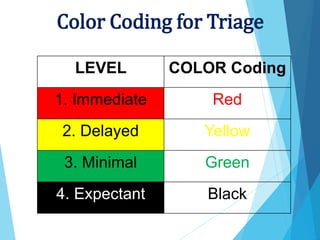
Color Coding for Triage
LEVEL COLOR Coding
1. Immediate Red
2. Delayed Yellow
3. Minimal Green
4. Expectant Black
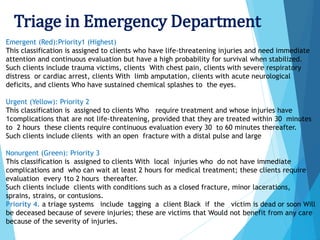
Triage in Emergency Department
Emergent (Red):Priority1 (Highest)
This classification is assigned to clients who have life-threatening injuries and need immediate
attention and continuous evaluation but have a high probability for survival when stabilized.
Such clients include trauma victims, clients With chest pain, clients with severe respiratory
distress or cardiac arrest, clients With limb amputation, clients with acute neurological
deficits, and clients Who have sustained chemical splashes to the eyes.
Urgent (Yellow): Priority 2
This classification is assigned to clients Who require treatment and whose injuries have
1complications that are not life-threatening, provided that they are treated within 30 minutes
to 2 hours these clients require continuous evaluation every 30 to 60 minutes thereafter.
Such clients include clients with an open fracture with a distal pulse and large
Nonurgent (Green): Priority 3
This classification is assigned to clients With local injuries who do not have immediate
complications and who can wait at least 2 hours for medical treatment; these clients require
evaluation every 1to 2 hours thereafter.
Such clients include clients with conditions such as a closed fracture, minor lacerations,
sprains, strains, or contusions.
Priority 4. a triage systems include tagging a client Black if the victim is dead or soon Will
be deceased because of severe injuries; these are victims that Would not benefit from any care
because of the severity of injuries.
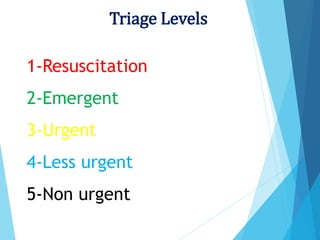
1-Resuscitation
2-Emergent
3-Urgent
4-Less urgent
5-Non urgent
Triage Levels
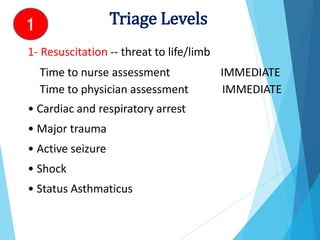
Triage Levels
1- Resuscitation -- threat to life/limb
Time to nurse assessment IMMEDIATE
Time to physician assessment IMMEDIATE
• Cardiac and respiratory arrest
• Major trauma
• Active seizure
• Shock
• Status Asthmaticus
1
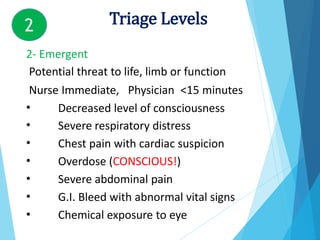
2- Emergent
Potential threat to life, limb or function
Nurse Immediate, Physician <15 minutes
•
•
•
•
•
•
•
Decreased level of consciousness
Severe respiratory distress
Chest pain with cardiac suspicion
Overdose (CONSCIOUS!)
Severe abdominal pain
G.I. Bleed with abnormal vital signs
Chemical exposure to eye
Triage Levels
2
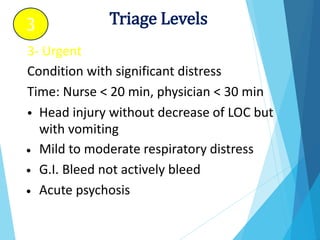
3- Urgent
Condition with significant distress
Time: Nurse < 20 min, physician < 30 min
• Head injury without decrease of LOC but
with vomiting
Mild to moderate respiratory distress
G.I. Bleed not actively bleed
Acute psychosis
•
•
•
Triage Levels
3
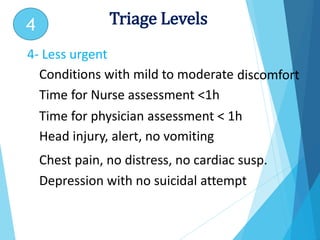
4- Less urgent
Conditions with mild to moderate
Time for Nurse assessment <1h
discomfort
Time for physician assessment < 1h
Head injury, alert, no vomiting
Chest pain, no distress, no cardiac susp.
Depression with no suicidal attempt
Triage Levels
4
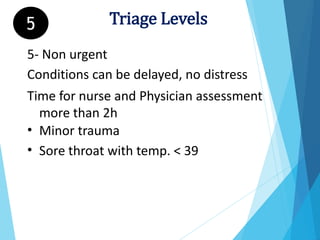
5- Non urgent
Conditions can be delayed, no distress
Time for nurse and Physician assessment
more than 2h
•
•
Minor trauma
Sore throat with temp. < 39
Triage Levels
5
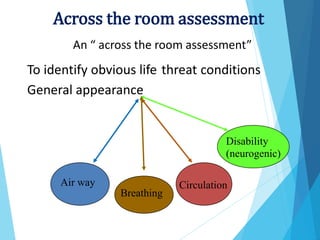
An “ across the room assessment”
To identify obvious life
General appearance
threat conditions
Disability
(neurogenic)
Air way Circulation
Breathing
Across the room assessment
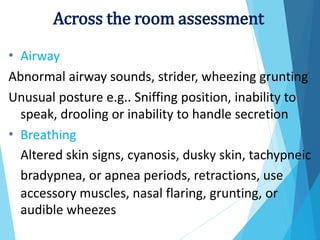
• Airway
Abnormal airway sounds, strider, wheezing grunting
Unusual posture e.g.. Sniffing position, inability to
speak, drooling or inability to handle secretion
• Breathing
Altered skin signs, cyanosis, dusky skin, tachypneic
bradypnea, or apnea periods, retractions, use
accessory muscles, nasal flaring, grunting, or
audible wheezes
Across the room assessment
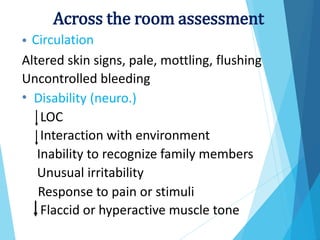
Circulation
•
Altered skin signs, pale, mottling,
Uncontrolled bleeding
flushing
• Disability (neuro.)
LOC
Interaction with environment
Inability to recognize family members
Unusual irritability
Response to pain or stimuli
Flaccid or hyperactive muscle tone
Across the room assessment
•
•
•
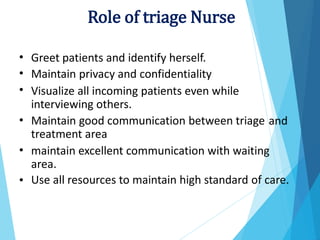
Greet patients and identify herself.
Maintain privacy and confidentiality
Visualize all incoming patients even while
interviewing others.
Maintain good communication between triage
treatment area
• and
• maintain excellent communication with waiting
area.
Use all resources to maintain high standard of care.
•
Role of triage Nurse
• Teaching ----- use of thermometer, first aid
??? avoid lecturing.
•
•
•
Crowd control.
Telephone.
Communicate with team
feed back on decisions.
leader and seek
Role of triage Nurse
Thanks
You

Triage.pptx

  • 1.
  • 2.
    Meaning of TRIAGE T : Targeting  R : Relativity  I : Intervals  A : Analytics  G : Grouping  E : Explorer
  • 3.
    • It’s the processby which patients classified according to the type and urgency of their conditions to get the Right Right Right Right patient to the place at the time with the care provider Triage is the term derived meaning to sort or to choose. Definition of Triage
  • 4.
    Non disaster: Toprovide the best care for each individual patient. Multi casualty/disaster: To provide the most effective care for the greatest number of patients. • • Triage Categories
  • 5.
    Definition: an incident,either natural or human- made, that produces patients in numbers needing services beyond immediately available resources. May involve a large no. of patients or a small no. of patients if their needs place significant demands on resources. The key to successful disaster management is to provide care to those who are in greatest need first and just as importantly, not provide care to those who have little or no chance of survival. Correct triage is essential to accomplish this goal • • Disaster
  • 6.
    Color Coding forTriage LEVEL COLOR Coding 1. Immediate Red 2. Delayed Yellow 3. Minimal Green 4. Expectant Black
  • 7.
    Triage in EmergencyDepartment Emergent (Red):Priority1 (Highest) This classification is assigned to clients who have life-threatening injuries and need immediate attention and continuous evaluation but have a high probability for survival when stabilized. Such clients include trauma victims, clients With chest pain, clients with severe respiratory distress or cardiac arrest, clients With limb amputation, clients with acute neurological deficits, and clients Who have sustained chemical splashes to the eyes. Urgent (Yellow): Priority 2 This classification is assigned to clients Who require treatment and whose injuries have 1complications that are not life-threatening, provided that they are treated within 30 minutes to 2 hours these clients require continuous evaluation every 30 to 60 minutes thereafter. Such clients include clients with an open fracture with a distal pulse and large Nonurgent (Green): Priority 3 This classification is assigned to clients With local injuries who do not have immediate complications and who can wait at least 2 hours for medical treatment; these clients require evaluation every 1to 2 hours thereafter. Such clients include clients with conditions such as a closed fracture, minor lacerations, sprains, strains, or contusions. Priority 4. a triage systems include tagging a client Black if the victim is dead or soon Will be deceased because of severe injuries; these are victims that Would not benefit from any care because of the severity of injuries.
  • 8.
  • 9.
    Triage Levels 1- Resuscitation-- threat to life/limb Time to nurse assessment IMMEDIATE Time to physician assessment IMMEDIATE • Cardiac and respiratory arrest • Major trauma • Active seizure • Shock • Status Asthmaticus 1
  • 10.
    2- Emergent Potential threatto life, limb or function Nurse Immediate, Physician <15 minutes • • • • • • • Decreased level of consciousness Severe respiratory distress Chest pain with cardiac suspicion Overdose (CONSCIOUS!) Severe abdominal pain G.I. Bleed with abnormal vital signs Chemical exposure to eye Triage Levels 2
  • 11.
    3- Urgent Condition withsignificant distress Time: Nurse < 20 min, physician < 30 min • Head injury without decrease of LOC but with vomiting Mild to moderate respiratory distress G.I. Bleed not actively bleed Acute psychosis • • • Triage Levels 3
  • 12.
    4- Less urgent Conditionswith mild to moderate Time for Nurse assessment <1h discomfort Time for physician assessment < 1h Head injury, alert, no vomiting Chest pain, no distress, no cardiac susp. Depression with no suicidal attempt Triage Levels 4
  • 13.
    5- Non urgent Conditionscan be delayed, no distress Time for nurse and Physician assessment more than 2h • • Minor trauma Sore throat with temp. < 39 Triage Levels 5
  • 14.
    An “ acrossthe room assessment” To identify obvious life General appearance threat conditions Disability (neurogenic) Air way Circulation Breathing Across the room assessment
  • 15.
    • Airway Abnormal airwaysounds, strider, wheezing grunting Unusual posture e.g.. Sniffing position, inability to speak, drooling or inability to handle secretion • Breathing Altered skin signs, cyanosis, dusky skin, tachypneic bradypnea, or apnea periods, retractions, use accessory muscles, nasal flaring, grunting, or audible wheezes Across the room assessment
  • 16.
    Circulation • Altered skin signs,pale, mottling, Uncontrolled bleeding flushing • Disability (neuro.) LOC Interaction with environment Inability to recognize family members Unusual irritability Response to pain or stimuli Flaccid or hyperactive muscle tone Across the room assessment
  • 17.
    • • • Greet patients andidentify herself. Maintain privacy and confidentiality Visualize all incoming patients even while interviewing others. Maintain good communication between triage treatment area • and • maintain excellent communication with waiting area. Use all resources to maintain high standard of care. • Role of triage Nurse
  • 18.
    • Teaching -----use of thermometer, first aid ??? avoid lecturing. • • • Crowd control. Telephone. Communicate with team feed back on decisions. leader and seek Role of triage Nurse
  • 19.