11E.N.T DepartmentE.N.T Department
SURGICALSURGICAL
PROCEDURESPROCEDURES
Dr. Ghulam saqulain
E.N.T SURGEON,
CAPITAL HOSPITAL
E.N.T DepartmentE.N.T Department
2
E.N.T DepartmentE.N.T Department
2
Laryngotomy
Emergency Procedure
“Laryngotomy is opening the airway through
the cricothyroid membrane”
• It is used for acute complete airway
obstruction when endotracheal intubation/
ventilation is not possible.
• The procedure can be accomplished in 15
to 30 seconds.
E.N.T DepartmentE.N.T Department
3
E.N.T DepartmentE.N.T Department
3
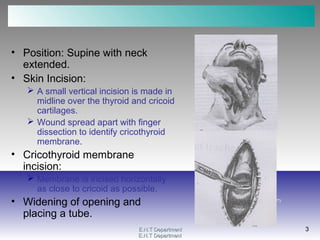
• Position: Supine with neck
extended.
• Skin Incision:
 A small vertical incision is made in
midline over the thyroid and cricoid
cartilages.
 Wound spread apart with finger
dissection to identify cricothyroid
membrane.
• Cricothyroid membrane
incision:
 Membrane is incised horizontally
as close to cricoid as possible.
• Widening of opening and
placing a tube.
E.N.T DepartmentE.N.T Department
4
E.N.T DepartmentE.N.T Department
4
TRACHEOSTOMY
•Environment:
•Best performed as an elective
procedure under endotracheal
anaesthesia, in an adequately
equipped operation theatre and aseptic
measures.
•Position:
•Supine position with a sandbag under
patient’s shoulders to give extension
of head and prominence to the trachea
and larynx.
•Under local anaesthesia a
compromised position of extension
will have to be found.
E.N.T DepartmentE.N.T Department
5
E.N.T DepartmentE.N.T Department
5
• Anaesthesia:
 Endotracheal anaesthesia
or
 Local anaesthesia (in
obstructive pathologies)
obtained by injection of
skin and subcutaneous
tissues with Xylocaine 2%
1:200000 adrenaline
solution.
 Drugs which depress resp.
system better avoided.
E.N.T DepartmentE.N.T Department
6
E.N.T DepartmentE.N.T Department
6
Elective Tracheostomy
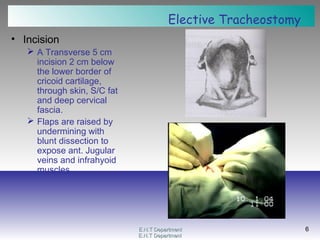
• Incision
 A Transverse 5 cm
incision 2 cm below
the lower border of
cricoid cartilage,
through skin, S/C fat
and deep cervical
fascia.
 Flaps are raised by
undermining with
blunt dissection to
expose ant. Jugular
veins and infrahyoid
muscles.
E.N.T DepartmentE.N.T Department
7
E.N.T DepartmentE.N.T Department
7
•Separation of Infrahyoid
Muscles
•The fibrous median
raphe b/w the
sternohyoid muscles is
defined and separated
with blunt dissection
•The sternothyroid
muscles on a deeper
plane are identified and
retracted laterally.
E.N.T DepartmentE.N.T Department
8
E.N.T DepartmentE.N.T Department
8
•Identification of Thyroid Isthmus:
•Anatomical variations in size
and position of thyroid isthmus
should be expected
•The thyroid isthmus may be
small and not interfere with the
approach but in most patients it
is of sufficient size to need
dividing.
•A small horizontal incision is
made in the pretracheal fascia
•Pull thyroid isthmus up or
down or
•Divide the thyroid isthmus b/w
large haemostats and ligate or
are over sewn
E.N.T DepartmentE.N.T Department
9
E.N.T DepartmentE.N.T Department
9
•Opening of the Trachea:
•Trachea is retracted in
an anterio-superior
direction by a tracheal
hook below the cricoid
•A transverse incision
into intercartilaginous
membrane below the 2nd
or 3rd
ring and converted
into a circular opening.
E.N.T DepartmentE.N.T Department
10
E.N.T DepartmentE.N.T Department
10
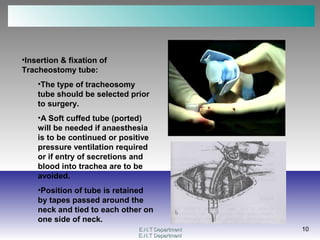
•Insertion & fixation of
Tracheostomy tube:
•The type of tracheosomy
tube should be selected prior
to surgery.
•A Soft cuffed tube (ported)
will be needed if anaesthesia
is to be continued or positive
pressure ventilation required
or if entry of secretions and
blood into trachea are to be
avoided.
•Position of tube is retained
by tapes passed around the
neck and tied to each other on
one side of neck.
E.N.T DepartmentE.N.T Department
11
E.N.T DepartmentE.N.T Department
11
• Wound Closure and
Dressing:
Wound loosely
approximated with skin
sutures and sterile
sponge trachesotomy
dressing is done around
the tube.
There should be
sufficient space
remaining around the
tube to minimize the
danger of subcutaneous
emphysema.
E.N.T DepartmentE.N.T Department
12
E.N.T DepartmentE.N.T Department
12
PaediatricTracheostomy
• Tracheostomy in children and babies
causes anxiety to all concerned.
• Needs to be carried out with precision
and in controlled conditions.
• It needs to be done under general
anaesthesia with:
 Endotracheal intubation
 Face mask or laryngeal mask with PPV
 Bronchoscope
• Local with vasoconstrictor not required.
• Slight extension of neck to avoid
thoracic trachea coming up into neck.
E.N.T DepartmentE.N.T Department
13
E.N.T DepartmentE.N.T Department
13
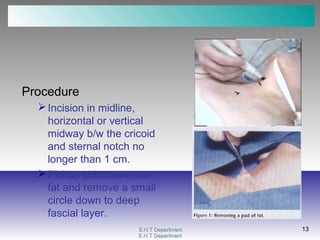
Procedure
Incision in midline,
horizontal or vertical
midway b/w the cricoid
and sternal notch no
longer than 1 cm.
Pickup subcutaneous
fat and remove a small
circle down to deep
fascial layer.
E.N.T DepartmentE.N.T Department
14
E.N.T DepartmentE.N.T Department
14
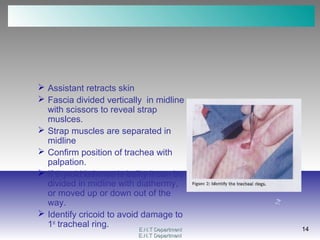
 Assistant retracts skin
 Fascia divided vertically in midline
with scissors to reveal strap
muslces.
 Strap muscles are separated in
midline
 Confirm position of trachea with
palpation.
 If thyroid isthmus is bulky it can be
divided in midline with diathermy,
or moved up or down out of the
way.
 Identify cricoid to avoid damage to
1st
tracheal ring.
E.N.T DepartmentE.N.T Department
15
E.N.T DepartmentE.N.T Department
15
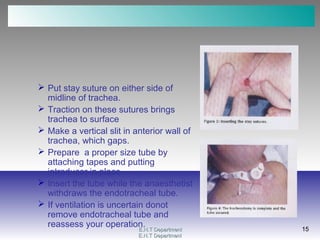
 Put stay suture on either side of
midline of trachea.
 Traction on these sutures brings
trachea to surface
 Make a vertical slit in anterior wall of
trachea, which gaps.
 Prepare a proper size tube by
attaching tapes and putting
introducer in place.
 Insert the tube while the anaesthetist
withdraws the endotracheal tube.
 If ventilation is uncertain donot
remove endotracheal tube and
reassess your operation.
E.N.T DepartmentE.N.T Department
16
E.N.T DepartmentE.N.T Department
16
Do not lose control
of
yourself or the airway
E.N.T DepartmentE.N.T Department
17
E.N.T DepartmentE.N.T Department
17
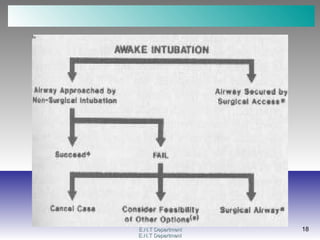
When to do What?
(Non Surgical Versus Surgical Airway)
Dr.Raza RathoreDr.Raza Rathore
Head of Dept of AnaesthesiaHead of Dept of Anaesthesia
Capital HospitalCapital Hospital
E.N.T DepartmentE.N.T Department
18
E.N.T DepartmentE.N.T Department
18
E.N.T DepartmentE.N.T Department
19
E.N.T DepartmentE.N.T Department
19
What to Do When?
E.N.T DepartmentE.N.T Department
20
E.N.T DepartmentE.N.T Department
20
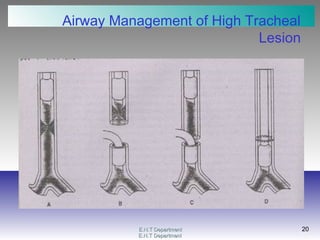
Airway Management of High Tracheal
Lesion
E.N.T DepartmentE.N.T Department
21
E.N.T DepartmentE.N.T Department
21
E.N.T DepartmentE.N.T Department
22
E.N.T DepartmentE.N.T Department
22
Anaesthetic airway management in lower
tracheal stenosis.
• Airway management is of paramount importance in
tracheal stenosis.
• It is necessary to keep the patient spontaneously
breathing until airway is secured.
• Appropriate ventilation technique needs to be employed
when trachea is opened for resection:
 Jet ventilation
 Multiple risks. Accurate measurement of end tidal CO2 and tidal volume
is impossible.
 Distal tracheal intubation
 Spontaneous ventilation, veno – venous extracorporeal
membrane oxygenator and Special Equipment & expertise.
 Cardiopulmonary bypass.
E.N.T DepartmentE.N.T Department
23
E.N.T DepartmentE.N.T Department
23
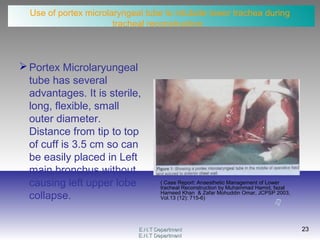
Use of portex microlaryngeal tube to intubate lower trachea during
tracheal reconstruction.
Portex Microlaryungeal
tube has several
advantages. It is sterile,
long, flexible, small
outer diameter.
Distance from tip to top
of cuff is 3.5 cm so can
be easily placed in Left
main bronchus without
causing left upper lobe
collapse.
( Case Report: Anaesthetic Management of Lower
tracheal Reconstruction by Muhammad Hamid, fazal
Hameed Khan & Zafar Mohuddin Omar, JCPSP 2003,
Vol.13 (12): 715-6)
E.N.T DepartmentE.N.T Department
24
E.N.T DepartmentE.N.T Department
24
Percutaneous Tracheosmy
E.N.T DepartmentE.N.T Department
25
E.N.T DepartmentE.N.T Department
25
Thank You

Tracheostomy surgical procedure

  • 1.
  • 2.
    E.N.T DepartmentE.N.T Department 2 E.N.TDepartmentE.N.T Department 2 Laryngotomy Emergency Procedure “Laryngotomy is opening the airway through the cricothyroid membrane” • It is used for acute complete airway obstruction when endotracheal intubation/ ventilation is not possible. • The procedure can be accomplished in 15 to 30 seconds.
  • 3.
    E.N.T DepartmentE.N.T Department 3 E.N.TDepartmentE.N.T Department 3 • Position: Supine with neck extended. • Skin Incision:  A small vertical incision is made in midline over the thyroid and cricoid cartilages.  Wound spread apart with finger dissection to identify cricothyroid membrane. • Cricothyroid membrane incision:  Membrane is incised horizontally as close to cricoid as possible. • Widening of opening and placing a tube.
  • 4.
    E.N.T DepartmentE.N.T Department 4 E.N.TDepartmentE.N.T Department 4 TRACHEOSTOMY •Environment: •Best performed as an elective procedure under endotracheal anaesthesia, in an adequately equipped operation theatre and aseptic measures. •Position: •Supine position with a sandbag under patient’s shoulders to give extension of head and prominence to the trachea and larynx. •Under local anaesthesia a compromised position of extension will have to be found.
  • 5.
    E.N.T DepartmentE.N.T Department 5 E.N.TDepartmentE.N.T Department 5 • Anaesthesia:  Endotracheal anaesthesia or  Local anaesthesia (in obstructive pathologies) obtained by injection of skin and subcutaneous tissues with Xylocaine 2% 1:200000 adrenaline solution.  Drugs which depress resp. system better avoided.
  • 6.
    E.N.T DepartmentE.N.T Department 6 E.N.TDepartmentE.N.T Department 6 Elective Tracheostomy • Incision  A Transverse 5 cm incision 2 cm below the lower border of cricoid cartilage, through skin, S/C fat and deep cervical fascia.  Flaps are raised by undermining with blunt dissection to expose ant. Jugular veins and infrahyoid muscles.
  • 7.
    E.N.T DepartmentE.N.T Department 7 E.N.TDepartmentE.N.T Department 7 •Separation of Infrahyoid Muscles •The fibrous median raphe b/w the sternohyoid muscles is defined and separated with blunt dissection •The sternothyroid muscles on a deeper plane are identified and retracted laterally.
  • 8.
    E.N.T DepartmentE.N.T Department 8 E.N.TDepartmentE.N.T Department 8 •Identification of Thyroid Isthmus: •Anatomical variations in size and position of thyroid isthmus should be expected •The thyroid isthmus may be small and not interfere with the approach but in most patients it is of sufficient size to need dividing. •A small horizontal incision is made in the pretracheal fascia •Pull thyroid isthmus up or down or •Divide the thyroid isthmus b/w large haemostats and ligate or are over sewn
  • 9.
    E.N.T DepartmentE.N.T Department 9 E.N.TDepartmentE.N.T Department 9 •Opening of the Trachea: •Trachea is retracted in an anterio-superior direction by a tracheal hook below the cricoid •A transverse incision into intercartilaginous membrane below the 2nd or 3rd ring and converted into a circular opening.
  • 10.
    E.N.T DepartmentE.N.T Department 10 E.N.TDepartmentE.N.T Department 10 •Insertion & fixation of Tracheostomy tube: •The type of tracheosomy tube should be selected prior to surgery. •A Soft cuffed tube (ported) will be needed if anaesthesia is to be continued or positive pressure ventilation required or if entry of secretions and blood into trachea are to be avoided. •Position of tube is retained by tapes passed around the neck and tied to each other on one side of neck.
  • 11.
    E.N.T DepartmentE.N.T Department 11 E.N.TDepartmentE.N.T Department 11 • Wound Closure and Dressing: Wound loosely approximated with skin sutures and sterile sponge trachesotomy dressing is done around the tube. There should be sufficient space remaining around the tube to minimize the danger of subcutaneous emphysema.
  • 12.
    E.N.T DepartmentE.N.T Department 12 E.N.TDepartmentE.N.T Department 12 PaediatricTracheostomy • Tracheostomy in children and babies causes anxiety to all concerned. • Needs to be carried out with precision and in controlled conditions. • It needs to be done under general anaesthesia with:  Endotracheal intubation  Face mask or laryngeal mask with PPV  Bronchoscope • Local with vasoconstrictor not required. • Slight extension of neck to avoid thoracic trachea coming up into neck.
  • 13.
    E.N.T DepartmentE.N.T Department 13 E.N.TDepartmentE.N.T Department 13 Procedure Incision in midline, horizontal or vertical midway b/w the cricoid and sternal notch no longer than 1 cm. Pickup subcutaneous fat and remove a small circle down to deep fascial layer.
  • 14.
    E.N.T DepartmentE.N.T Department 14 E.N.TDepartmentE.N.T Department 14  Assistant retracts skin  Fascia divided vertically in midline with scissors to reveal strap muslces.  Strap muscles are separated in midline  Confirm position of trachea with palpation.  If thyroid isthmus is bulky it can be divided in midline with diathermy, or moved up or down out of the way.  Identify cricoid to avoid damage to 1st tracheal ring.
  • 15.
    E.N.T DepartmentE.N.T Department 15 E.N.TDepartmentE.N.T Department 15  Put stay suture on either side of midline of trachea.  Traction on these sutures brings trachea to surface  Make a vertical slit in anterior wall of trachea, which gaps.  Prepare a proper size tube by attaching tapes and putting introducer in place.  Insert the tube while the anaesthetist withdraws the endotracheal tube.  If ventilation is uncertain donot remove endotracheal tube and reassess your operation.
  • 16.
    E.N.T DepartmentE.N.T Department 16 E.N.TDepartmentE.N.T Department 16 Do not lose control of yourself or the airway
  • 17.
    E.N.T DepartmentE.N.T Department 17 E.N.TDepartmentE.N.T Department 17 When to do What? (Non Surgical Versus Surgical Airway) Dr.Raza RathoreDr.Raza Rathore Head of Dept of AnaesthesiaHead of Dept of Anaesthesia Capital HospitalCapital Hospital
  • 18.
    E.N.T DepartmentE.N.T Department 18 E.N.TDepartmentE.N.T Department 18
  • 19.
    E.N.T DepartmentE.N.T Department 19 E.N.TDepartmentE.N.T Department 19 What to Do When?
  • 20.
    E.N.T DepartmentE.N.T Department 20 E.N.TDepartmentE.N.T Department 20 Airway Management of High Tracheal Lesion
  • 21.
    E.N.T DepartmentE.N.T Department 21 E.N.TDepartmentE.N.T Department 21
  • 22.
    E.N.T DepartmentE.N.T Department 22 E.N.TDepartmentE.N.T Department 22 Anaesthetic airway management in lower tracheal stenosis. • Airway management is of paramount importance in tracheal stenosis. • It is necessary to keep the patient spontaneously breathing until airway is secured. • Appropriate ventilation technique needs to be employed when trachea is opened for resection:  Jet ventilation  Multiple risks. Accurate measurement of end tidal CO2 and tidal volume is impossible.  Distal tracheal intubation  Spontaneous ventilation, veno – venous extracorporeal membrane oxygenator and Special Equipment & expertise.  Cardiopulmonary bypass.
  • 23.
    E.N.T DepartmentE.N.T Department 23 E.N.TDepartmentE.N.T Department 23 Use of portex microlaryngeal tube to intubate lower trachea during tracheal reconstruction. Portex Microlaryungeal tube has several advantages. It is sterile, long, flexible, small outer diameter. Distance from tip to top of cuff is 3.5 cm so can be easily placed in Left main bronchus without causing left upper lobe collapse. ( Case Report: Anaesthetic Management of Lower tracheal Reconstruction by Muhammad Hamid, fazal Hameed Khan & Zafar Mohuddin Omar, JCPSP 2003, Vol.13 (12): 715-6)
  • 24.
    E.N.T DepartmentE.N.T Department 24 E.N.TDepartmentE.N.T Department 24 Percutaneous Tracheosmy
  • 25.
    E.N.T DepartmentE.N.T Department 25 E.N.TDepartmentE.N.T Department 25 Thank You