Dr.Maleka Afroz
Associate Professor, ENT
USTC, Foy’s Lake Chittagong




Endotracheal intubation
Laryngotomy or Cricothyrodotomy
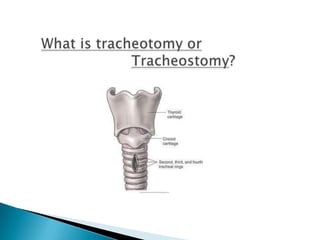
Tracheostomy










To bypass Airway obstruction (Ca larynx)
Tracheobronchial toiletting (Acute
laryngotrachealbronchitis,neuroparalysis)
Tracheobronchial protection (Unconscious patient)
Patient on ventilator ( ICU)
Patients with respiratory insufficiency ( COPD)
Prior to radical Head- neck or Maxillofacial surgery
as a temporary procedure
Prior to total laryngectomy as a permanent
procedure





Emergency
Elective
Permanent
Obstructive –Congenital
Acquired-Traumatic
Inflammatory
Neoplastic
F.B. in larynx
Paralytic
Allergy
Non obstructive-Mentioned earlier.




A little variation is marked in the operative
techniques between emergency, elective
&permanent procedure.
As well as between child & adult
tracheostomy.
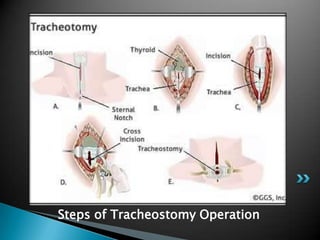
Steps of Tracheostomy Operation


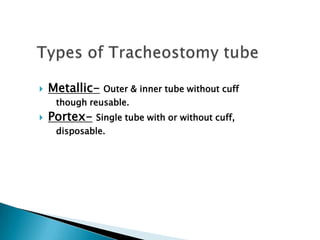
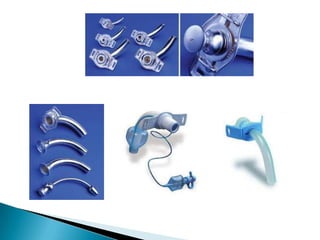
Metallic- Outer & inner tube without cuff
though reusable.



Portex- Single tube with or without cuff,
disposable.


Care of the tube-Constant supervision for

tube blockage or tube displacement, Inner tube,
Outer tube, Cuff, Suction clearance, Humidification.




Care of the wound-Regular dressing.
Care of the patient- Breathing exercise, Pen
& Paper, Bell.


Immediate- Hemorrhage, Aphonia, Apnoea, Injury to
Structures around (apical pleura, nerve, esophagus,
cricoid cartilage, fist tracheal ring), surgical emphysema,
Tube displacement.



Intermediate- Tube blockage, Chest infection, wound
infection.



Late- Layrngeal stenosis, Tracheal stenosis, Tracheo

oesophageal fistula, Tracheo cuteneous fistula, Difficult
decannulation.

Tracheostomy a life saving emergency procedure