Critical care units
An Intensive Care Unit (ICU) or
Critical Care Unit (CCU
) is a specialised facility in a hospital that provides
  intensive care medicine. Many hospitals also have designated
  intensive care areas for certain specialities of medicine, as
  dictated by the needs and available resources of each hospital.
  The naming is not rigidly standardized.
Specialized types of ICUs include
 :
 Neonatal intensive care unit (NICU)
 Special Care Baby unit (SCBU)
 Pediatric Intensive Care Unit (PICU)
 Psychiatric Intensive Care Unit (PICU)
 Coronary Care Unit (CCU) for heart disease
 Medical Intensive Care Unit (MICU)
 Surgical Intensive Care Unit (SICU)
 Cardiac Surgery Intensive Care Unit (CSICU)
 Neuroscience Critical Care Unit (NCCU)
 Overnight Intensive Recovery (OIR)
 Neuro Intensive Care Unit (NICU)
 Burn Wounds Intensive Care Unit
 Trauma Intensive care Unit (TICU)
 Shock Trauma Intensive care Unit (STICU)
Equipment and systems

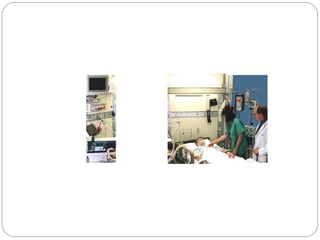
Common equipment in an ICU includes
 mechanical ventilator; dialysis equipment for renal
 problems; equipment for the constant monitoring of
 bodily functions; a web of intravenous lines, feeding
 tubes, nasogastric tubes, suction pumps, drains and
 catheters; and a wide array of drugs to treat the main
 condition(s), induce sedation, reduce pain, and prevent
 secondary infections
Mechanical ventilation
is a method to mechanically assist or replace spontaneous
  breathing when patients cannot do so on their own, and must
  be done so after invasive intubation with an endotracheal or
  tracheostomy tube through which air is directly delivered (in
  contrast to noninvasive ventilation).
Common indications for mechanical
ventilation
 Apnea with respiratory arrest
 Acute lung injury
 Respiratory rate >30 breaths per minute
 Chronic obstructive pulmonary disease (COPD)
 Clinical deterioration
 Respiratory muscle fatigue
 Obtundation or coma
 Hypotension
 Tachypnea or bradypnea
 Blood gases showing persistent hypoxemia
 Acute partial pressure of carbon dioxide (PCO2) of >50 mm Hg with pH
  <7.25
 Neuromuscular disease
A mechanical ventilator
is a machine that generates a controlled flow of gas into a
  patient’s airways. Oxygen and air are received from
  cylinders or wall outlets, the gas is pressure reduced and
  blended according to the prescribed inspired oxygen tension
  (FiO2), accumulated in a receptacle within the machine, and
  delivered to the patient using one of many available modes of
  ventilation.
ways to ventilate a patient?
There really is only two ways to ventilate a patient, using
  (conventional) positive pressure or negative pressure. Some
  of the earliest ventilators were negative pressure chambers
  (iron lungs).
Mode or Breath Pattern
 CMV = Conventional controlled ventilation, without
  allowances for spontaneous breathing. Many anesthesia
  ventilators operate in this way.
 Assist-Control = Where assisted breaths are facsimiles of
  controlled breaths.
 Intermittent Mandatory Ventilation = Which mixes
  controlled breaths and spontaneous breaths. Breaths
  may also be synchronized to prevent "stacking".
 Pressure Support = Where the patient has control over
  all aspects of his/her breath except the pressure limit.)
Modes of ventilation
Assist Control (AC). In this mode the ventilator provides a
  mechanical breath with either a preset tidal volume or peak
  pressure every time the patient initiates a breath. Traditional
  assist-control used only a preset tidal volume--when a preset
  peak pressure is used this is also sometimes termed
  Intermittent Positive Pressure Ventilation or IPPV
Synchronized Intermittent Mandatory
Ventilation (SIMV).
 In this mode the ventilator provides a preset mechanical breath
  (pressure or volume limited) every specified number of seconds
  (determined by dividing the respiratory rate into 60 - thus a
  respiratory rate of 12 results in a 5 second cycle time). Within
  that cycle time the ventilator waits for the patient to initiate a
  breath using either a pressure or flow sensor. When the ventilator
  senses the first patient breathing attempt within the cycle, it
  delivers the preset ventilator breath. If the patient fails to initiate a
  breath, the ventilator delivers a mechanical breath at the end of
  the breath cycle. Additional spontaneous breaths after the first one
  within the breath cycle do not trigger another SIMV breath
Controlled Mechanical Ventilation
(CMV).
In this mode the ventilator provides a mechanical breath on a
  preset timing. Patient respiratory efforts are ignored. This is
  generally uncomfortable for children and adults who are
  conscious and is usually only used in an unconscious patient.
  It may also be used in infants who often quickly adapt their
  breathing pattern to the ventilator timing.
Pressure Support Ventilation (PSV).
 This was developed as a method to decrease the work of breathing
  in-between ventilator mandated breaths. Thus, for example,
  SIMV might be combined with PSV so that additional breaths
  beyond the SIMV programmed breaths are supported. However,
  while the SIMV mandated breaths have a preset volume or peak
  pressure, the PSV breaths are designed to cut short when the
  inspiratory flow reaches a percentage of the peak inspiratory flow
  (e.g. 10-25%). Also, the peak pressure set for the PSV breaths is
  usually a lower pressure than that set for the SIMV breath. PSV
  can be also be used as an independent mode..
Continuous Positive Airway Pressure
(CPAP).
A continuous level of elevated pressure is provided
  through the patient circuit to maintain adequate
  oxygenation, decrease the work of breathing, and
  decrease the work of the heart (such as in left-sided heart
  failure - CHF). Note that no cycling of ventilator
  pressures occurs and the patient must initiate all breaths.
  In addition, no additional pressure above the CPAP
  pressure is provided during those breaths. CPAP may be
  used invasively through an endotracheal tube or
  tracheostomy or non-invasively with a face mask or nasal
  prongs
Positive End Expiratory Pressure (PEEP)
 is functionally the same as CPAP, but refers to the use of an
  elevated pressure during the expiratory phase of the ventilatory
  cycle. After delivery of the set amount of breath by the ventilator,
  the patient then exhales passively. The volume of gas remaining in
  the lung after a normal expiration is termed the functional residual
  capacity (FRC). The FRC is primarily determined by the elastic
  qualities of the lung and the chest wall. In many lung diseases, the
  FRC is reduced due to collapse of the unstable alveoli, leading to a
  decreased surface area for gas exchange and intrapulmonary
  shunting), with wasted oxygen inspired. Adding PEEP can reduce
  the work of breathing (at low levels) and help preserve FRC.
Initial ventilator settings
 Tidal Volume, Rate, Pressures and Initial FiO2
 For adult patients and older children
   without existing lung disease -- a tidal volume of 12 mL per kg body weight is set
    to be delivered at a rate of 12 a minute (12-12 rule).
   with COPD -- a reduced tidal volume of 10 ml/kg is to be delivered 10 times a
    minute to prevent overinflation and hyperventilation (10-10 rule).
   with acute respiratory distress syndrome (ARDS) -- an even more reduced tidal
    volume of 6-8 mL/kg is used with a rate of 10-12/minute. This reduced tidal
    volume allows for minimal volutrauma but may result in an elevated pCO2 (due
    to the relative decreased oxygen delivered) but this elevation does not need to be
    corrected (termed permissive hypercapnia)
Alarms
Mechanical ventilators are equipped with alarms to notify
  you of any changes in their ventilation status. Here are some
  of the most common causes of low and high pressure alarm
  situations
Low-Pressure Alarms

Patient disconnection 
Circuit leaks 
Airway leaks 
Chest tube leaks 
High-Pressure Alarms
 Patient coughing 
 Secretions or mucus in the airway 
 Patient biting tube 
 Airway problems 
 Reduced lung compliance (eg. pneumothorax) 
 Increased airway resistance 
 Patient fighting the ventilator 
 Accumulation of water in the circuit 
 Kinking in the circuit 
 Problems with inspiratory or expiratory valves 

Critical care units

  • 1.
  • 4.
    An Intensive CareUnit (ICU) or Critical Care Unit (CCU ) is a specialised facility in a hospital that provides intensive care medicine. Many hospitals also have designated intensive care areas for certain specialities of medicine, as dictated by the needs and available resources of each hospital. The naming is not rigidly standardized.
  • 5.
    Specialized types ofICUs include  :  Neonatal intensive care unit (NICU)  Special Care Baby unit (SCBU)  Pediatric Intensive Care Unit (PICU)  Psychiatric Intensive Care Unit (PICU)  Coronary Care Unit (CCU) for heart disease  Medical Intensive Care Unit (MICU)  Surgical Intensive Care Unit (SICU)  Cardiac Surgery Intensive Care Unit (CSICU)  Neuroscience Critical Care Unit (NCCU)  Overnight Intensive Recovery (OIR)  Neuro Intensive Care Unit (NICU)  Burn Wounds Intensive Care Unit  Trauma Intensive care Unit (TICU)  Shock Trauma Intensive care Unit (STICU)
  • 6.
    Equipment and systems Commonequipment in an ICU includes mechanical ventilator; dialysis equipment for renal problems; equipment for the constant monitoring of bodily functions; a web of intravenous lines, feeding tubes, nasogastric tubes, suction pumps, drains and catheters; and a wide array of drugs to treat the main condition(s), induce sedation, reduce pain, and prevent secondary infections
  • 7.
  • 8.
    Mechanical ventilation is amethod to mechanically assist or replace spontaneous breathing when patients cannot do so on their own, and must be done so after invasive intubation with an endotracheal or tracheostomy tube through which air is directly delivered (in contrast to noninvasive ventilation).
  • 9.
    Common indications formechanical ventilation  Apnea with respiratory arrest  Acute lung injury  Respiratory rate >30 breaths per minute  Chronic obstructive pulmonary disease (COPD)  Clinical deterioration  Respiratory muscle fatigue  Obtundation or coma  Hypotension  Tachypnea or bradypnea  Blood gases showing persistent hypoxemia  Acute partial pressure of carbon dioxide (PCO2) of >50 mm Hg with pH <7.25  Neuromuscular disease
  • 10.
    A mechanical ventilator isa machine that generates a controlled flow of gas into a patient’s airways. Oxygen and air are received from cylinders or wall outlets, the gas is pressure reduced and blended according to the prescribed inspired oxygen tension (FiO2), accumulated in a receptacle within the machine, and delivered to the patient using one of many available modes of ventilation.
  • 12.
    ways to ventilatea patient? There really is only two ways to ventilate a patient, using (conventional) positive pressure or negative pressure. Some of the earliest ventilators were negative pressure chambers (iron lungs).
  • 13.
    Mode or BreathPattern  CMV = Conventional controlled ventilation, without allowances for spontaneous breathing. Many anesthesia ventilators operate in this way.  Assist-Control = Where assisted breaths are facsimiles of controlled breaths.  Intermittent Mandatory Ventilation = Which mixes controlled breaths and spontaneous breaths. Breaths may also be synchronized to prevent "stacking".  Pressure Support = Where the patient has control over all aspects of his/her breath except the pressure limit.)
  • 14.
    Modes of ventilation AssistControl (AC). In this mode the ventilator provides a mechanical breath with either a preset tidal volume or peak pressure every time the patient initiates a breath. Traditional assist-control used only a preset tidal volume--when a preset peak pressure is used this is also sometimes termed Intermittent Positive Pressure Ventilation or IPPV
  • 17.
    Synchronized Intermittent Mandatory Ventilation(SIMV).  In this mode the ventilator provides a preset mechanical breath (pressure or volume limited) every specified number of seconds (determined by dividing the respiratory rate into 60 - thus a respiratory rate of 12 results in a 5 second cycle time). Within that cycle time the ventilator waits for the patient to initiate a breath using either a pressure or flow sensor. When the ventilator senses the first patient breathing attempt within the cycle, it delivers the preset ventilator breath. If the patient fails to initiate a breath, the ventilator delivers a mechanical breath at the end of the breath cycle. Additional spontaneous breaths after the first one within the breath cycle do not trigger another SIMV breath
  • 18.
    Controlled Mechanical Ventilation (CMV). Inthis mode the ventilator provides a mechanical breath on a preset timing. Patient respiratory efforts are ignored. This is generally uncomfortable for children and adults who are conscious and is usually only used in an unconscious patient. It may also be used in infants who often quickly adapt their breathing pattern to the ventilator timing.
  • 19.
    Pressure Support Ventilation(PSV).  This was developed as a method to decrease the work of breathing in-between ventilator mandated breaths. Thus, for example, SIMV might be combined with PSV so that additional breaths beyond the SIMV programmed breaths are supported. However, while the SIMV mandated breaths have a preset volume or peak pressure, the PSV breaths are designed to cut short when the inspiratory flow reaches a percentage of the peak inspiratory flow (e.g. 10-25%). Also, the peak pressure set for the PSV breaths is usually a lower pressure than that set for the SIMV breath. PSV can be also be used as an independent mode..
  • 20.
    Continuous Positive AirwayPressure (CPAP). A continuous level of elevated pressure is provided through the patient circuit to maintain adequate oxygenation, decrease the work of breathing, and decrease the work of the heart (such as in left-sided heart failure - CHF). Note that no cycling of ventilator pressures occurs and the patient must initiate all breaths. In addition, no additional pressure above the CPAP pressure is provided during those breaths. CPAP may be used invasively through an endotracheal tube or tracheostomy or non-invasively with a face mask or nasal prongs
  • 21.
    Positive End ExpiratoryPressure (PEEP)  is functionally the same as CPAP, but refers to the use of an elevated pressure during the expiratory phase of the ventilatory cycle. After delivery of the set amount of breath by the ventilator, the patient then exhales passively. The volume of gas remaining in the lung after a normal expiration is termed the functional residual capacity (FRC). The FRC is primarily determined by the elastic qualities of the lung and the chest wall. In many lung diseases, the FRC is reduced due to collapse of the unstable alveoli, leading to a decreased surface area for gas exchange and intrapulmonary shunting), with wasted oxygen inspired. Adding PEEP can reduce the work of breathing (at low levels) and help preserve FRC.
  • 22.
    Initial ventilator settings Tidal Volume, Rate, Pressures and Initial FiO2  For adult patients and older children  without existing lung disease -- a tidal volume of 12 mL per kg body weight is set to be delivered at a rate of 12 a minute (12-12 rule).  with COPD -- a reduced tidal volume of 10 ml/kg is to be delivered 10 times a minute to prevent overinflation and hyperventilation (10-10 rule).  with acute respiratory distress syndrome (ARDS) -- an even more reduced tidal volume of 6-8 mL/kg is used with a rate of 10-12/minute. This reduced tidal volume allows for minimal volutrauma but may result in an elevated pCO2 (due to the relative decreased oxygen delivered) but this elevation does not need to be corrected (termed permissive hypercapnia)
  • 23.
    Alarms Mechanical ventilators areequipped with alarms to notify you of any changes in their ventilation status. Here are some of the most common causes of low and high pressure alarm situations
  • 24.
    Low-Pressure Alarms Patient disconnection  Circuitleaks  Airway leaks  Chest tube leaks 
  • 25.
    High-Pressure Alarms  Patientcoughing   Secretions or mucus in the airway   Patient biting tube   Airway problems   Reduced lung compliance (eg. pneumothorax)   Increased airway resistance   Patient fighting the ventilator   Accumulation of water in the circuit   Kinking in the circuit   Problems with inspiratory or expiratory valves 

Editor's Notes

  • #2 गुरुवार दिसंबर 27, 2012 HIKMET QUBEILAT
  • #3 गुरुवार दिसंबर 27, 2012 HIKMET QUBEILAT
  • #4 गुरुवार दिसंबर 27, 2012 HIKMET QUBEILAT
  • #5 गुरुवार दिसंबर 27, 2012 HIKMET QUBEILAT
  • #6 गुरुवार दिसंबर 27, 2012 HIKMET QUBEILAT
  • #7 गुरुवार दिसंबर 27, 2012 HIKMET QUBEILAT
  • #8 गुरुवार दिसंबर 27, 2012 HIKMET QUBEILAT
  • #9 गुरुवार दिसंबर 27, 2012 HIKMET QUBEILAT
  • #10 गुरुवार दिसंबर 27, 2012 HIKMET QUBEILAT
  • #11 गुरुवार दिसंबर 27, 2012 HIKMET QUBEILAT
  • #12 गुरुवार दिसंबर 27, 2012 HIKMET QUBEILAT
  • #13 गुरुवार दिसंबर 27, 2012 HIKMET QUBEILAT
  • #14 गुरुवार दिसंबर 27, 2012 HIKMET QUBEILAT
  • #15 गुरुवार दिसंबर 27, 2012 HIKMET QUBEILAT
  • #16 गुरुवार दिसंबर 27, 2012 HIKMET QUBEILAT
  • #17 गुरुवार दिसंबर 27, 2012 HIKMET QUBEILAT
  • #18 गुरुवार दिसंबर 27, 2012 HIKMET QUBEILAT
  • #19 गुरुवार दिसंबर 27, 2012 HIKMET QUBEILAT
  • #20 गुरुवार दिसंबर 27, 2012 HIKMET QUBEILAT
  • #21 गुरुवार दिसंबर 27, 2012 HIKMET QUBEILAT
  • #22 गुरुवार दिसंबर 27, 2012 HIKMET QUBEILAT
  • #23 गुरुवार दिसंबर 27, 2012 HIKMET QUBEILAT
  • #24 गुरुवार दिसंबर 27, 2012 HIKMET QUBEILAT
  • #25 गुरुवार दिसंबर 27, 2012 HIKMET QUBEILAT
  • #26 गुरुवार दिसंबर 27, 2012 HIKMET QUBEILAT