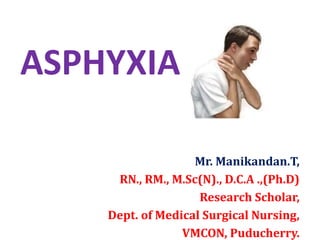
ASPHYXIA
Mr. Manikandan.T,
RN., RM., M.Sc(N)., D.C.A .,(Ph.D)
Research Scholar,
Dept. of Medical Surgical Nursing,
VMCON, Puducherry.
DEFINITION:
• A condition in which the lung do not get sufficient
oxygen supply of air for breathing.
• If this condition continues for some minutes,
breathing and heart action stops and death occurs.
Asphyxia can be induced by choking, drowning,
electric shock, injury or the inhalation of toxic gases.
Types
• Physical
• chemical
Physical asphyxia
choking
aspiration
suffocation
strangulation
Drug over
dose
Birth
asphyxia
• Choking:
when food or an object gets stuck in your airway and blocks air from
getting into lungs.
• Aspiration:
when something you eat or drink goes down the wrong pipe and enters
airway or lungs.
• Suffocation(smothering):
when something heavy covers the face or chest and prevents you from
breathing
• Strangulation:
if a cord or rope or other object long enough to go around the neck
presses on airway.
• Drug overdose:
opioids when it taken high dose it slows down the breathing
• Birth asphyxia:
unborn child may get too little oxygen during pregnancy may be due to
problem with placenta
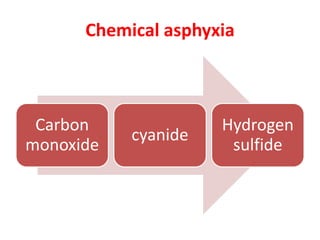
Chemical asphyxia
Carbon
monoxide
cyanide
Hydrogen
sulfide
Carbon monoxide :
colorless, odorless gas if you breathe in too much it
replaces the oxygen in blood
Cyanide :
it keep cells from taking oxygen in
Hydrogen sulfide:
gas smell like rotten egg. It can come from sewage, liquid
manure, natural gas. If you breathe in too much it prevents
oxygen from entering your cells
CAUSES OF ASPHYXIA:
1. Condition affecting air passage:
• Spasm
• Obstruction
• Compression.
2. Condition affecting the respiratory mechanism:
• Epilepsy, tetanus, rabies, nerve disease causing paralysis of
chest wall or diaphragm
CONT….:
3. Condition affecting the respiratory centre:
• Morphine, barbiturates, drowning, choking, suffocation by
smoke, asthma, external heart compression, electric shock,
stroke, strangulation, swelling within the throat, suffocation by
poison gases, artificial respiration.
4. Compression of chest:
5. Lack of oxygen:
• It is in high altitude with low atmospheric pressure.
SIGNS & SYMPTOMS:
• PHASE 1:
Rate of breathing exercise or increases,
Breaths get shorter,
Veins of neck become swollen,
Face, lips, nails, fingers and toes turn blue.,
Pulse gets faster and feeble.
• PHASE 2:
Consciousness is lost totally or partially
Forth may appear at the mouth and nostrils.
Fits may occur
MANAGEMENT:
• Remove the cause if possible
• Make the airway passage clear
• Check the level of cyanosis
• Give artificial respiration
• Arrange for transportation, send the casualty to the hospital
immediately.
• Heimlich maneuver – grasping the victim from behind with hands
linked in front and compressing the abdomen just below the ribs.
• Encourage the victim to cough up foriegn objects in throat
• Rap victim between shoulder blade to dislodge object.
• For asphyxia caused by gas or fumes remove victim to a clear
atmosphere, use artificial respiration
Heimlich maneuver
• Drowning – tilt the client to one side with head
down
• Strangulation: remove the band
• Suffocation: remove the victim as soon as
possible to fresh air
• For all the victim loosen the clothing
• If breathing gets restored give sips of water
If breathing does not restore then start artificial
respiration
Mouth – moth respiration:
• Tilt the head at back
• Pinch the nostril, cover the mouth of the casuality
• Blow into his lungs until his chest expands
• Repeat it for 15-20 times,
• Blowing of air should be done with an open mouth, covering both
mouth and nose
• Other hand ensure medical help
• If it is not possible to give 2 effective breaths start chest compression
• First aider should give 15 chest compression – 2 inflation
• Cycle should continue until patient recovers or till medical aid is
called for
Note
• Observe the following while chest
compression
Bluish discoloration of face
Dilated pupil
Carotid pulse
THANKS FOR YOUR KIND LISTENING

Asphyxia

  • 1.
    ASPHYXIA Mr. Manikandan.T, RN., RM.,M.Sc(N)., D.C.A .,(Ph.D) Research Scholar, Dept. of Medical Surgical Nursing, VMCON, Puducherry.
  • 2.
    DEFINITION: • A conditionin which the lung do not get sufficient oxygen supply of air for breathing. • If this condition continues for some minutes, breathing and heart action stops and death occurs. Asphyxia can be induced by choking, drowning, electric shock, injury or the inhalation of toxic gases.
  • 3.
  • 4.
  • 5.
    • Choking: when foodor an object gets stuck in your airway and blocks air from getting into lungs. • Aspiration: when something you eat or drink goes down the wrong pipe and enters airway or lungs. • Suffocation(smothering): when something heavy covers the face or chest and prevents you from breathing • Strangulation: if a cord or rope or other object long enough to go around the neck presses on airway. • Drug overdose: opioids when it taken high dose it slows down the breathing • Birth asphyxia: unborn child may get too little oxygen during pregnancy may be due to problem with placenta
  • 6.
  • 7.
    Carbon monoxide : colorless,odorless gas if you breathe in too much it replaces the oxygen in blood Cyanide : it keep cells from taking oxygen in Hydrogen sulfide: gas smell like rotten egg. It can come from sewage, liquid manure, natural gas. If you breathe in too much it prevents oxygen from entering your cells
  • 8.
    CAUSES OF ASPHYXIA: 1.Condition affecting air passage: • Spasm • Obstruction • Compression. 2. Condition affecting the respiratory mechanism: • Epilepsy, tetanus, rabies, nerve disease causing paralysis of chest wall or diaphragm
  • 9.
    CONT….: 3. Condition affectingthe respiratory centre: • Morphine, barbiturates, drowning, choking, suffocation by smoke, asthma, external heart compression, electric shock, stroke, strangulation, swelling within the throat, suffocation by poison gases, artificial respiration. 4. Compression of chest: 5. Lack of oxygen: • It is in high altitude with low atmospheric pressure.
  • 10.
    SIGNS & SYMPTOMS: •PHASE 1: Rate of breathing exercise or increases, Breaths get shorter, Veins of neck become swollen, Face, lips, nails, fingers and toes turn blue., Pulse gets faster and feeble. • PHASE 2: Consciousness is lost totally or partially Forth may appear at the mouth and nostrils. Fits may occur
  • 11.
    MANAGEMENT: • Remove thecause if possible • Make the airway passage clear • Check the level of cyanosis • Give artificial respiration • Arrange for transportation, send the casualty to the hospital immediately. • Heimlich maneuver – grasping the victim from behind with hands linked in front and compressing the abdomen just below the ribs. • Encourage the victim to cough up foriegn objects in throat • Rap victim between shoulder blade to dislodge object. • For asphyxia caused by gas or fumes remove victim to a clear atmosphere, use artificial respiration
  • 12.
  • 13.
    • Drowning –tilt the client to one side with head down • Strangulation: remove the band • Suffocation: remove the victim as soon as possible to fresh air • For all the victim loosen the clothing • If breathing gets restored give sips of water
  • 14.
    If breathing doesnot restore then start artificial respiration Mouth – moth respiration: • Tilt the head at back • Pinch the nostril, cover the mouth of the casuality • Blow into his lungs until his chest expands • Repeat it for 15-20 times, • Blowing of air should be done with an open mouth, covering both mouth and nose • Other hand ensure medical help • If it is not possible to give 2 effective breaths start chest compression • First aider should give 15 chest compression – 2 inflation • Cycle should continue until patient recovers or till medical aid is called for
  • 16.
    Note • Observe thefollowing while chest compression Bluish discoloration of face Dilated pupil Carotid pulse
  • 17.
    THANKS FOR YOURKIND LISTENING