PRESENTED BY:
Mr. Manikandan.T,
RN., RM., M.Sc(N)., D.C.A .,(Ph.D)
Assistant Professor,
Dept. of Medical Surgical Nursing,
VMCON, Puducherry.
The nursing process entails gathering and
analyzing data in order to identify clients
strengths and potential or actual health
problems and developing and continually
reviewing a plan of nursing interventions
to achieve mutually agreed outcomes
Critical thinking is used throughout
nursing the process
Critical thinking and the creativity it
requires and inspires are key elements in
quality nursing care
Critical thinking as “ the act of thinking
about thinking – PAUL (1988)
Critical thinking is reasonable, rationale,
reflective, autonomous, creative, fair
and inspires an attitude of inquiry that
focuses on deciding what to believe or
do
It means capable
of judging
carefully and
accurately
It is thinking that results in
the development of new
ideas and new products –
REILLY & OERMANN (1992)
Nurses must be critical thinkers
because of the nature of the
discipline and the nature of their
work
Reilly & Oermann states that one
can think critically about nursing
without a basic knowledge of its
concepts, theories and content
Nurses use knowledge from other
subjects and fields. Eg: The nurse
might use knowledge of anatomy and
physiology of lungs to promote
respiratory function of a patient who
has dyspnoea
Nurses deals with change in stressful
environments. Eg: Emergency
situation, unexpected situation
Nurses makes important
decisions.
Eg: Nurses must use good
judgement to decide which
observations must be reported to
physician immediately and which
can be noted in the client record for
the physician to address later
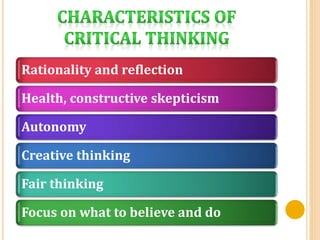
Rationality and reflection
Health, constructive skepticism
Autonomy
Creative thinking
Fair thinking
Focus on what to believe and do
It is based on reasons and evidence
rather than on preference or self
interest
Eg: Vanitha decided to become a nurse
after watching a Remo film in which
nurses were shown as attractive and
heroic
Lilly who thinks more critically asked a
counselor about the job opportunities
available for nurses
Critical thinkers do not accept or reject
ideas unless they understand them
Eg: When a salesperson insisted that a
new detergent powder was better than
that being used on Sarah’s house. Sarah
asked “ what do you mean by better?
What information do you have to show
that this is so?
Critical thinkers are not
easily manipulated. They
think for themselves, rather
than being led by their peer
group or passively accepting
the beliefs of others
Critical thinkers create original
ideas by finding connections among
thoughts and concepts
Eg: Nurse Mary remembered a song
her mother used to sing to her, and
sang it to help comfort a frightened
child in the hospital
Critical thinking is not biased or one sided. Critical
thinkers recognize the bias and prejudice of others
thinking and seek information from all points of view
before taking a stand or action
Critical thinking is used
to decide on a cause of
action, make reliable
observations, draw
sound conclusion, solve
problems and evaluate
policies, claims and
actions
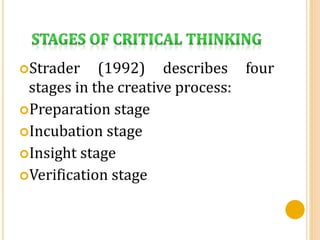
Strader (1992) describes four
stages in the creative process:
Preparation stage
Incubation stage
Insight stage
Verification stage
The creative thinker
gathers information
related to the
problem or concern
The creative thinker
unconsciously considers
and consciously works or
possible solutions or
decisions
During this stage,
appropriate solutions
emerge and are developed
and the solutions believed
to be most appropriate is
implemented
During this stage, the
implemented solution is
evaluated for its
effectiveness
Complex thinking
process such as critical
analysis, problem solving
and decision making
requires the use of
cognitive critical
thinking skills
It is a set of questions one can
apply to a particular situation or
idea to determine essential
information and ideas and discard
superfluous information and ideas
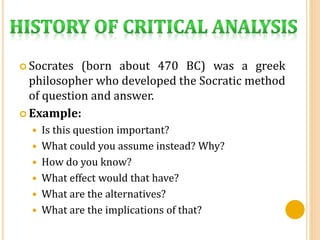
 Socrates (born about 470 BC) was a greek
philosopher who developed the Socratic method
of question and answer.
 Example:
 Is this question important?
 What could you assume instead? Why?
 How do you know?
 What effect would that have?
 What are the alternatives?
 What are the implications of that?
It is a technique one can use to look
beneath the surface, recognize and
examine assumptions, search for
inconsistencies, examine multiple points of
view and differentiate what one knows
from what one merely believes
Example: Nurse should employ this
question method during an end of shift
report, review a history, planning care
There are two types of skills
used in critical thinking.
They are:
Inductive reasoning
Deductive reasoning
Inductive reasoning generalizations are formed
from a set of facts or observations ( specific
to general)
Example: The nurse who observes that a patient
has dry skin, poor skin turgor, sunken eyes and
decreased urine output may make the
generalization that the patient appears
dehydrated
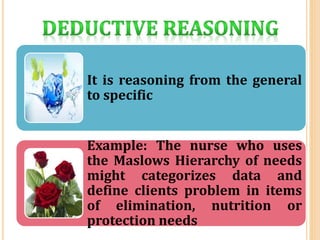
It is reasoning from the general
to specific
Example: The nurse who uses
the Maslows Hierarchy of needs
might categorizes data and
define clients problem in items
of elimination, nutrition or
protection needs
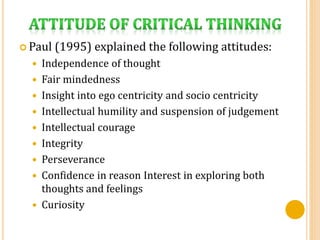
 Paul (1995) explained the following attitudes:
 Independence of thought
 Fair mindedness
 Insight into ego centricity and socio centricity
 Intellectual humility and suspension of judgement
 Intellectual courage
 Integrity
 Perseverance
 Confidence in reason Interest in exploring both
thoughts and feelings
 Curiosity
Critical thinking
requires that
individuals think
for themselves
Critical thinkers are fair
minded, assessing all
viewpoints with the same
standards and not basing
their judgments on personal
or group bias or prejudice
Critical thinkers are open to the
possibility that their personal
biases or social pressures and
customs could unduly affect
their thinking
Intellectual humility
means having an
awareness of the
limits of ones
knowledge
One is willing to consider
and examine fairly ones
own ideas or views
especially those to which
one may have a strongly
negative reaction
It requires that individuals
apply the same rigorous
standards of proof to their
own knowledge and beliefs as
they apply to the knowledge
and beliefs of others
It means finding
effective
solutions to client
and nursing
problems
Critical thinkers believes the
well reasoned thinking will lead
to trust worthy conclusions
A critical thinkers
knows that emotions
can influence thinking
and that after feelings
underlie thoughts
The internal conversation going on
within the mind of a critical thinker is
filled with questions
Example:
Why do we believe this?
The curious individual may value
tradition but is not afraid to examine
traditions to be same they are still
valid
Using critical thinking to develop a
plan of nursing care requires
considering the human factors that
might influence the plan
Nurses must use critical thinking skills
in all practice settings – acute care,
ambulatory care, extended care and in
the home & community
Fonteyn (1998) identified 12
predominant thinking strategies
used by nurses, regardless of their
area of clinical practice
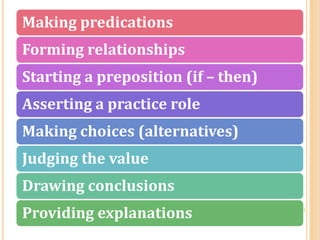
 Recognizing a pattern
 Setting priorities
 Searching for information
 Generating hypothesis
Making predications
Forming relationships
Starting a preposition (if – then)
Asserting a practice role
Making choices (alternatives)
Judging the value
Drawing conclusions
Providing explanations
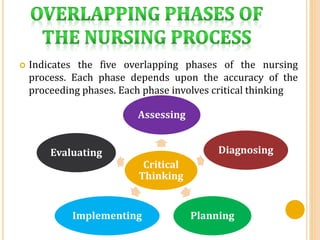
 Indicates the five overlapping phases of the nursing
process. Each phase depends upon the accuracy of the
proceeding phases. Each phase involves critical thinking
Critical
Thinking
Assessing
Diagnosing
PlanningImplementing
Evaluating
Nursing process is a systematic
rationale method of planning and
providing individualized nursing care
Nursing process is a process is used to
identify, diagnose and treat human
response to health and illness –
American Nurses Association
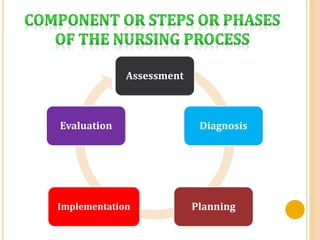
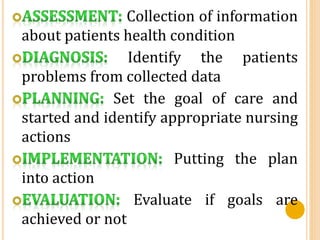
Assessment
Diagnosis
PlanningImplementation
Evaluation
Collection of information
about patients health condition
Identify the patients
problems from collected data
Set the goal of care and
started and identify appropriate nursing
actions
Putting the plan
into action
Evaluate if goals are
achieved or not
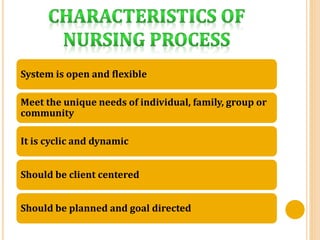
System is open and flexible
Meet the unique needs of individual, family, group or
community
It is cyclic and dynamic
Should be client centered
Should be planned and goal directed
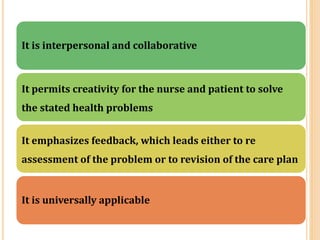
It is interpersonal and collaborative
It permits creativity for the nurse and patient to solve
the stated health problems
It emphasizes feedback, which leads either to re
assessment of the problem or to revision of the care plan
It is universally applicable
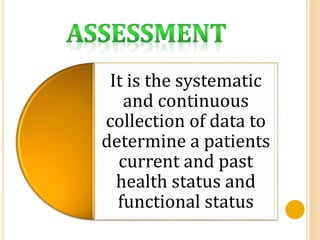
It is the systematic
and continuous
collection of data to
determine a patients
current and past
health status and
functional status
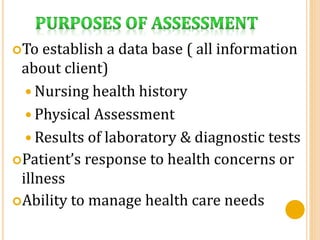
To establish a data base ( all information
about client)
 Nursing health history
 Physical Assessment
 Results of laboratory & diagnostic tests
Patient’s response to health concerns or
illness
Ability to manage health care needs
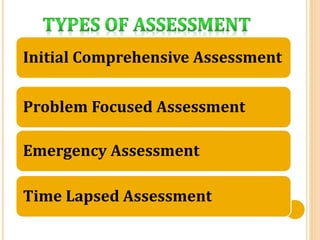
Initial Comprehensive Assessment
Problem Focused Assessment
Emergency Assessment
Time Lapsed Assessment
Performed with in specified time after
admission to a health care agency
Also called an admission assessment
Example: Nursing Admission Assessment
 To evaluate health status
 To identify functional health patterns
 To provide an in depth comprehensive
databases
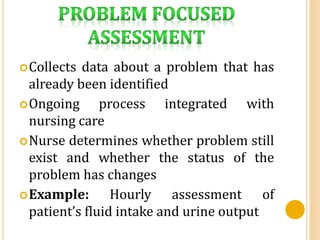
Collects data about a problem that has
already been identified
Ongoing process integrated with
nursing care
Nurse determines whether problem still
exist and whether the status of the
problem has changes
Example: Hourly assessment of
patient’s fluid intake and urine output
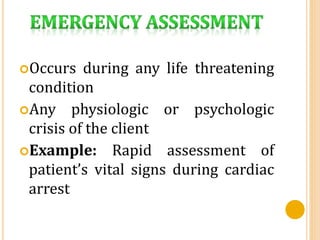
Occurs during any life threatening
condition
Any physiologic or psychologic
crisis of the client
Example: Rapid assessment of
patient’s vital signs during cardiac
arrest
Several months after initial
assessment
Evaluate the changes in the clients
health & functional status
Example:
 Periodic output patient clinic visits
 Home health visits
 Health & development screening
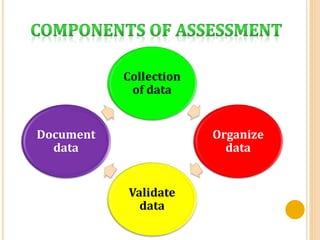
Collection
of data
Organize
data
Validate
data
Document
data
It is the process of gathering information about a
patients health status
Includes physical, psychological, emotion, socio
cultural, spiritual factors that may affect clients
health status
Includes past health history of client ( allergies,
past surgeries, chronic diseases, use of folk healing
methods), present problems of client (pain,
nausea, vomiting etc)
It referred to as
symptoms or sensations and can be
described by that affected person or patient
Example: Pain, itching, tinnitus, feeling of
worry
It referred to as signs,
are detectable by an observer mainly using
inspection, percussion, palpation or
auscultation
Example: Pallor, Diaphoresis, Jaundice, BP –
150/100 mmhg
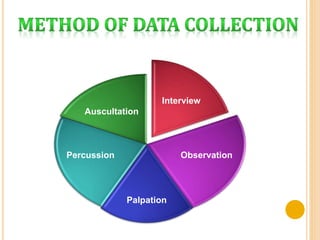
Interview
Observation
Palpation
Percussion
Auscultation
Listen attentively, using all your
senses
Speak slowly and clearly
Use language that client understand
Clarify points that are not
understood
Plan questions to follow a logical
sequence
Ask only one question at a time
Allow the patient to clarify the asked question,
if need
Do not impose your own values on the patient
Avoid using personal examples
Non verbally convey respect, concern, interest
and acceptance
Use and accept silence to help the patient
search for more thoughts or to organize them
Use eye contact and be calm, unhurried and
sympathetic
Data directly
gathered from the patient using
interview and physical examination
Data
gathered from family members,
significant others, medical records/
charts, health team members and
journals/ literature
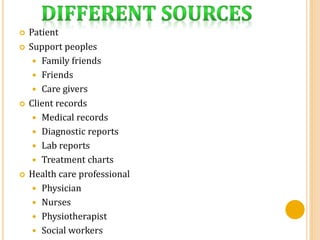
 Patient
 Support peoples
 Family friends
 Friends
 Care givers
 Client records
 Medical records
 Diagnostic reports
 Lab reports
 Treatment charts
 Health care professional
 Physician
 Nurses
 Physiotherapist
 Social workers
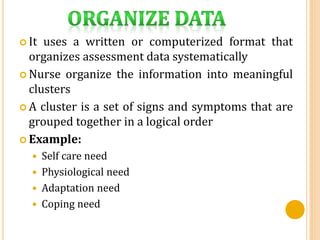
 It uses a written or computerized format that
organizes assessment data systematically
 Nurse organize the information into meaningful
clusters
 A cluster is a set of signs and symptoms that are
grouped together in a logical order
 Example:
 Self care need
 Physiological need
 Adaptation need
 Coping need
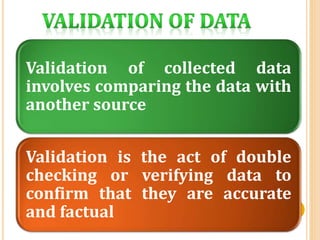
Validation of collected data
involves comparing the data with
another source
Validation is the act of double
checking or verifying data to
confirm that they are accurate
and factual
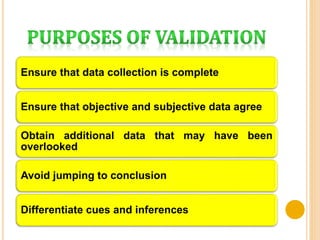
Ensure that data collection is complete
Ensure that objective and subjective data agree
Obtain additional data that may have been
overlooked
Avoid jumping to conclusion
Differentiate cues and inferences
Deciding whether the data require
validation
Determining ways to validate the data
Identifying areas where data are
missing
Failure to validate data may result in
premature closure of assessment or
collection of inaccurate data
To complete the assessment phase, the
nurse records patient data
Accurate documentation is essential and
should include all data collected about the
patients health status
Data are recorded in a factual manner and
not interpreted by the nurse
Example: The nurse records the patient’s
breakfast intake (objective data) as “ coffee
200ml, Idly – 4 Nos, Sambar – 200ml, rather
than as “appetite good” ( a judgment)
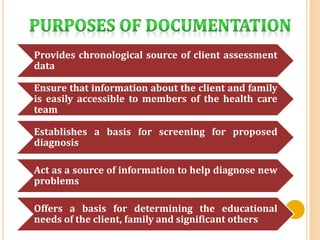
Provides chronological source of client assessment
data
Ensure that information about the client and family
is easily accessible to members of the health care
team
Establishes a basis for screening for proposed
diagnosis
Act as a source of information to help diagnose new
problems
Offers a basis for determining the educational
needs of the client, family and significant others
 Document legibly or print neatly in un erasable ink
 Use correct grammar and spelling
 Avoid wordiness that creates redundancy
 Use phrases instead of sentences to record data
 Record data findings objectively with sequence
 Avoid short form of words
 Record complete information and details for all
client symptoms or experiences
 Support objective data with specific observations
obtained during physical examination
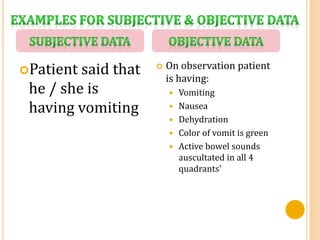
Patient said that
he / she is
having vomiting
 On observation patient
is having:
 Vomiting
 Nausea
 Dehydration
 Color of vomit is green
 Active bowel sounds
auscultated in all 4
quadrants'
Diagnosing is the second phase of
the nursing process, in which the
nurse interprets assessment data,
identifies client strengths and health
problems and formulate diagnostic
statements
It is a clinical judgment about
individual, family or community
responses to actual and potential health
problems / life processes – NANDA -
2003
NANDA – North American Nursing
Diagnosis Association
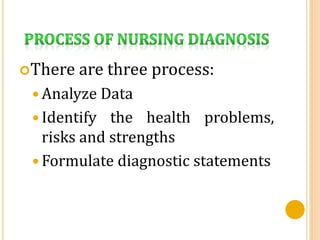
There are three process:
 Analyze Data
 Identify the health problems,
risks and strengths
 Formulate diagnostic statements
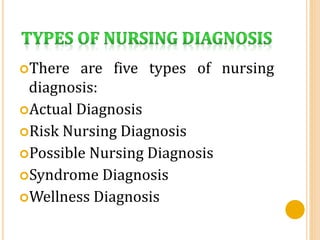
There are five types of nursing
diagnosis:
Actual Diagnosis
Risk Nursing Diagnosis
Possible Nursing Diagnosis
Syndrome Diagnosis
Wellness Diagnosis
It is a client problem that is present
at the time of the nursing
assessment.
It is based on the presence of
associated signs and symptoms
Example:
Ineffective Breathing Pattern
Anxiety
It is a clinical judgment that a problem
does not exist, but the presence of risk
factors indicates that a problem is likely
to develop unless nurses intervention
Example: Risk for infection, Risk for
complication
 It is one in which evidence about a health
problem is incomplete or unclear
 Eg: An elderly widow who lives alone is
admitted to the hospital. The nurse notices
that she has no visitors and is pleased with
attention and conversation from the nursing
staff
 The nurse may write a nursing diagnosis of
possible social isolation related to unknown
etiology
It is a diagnosis that is associated
with a cluster of other nursing
diagnosis
Eg:
Disuse syndrome (long term bed
ridden patients)
Impaired physical mobility
It is one indicating a healthy response of
a patient who desire a higher level of
wellness
Eg:
Individual coping
Family coping
Potential for enhanced spiritual well
being
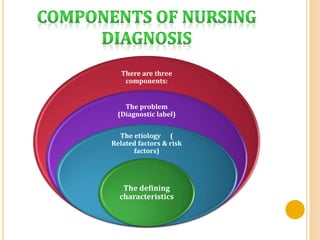
There are three
components:
The problem
(Diagnostic label)
The etiology (
Related factors & risk
factors)
The defining
characteristics
It Describes the patient
response to health
problems
Eg:
Activity intolerance
Constipation
 These are causative factors that have
influenced the clients actual or potential
response to the health problem
 The related phase identifies the etiology or
cause of the clients response to health
problem
 Eg: Activity intolerance related to generalized
weakness or obesity or sedentary life style
 Constipation related to inadequate fluid
intake or inadequate fiber intake
These are the cluster of signs and
symptoms that indicate the
presence of particular diagnostic
label
Eg: Impaired response to activity,
weak, thready pulse, tachycardia,
irregular pulse and shallow
respiration
The diagnostic process uses the
critical thinking skills of analyses
and synthesis
This process has three stages:
 Analyzing data
 Identifying health problems, risk &
strengths
 Formulating diagnostic statements
It involves the following stages:
 Compare data against standards
 Cluster cues
 Identifying gaps and
inconsistencies
After data are analyzed,
the nurse and patient
can together identify
strengths & problems.
This is primarily a
decision making process
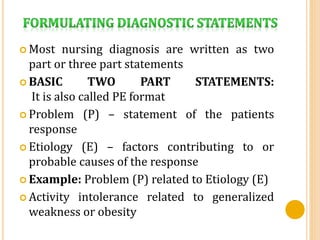
 Most nursing diagnosis are written as two
part or three part statements
 BASIC TWO PART STATEMENTS:
It is also called PE format
 Problem (P) – statement of the patients
response
 Etiology (E) – factors contributing to or
probable causes of the response
 Example: Problem (P) related to Etiology (E)
 Activity intolerance related to generalized
weakness or obesity
 It is also called as PES format & includes:
 Problem (P) – statement of the patient’s
response
 Etiology (E) – factors contributing to or
probable causes of the responses
 Signs & Symptoms (S) – defining
characteristics evidenced by the client
 Example: Problem related to etiology as
evidenced by signs and symptoms
 Activity intolerance related to generalized
weakness as evidenced by fatigue
It is a statement
of nursing
judgment and
refers to a
condition that
nurses are
licensed to treat
It is made by a
physician and
refers to a
condition that
only a physician
can treat
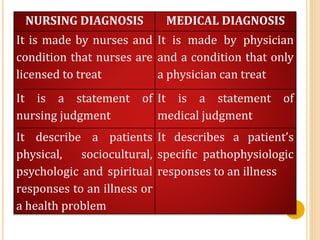
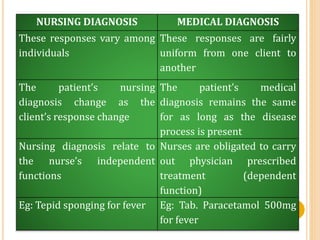
NURSING DIAGNOSIS MEDICAL DIAGNOSIS
It is made by nurses and
condition that nurses are
licensed to treat
It is made by physician
and a condition that only
a physician can treat
It is a statement of
nursing judgment
It is a statement of
medical judgment
It describe a patients
physical, sociocultural,
psychologic and spiritual
responses to an illness or
a health problem
It describes a patient’s
specific pathophysiologic
responses to an illness
NURSING DIAGNOSIS MEDICAL DIAGNOSIS
These responses vary among
individuals
These responses are fairly
uniform from one client to
another
The patient’s nursing
diagnosis change as the
client’s response change
The patient’s medical
diagnosis remains the same
for as long as the disease
process is present
Nursing diagnosis relate to
the nurse’s independent
functions
Nurses are obligated to carry
out physician prescribed
treatment (dependent
function)
Eg: Tepid sponging for fever Eg: Tab. Paracetamol 500mg
for fever
Planning is the third phase of the
nursing process, in which the nurse
and client develop client goals/
desired outcomes and nursing
strategies to prevent, reduce or
alleviate the client’s health problem
Planning is a category of
nursing behaviors in which
client centered goals and
expected outcomes are
established and nursing
interventions are selected
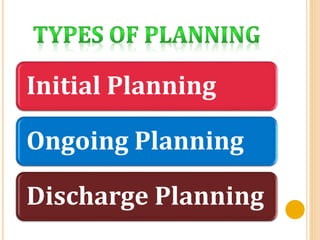
Initial Planning
Ongoing Planning
Discharge Planning
It should be
initiated as soon as
possible after the
initial assessment
It occurs at the
beginning of a
shift as the nurse
plans the care to
be given that day
It begins at first client contact and
involves comprehensive and ongoing
assessment to obtain information
about the patients ongoing needs
The end product of the planning phase
of the nursing process is a formal or
informal plan of care
 An informal care plan
 Formal care plan
 Standardized care plan
 Individualized care plan
 Kardex care plan
It is a plan of action that exists
in the nurses mind
Eg: Nurse may think “ Mrs.
Shanthi is very tired, I will need
to reinforce her teaching after
she is rested”