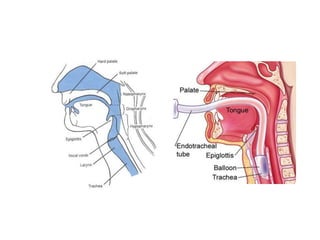
ENDOTRACHEAL TUBE

     (ET Tube)
• Endotracheal tubes are curved tubes used for
  intubation
• Tubes were previously made up of latex (indian
  rubber) and those still available , currently plastic
  tubes (PVC) are preferred because of following
  advantages :
 Disposable (less chances of infection)
 Hypoallergenic ( since latex allergy is fairly
  comman)
 Transparent (easy visualization of blockage ETT
  due to blood , pus , secretions
• THE ET TUBE HAS THE FOLLOWING
  COMPONENTS :
 PROXIMAL END – 15mm adapter (connector)
  which fits to ventilator or ambu bag
 CENTRAL PORTION –
1. A vocal cord guide (black line ) which should be
   placed at the level of the opening of the vocal
   cords so that the tip of the ET tube is
   positioned above the bifurcation if the trachea.
2. A radio-opaque marker which is essential for
   accurate visualization of the position of the ET
   tube within the trachea by means of an X-ray
3. The distance indicator (marked in
   centimeters) which facilitates placement of
   ET tube.
4. A cuff- incase of cuff ET tube
 DISTAL END – has Murphy’s eye (opening in
   the lateral wall ) which prevents complete
   blockage of ET tube incase the distal end is
   impacted with secretion , blood , etc.
TYPES
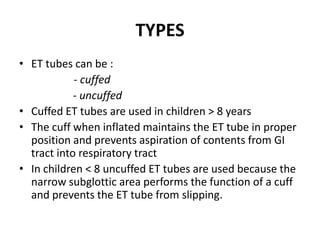
• ET tubes can be :
            - cuffed
            - uncuffed
• Cuffed ET tubes are used in children > 8 years
• The cuff when inflated maintains the ET tube in proper
  position and prevents aspiration of contents from GI
  tract into respiratory tract
• In children < 8 uncuffed ET tubes are used because the
  narrow subglottic area performs the function of a cuff
  and prevents the ET tube from slipping.
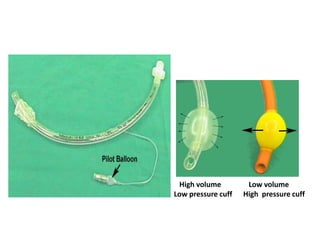
High volume         Low volume
Low pressure cuff   High pressure cuff
SIZE
• From 2mm to 16 mms (internal diameter )
 The size of the tube can be determined by –

 internal diameter of ETT (mm) = age in years +4
                                          4
 Roughly the diameter of the childs little finger is
  the same as that required for the ETT
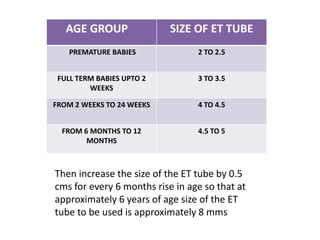
 The following table gives an idea abpout the size
  of ETT in different age groups.
AGE GROUP               SIZE OF ET TUBE
    PREMATURE BABIES             2 TO 2.5


 FULL TERM BABIES UPTO 2         3 TO 3.5
         WEEKS

FROM 2 WEEKS TO 24 WEEKS         4 TO 4.5


  FROM 6 MONTHS TO 12            4.5 TO 5
        MONTHS


Then increase the size of the ET tube by 0.5
cms for every 6 months rise in age so that at
approximately 6 years of age size of the ET
tube to be used is approximately 8 mms
USES
 For Mechanical Ventilation
 For Intermittent Postive Pressure Ventilation
  (IPPV)
 During resuscitation
 Direct suctioning of trachea in meconium
  aspiration
 In Epiglottits &life threatening croup
 In tetanus (however for long term bases,
  tracheostomy is preferable)
 In diptheria
 In angioneurotic edema
COMPLICATIONS
 Mechanical trauma to tongue, teeth , palate ,
  pharynx & larynx during intubation procedure
 Stimulation of posterior of posterior pharyngeal
  wall leading to coughing , vomiting or vasovagal
  episode with resultant hypoxia , bradycardia.
 Prolonged intubation may cause pressure
  necrosis of laryngeal structures leading to
  persistant hoarseness ( hence tracheostomy) is
  indicated in patients requiring long-term
  mechanical ventilation)
 Pneumothorax.
AMBU BAG
• PARTS OF THE AMBU BAG
 PATIENT OUTLET (to which mask is attached )
 ONE-WAY VALVE UNIT (just proximal to
  patient outlet )
 PRESSURE RELEASE VALVE
 Attachment site for manometer
 size : the size of the bag varies depending on
  the volume ( ranges from 250 ml to 750 ml for
  paediatric use)
 pressure release valves : are usually set to
  release at pressure of 30-35cms of water
 at the end there are two inlets
 OXYGEN INLET : This inlet is attached to a
  tube carrying oxygen from the source (central
  oxygen line or oxygen cylinder )
 AIR INLET : if kept open the concentration of
  02 is approx 40% FiO2. for the Fi02 to be near
  90-100% , and oxygen reservoir should be
  attached.
MECHANISM OF VENTILATION

 in the resting stage the ambu bag is filled with air
  . On squeezing the bag to initiate ventilation the
  one wave valve proximal to the patients outlet
  opens resulting in release of air , stored in the
  bag to the patient. On releasing the pressure the
  bag gets re-inflated with air. The patients exhaled
  air cannot re-enter the bag due to one wave
  mechanism of the valve at the patient outlet.

USES : for giving intermittent positive pressure
  ventilation
Endotracheal tubes

Endotracheal tubes

  • 1.
  • 3.
    • Endotracheal tubesare curved tubes used for intubation • Tubes were previously made up of latex (indian rubber) and those still available , currently plastic tubes (PVC) are preferred because of following advantages :  Disposable (less chances of infection)  Hypoallergenic ( since latex allergy is fairly comman)  Transparent (easy visualization of blockage ETT due to blood , pus , secretions
  • 4.
    • THE ETTUBE HAS THE FOLLOWING COMPONENTS :  PROXIMAL END – 15mm adapter (connector) which fits to ventilator or ambu bag  CENTRAL PORTION – 1. A vocal cord guide (black line ) which should be placed at the level of the opening of the vocal cords so that the tip of the ET tube is positioned above the bifurcation if the trachea. 2. A radio-opaque marker which is essential for accurate visualization of the position of the ET tube within the trachea by means of an X-ray
  • 5.
    3. The distanceindicator (marked in centimeters) which facilitates placement of ET tube. 4. A cuff- incase of cuff ET tube  DISTAL END – has Murphy’s eye (opening in the lateral wall ) which prevents complete blockage of ET tube incase the distal end is impacted with secretion , blood , etc.
  • 7.
    TYPES • ET tubescan be : - cuffed - uncuffed • Cuffed ET tubes are used in children > 8 years • The cuff when inflated maintains the ET tube in proper position and prevents aspiration of contents from GI tract into respiratory tract • In children < 8 uncuffed ET tubes are used because the narrow subglottic area performs the function of a cuff and prevents the ET tube from slipping.
  • 8.
    High volume Low volume Low pressure cuff High pressure cuff
  • 10.
    SIZE • From 2mmto 16 mms (internal diameter )  The size of the tube can be determined by – internal diameter of ETT (mm) = age in years +4 4  Roughly the diameter of the childs little finger is the same as that required for the ETT  The following table gives an idea abpout the size of ETT in different age groups.
  • 11.
    AGE GROUP SIZE OF ET TUBE PREMATURE BABIES 2 TO 2.5 FULL TERM BABIES UPTO 2 3 TO 3.5 WEEKS FROM 2 WEEKS TO 24 WEEKS 4 TO 4.5 FROM 6 MONTHS TO 12 4.5 TO 5 MONTHS Then increase the size of the ET tube by 0.5 cms for every 6 months rise in age so that at approximately 6 years of age size of the ET tube to be used is approximately 8 mms
  • 12.
    USES  For MechanicalVentilation  For Intermittent Postive Pressure Ventilation (IPPV)  During resuscitation  Direct suctioning of trachea in meconium aspiration  In Epiglottits &life threatening croup  In tetanus (however for long term bases, tracheostomy is preferable)  In diptheria  In angioneurotic edema
  • 13.
    COMPLICATIONS  Mechanical traumato tongue, teeth , palate , pharynx & larynx during intubation procedure  Stimulation of posterior of posterior pharyngeal wall leading to coughing , vomiting or vasovagal episode with resultant hypoxia , bradycardia.  Prolonged intubation may cause pressure necrosis of laryngeal structures leading to persistant hoarseness ( hence tracheostomy) is indicated in patients requiring long-term mechanical ventilation)  Pneumothorax.
  • 14.
    AMBU BAG • PARTSOF THE AMBU BAG  PATIENT OUTLET (to which mask is attached )  ONE-WAY VALVE UNIT (just proximal to patient outlet )  PRESSURE RELEASE VALVE  Attachment site for manometer
  • 16.
     size :the size of the bag varies depending on the volume ( ranges from 250 ml to 750 ml for paediatric use)  pressure release valves : are usually set to release at pressure of 30-35cms of water  at the end there are two inlets  OXYGEN INLET : This inlet is attached to a tube carrying oxygen from the source (central oxygen line or oxygen cylinder )  AIR INLET : if kept open the concentration of 02 is approx 40% FiO2. for the Fi02 to be near 90-100% , and oxygen reservoir should be attached.
  • 17.
    MECHANISM OF VENTILATION in the resting stage the ambu bag is filled with air . On squeezing the bag to initiate ventilation the one wave valve proximal to the patients outlet opens resulting in release of air , stored in the bag to the patient. On releasing the pressure the bag gets re-inflated with air. The patients exhaled air cannot re-enter the bag due to one wave mechanism of the valve at the patient outlet. USES : for giving intermittent positive pressure ventilation