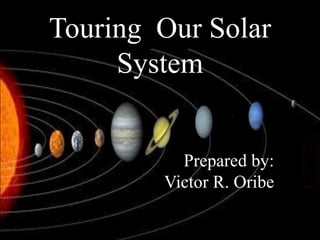
Touring Our Solar
     System


          Prepared by:
        Victor R. Oribe
How Did the Planets Form?
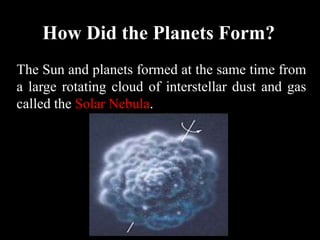
The Sun and planets formed at the same time from
a large rotating cloud of interstellar dust and gas
called the Solar Nebula.
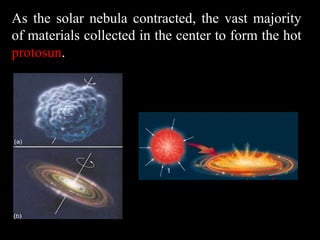
As the solar nebula contracted, the vast majority
of materials collected in the center to form the hot
protosun.
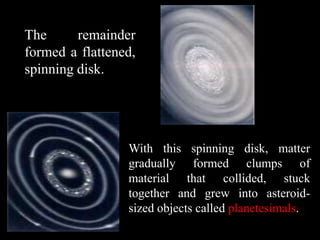
The      remainder
formed a flattened,
spinning disk.


                 With this spinning disk, matter
                 gradually formed clumps of
                 material that collided, stuck
                 together and grew into asteroid-
                 sized objects called planetesimals.
The composition of these planetesimals
depended largely on their locations with
respect to their protostar.

Temperature were greater near the protosun
and much lower in the outer reaches of the
disk.

This was critical since only those materials
that could condense in a particular location
would be available to form planetesimal.
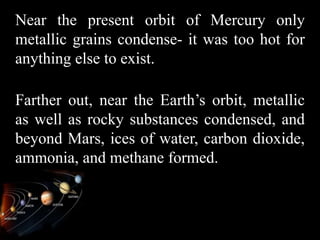
Near the present orbit of Mercury only
metallic grains condense- it was too hot for
anything else to exist.

Farther out, near the Earth’s orbit, metallic
as well as rocky substances condensed, and
beyond Mars, ices of water, carbon dioxide,
ammonia, and methane formed.
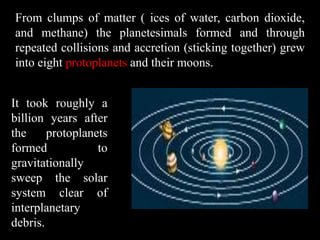
From clumps of matter ( ices of water, carbon dioxide,
and methane) the planetesimals formed and through
repeated collisions and accretion (sticking together) grew
into eight protoplanets and their moons.


It took roughly a
billion years after
the     protoplanets
formed            to
gravitationally
sweep the solar
system clear of
interplanetary
debris.
The period of intense bombardment is
clearly visible on the Moon and elsewhere in
the solar system.

Only a small amount of the interplanetary
matter escaped capture by a planet or moon
and became the asteroid, comets, and
meteoroids.
Terrestrial and Jovian Planets
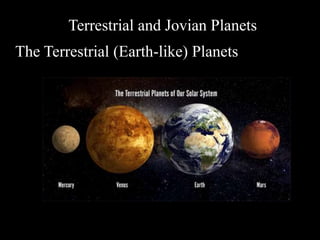
The Terrestrial (Earth-like) Planets
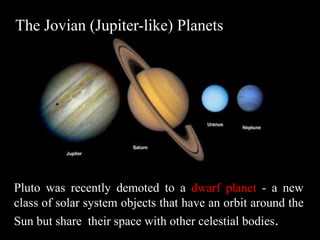
The Jovian (Jupiter-like) Planets


Pluto was recently demoted to a dwarf planet - a new
class of solar system objects that have an orbit around the
Sun but share their space with other celestial bodies.
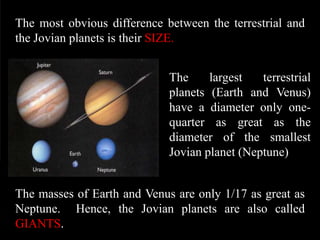
The most obvious difference between the terrestrial and
the Jovian planets is their SIZE.


                             The     largest   terrestrial
                             planets (Earth and Venus)
                             have a diameter only one-
                             quarter as great as the
                             diameter of the smallest
                             Jovian planet (Neptune)


The masses of Earth and Venus are only 1/17 as great as
Neptune. Hence, the Jovian planets are also called
GIANTS.
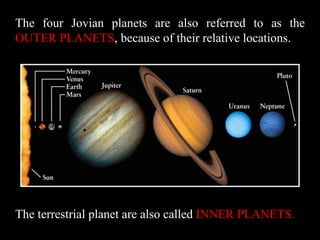
The four Jovian planets are also referred to as the
OUTER PLANETS, because of their relative locations.


The terrestrial planet are also called INNER PLANETS.
Other dimension in which the terrestrial and the Jovian
planets differ include: DENSITY, CHEMICAL
MAKEUP, and the RATE OF RORATION.

The density of the Terrestrial planets average about FIVE
times the density of water.

The density of the Jovian planets averages only 1.5 times
of water.

One of the outer planets, Saturn, has a density only 0.7
times that of water, which means that Saturn would float
if placed in a large enough water tank.
The Composition of the Planets
The substances that make up the planets are divided into
three compositional groups: GASES, ROCKS, and ICES,
based on their melting point.

1. Gases
       Hydrogen and Helium, are those with melting
       points near absolute zero (0K).

       Hydrogen and Helium, are the most abundant
       constituents of the solar nebula.
2. Rocks
     Rocks present in the planets are usually silicate
     minerals and metallic iron, which have a melting
     points that exceed 7000C (13000 F)


3. Ices
     Ices in the planets includes ammonia, methane,
     carbon dioxide, and water.

     This gases have intermediate melting points (for
     example, water has a melting point of 00C (320 F)
The terrestrial planets are dense, consisting
mostly of rocky and metallic substances, with
minor amounts of ices.

The Jovian planets, on the other hand, contain
large amounts of gases (hydrogen and helium)
and ices (mostly water, ammonia, and
methane).    This accounts for their low
densities.
Jovian planets also contain substantial amounts
of rocky and metallic materials, which are
concentrated in their central cores.
The Atmosphere of the Planets
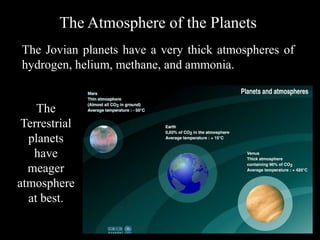
The Jovian planets have a very thick atmospheres of
hydrogen, helium, methane, and ammonia.


    The
 Terrestrial
  planets
   have
  meager
atmosphere
  at best.
Reasons for the Differences in the
      Atmosphere of the Planets
1. Location of each planet within the solar
nebula during its formation.
   The outer planets formed where the temperature
   was low enough to allow water vapor, ammonia,
   and methane to condense into ices, thus, the
   Jovian planets contain large amounts of these
   volatile gases.

   While the inner regions of the developing solar
   system, the environment was too hot for ices to
   survive.
Consequently, one of the long-standing questions for the
nebular hypothesis was “How did Earth acquire water
and other volatile gases?”

During the protoplanet stage, Earth was bombarded with
icy fragments (planetesimals) that originated beyond the
orbit of Mars.

Like the inner planet, they (Mercury and Moon) surely
would have been bombarded by icy bodies.

Why do Mercury and our Moon lack an atmosphere?
2. More massive planets have better
chance of retaining their atmospheres
because atoms and molecules need a
higher speed to escape.
  On the Moon the escape velocity is only 2.4 km/s
  compared with more than 11 km/s for Earth.

  Because of their strong gravitational fields, the
  Jovian planets have escape velocities that are
  mush higher than that of Earth, which is the
  largest terrestrial planet.
3. The molecular motion of a gas is
temperature-dependent.
   At the low temperatures of the Jovian planets even
   the lightest gases (hydrogen and helium0 are
   unlikely to acquire the speed needed to escape.

   By the contrast, a comparatively warm body with
   a small surface gravity, such a Mercury and our
   Moon, is unable to hold even heavy gases such as
   carbon dioxide and radon.
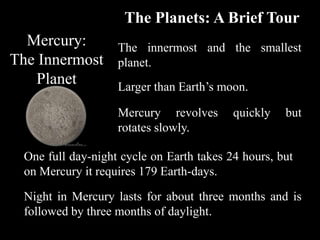
The Planets: A Brief Tour
  Mercury:         The innermost and the smallest
The Innermost      planet.
    Planet         Larger than Earth’s moon.

                   Mercury revolves       quickly   but
                   rotates slowly.

 One full day-night cycle on Earth takes 24 hours, but
 on Mercury it requires 179 Earth-days.

 Night in Mercury lasts for about three months and is
 followed by three months of daylight.
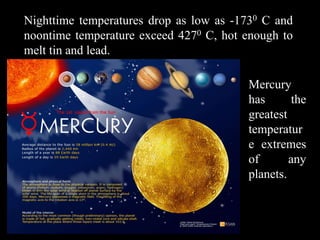
Nighttime temperatures drop as low as -1730 C and
noontime temperature exceed 4270 C, hot enough to
melt tin and lead.

                                        Mercury
                                        has       the
                                        greatest
                                        temperatur
                                        e extremes
                                        of       any
                                        planets.
Mercury absorbs most of the sunlight that strikes it,
reflecting only 6% into space.
The low reflectivity of sunlight from Mercury is
characteristic of terrestrial bodies that have virtually no
atmosphere.
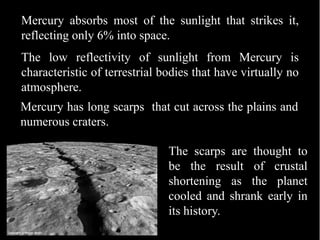
Mercury has long scarps that cut across the plains and
numerous craters.

                               The scarps are thought to
                               be the result of crustal
                               shortening as the planet
                               cooled and shrank early in
                               its history.
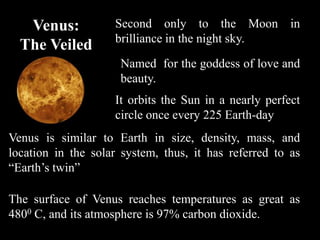
Venus:           Second only to the Moon in
                    brilliance in the night sky.
  The Veiled
   Planet            Named for the goddess of love and
                     beauty.
                    It orbits the Sun in a nearly perfect
                    circle once every 225 Earth-day
Venus is similar to Earth in size, density, mass, and
location in the solar system, thus, it has referred to as
“Earth’s twin”

The surface of Venus reaches temperatures as great as
4800 C, and its atmosphere is 97% carbon dioxide.
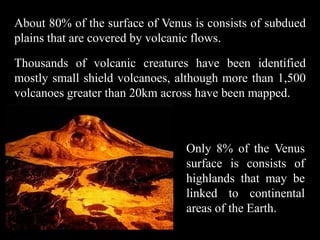
About 80% of the surface of Venus is consists of subdued
plains that are covered by volcanic flows.

Thousands of volcanic creatures have been identified
mostly small shield volcanoes, although more than 1,500
volcanoes greater than 20km across have been mapped.


                                 Only 8% of the Venus
                                 surface is consists of
                                 highlands that may be
                                 linked to continental
                                 areas of the Earth.
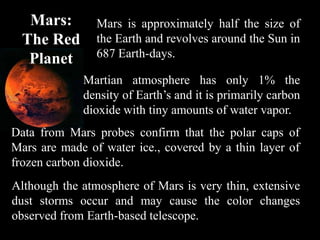
Mars:        Mars is approximately half the size of
  The Red       the Earth and revolves around the Sun in
   Planet       687 Earth-days.

             Martian atmosphere has only 1% the
             density of Earth’s and it is primarily carbon
             dioxide with tiny amounts of water vapor.
Data from Mars probes confirm that the polar caps of
Mars are made of water ice., covered by a thin layer of
frozen carbon dioxide.
Although the atmosphere of Mars is very thin, extensive
dust storms occur and may cause the color changes
observed from Earth-based telescope.
Hurricane-force winds up to 270km per hour can persist
for weeks.
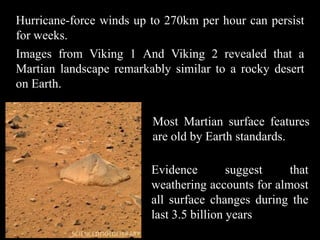
Images from Viking 1 And Viking 2 revealed that a
Martian landscape remarkably similar to a rocky desert
on Earth.


                         Most Martian surface features
                         are old by Earth standards.

                         Evidence         suggest   that
                         weathering accounts for almost
                         all surface changes during the
                         last 3.5 billion years
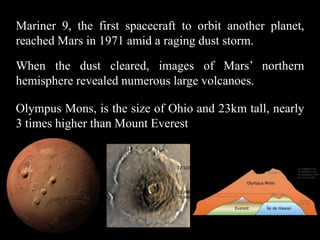
Mariner 9, the first spacecraft to orbit another planet,
reached Mars in 1971 amid a raging dust storm.

When the dust cleared, images of Mars’ northern
hemisphere revealed numerous large volcanoes.

Olympus Mons, is the size of Ohio and 23km tall, nearly
3 times higher than Mount Everest
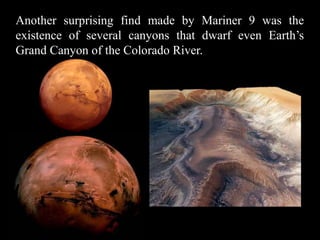
Another surprising find made by Mariner 9 was the
existence of several canyons that dwarf even Earth’s
Grand Canyon of the Colorado River.
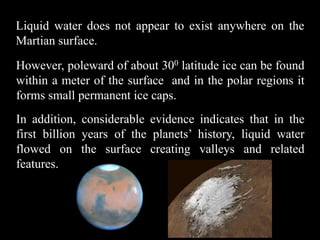
Liquid water does not appear to exist anywhere on the
Martian surface.
However, poleward of about 300 latitude ice can be found
within a meter of the surface and in the polar regions it
forms small permanent ice caps.
In addition, considerable evidence indicates that in the
first billion years of the planets’ history, liquid water
flowed on the surface creating valleys and related
features.
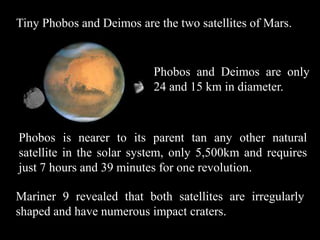
Tiny Phobos and Deimos are the two satellites of Mars.


                          Phobos and Deimos are only
                          24 and 15 km in diameter.


Phobos is nearer to its parent tan any other natural
satellite in the solar system, only 5,500km and requires
just 7 hours and 39 minutes for one revolution.

Mariner 9 revealed that both satellites are irregularly
shaped and have numerous impact craters.
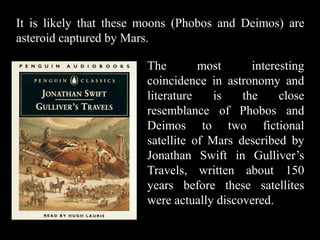
It is likely that these moons (Phobos and Deimos) are
asteroid captured by Mars.

                        The        most      interesting
                        coincidence in astronomy and
                        literature    is   the     close
                        resemblance of Phobos and
                        Deimos to two fictional
                        satellite of Mars described by
                        Jonathan Swift in Gulliver’s
                        Travels, written about 150
                        years before these satellites
                        were actually discovered.
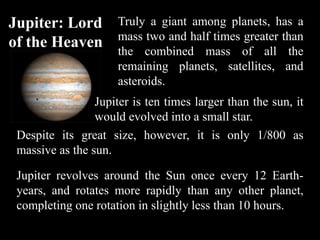
Jupiter: Lord         Truly a giant among planets, has a
                      mass two and half times greater than
of the Heaven
                      the combined mass of all the
                      remaining planets, satellites, and
                      asteroids.
                 Jupiter is ten times larger than the sun, it
                 would evolved into a small star.
 Despite its great size, however, it is only 1/800 as
 massive as the sun.

 Jupiter revolves around the Sun once every 12 Earth-
 years, and rotates more rapidly than any other planet,
 completing one rotation in slightly less than 10 hours.
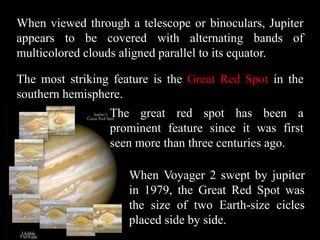
When viewed through a telescope or binoculars, Jupiter
appears to be covered with alternating bands of
multicolored clouds aligned parallel to its equator.

The most striking feature is the Great Red Spot in the
southern hemisphere.
                 The great red spot has been a
                 prominent feature since it was first
                 seen more than three centuries ago.

                     When Voyager 2 swept by jupiter
                     in 1979, the Great Red Spot was
                     the size of two Earth-size cicles
                     placed side by side.
Images from Pioneer II as it moved near Jupiter’s cloud
tops in 1974 indicated that the Great Red Spot is a
counterclockwise-rotating storm caught between two
Jetstream-like bonds flowing in opposite directions.
This huge, hurricane-like storm makes a complete
rotation about once every 12 days.

The winds on Jupiter are the product of different heating,
which generates vertical convective motions in the
atmosphere.
Jupiter’s convective flow produces alternating dark-
colored belts and light-colored zones
Jupiter’s atmosphere is composed mainly of Hydrogen
(90% and Helium (10%) but also contains lesser amounts
of methane, ammonia, and water which form clouds
composed of liquid droplets or icy crystals.
Atmospheric pressure at the top of the clouds is equal to
sea-level pressure on Earth.
The pressure in Jupiter increases rapidly toward its
surface.
At 1,000 km below the clouds, the pressure is great
enough to compress hydrogen gas into a liquid.
Less than halfway into Jupiter’s interior, extreme
pressures cause the liquid hydrogen to turn into liquid
metallic hydrogen.
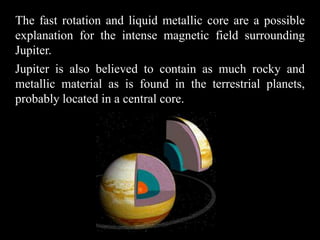
The fast rotation and liquid metallic core are a possible
explanation for the intense magnetic field surrounding
Jupiter.
Jupiter is also believed to contain as much rocky and
metallic material as is found in the terrestrial planets,
probably located in a central core.
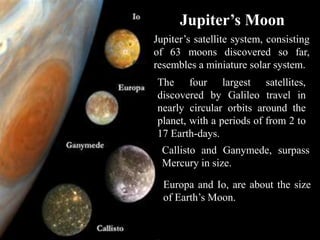
Jupiter’s Moon
Jupiter’s satellite system, consisting
of 63 moons discovered so far,
resembles a miniature solar system.
The four largest satellites,
discovered by Galileo travel in
nearly circular orbits around the
planet, with a periods of from 2 to
17 Earth-days.
  Callisto and Ganymede, surpass
  Mercury in size.

  Europa and Io, are about the size
  of Earth’s Moon.
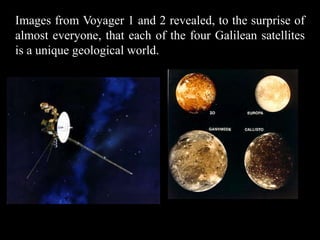
Images from Voyager 1 and 2 revealed, to the surprise of
almost everyone, that each of the four Galilean satellites
is a unique geological world.
The composition of each Jupiter’s satellite is strikingly
different, which implies a different evolution for each
one.
Ganymede has a dynamic core that generates a strong
magnetic field not observed on the other satellites.
Io, is perhaps the most volcanically active body in the
solar system, more than 80 active sulfurous volcanic
centers.

The heat source for volcanic activity is tidal energy
generated by a relentless “tug of war” between Io and
Jupiter and the other Galilean satellites.
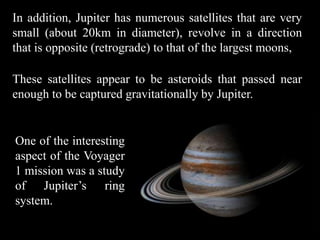
In addition, Jupiter has numerous satellites that are very
small (about 20km in diameter), revolve in a direction
that is opposite (retrograde) to that of the largest moons,

These satellites appear to be asteroids that passed near
enough to be captured gravitationally by Jupiter.


One of the interesting
aspect of the Voyager
1 mission was a study
of Jupiter’s ring
system.
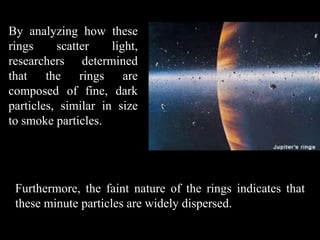
By analyzing how these
rings     scatter    light,
researchers determined
that the rings are
composed of fine, dark
particles, similar in size
to smoke particles.


 Furthermore, the faint nature of the rings indicates that
 these minute particles are widely dispersed.
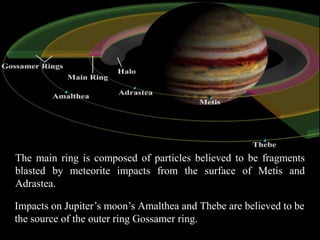
The main ring is composed of particles believed to be fragments
blasted by meteorite impacts from the surface of Metis and
Adrastea.

Impacts on Jupiter’s moon’s Amalthea and Thebe are believed to be
the source of the outer ring Gossamer ring.
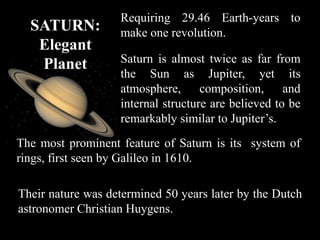
Requiring 29.46 Earth-years to
  SATURN:          make one revolution.
   Elegant
   Planet          Saturn is almost twice as far from
                   the Sun as Jupiter, yet its
                   atmosphere, composition, and
                   internal structure are believed to be
                   remarkably similar to Jupiter’s.
The most prominent feature of Saturn is its system of
rings, first seen by Galileo in 1610.

Their nature was determined 50 years later by the Dutch
astronomer Christian Huygens.
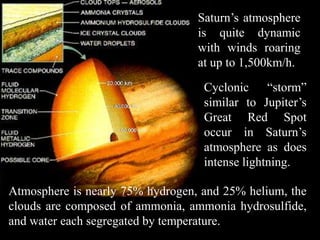
Saturn’s atmosphere
                                  is quite dynamic
                                  with winds roaring
                                  at up to 1,500km/h.
                                   Cyclonic “storm”
                                   similar to Jupiter’s
                                   Great Red Spot
                                   occur in Saturn’s
                                   atmosphere as does
                                   intense lightning.

Atmosphere is nearly 75% hydrogen, and 25% helium, the
clouds are composed of ammonia, ammonia hydrosulfide,
and water each segregated by temperature.
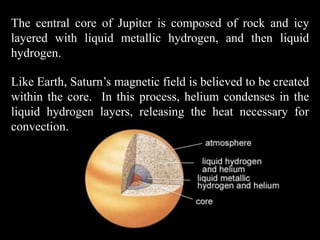
The central core of Jupiter is composed of rock and icy
layered with liquid metallic hydrogen, and then liquid
hydrogen.

Like Earth, Saturn’s magnetic field is believed to be created
within the core. In this process, helium condenses in the
liquid hydrogen layers, releasing the heat necessary for
convection.
The origin of planetary ring system is still being debated.
Perhaps the rings formed out of a flattened cloud of dust
and gases the encircled the parent planet.

The ring formed at the same time and from the same
materials as the planets and moons.

Perhaps the ring formed later, when a moon or large
asteroid was gravitationally pulled apart after staying too
close to a planet.
Another hypothesis suggest that a foreign body blasted
apart one of the planet’s moons; the fragments of which
would tend to jostle one another and form a flat, thin ring.
The Saturnian satellite system consists of 56 known moons.
If you count the “moonlets” that comprise Saturn’s rings,
this planet has millions of satellites.

The largest, Titan, is bigger than Mercury and is the
second-largest satellite in the solar system (after Jupiter’s
Ganymede).

Titan and Neptune’s Triton are the only satellites in the
solar system known to have a substantial atmosphere.

The atmospheric pressure at Titan’s surface is about 1.5
times that of the Earth’s surface.
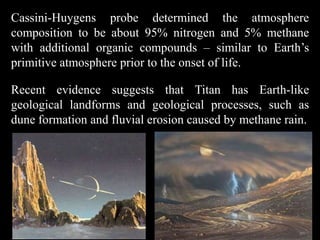
Cassini-Huygens probe determined the atmosphere
composition to be about 95% nitrogen and 5% methane
with additional organic compounds – similar to Earth’s
primitive atmosphere prior to the onset of life.

Recent evidence suggests that Titan has Earth-like
geological landforms and geological processes, such as
dune formation and fluvial erosion caused by methane rain.
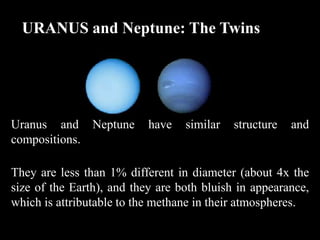
URANUS and Neptune: The Twins


Uranus and Neptune         have   similar   structure   and
compositions.

They are less than 1% different in diameter (about 4x the
size of the Earth), and they are both bluish in appearance,
which is attributable to the methane in their atmospheres.
Uranus and Neptune take 84 and 165 Earth-days,
respectively, to complete one revolution around the
Sun.

The core composition is similar to that of the other
gas giants with a rocky silicate and iron core, but
with less liquid metallic hydrogen and more ice
than Jupiter and Saturn.


Neptune, however, is colder, because it is half again
as distant from the Sun as in Uranus.
Uranus: The sideways Planet
Uranus rotates on its sideways. Its axis of rotation,
instead of being generally perpendicular to the
plane of its orbit, like the other planets, lies nearly
parallel to the plane of its orbit.
Its rotational motion, therefore, has the appearance
of a rolling ball, rather than the toplike spinning of
other planet.
A surprise discovery in 1977 revealed that Uranus
has a ring system
Spectacular views from Voyager 2 of the five
largest moons of Uranus show quite varied terrains.

           Neptune: The Windy Planet

Neptune has a dynamic atmosphere, much like
those of Jupiter and Saturn.

Wind exceeding 1,000km/h encircle the planet,
making it one of the widest places in the solar
system.
Neptune has an Earth-size blemish called the Great
Dark Spot that is reminiscent of Jupiter’s Great Red
Spot and is assumed to be a large rotating storm.


About 5 years after the
Voyager 2 encounter, when the
Hubble      Space    Telescope
viewed Neptune, the spot had
vanished, and was replaced by
another dark spot in the
planet’s northern hemisphere.
Six new satellite were discovered in the Voyager
images, bringing Neptune’s family to 8, and more
recent observations bring the total to 13.

Triton, Neptune’s largest moon, is a most
interesting objects.

It is the only large moon in the solar system that
exhibits retrograde motion.

Triton exhibits one of the most amazing
manifestations of volcanism, the eruption of ices.
Minor Members of the
     Solar System


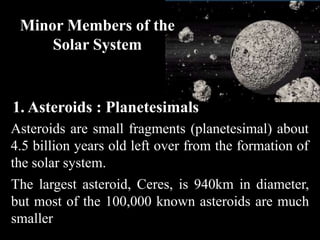
1. Asteroids : Planetesimals
Asteroids are small fragments (planetesimal) about
4.5 billion years old left over from the formation of
the solar system.
The largest asteroid, Ceres, is 940km in diameter,
but most of the 100,000 known asteroids are much
smaller
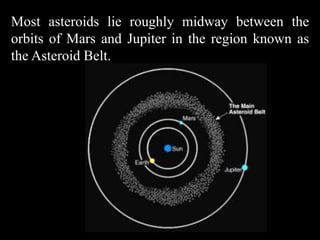
Most asteroids lie roughly midway between the
orbits of Mars and Jupiter in the region known as
the Asteroid Belt.
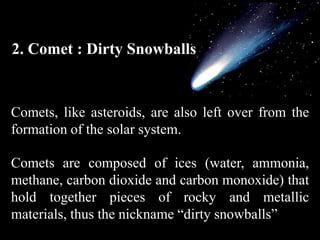
2. Comet : Dirty Snowballs


Comets, like asteroids, are also left over from the
formation of the solar system.

Comets are composed of ices (water, ammonia,
methane, carbon dioxide and carbon monoxide) that
hold together pieces of rocky and metallic
materials, thus the nickname “dirty snowballs”
Comets are among the most interesting and
unpredictable bodies in the solar system.
Many comets travel in very elongated orbits that
carry them far beyond Pluto. These comets take
hundreds of thousands of years to complete a single
orbit around the Sun.
However, a few short-period comets (those having
orbital period of less than 200 years) such as
Halley’s comet, make a regular encounters with the
inner solar system.
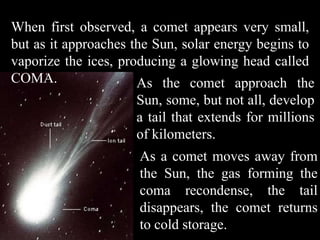
When first observed, a comet appears very small,
but as it approaches the Sun, solar energy begins to
vaporize the ices, producing a glowing head called
COMA.                 As the comet approach the
                     Sun, some, but not all, develop
                     a tail that extends for millions
                     of kilometers.
                      As a comet moves away from
                      the Sun, the gas forming the
                      coma recondense, the tail
                      disappears, the comet returns
                      to cold storage.
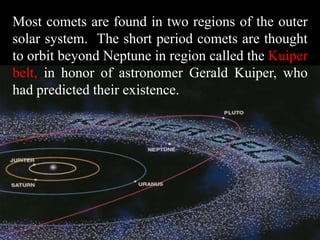
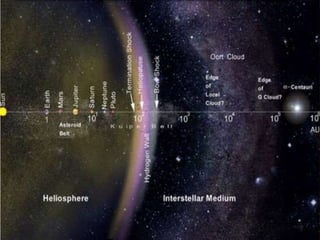
Most comets are found in two regions of the outer
solar system. The short period comets are thought
to orbit beyond Neptune in region called the Kuiper
belt, in honor of astronomer Gerald Kuiper, who
had predicted their existence.
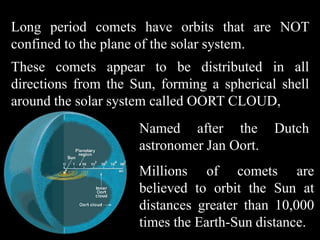
Long period comets have orbits that are NOT
confined to the plane of the solar system.
These comets appear to be distributed in all
directions from the Sun, forming a spherical shell
around the solar system called OORT CLOUD,
                     Named after the        Dutch
                     astronomer Jan Oort.
                     Millions of comets are
                     believed to orbit the Sun at
                     distances greater than 10,000
                     times the Earth-Sun distance.
The most famous short-period comet is Halley’s
Comet.
Its orbital period averages 76 years, and every one
of its 29 appearances since 240 BC has been
recorded by Chinese astronomers.
When seen in 1910, Halley’s Comet had developed
a tail nearly 1.6 million km long and was visible
during daytime.

Last perihelion Feb. 9, 1986, next aphelion
December 9, 2023.
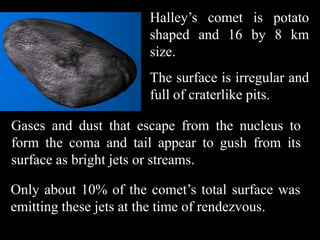
Halley’s comet is potato
                      shaped and 16 by 8 km
                      size.
                      The surface is irregular and
                      full of craterlike pits.

Gases and dust that escape from the nucleus to
form the coma and tail appear to gush from its
surface as bright jets or streams.

Only about 10% of the comet’s total surface was
emitting these jets at the time of rendezvous.
Meteoroids:
    Visitors to Earth
Also called the “shooting star”
The streak of light that lasts from an eyeblink to
a few seconds occurs when a small solid particle,
a meteoroid, enter Earth’s atmosphere from
interplanetary space.

The remains of meteoroids, when found on
Earth, are referred to as meteorites.
Most meteoroids originate from any one of the
following three sources:
     1. Interplanetary debris that was not
     gravitationally swept up by the planets
     during the formation of the solar system.

     2. Material that is continually being lost
     from the asteroid belt.

     3. The solid remains of comets that once
     passed through Earth’s orbit.
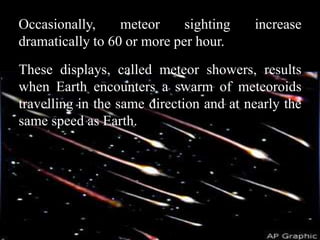
Occasionally,     meteor     sighting    increase
dramatically to 60 or more per hour.
These displays, called meteor showers, results
when Earth encounters a swarm of meteoroids
travelling in the same direction and at nearly the
same speed as Earth.
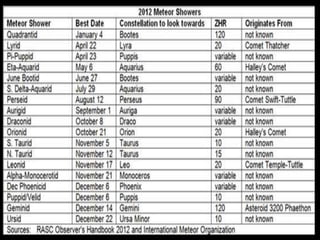
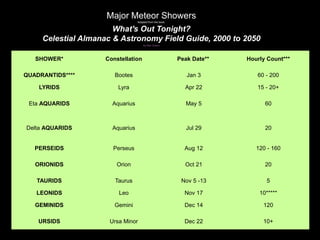
Major Meteor Showers
                                 Adapted from the book,


                       What's Out Tonight?
     Celestial Almanac & Astronomy Field Guide, 2000 to 2050
                                     by Ken Graun


   SHOWER*          Constellation                         Peak Date**   Hourly Count***

QUADRANTIDS****        Bootes                                Jan 3         60 - 200

    LYRIDS              Lyra                                Apr 22         15 - 20+

 Eta AQUARIDS         Aquarius                               May 5            60


Delta AQUARIDS        Aquarius                               Jul 29           20


   PERSEIDS           Perseus                               Aug 12         120 - 160

   ORIONIDS             Orion                               Oct 21            20

   TAURIDS             Taurus                              Nov 5 -13          5

   LEONIDS              Leo                                 Nov 17          10*****

   GEMINIDS            Gemini                               Dec 14           120

    URSIDS           Ursa Minor                             Dec 22           10+
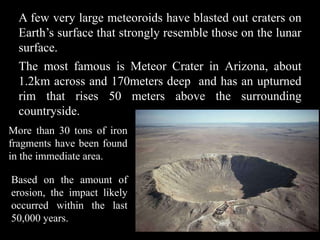
A few very large meteoroids have blasted out craters on
  Earth’s surface that strongly resemble those on the lunar
  surface.
  The most famous is Meteor Crater in Arizona, about
  1.2km across and 170meters deep and has an upturned
  rim that rises 50 meters above the surrounding
  countryside.
More than 30 tons of iron
fragments have been found
in the immediate area.

Based on the amount of
erosion, the impact likely
occurred within the last
50,000 years.
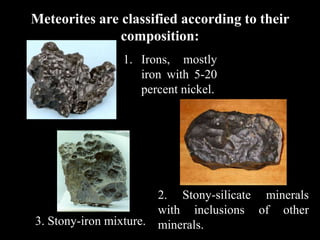
Meteorites are classified according to their
               composition:
               1. Irons, mostly
                  iron with 5-20
                  percent nickel.


                       2. Stony-silicate minerals
                       with inclusions of other
3. Stony-iron mixture. minerals.
The Dwarf Planets
Since Pluto’s discovery in 1930, it has been a mystery
on the edge of the solar system.
At first, Pluto was thought to be about as large as Earth,
but as better images were obtained, Pluto’s diameter was
estimated to be a little than one half that of Earth.
In 1978, astronomers discovered that Pluto has a
satellite (Charon), whose brightness combined with its
parent made Pluto appear much larger than it really was.

Recent images obtained by the Hubble Space Telescope
established the diameter of Pluto at only 2,300km. 1/5
that of the Earth and less than half of Mercury.
Seven moons, including Earth’s moon are larger than
Pluto.
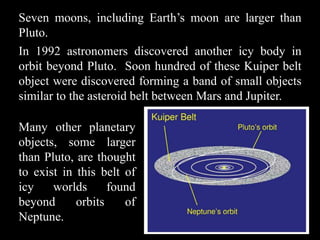
In 1992 astronomers discovered another icy body in
orbit beyond Pluto. Soon hundred of these Kuiper belt
object were discovered forming a band of small objects
similar to the asteroid belt between Mars and Jupiter.

Many other planetary
objects, some larger
than Pluto, are thought
to exist in this belt of
icy    worlds      found
beyond      orbits    of
Neptune.
The International Astronomical Union, a group that has
the power to determine whether or not Pluto is a Planet,
voted August 24, 2006, to ad a new class of planets
called dwarf planets.
These include “celestial bodies that orbit around the
Sun, are essentially round due to their self-gravity, but
are not the only object to occupy their area of space”

Pluto is recognized as a dwarf planet and the prototype
of new category of planetary object.

This is not the first time a planet has been demoted. In
the mid-1800 astronomy textbooks listed as many as 11
planets in our solar system, including the asteroids
Vesta, Juno, Ceres, and Pallas.
SAQ’s
1. By what criteria are the planets placed into either the Jovian or terrestrial group?
2. What are the three types of materials thought to make up the planets? How are
    they different? How does their distribution account for the density differences
    between the terrestrial and Jovian planetary groups?
3. Explain why the terrestrial planets have meager atmospheres, as compared to the
    Jovian planets.
4. How is crater density used in the relative dating of features in the Moon?
5. Briefly outline the history of the Moon.
6. How are the Maria of the Moon THOUGHT TO BE SIMILAR TO THE Columbia
    Plateau?
7. Venus has been referred to as “Earth’s twin”. In what ways are these two planets
    similar? How do they differ?
8. What surface features does Mars have that are also common on Earth?
9. Why are the largest volcanoes on Earth so much smaller than the largest ones on
    Mars?
10. Why might astrobiologists be intrigued by the evidence that groundwater has
    seeped onto the surface of Mars?
11. The two “moon” of Mars were once suggested to be artificial. What characteristics
    do they have that would cause such speculations?
12. What is the nature of Jupiter’s Great Red Spot?
13. Why are the Galilean satellites of Jupiter so named/
14. What is distinctive about Jupiter’s satellite Io?
15. Why are the outer satellites of Jupiter thought to have been captured rather than
having been formed with the rest of the satellite system?
16. How are Jupiter and Saturn similar?
17. What two roles do ring moons play in the nature of planetary ring system?
18. How are Saturn’s satellite Titan and Neptune’s satellite Triton similar?
19. What do you think would happen if Earth passed through the tail of a comet?
20. Why are impact carters more common on the Moon than on Earth, even though
the Moon is a much smaller target and has a weaker gravitational field?
21. Compare meteoroid, meteor, and meteorite.
22. Where are most comet thought to reside? What eventually becomes that orbit
close to the Sun?
23. What are the three main sources of meteoroids?
24. Where are most asteroids found?
25. It has been estimated that Halley’s comet has a mass of 100 billion tons.
Furthermore, this comet is estimated to lose 100 million tons of materials during the
few months that its orbit brings it close to the Sun. With an orbital period of 76 years,
what is the maximum remaining life span of Halley’s Comet?

Touring our solar system (astronomy)

  • 1.
    Touring Our Solar System Prepared by: Victor R. Oribe
  • 2.
    How Did thePlanets Form? The Sun and planets formed at the same time from a large rotating cloud of interstellar dust and gas called the Solar Nebula.
  • 3.
    As the solarnebula contracted, the vast majority of materials collected in the center to form the hot protosun.
  • 4.
    The remainder formed a flattened, spinning disk. With this spinning disk, matter gradually formed clumps of material that collided, stuck together and grew into asteroid- sized objects called planetesimals.
  • 5.
    The composition ofthese planetesimals depended largely on their locations with respect to their protostar. Temperature were greater near the protosun and much lower in the outer reaches of the disk. This was critical since only those materials that could condense in a particular location would be available to form planetesimal.
  • 6.
    Near the presentorbit of Mercury only metallic grains condense- it was too hot for anything else to exist. Farther out, near the Earth’s orbit, metallic as well as rocky substances condensed, and beyond Mars, ices of water, carbon dioxide, ammonia, and methane formed.
  • 7.
    From clumps ofmatter ( ices of water, carbon dioxide, and methane) the planetesimals formed and through repeated collisions and accretion (sticking together) grew into eight protoplanets and their moons. It took roughly a billion years after the protoplanets formed to gravitationally sweep the solar system clear of interplanetary debris.
  • 8.
    The period ofintense bombardment is clearly visible on the Moon and elsewhere in the solar system. Only a small amount of the interplanetary matter escaped capture by a planet or moon and became the asteroid, comets, and meteoroids.
  • 9.
    Terrestrial and JovianPlanets The Terrestrial (Earth-like) Planets
  • 10.
    The Jovian (Jupiter-like)Planets Pluto was recently demoted to a dwarf planet - a new class of solar system objects that have an orbit around the Sun but share their space with other celestial bodies.
  • 11.
    The most obviousdifference between the terrestrial and the Jovian planets is their SIZE. The largest terrestrial planets (Earth and Venus) have a diameter only one- quarter as great as the diameter of the smallest Jovian planet (Neptune) The masses of Earth and Venus are only 1/17 as great as Neptune. Hence, the Jovian planets are also called GIANTS.
  • 12.
    The four Jovianplanets are also referred to as the OUTER PLANETS, because of their relative locations. The terrestrial planet are also called INNER PLANETS.
  • 13.
    Other dimension inwhich the terrestrial and the Jovian planets differ include: DENSITY, CHEMICAL MAKEUP, and the RATE OF RORATION. The density of the Terrestrial planets average about FIVE times the density of water. The density of the Jovian planets averages only 1.5 times of water. One of the outer planets, Saturn, has a density only 0.7 times that of water, which means that Saturn would float if placed in a large enough water tank.
  • 14.
    The Composition ofthe Planets The substances that make up the planets are divided into three compositional groups: GASES, ROCKS, and ICES, based on their melting point. 1. Gases Hydrogen and Helium, are those with melting points near absolute zero (0K). Hydrogen and Helium, are the most abundant constituents of the solar nebula.
  • 15.
    2. Rocks Rocks present in the planets are usually silicate minerals and metallic iron, which have a melting points that exceed 7000C (13000 F) 3. Ices Ices in the planets includes ammonia, methane, carbon dioxide, and water. This gases have intermediate melting points (for example, water has a melting point of 00C (320 F)
  • 16.
    The terrestrial planetsare dense, consisting mostly of rocky and metallic substances, with minor amounts of ices. The Jovian planets, on the other hand, contain large amounts of gases (hydrogen and helium) and ices (mostly water, ammonia, and methane). This accounts for their low densities. Jovian planets also contain substantial amounts of rocky and metallic materials, which are concentrated in their central cores.
  • 17.
    The Atmosphere ofthe Planets The Jovian planets have a very thick atmospheres of hydrogen, helium, methane, and ammonia. The Terrestrial planets have meager atmosphere at best.
  • 18.
    Reasons for theDifferences in the Atmosphere of the Planets 1. Location of each planet within the solar nebula during its formation. The outer planets formed where the temperature was low enough to allow water vapor, ammonia, and methane to condense into ices, thus, the Jovian planets contain large amounts of these volatile gases. While the inner regions of the developing solar system, the environment was too hot for ices to survive.
  • 19.
    Consequently, one ofthe long-standing questions for the nebular hypothesis was “How did Earth acquire water and other volatile gases?” During the protoplanet stage, Earth was bombarded with icy fragments (planetesimals) that originated beyond the orbit of Mars. Like the inner planet, they (Mercury and Moon) surely would have been bombarded by icy bodies. Why do Mercury and our Moon lack an atmosphere?
  • 20.
    2. More massiveplanets have better chance of retaining their atmospheres because atoms and molecules need a higher speed to escape. On the Moon the escape velocity is only 2.4 km/s compared with more than 11 km/s for Earth. Because of their strong gravitational fields, the Jovian planets have escape velocities that are mush higher than that of Earth, which is the largest terrestrial planet.
  • 21.
    3. The molecularmotion of a gas is temperature-dependent. At the low temperatures of the Jovian planets even the lightest gases (hydrogen and helium0 are unlikely to acquire the speed needed to escape. By the contrast, a comparatively warm body with a small surface gravity, such a Mercury and our Moon, is unable to hold even heavy gases such as carbon dioxide and radon.
  • 22.
    The Planets: ABrief Tour Mercury: The innermost and the smallest The Innermost planet. Planet Larger than Earth’s moon. Mercury revolves quickly but rotates slowly. One full day-night cycle on Earth takes 24 hours, but on Mercury it requires 179 Earth-days. Night in Mercury lasts for about three months and is followed by three months of daylight.
  • 23.
    Nighttime temperatures dropas low as -1730 C and noontime temperature exceed 4270 C, hot enough to melt tin and lead. Mercury has the greatest temperatur e extremes of any planets.
  • 24.
    Mercury absorbs mostof the sunlight that strikes it, reflecting only 6% into space. The low reflectivity of sunlight from Mercury is characteristic of terrestrial bodies that have virtually no atmosphere. Mercury has long scarps that cut across the plains and numerous craters. The scarps are thought to be the result of crustal shortening as the planet cooled and shrank early in its history.
  • 25.
    Venus: Second only to the Moon in brilliance in the night sky. The Veiled Planet Named for the goddess of love and beauty. It orbits the Sun in a nearly perfect circle once every 225 Earth-day Venus is similar to Earth in size, density, mass, and location in the solar system, thus, it has referred to as “Earth’s twin” The surface of Venus reaches temperatures as great as 4800 C, and its atmosphere is 97% carbon dioxide.
  • 26.
    About 80% ofthe surface of Venus is consists of subdued plains that are covered by volcanic flows. Thousands of volcanic creatures have been identified mostly small shield volcanoes, although more than 1,500 volcanoes greater than 20km across have been mapped. Only 8% of the Venus surface is consists of highlands that may be linked to continental areas of the Earth.
  • 27.
    Mars: Mars is approximately half the size of The Red the Earth and revolves around the Sun in Planet 687 Earth-days. Martian atmosphere has only 1% the density of Earth’s and it is primarily carbon dioxide with tiny amounts of water vapor. Data from Mars probes confirm that the polar caps of Mars are made of water ice., covered by a thin layer of frozen carbon dioxide. Although the atmosphere of Mars is very thin, extensive dust storms occur and may cause the color changes observed from Earth-based telescope.
  • 28.
    Hurricane-force winds upto 270km per hour can persist for weeks. Images from Viking 1 And Viking 2 revealed that a Martian landscape remarkably similar to a rocky desert on Earth. Most Martian surface features are old by Earth standards. Evidence suggest that weathering accounts for almost all surface changes during the last 3.5 billion years
  • 29.
    Mariner 9, thefirst spacecraft to orbit another planet, reached Mars in 1971 amid a raging dust storm. When the dust cleared, images of Mars’ northern hemisphere revealed numerous large volcanoes. Olympus Mons, is the size of Ohio and 23km tall, nearly 3 times higher than Mount Everest
  • 30.
    Another surprising findmade by Mariner 9 was the existence of several canyons that dwarf even Earth’s Grand Canyon of the Colorado River.
  • 31.
    Liquid water doesnot appear to exist anywhere on the Martian surface. However, poleward of about 300 latitude ice can be found within a meter of the surface and in the polar regions it forms small permanent ice caps. In addition, considerable evidence indicates that in the first billion years of the planets’ history, liquid water flowed on the surface creating valleys and related features.
  • 32.
    Tiny Phobos andDeimos are the two satellites of Mars. Phobos and Deimos are only 24 and 15 km in diameter. Phobos is nearer to its parent tan any other natural satellite in the solar system, only 5,500km and requires just 7 hours and 39 minutes for one revolution. Mariner 9 revealed that both satellites are irregularly shaped and have numerous impact craters.
  • 33.
    It is likelythat these moons (Phobos and Deimos) are asteroid captured by Mars. The most interesting coincidence in astronomy and literature is the close resemblance of Phobos and Deimos to two fictional satellite of Mars described by Jonathan Swift in Gulliver’s Travels, written about 150 years before these satellites were actually discovered.
  • 34.
    Jupiter: Lord Truly a giant among planets, has a mass two and half times greater than of the Heaven the combined mass of all the remaining planets, satellites, and asteroids. Jupiter is ten times larger than the sun, it would evolved into a small star. Despite its great size, however, it is only 1/800 as massive as the sun. Jupiter revolves around the Sun once every 12 Earth- years, and rotates more rapidly than any other planet, completing one rotation in slightly less than 10 hours.
  • 35.
    When viewed througha telescope or binoculars, Jupiter appears to be covered with alternating bands of multicolored clouds aligned parallel to its equator. The most striking feature is the Great Red Spot in the southern hemisphere. The great red spot has been a prominent feature since it was first seen more than three centuries ago. When Voyager 2 swept by jupiter in 1979, the Great Red Spot was the size of two Earth-size cicles placed side by side.
  • 36.
    Images from PioneerII as it moved near Jupiter’s cloud tops in 1974 indicated that the Great Red Spot is a counterclockwise-rotating storm caught between two Jetstream-like bonds flowing in opposite directions. This huge, hurricane-like storm makes a complete rotation about once every 12 days. The winds on Jupiter are the product of different heating, which generates vertical convective motions in the atmosphere. Jupiter’s convective flow produces alternating dark- colored belts and light-colored zones
  • 37.
    Jupiter’s atmosphere iscomposed mainly of Hydrogen (90% and Helium (10%) but also contains lesser amounts of methane, ammonia, and water which form clouds composed of liquid droplets or icy crystals. Atmospheric pressure at the top of the clouds is equal to sea-level pressure on Earth. The pressure in Jupiter increases rapidly toward its surface. At 1,000 km below the clouds, the pressure is great enough to compress hydrogen gas into a liquid. Less than halfway into Jupiter’s interior, extreme pressures cause the liquid hydrogen to turn into liquid metallic hydrogen.
  • 38.
    The fast rotationand liquid metallic core are a possible explanation for the intense magnetic field surrounding Jupiter. Jupiter is also believed to contain as much rocky and metallic material as is found in the terrestrial planets, probably located in a central core.
  • 39.
    Jupiter’s Moon Jupiter’s satellitesystem, consisting of 63 moons discovered so far, resembles a miniature solar system. The four largest satellites, discovered by Galileo travel in nearly circular orbits around the planet, with a periods of from 2 to 17 Earth-days. Callisto and Ganymede, surpass Mercury in size. Europa and Io, are about the size of Earth’s Moon.
  • 40.
    Images from Voyager1 and 2 revealed, to the surprise of almost everyone, that each of the four Galilean satellites is a unique geological world.
  • 41.
    The composition ofeach Jupiter’s satellite is strikingly different, which implies a different evolution for each one. Ganymede has a dynamic core that generates a strong magnetic field not observed on the other satellites. Io, is perhaps the most volcanically active body in the solar system, more than 80 active sulfurous volcanic centers. The heat source for volcanic activity is tidal energy generated by a relentless “tug of war” between Io and Jupiter and the other Galilean satellites.
  • 42.
    In addition, Jupiterhas numerous satellites that are very small (about 20km in diameter), revolve in a direction that is opposite (retrograde) to that of the largest moons, These satellites appear to be asteroids that passed near enough to be captured gravitationally by Jupiter. One of the interesting aspect of the Voyager 1 mission was a study of Jupiter’s ring system.
  • 43.
    By analyzing howthese rings scatter light, researchers determined that the rings are composed of fine, dark particles, similar in size to smoke particles. Furthermore, the faint nature of the rings indicates that these minute particles are widely dispersed.
  • 44.
    The main ringis composed of particles believed to be fragments blasted by meteorite impacts from the surface of Metis and Adrastea. Impacts on Jupiter’s moon’s Amalthea and Thebe are believed to be the source of the outer ring Gossamer ring.
  • 45.
    Requiring 29.46 Earth-yearsto SATURN: make one revolution. Elegant Planet Saturn is almost twice as far from the Sun as Jupiter, yet its atmosphere, composition, and internal structure are believed to be remarkably similar to Jupiter’s. The most prominent feature of Saturn is its system of rings, first seen by Galileo in 1610. Their nature was determined 50 years later by the Dutch astronomer Christian Huygens.
  • 46.
    Saturn’s atmosphere is quite dynamic with winds roaring at up to 1,500km/h. Cyclonic “storm” similar to Jupiter’s Great Red Spot occur in Saturn’s atmosphere as does intense lightning. Atmosphere is nearly 75% hydrogen, and 25% helium, the clouds are composed of ammonia, ammonia hydrosulfide, and water each segregated by temperature.
  • 47.
    The central coreof Jupiter is composed of rock and icy layered with liquid metallic hydrogen, and then liquid hydrogen. Like Earth, Saturn’s magnetic field is believed to be created within the core. In this process, helium condenses in the liquid hydrogen layers, releasing the heat necessary for convection.
  • 48.
    The origin ofplanetary ring system is still being debated. Perhaps the rings formed out of a flattened cloud of dust and gases the encircled the parent planet. The ring formed at the same time and from the same materials as the planets and moons. Perhaps the ring formed later, when a moon or large asteroid was gravitationally pulled apart after staying too close to a planet. Another hypothesis suggest that a foreign body blasted apart one of the planet’s moons; the fragments of which would tend to jostle one another and form a flat, thin ring.
  • 49.
    The Saturnian satellitesystem consists of 56 known moons. If you count the “moonlets” that comprise Saturn’s rings, this planet has millions of satellites. The largest, Titan, is bigger than Mercury and is the second-largest satellite in the solar system (after Jupiter’s Ganymede). Titan and Neptune’s Triton are the only satellites in the solar system known to have a substantial atmosphere. The atmospheric pressure at Titan’s surface is about 1.5 times that of the Earth’s surface.
  • 50.
    Cassini-Huygens probe determinedthe atmosphere composition to be about 95% nitrogen and 5% methane with additional organic compounds – similar to Earth’s primitive atmosphere prior to the onset of life. Recent evidence suggests that Titan has Earth-like geological landforms and geological processes, such as dune formation and fluvial erosion caused by methane rain.
  • 51.
    URANUS and Neptune:The Twins Uranus and Neptune have similar structure and compositions. They are less than 1% different in diameter (about 4x the size of the Earth), and they are both bluish in appearance, which is attributable to the methane in their atmospheres.
  • 52.
    Uranus and Neptunetake 84 and 165 Earth-days, respectively, to complete one revolution around the Sun. The core composition is similar to that of the other gas giants with a rocky silicate and iron core, but with less liquid metallic hydrogen and more ice than Jupiter and Saturn. Neptune, however, is colder, because it is half again as distant from the Sun as in Uranus.
  • 53.
    Uranus: The sidewaysPlanet Uranus rotates on its sideways. Its axis of rotation, instead of being generally perpendicular to the plane of its orbit, like the other planets, lies nearly parallel to the plane of its orbit. Its rotational motion, therefore, has the appearance of a rolling ball, rather than the toplike spinning of other planet. A surprise discovery in 1977 revealed that Uranus has a ring system
  • 54.
    Spectacular views fromVoyager 2 of the five largest moons of Uranus show quite varied terrains. Neptune: The Windy Planet Neptune has a dynamic atmosphere, much like those of Jupiter and Saturn. Wind exceeding 1,000km/h encircle the planet, making it one of the widest places in the solar system.
  • 55.
    Neptune has anEarth-size blemish called the Great Dark Spot that is reminiscent of Jupiter’s Great Red Spot and is assumed to be a large rotating storm. About 5 years after the Voyager 2 encounter, when the Hubble Space Telescope viewed Neptune, the spot had vanished, and was replaced by another dark spot in the planet’s northern hemisphere.
  • 56.
    Six new satellitewere discovered in the Voyager images, bringing Neptune’s family to 8, and more recent observations bring the total to 13. Triton, Neptune’s largest moon, is a most interesting objects. It is the only large moon in the solar system that exhibits retrograde motion. Triton exhibits one of the most amazing manifestations of volcanism, the eruption of ices.
  • 57.
    Minor Members ofthe Solar System 1. Asteroids : Planetesimals Asteroids are small fragments (planetesimal) about 4.5 billion years old left over from the formation of the solar system. The largest asteroid, Ceres, is 940km in diameter, but most of the 100,000 known asteroids are much smaller
  • 58.
    Most asteroids lieroughly midway between the orbits of Mars and Jupiter in the region known as the Asteroid Belt.
  • 59.
    2. Comet :Dirty Snowballs Comets, like asteroids, are also left over from the formation of the solar system. Comets are composed of ices (water, ammonia, methane, carbon dioxide and carbon monoxide) that hold together pieces of rocky and metallic materials, thus the nickname “dirty snowballs”
  • 60.
    Comets are amongthe most interesting and unpredictable bodies in the solar system. Many comets travel in very elongated orbits that carry them far beyond Pluto. These comets take hundreds of thousands of years to complete a single orbit around the Sun. However, a few short-period comets (those having orbital period of less than 200 years) such as Halley’s comet, make a regular encounters with the inner solar system.
  • 61.
    When first observed,a comet appears very small, but as it approaches the Sun, solar energy begins to vaporize the ices, producing a glowing head called COMA. As the comet approach the Sun, some, but not all, develop a tail that extends for millions of kilometers. As a comet moves away from the Sun, the gas forming the coma recondense, the tail disappears, the comet returns to cold storage.
  • 62.
    Most comets arefound in two regions of the outer solar system. The short period comets are thought to orbit beyond Neptune in region called the Kuiper belt, in honor of astronomer Gerald Kuiper, who had predicted their existence.
  • 63.
    Long period cometshave orbits that are NOT confined to the plane of the solar system. These comets appear to be distributed in all directions from the Sun, forming a spherical shell around the solar system called OORT CLOUD, Named after the Dutch astronomer Jan Oort. Millions of comets are believed to orbit the Sun at distances greater than 10,000 times the Earth-Sun distance.
  • 65.
    The most famousshort-period comet is Halley’s Comet. Its orbital period averages 76 years, and every one of its 29 appearances since 240 BC has been recorded by Chinese astronomers. When seen in 1910, Halley’s Comet had developed a tail nearly 1.6 million km long and was visible during daytime. Last perihelion Feb. 9, 1986, next aphelion December 9, 2023.
  • 66.
    Halley’s comet ispotato shaped and 16 by 8 km size. The surface is irregular and full of craterlike pits. Gases and dust that escape from the nucleus to form the coma and tail appear to gush from its surface as bright jets or streams. Only about 10% of the comet’s total surface was emitting these jets at the time of rendezvous.
  • 67.
    Meteoroids: Visitors to Earth Also called the “shooting star” The streak of light that lasts from an eyeblink to a few seconds occurs when a small solid particle, a meteoroid, enter Earth’s atmosphere from interplanetary space. The remains of meteoroids, when found on Earth, are referred to as meteorites.
  • 68.
    Most meteoroids originatefrom any one of the following three sources: 1. Interplanetary debris that was not gravitationally swept up by the planets during the formation of the solar system. 2. Material that is continually being lost from the asteroid belt. 3. The solid remains of comets that once passed through Earth’s orbit.
  • 69.
    Occasionally, meteor sighting increase dramatically to 60 or more per hour. These displays, called meteor showers, results when Earth encounters a swarm of meteoroids travelling in the same direction and at nearly the same speed as Earth.
  • 71.
    Major Meteor Showers Adapted from the book, What's Out Tonight? Celestial Almanac & Astronomy Field Guide, 2000 to 2050 by Ken Graun SHOWER* Constellation Peak Date** Hourly Count*** QUADRANTIDS**** Bootes Jan 3 60 - 200 LYRIDS Lyra Apr 22 15 - 20+ Eta AQUARIDS Aquarius May 5 60 Delta AQUARIDS Aquarius Jul 29 20 PERSEIDS Perseus Aug 12 120 - 160 ORIONIDS Orion Oct 21 20 TAURIDS Taurus Nov 5 -13 5 LEONIDS Leo Nov 17 10***** GEMINIDS Gemini Dec 14 120 URSIDS Ursa Minor Dec 22 10+
  • 72.
    A few verylarge meteoroids have blasted out craters on Earth’s surface that strongly resemble those on the lunar surface. The most famous is Meteor Crater in Arizona, about 1.2km across and 170meters deep and has an upturned rim that rises 50 meters above the surrounding countryside. More than 30 tons of iron fragments have been found in the immediate area. Based on the amount of erosion, the impact likely occurred within the last 50,000 years.
  • 73.
    Meteorites are classifiedaccording to their composition: 1. Irons, mostly iron with 5-20 percent nickel. 2. Stony-silicate minerals with inclusions of other 3. Stony-iron mixture. minerals.
  • 74.
    The Dwarf Planets SincePluto’s discovery in 1930, it has been a mystery on the edge of the solar system. At first, Pluto was thought to be about as large as Earth, but as better images were obtained, Pluto’s diameter was estimated to be a little than one half that of Earth. In 1978, astronomers discovered that Pluto has a satellite (Charon), whose brightness combined with its parent made Pluto appear much larger than it really was. Recent images obtained by the Hubble Space Telescope established the diameter of Pluto at only 2,300km. 1/5 that of the Earth and less than half of Mercury.
  • 75.
    Seven moons, includingEarth’s moon are larger than Pluto. In 1992 astronomers discovered another icy body in orbit beyond Pluto. Soon hundred of these Kuiper belt object were discovered forming a band of small objects similar to the asteroid belt between Mars and Jupiter. Many other planetary objects, some larger than Pluto, are thought to exist in this belt of icy worlds found beyond orbits of Neptune.
  • 76.
    The International AstronomicalUnion, a group that has the power to determine whether or not Pluto is a Planet, voted August 24, 2006, to ad a new class of planets called dwarf planets. These include “celestial bodies that orbit around the Sun, are essentially round due to their self-gravity, but are not the only object to occupy their area of space” Pluto is recognized as a dwarf planet and the prototype of new category of planetary object. This is not the first time a planet has been demoted. In the mid-1800 astronomy textbooks listed as many as 11 planets in our solar system, including the asteroids Vesta, Juno, Ceres, and Pallas.
  • 77.
    SAQ’s 1. By whatcriteria are the planets placed into either the Jovian or terrestrial group? 2. What are the three types of materials thought to make up the planets? How are they different? How does their distribution account for the density differences between the terrestrial and Jovian planetary groups? 3. Explain why the terrestrial planets have meager atmospheres, as compared to the Jovian planets. 4. How is crater density used in the relative dating of features in the Moon? 5. Briefly outline the history of the Moon. 6. How are the Maria of the Moon THOUGHT TO BE SIMILAR TO THE Columbia Plateau? 7. Venus has been referred to as “Earth’s twin”. In what ways are these two planets similar? How do they differ? 8. What surface features does Mars have that are also common on Earth? 9. Why are the largest volcanoes on Earth so much smaller than the largest ones on Mars? 10. Why might astrobiologists be intrigued by the evidence that groundwater has seeped onto the surface of Mars? 11. The two “moon” of Mars were once suggested to be artificial. What characteristics do they have that would cause such speculations?
  • 78.
    12. What isthe nature of Jupiter’s Great Red Spot? 13. Why are the Galilean satellites of Jupiter so named/ 14. What is distinctive about Jupiter’s satellite Io? 15. Why are the outer satellites of Jupiter thought to have been captured rather than having been formed with the rest of the satellite system? 16. How are Jupiter and Saturn similar? 17. What two roles do ring moons play in the nature of planetary ring system? 18. How are Saturn’s satellite Titan and Neptune’s satellite Triton similar? 19. What do you think would happen if Earth passed through the tail of a comet? 20. Why are impact carters more common on the Moon than on Earth, even though the Moon is a much smaller target and has a weaker gravitational field? 21. Compare meteoroid, meteor, and meteorite. 22. Where are most comet thought to reside? What eventually becomes that orbit close to the Sun? 23. What are the three main sources of meteoroids? 24. Where are most asteroids found? 25. It has been estimated that Halley’s comet has a mass of 100 billion tons. Furthermore, this comet is estimated to lose 100 million tons of materials during the few months that its orbit brings it close to the Sun. With an orbital period of 76 years, what is the maximum remaining life span of Halley’s Comet?