What are Comets?
Comets are celestial bodies of
small mass that travel around the
Sun, usually in elongated orbits.
They become visible as they near
the Sun and sometimes they form
a visible tail.
This is an icy body that releases
gas or dust. They are often
compared to dirty snowballs,
though recent research has led
some scientists to call them snowy
dirtballs.
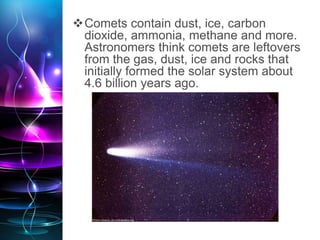
Comets contain dust, ice, carbon
dioxide, ammonia, methane and more.
Astronomers think comets are leftovers
from the gas, dust, ice and rocks that
initially formed the solar system about
4.6 billion years ago.
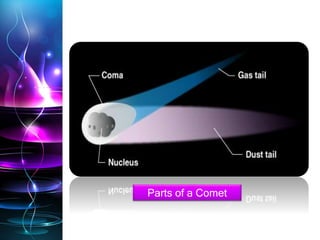
Parts of a Comet
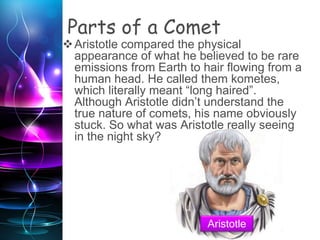
Aristotle compared the physical
appearance of what he believed to be rare
emissions from Earth to hair flowing from a
human head. He called them kometes,
which literally meant “long haired”.
Although Aristotle didn’t understand the
true nature of comets, his name obviously
stuck. So what was Aristotle really seeing
in the night sky?
Aristotle
1. The Nucleus
The Nucleus essentially
comprises the entire comet
when it is far from the sun,
during which time it is frozen.
The nuclei can remain in a solid,
pristine state, unobserved by
even the world’s most powerful
telescopes until it approaches
the Sun.
The Coma
The cold, solid nucleus warms
as it approaches the Sun and the
comet begins to transform.
Expelled water, dust, gas and
debris form a fuzzy haze around
the nucleus called the coma.
This happens when the comet is
about 7.5 x 10⁸
km from the sun.
A comet’s coma can span a few
miles in diameter to hundreds of
thousands.
The Dust Tail
As the nucleus and coma move
closer to our Sun, the comet
continues its transformation into
one of the most breath-taking
objects on our solar system.
Heavier particles and debris are
released by vaporizing ices. They
form another part of the comet
called the dust tail.
There can even be more than one
dust tail.
The Ion Tail
Some ionized gases are
pushed directly away from
the Sun by the Sun’s high
speed solar wind. These
ionized gases form the
comet’s blue, ion tail.
Both the ion and dust tail(s)
can be hundreds of
thousands or even millions
of miles long.
Parts of a Comet
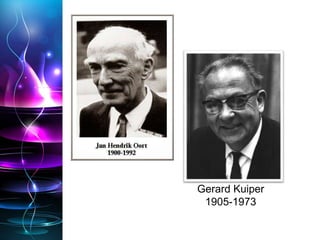
Origin of Comets
In 1950 the Dutch Astronomer Jan
Oort proposed that the Sun is
surrounded by an enormous “cloud”
of comet material at a distance
about 1,000 times that of the radius
of the known solar system.
This theory was followed in 1951 by
Dutch-American astronomer Gerard
Kupier’s proposal that a ring of
cometary material lies in the plane of
the solar system, several hundred
times as far from the Sun as the
Earth is.
Gerard Kuiper
1905-1973
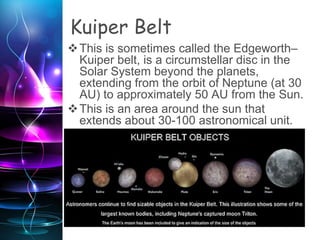
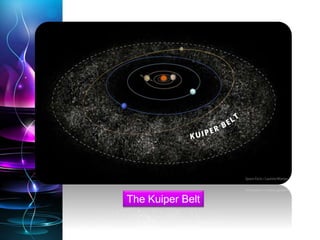
Kuiper Belt
This is sometimes called the Edgeworth–
Kuiper belt, is a circumstellar disc in the
Solar System beyond the planets,
extending from the orbit of Neptune (at 30
AU) to approximately 50 AU from the Sun.
This is an area around the sun that
extends about 30-100 astronomical unit.
The Kuiper Belt
Oort Cloud
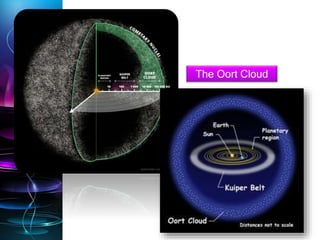
The Oort Cloud is an extended shell of icy
objects that exist in the outermost
reaches of the solar system.
It is named after astronomer Jan Oort,
who first theorised its existence.
The Oort Cloud is roughly spherical, and
is thought to be the origin of most of the
long-period comets that have been
observed.
The Oort Cloud is very distant from the
Sun and it can be disrupted by the nearby
passage of a star, nebula, or by actions in
the disk of the Milky Way. Those actions
knock cometary nuclei out of their orbits,
and send them on a headlong rush
toward the Sun.
The Oort Cloud
Orbit of Comets
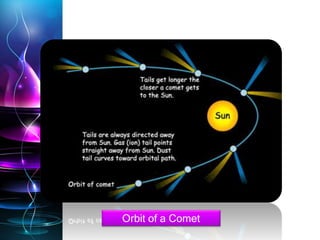
 Comets go around the Sun in a highly
elliptical orbit. They can spend hundreds
and thousands of years out in the depths of
the solar system before they return to Sun
at their perihelion.
 Like all orbiting bodies, comets follow
Kepler's Laws - the closer they are to the
Sun, the faster they move.
 While a comet is at a great distance from
the Sun, its exists as a dirty snowball
several kilmoeters across. But as it comes
closer to the Sun, the warming of its
surface causes its materials to melt and
vapourise producing the comet's
characteristic tail. Comet tails can be as
long as the distance between the Earth and
the Sun.
Orbit of a Comet
Top 10 Famous
Comets
http://listosaur.com/science-a-technology/10-famous-comets-
in-history/
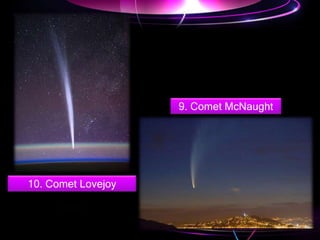
10. Comet Lovejoy
9. Comet McNaught
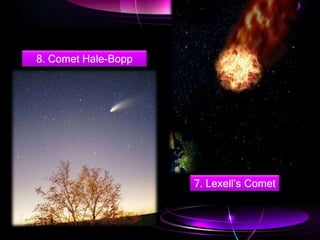
7. Lexell’s Comet
8. Comet Hale-Bopp
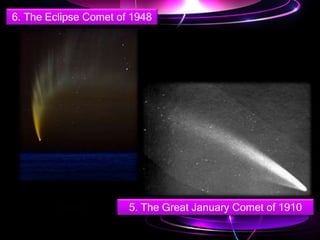
6. The Eclipse Comet of 1948
5. The Great January Comet of 1910
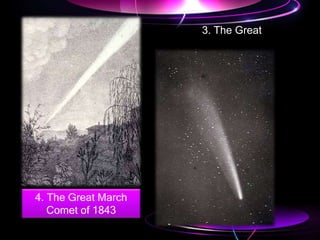
4. The Great March
Comet of 1843
3. The Great
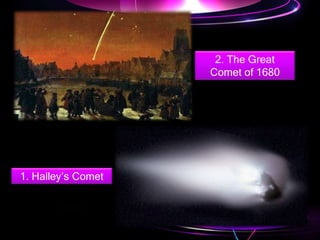
2. The Great
Comet of 1680
1. Halley’s Comet
Comets (Project in Science)

Comets (Project in Science)

  • 2.
    What are Comets? Cometsare celestial bodies of small mass that travel around the Sun, usually in elongated orbits. They become visible as they near the Sun and sometimes they form a visible tail. This is an icy body that releases gas or dust. They are often compared to dirty snowballs, though recent research has led some scientists to call them snowy dirtballs.
  • 3.
    Comets contain dust,ice, carbon dioxide, ammonia, methane and more. Astronomers think comets are leftovers from the gas, dust, ice and rocks that initially formed the solar system about 4.6 billion years ago.
  • 4.
    Parts of aComet Aristotle compared the physical appearance of what he believed to be rare emissions from Earth to hair flowing from a human head. He called them kometes, which literally meant “long haired”. Although Aristotle didn’t understand the true nature of comets, his name obviously stuck. So what was Aristotle really seeing in the night sky? Aristotle
  • 5.
    1. The Nucleus TheNucleus essentially comprises the entire comet when it is far from the sun, during which time it is frozen. The nuclei can remain in a solid, pristine state, unobserved by even the world’s most powerful telescopes until it approaches the Sun.
  • 6.
    The Coma The cold,solid nucleus warms as it approaches the Sun and the comet begins to transform. Expelled water, dust, gas and debris form a fuzzy haze around the nucleus called the coma. This happens when the comet is about 7.5 x 10⁸ km from the sun. A comet’s coma can span a few miles in diameter to hundreds of thousands.
  • 7.
    The Dust Tail Asthe nucleus and coma move closer to our Sun, the comet continues its transformation into one of the most breath-taking objects on our solar system. Heavier particles and debris are released by vaporizing ices. They form another part of the comet called the dust tail. There can even be more than one dust tail.
  • 8.
    The Ion Tail Someionized gases are pushed directly away from the Sun by the Sun’s high speed solar wind. These ionized gases form the comet’s blue, ion tail. Both the ion and dust tail(s) can be hundreds of thousands or even millions of miles long.
  • 9.
  • 10.
    Origin of Comets In1950 the Dutch Astronomer Jan Oort proposed that the Sun is surrounded by an enormous “cloud” of comet material at a distance about 1,000 times that of the radius of the known solar system. This theory was followed in 1951 by Dutch-American astronomer Gerard Kupier’s proposal that a ring of cometary material lies in the plane of the solar system, several hundred times as far from the Sun as the Earth is.
  • 11.
  • 12.
    Kuiper Belt This issometimes called the Edgeworth– Kuiper belt, is a circumstellar disc in the Solar System beyond the planets, extending from the orbit of Neptune (at 30 AU) to approximately 50 AU from the Sun. This is an area around the sun that extends about 30-100 astronomical unit.
  • 13.
  • 14.
    Oort Cloud The OortCloud is an extended shell of icy objects that exist in the outermost reaches of the solar system. It is named after astronomer Jan Oort, who first theorised its existence. The Oort Cloud is roughly spherical, and is thought to be the origin of most of the long-period comets that have been observed. The Oort Cloud is very distant from the Sun and it can be disrupted by the nearby passage of a star, nebula, or by actions in the disk of the Milky Way. Those actions knock cometary nuclei out of their orbits, and send them on a headlong rush toward the Sun.
  • 15.
  • 16.
    Orbit of Comets Comets go around the Sun in a highly elliptical orbit. They can spend hundreds and thousands of years out in the depths of the solar system before they return to Sun at their perihelion.  Like all orbiting bodies, comets follow Kepler's Laws - the closer they are to the Sun, the faster they move.  While a comet is at a great distance from the Sun, its exists as a dirty snowball several kilmoeters across. But as it comes closer to the Sun, the warming of its surface causes its materials to melt and vapourise producing the comet's characteristic tail. Comet tails can be as long as the distance between the Earth and the Sun.
  • 17.
  • 18.
  • 19.
    10. Comet Lovejoy 9.Comet McNaught
  • 20.
    7. Lexell’s Comet 8.Comet Hale-Bopp
  • 21.
    6. The EclipseComet of 1948 5. The Great January Comet of 1910
  • 22.
    4. The GreatMarch Comet of 1843 3. The Great
  • 23.
    2. The Great Cometof 1680 1. Halley’s Comet