Our Solar System
  Ag Earth Science
      Mr. Silva
The Terrestrial Planets
 The four planets closest to the sun.
   Mercury, Venus, Earth, and Mars
 The terrestrial planets are much like
  Earth.
 The four inner planets:
   Are relatively small and dense
   Have rocky surfaces (crusts), mantels, and
    iron cores
More on the First Four
 Mercury and Mars have crusts that are
  scarred by craters.
 Earth and Venus do not have craters because
  their surface is continually eroded.
 Common characteristics of the terrestrial
  planets:
   Higher temperature than outer planets
   Have few (if any) moons
   No rings around the terrestrial planets
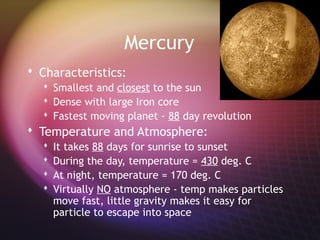
Mercury
 Characteristics:
   Smallest and closest to the sun
   Dense with large Iron core
   Fastest moving planet - 88 day revolution
 Temperature and Atmosphere:
     It takes 88 days for sunrise to sunset
     During the day, temperature = 430 deg. C
     At night, temperature = 170 deg. C
     Virtually NO atmosphere - temp makes particles
      move fast, little gravity makes it easy for
      particle to escape into space
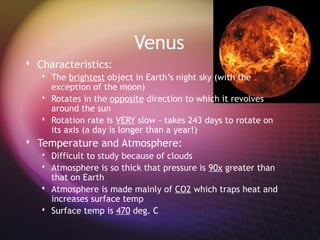
Venus
 Characteristics:
    The brightest object in Earth’s night sky (with the
     exception of the moon)
    Rotates in the opposite direction to which it revolves
     around the sun
    Rotation rate is VERY slow - takes 243 days to rotate on
     its axis (a day is longer than a year!)
 Temperature and Atmosphere:
    Difficult to study because of clouds
    Atmosphere is so thick that pressure is 90x greater than
     that on Earth
    Atmosphere is made mainly of CO2 which traps heat and
     increases surface temp
    Surface temp is 470 deg. C
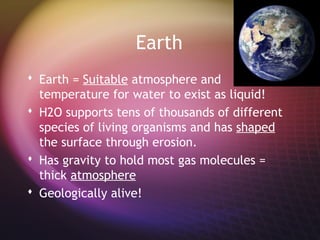
Earth
 Earth = Suitable atmosphere and
  temperature for water to exist as liquid!
 H2O supports tens of thousands of different
  species of living organisms and has shaped
  the surface through erosion.
 Has gravity to hold most gas molecules =
  thick atmosphere
 Geologically alive!
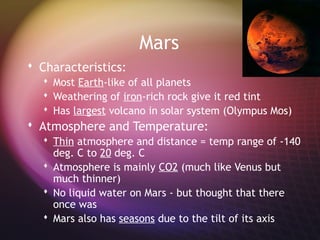
Mars
 Characteristics:
   Most Earth-like of all planets
   Weathering of iron-rich rock give it red tint
   Has largest volcano in solar system (Olympus Mos)
 Atmosphere and Temperature:
   Thin atmosphere and distance = temp range of -140
    deg. C to 20 deg. C
   Atmosphere is mainly CO2 (much like Venus but
    much thinner)
   No liquid water on Mars - but thought that there
    once was
   Mars also has seasons due to the tilt of its axis
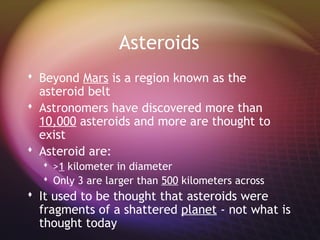
Asteroids
 Beyond Mars is a region known as the
  asteroid belt
 Astronomers have discovered more than
  10,000 asteroids and more are thought to
  exist
 Asteroid are:
   >1 kilometer in diameter
   Only 3 are larger than 500 kilometers across
 It used to be thought that asteroids were
  fragments of a shattered planet - not what is
  thought today
Scientific Discovery
• It is said that Scientific Discovery can happen in
  different ways:
   • Discovery by accident
   • Theories predict phenomena that scientists try to find
• Uranus (Yoor uh nus) and Neptune were discovered by
  these two methods
• Uranus discovered by chance - thought it was a dim
  star
• Neptune was found when someone predicted that
  there was something affecting Uranus’ orbit.
Gas Giants
• The “Gas Giants” are the next four planets in the
  Solar System
   • Jupiter, Saturn, Uranus, and Neptune
• Common Characteristics:
   • Much colder than terrestrial planets
   • More massive than terrestrial planets
   • Composed of mainly Hydrogen and Helium
   • No solid surface - intense pressure means that H and He
     exist in liquid form
   • Small dense cores of metal and rock
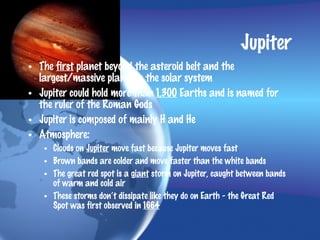
Jupiter
• The first planet beyond the asteroid belt and the
  largest/massive planet in the solar system
• Jupiter could hold more than 1,300 Earths and is named for
  the ruler of the Roman Gods
• Jupiter is composed of mainly H and He
• Atmosphere:
   • Clouds on Jupiter move fast because Jupiter moves fast
   • Brown bands are colder and move faster than the white bands
   • The great red spot is a giant storm on Jupiter, caught between bands
     of warm and cold air
   • These storms don’t dissipate like they do on Earth - the Great Red
     Spot was first observed in 1664
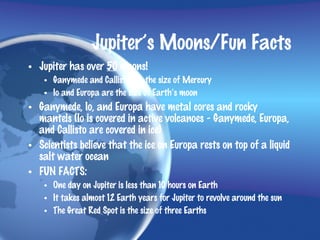
Jupiter’s Moons/Fun Facts
• Jupiter has over 50 moons!
    • Ganymede and Callisto are the size of Mercury
    • Io and Europa are the size of Earth’s moon
• Ganymede, Io, and Europa have metal cores and rocky
  mantels (Io is covered in active volcanoes - Ganymede, Europa,
  and Callisto are covered in ice)
• Scientists believe that the ice on Europa rests on top of a liquid
  salt water ocean
• FUN FACTS:
    • One day on Jupiter is less than 10 hours on Earth
    • It takes almost 12 Earth years for Jupiter to revolve around the sun
    • The Great Red Spot is the size of three Earths
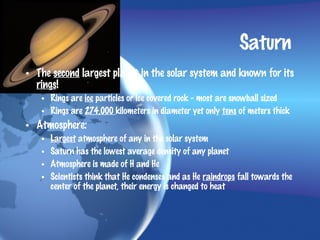
Saturn
• The second largest planet in the solar system and known for its
  rings!
   • Rings are ice particles or ice covered rock - most are snowball sized
   • Rings are 274,000 kilometers in diameter yet only tens of meters thick
• Atmosphere:
   •   Largest atmosphere of any in the solar system
   •   Saturn has the lowest average density of any planet
   •   Atmosphere is made of H and He
   •   Scientists think that He condenses and as He raindrops fall towards the
       center of the planet, their energy is changed to heat
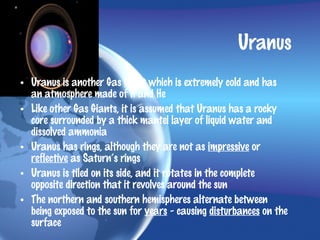
Uranus
• Uranus is another Gas Giant which is extremely cold and has
  an atmosphere made of H and He
• Like other Gas Giants, it is assumed that Uranus has a rocky
  core surrounded by a thick mantel layer of liquid water and
  dissolved ammonia
• Uranus has rings, although they are not as impressive or
  reflective as Saturn’s rings
• Uranus is tiled on its side, and it rotates in the complete
  opposite direction that it revolves around the sun
• The northern and southern hemispheres alternate between
  being exposed to the sun for years - causing disturbances on the
  surface
Uranus’ Moons/Fun Facts
• Uranus has more than 20 moons
• FUN FACTS:
  • Uranus is thought to have been tilted on its side by a
    collision with another planet sized object
  • The rings and moons of Uranus follow the irregular
    rotation of the planet
  • One day on Uranus is about 17 Earth hours
  • It takes almost 84 Earth years for Uranus to revolve
    around the sun
  • Blue-Green color comes from methane in the atmosphere
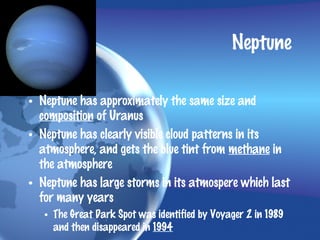
Neptune

• Neptune has approximately the same size and
  composition of Uranus
• Neptune has clearly visible cloud patterns in its
  atmosphere, and gets the blue tint from methane in
  the atmosphere
• Neptune has large storms in its atmospere which last
  for many years
   • The Great Dark Spot was identified by Voyager 2 in 1989
     and then disappeared in 1994
Neptune’s Moons/Fun Facts
• Neptune has 8 moons
• Triton is the largest moon - has a thin
  atmosphere and an icy crust
• FUN FACTS:
  • Neptune also has a small band of coal colored
    rings
  • One day on Neptune is about 15 Earth hours
  • It takes almost 165 Earth years for Neptune to
    revolve around the sun.
Pluto – A Planet No More 
• Pluto is small and dense - much like the moons
  of the Gas Giants
• Pluto is made up of a mixture of ice and rock
• Pluto has a single moon - Charon - which is
  almost identical in size (almost like a double
  planet)
• Pluto is now considered a “dwarf planet” and
  is not recognized as having official planet
  standing

7.1 the solar system

  • 1.
    Our Solar System Ag Earth Science Mr. Silva
  • 2.
    The Terrestrial Planets The four planets closest to the sun.  Mercury, Venus, Earth, and Mars  The terrestrial planets are much like Earth.  The four inner planets:  Are relatively small and dense  Have rocky surfaces (crusts), mantels, and iron cores
  • 3.
    More on theFirst Four  Mercury and Mars have crusts that are scarred by craters.  Earth and Venus do not have craters because their surface is continually eroded.  Common characteristics of the terrestrial planets:  Higher temperature than outer planets  Have few (if any) moons  No rings around the terrestrial planets
  • 4.
    Mercury  Characteristics:  Smallest and closest to the sun  Dense with large Iron core  Fastest moving planet - 88 day revolution  Temperature and Atmosphere:  It takes 88 days for sunrise to sunset  During the day, temperature = 430 deg. C  At night, temperature = 170 deg. C  Virtually NO atmosphere - temp makes particles move fast, little gravity makes it easy for particle to escape into space
  • 5.
    Venus  Characteristics:  The brightest object in Earth’s night sky (with the exception of the moon)  Rotates in the opposite direction to which it revolves around the sun  Rotation rate is VERY slow - takes 243 days to rotate on its axis (a day is longer than a year!)  Temperature and Atmosphere:  Difficult to study because of clouds  Atmosphere is so thick that pressure is 90x greater than that on Earth  Atmosphere is made mainly of CO2 which traps heat and increases surface temp  Surface temp is 470 deg. C
  • 6.
    Earth  Earth =Suitable atmosphere and temperature for water to exist as liquid!  H2O supports tens of thousands of different species of living organisms and has shaped the surface through erosion.  Has gravity to hold most gas molecules = thick atmosphere  Geologically alive!
  • 7.
    Mars  Characteristics:  Most Earth-like of all planets  Weathering of iron-rich rock give it red tint  Has largest volcano in solar system (Olympus Mos)  Atmosphere and Temperature:  Thin atmosphere and distance = temp range of -140 deg. C to 20 deg. C  Atmosphere is mainly CO2 (much like Venus but much thinner)  No liquid water on Mars - but thought that there once was  Mars also has seasons due to the tilt of its axis
  • 8.
    Asteroids  Beyond Marsis a region known as the asteroid belt  Astronomers have discovered more than 10,000 asteroids and more are thought to exist  Asteroid are:  >1 kilometer in diameter  Only 3 are larger than 500 kilometers across  It used to be thought that asteroids were fragments of a shattered planet - not what is thought today
  • 9.
    Scientific Discovery • Itis said that Scientific Discovery can happen in different ways: • Discovery by accident • Theories predict phenomena that scientists try to find • Uranus (Yoor uh nus) and Neptune were discovered by these two methods • Uranus discovered by chance - thought it was a dim star • Neptune was found when someone predicted that there was something affecting Uranus’ orbit.
  • 10.
    Gas Giants • The“Gas Giants” are the next four planets in the Solar System • Jupiter, Saturn, Uranus, and Neptune • Common Characteristics: • Much colder than terrestrial planets • More massive than terrestrial planets • Composed of mainly Hydrogen and Helium • No solid surface - intense pressure means that H and He exist in liquid form • Small dense cores of metal and rock
  • 11.
    Jupiter • The firstplanet beyond the asteroid belt and the largest/massive planet in the solar system • Jupiter could hold more than 1,300 Earths and is named for the ruler of the Roman Gods • Jupiter is composed of mainly H and He • Atmosphere: • Clouds on Jupiter move fast because Jupiter moves fast • Brown bands are colder and move faster than the white bands • The great red spot is a giant storm on Jupiter, caught between bands of warm and cold air • These storms don’t dissipate like they do on Earth - the Great Red Spot was first observed in 1664
  • 12.
    Jupiter’s Moons/Fun Facts •Jupiter has over 50 moons! • Ganymede and Callisto are the size of Mercury • Io and Europa are the size of Earth’s moon • Ganymede, Io, and Europa have metal cores and rocky mantels (Io is covered in active volcanoes - Ganymede, Europa, and Callisto are covered in ice) • Scientists believe that the ice on Europa rests on top of a liquid salt water ocean • FUN FACTS: • One day on Jupiter is less than 10 hours on Earth • It takes almost 12 Earth years for Jupiter to revolve around the sun • The Great Red Spot is the size of three Earths
  • 13.
    Saturn • The secondlargest planet in the solar system and known for its rings! • Rings are ice particles or ice covered rock - most are snowball sized • Rings are 274,000 kilometers in diameter yet only tens of meters thick • Atmosphere: • Largest atmosphere of any in the solar system • Saturn has the lowest average density of any planet • Atmosphere is made of H and He • Scientists think that He condenses and as He raindrops fall towards the center of the planet, their energy is changed to heat
  • 14.
    Uranus • Uranus isanother Gas Giant which is extremely cold and has an atmosphere made of H and He • Like other Gas Giants, it is assumed that Uranus has a rocky core surrounded by a thick mantel layer of liquid water and dissolved ammonia • Uranus has rings, although they are not as impressive or reflective as Saturn’s rings • Uranus is tiled on its side, and it rotates in the complete opposite direction that it revolves around the sun • The northern and southern hemispheres alternate between being exposed to the sun for years - causing disturbances on the surface
  • 15.
    Uranus’ Moons/Fun Facts •Uranus has more than 20 moons • FUN FACTS: • Uranus is thought to have been tilted on its side by a collision with another planet sized object • The rings and moons of Uranus follow the irregular rotation of the planet • One day on Uranus is about 17 Earth hours • It takes almost 84 Earth years for Uranus to revolve around the sun • Blue-Green color comes from methane in the atmosphere
  • 16.
    Neptune • Neptune hasapproximately the same size and composition of Uranus • Neptune has clearly visible cloud patterns in its atmosphere, and gets the blue tint from methane in the atmosphere • Neptune has large storms in its atmospere which last for many years • The Great Dark Spot was identified by Voyager 2 in 1989 and then disappeared in 1994
  • 17.
    Neptune’s Moons/Fun Facts •Neptune has 8 moons • Triton is the largest moon - has a thin atmosphere and an icy crust • FUN FACTS: • Neptune also has a small band of coal colored rings • One day on Neptune is about 15 Earth hours • It takes almost 165 Earth years for Neptune to revolve around the sun.
  • 18.
    Pluto – APlanet No More  • Pluto is small and dense - much like the moons of the Gas Giants • Pluto is made up of a mixture of ice and rock • Pluto has a single moon - Charon - which is almost identical in size (almost like a double planet) • Pluto is now considered a “dwarf planet” and is not recognized as having official planet standing