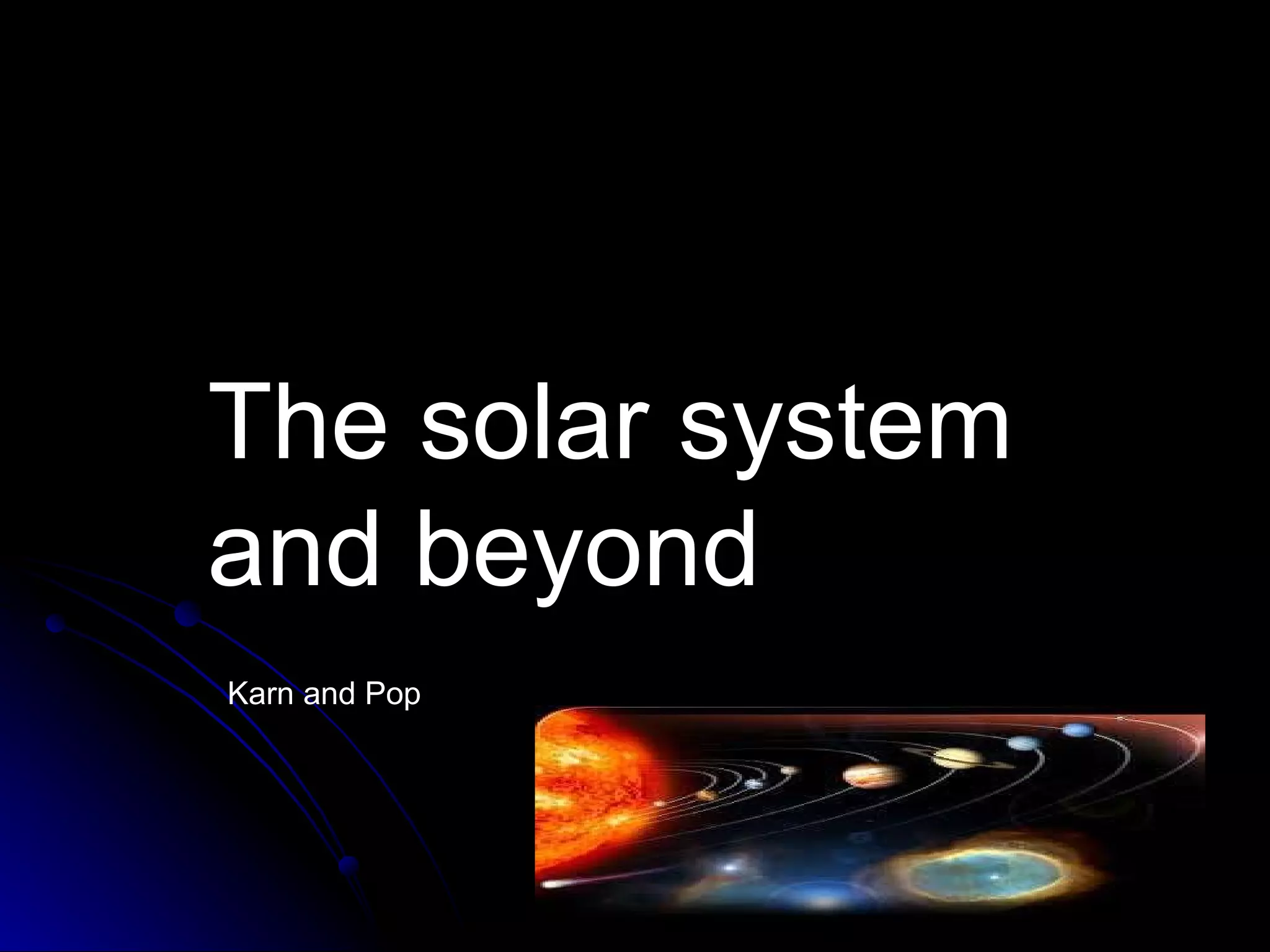
The solar system and beyond Karn and Pop
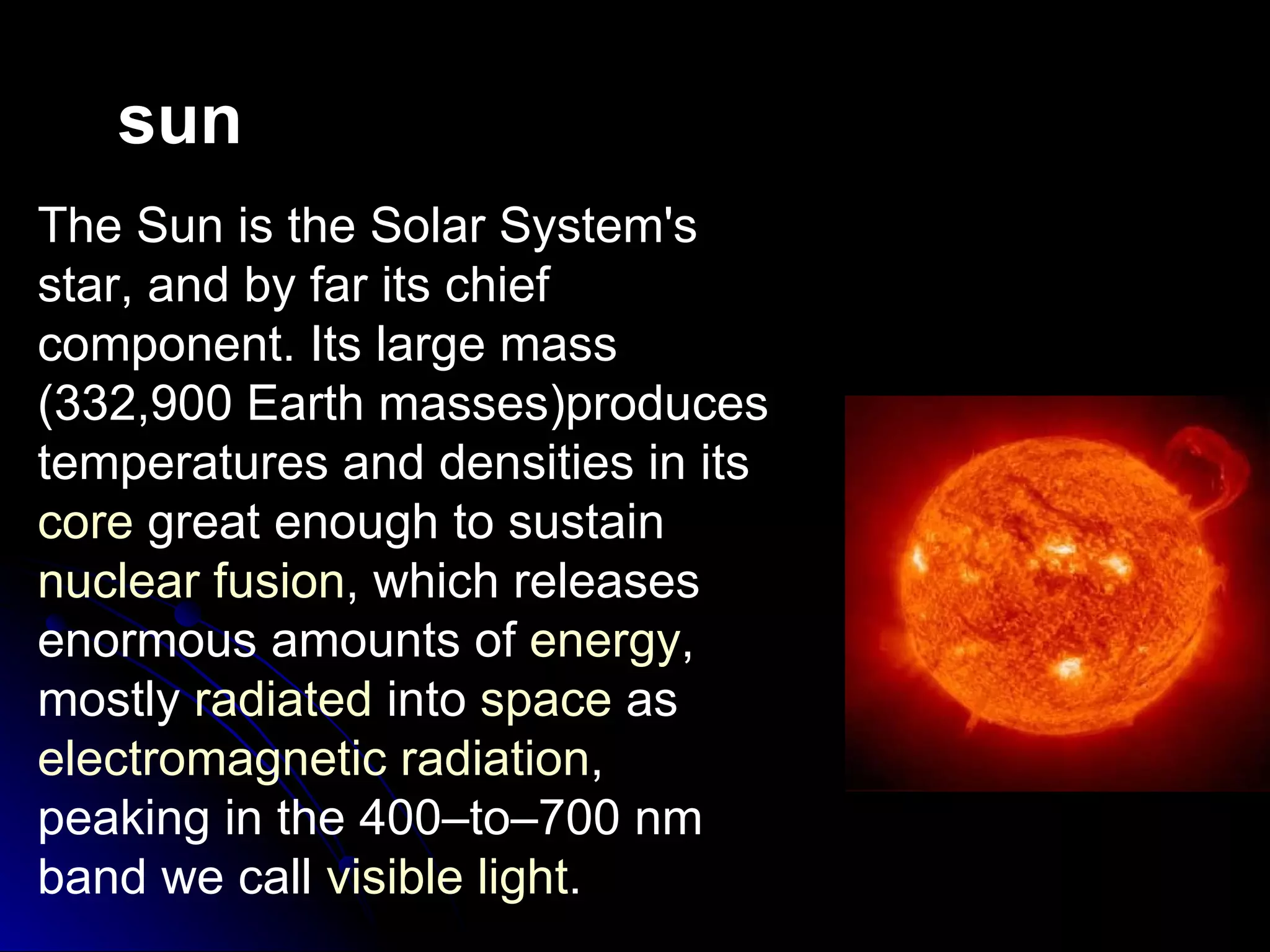
The Sun is the Solar System's star, and by far its chief component .  Its large mass  ( 332,900 Earth masses ) produces temperatures and densities in its  core  great enough to sustain  nuclear fusion , which releases enormous amounts of  energy , mostly  radiated  into  space  as  electromagnetic radiation , peaking in the 400–to–700 nm band we call  visible light . sun
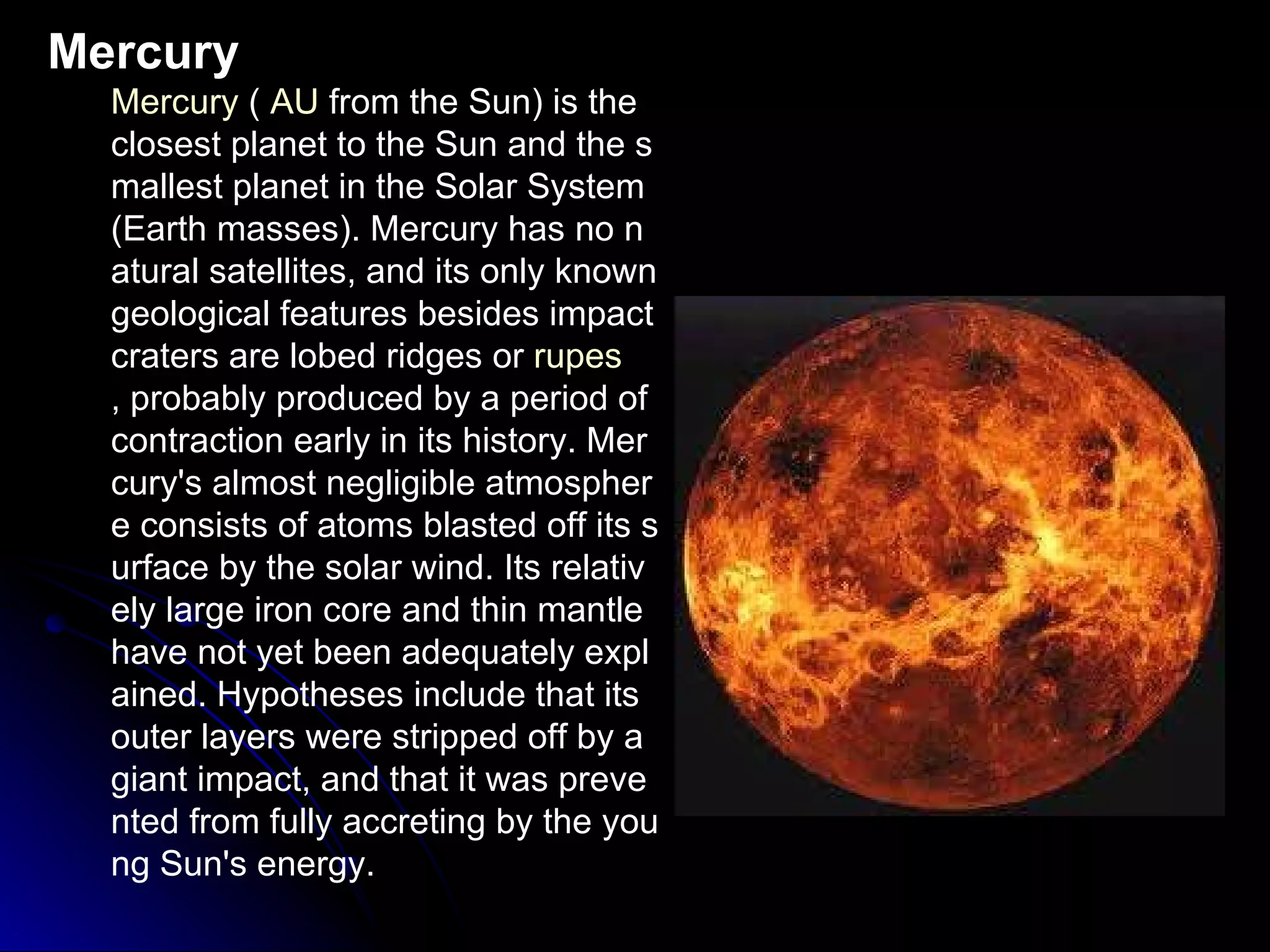
Mercury Mercury  (  AU  from the Sun) is the closest planet to the Sun and the smallest planet in the Solar System  (Earth masses). Mercury has no natural satellites, and its only known geological features besides impact craters are lobed ridges or  rupes , probably produced by a period of contraction early in its history. Mercury's almost negligible atmosphere consists of atoms blasted off its surface by the solar wind. Its relatively large iron core and thin mantle have not yet been adequately explained. Hypotheses include that its outer layers were stripped off by a giant impact, and that it was prevented from fully accreting by the young Sun's energy.
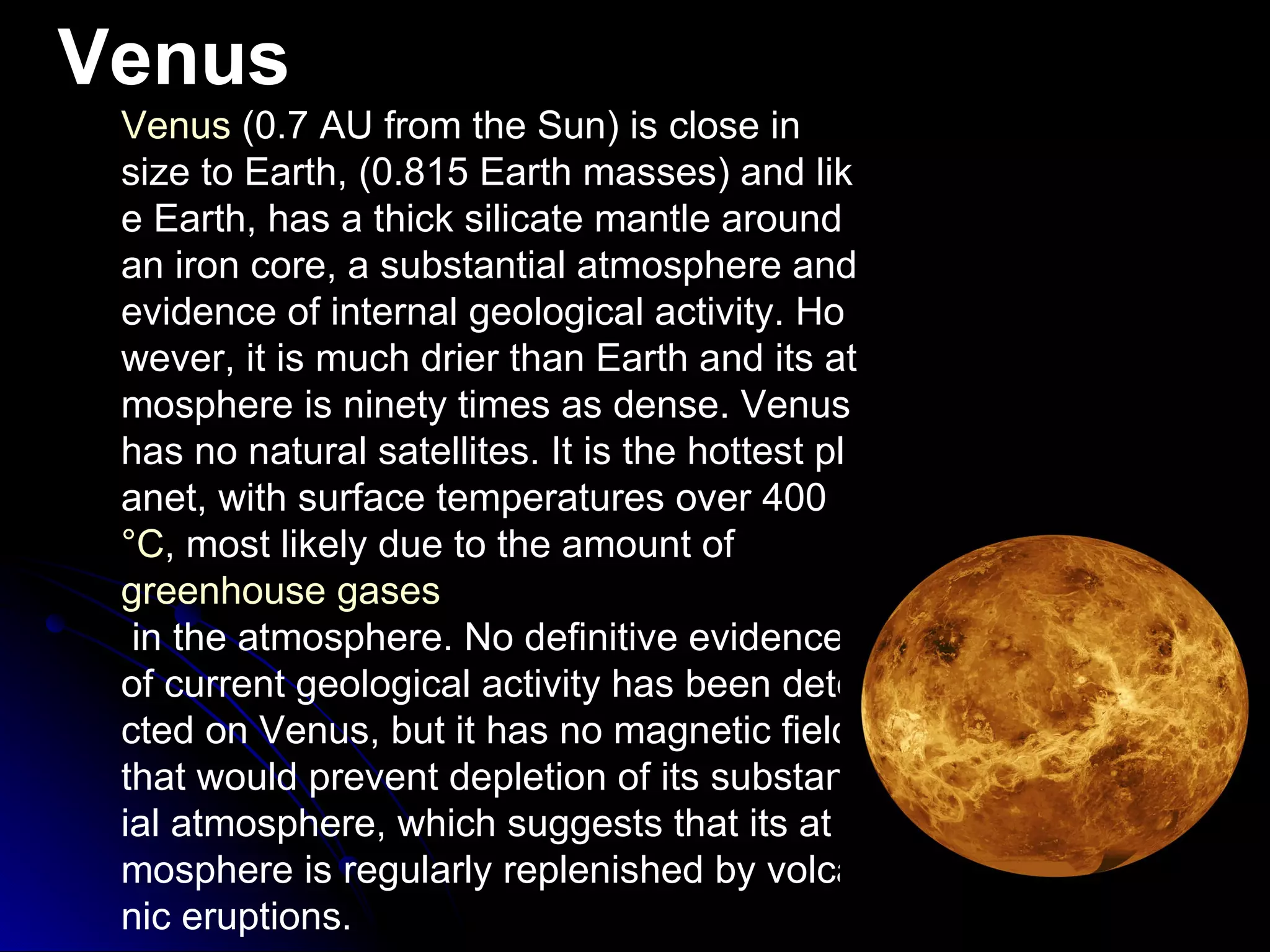
Venus Venus  (0.7 AU from the Sun) is close in size to Earth, (0.815 Earth masses) and like Earth, has a thick silicate mantle around an iron core, a substantial atmosphere and evidence of internal geological activity. However, it is much drier than Earth and its atmosphere is ninety times as dense. Venus has no natural satellites. It is the hottest planet, with surface temperatures over 400  °C , most likely due to the amount of  greenhouse gases  in the atmosphere. No definitive evidence of current geological activity has been detected on Venus, but it has no magnetic field that would prevent depletion of its substantial atmosphere, which suggests that its atmosphere is regularly replenished by volcanic eruptions.
Earth Earth  (1 AU from the Sun) is the largest and densest of the inner planets, the only one known to have current geological activity, and is the only place in the  universe  where  life  is known to exist. Its liquid  hydrosphere  is unique among the terrestrial planets, and it is also the only planet where  plate tectonics  has been observed. Earth's atmosphere is radically different from those of the other planets, having been altered by the presence of life to contain 21% free  oxygen . [38]  It has one natural satellite, the  Moon , the only large satellite of a terrestrial planet in the Solar System.
Mars Mars  (1.5 AU from the Sun) is smaller than Earth and Venus (0.107 Earth masses). It possesses an atmosphere of mostly  carbon dioxide  with a surface pressure of 6.1 millibars (roughly 0.6 percent that of the Earth's). [39]  Its surface, peppered with vast volcanoes such as  Olympus  Mons  and rift valleys such as  Valles   Marineris , shows geological activity that may have persisted until as recently as 2 million years ago. Its red colour comes from  iron oxide  (rust) in its soil. Mars has two tiny natural satellites ( Deimos  and  Phobos ) thought to be captured  asteroids
Jupiter Jupiter  (5.2 AU), at 318 Earth masses, is 2.5 times the mass of all the other planets put together. It is composed largely of  hydrogen  and  helium . Jupiter's strong internal heat creates a number of semi-permanent features in its atmosphere, such as cloud bands and the  Great Red Spot . Jupiter has  63 known satellites .  The four largest,  Ganymede ,  Callisto ,  Io , and  Europa , show similarities to the terrestrial planets, such as volcanism and internal heating . [ 54 ]  Ganymede, the largest satellite in the Solar System, is larger than Mercury .
Saturn Saturn  (9.5 AU), distinguished by its extensive  ring system , has several similarities to Jupiter, such as its atmospheric composition and magnetosphere. Although Saturn has 60% of Jupiter's volume, it is less than a third as massive, at 95 Earth masses, making it the least dense planet in the Solar System. The rings of Saturn are made up of small ice and rock particles. Saturn has  62  confirmed  satellites ; two of which,  Titan  and  Enceladus , show signs of geological activity, though they are largely  made  of  ice . [ 55 ]  Titan, the second largest moon in the Solar System, is larger than Mercury and the only satellite in the Solar System with a substantial atmosphere
Uranus Uranus  (19.6 AU), at 14 Earth masses, is the lightest of the outer planets. Uniquely among the planets, it orbits the Sun on its side; its  axial tilt  is over ninety degrees to the  ecliptic . It has a much colder core than the other gas giants, and radiates very little heat into space. [56] Uranus has  27 known satellites , the largest ones being  Titania ,  Oberon ,  Umbriel ,  Ariel  and  Miranda .
Neptune Neptune  (30 AU), though slightly smaller than Uranus, is more massive (equivalent to 17 Earths) and therefore more  dense . It radiates more internal heat, but not as much as Jupiter or Saturn. [57] Neptune has  13 known satellites .  The largest,  Triton , is geologically active, with  geysers  of  liquid   nitrogen . [ 58 ]  Triton is the only large satellite with a  retrograde   orbit .  Neptune is accompanied in its orbit by a number of  minor   planets , termed  Neptune   Trojans , that are in 1:1   resonance  with it .
Pluto Pluto , is the second-largest known  dwarf planet  in the  Solar System  (after  Eris ) and the tenth-largest body observed directly orbiting the  Sun . Originally classified as a planet, Pluto is now considered the largest member of a distinct population known as the  Kuiper  belt . [ note  9] Like other members of the Kuiper belt, Pluto is composed primarily of rock and ice and is relatively small :  approximately a fifth the mass of the  Earth 's  Moon  and a third its volume .  It has an  eccentric  and highly inclined orbit that takes it from 30 to 49  AU  ( 4.4–7.4 billion km )  from the Sun .  This causes Pluto to periodically come closer to the Sun than  Neptune .
cite www.google.com and http :// en . wikipedia . org / wiki / Solar_System
the end

Solar system

  • 1.
    The solar systemand beyond Karn and Pop
  • 2.
    The Sun isthe Solar System's star, and by far its chief component . Its large mass ( 332,900 Earth masses ) produces temperatures and densities in its core great enough to sustain nuclear fusion , which releases enormous amounts of energy , mostly radiated into space as electromagnetic radiation , peaking in the 400–to–700 nm band we call visible light . sun
  • 3.
    Mercury Mercury (  AU from the Sun) is the closest planet to the Sun and the smallest planet in the Solar System (Earth masses). Mercury has no natural satellites, and its only known geological features besides impact craters are lobed ridges or rupes , probably produced by a period of contraction early in its history. Mercury's almost negligible atmosphere consists of atoms blasted off its surface by the solar wind. Its relatively large iron core and thin mantle have not yet been adequately explained. Hypotheses include that its outer layers were stripped off by a giant impact, and that it was prevented from fully accreting by the young Sun's energy.
  • 4.
    Venus Venus (0.7 AU from the Sun) is close in size to Earth, (0.815 Earth masses) and like Earth, has a thick silicate mantle around an iron core, a substantial atmosphere and evidence of internal geological activity. However, it is much drier than Earth and its atmosphere is ninety times as dense. Venus has no natural satellites. It is the hottest planet, with surface temperatures over 400 °C , most likely due to the amount of greenhouse gases in the atmosphere. No definitive evidence of current geological activity has been detected on Venus, but it has no magnetic field that would prevent depletion of its substantial atmosphere, which suggests that its atmosphere is regularly replenished by volcanic eruptions.
  • 5.
    Earth Earth (1 AU from the Sun) is the largest and densest of the inner planets, the only one known to have current geological activity, and is the only place in the universe where life is known to exist. Its liquid hydrosphere is unique among the terrestrial planets, and it is also the only planet where plate tectonics has been observed. Earth's atmosphere is radically different from those of the other planets, having been altered by the presence of life to contain 21% free oxygen . [38] It has one natural satellite, the Moon , the only large satellite of a terrestrial planet in the Solar System.
  • 6.
    Mars Mars (1.5 AU from the Sun) is smaller than Earth and Venus (0.107 Earth masses). It possesses an atmosphere of mostly carbon dioxide with a surface pressure of 6.1 millibars (roughly 0.6 percent that of the Earth's). [39] Its surface, peppered with vast volcanoes such as Olympus Mons and rift valleys such as Valles Marineris , shows geological activity that may have persisted until as recently as 2 million years ago. Its red colour comes from iron oxide (rust) in its soil. Mars has two tiny natural satellites ( Deimos and Phobos ) thought to be captured asteroids
  • 7.
    Jupiter Jupiter (5.2 AU), at 318 Earth masses, is 2.5 times the mass of all the other planets put together. It is composed largely of hydrogen and helium . Jupiter's strong internal heat creates a number of semi-permanent features in its atmosphere, such as cloud bands and the Great Red Spot . Jupiter has 63 known satellites . The four largest, Ganymede , Callisto , Io , and Europa , show similarities to the terrestrial planets, such as volcanism and internal heating . [ 54 ] Ganymede, the largest satellite in the Solar System, is larger than Mercury .
  • 8.
    Saturn Saturn (9.5 AU), distinguished by its extensive ring system , has several similarities to Jupiter, such as its atmospheric composition and magnetosphere. Although Saturn has 60% of Jupiter's volume, it is less than a third as massive, at 95 Earth masses, making it the least dense planet in the Solar System. The rings of Saturn are made up of small ice and rock particles. Saturn has 62 confirmed satellites ; two of which, Titan and Enceladus , show signs of geological activity, though they are largely made of ice . [ 55 ] Titan, the second largest moon in the Solar System, is larger than Mercury and the only satellite in the Solar System with a substantial atmosphere
  • 9.
    Uranus Uranus (19.6 AU), at 14 Earth masses, is the lightest of the outer planets. Uniquely among the planets, it orbits the Sun on its side; its axial tilt is over ninety degrees to the ecliptic . It has a much colder core than the other gas giants, and radiates very little heat into space. [56] Uranus has 27 known satellites , the largest ones being Titania , Oberon , Umbriel , Ariel and Miranda .
  • 10.
    Neptune Neptune (30 AU), though slightly smaller than Uranus, is more massive (equivalent to 17 Earths) and therefore more dense . It radiates more internal heat, but not as much as Jupiter or Saturn. [57] Neptune has 13 known satellites . The largest, Triton , is geologically active, with geysers of liquid nitrogen . [ 58 ] Triton is the only large satellite with a retrograde orbit . Neptune is accompanied in its orbit by a number of minor planets , termed Neptune Trojans , that are in 1:1 resonance with it .
  • 11.
    Pluto Pluto ,is the second-largest known dwarf planet in the Solar System (after Eris ) and the tenth-largest body observed directly orbiting the Sun . Originally classified as a planet, Pluto is now considered the largest member of a distinct population known as the Kuiper belt . [ note 9] Like other members of the Kuiper belt, Pluto is composed primarily of rock and ice and is relatively small : approximately a fifth the mass of the Earth 's Moon and a third its volume . It has an eccentric and highly inclined orbit that takes it from 30 to 49  AU ( 4.4–7.4 billion km ) from the Sun . This causes Pluto to periodically come closer to the Sun than Neptune .
  • 12.
    cite www.google.com andhttp :// en . wikipedia . org / wiki / Solar_System
  • 13.