The Stars:
Characteristics, Magnitude, Stellar
Classifications, H-R Diagram, Motions and
Significance
Laver Joy Lovido
Marjonlien A. Mahusay
Characteristics of stars
• Size
• Color
• Temperature
• Composition
• Brightness
Size of a Star
anywhere from 20km to 1 trillion km in diameter
Main Group by Star
1. Neutron Star
• **Can be the distance you travel to school
2. White Dwarf Star
• **Can be the size of Asia
3. Medium-sized Star
• **Our own Sun
4. Giant Star
• *The diameter 10 to 100X larger than our
sun
5. Super-giant Star
• *The diameter 1000X larger than sun
Size of a Star
Color: star can be
Blue, White, Orange
or Yellow, red
Temperature:
Blue – hottest (35000⁰C)
Yellow – our Sun
(5500⁰C)
Red - coolest(3000⁰C)
Color and Temperature
Characteristics of stars
Color: stars can be red, blue, white, orange or yellow
Composition: contain different elements determined using
spectra
• Temperature: Blue is the hottest (35000 C)
Yellow (our sun) (5500 C)
Red is the coolest (3000 C)
Composition
Astronomers use a spectroscope to determine
what stars are made of by their spectral lines
• Hydrogen (70% of the total mass of a star )
• Helium (28% of the total mass of a star)
• Trace Elements- O, Ne, C, N and other
elements (2% )
Magnitude of Star
1. Apparent magnitude
2. Absolute magnitude
Magnitude of Star
1. Apparent magnitude
 is the brightness of a star when viewed from
Earth
 The lower the number on the scale, the brighter
the star appears to us.
factors :
 how big it is
 how hot it is
 how far away it is.
Analyzing the Apparent Magnitude of
Stars
Relating Magnitudes to Brightness Ratio
Magnitude Difference Ratio of Brightness
1 2.512:1
2 2.5122 = 6.31:1
3 2.5123 = 15.85:1
4 2.5124 = 39.8:1
5 2.5125 = 100:1
.
.
.
10 2.51210 = 104:1
EXAMPLE:
Suppose stars 1 & 2 have magnitudes of
m1=6 m2= 1: the ratio of their
brightness is:
SOLUTION:
=2.512m1-m2
=2.5126-1
=100.02
Analyzing the Apparent Magnitude
of Stars
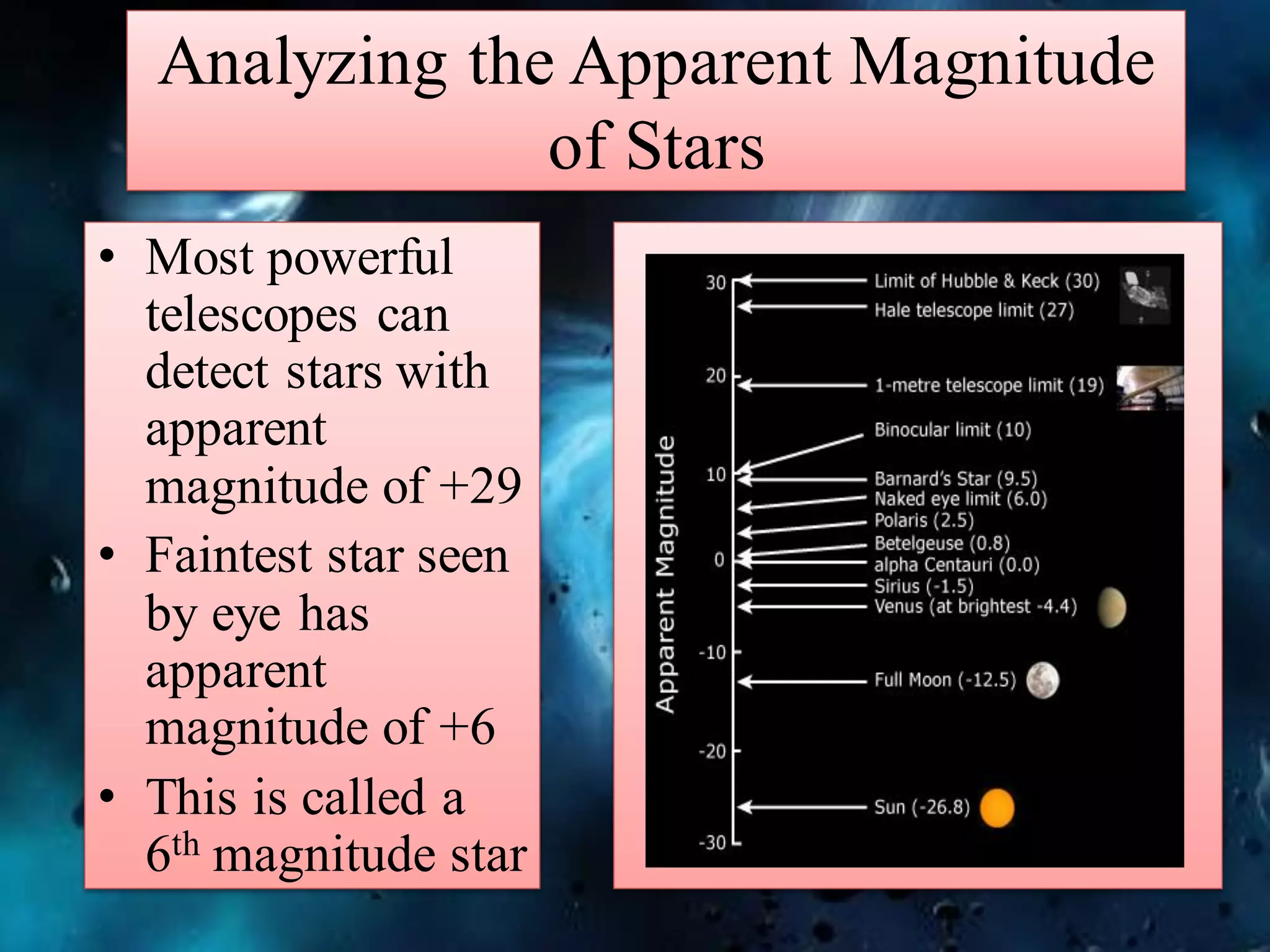
• Most powerful
telescopes can
detect stars with
apparent
magnitude of +29
• Faintest star seen
by eye has
apparent
magnitude of +6
• This is called a
6th magnitude star
2. Absolute Magnitude
the actual brightness of a star, assuming all stars
were set at a standard distance from Earth.
true brightness
 If sun was 32.6 light-years away, it would be
5th magnitude
•So absolute magnitude of sun = +5
•Most stars are between -5 and +15
Magnitude of Star
Analyzing the Absolute Magnitude of
Stars
Relating Absolute Magnitude to Luminosity
Absolute Magnitude Approximate Luminosity
in Solar Units
-5 10,000
0 100
5 1
10 0.01
EXAMPLE:
If Sirius A has Absolute Magnitude of 1.5,
how many times that sirius is brightre than
the sun?
SOLUTION:
5-1.5=3.5
2.5123.5 = 25
Comparison of the Nearest Stars in terms of
Apparent and Absolute Magnitude
Name Distance (ly) Apparent
Visual
Magnitude
AbsoluteVisual
Magnitude
Sun -26.8 4.83
ProximaCentauri 4.23 11.09 15.5
Alpha CentauriA 4.35 0.01 4.4
B 4.35 1.34 5.7
Barnard’s Star 5.98 9.55 13.2
Wolf359 7.80 14.45 16.6
Stellar Classification
1. Color
2. Temperature
2. Size
3. Brightness
Stellar Classification
Analyzing Starlight
The surface temperature
of a star is indicated by
its color.
Blue stars shine with the
hottest temperatures and
Red stars with the
coolest.
Stellar Classification
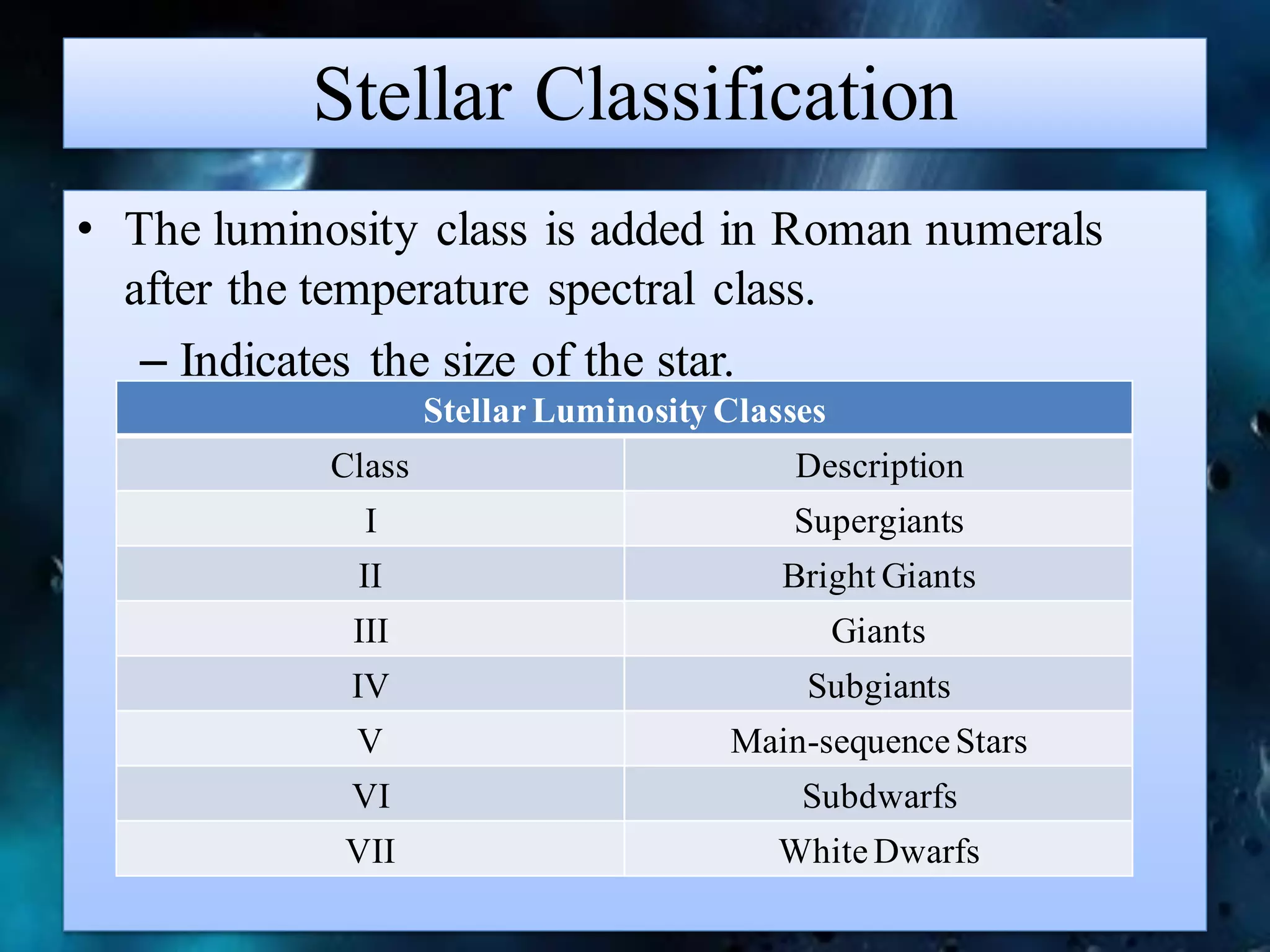
• The luminosity class is added in Roman numerals
after the temperature spectral class.
– Indicates the size of the star.
Stellar Luminosity Classes
Class Description
I Supergiants
II Bright Giants
III Giants
IV Subgiants
V Main-sequenceStars
VI Subdwarfs
VII WhiteDwarfs
Getting Familiar to the Spectral Sequence
Spectral type- a way of classifying a star by the
lines that appears in its spectrum; it is related
to surface temperature.
Basic spectral types are designated by letters :
 OBAFGKM with O for the hottest and M
for the coolest.
 subdivided with numbers from 0-9
Spectral classes are as follows:
Oh Be A Fine Girl/Guy, Kiss Me!
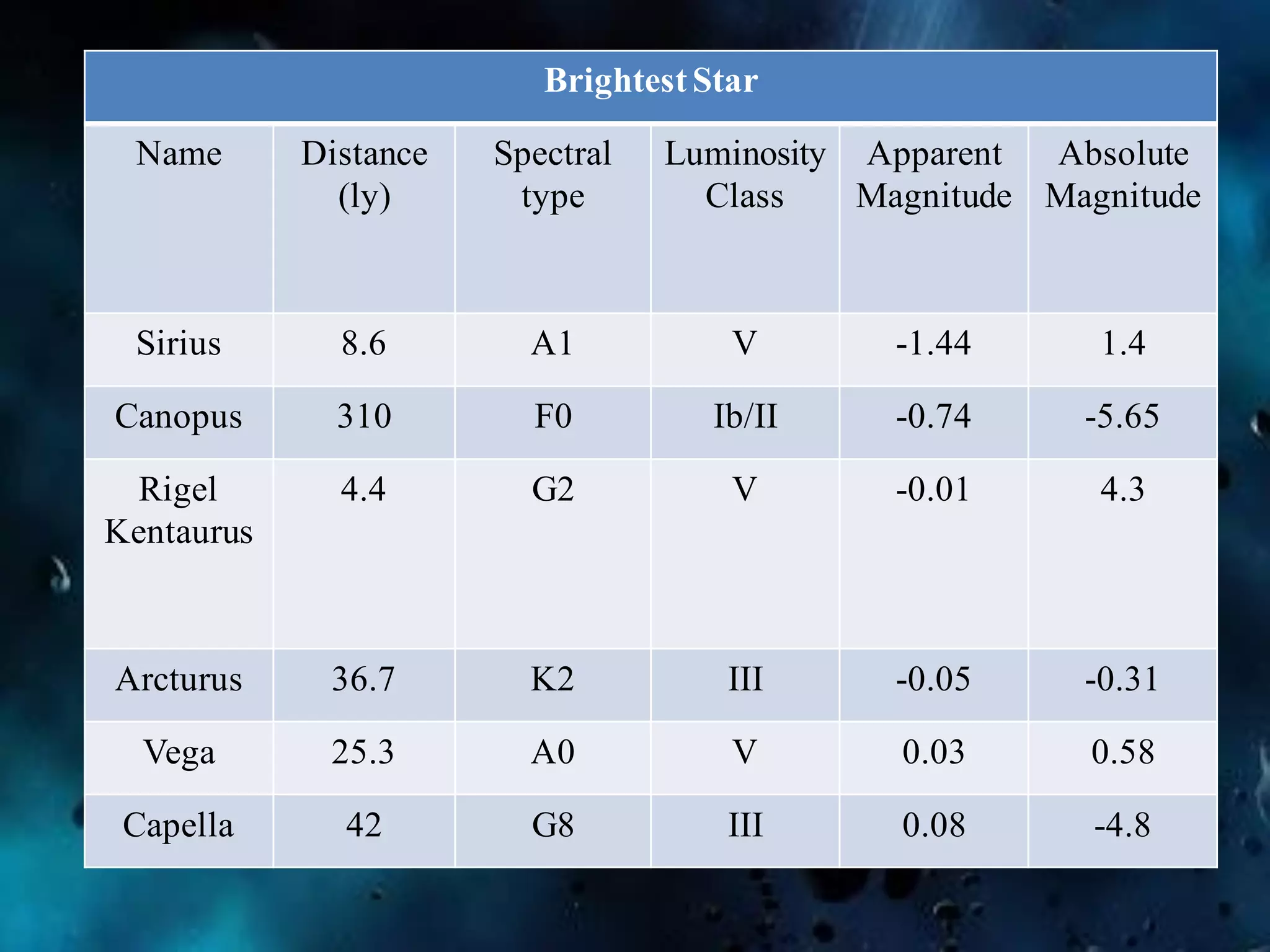
BrightestStar
Name Distance
(ly)
Spectral
type
Luminosity
Class
Apparent
Magnitude
Absolute
Magnitude
Sirius 8.6 A1 V -1.44 1.4
Canopus 310 F0 Ib/II -0.74 -5.65
Rigel
Kentaurus
4.4 G2 V -0.01 4.3
Arcturus 36.7 K2 III -0.05 -0.31
Vega 25.3 A0 V 0.03 0.58
Capella 42 G8 III 0.08 -4.8
Hertzsprung-Russsell Diagram
developed by Einar Hertzsprung and Henry
Russell in the early 20th century.
 graph that exhibits the intrinsic stellar
properties such as the sizes, colors and
temperatures
Plots the individual stars as points , with stellar
luminosity on the vertical axis and surface
temperature con the horizontal axis
Hertzsprung-Russsell Diagram
Stellar Motion
Stellar Motion
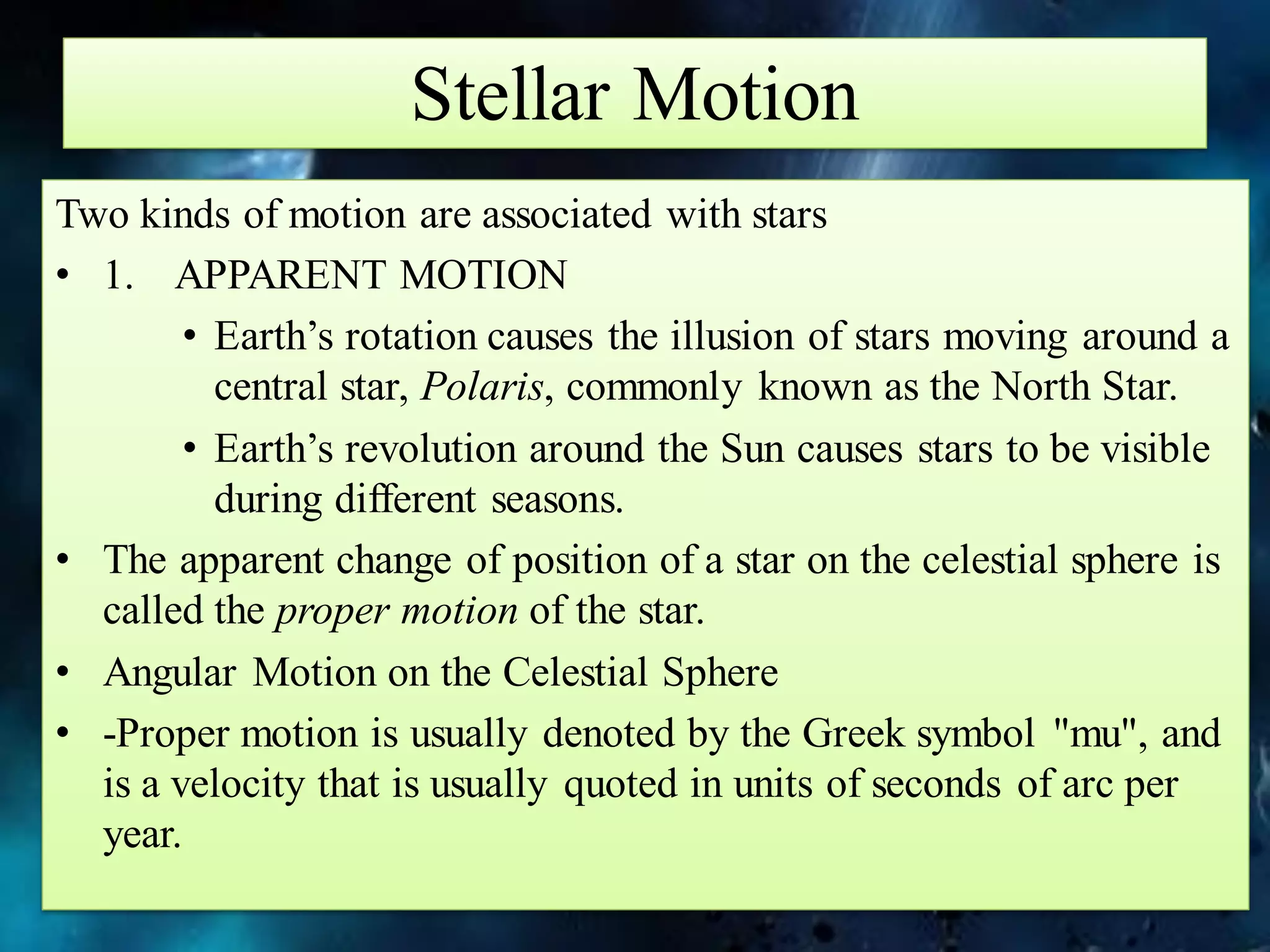
Two kinds of motion are associated with stars
• 1. APPARENT MOTION
• Earth’s rotation causes the illusion of stars moving around a
central star, Polaris, commonly known as the North Star.
• Earth’s revolution around the Sun causes stars to be visible
during different seasons.
• The apparent change of position of a star on the celestial sphere is
called the proper motion of the star.
• Angular Motion on the Celestial Sphere
• -Proper motion is usually denoted by the Greek symbol "mu", and
is a velocity that is usually quoted in units of seconds of arc per
year.
Stellar Motion
2. ACTUAL MOTION
– First, they move slightly across the sky (only see the
closest ones).
– Second, they may revolve around another star
(binary system).
– Third, they may either move away from or toward
our solar system.
• The apparent shift in the wavelength of light emitted by
a light source moving away from or toward an observer
is called the Doppler Effect.
– Also used for sound waves on Earth.
Stellar Motion
Stellar Motion
Significance of Stars
Why is it important to learn about the stars?
1. studying stars is important because it helps
tell us how we got all the other elements that
make up things around us (and in us!).
2. To learn from other stars may help us
understand our own Sun, which is also a star.
The Sun only seems different to us because it
is so much closer to us than other stars.
3. we can also learn something about how they
are born and die. This helps us understand
how our own solar system was formed.
4. Stars contain a large fraction of all the visible
mass in galaxies. As a result, their combined
gravitational forces affect the 'dynamics' of
galaxies, i.e. the ways in which galaxies move
and evolve in shape.
The gravitational pull of one particular star, our
Sun, is especially important since it is the Sun's
gravitational attraction that keeps the Earth in
orbit.
-Scott Sandford
-Astrophysics Branch
-NASA/Ames Research Center

The Star

  • 1.
    The Stars: Characteristics, Magnitude,Stellar Classifications, H-R Diagram, Motions and Significance Laver Joy Lovido Marjonlien A. Mahusay
  • 3.
    Characteristics of stars •Size • Color • Temperature • Composition • Brightness
  • 4.
    Size of aStar anywhere from 20km to 1 trillion km in diameter Main Group by Star 1. Neutron Star • **Can be the distance you travel to school 2. White Dwarf Star • **Can be the size of Asia 3. Medium-sized Star • **Our own Sun
  • 5.
    4. Giant Star •*The diameter 10 to 100X larger than our sun 5. Super-giant Star • *The diameter 1000X larger than sun Size of a Star
  • 6.
    Color: star canbe Blue, White, Orange or Yellow, red Temperature: Blue – hottest (35000⁰C) Yellow – our Sun (5500⁰C) Red - coolest(3000⁰C) Color and Temperature
  • 7.
    Characteristics of stars Color:stars can be red, blue, white, orange or yellow Composition: contain different elements determined using spectra • Temperature: Blue is the hottest (35000 C) Yellow (our sun) (5500 C) Red is the coolest (3000 C)
  • 8.
    Composition Astronomers use aspectroscope to determine what stars are made of by their spectral lines • Hydrogen (70% of the total mass of a star ) • Helium (28% of the total mass of a star) • Trace Elements- O, Ne, C, N and other elements (2% )
  • 9.
    Magnitude of Star 1.Apparent magnitude 2. Absolute magnitude
  • 10.
    Magnitude of Star 1.Apparent magnitude  is the brightness of a star when viewed from Earth  The lower the number on the scale, the brighter the star appears to us. factors :  how big it is  how hot it is  how far away it is.
  • 11.
    Analyzing the ApparentMagnitude of Stars Relating Magnitudes to Brightness Ratio Magnitude Difference Ratio of Brightness 1 2.512:1 2 2.5122 = 6.31:1 3 2.5123 = 15.85:1 4 2.5124 = 39.8:1 5 2.5125 = 100:1 . . . 10 2.51210 = 104:1
  • 12.
    EXAMPLE: Suppose stars 1& 2 have magnitudes of m1=6 m2= 1: the ratio of their brightness is: SOLUTION: =2.512m1-m2 =2.5126-1 =100.02
  • 13.
    Analyzing the ApparentMagnitude of Stars • Most powerful telescopes can detect stars with apparent magnitude of +29 • Faintest star seen by eye has apparent magnitude of +6 • This is called a 6th magnitude star
  • 14.
    2. Absolute Magnitude theactual brightness of a star, assuming all stars were set at a standard distance from Earth. true brightness  If sun was 32.6 light-years away, it would be 5th magnitude •So absolute magnitude of sun = +5 •Most stars are between -5 and +15 Magnitude of Star
  • 15.
    Analyzing the AbsoluteMagnitude of Stars Relating Absolute Magnitude to Luminosity Absolute Magnitude Approximate Luminosity in Solar Units -5 10,000 0 100 5 1 10 0.01
  • 16.
    EXAMPLE: If Sirius Ahas Absolute Magnitude of 1.5, how many times that sirius is brightre than the sun? SOLUTION: 5-1.5=3.5 2.5123.5 = 25
  • 17.
    Comparison of theNearest Stars in terms of Apparent and Absolute Magnitude Name Distance (ly) Apparent Visual Magnitude AbsoluteVisual Magnitude Sun -26.8 4.83 ProximaCentauri 4.23 11.09 15.5 Alpha CentauriA 4.35 0.01 4.4 B 4.35 1.34 5.7 Barnard’s Star 5.98 9.55 13.2 Wolf359 7.80 14.45 16.6
  • 18.
  • 19.
    1. Color 2. Temperature 2.Size 3. Brightness Stellar Classification
  • 20.
    Analyzing Starlight The surfacetemperature of a star is indicated by its color. Blue stars shine with the hottest temperatures and Red stars with the coolest.
  • 21.
    Stellar Classification • Theluminosity class is added in Roman numerals after the temperature spectral class. – Indicates the size of the star. Stellar Luminosity Classes Class Description I Supergiants II Bright Giants III Giants IV Subgiants V Main-sequenceStars VI Subdwarfs VII WhiteDwarfs
  • 22.
    Getting Familiar tothe Spectral Sequence Spectral type- a way of classifying a star by the lines that appears in its spectrum; it is related to surface temperature. Basic spectral types are designated by letters :  OBAFGKM with O for the hottest and M for the coolest.  subdivided with numbers from 0-9
  • 23.
    Spectral classes areas follows: Oh Be A Fine Girl/Guy, Kiss Me!
  • 25.
    BrightestStar Name Distance (ly) Spectral type Luminosity Class Apparent Magnitude Absolute Magnitude Sirius 8.6A1 V -1.44 1.4 Canopus 310 F0 Ib/II -0.74 -5.65 Rigel Kentaurus 4.4 G2 V -0.01 4.3 Arcturus 36.7 K2 III -0.05 -0.31 Vega 25.3 A0 V 0.03 0.58 Capella 42 G8 III 0.08 -4.8
  • 26.
    Hertzsprung-Russsell Diagram developed byEinar Hertzsprung and Henry Russell in the early 20th century.  graph that exhibits the intrinsic stellar properties such as the sizes, colors and temperatures Plots the individual stars as points , with stellar luminosity on the vertical axis and surface temperature con the horizontal axis
  • 27.
  • 28.
  • 29.
    Stellar Motion Two kindsof motion are associated with stars • 1. APPARENT MOTION • Earth’s rotation causes the illusion of stars moving around a central star, Polaris, commonly known as the North Star. • Earth’s revolution around the Sun causes stars to be visible during different seasons. • The apparent change of position of a star on the celestial sphere is called the proper motion of the star. • Angular Motion on the Celestial Sphere • -Proper motion is usually denoted by the Greek symbol "mu", and is a velocity that is usually quoted in units of seconds of arc per year.
  • 30.
  • 31.
    2. ACTUAL MOTION –First, they move slightly across the sky (only see the closest ones). – Second, they may revolve around another star (binary system). – Third, they may either move away from or toward our solar system. • The apparent shift in the wavelength of light emitted by a light source moving away from or toward an observer is called the Doppler Effect. – Also used for sound waves on Earth. Stellar Motion
  • 32.
  • 33.
  • 34.
    Why is itimportant to learn about the stars? 1. studying stars is important because it helps tell us how we got all the other elements that make up things around us (and in us!). 2. To learn from other stars may help us understand our own Sun, which is also a star. The Sun only seems different to us because it is so much closer to us than other stars.
  • 35.
    3. we canalso learn something about how they are born and die. This helps us understand how our own solar system was formed. 4. Stars contain a large fraction of all the visible mass in galaxies. As a result, their combined gravitational forces affect the 'dynamics' of galaxies, i.e. the ways in which galaxies move and evolve in shape.
  • 36.
    The gravitational pullof one particular star, our Sun, is especially important since it is the Sun's gravitational attraction that keeps the Earth in orbit. -Scott Sandford -Astrophysics Branch -NASA/Ames Research Center