Topology is Loading


                      Click To Skip This Step
Topology
 Presented By : Ravi Kumar
Roll No : JU-1112-0015
What is Topology ?
The topology defines the shape and structure
of a Local Area Network (LAN) or other
communications system.
Topologies are either physical or logical
Physical Topology
The physical layout of devices on a network, or the way that the
devices on a network are arranged and how they communicate
with each other.
 The way that the workstations are connected to the network
through the actual cables that transmit data –the physical
structure of the network -- is called the physical topology.
Logical Topology
The logical topology, in contrast, is the way that the
signals act on the network media, or the way that the
data passes through the network from one device to the
next without regard to the physical interconnection of
the devices
Types Of Topologies
Different types of topologies are
•   Single Node Topology
•   Bus Topology
•   Star Topology
•   Ring Topology
•   Mesh Topology
•   Tree and Hybrid Topology
Single Node Topology
In a single node Topology, just a single
device called a dumb terminal is connected
to the server.
Advantages Of Single Node Topology are:

 Easy to Install , configure and manage
 Least expensive , as a ‘Dumb Terminal’ is the cheapest computer
 Single cable is required
 Disadvantages Of Single Node Topology are:
 Only a single device is connected in the entire network
 Dumb Terminal is dependent on the server for resource
Bus Topology
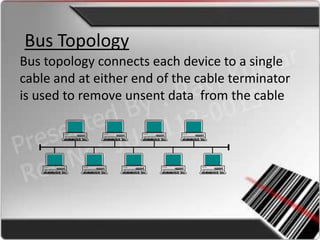
Bus topology connects each device to a single
cable and at either end of the cable terminator
is used to remove unsent data from the cable
Advantages Of Bus Topology are:
  Easy to connect a device to linear bus
  Requires less cable
  Less expansive than other topologies
  Works better for smaller networks
  Disadvantages Of Bus Topology are:
 Entire network gets affected if there is a break in the main cable
 Terminators are required at both end of the backbone cable
 Difficult to detect the faulty device
 Limited number of devices can be attached
 Heavy traffic and addition of devices degrades the performance
 Expansive than single node topology
Star Topology
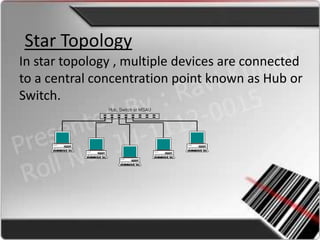
In star topology , multiple devices are connected
to a central concentration point known as Hub or
Switch.
Advantages Of Star Topology are:
 Easy to install , configure and manage
 Easy to detect faulty device
 Easier to expand
 Connecting or removing device does not affects the network
 Hub provides a centralized management
Disadvantages Of Star Topology are:
Increased devices causes traffic which makes the network slow
Requires more cable length than a linear topology
Hub failure leads to network failure
More expensive
Ring Topology
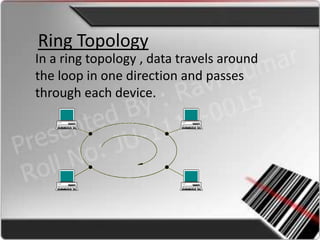
In a ring topology , data travels around
the loop in one direction and passes
through each device.
Advantages Of Ring Topology are:
Easier to manage as compared to bus topology
Handles large volume of traffic
Very reliable and offers great speed
Provides a good communication over a long distance
No terminators are required
 Disadvantages Of Ring Topology are:
More cable wires compared to bus topology are required
One faulty device affects the entire network
Addition and changes of devices can affects the network
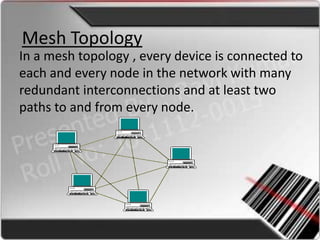
Mesh Topology
In a mesh topology , every device is connected to
each and every node in the network with many
redundant interconnections and at least two
paths to and from every node.
Advantages Of Mesh Topology are:
 Provides redundant paths which help in sending data using an
alternate path if a specific path fails to send the data
 Entire network does not affected by one faulty device
 Centralized management is not required as in star topology
 Easy to detect the faulty device
Disadvantages Of Mesh Topology are:
More cabling is required as compared to bus, star and ring topologies
Each link from one device to another requires an individual NIC
Very expansive as compared to Bus ,Star and Ring topologies
Data carrying capacity is underutilized unless all devices
are transmitting almost constantly
Difficult to configure
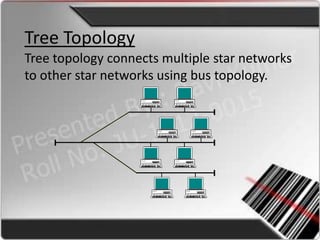
Tree Topology
Tree topology connects multiple star networks
to other star networks using bus topology.
Advantages Of Ring Topology are:
Point-to-Point wiring for each device
Easy to detect a faulty device
Easy to expand a network
Disadvantages Of Ring Topology are:
More difficult to configure as compared to other topologies
Fault in the backbone affects the entire network
More expansive than other topologies
Overall length of each segment is limited by the
  type of cabling used
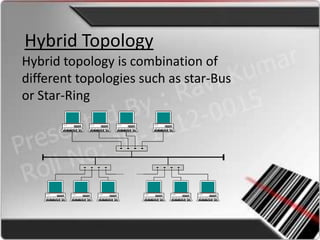
Hybrid Topology
Hybrid topology is combination of
different topologies such as star-Bus
or Star-Ring
Advantages Of Hybrid Topology are:
 Useful for implementing larger networks
 Handles larger volume of traffic
 Easy to detect and remove faulty devices
Disadvantages Of Hybrid Topology are:
 More cabling is required as compared to all other topologies
 More expensive than all other topologies
 Complex structure
 MAU is required
 Installation and reconfiguration is difficult
Created By : Ravi Kumar

Topology

  • 1.
    Topology is Loading Click To Skip This Step
  • 2.
    Topology Presented By: Ravi Kumar Roll No : JU-1112-0015
  • 3.
    What is Topology? The topology defines the shape and structure of a Local Area Network (LAN) or other communications system. Topologies are either physical or logical
  • 4.
    Physical Topology The physicallayout of devices on a network, or the way that the devices on a network are arranged and how they communicate with each other. The way that the workstations are connected to the network through the actual cables that transmit data –the physical structure of the network -- is called the physical topology. Logical Topology The logical topology, in contrast, is the way that the signals act on the network media, or the way that the data passes through the network from one device to the next without regard to the physical interconnection of the devices
  • 5.
    Types Of Topologies Differenttypes of topologies are • Single Node Topology • Bus Topology • Star Topology • Ring Topology • Mesh Topology • Tree and Hybrid Topology
  • 6.
    Single Node Topology Ina single node Topology, just a single device called a dumb terminal is connected to the server.
  • 7.
    Advantages Of SingleNode Topology are:  Easy to Install , configure and manage  Least expensive , as a ‘Dumb Terminal’ is the cheapest computer  Single cable is required Disadvantages Of Single Node Topology are:  Only a single device is connected in the entire network  Dumb Terminal is dependent on the server for resource
  • 8.
    Bus Topology Bus topologyconnects each device to a single cable and at either end of the cable terminator is used to remove unsent data from the cable
  • 9.
    Advantages Of BusTopology are:  Easy to connect a device to linear bus  Requires less cable  Less expansive than other topologies  Works better for smaller networks Disadvantages Of Bus Topology are:  Entire network gets affected if there is a break in the main cable  Terminators are required at both end of the backbone cable  Difficult to detect the faulty device  Limited number of devices can be attached  Heavy traffic and addition of devices degrades the performance  Expansive than single node topology
  • 10.
    Star Topology In startopology , multiple devices are connected to a central concentration point known as Hub or Switch.
  • 11.
    Advantages Of StarTopology are:  Easy to install , configure and manage  Easy to detect faulty device  Easier to expand  Connecting or removing device does not affects the network  Hub provides a centralized management Disadvantages Of Star Topology are: Increased devices causes traffic which makes the network slow Requires more cable length than a linear topology Hub failure leads to network failure More expensive
  • 12.
    Ring Topology In aring topology , data travels around the loop in one direction and passes through each device.
  • 13.
    Advantages Of RingTopology are: Easier to manage as compared to bus topology Handles large volume of traffic Very reliable and offers great speed Provides a good communication over a long distance No terminators are required Disadvantages Of Ring Topology are: More cable wires compared to bus topology are required One faulty device affects the entire network Addition and changes of devices can affects the network
  • 14.
    Mesh Topology In amesh topology , every device is connected to each and every node in the network with many redundant interconnections and at least two paths to and from every node.
  • 15.
    Advantages Of MeshTopology are:  Provides redundant paths which help in sending data using an alternate path if a specific path fails to send the data  Entire network does not affected by one faulty device  Centralized management is not required as in star topology  Easy to detect the faulty device Disadvantages Of Mesh Topology are: More cabling is required as compared to bus, star and ring topologies Each link from one device to another requires an individual NIC Very expansive as compared to Bus ,Star and Ring topologies Data carrying capacity is underutilized unless all devices are transmitting almost constantly Difficult to configure
  • 16.
    Tree Topology Tree topologyconnects multiple star networks to other star networks using bus topology.
  • 17.
    Advantages Of RingTopology are: Point-to-Point wiring for each device Easy to detect a faulty device Easy to expand a network Disadvantages Of Ring Topology are: More difficult to configure as compared to other topologies Fault in the backbone affects the entire network More expansive than other topologies Overall length of each segment is limited by the type of cabling used
  • 18.
    Hybrid Topology Hybrid topologyis combination of different topologies such as star-Bus or Star-Ring
  • 19.
    Advantages Of HybridTopology are:  Useful for implementing larger networks  Handles larger volume of traffic  Easy to detect and remove faulty devices Disadvantages Of Hybrid Topology are:  More cabling is required as compared to all other topologies  More expensive than all other topologies  Complex structure  MAU is required  Installation and reconfiguration is difficult
  • 20.
    Created By :Ravi Kumar